%67%6f%61%6c
-
 KAIST Welcomes the Class of 2026: “Play Boldly, Learn Deeply” - President Kwang-Hyung Lee
< President Kwang-Hyung Lee pictured with NYU exchange students >
KAIST announced on December 15th that it has delivered a congratulatory message to the successful applicants of the 2026 undergraduate early admissions, sharing the university’s unique educational philosophy of encouraging challenge and failure, as well as its vision for cultivating global talent.
For the 2026 undergraduate admissions, KAIST selected future scientific leaders based on its core values and talent ideals: Creativity, Challenge, and Caring. KAIST plans to strengthen education focused on nurturing convergent talent who can cross disciplinary boundaries. The recent upward trend in applications to KAIST reflects the growing importance of scientific talent who will lead national competitiveness amidst intense global competition in AI, semiconductors, space, and biotechnology.
In his congratulatory message, President Kwang Hyung Lee emphasized, “KAIST is a place where you can play and study to your heart's content with friends, start your own business, and even experience failure. KAIST is a ‘playground for eccentrics’ where you can try anything.”
He specifically introduced a challenge-oriented academic culture, stating, “Do not fear failure. If you organize and share your experiences of failure well, you might even receive a ‘Failure Award.’”
President Lee further stressed, “KAIST is the perfect school for students who want to blaze new trails through creativity and inquiry, and for those who wish to change the world. If your goal is simply to get an ‘A’ in every subject or to secure a stable job, you do not need to come here. However, if you are a student who prefers defining your own problems over doing what others tell you and wants to challenge yourself beyond established frameworks, you must come to KAIST.”
He also highlighted the free, student-led environment by stating, “For a KAISTian, the only limit to challenge is imagination,” adding, “During my tenure as President, I have never once rejected an idea proposed by students.”
Regarding the global educational environment, President Lee explained, “KAIST is no longer just a domestic university; it is a platform where you can study, research, and be active on the world stage. We actively support students’ global experiences through the joint campus operation with New York University (NYU), the establishment of a Silicon Valley campus, and exchange programs with over 100 overseas universities.”
Meanwhile, to lead the AI era, KAIST recently established the nation’s first AI College and is building a full-scale education and research system covering all fields of artificial intelligence. The AI College plans to systematically foster next-generation AI leaders through a curriculum linked from undergraduate to graduate levels.
In addition, KAIST is strengthening education in humanities, culture, and the arts alongside science and technology. The university operates seven humanities and social science minor programs—Digital Humanities & Social Sciences, Economics, Culture Technology, Intellectual Property, Science & Technology Policy, Entrepreneurship, and Future Strategy. It also expands students' imagination and creativity through on-campus art museums, numerous galleries, and regular performances and cultural events.
Furthermore, KAIST encourages challenge and balanced growth through the “Mountaineering Scholarship,” which provides up to 700,000 KRW annually to students who complete designated hiking courses, regardless of grades or income level.
President Lee concluded his message of support by saying, “My heart is already racing at the thought of pioneering the 21st-century future with all of you. I look forward to seeing you grow into ‘stars,’ each with your own unique color, and shine on the global stage.”
< President Kwang Hyung Lee performing with the student lab club 'Gootos' at Innovate Korea 2024 >
2025.12.15 View 7310
-
 'Think Out of the Box,' Team Circos Wins the P4G Innovation Sprint
<The winning team of the P4G Innovation Sprint poses with the Crown Prince of Denmark (sixth from the left in the first row) and President Shin (fifth from the left in the first row) during the awarding ceremony.>
Team Circos from KAIST and Denmark made a new sustainable business model for Hempel, a global coating supplier group in Denmark, and won the first prize at the P4G (the Partnership for Green Growth and Global Goals) Innovation Sprint held at KAIST’s Seoul campus on May 22. The six-member team was awarded one million KRW in prize money by the Crown Prince of Denmark. Two of winning team members have the privilege of traveling to visit Hempel in Denmark.
The winning team thought outside the box, inspired by box wine which reduced the sales price from traditional bottled wine. Six teams made up of members from different academic disciplines spent two nights and three days brainstorming ways to resolve the challenges of corporations such as Velux and Hempel from Denmark and SK from Korea.
The P4G Innovation Sprint is one of the events co-hosted by KAIST and Technological University of Denmark in celebration of the 60th anniversary of diplomatic relations establishment between Denmark and Korea and the 8th anniversary of the Green Growth Alliance between the two countries. The Crown Prince Couple also made a royal visit to Korea in honor of the 60th anniversary celebration and Green Growth Alliance between the two countries.
This Innovation Sprint aimed to develop young academics’ perspectives, skills, and talents for the next generation to better research the Sustainable Development Goals set by UN.
Three teams made their final five-minute pitches before the Crown Prince and President Sung-Chul
Shin and responded to questions from the four-member jury.
The Crown Prince of Denmark and President Shin both agreed that the collaborative and convergent ideas will address global problems.
The Crown Prince stressed in his congratulatory remarks the importance of partnership in this polarizing world to achieve sustainable improvements saying, “Partnerships are only possible to sustain through collaboration and hard work while staying curious, creative, and critical. " He also shared the special relationship with KAIST. His father-in-law Professor John Donaldson used to be a visiting professor of applied mathmatics at KAIST back in 2003.
President Shin added, “Collaboration across boundaries is most critical for responding to these issues. In that sense, this P4G Innovation Sprint is a shining example for demonstrating the collaborative efforts between teammates from diverse disciplines. When we work together and build convergent ideas, we will be more innovative and go further.”
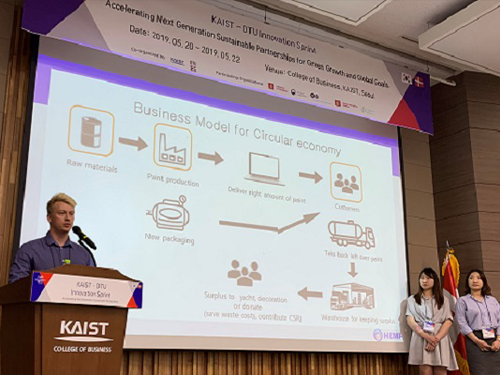
<Winning team member Nicolai Thorball from DTU pitches at the final in the presence of the Crown Prince of Denmark and KAIST President Shin.>
“The canned packaging in the paint industry results in 40 times more carbon emission in the course of production. However, when using aluminum packaging which is recyclable, the waste amount will be cut dramatically,” pitched Nicolai Thorball from DTU on exchange at Seoul National University. Nicolai, whose major is environmental engineering, is one of two Danish students including Thomsen Xandra Flyvbjerg from the University of Southern Denmark. Flyvbjergy, majoring in business, is now on exchange at Sungkynkwan University.
“I am very glad to have the chance to understand the concept of the circular economy and green growth at the sprint. It was also very challenging to make ideation from so many ideas brainstormed,” said Dong-Eun Lee, a KAIST undergraduate from the Department of Biological Sciences. He said that he learned a lot from his two other teammates who are from the Program of Green Business & Policy at KAIST College of Business, Jae-Hee Park and Kyung-Hyun Kim. Juho Park majoring in mechanical engineering at KAIST was one of the team.
Circos’ solution for a sustainable model received acclaim from the jury members. DTU Senior Vice President Marianne Thellerson, one of jurors, claimed their model has very high market feasibility, saying, “Their idea could be commercialized right now into the market.” Professor Hee-Kyung Park from KAIST who helped participants’ ideation as one of four mentors said, “The winning team perfectly met all the components of the evaluation criteria, Solution, Acceleration, and Pitch.”
At this sprint, 10 students from Denmark and 29 KAIST students were divided into 6 teams and given the challenges of three companies. The Danish window facility company Velux presented its future glass window system and the paint company Hempel their circular economic new business model. SK challenged the students to help it become a global clean energy solution company. The event was based on a hacker blueprint that found the optimal solution to the topics proposed.
2019.05.23 View 17178