%52%41%47
-
 KAIST Develops Vector Database Technology for Reliable Retrieval of Up-to-Date Information
When new information is continually added and old information is removed, an AI system may fail to find the correct material even when that material exists. KAIST researchers have developed a vector database technology that preserves the search paths leading to the needed information as data changes. This allows AI to find up-to-date information more accurately and quickly.
KAIST (President Choongsik Bae) announced on October 5 that a research team led by Professor Min-Soo Kim from the School of Computing has developed CONDA (Connectivity-Aware Dynamic Index). CONDA is a dynamic vector database indexing technology that maintains high search accuracy even as data is continuously added and deleted.
Generative AI models do not inherently have access to information that emerges after training. Retrieval-augmented generation (RAG) has been widely adopted to address this limitation. RAG searches sources such as recent news or internal company documents and uses the results in its answers.
For RAG to work properly, the system needs a search technology that can quickly and accurately find the information relevant to a question among vast amounts of data. Many AI services today convert the meaning of documents or images into vectors, which are numerical representations that computers can process. They then link pieces of information with similar meanings and follow these links to find the material they need.
The challenge is that data in real companies and on the internet changes constantly. New documents, news, and product information keep arriving, while older information is modified or deleted. As these changes repeat, the links built between data points can gradually break, a problem the researchers call "connectivity collapse." The needed information is still in the database, but the AI can no longer reach it, and search accuracy drops. In other words, the information itself has not been lost. The search path that leads to it has been broken.
CONDA considers both distances between data points and whether the search paths needed to reach the information remain connected. When new data is added or existing data is deleted, CONDA preserves the links that are important for search. This prevents specific pieces of information from becoming isolated in the search graph.
In experiments where data was constantly added and deleted, CONDA improved search accuracy (recall) by up to 24.5% compared with state-of-the-art methods. It also increased data update throughput by up to 1.90 times.
The team also ran searches and data updates at the same time for six hours on a large-scale dataset containing 100 million vectors. Throughout the test, CONDA recorded the lowest search latency and the highest search accuracy among the compared methods. This result suggests that the technology can be applied to large-scale AI services.
The technology can be used in knowledge search systems where information such as internal company regulations and work documents changes frequently. It can also be used in a range of AI services where data changes continuously, including news search, product search, and recommendation systems. In particular, it is expected to serve as a foundational technology for RAG, in which generative AI searches external information and uses it in its answers. CONDA allows this up-to-date information to be retrieved reliably over extended periods.
The research results are also being applied to a commercial product. CONDA is being integrated into AkasicDB, the database product of GraphAI, an AI data infrastructure company founded by Professor Kim. It is scheduled for commercial release in the fourth quarter of this year.
"The key value of retrieval-augmented generation (RAG) is that it allows large language models (LLMs) to find and use the latest information they were not trained on at the moment it is needed," said Professor Kim. He added that the study is significant because it presents a data infrastructure that lets AI use up-to-date knowledge accurately over long periods, even in real-world environments where data changes constantly.
Darae Lee, who completed a master's degree at the KAIST School of Computing, is the first author of the study, and Professor Kim is the corresponding author. The findings were presented on September 2 at VLDB 2026 (the International Conference on Very Large Data Bases), a leading international conference in the database field.
Paper title: CONDA: A Connectivity-Aware Dynamic Index for Approximate Nearest Neighbor Search over Evolving Data
DOI: 10.14778/3836663.3836694
This research was supported by the Mid-Career Researcher Program of the National Research Foundation of Korea (NRF) and the SW Star Lab program of the Institute of Information & Communications Technology Planning & Evaluation (IITP), both funded by the Ministry of Science and ICT (MSIT).
2026.10.06 View 768
KAIST Develops Vector Database Technology for Reliable Retrieval of Up-to-Date Information
When new information is continually added and old information is removed, an AI system may fail to find the correct material even when that material exists. KAIST researchers have developed a vector database technology that preserves the search paths leading to the needed information as data changes. This allows AI to find up-to-date information more accurately and quickly.
KAIST (President Choongsik Bae) announced on October 5 that a research team led by Professor Min-Soo Kim from the School of Computing has developed CONDA (Connectivity-Aware Dynamic Index). CONDA is a dynamic vector database indexing technology that maintains high search accuracy even as data is continuously added and deleted.
Generative AI models do not inherently have access to information that emerges after training. Retrieval-augmented generation (RAG) has been widely adopted to address this limitation. RAG searches sources such as recent news or internal company documents and uses the results in its answers.
For RAG to work properly, the system needs a search technology that can quickly and accurately find the information relevant to a question among vast amounts of data. Many AI services today convert the meaning of documents or images into vectors, which are numerical representations that computers can process. They then link pieces of information with similar meanings and follow these links to find the material they need.
The challenge is that data in real companies and on the internet changes constantly. New documents, news, and product information keep arriving, while older information is modified or deleted. As these changes repeat, the links built between data points can gradually break, a problem the researchers call "connectivity collapse." The needed information is still in the database, but the AI can no longer reach it, and search accuracy drops. In other words, the information itself has not been lost. The search path that leads to it has been broken.
CONDA considers both distances between data points and whether the search paths needed to reach the information remain connected. When new data is added or existing data is deleted, CONDA preserves the links that are important for search. This prevents specific pieces of information from becoming isolated in the search graph.
In experiments where data was constantly added and deleted, CONDA improved search accuracy (recall) by up to 24.5% compared with state-of-the-art methods. It also increased data update throughput by up to 1.90 times.
The team also ran searches and data updates at the same time for six hours on a large-scale dataset containing 100 million vectors. Throughout the test, CONDA recorded the lowest search latency and the highest search accuracy among the compared methods. This result suggests that the technology can be applied to large-scale AI services.
The technology can be used in knowledge search systems where information such as internal company regulations and work documents changes frequently. It can also be used in a range of AI services where data changes continuously, including news search, product search, and recommendation systems. In particular, it is expected to serve as a foundational technology for RAG, in which generative AI searches external information and uses it in its answers. CONDA allows this up-to-date information to be retrieved reliably over extended periods.
The research results are also being applied to a commercial product. CONDA is being integrated into AkasicDB, the database product of GraphAI, an AI data infrastructure company founded by Professor Kim. It is scheduled for commercial release in the fourth quarter of this year.
"The key value of retrieval-augmented generation (RAG) is that it allows large language models (LLMs) to find and use the latest information they were not trained on at the moment it is needed," said Professor Kim. He added that the study is significant because it presents a data infrastructure that lets AI use up-to-date knowledge accurately over long periods, even in real-world environments where data changes constantly.
Darae Lee, who completed a master's degree at the KAIST School of Computing, is the first author of the study, and Professor Kim is the corresponding author. The findings were presented on September 2 at VLDB 2026 (the International Conference on Very Large Data Bases), a leading international conference in the database field.
Paper title: CONDA: A Connectivity-Aware Dynamic Index for Approximate Nearest Neighbor Search over Evolving Data
DOI: 10.14778/3836663.3836694
This research was supported by the Mid-Career Researcher Program of the National Research Foundation of Korea (NRF) and the SW Star Lab program of the Institute of Information & Communications Technology Planning & Evaluation (IITP), both funded by the Ministry of Science and ICT (MSIT).
2026.10.06 View 768 -
 KAIST Develops Next-Generation Database Technology That Reduces AI Hallucinations and Improves Accuracy by 78%
One of the greatest weaknesses of AI agents that read and understand vast amounts of enterprise data is “hallucination” — the generation of plausible-sounding but factually incorrect information. KAIST researchers have developed a next-generation database technology capable of understanding documents, data, and relationships among entities all at once. The technology improves AI response accuracy by up to 78% and processing speed by up to 20 times, addressing a key challenge in the commercialization of enterprise AI.
KAIST, led by President Kwang Hyung Lee, announced on the 19th that a research team led by Professor Min-Soo Kim of the School of Computing, in collaboration with faculty startup GraphAI Co., Ltd., has developed “AkasicDB,” a next-generation database technology that integrates the functions of vector databases, graph databases, and relational databases into a single database management system (DBMS). Based on this technology, the team also developed a new Retrieval-Augmented Generation (RAG) method called “Omni RAG.”
AkasicDB is designed to integrate and execute the functions of vector databases, which convert the meaning of documents or images into numerical vectors to search for similar information; graph databases, which store and analyze relationships among entities such as people, companies, and products; and relational databases, which systematically manage data in table form. Omni RAG, developed on this foundation, improves the accuracy of generative AI responses by simultaneously utilizing semantic information from documents, relationships among entities, and structured data.
AI agents have recently been spreading rapidly based on RAG technology, which searches vast collections of corporate documents and expert knowledge and generates responses based on the retrieved information. However, real-world enterprise data is distributed across various forms, including documents, tables, and relationships among entities, making it difficult for AI to comprehensively understand and use the data. As a result, AI may generate factually incorrect responses without sufficient grounding, creating hallucination issues that have been regarded as a major obstacle to the broader adoption of enterprise AI.
Conventional RAG typically works by converting user queries and documents into vectors, retrieving semantically similar documents, and providing them to a large language model (LLM), an AI model trained on massive datasets to generate human-like language. While this approach is effective for searching unstructured documents, it has limitations when handling complex queries that must also consider relationships among entities in documents or structured conditions such as specific periods, types, or ranges.
For example, a query such as, “Find clauses related to Company A among contracts signed last year, and explain how those clauses are connected to product supply issues,” requires vector search to identify document meaning, graph search to explore relationships among entities, and relational queries to filter by date and type. In existing systems, this required building multiple types of databases separately and combining the results at the application layer, leading to management complexity and response delays.
To solve this problem, the research team proposed Omni RAG, which integrates vector similarity search, graph traversal, and relational filtering within a single query and execution plan. Omni RAG identifies more accurate evidence by simultaneously utilizing semantic information from documents, relationship information from knowledge graphs, and structural conditions from tabular data, significantly reducing AI hallucinations.
AkasicDB, developed to support this method, adopts a new architecture that integrates graph databases, vector databases, and relational databases into a single engine. Users can express complex RAG queries that combine vector search, graph traversal, and relational filtering as a single SQL/GQL* query, and AkasicDB optimizes and processes the query as one unified execution plan.
SQL/GQL, or Structured Query Language/Graph Query Language, refers to command languages used to search or modify information stored in databases. SQL is the traditional language used to handle tabular data, while GQL is a language dedicated to graph data and is used to analyze connections among entities such as people, companies, and products.
Through this integrated architecture, AkasicDB minimizes unnecessary intermediate result generation and data movement, greatly reducing the number of tokens used by LLMs and shortening response latency. In experiments, complex search queries that took up to 21.3 seconds in existing systems were processed in under one second, achieving a performance improvement of more than 20 times. Omni RAG also improved response accuracy by up to 78% compared with conventional RAG. These results demonstrate its potential to substantially mitigate hallucination, one of the core challenges for enterprise AI agents.
Professor Min-Soo Kim said, “For AI agents to accurately understand and utilize the vast amounts of data held by enterprises, data infrastructure capable of processing vector, graph, and relational data in an integrated manner within a single system is essential. AkasicDB is a next-generation database technology for the era of AI agents, and we expect it to be used as core data infrastructure in fields requiring high reliability, including defense, manufacturing, finance, law, science, and technology.”
KAIST School of Computing Ph.D. student Geonho Lee participated in this research as the first author. The research results were presented as a demo paper on June 2 at ACM SIGMOD 2026, one of the world’s most prestigious international conferences in the field of databases, where they drew strong interest from global companies and researchers.
※ Paper title: AkasicDB: Demonstrating Omni RAG with a Unified Vector-Graph-Relational DBMS
DOI: https://doi.org/10.1145/3788853.3801609
※ Author information: Geonho Lee, KAIST, first author; Jeongho Park and Donghyoung Han, GraphAI Co., Ltd., co-authors; Professor Min-Soo Kim, KAIST, corresponding author
※ Demonstration video: https://www.youtube.com/watch?v=KD6MznZ61P4
2026.06.19 View 4647
KAIST Develops Next-Generation Database Technology That Reduces AI Hallucinations and Improves Accuracy by 78%
One of the greatest weaknesses of AI agents that read and understand vast amounts of enterprise data is “hallucination” — the generation of plausible-sounding but factually incorrect information. KAIST researchers have developed a next-generation database technology capable of understanding documents, data, and relationships among entities all at once. The technology improves AI response accuracy by up to 78% and processing speed by up to 20 times, addressing a key challenge in the commercialization of enterprise AI.
KAIST, led by President Kwang Hyung Lee, announced on the 19th that a research team led by Professor Min-Soo Kim of the School of Computing, in collaboration with faculty startup GraphAI Co., Ltd., has developed “AkasicDB,” a next-generation database technology that integrates the functions of vector databases, graph databases, and relational databases into a single database management system (DBMS). Based on this technology, the team also developed a new Retrieval-Augmented Generation (RAG) method called “Omni RAG.”
AkasicDB is designed to integrate and execute the functions of vector databases, which convert the meaning of documents or images into numerical vectors to search for similar information; graph databases, which store and analyze relationships among entities such as people, companies, and products; and relational databases, which systematically manage data in table form. Omni RAG, developed on this foundation, improves the accuracy of generative AI responses by simultaneously utilizing semantic information from documents, relationships among entities, and structured data.
AI agents have recently been spreading rapidly based on RAG technology, which searches vast collections of corporate documents and expert knowledge and generates responses based on the retrieved information. However, real-world enterprise data is distributed across various forms, including documents, tables, and relationships among entities, making it difficult for AI to comprehensively understand and use the data. As a result, AI may generate factually incorrect responses without sufficient grounding, creating hallucination issues that have been regarded as a major obstacle to the broader adoption of enterprise AI.
Conventional RAG typically works by converting user queries and documents into vectors, retrieving semantically similar documents, and providing them to a large language model (LLM), an AI model trained on massive datasets to generate human-like language. While this approach is effective for searching unstructured documents, it has limitations when handling complex queries that must also consider relationships among entities in documents or structured conditions such as specific periods, types, or ranges.
For example, a query such as, “Find clauses related to Company A among contracts signed last year, and explain how those clauses are connected to product supply issues,” requires vector search to identify document meaning, graph search to explore relationships among entities, and relational queries to filter by date and type. In existing systems, this required building multiple types of databases separately and combining the results at the application layer, leading to management complexity and response delays.
To solve this problem, the research team proposed Omni RAG, which integrates vector similarity search, graph traversal, and relational filtering within a single query and execution plan. Omni RAG identifies more accurate evidence by simultaneously utilizing semantic information from documents, relationship information from knowledge graphs, and structural conditions from tabular data, significantly reducing AI hallucinations.
AkasicDB, developed to support this method, adopts a new architecture that integrates graph databases, vector databases, and relational databases into a single engine. Users can express complex RAG queries that combine vector search, graph traversal, and relational filtering as a single SQL/GQL* query, and AkasicDB optimizes and processes the query as one unified execution plan.
SQL/GQL, or Structured Query Language/Graph Query Language, refers to command languages used to search or modify information stored in databases. SQL is the traditional language used to handle tabular data, while GQL is a language dedicated to graph data and is used to analyze connections among entities such as people, companies, and products.
Through this integrated architecture, AkasicDB minimizes unnecessary intermediate result generation and data movement, greatly reducing the number of tokens used by LLMs and shortening response latency. In experiments, complex search queries that took up to 21.3 seconds in existing systems were processed in under one second, achieving a performance improvement of more than 20 times. Omni RAG also improved response accuracy by up to 78% compared with conventional RAG. These results demonstrate its potential to substantially mitigate hallucination, one of the core challenges for enterprise AI agents.
Professor Min-Soo Kim said, “For AI agents to accurately understand and utilize the vast amounts of data held by enterprises, data infrastructure capable of processing vector, graph, and relational data in an integrated manner within a single system is essential. AkasicDB is a next-generation database technology for the era of AI agents, and we expect it to be used as core data infrastructure in fields requiring high reliability, including defense, manufacturing, finance, law, science, and technology.”
KAIST School of Computing Ph.D. student Geonho Lee participated in this research as the first author. The research results were presented as a demo paper on June 2 at ACM SIGMOD 2026, one of the world’s most prestigious international conferences in the field of databases, where they drew strong interest from global companies and researchers.
※ Paper title: AkasicDB: Demonstrating Omni RAG with a Unified Vector-Graph-Relational DBMS
DOI: https://doi.org/10.1145/3788853.3801609
※ Author information: Geonho Lee, KAIST, first author; Jeongho Park and Donghyoung Han, GraphAI Co., Ltd., co-authors; Professor Min-Soo Kim, KAIST, corresponding author
※ Demonstration video: https://www.youtube.com/watch?v=KD6MznZ61P4
2026.06.19 View 4647 -
 KAIST Develops Hydrogel Material with Improved Skin Adhesion and Controllable Degradation Rate
<(From Left) Researcher Han-Yeol Yang, Professor Haeshin Lee>
Could wound healing dressings adhere better, and drug delivery patches become more sophisticated? A KAIST research team has developed a technology that leverages natural ingredients derived from plants to increase the strength of seaweed-based hydrogel (a gel material that contains a large amount of water while maintaining its shape) by more than fivefold, while also controlling its adhesiveness and degradation rate.
KAIST announced on June 9th that a research team led by Professor Haeshin Lee from the Department of Chemistry has developed a new material design strategy that utilizes tannic acid—a type of polyphenol, which is a natural antioxidant abundant in tea and fruits—to enhance the mechanical strength and adhesiveness of seaweed-derived hydrogel and to control its degradation rate.
Hydrogel is a high-moisture gel material used in contact lenses, acne patches, mask packs, and wound healing dressings. Because it can adhere closely to the skin while holding drugs or active ingredients, it is being utilized in various bio and healthcare fields, such as drug delivery systems (materials that effectively deliver drugs to desired sites), wound dressings (medical dressings that protect wounds and aid healing), tissue engineering scaffolds (structures that help regenerate artificial tissue), and cosmetic materials.
Among various hydrogel materials, the research team focused on 'κ-Carrageenan'. κ-Carrageenan is a natural polymer extracted from red seaweed (rhodophytes) such as agar-agar, and it is a familiar food ingredient used to increase the viscosity and maintain the shape of jellies and sauces. However, there were limitations to improving the performance of hydrogels made with κ-Carrageenan. The κ-Carrageenan molecule contains many structures called sulfate groups, which create intermolecular repulsion—much like magnets of the same pole pushing each other away—and prevent the formation of a dense structure. For this reason, it was difficult to increase the strength and adhesiveness of the hydrogel or to adjust the degradation rate to a desired level.
To solve this problem, the research team focused on finding a natural substance that could effectively interact with the sulfate groups. As a result, they determined that tannic acid, a natural polyphenol abundant in tea and fruits, could be a promising candidate.
Polyphenols are natural ingredients produced by plants to protect themselves from external environments such as ultraviolet rays or pests, and they have the characteristic of being able to bind with multiple substances simultaneously. In particular, tannic acid has multiple binding sites (galloyl groups), so it was expected to interact strongly with the sulfate groups of κ-Carrageenan and connect the molecules together. The research team believed that this characteristic could be utilized to reinforce the hydrogel structure.
As a result of the study, it was confirmed that the sulfate group, which was previously considered a factor hindering hydrogel formation, actually acts as a core binding site with tannic acid. In other words, the structure that was previously considered a "weakness" played a role in making the hydrogel even firmer upon meeting tannic acid.
< Research Image Related to Polyphenol Interactions >
In fact, the storage modulus (an index representing the firmness and elasticity of a gel) of the κ-Carrageenan hydrogel with added tannic acid was approximately 1,632 Pa, showing an improvement of more than fivefold compared to the pure κ-Carrageenan hydrogel (approximately 294 Pa). This means that the hydrogel can maintain its shape more stably even under external pressure or deformation, demonstrating that it can increase the durability and usability of wound healing dressings or drug delivery patches.
In addition, the research team confirmed that tannic acid stably reinforces the internal network structure (gel network) of the already formed hydrogel, regardless of the point in time when the tannic acid is added. This implies that tannic acid connects molecules at multiple points, allowing the internal structure of the hydrogel to remain consistently firm.
Notably, the research team succeeded in implementing rapid degradability and strong adhesiveness simultaneously. In experiments simulating the human stomach and intestinal environments, the hydrogel containing tannic acid degraded relatively quickly while adhering strongly to the skin and rough surfaces. This means that wound healing dressings will not easily fall off during use but can naturally degrade after completing their role, and drug delivery patches can be utilized to stably deliver drugs for a desired period.
This study is meaningful in that it presented a design principle capable of simultaneously controlling the strength, adhesiveness, and degradation rate of hydrogel using only food-grade natural ingredients without complex chemical synthesis processes. The research team expects this technology to be utilized in various bio and healthcare fields, such as capsules and coating materials for food and functional foods, skin-adhering cosmetics and skincare products, wound dressings, drug delivery patches, and tissue engineering scaffolds.
<Research Image (AI-Generated)>
Professor Haeshin Lee said, "This study is an example showing that the mechanical strength, adhesiveness, and degradation behavior of hydrogel can be designed together using only naturally derived materials," adding, "It can be expanded into a safer and simpler natural polymer gel platform in the fields of food, cosmetics, and biomaterials."
This study, in which PhD student Han-Yeol Yang participated as the first author, was published on April 21st in 'Biomimetics', an international academic journal in the field of biomimetics. ※ Paper Title: Adhesive κ-Carrageenan Hydrogels by Polyphenol Intervention, DOI: 10.3390/biomimetics11040290
Meanwhile, this research was conducted with research funding support from Polyphenol Factory Inc., a faculty-led startup enterprise of KAIST.
2026.06.09 View 4590
KAIST Develops Hydrogel Material with Improved Skin Adhesion and Controllable Degradation Rate
<(From Left) Researcher Han-Yeol Yang, Professor Haeshin Lee>
Could wound healing dressings adhere better, and drug delivery patches become more sophisticated? A KAIST research team has developed a technology that leverages natural ingredients derived from plants to increase the strength of seaweed-based hydrogel (a gel material that contains a large amount of water while maintaining its shape) by more than fivefold, while also controlling its adhesiveness and degradation rate.
KAIST announced on June 9th that a research team led by Professor Haeshin Lee from the Department of Chemistry has developed a new material design strategy that utilizes tannic acid—a type of polyphenol, which is a natural antioxidant abundant in tea and fruits—to enhance the mechanical strength and adhesiveness of seaweed-derived hydrogel and to control its degradation rate.
Hydrogel is a high-moisture gel material used in contact lenses, acne patches, mask packs, and wound healing dressings. Because it can adhere closely to the skin while holding drugs or active ingredients, it is being utilized in various bio and healthcare fields, such as drug delivery systems (materials that effectively deliver drugs to desired sites), wound dressings (medical dressings that protect wounds and aid healing), tissue engineering scaffolds (structures that help regenerate artificial tissue), and cosmetic materials.
Among various hydrogel materials, the research team focused on 'κ-Carrageenan'. κ-Carrageenan is a natural polymer extracted from red seaweed (rhodophytes) such as agar-agar, and it is a familiar food ingredient used to increase the viscosity and maintain the shape of jellies and sauces. However, there were limitations to improving the performance of hydrogels made with κ-Carrageenan. The κ-Carrageenan molecule contains many structures called sulfate groups, which create intermolecular repulsion—much like magnets of the same pole pushing each other away—and prevent the formation of a dense structure. For this reason, it was difficult to increase the strength and adhesiveness of the hydrogel or to adjust the degradation rate to a desired level.
To solve this problem, the research team focused on finding a natural substance that could effectively interact with the sulfate groups. As a result, they determined that tannic acid, a natural polyphenol abundant in tea and fruits, could be a promising candidate.
Polyphenols are natural ingredients produced by plants to protect themselves from external environments such as ultraviolet rays or pests, and they have the characteristic of being able to bind with multiple substances simultaneously. In particular, tannic acid has multiple binding sites (galloyl groups), so it was expected to interact strongly with the sulfate groups of κ-Carrageenan and connect the molecules together. The research team believed that this characteristic could be utilized to reinforce the hydrogel structure.
As a result of the study, it was confirmed that the sulfate group, which was previously considered a factor hindering hydrogel formation, actually acts as a core binding site with tannic acid. In other words, the structure that was previously considered a "weakness" played a role in making the hydrogel even firmer upon meeting tannic acid.
< Research Image Related to Polyphenol Interactions >
In fact, the storage modulus (an index representing the firmness and elasticity of a gel) of the κ-Carrageenan hydrogel with added tannic acid was approximately 1,632 Pa, showing an improvement of more than fivefold compared to the pure κ-Carrageenan hydrogel (approximately 294 Pa). This means that the hydrogel can maintain its shape more stably even under external pressure or deformation, demonstrating that it can increase the durability and usability of wound healing dressings or drug delivery patches.
In addition, the research team confirmed that tannic acid stably reinforces the internal network structure (gel network) of the already formed hydrogel, regardless of the point in time when the tannic acid is added. This implies that tannic acid connects molecules at multiple points, allowing the internal structure of the hydrogel to remain consistently firm.
Notably, the research team succeeded in implementing rapid degradability and strong adhesiveness simultaneously. In experiments simulating the human stomach and intestinal environments, the hydrogel containing tannic acid degraded relatively quickly while adhering strongly to the skin and rough surfaces. This means that wound healing dressings will not easily fall off during use but can naturally degrade after completing their role, and drug delivery patches can be utilized to stably deliver drugs for a desired period.
This study is meaningful in that it presented a design principle capable of simultaneously controlling the strength, adhesiveness, and degradation rate of hydrogel using only food-grade natural ingredients without complex chemical synthesis processes. The research team expects this technology to be utilized in various bio and healthcare fields, such as capsules and coating materials for food and functional foods, skin-adhering cosmetics and skincare products, wound dressings, drug delivery patches, and tissue engineering scaffolds.
<Research Image (AI-Generated)>
Professor Haeshin Lee said, "This study is an example showing that the mechanical strength, adhesiveness, and degradation behavior of hydrogel can be designed together using only naturally derived materials," adding, "It can be expanded into a safer and simpler natural polymer gel platform in the fields of food, cosmetics, and biomaterials."
This study, in which PhD student Han-Yeol Yang participated as the first author, was published on April 21st in 'Biomimetics', an international academic journal in the field of biomimetics. ※ Paper Title: Adhesive κ-Carrageenan Hydrogels by Polyphenol Intervention, DOI: 10.3390/biomimetics11040290
Meanwhile, this research was conducted with research funding support from Polyphenol Factory Inc., a faculty-led startup enterprise of KAIST.
2026.06.09 View 4590 -
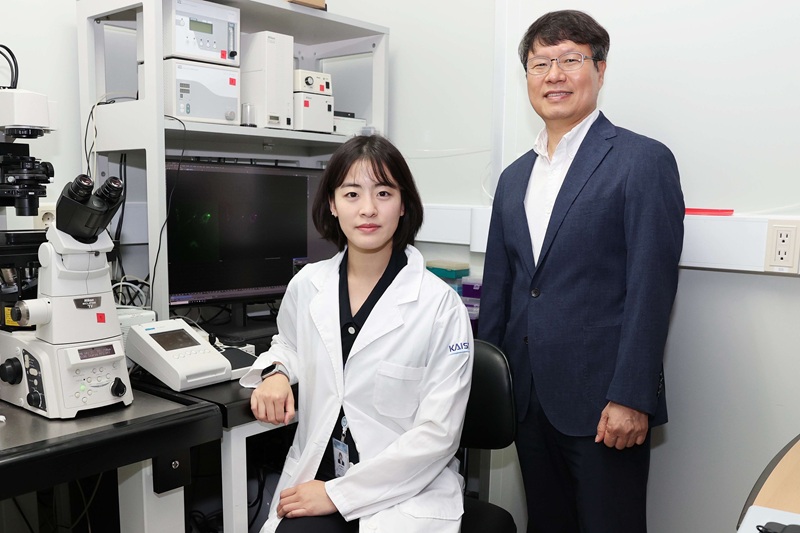 KAIST Team Develops Optogenetic Platform for Spatiotemporal Control of Protein and mRNA Storage and Release
<Dr. Chaeyeon Lee, Professor Won Do Heo from Department of Biological Sciences>
A KAIST research team led by Professor Won Do Heo (Department of Biological Sciences) has developed an optogenetic platform, RELISR (REversible LIght-induced Store and Release), that enables precise spatiotemporal control over the storage and release of proteins and mRNAs in living cells and animals.
Traditional optogenetic condensate systems have been limited by their reliance on non-specific multivalent interactions, which can lead to unintended sequestration or release of endogenous molecules. RELISR overcomes these limitations by employing highly specific protein–protein (nanobody–antigen) and protein–RNA (MCP–MS2) interactions, enabling the selective and reversible compartmentalization of target proteins or mRNAs within engineered, membrane-less condensates.
In the dark, RELISR stably sequesters target molecules within condensates, physically isolating them from the cellular environment. Upon blue light stimulation, the condensates rapidly dissolve, releasing the stored proteins or mRNAs, which immediately regain their cellular functions or translational competency. This allows for reversible and rapid modulation of molecular activities in response to optical cues.
< Figure 1. Overview of the Artificial Condensate System (RELISR). The artificial condensate system, RELISR, includes "Protein-RELISR" for storing proteins and "mRNA-RELISR" for storing mRNA. These artificial condensates can be disassembled by blue light irradiation and reassembled in a dark state>
The research team demonstrated that RELISR enables temporal and spatial regulation of protein activity and mRNA translation in various cell types, including cultured neurons and mouse liver tissue. Comparative studies showed that RELISR provides more robust and reversible control of translation than previous systems based on spatial translocation.
While previous optogenetic systems such as LARIAT (Lee et al., Nature Methods, 2014) and mRNA-LARIAT (Kim et al., Nat. Cell Biol., 2019) enabled the selective sequestration of proteins or mRNAs into membrane-less condensates in response to light, they were primarily limited to the trapping phase. The RELISR platform introduced in this study establishes a new paradigm by enabling both the targeted storage of proteins and mRNAs and their rapid, light-triggered release. This approach allows researchers to not only confine molecular function on demand, but also to restore activity with precise temporal control.
< Figure 2. Cell shape change using the artificial condensate system (RELISR). A target protein, Vav2, which contributes to cell shape, was stored within the artificial condensate and then released after light irradiation. This release activated the target protein Vav2, causing a change in cell shape. It was confirmed that the storage, release, and activation of various proteins were effectively achieved>
Professor Heo stated, “RELISR is a versatile optogenetic tool that enables the precise control of protein and mRNA function at defined times and locations in living systems. We anticipate this platform will be broadly applicable for studies of cell signaling, neural circuits, and therapeutic development. Furthermore, the combination of RELISR with genome editing or tissue-targeted delivery could further expand its utility for molecular medicine.”
< Figure 3. Expression of a target mRNA using the artificial condensate system (RELISR) in mice. The genetic material for the artificial condensate system, RELISR, was injected into a living mouse. Using this system, a target mRNA was stored within the mouse's liver. Upon light irradiation, the mRNA was released, which induced the translation of a luminescent protein>
This research was conducted by first author Dr. Chaeyeon Lee, under the supervision of Professor Heo, with contributions from Dr. Daseuli Yu (co-corresponding author) and Professor YongKeun Park (co-corresponding author, Department of Physics), whose group performed quantitative imaging analyses of biophysical changes induced by RELISR in cells.
The findings were published in Nature Communications (July 7, 2025; DOI: 10.1038/s41467-025-61322-y). This work was supported by the Samsung Future Technology Foundation and the National Research Foundation of Korea.
2025.07.23 View 8235
KAIST Team Develops Optogenetic Platform for Spatiotemporal Control of Protein and mRNA Storage and Release
<Dr. Chaeyeon Lee, Professor Won Do Heo from Department of Biological Sciences>
A KAIST research team led by Professor Won Do Heo (Department of Biological Sciences) has developed an optogenetic platform, RELISR (REversible LIght-induced Store and Release), that enables precise spatiotemporal control over the storage and release of proteins and mRNAs in living cells and animals.
Traditional optogenetic condensate systems have been limited by their reliance on non-specific multivalent interactions, which can lead to unintended sequestration or release of endogenous molecules. RELISR overcomes these limitations by employing highly specific protein–protein (nanobody–antigen) and protein–RNA (MCP–MS2) interactions, enabling the selective and reversible compartmentalization of target proteins or mRNAs within engineered, membrane-less condensates.
In the dark, RELISR stably sequesters target molecules within condensates, physically isolating them from the cellular environment. Upon blue light stimulation, the condensates rapidly dissolve, releasing the stored proteins or mRNAs, which immediately regain their cellular functions or translational competency. This allows for reversible and rapid modulation of molecular activities in response to optical cues.
< Figure 1. Overview of the Artificial Condensate System (RELISR). The artificial condensate system, RELISR, includes "Protein-RELISR" for storing proteins and "mRNA-RELISR" for storing mRNA. These artificial condensates can be disassembled by blue light irradiation and reassembled in a dark state>
The research team demonstrated that RELISR enables temporal and spatial regulation of protein activity and mRNA translation in various cell types, including cultured neurons and mouse liver tissue. Comparative studies showed that RELISR provides more robust and reversible control of translation than previous systems based on spatial translocation.
While previous optogenetic systems such as LARIAT (Lee et al., Nature Methods, 2014) and mRNA-LARIAT (Kim et al., Nat. Cell Biol., 2019) enabled the selective sequestration of proteins or mRNAs into membrane-less condensates in response to light, they were primarily limited to the trapping phase. The RELISR platform introduced in this study establishes a new paradigm by enabling both the targeted storage of proteins and mRNAs and their rapid, light-triggered release. This approach allows researchers to not only confine molecular function on demand, but also to restore activity with precise temporal control.
< Figure 2. Cell shape change using the artificial condensate system (RELISR). A target protein, Vav2, which contributes to cell shape, was stored within the artificial condensate and then released after light irradiation. This release activated the target protein Vav2, causing a change in cell shape. It was confirmed that the storage, release, and activation of various proteins were effectively achieved>
Professor Heo stated, “RELISR is a versatile optogenetic tool that enables the precise control of protein and mRNA function at defined times and locations in living systems. We anticipate this platform will be broadly applicable for studies of cell signaling, neural circuits, and therapeutic development. Furthermore, the combination of RELISR with genome editing or tissue-targeted delivery could further expand its utility for molecular medicine.”
< Figure 3. Expression of a target mRNA using the artificial condensate system (RELISR) in mice. The genetic material for the artificial condensate system, RELISR, was injected into a living mouse. Using this system, a target mRNA was stored within the mouse's liver. Upon light irradiation, the mRNA was released, which induced the translation of a luminescent protein>
This research was conducted by first author Dr. Chaeyeon Lee, under the supervision of Professor Heo, with contributions from Dr. Daseuli Yu (co-corresponding author) and Professor YongKeun Park (co-corresponding author, Department of Physics), whose group performed quantitative imaging analyses of biophysical changes induced by RELISR in cells.
The findings were published in Nature Communications (July 7, 2025; DOI: 10.1038/s41467-025-61322-y). This work was supported by the Samsung Future Technology Foundation and the National Research Foundation of Korea.
2025.07.23 View 8235 -
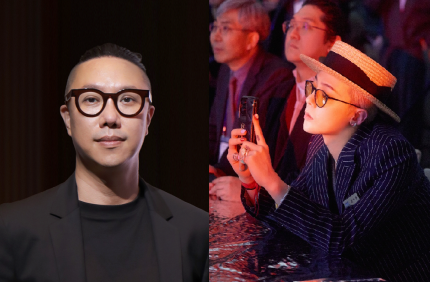 KAIST sends out Music and Bio-Signs of Professor Kwon Ji-yong, a.k.a. G-Dragon, into Space to Pulsate through Universe and Resonate among Stars
KAIST (President Kwang-Hyung Lee) announced on the 10th of April that it successfully promoted the world’s first ‘Space Sound Source Transmission Project’ based on media art at the KAIST Space Research Institute on April 9th through collaboration between Professor Jinjoon Lee of the Graduate School of Culture Technology, a world-renowned media artist, and the global K-Pop artist, G-Dragon.
This project was proposed as part of the ‘AI Entertech Research Center’ being promoted by KAIST and Galaxy Corporation. It is a project to transmit the message and sound of G-Dragon (real name, Kwon Ji-yong), a singer/song writer affiliated with Galaxy Corporation and a visiting professor in the Department of Mechanical Engineering at KAIST, to space for the first time in the world.
This is a convergence project that combines science, technology, art, and popular music, and is a new form of ‘space culture content’ experiment that connects KAIST’s cutting-edge space technology, Professor Jinjoon Lee’s media art work, and G-Dragon’s voice and sound source containing his latest digital single, "HOME SWEET HOME".
< Photo 1. Professor Jinjoon Lee's Open Your Eyes Project "Iris"'s imagery projected on the 13m space antenna at the Space Research Institute >
This collaboration was planned with the theme of ‘emotional signals that expand the inner universe of humans to the outer universe.’ The image of G-Dragon’s iris was augmented through AI as a window into soul symbolizing his uniqueness and identity, and the new song “Home Sweet Home” was combined as an audio message containing the vibration of that emotion.
This was actually transmitted into space using a next-generation small satellite developed by KAIST Space Research Institute, completing a symbolic performance in which an individual’s inner universe is transmitted to outer space.
Professor Jinjoon Lee’s cinematic media art work “Iris” was unveiled at the site. This work was screened in the world’s first projection mapping method* on KAIST Space Research Institute’s 13m space antenna. This video was created using generative artificial intelligence (AI) technology based on the image of G-Dragon's iris, and combined with sound using the data of the sounds of Emile Bell rings – the bell that holds a thousand years of history, it presented an emotional art experience that transcends time and space.
*Projection Mapping: A technology that projects light and images onto actual structures to create visual changes, and is a method of expression that artistically reinterprets space.
This work is one of the major research achievements of KAIST TX Lab and Professor Lee based on new media technology based on biometric data such as iris, heartbeat, and brain waves.
Professor Jinjoon Lee said, "The iris is a symbol that reflects inner emotions and identity, so much so that it is called the 'mirror of the soul,' and this work sought to express 'the infinite universe seen from the inside of humanity' through G-Dragon's gaze."
< Photo 2. (From left) Professor Jinjoon Lee of the Graduate School of Culture Technology and G-Dragon (Visiting Professor Kwon Ji-yong of the Department of Mechanical Engineering) >
He continued, "The universe is a realm of technology as well as a stage for imagination and emotion, and I look forward to an encounter with the unknown through a new attempt to speak of art in the language of science including AI and imagine science in the form of art." “G-Dragon’s voice and music have now begun their journey to space,” said Yong-ho Choi, Galaxy Corporation’s Chief Happiness Officer (CHO). “This project is an act of leaving music as a legacy for humanity, while also having an important meaning of attempting to communicate with space.” He added, “This is a pioneering step to introduce human culture to space, and it will remain as a monumental performance that opens a new chapter in the history of music comparable to the Beatles.”
Galaxy Corporation is leading the future entertainment technology industry through its collaboration with KAIST, and was recently selected as the only entertainment technology company in a private meeting with Microsoft CEO Nadella. In particular, it is promoting the globalization of AI entertainment technology, receiving praise as a “pioneer of imagination” for new forms of AI entertainment content, including the AI contents for the deceased.
< Photo 3. Photo of G-Dragon's Home Sweet Home being sent into the space via Professor Jinjoon Lee's Space Sound Source Transmission Project >
Through this project, KAIST Space Research Institute presented new possibilities for utilizing satellite technology, and showed a model for science to connect with society in a more popular way.
KAIST President Kwang-Hyung Lee said, “KAIST is a place that always supports new imaginations and challenges,” and added, “We will continue to strive to continue creative research that no one has ever thought of, like this project that combines science, technology, and art.”
In the meantime, Galaxy Corporation, the agency of G-Dragon’s Professor Kwon Ji-yong, is an AI entertainment company that presents a new paradigm based on IP, media, tech, and entertainment convergence technology.
2025.04.10 View 17429
KAIST sends out Music and Bio-Signs of Professor Kwon Ji-yong, a.k.a. G-Dragon, into Space to Pulsate through Universe and Resonate among Stars
KAIST (President Kwang-Hyung Lee) announced on the 10th of April that it successfully promoted the world’s first ‘Space Sound Source Transmission Project’ based on media art at the KAIST Space Research Institute on April 9th through collaboration between Professor Jinjoon Lee of the Graduate School of Culture Technology, a world-renowned media artist, and the global K-Pop artist, G-Dragon.
This project was proposed as part of the ‘AI Entertech Research Center’ being promoted by KAIST and Galaxy Corporation. It is a project to transmit the message and sound of G-Dragon (real name, Kwon Ji-yong), a singer/song writer affiliated with Galaxy Corporation and a visiting professor in the Department of Mechanical Engineering at KAIST, to space for the first time in the world.
This is a convergence project that combines science, technology, art, and popular music, and is a new form of ‘space culture content’ experiment that connects KAIST’s cutting-edge space technology, Professor Jinjoon Lee’s media art work, and G-Dragon’s voice and sound source containing his latest digital single, "HOME SWEET HOME".
< Photo 1. Professor Jinjoon Lee's Open Your Eyes Project "Iris"'s imagery projected on the 13m space antenna at the Space Research Institute >
This collaboration was planned with the theme of ‘emotional signals that expand the inner universe of humans to the outer universe.’ The image of G-Dragon’s iris was augmented through AI as a window into soul symbolizing his uniqueness and identity, and the new song “Home Sweet Home” was combined as an audio message containing the vibration of that emotion.
This was actually transmitted into space using a next-generation small satellite developed by KAIST Space Research Institute, completing a symbolic performance in which an individual’s inner universe is transmitted to outer space.
Professor Jinjoon Lee’s cinematic media art work “Iris” was unveiled at the site. This work was screened in the world’s first projection mapping method* on KAIST Space Research Institute’s 13m space antenna. This video was created using generative artificial intelligence (AI) technology based on the image of G-Dragon's iris, and combined with sound using the data of the sounds of Emile Bell rings – the bell that holds a thousand years of history, it presented an emotional art experience that transcends time and space.
*Projection Mapping: A technology that projects light and images onto actual structures to create visual changes, and is a method of expression that artistically reinterprets space.
This work is one of the major research achievements of KAIST TX Lab and Professor Lee based on new media technology based on biometric data such as iris, heartbeat, and brain waves.
Professor Jinjoon Lee said, "The iris is a symbol that reflects inner emotions and identity, so much so that it is called the 'mirror of the soul,' and this work sought to express 'the infinite universe seen from the inside of humanity' through G-Dragon's gaze."
< Photo 2. (From left) Professor Jinjoon Lee of the Graduate School of Culture Technology and G-Dragon (Visiting Professor Kwon Ji-yong of the Department of Mechanical Engineering) >
He continued, "The universe is a realm of technology as well as a stage for imagination and emotion, and I look forward to an encounter with the unknown through a new attempt to speak of art in the language of science including AI and imagine science in the form of art." “G-Dragon’s voice and music have now begun their journey to space,” said Yong-ho Choi, Galaxy Corporation’s Chief Happiness Officer (CHO). “This project is an act of leaving music as a legacy for humanity, while also having an important meaning of attempting to communicate with space.” He added, “This is a pioneering step to introduce human culture to space, and it will remain as a monumental performance that opens a new chapter in the history of music comparable to the Beatles.”
Galaxy Corporation is leading the future entertainment technology industry through its collaboration with KAIST, and was recently selected as the only entertainment technology company in a private meeting with Microsoft CEO Nadella. In particular, it is promoting the globalization of AI entertainment technology, receiving praise as a “pioneer of imagination” for new forms of AI entertainment content, including the AI contents for the deceased.
< Photo 3. Photo of G-Dragon's Home Sweet Home being sent into the space via Professor Jinjoon Lee's Space Sound Source Transmission Project >
Through this project, KAIST Space Research Institute presented new possibilities for utilizing satellite technology, and showed a model for science to connect with society in a more popular way.
KAIST President Kwang-Hyung Lee said, “KAIST is a place that always supports new imaginations and challenges,” and added, “We will continue to strive to continue creative research that no one has ever thought of, like this project that combines science, technology, and art.”
In the meantime, Galaxy Corporation, the agency of G-Dragon’s Professor Kwon Ji-yong, is an AI entertainment company that presents a new paradigm based on IP, media, tech, and entertainment convergence technology.
2025.04.10 View 17429 -
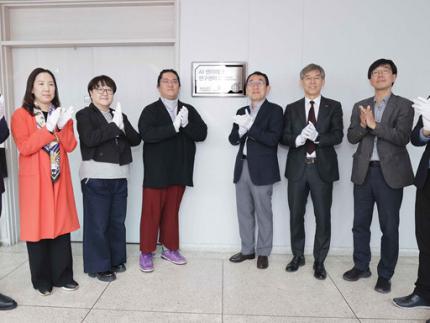 KAIST, Galaxy Corporation Hold Signboard Ceremony for ‘AI Entertech Research Center’
KAIST (President Kwang-Hyung Lee) announced on the 9th that it will hold a signboard ceremony for the establishment of the ‘AI Entertech Research Center’ with the artificial intelligence entertech company, Galaxy Corporation (CEO Yong-ho Choi) at the main campus of KAIST.
< (Galaxy Corporation, from center to the left) CEO Yongho Choi, Director Hyunjung Kim and related persons / (KAIST, from center to the right) Professor SeungSeob Lee of the Department of Mechanical Engineering, Provost and Executive Vice President Gyun Min Lee, Dean Jung Kim of the Department of Mechanical Engineering and Professor Yong Jin Yoon of the same department >
This collaboration is a part of KAIST’s art convergence research strategy and is an extension of its efforts to lead future K-Culture through the development of creative cultural content based on science and technology. Beyond simple technological development, KAIST has been continuously implementing the convergence model of ‘Tech-Art’ that expands the horizon of the content industry through the fusion of emotional technology and cultural imagination.
Previously, KAIST established the ‘Sumi Jo Performing Arts Research Center’ in collaboration with world-renowned soprano Sumi Jo, a visiting professor, and has been leading the convergence research of art and engineering, such as AI-based interactive performance technology and immersive content. The establishment of the ‘AI Entertech Research Center’ this time is being evaluated as a new challenge for the technological expansion of the K-content industry.
In addition, the role of singer G-Dragon (real name Kwon Ji-yong), an artist affiliated with Galaxy Corporation and a visiting professor in the Department of Mechanical Engineering at KAIST, was also a major factor. Since being appointed to KAIST last year, Professor Kwon has been actively promoting the establishment of a research center and soliciting KAIST research projects through his agency to develop the ‘AI Entertech’ field, which fuses entertainment and cutting-edge technology.
< (Galaxy Corporation, from center to the left) CEO Yongho Choi, Director Hyunjung Kim and related persons / (KAIST, from center to the right) Professor SeungSeob Lee of the Department of Mechanical Engineering, Provost and Executive Vice President Gyun Min Lee, Dean Jung Kim of the Department of Mechanical Engineering and Professor Yong Jin Yoon of the same department >
The AI Entertech Research Center is scheduled to officially launch in the third quarter of this year, and this inauguration ceremony was held in line with Professor Kwon Ji-yong’s schedule to visit KAIST. Galaxy Corporation recently had a private meeting with Microsoft (MS) CEO Nadella as the only entertech company, and is actively promoting the globalization of AI entertech. In addition, since last year, it has established a cooperative relationship with KAIST and plans to actively seek the convergence of entertech and technology that transcends time and space through the establishment of a research center.
Professor Kwon Ji-yong will attend the ‘Innovate Korea 2025’ event co-hosted by KAIST, Herald Media Group, and the National Research Council of Science and Technology, held at the KAIST Lyu Keun-Chul Sports Complex in the afternoon of the same day, and will give a special talk on the topic of ‘The Future of AI Entertech.’ In addition to Professor Kwon, Professor SeungSeob Lee of the Department of Mechanical Engineering at KAIST, Professor Sang-gyun Kim of Kyunghee University, and CEO Yong-ho Choi of Galaxy Corporation will also participate in this talk show.
The two organizations signed an MOU last year to jointly research science and technology for the global spread of K-pop, and the establishment of this research center is the first tangible result of this. Once the research center is fully operational, various projects such as the development of an AI-based entertech platform and joint research on global content technology will be promoted.
< A photo of Professor Kwon Ji-yong (right) from at the talk show with KAIST President Kwang-Hyung Lee (left) from the previous year >
Yong-ho Choi, Galaxy Corporation CHO (Chief Happiness Officer), said, “This collaboration is the starting point for providing a completely new entertainment experience to fans around the world by grafting KAIST AI and cutting-edge technologies onto the fandom platform,” and added, “The convergence of AI and entertech is not just technological advancement; it is a driving force for innovation that enriches human life.”
Kwang-Hyung Lee, KAIST President, said, “I am confident that KAIST’s scientific and technological capabilities, combined with Professor Kwon Ji-yong’s global sensibility, will lead the technological evolution of K-culture,” and added, “I hope that KAIST’s spirit of challenge and research DNA will create a new wave in the entertech market.”
Meanwhile, Galaxy Corporation, the agency of Professor G-Dragon Kwon Ji-yong, is an AI entertainment technology company that presents a new paradigm based on IP, media, tech, and entertainment convergence technology. (End)
2025.04.09 View 16632
KAIST, Galaxy Corporation Hold Signboard Ceremony for ‘AI Entertech Research Center’
KAIST (President Kwang-Hyung Lee) announced on the 9th that it will hold a signboard ceremony for the establishment of the ‘AI Entertech Research Center’ with the artificial intelligence entertech company, Galaxy Corporation (CEO Yong-ho Choi) at the main campus of KAIST.
< (Galaxy Corporation, from center to the left) CEO Yongho Choi, Director Hyunjung Kim and related persons / (KAIST, from center to the right) Professor SeungSeob Lee of the Department of Mechanical Engineering, Provost and Executive Vice President Gyun Min Lee, Dean Jung Kim of the Department of Mechanical Engineering and Professor Yong Jin Yoon of the same department >
This collaboration is a part of KAIST’s art convergence research strategy and is an extension of its efforts to lead future K-Culture through the development of creative cultural content based on science and technology. Beyond simple technological development, KAIST has been continuously implementing the convergence model of ‘Tech-Art’ that expands the horizon of the content industry through the fusion of emotional technology and cultural imagination.
Previously, KAIST established the ‘Sumi Jo Performing Arts Research Center’ in collaboration with world-renowned soprano Sumi Jo, a visiting professor, and has been leading the convergence research of art and engineering, such as AI-based interactive performance technology and immersive content. The establishment of the ‘AI Entertech Research Center’ this time is being evaluated as a new challenge for the technological expansion of the K-content industry.
In addition, the role of singer G-Dragon (real name Kwon Ji-yong), an artist affiliated with Galaxy Corporation and a visiting professor in the Department of Mechanical Engineering at KAIST, was also a major factor. Since being appointed to KAIST last year, Professor Kwon has been actively promoting the establishment of a research center and soliciting KAIST research projects through his agency to develop the ‘AI Entertech’ field, which fuses entertainment and cutting-edge technology.
< (Galaxy Corporation, from center to the left) CEO Yongho Choi, Director Hyunjung Kim and related persons / (KAIST, from center to the right) Professor SeungSeob Lee of the Department of Mechanical Engineering, Provost and Executive Vice President Gyun Min Lee, Dean Jung Kim of the Department of Mechanical Engineering and Professor Yong Jin Yoon of the same department >
The AI Entertech Research Center is scheduled to officially launch in the third quarter of this year, and this inauguration ceremony was held in line with Professor Kwon Ji-yong’s schedule to visit KAIST. Galaxy Corporation recently had a private meeting with Microsoft (MS) CEO Nadella as the only entertech company, and is actively promoting the globalization of AI entertech. In addition, since last year, it has established a cooperative relationship with KAIST and plans to actively seek the convergence of entertech and technology that transcends time and space through the establishment of a research center.
Professor Kwon Ji-yong will attend the ‘Innovate Korea 2025’ event co-hosted by KAIST, Herald Media Group, and the National Research Council of Science and Technology, held at the KAIST Lyu Keun-Chul Sports Complex in the afternoon of the same day, and will give a special talk on the topic of ‘The Future of AI Entertech.’ In addition to Professor Kwon, Professor SeungSeob Lee of the Department of Mechanical Engineering at KAIST, Professor Sang-gyun Kim of Kyunghee University, and CEO Yong-ho Choi of Galaxy Corporation will also participate in this talk show.
The two organizations signed an MOU last year to jointly research science and technology for the global spread of K-pop, and the establishment of this research center is the first tangible result of this. Once the research center is fully operational, various projects such as the development of an AI-based entertech platform and joint research on global content technology will be promoted.
< A photo of Professor Kwon Ji-yong (right) from at the talk show with KAIST President Kwang-Hyung Lee (left) from the previous year >
Yong-ho Choi, Galaxy Corporation CHO (Chief Happiness Officer), said, “This collaboration is the starting point for providing a completely new entertainment experience to fans around the world by grafting KAIST AI and cutting-edge technologies onto the fandom platform,” and added, “The convergence of AI and entertech is not just technological advancement; it is a driving force for innovation that enriches human life.”
Kwang-Hyung Lee, KAIST President, said, “I am confident that KAIST’s scientific and technological capabilities, combined with Professor Kwon Ji-yong’s global sensibility, will lead the technological evolution of K-culture,” and added, “I hope that KAIST’s spirit of challenge and research DNA will create a new wave in the entertech market.”
Meanwhile, Galaxy Corporation, the agency of Professor G-Dragon Kwon Ji-yong, is an AI entertainment technology company that presents a new paradigm based on IP, media, tech, and entertainment convergence technology. (End)
2025.04.09 View 16632 -
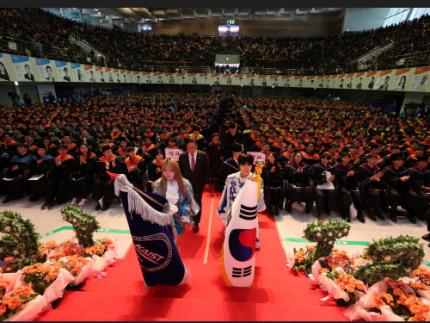 KAIST Holds 2025 Commencement Ceremony
KAIST (President Kwang-Hyung Lee) held its 2025 Commencement Ceremony at the Lyu Keun-Chul Sports Complex on the Daejeon Main Campus at 2 p.m. on the 14th of February.
< A scene from KAIST Commencement 2025 - Guests of Honor and Administrative Professors Entering the Stage headed by the color guards of the ELKA (Encouraging Leaders of KAIST) >
At this ceremony, a total of 3,144 degrees were conferred, including 785 doctorates, 1,643 masters, and 716 bachelors. With this, KAIST has produced a total of 81,156 advanced science and technology personnel, including 17,313 doctorates, 41,566 masters, and 22,277 bachelors since its establishment in 1971.
Changyu Lee from the School of Computing received the Minister of Science and ICT Award, and the Chairman of the KAIST Board of Trustees Award went to Lance Khizner Dabu Gragasin, an international student from the Philippines of the Department of Chemical and Biological Engineering. The President’s Award was given to Seoyeong Yang of the Department of Biological Sciences, and the Alumni Association President’s Award and the Development Foundation Chairman’s Award was given to Gahyeon Bae of the Department of Industrial Design and Buyeon Kim of the Department of Mechanical Engineering, respectively.
Minister of Science and ICT Sang-Im Yoo joined the ceremony to deliver a congratulatory speech and to present the awards to outstanding graduates.
< Minister Sang-Im Yoo of the Ministry of Science, Technology and ICT giving his congratulatory message at KAIST Commencement 2025 >
The valedictorian speeches were given by Minjae Kim of the School of Computing, who has practiced the value of sharing that learning is not competition but cooperation, and Mohammed Haruna Hamza of the Department of Aerospace Engineering, a Nigerian international student. Mr. Hamza is the first foreign student to represent the graduating class as valedictorian since the founding of KAIST.
Hamza lost his home and school in his home country due to a terrorist group’s bombing and moved south, but despite the adversity, he continued his studies while pursuing his dream of becoming an aerospace engineer. As a result of his efforts, Hamza was invited by the Korean government to study at KAIST. He expressed his determination to pursue his dream by saying, “I am grateful for the people and experiences that helped me overcome my adversity. The future is the result of the decisions we make today.”
A Pakistani international student was chosen as one of this year's "Most Talked about Graduates of the Year". It is Ali Syed Sheraz who wore his doctoral cap at this year’s commencement ceremony. Ali, a single father who left his one-year-old son behind in his home country, working as a university lecturer. He joined the Ph.D. program in mechanical engineering in 2019 with a passion for mechanical energy.
Ali’s academic journey was full of challenges and growth. Due to COVID-19, his research was suspended for six months, and he had difficulty continuing his studies undergoing three surgeries after a bicycle accident, including a surgery for a fractured elbow, a nose surgery, and removal of kidney stones.
However, he accepted these failure and hardship as a process of growth and participated in the ‘Failed Project Showcase’ and ‘Failure Essay Contest’ held by the KAIST Failure Society, sharing his experiences and growing into a more solid researcher.
< Most Talked about Graduate Graduate of the Year - Syed Sheraz Ali >
Despite experiencing various hardships, he found lessons to learn from them and changed his perspective, which made him unafraid of taking on new challenges. He showed through his own example that failure is not just stumbling blocks but can be a stepping stone to success by looking at his studies and personal life positively.
Furthermore, after becoming the president of the Muslim Student Association, Ali introduced halal menus to the cafeteria on campus so that more Muslim students could eat comfortably. Thanks to this change, his time at KAIST has become an opportunity to understand and experience various cultures more.
Ali is researching artificial muscles (soft actuators) with the world's highest bending strain using MXene, an artificial muscle nanomaterial that can move smoothly, in Professor Il-kwon Oh's lab.
Ali said, "After completing my Ph.D., I plan to develop soft robots, healthcare electronics, and next-generation tactile technology based on MXene, a next-generation 2D material. It is important for my juniors not to be afraid of failure and to have a challenging attitude."
Another 'Most Talked about Graduate of the Year', Mr. Sung-Hyun Jung, who graduated with a master's degree from the Graduate School of Bio Innvation Management, is the CEO of Promedius, a medical AI startup, and has commercialized an osteoporosis diagnosis software based on chest X-rays using AI, and grown it into a leading company in the bone health field.
CEO Jung's challenge shows that KAIST's management education is not just theoretical but practical enough to be applied immediately in the field. CEO Jung, who is also the father of three daughters, experienced business failure in China during the period when the conflict between Korea and China was intensifying.
He moved to Silicon Valley in the United States to revive his business and tried to acquire even small businesses, but the reality was not easy. He worked hard, standing 14 hours a day in a kimchi factory and a restaurant kitchen to make a living. After finishing his life in the United States, CEO Jung returned to Korea and had the opportunity to join Lunit, a global medical AI leader founded by KAIST graduates. CEO Jung experienced the growth of the global medical AI market firsthand with unit Chairman Seungwook Paek.
When he entered the Master's Program at the Graduate School of Bio Innvation Management in 2023 to acquire more specialized knowledge, CEO Jung had just transferred to Promedius and was in a crisis situation with only about 6 months left before the company's funds were exhausted.
While considering a change in business direction because he judged that it would be difficult to survive with existing business items, he learned keywords and investment review perspectives that venture capital (VC) pays attention to in Professor Hoonje Cho’s ‘Bio-innovation Business Startup Strategy and Practice’ class. He attracted 11.4 billion won in investment by applying the investment proposal he wrote based on what he learned from the class to actual practice.
< Most Talked about Graduate of the Year - Sung-Hyun Jung >
In addition, he applied the innovation strategy in the medical field he learned in Professor Kihwan Park’s ‘Innovation and Marketing in Bio and Pharmaceutics’ to the field of osteoporosis, and achieved the result of being selected as the first Asian company to be a corporate advisory committee member of the International Osteoporosis Foundation (IOF). Through this, he established the company as a representative global entity in the osteoporosis field in just one year.
CEO Jung, who applied what he learned from KAIST to actual management and achieved results in the global market in a short period of time, said, “I want to prove that KAIST education is not limited to theory, but is very practical.” He said, “I want to let people know that my life, once full of hardship, got on the track toward success after encountering KAIST,” and expressed his ambition, saying, “My long-term goal is to create a world-class company that is recognized globally.”
In addition, an honorary doctorate was awarded to Chairman Joong Keun Lee of Booyoung Group at the commencement ceremony.
Chairman Joong Keun Lee, who is an entrepreneur that led Booyoung Group, a leading general construction company, received the honorary doctorate in business administration, for leading the development of domestic housing welfare, education, and culture.
KAIST Provost Gyunmin Lee said, “Chairman Joong Keun Lee spared no effort in providing dedicated support for the development of domestic science and technology and the cultivation of future talents. He is awarded the honorary doctorate in recognition of his social responsibility in various fields, including scholarships and support for educational facilities, as well as domestic and international education, culture, veterans affairs, and overseas support.”
Since founding Booyoung Group in 1983, Chairman Lee has boldly entered the rental housing business, a field that large construction companies had avoided, and has played a significant role in improving the quality of life of ordinary citizens by supplying 230,000 households out of 383 complexes and approximately 300,000 households nationwide as rental housing, thereby contributing greatly to the stability of national housing.
< Chairman Joong Keun Lee giving his acceptance speech for his honorary Doctorate >
Chairman Joong Keun Lee, who has been offering hope for a sustainable future, said, “I am honored to receive an honorary doctorate from KAIST, and I hope that KAIST students will nurture their dreams and talents and grow into global talents who will contribute to national development.”
President Kwang-Hyung Lee said, “Chairman Joong Keun Lee has been carrying out various social contribution activities, and in particular, through supporting academic infrastructure, which is the core of national competitiveness, we can see his deep interest in and sense of responsibility for the development of science and technology in our country.” He added, “I am truly delighted to have him as a member of the KAIST family, and I congratulate him on behalf of all members, including our students.”
President Kwang-Hyung Lee also delivered a message of encouragement at the ceremony to charge the graduates to, “Find and keep a dream of your own, be on the lookout for opportunities, don’t be afraid of making mistakes, and do not shy away from taking on challenging tasks.” He added, “Even if you fail, don’t give up. Keep on trying so that you will get to that stage of radiate your own light on the stages where anything is possible.” (End)
2025.02.14 View 23133
KAIST Holds 2025 Commencement Ceremony
KAIST (President Kwang-Hyung Lee) held its 2025 Commencement Ceremony at the Lyu Keun-Chul Sports Complex on the Daejeon Main Campus at 2 p.m. on the 14th of February.
< A scene from KAIST Commencement 2025 - Guests of Honor and Administrative Professors Entering the Stage headed by the color guards of the ELKA (Encouraging Leaders of KAIST) >
At this ceremony, a total of 3,144 degrees were conferred, including 785 doctorates, 1,643 masters, and 716 bachelors. With this, KAIST has produced a total of 81,156 advanced science and technology personnel, including 17,313 doctorates, 41,566 masters, and 22,277 bachelors since its establishment in 1971.
Changyu Lee from the School of Computing received the Minister of Science and ICT Award, and the Chairman of the KAIST Board of Trustees Award went to Lance Khizner Dabu Gragasin, an international student from the Philippines of the Department of Chemical and Biological Engineering. The President’s Award was given to Seoyeong Yang of the Department of Biological Sciences, and the Alumni Association President’s Award and the Development Foundation Chairman’s Award was given to Gahyeon Bae of the Department of Industrial Design and Buyeon Kim of the Department of Mechanical Engineering, respectively.
Minister of Science and ICT Sang-Im Yoo joined the ceremony to deliver a congratulatory speech and to present the awards to outstanding graduates.
< Minister Sang-Im Yoo of the Ministry of Science, Technology and ICT giving his congratulatory message at KAIST Commencement 2025 >
The valedictorian speeches were given by Minjae Kim of the School of Computing, who has practiced the value of sharing that learning is not competition but cooperation, and Mohammed Haruna Hamza of the Department of Aerospace Engineering, a Nigerian international student. Mr. Hamza is the first foreign student to represent the graduating class as valedictorian since the founding of KAIST.
Hamza lost his home and school in his home country due to a terrorist group’s bombing and moved south, but despite the adversity, he continued his studies while pursuing his dream of becoming an aerospace engineer. As a result of his efforts, Hamza was invited by the Korean government to study at KAIST. He expressed his determination to pursue his dream by saying, “I am grateful for the people and experiences that helped me overcome my adversity. The future is the result of the decisions we make today.”
A Pakistani international student was chosen as one of this year's "Most Talked about Graduates of the Year". It is Ali Syed Sheraz who wore his doctoral cap at this year’s commencement ceremony. Ali, a single father who left his one-year-old son behind in his home country, working as a university lecturer. He joined the Ph.D. program in mechanical engineering in 2019 with a passion for mechanical energy.
Ali’s academic journey was full of challenges and growth. Due to COVID-19, his research was suspended for six months, and he had difficulty continuing his studies undergoing three surgeries after a bicycle accident, including a surgery for a fractured elbow, a nose surgery, and removal of kidney stones.
However, he accepted these failure and hardship as a process of growth and participated in the ‘Failed Project Showcase’ and ‘Failure Essay Contest’ held by the KAIST Failure Society, sharing his experiences and growing into a more solid researcher.
< Most Talked about Graduate Graduate of the Year - Syed Sheraz Ali >
Despite experiencing various hardships, he found lessons to learn from them and changed his perspective, which made him unafraid of taking on new challenges. He showed through his own example that failure is not just stumbling blocks but can be a stepping stone to success by looking at his studies and personal life positively.
Furthermore, after becoming the president of the Muslim Student Association, Ali introduced halal menus to the cafeteria on campus so that more Muslim students could eat comfortably. Thanks to this change, his time at KAIST has become an opportunity to understand and experience various cultures more.
Ali is researching artificial muscles (soft actuators) with the world's highest bending strain using MXene, an artificial muscle nanomaterial that can move smoothly, in Professor Il-kwon Oh's lab.
Ali said, "After completing my Ph.D., I plan to develop soft robots, healthcare electronics, and next-generation tactile technology based on MXene, a next-generation 2D material. It is important for my juniors not to be afraid of failure and to have a challenging attitude."
Another 'Most Talked about Graduate of the Year', Mr. Sung-Hyun Jung, who graduated with a master's degree from the Graduate School of Bio Innvation Management, is the CEO of Promedius, a medical AI startup, and has commercialized an osteoporosis diagnosis software based on chest X-rays using AI, and grown it into a leading company in the bone health field.
CEO Jung's challenge shows that KAIST's management education is not just theoretical but practical enough to be applied immediately in the field. CEO Jung, who is also the father of three daughters, experienced business failure in China during the period when the conflict between Korea and China was intensifying.
He moved to Silicon Valley in the United States to revive his business and tried to acquire even small businesses, but the reality was not easy. He worked hard, standing 14 hours a day in a kimchi factory and a restaurant kitchen to make a living. After finishing his life in the United States, CEO Jung returned to Korea and had the opportunity to join Lunit, a global medical AI leader founded by KAIST graduates. CEO Jung experienced the growth of the global medical AI market firsthand with unit Chairman Seungwook Paek.
When he entered the Master's Program at the Graduate School of Bio Innvation Management in 2023 to acquire more specialized knowledge, CEO Jung had just transferred to Promedius and was in a crisis situation with only about 6 months left before the company's funds were exhausted.
While considering a change in business direction because he judged that it would be difficult to survive with existing business items, he learned keywords and investment review perspectives that venture capital (VC) pays attention to in Professor Hoonje Cho’s ‘Bio-innovation Business Startup Strategy and Practice’ class. He attracted 11.4 billion won in investment by applying the investment proposal he wrote based on what he learned from the class to actual practice.
< Most Talked about Graduate of the Year - Sung-Hyun Jung >
In addition, he applied the innovation strategy in the medical field he learned in Professor Kihwan Park’s ‘Innovation and Marketing in Bio and Pharmaceutics’ to the field of osteoporosis, and achieved the result of being selected as the first Asian company to be a corporate advisory committee member of the International Osteoporosis Foundation (IOF). Through this, he established the company as a representative global entity in the osteoporosis field in just one year.
CEO Jung, who applied what he learned from KAIST to actual management and achieved results in the global market in a short period of time, said, “I want to prove that KAIST education is not limited to theory, but is very practical.” He said, “I want to let people know that my life, once full of hardship, got on the track toward success after encountering KAIST,” and expressed his ambition, saying, “My long-term goal is to create a world-class company that is recognized globally.”
In addition, an honorary doctorate was awarded to Chairman Joong Keun Lee of Booyoung Group at the commencement ceremony.
Chairman Joong Keun Lee, who is an entrepreneur that led Booyoung Group, a leading general construction company, received the honorary doctorate in business administration, for leading the development of domestic housing welfare, education, and culture.
KAIST Provost Gyunmin Lee said, “Chairman Joong Keun Lee spared no effort in providing dedicated support for the development of domestic science and technology and the cultivation of future talents. He is awarded the honorary doctorate in recognition of his social responsibility in various fields, including scholarships and support for educational facilities, as well as domestic and international education, culture, veterans affairs, and overseas support.”
Since founding Booyoung Group in 1983, Chairman Lee has boldly entered the rental housing business, a field that large construction companies had avoided, and has played a significant role in improving the quality of life of ordinary citizens by supplying 230,000 households out of 383 complexes and approximately 300,000 households nationwide as rental housing, thereby contributing greatly to the stability of national housing.
< Chairman Joong Keun Lee giving his acceptance speech for his honorary Doctorate >
Chairman Joong Keun Lee, who has been offering hope for a sustainable future, said, “I am honored to receive an honorary doctorate from KAIST, and I hope that KAIST students will nurture their dreams and talents and grow into global talents who will contribute to national development.”
President Kwang-Hyung Lee said, “Chairman Joong Keun Lee has been carrying out various social contribution activities, and in particular, through supporting academic infrastructure, which is the core of national competitiveness, we can see his deep interest in and sense of responsibility for the development of science and technology in our country.” He added, “I am truly delighted to have him as a member of the KAIST family, and I congratulate him on behalf of all members, including our students.”
President Kwang-Hyung Lee also delivered a message of encouragement at the ceremony to charge the graduates to, “Find and keep a dream of your own, be on the lookout for opportunities, don’t be afraid of making mistakes, and do not shy away from taking on challenging tasks.” He added, “Even if you fail, don’t give up. Keep on trying so that you will get to that stage of radiate your own light on the stages where anything is possible.” (End)
2025.02.14 View 23133 -
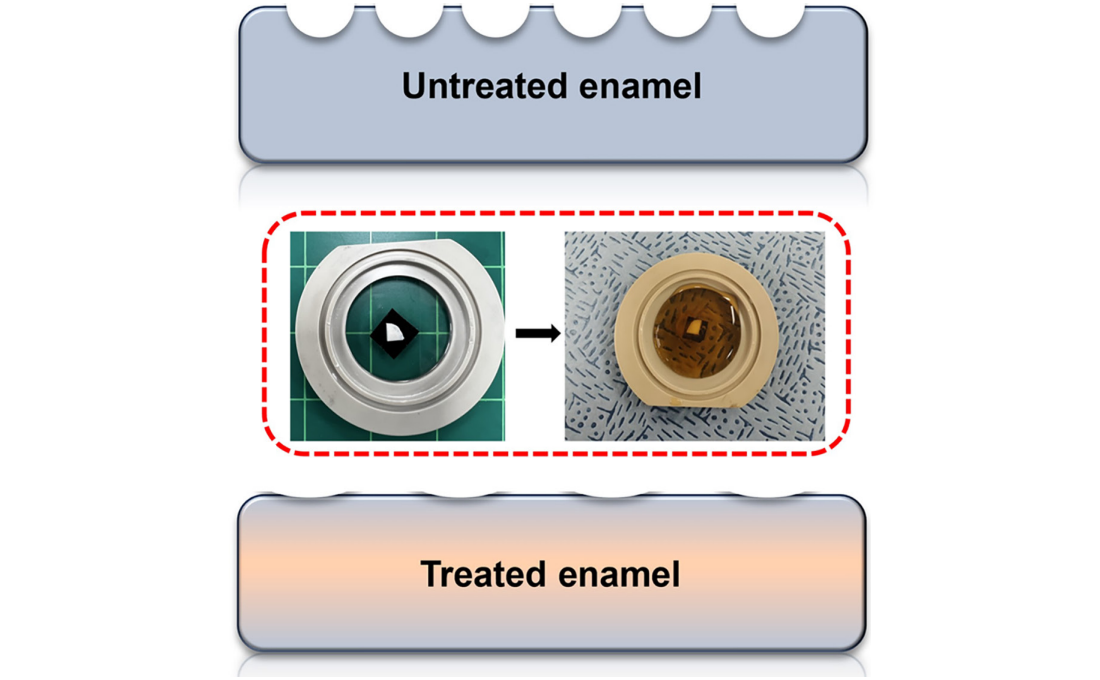 KAIST Scientifically Identifies a Method to Prevent Dental Erosion from Carbonated Drinks
A Korean research team, which had previously visualized and scientifically proven the harmful effects of carbonated drinks like cola on dental health using nanotechnology, has now identified a mechanism for an effective method to prevent tooth damage caused by these beverages.
KAIST (represented by President Kwang Hyung Lee) announced on the 5th of December that a team led by Professor Seungbum Hong from the Department of Materials Science and Engineering, in collaboration with Seoul National University's School of Dentistry (Departments of Pediatric Dentistry and Oral Microbiology) and Professor Hye Ryung Byon’s research team from the Department of Chemistry, has revealed through nanotechnology that silver diamine fluoride (SDF)* forms a fluoride-containing protective layer on the tooth surface, effectively inhibiting cola-induced erosion.
*SDF (Silver Diamine Fluoride): A dental agent primarily used for the treatment and prevention of tooth decay. SDF strengthens carious lesions, suppresses bacterial growth, and halts the progression of cavities.
The team analyzed the surface morphology and mechanical properties of tooth enamel on a nanoscale using atomic force microscopy (AFM). They also examined the chemical properties of the nano-film formed by SDF treatment using X-ray photoelectron spectroscopy (XPS)* and Fourier-transform infrared spectroscopy (FTIR)*.
*XPS (X-ray Photoelectron Spectroscopy): A powerful surface analysis technique used to investigate the chemical composition and electronic structure of materials.
*FTIR (Fourier-Transform Infrared Spectroscopy): An analytical method that identifies the molecular structure and composition of materials by analyzing how they absorb or transmit infrared light.
The findings showed significant differences in surface roughness and elastic modulus between teeth exposed to cola with and without SDF treatment. Teeth treated with SDF exhibited minimal changes in surface roughness due to erosion (from 64 nm to 70 nm) and maintained a high elastic modulus (from 215 GPa to 205 GPa).
This was attributed to the formation of a fluoroapatite* layer by SDF, which acted as a protective shield.
*Fluoroapatite: A phosphate mineral with the chemical formula Ca₅(PO₄)₃F (calcium fluoro-phosphate). It can occur naturally or be synthesized biologically/artificially and plays a crucial role in strengthening teeth and bones.
< Figure 1. Schematic of the workflow. Surface morphology and mechanical properties of untreated and treated silver diamine fluoride (SDF) treated enamel exposed to cola were analyzed over time using atomic force microscopy (AFM). >
Professor Young J. Kim from Seoul National University's Department of Pediatric Dentistry noted, "This technology could be applied to prevent dental erosion and strengthen teeth for both children and adults. It is a cost-effective and accessible dental treatment."
< Figure 2. Changes in surface roughness and elastic modulus according to time of exposure to cola for SDF untreated and treated teeth. After 1 hour, the surface roughness of the SDF untreated teeth rapidly became rougher from 83 nm to 287 nm and the elastic modulus weakened from 125 GPa to 13 GPa, whereas the surface roughness of the SDF treated teeth changed only slightly from 64 nm to 70 nm and the elastic modulus barely changed from 215 GPa to 205 GPa, maintaining a similar state to the initial state. >
Professor Seungbum Hong emphasized, "Dental health significantly impacts quality of life. This research offers an effective non-invasive method to prevent early dental erosion, moving beyond traditional surgical treatments. By simply applying SDF, dental erosion can be prevented and enamel strengthened, potentially reducing pain and costs associated with treatment."
This study, led by the first author Aditi Saha, a PhD student in KAIST’s Department of Materials Science and Engineering, was published in the international journal Biomaterials Research on November 7 under the title "Nanoscale Study on Noninvasive Prevention of Dental Erosion of Enamel by Silver Diamine Fluoride". The research was supported by the National Research Foundation of Korea.
2024.12.11 View 15013
KAIST Scientifically Identifies a Method to Prevent Dental Erosion from Carbonated Drinks
A Korean research team, which had previously visualized and scientifically proven the harmful effects of carbonated drinks like cola on dental health using nanotechnology, has now identified a mechanism for an effective method to prevent tooth damage caused by these beverages.
KAIST (represented by President Kwang Hyung Lee) announced on the 5th of December that a team led by Professor Seungbum Hong from the Department of Materials Science and Engineering, in collaboration with Seoul National University's School of Dentistry (Departments of Pediatric Dentistry and Oral Microbiology) and Professor Hye Ryung Byon’s research team from the Department of Chemistry, has revealed through nanotechnology that silver diamine fluoride (SDF)* forms a fluoride-containing protective layer on the tooth surface, effectively inhibiting cola-induced erosion.
*SDF (Silver Diamine Fluoride): A dental agent primarily used for the treatment and prevention of tooth decay. SDF strengthens carious lesions, suppresses bacterial growth, and halts the progression of cavities.
The team analyzed the surface morphology and mechanical properties of tooth enamel on a nanoscale using atomic force microscopy (AFM). They also examined the chemical properties of the nano-film formed by SDF treatment using X-ray photoelectron spectroscopy (XPS)* and Fourier-transform infrared spectroscopy (FTIR)*.
*XPS (X-ray Photoelectron Spectroscopy): A powerful surface analysis technique used to investigate the chemical composition and electronic structure of materials.
*FTIR (Fourier-Transform Infrared Spectroscopy): An analytical method that identifies the molecular structure and composition of materials by analyzing how they absorb or transmit infrared light.
The findings showed significant differences in surface roughness and elastic modulus between teeth exposed to cola with and without SDF treatment. Teeth treated with SDF exhibited minimal changes in surface roughness due to erosion (from 64 nm to 70 nm) and maintained a high elastic modulus (from 215 GPa to 205 GPa).
This was attributed to the formation of a fluoroapatite* layer by SDF, which acted as a protective shield.
*Fluoroapatite: A phosphate mineral with the chemical formula Ca₅(PO₄)₃F (calcium fluoro-phosphate). It can occur naturally or be synthesized biologically/artificially and plays a crucial role in strengthening teeth and bones.
< Figure 1. Schematic of the workflow. Surface morphology and mechanical properties of untreated and treated silver diamine fluoride (SDF) treated enamel exposed to cola were analyzed over time using atomic force microscopy (AFM). >
Professor Young J. Kim from Seoul National University's Department of Pediatric Dentistry noted, "This technology could be applied to prevent dental erosion and strengthen teeth for both children and adults. It is a cost-effective and accessible dental treatment."
< Figure 2. Changes in surface roughness and elastic modulus according to time of exposure to cola for SDF untreated and treated teeth. After 1 hour, the surface roughness of the SDF untreated teeth rapidly became rougher from 83 nm to 287 nm and the elastic modulus weakened from 125 GPa to 13 GPa, whereas the surface roughness of the SDF treated teeth changed only slightly from 64 nm to 70 nm and the elastic modulus barely changed from 215 GPa to 205 GPa, maintaining a similar state to the initial state. >
Professor Seungbum Hong emphasized, "Dental health significantly impacts quality of life. This research offers an effective non-invasive method to prevent early dental erosion, moving beyond traditional surgical treatments. By simply applying SDF, dental erosion can be prevented and enamel strengthened, potentially reducing pain and costs associated with treatment."
This study, led by the first author Aditi Saha, a PhD student in KAIST’s Department of Materials Science and Engineering, was published in the international journal Biomaterials Research on November 7 under the title "Nanoscale Study on Noninvasive Prevention of Dental Erosion of Enamel by Silver Diamine Fluoride". The research was supported by the National Research Foundation of Korea.
2024.12.11 View 15013 -
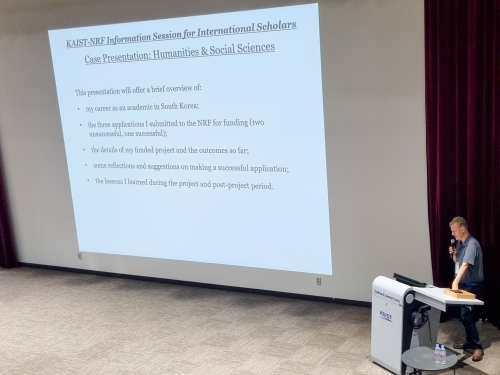 KAIST ISSS Research Session Captivates 150↑ International Scholars, Achieve Major Success
< Photo. Scholars gatheres for NRF Information Session at Chung Keun Mo Hall >
KAIST’s International Office, headed by Vice President Soyoung Kim, successfully organized the ‘NRF Information Session for International Scholars’ on September 11, 2024, in collaboration with the National Research Foundation of Korea (NRF).
The event was held at KAIST’s main campus to enourage the international scholar’s active participation in research projects and support their establishment of stable research environment and integration into Korea’s academic community by introducing NRF’s key research programs.
Divided into two main segments – science and engineering, and humanities and social sciences – the session attracted approximately 150 international faculty and researchers from 23 universities across the nation.
The event commenced with a keynote address by Vice President Soyoung Kim, followed by a presentation from Dr. Seol Min of the National Research Foundation, who highlighted basic research initiatives in the science and technology sector. Subsequently, Professor Daniel Martin from the Digital Humanities and Social Sciences Department and Professor Thomas Steinberger from the Department of Business and Technology Management presented practical research project support case studies, sharing invaluable insights gained from their domestic research experiences.
Following the information session, participants engaged in a networking event, where researchers involved in major R&D projects exchanged insights and discussed their ongoing research initiatives.
An international professor remarked, “My understanding of NRF’s research programs for international researchers has broadened considerably. I am now more inclined to actively participate in projects organized by NRF in the future.”
Vice President Kim expressed her aspiration that the event would address the challenges faced by researchers and offer essential support to those engaged in research projects. “We will stay attuned to the needs of the research community and work towards creating a more supportive research environment,” said the VP.
Meanwhile, KAIST hosts a distinguished faculty comprising 134 professors from 22 countries and 71 researchers representing 23 nations, all contributing to groundbreaking academic achievements. Additionally, KAIST is home to over 1,000 international students from more than 100 countries, actively pursuing their studies. This diverse composition of global talent reinforces KAIST's position as a leading international hub for research and education.
2024.09.13 View 14776
KAIST ISSS Research Session Captivates 150↑ International Scholars, Achieve Major Success
< Photo. Scholars gatheres for NRF Information Session at Chung Keun Mo Hall >
KAIST’s International Office, headed by Vice President Soyoung Kim, successfully organized the ‘NRF Information Session for International Scholars’ on September 11, 2024, in collaboration with the National Research Foundation of Korea (NRF).
The event was held at KAIST’s main campus to enourage the international scholar’s active participation in research projects and support their establishment of stable research environment and integration into Korea’s academic community by introducing NRF’s key research programs.
Divided into two main segments – science and engineering, and humanities and social sciences – the session attracted approximately 150 international faculty and researchers from 23 universities across the nation.
The event commenced with a keynote address by Vice President Soyoung Kim, followed by a presentation from Dr. Seol Min of the National Research Foundation, who highlighted basic research initiatives in the science and technology sector. Subsequently, Professor Daniel Martin from the Digital Humanities and Social Sciences Department and Professor Thomas Steinberger from the Department of Business and Technology Management presented practical research project support case studies, sharing invaluable insights gained from their domestic research experiences.
Following the information session, participants engaged in a networking event, where researchers involved in major R&D projects exchanged insights and discussed their ongoing research initiatives.
An international professor remarked, “My understanding of NRF’s research programs for international researchers has broadened considerably. I am now more inclined to actively participate in projects organized by NRF in the future.”
Vice President Kim expressed her aspiration that the event would address the challenges faced by researchers and offer essential support to those engaged in research projects. “We will stay attuned to the needs of the research community and work towards creating a more supportive research environment,” said the VP.
Meanwhile, KAIST hosts a distinguished faculty comprising 134 professors from 22 countries and 71 researchers representing 23 nations, all contributing to groundbreaking academic achievements. Additionally, KAIST is home to over 1,000 international students from more than 100 countries, actively pursuing their studies. This diverse composition of global talent reinforces KAIST's position as a leading international hub for research and education.
2024.09.13 View 14776 -
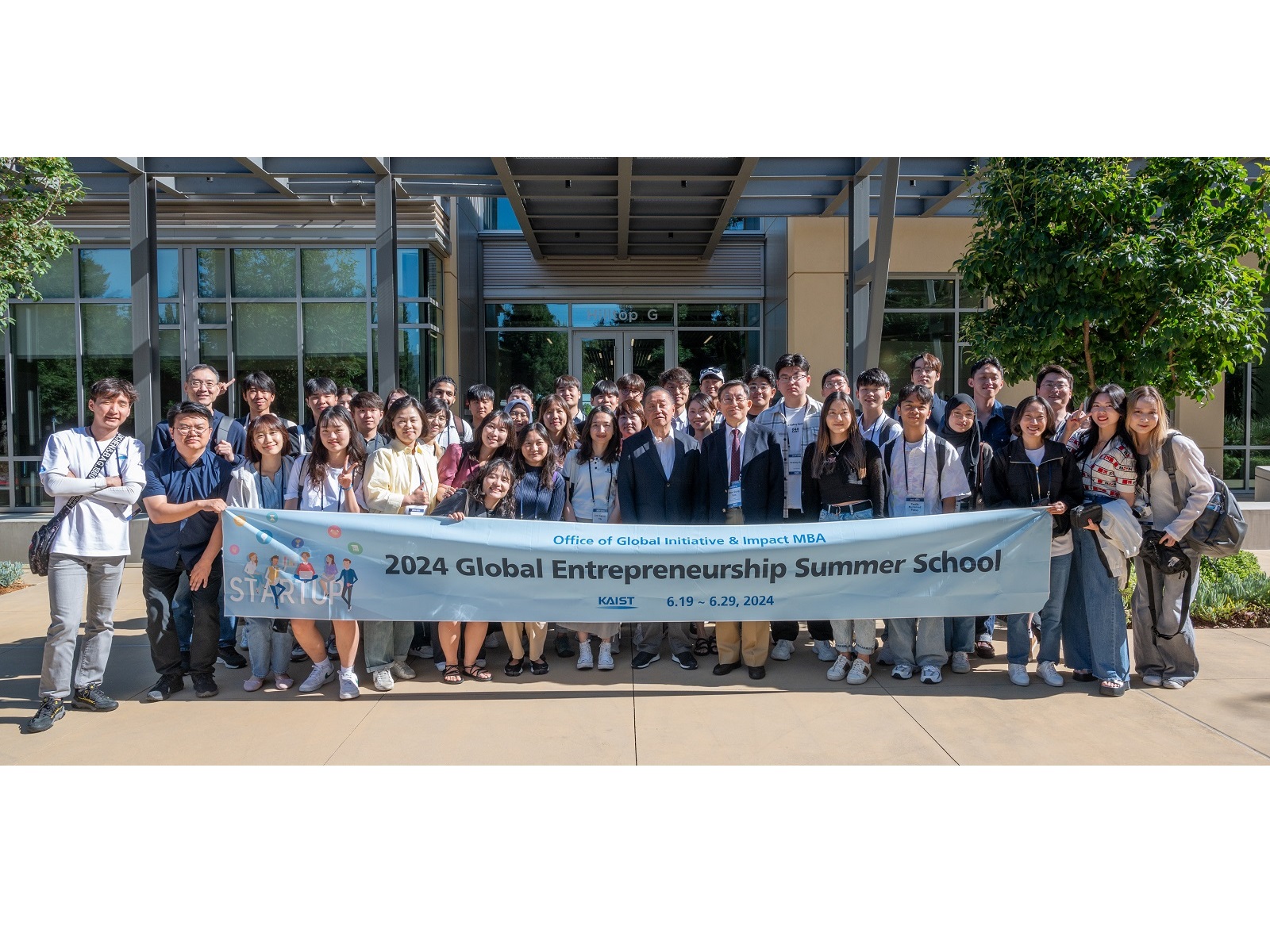 The 3rd Global Entrepreneurship Summer School (GESS 2024) Successfully Completed in Silicon Valley
The 2024 Global Entrepreneurship Summer School (2024 KAIST GESS), hosted by the Office of Global Initiatives under the KAIST International Office (Director Man-Sung Yim), was held for the third time. This program allows students to visit Silicon Valley, a global startup hub, to directly experience its famous startup ecosystem and develop their capabilities for global expansion. A total of 20 students were selected through applications, interviews, final presentations, mentoring, and peer evaluations. Additionally, 17 students from the KAIST Impact MBA course at the KAIST Business School also participated.
Before starting the Silicon Valley program, participants received mentoring on business model development and pitching advice from a senior entrepreneur at KAIST for about two months, beginning last May. Afterward, they developed business items for each team at KAIST’s main campus in Daejeon. For seven days, starting from June 23rd, workshops were held under the themes of global entrepreneurship, learning through failure, capital and network, and startup culture at KOTRA Silicon Valley Trade Center, JP Morgan, and Plug and Play Tech Center. This program's lecture series provided prospective entrepreneurs with the opportunity to systematically learn the mindset and gain the experience needed to start a global business.
The participants also visited local companies and gained experience in the field of global technology startups. Visits included Bear Robotics (CEO John Ha), Soundable Health (CEO Cathering Song), ImpriMed (CEO Sungwon Lim), Phantom AI (CEO Hyunggi Cho), B Garage (CEO Aiden Kim), and Simple Steps (CEO Doyeon Kim). Lectures contained vivid experiences from Silicon Valley CEOs and company tours boosted the students' passion for entrepreneurship. In particular, Doyeon Kim, CEO of Simple Steps, which helps prevent career breaks for Korean female immigrants in Silicon Valley and allows talented female immigrants to demonstrate their abilities in society, said, “As a KAIST alumna entrepreneur, it was meaningful to share my experience with this generation of students who dream of starting a global business and creating social enterprises in the United States.”
This program also included a tour of Silicon Valley's big tech companies that have made a significant impact on the digital ecosystem through technological advancement and innovation. This included Broadcom, which maintains a strong global presence in the semiconductor and infrastructure software technology fields. At the invitation of Chairman Hock Tan, GESS participants had the opportunity to attend his lecture and ask questions. Chairman Tan, who received an honorary doctorate in engineering from KAIST last February, emphasized that experiencing failure and giving consistent effort over a long period of time are more important than anything else in order to grow as a global entrepreneur, and that technologies influencing the global market evolve over generations.
< Photo. Group photo of GESS 2024 participants at Broadcom with Chairman Hock Tan (center) ⓒBroadcom>
As part of this program, participants conducted a volunteer program called 'Let's play with AI+ Tech' with the Sunnyvale community in Silicon Valley and Foothill College to help grow together with the community. Through this program, GESS participants cultivated the virtues of a global leader. In this volunteer activity, low-income elementary school students and parents from the Sunnyvale community participated in chatbot training led by KAIST students, providing an opportunity to work with underprivileged groups in the local community.
In the final pitching event, the highlight of the program, local venture investors from Silicon Valley were invited as judges and evaluated the pitches for each team's business items. The participating students, who developed their own business models while receiving advice through face-to-face mentoring from a professional accelerator in Silicon Valley, showcased their creative and innovative ideas, presenting themselves as future global entrepreneurs. Merey Makhmutova (BS in Civil and Environmental Engineering) from the K-Bridge team, who won the final pitch, expressed her ambition: “Even before GESS pitch day, our team kept refining the pitch deck as we attended the lectures and benefitted from the mentoring. Our intense teamwork was a significant reason why we ultimately won first prize.” She added that K-Bridge aims to win an award at the upcoming UKC Pitching Competition and expressed her gratitude for being able to participate in this program. Arseniy Kan (BS in Electrical Engineering) from the KAIST Enablers team, who took second place, said, “The 2024 KAIST GESS Program became the most unforgettable and precious opportunity of my lifetime, and I dream of using this opportunity as a stepping stone to becoming a global entrepreneur.“ Additionally, Kangster (CEO Kang Kim), who won the Impact MBA final pitching session, had the opportunity to secure a meeting with a local investment company after their GESS final pitch.
The 2024 KAIST GESS was held in cooperation with the KAIST International Office, the KAIST College of Business, and Startup KAIST. Director Man-Sung Yim from the Office of Global Initiatives, who hosted the event, said, “KAIST students will grow into leaders with global influence and contribute to the international community by creating global value. At the same time, we hope to raise the international status of our university.” Professor Sangchan Park, who led the 17 Impact MBA students in this educational program, added, “Meeting with companies leading the global market and visiting Silicon Valley has been a valuable learning experience for students aiming to start a global startup.”
KAIST plans to continue promoting its global entrepreneurship education program by enriching its curriculum each year and helping students grow into entrepreneurs with the virtues of global leaders.
2024.07.03 View 24623
The 3rd Global Entrepreneurship Summer School (GESS 2024) Successfully Completed in Silicon Valley
The 2024 Global Entrepreneurship Summer School (2024 KAIST GESS), hosted by the Office of Global Initiatives under the KAIST International Office (Director Man-Sung Yim), was held for the third time. This program allows students to visit Silicon Valley, a global startup hub, to directly experience its famous startup ecosystem and develop their capabilities for global expansion. A total of 20 students were selected through applications, interviews, final presentations, mentoring, and peer evaluations. Additionally, 17 students from the KAIST Impact MBA course at the KAIST Business School also participated.
Before starting the Silicon Valley program, participants received mentoring on business model development and pitching advice from a senior entrepreneur at KAIST for about two months, beginning last May. Afterward, they developed business items for each team at KAIST’s main campus in Daejeon. For seven days, starting from June 23rd, workshops were held under the themes of global entrepreneurship, learning through failure, capital and network, and startup culture at KOTRA Silicon Valley Trade Center, JP Morgan, and Plug and Play Tech Center. This program's lecture series provided prospective entrepreneurs with the opportunity to systematically learn the mindset and gain the experience needed to start a global business.
The participants also visited local companies and gained experience in the field of global technology startups. Visits included Bear Robotics (CEO John Ha), Soundable Health (CEO Cathering Song), ImpriMed (CEO Sungwon Lim), Phantom AI (CEO Hyunggi Cho), B Garage (CEO Aiden Kim), and Simple Steps (CEO Doyeon Kim). Lectures contained vivid experiences from Silicon Valley CEOs and company tours boosted the students' passion for entrepreneurship. In particular, Doyeon Kim, CEO of Simple Steps, which helps prevent career breaks for Korean female immigrants in Silicon Valley and allows talented female immigrants to demonstrate their abilities in society, said, “As a KAIST alumna entrepreneur, it was meaningful to share my experience with this generation of students who dream of starting a global business and creating social enterprises in the United States.”
This program also included a tour of Silicon Valley's big tech companies that have made a significant impact on the digital ecosystem through technological advancement and innovation. This included Broadcom, which maintains a strong global presence in the semiconductor and infrastructure software technology fields. At the invitation of Chairman Hock Tan, GESS participants had the opportunity to attend his lecture and ask questions. Chairman Tan, who received an honorary doctorate in engineering from KAIST last February, emphasized that experiencing failure and giving consistent effort over a long period of time are more important than anything else in order to grow as a global entrepreneur, and that technologies influencing the global market evolve over generations.
< Photo. Group photo of GESS 2024 participants at Broadcom with Chairman Hock Tan (center) ⓒBroadcom>
As part of this program, participants conducted a volunteer program called 'Let's play with AI+ Tech' with the Sunnyvale community in Silicon Valley and Foothill College to help grow together with the community. Through this program, GESS participants cultivated the virtues of a global leader. In this volunteer activity, low-income elementary school students and parents from the Sunnyvale community participated in chatbot training led by KAIST students, providing an opportunity to work with underprivileged groups in the local community.
In the final pitching event, the highlight of the program, local venture investors from Silicon Valley were invited as judges and evaluated the pitches for each team's business items. The participating students, who developed their own business models while receiving advice through face-to-face mentoring from a professional accelerator in Silicon Valley, showcased their creative and innovative ideas, presenting themselves as future global entrepreneurs. Merey Makhmutova (BS in Civil and Environmental Engineering) from the K-Bridge team, who won the final pitch, expressed her ambition: “Even before GESS pitch day, our team kept refining the pitch deck as we attended the lectures and benefitted from the mentoring. Our intense teamwork was a significant reason why we ultimately won first prize.” She added that K-Bridge aims to win an award at the upcoming UKC Pitching Competition and expressed her gratitude for being able to participate in this program. Arseniy Kan (BS in Electrical Engineering) from the KAIST Enablers team, who took second place, said, “The 2024 KAIST GESS Program became the most unforgettable and precious opportunity of my lifetime, and I dream of using this opportunity as a stepping stone to becoming a global entrepreneur.“ Additionally, Kangster (CEO Kang Kim), who won the Impact MBA final pitching session, had the opportunity to secure a meeting with a local investment company after their GESS final pitch.
The 2024 KAIST GESS was held in cooperation with the KAIST International Office, the KAIST College of Business, and Startup KAIST. Director Man-Sung Yim from the Office of Global Initiatives, who hosted the event, said, “KAIST students will grow into leaders with global influence and contribute to the international community by creating global value. At the same time, we hope to raise the international status of our university.” Professor Sangchan Park, who led the 17 Impact MBA students in this educational program, added, “Meeting with companies leading the global market and visiting Silicon Valley has been a valuable learning experience for students aiming to start a global startup.”
KAIST plans to continue promoting its global entrepreneurship education program by enriching its curriculum each year and helping students grow into entrepreneurs with the virtues of global leaders.
2024.07.03 View 24623 -
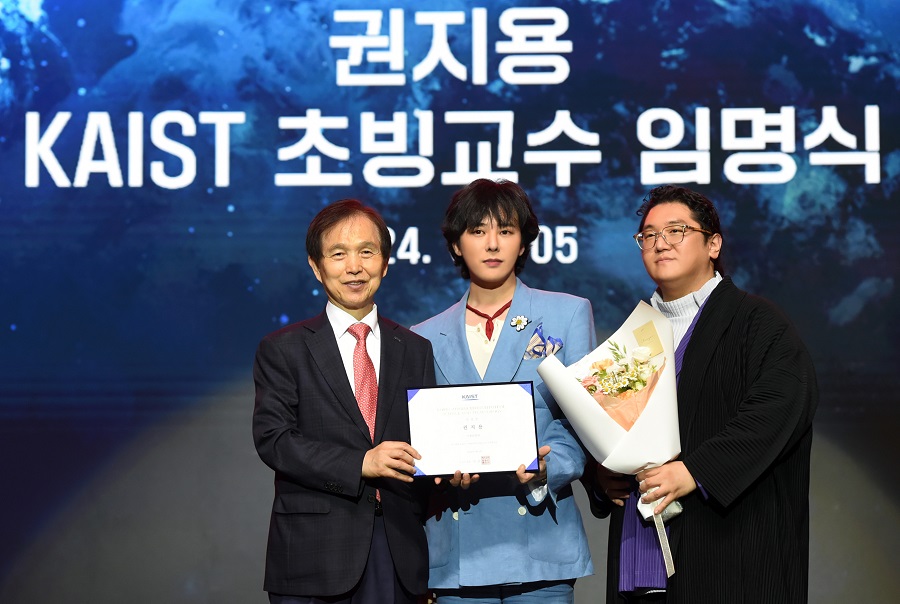 KAIST appoints K-Pop Star “G-Dragon” Kwon Ji-yong as a visiting professor
KAIST (President Kwang Hyung Lee) announced on June 5th that its Department of Mechanical Engineering has appointed Kwon Ji-yong, a K-Pop star better known as G-Dragon, as a visiting professor. The appointment was officiated at the “Innovate Korea 2024” event held at the KAIST Sports Complex in the morning of the 5th.
This appointment was promoted to expand the global competitiveness of Korean culture by applying the latest scientific technology developed from KAIST to K-content and the cultural industry.
An official from Galaxy Corporation, Mr. Kwon’s agency, said, “Through this appointment, we expect to contribute to market innovation and to the global spread and growth of K-culture through research and development of ‘entertech’*.”
* Entertech: A compound word of ‘entertainment’ and ‘technology’ refering to an industry that creates new added value by combining ICT with intellectual property rights (IP) and contents, which are the core values of entertainment.
The newly appointed Visiting Professor Kwon Ji-yong is scheduled to give a special lecture on leadership to undergraduate and graduate students. The purpose is to share his experience and life as a world-class artist to provide KAIST students with vision and insight into the world, as well as the courage and inspiration to pioneer within their own fields of expertise.
In addition, cultural events are planned to be held to help facilitate communication with KAIST members and provide artistic experiences necessary to grow into creative and convergent talents.
Joint research that applies KAIST's various technologies to art and cultural contents will also be pursued. ‘(temporarily named) KAIST-Galaxy Corporation Entertech Research Center’ will be established within the Department of Mechanical Engineering, conducting ▴research on Digital Twin technology for Korean Wave artists, starting with G-Dragon himself ▴convergent research on science and technology encompassing artificial intelligence, robots, and metaverse and K-Culture and ▴research on the development of differentiated avatars of artists using the latest technologies such as volumetrics, motion capture, and haptics.
Galaxy Corporation produces highly talked about televised shows including 'Physical: 100 Season 2', which achieved the feat of ranking first in the Netflix’s ‘Global Top 10 Non-English TV Shows’ category, as well as 'Street Woman Fighter', '2 Days & 1 Night', 'Let's Play Soccer: Mungchyeoya Chanda' and 'Mr. Trot 2', and expanded its IP (intellectual property rights) to all aspects of entertainment, from broadcasting to the music industry by recruiting G-Dragon in December last year.
It is an 'entertech' company that is pioneering a new content market by combining IP with the latest digital technologies such as metaverse, avatar, and artificial intelligence (AI). Based on these achievements, it recently signed a partnership with a global investment bank (IB). Through global investment, the company is soon to be the first entertech startup to become a unicorn (corporate value of 1 trillion won).
Kwon Ji-yong said, “It is an honor to be a visiting professor at KAIST, where countless scientific geniuses come out of. I am hoping the best of science and technology experts and my expertise in the entertainment business will come together and a great synergy, a ‘big bang’ will be ensue as a result.
“More and more musicians are working with artificial intelligence and these cutting-edge technologies enable more diverse forms of creative work,” he continued. He also expressed his specific wish. “Through the AI avatar developed jointly by Galaxy Corporation and KAIST, I wish to communicate more closely with my fans around the world that I cannot meet so often otherwise.”
President Kwang-Hyung Lee said, “Considering that KAIST is a university that has always explored new things and pioneered unknown territories since its establishment, I believe that Kwon Ji-yong also shares KAIST's DNA in that he is a leader and pioneer who has attained world-class achievements in the world of culture and arts.”
President Lee continued expressing his expectations saying, “Kwon Ji-yong will not only contribute to taking KAIST’s science and technology to spread and grow K-culture on the global stage, through his activities but also in sharing his experience and spirit as the trend leader of the world, he will be an asset to the members of KAIST which aims to become a top-tier university.”
The period of Kwon Ji-yong’s professorship is two years from the 4th of this month to June of 2026. In addition, Professor Kwon Ji-yong has been appointed as KAIST’s global ambassador to help strengthen KAIST's international presence.
Professor Kwon Ji-yong, who began his career as G-Dragon, has established himself as an icon symbolizing Korean pop culture over 18 years as a member and the leader of the K-Pop idol group 'Big Bang', which debuted in 2006 and gained global popularity. While being recognized for his outstanding ability in all aspects of his music, from writing lyrics, composing, and producing to performing, he has also been active in fashion, becoming the first Asian man to be selected as a global ambassador for Chanel in 2016, spreading Korean music and fashion to the world.
In June, 2017, he released his 3rd solo album 'Kwon Ji Yong' on USB instead of the existing CD format, for the first time in Korea. He also attended CES, the world's largest home appliance and IT exhibition held in Las Vegas, USA in January of this year, extending his strides as a 'tech-tainer'.
2024.06.05 View 36788
KAIST appoints K-Pop Star “G-Dragon” Kwon Ji-yong as a visiting professor
KAIST (President Kwang Hyung Lee) announced on June 5th that its Department of Mechanical Engineering has appointed Kwon Ji-yong, a K-Pop star better known as G-Dragon, as a visiting professor. The appointment was officiated at the “Innovate Korea 2024” event held at the KAIST Sports Complex in the morning of the 5th.
This appointment was promoted to expand the global competitiveness of Korean culture by applying the latest scientific technology developed from KAIST to K-content and the cultural industry.
An official from Galaxy Corporation, Mr. Kwon’s agency, said, “Through this appointment, we expect to contribute to market innovation and to the global spread and growth of K-culture through research and development of ‘entertech’*.”
* Entertech: A compound word of ‘entertainment’ and ‘technology’ refering to an industry that creates new added value by combining ICT with intellectual property rights (IP) and contents, which are the core values of entertainment.
The newly appointed Visiting Professor Kwon Ji-yong is scheduled to give a special lecture on leadership to undergraduate and graduate students. The purpose is to share his experience and life as a world-class artist to provide KAIST students with vision and insight into the world, as well as the courage and inspiration to pioneer within their own fields of expertise.
In addition, cultural events are planned to be held to help facilitate communication with KAIST members and provide artistic experiences necessary to grow into creative and convergent talents.
Joint research that applies KAIST's various technologies to art and cultural contents will also be pursued. ‘(temporarily named) KAIST-Galaxy Corporation Entertech Research Center’ will be established within the Department of Mechanical Engineering, conducting ▴research on Digital Twin technology for Korean Wave artists, starting with G-Dragon himself ▴convergent research on science and technology encompassing artificial intelligence, robots, and metaverse and K-Culture and ▴research on the development of differentiated avatars of artists using the latest technologies such as volumetrics, motion capture, and haptics.
Galaxy Corporation produces highly talked about televised shows including 'Physical: 100 Season 2', which achieved the feat of ranking first in the Netflix’s ‘Global Top 10 Non-English TV Shows’ category, as well as 'Street Woman Fighter', '2 Days & 1 Night', 'Let's Play Soccer: Mungchyeoya Chanda' and 'Mr. Trot 2', and expanded its IP (intellectual property rights) to all aspects of entertainment, from broadcasting to the music industry by recruiting G-Dragon in December last year.
It is an 'entertech' company that is pioneering a new content market by combining IP with the latest digital technologies such as metaverse, avatar, and artificial intelligence (AI). Based on these achievements, it recently signed a partnership with a global investment bank (IB). Through global investment, the company is soon to be the first entertech startup to become a unicorn (corporate value of 1 trillion won).
Kwon Ji-yong said, “It is an honor to be a visiting professor at KAIST, where countless scientific geniuses come out of. I am hoping the best of science and technology experts and my expertise in the entertainment business will come together and a great synergy, a ‘big bang’ will be ensue as a result.
“More and more musicians are working with artificial intelligence and these cutting-edge technologies enable more diverse forms of creative work,” he continued. He also expressed his specific wish. “Through the AI avatar developed jointly by Galaxy Corporation and KAIST, I wish to communicate more closely with my fans around the world that I cannot meet so often otherwise.”
President Kwang-Hyung Lee said, “Considering that KAIST is a university that has always explored new things and pioneered unknown territories since its establishment, I believe that Kwon Ji-yong also shares KAIST's DNA in that he is a leader and pioneer who has attained world-class achievements in the world of culture and arts.”
President Lee continued expressing his expectations saying, “Kwon Ji-yong will not only contribute to taking KAIST’s science and technology to spread and grow K-culture on the global stage, through his activities but also in sharing his experience and spirit as the trend leader of the world, he will be an asset to the members of KAIST which aims to become a top-tier university.”
The period of Kwon Ji-yong’s professorship is two years from the 4th of this month to June of 2026. In addition, Professor Kwon Ji-yong has been appointed as KAIST’s global ambassador to help strengthen KAIST's international presence.
Professor Kwon Ji-yong, who began his career as G-Dragon, has established himself as an icon symbolizing Korean pop culture over 18 years as a member and the leader of the K-Pop idol group 'Big Bang', which debuted in 2006 and gained global popularity. While being recognized for his outstanding ability in all aspects of his music, from writing lyrics, composing, and producing to performing, he has also been active in fashion, becoming the first Asian man to be selected as a global ambassador for Chanel in 2016, spreading Korean music and fashion to the world.
In June, 2017, he released his 3rd solo album 'Kwon Ji Yong' on USB instead of the existing CD format, for the first time in Korea. He also attended CES, the world's largest home appliance and IT exhibition held in Las Vegas, USA in January of this year, extending his strides as a 'tech-tainer'.
2024.06.05 View 36788 -
 KAIST Develops Sodium Battery Capable of Rapid Charging in Just a Few Seconds
Sodium (Na), which is over 500 times more abundant than lithium (Li), has recently garnered significant attention for its potential in sodium-ion battery technologies. However, existing sodium-ion batteries face fundamental limitations, including lower power output, constrained storage properties, and longer charging times, necessitating the development of next-generation energy storage materials.
On the 11th of April, KAIST (represented by President Kwang Hyung Lee) announced that a research team led by Professor Jeung Ku Kang from the Department of Materials Science and Engineering had developed a high-energy, high-power hybrid sodium-ion battery capable of rapid charging.
The innovative hybrid energy storage system integrates anode materials typically used in batteries with cathodes suitable for supercapacitors. This combination allows the device to achieve both high storage capacities and rapid charge-discharge rates, positioning it as a viable next-generation alternative to lithium-ion batteries.
However, the development of a hybrid battery with high energy and high power density requires an improvement to the slow energy storage rate of battery-type anodes as well as the enhancement of the relatively low capacity of supercapacitor-type cathode materials.
< Figure 1. Schematic synthetic procedures of high-capacity/high-rate anode and cathode materials for a sodium-ion hybrid energy storages (SIHES) and their proposed energy storage mechanisms. Synthetic procedures for (a) ultrafine iron sulfide-embedded S-doped carbon/graphene (FS/C/G) anode and (b) zeolitic imidazolate framework-derived porous carbon (ZDPC) cathode materials. (c) Proposed energy storage mechanisms of Na+ ions in FS/C/G anode and ClO-4 ions in ZDPC cathode for an SIHES. >
To account for this, Professor Kang's team utilized two distinct metal-organic frameworks for the optimized synthesis of hybrid batteries. This approach led to the development of an anode material with improved kinetics through the inclusion of fine active materials in porous carbon derived from metal-organic frameworks. Additionally, a high-capacity cathode material was synthesized, and the combination of the cathode and anode materials allowed for the development of a sodium-ion storage system optimizing the balance and minimizing the disparities in energy storage rates between the electrodes.
The assembled full cell, comprising the newly developed anode and cathode, forms a high-performance hybrid sodium-ion energy storage device. This device surpasses the energy density of commercial lithium-ion batteries and exhibits the characteristics of supercapacitors' power density. It is expected to be suitable for rapid charging applications ranging from electric vehicles to smart electronic devices and aerospace technologies.
< Figure 2. Electrochemical characterizations of FS/C/G-20//ZDPC SIHES full cells (left). Ragone plots for FS/C/G-20//ZDPC (this work) and other previously reported sodium-ion electrochemical energy storage devices (right). >
Professor Kang noted that the hybrid sodium-ion energy storage device, capable of rapid charging and achieving an energy density of 247 Wh/kg and a power density of 34,748 W/kg, represents a breakthrough in overcoming the current limitations of energy storage systems. He anticipates broader applications across various electronic devices, including electric vehicles.
This research, co-authored by KAIST doctoral candidates Jong Hui Choi and Dong Won Kim, was published in the international journal Energy Storage Materials on March 29 with the title "Low-crystallinity conductive multivalence iron sulfide-embedded S-doped anode and high-surface-area O-doped cathode of 3D porous N-rich graphitic carbon frameworks for high-performance sodium-ion hybrid energy storages."
The study was conducted with support from the Ministry of Science and ICT and the National Research Foundation of Korea through the Nanomaterial Technology Development Project.
2024.04.18 View 31081
KAIST Develops Sodium Battery Capable of Rapid Charging in Just a Few Seconds
Sodium (Na), which is over 500 times more abundant than lithium (Li), has recently garnered significant attention for its potential in sodium-ion battery technologies. However, existing sodium-ion batteries face fundamental limitations, including lower power output, constrained storage properties, and longer charging times, necessitating the development of next-generation energy storage materials.
On the 11th of April, KAIST (represented by President Kwang Hyung Lee) announced that a research team led by Professor Jeung Ku Kang from the Department of Materials Science and Engineering had developed a high-energy, high-power hybrid sodium-ion battery capable of rapid charging.
The innovative hybrid energy storage system integrates anode materials typically used in batteries with cathodes suitable for supercapacitors. This combination allows the device to achieve both high storage capacities and rapid charge-discharge rates, positioning it as a viable next-generation alternative to lithium-ion batteries.
However, the development of a hybrid battery with high energy and high power density requires an improvement to the slow energy storage rate of battery-type anodes as well as the enhancement of the relatively low capacity of supercapacitor-type cathode materials.
< Figure 1. Schematic synthetic procedures of high-capacity/high-rate anode and cathode materials for a sodium-ion hybrid energy storages (SIHES) and their proposed energy storage mechanisms. Synthetic procedures for (a) ultrafine iron sulfide-embedded S-doped carbon/graphene (FS/C/G) anode and (b) zeolitic imidazolate framework-derived porous carbon (ZDPC) cathode materials. (c) Proposed energy storage mechanisms of Na+ ions in FS/C/G anode and ClO-4 ions in ZDPC cathode for an SIHES. >
To account for this, Professor Kang's team utilized two distinct metal-organic frameworks for the optimized synthesis of hybrid batteries. This approach led to the development of an anode material with improved kinetics through the inclusion of fine active materials in porous carbon derived from metal-organic frameworks. Additionally, a high-capacity cathode material was synthesized, and the combination of the cathode and anode materials allowed for the development of a sodium-ion storage system optimizing the balance and minimizing the disparities in energy storage rates between the electrodes.
The assembled full cell, comprising the newly developed anode and cathode, forms a high-performance hybrid sodium-ion energy storage device. This device surpasses the energy density of commercial lithium-ion batteries and exhibits the characteristics of supercapacitors' power density. It is expected to be suitable for rapid charging applications ranging from electric vehicles to smart electronic devices and aerospace technologies.
< Figure 2. Electrochemical characterizations of FS/C/G-20//ZDPC SIHES full cells (left). Ragone plots for FS/C/G-20//ZDPC (this work) and other previously reported sodium-ion electrochemical energy storage devices (right). >
Professor Kang noted that the hybrid sodium-ion energy storage device, capable of rapid charging and achieving an energy density of 247 Wh/kg and a power density of 34,748 W/kg, represents a breakthrough in overcoming the current limitations of energy storage systems. He anticipates broader applications across various electronic devices, including electric vehicles.
This research, co-authored by KAIST doctoral candidates Jong Hui Choi and Dong Won Kim, was published in the international journal Energy Storage Materials on March 29 with the title "Low-crystallinity conductive multivalence iron sulfide-embedded S-doped anode and high-surface-area O-doped cathode of 3D porous N-rich graphitic carbon frameworks for high-performance sodium-ion hybrid energy storages."
The study was conducted with support from the Ministry of Science and ICT and the National Research Foundation of Korea through the Nanomaterial Technology Development Project.
2024.04.18 View 31081