%41%65%72%6f%73%70%61%63%65
-
 KAIST Opens the Era of “Space Sensors” with Optical Functions Reconfigurable by Electrical Signals Alone
Until now, satellites and space payloads have required new optical filters and sensors to be designed whenever their missions changed. A future is now on the horizon in which a single ultra-compact optical chip can perform a variety of roles—including those of a thermal imaging sensor, spectrometer, and infrared camera—using electrical signals alone.
KAIST (President Choongsik Bae) announced on 14th of July that a research team led by Professor Hyun Jung Kim from the Department of Aerospace Engineering, in collaboration with a research team led by Professor Juejun Hu at the Massachusetts Institute of Technology (MIT), has demonstrated the first transmissive mid-infrared amplitude-only spatial light modulator based on a scalable two-dimensional, electrically addressable metasurface architecture.
The key achievement of this research is that a single optical chip can perform a variety of sensor functions using electrical signals alone. Previously, new optical filters and sensors had to be fabricated for each new mission. In the future, the technology is expected to enable the realization of “software-defined sensors,” whose functions can be changed without replacing the hardware.
The device developed by the research team is a transmissive mid-infrared spatial light modulator, or SLM, based on a metasurface. A metasurface is an ultrathin optical structure that uses microscopic patterns much smaller than the width of a human hair to freely control the intensity, direction, and wavelength of light.
A spatial light modulator controls the spatial distribution of light on a pixel-by-pixel basis. In the present device, each pixel switches the intensity of transmitted mid-infrared light between two programmed states. The research team succeeded, for the first time in the world, in electrically and independently controlling each individual pixel.
Conventional spatial light modulators face significant limitations in the mid-infrared. Liquid-crystal-based devices suffer from material absorption and relatively slow response, while digital micromirror devices operate in reflection. Transmissive mid-infrared SLMs have therefore remained largely unexplored. This has limited their application to satellite sensors, ultra-compact spectrometers—which analyze light according to wavelength—and adaptive optical systems, which automatically adjust their optical performance in response to changes in the surrounding environment.
To address these limitations, the researchers used GSST—Ge₂Sb₂Se₄Te, or germanium-antimony-selenium-tellurium—an optical phase-change material (PCM) whose light transmittance changes when it receives an electrical signal.
Once GSST receives an electrical signal, it retains its state and continues to maintain the same optical performance even after the power is turned off. This nonvolatile characteristic eliminates the need for a continuous power supply, making the material suitable for satellites and space payloads, where the available electrical power is limited.
As the number of pixels on an optical chip increases, electrical current can flow into pixels other than the selected pixel, causing unintended pixels to operate as well. This is known as the “sneak-path” problem.
The research team solved this problem by integrating a silicon PIN diode into each pixel. A PIN diode is a semiconductor device that allows electrical current to flow only to the intended pixel. This enabled the researchers to accurately select and control only the desired pixels.
Using this approach, the team independently controlled all the pixels in a 6 × 6 pixel array and successfully produced desired optical patterns. The device also maintained stable performance after more than 16,700 switching cycles, demonstrating approximately 13 times greater endurance than previous technology.
The device was fabricated using silicon photonics, a technology that produces optical devices through standard semiconductor manufacturing processes. This makes it relatively easy to scale the technology to larger optical chips containing hundreds, thousands, or even more pixels.
The current device controls only the amount of transmitted light. In the future, however, more sophisticated metasurface designs are expected to enable the technology to develop into “universal reconfigurable optics,” capable of freely controlling the direction and polarization of light as well.
The greatest significance of this research is that it presents a new concept in which “optics, too, can be changed like software.” In other words, the study provides a foundation for programmable optical hardware that could support different sensing functions through reconfiguration rather than hardware replacement. In the future, this is expected to usher in an era of software-defined sensors, in which a single optical chip can perform different functions depending on the situation, serving as a thermal imaging sensor, spectrometer, infrared camera, or optical communication device.
Once commercialized, the technology is expected to make it possible to implement a wide range of optical systems on a single platform. Potential applications include satellites and space payloads, launch-vehicle health diagnostics, thermal monitoring of space stations, measurement of in-space manufacturing processes, infrared imaging, and optical communications.
This research is an achievement that further advances MIT–NASA collaborative research initiated in 2018, when Professor Hyun Jung Kim was working as a researcher at the National Aeronautics and Space Administration (NASA), and subsequently continued at KAIST.
Building on this foundation, KAIST’s STAR Lab and Professor Juejun Hu’s research team at MIT are currently conducting joint research on active meta-optics, silicon photonics, and space sensor systems, with the goal of applying the technology in actual space environments.
The two teams have established a full-cycle international collaborative research framework encompassing material development, chip design and fabrication, sensor-system integration, space-environment verification, and future flight demonstrations.
Professor Kim’s research team is now developing the technology into an operational space sensor. Under the Ministry of Science and ICT’s Young Researcher Program, the team is developing an ultra-precise system for measuring the surface temperature of launch vehicles.
The research is also being expanded through the “Space Services and Manufacturing Research Center” under the Innovation Research Center Program. The team is conducting research to develop the technology into a common optical platform that can be used for space-station thermal monitoring, anomaly diagnosis, measurement of in-space manufacturing processes, and optical communications.
“This research is not simply about creating one more new optical device,” said Professor Kim. “It presents the foundation for an era of software-defined sensors, in which a single optical chip performs a variety of functions depending on the mission.”
“By combining MIT’s nanophotonics technology—which uses nanostructures to control light—with KAIST’s space sensor technology, we plan to develop this technology into an actual space system,” she added. The research was published online in the international journal Nature Communications on July 7.
Paper title: “Two-Dimensional Pixel-Level Addressable Mid-Infrared Metasurface Spatial Light Modulator”
DOI: 10.1038/s41467-026-75346-5
This work was funded by the Air Force SBIR Program under contract FA2394-23-C-5076, the National Science Foundation under awards 2329088 and 2132929, and National Research Foundation of Korea (NRF) grant funded by the Korea government (MSIT) (RS-2025-00515651 and RS-2025-02213804).
2026.07.14 View 3387
KAIST Opens the Era of “Space Sensors” with Optical Functions Reconfigurable by Electrical Signals Alone
Until now, satellites and space payloads have required new optical filters and sensors to be designed whenever their missions changed. A future is now on the horizon in which a single ultra-compact optical chip can perform a variety of roles—including those of a thermal imaging sensor, spectrometer, and infrared camera—using electrical signals alone.
KAIST (President Choongsik Bae) announced on 14th of July that a research team led by Professor Hyun Jung Kim from the Department of Aerospace Engineering, in collaboration with a research team led by Professor Juejun Hu at the Massachusetts Institute of Technology (MIT), has demonstrated the first transmissive mid-infrared amplitude-only spatial light modulator based on a scalable two-dimensional, electrically addressable metasurface architecture.
The key achievement of this research is that a single optical chip can perform a variety of sensor functions using electrical signals alone. Previously, new optical filters and sensors had to be fabricated for each new mission. In the future, the technology is expected to enable the realization of “software-defined sensors,” whose functions can be changed without replacing the hardware.
The device developed by the research team is a transmissive mid-infrared spatial light modulator, or SLM, based on a metasurface. A metasurface is an ultrathin optical structure that uses microscopic patterns much smaller than the width of a human hair to freely control the intensity, direction, and wavelength of light.
A spatial light modulator controls the spatial distribution of light on a pixel-by-pixel basis. In the present device, each pixel switches the intensity of transmitted mid-infrared light between two programmed states. The research team succeeded, for the first time in the world, in electrically and independently controlling each individual pixel.
Conventional spatial light modulators face significant limitations in the mid-infrared. Liquid-crystal-based devices suffer from material absorption and relatively slow response, while digital micromirror devices operate in reflection. Transmissive mid-infrared SLMs have therefore remained largely unexplored. This has limited their application to satellite sensors, ultra-compact spectrometers—which analyze light according to wavelength—and adaptive optical systems, which automatically adjust their optical performance in response to changes in the surrounding environment.
To address these limitations, the researchers used GSST—Ge₂Sb₂Se₄Te, or germanium-antimony-selenium-tellurium—an optical phase-change material (PCM) whose light transmittance changes when it receives an electrical signal.
Once GSST receives an electrical signal, it retains its state and continues to maintain the same optical performance even after the power is turned off. This nonvolatile characteristic eliminates the need for a continuous power supply, making the material suitable for satellites and space payloads, where the available electrical power is limited.
As the number of pixels on an optical chip increases, electrical current can flow into pixels other than the selected pixel, causing unintended pixels to operate as well. This is known as the “sneak-path” problem.
The research team solved this problem by integrating a silicon PIN diode into each pixel. A PIN diode is a semiconductor device that allows electrical current to flow only to the intended pixel. This enabled the researchers to accurately select and control only the desired pixels.
Using this approach, the team independently controlled all the pixels in a 6 × 6 pixel array and successfully produced desired optical patterns. The device also maintained stable performance after more than 16,700 switching cycles, demonstrating approximately 13 times greater endurance than previous technology.
The device was fabricated using silicon photonics, a technology that produces optical devices through standard semiconductor manufacturing processes. This makes it relatively easy to scale the technology to larger optical chips containing hundreds, thousands, or even more pixels.
The current device controls only the amount of transmitted light. In the future, however, more sophisticated metasurface designs are expected to enable the technology to develop into “universal reconfigurable optics,” capable of freely controlling the direction and polarization of light as well.
The greatest significance of this research is that it presents a new concept in which “optics, too, can be changed like software.” In other words, the study provides a foundation for programmable optical hardware that could support different sensing functions through reconfiguration rather than hardware replacement. In the future, this is expected to usher in an era of software-defined sensors, in which a single optical chip can perform different functions depending on the situation, serving as a thermal imaging sensor, spectrometer, infrared camera, or optical communication device.
Once commercialized, the technology is expected to make it possible to implement a wide range of optical systems on a single platform. Potential applications include satellites and space payloads, launch-vehicle health diagnostics, thermal monitoring of space stations, measurement of in-space manufacturing processes, infrared imaging, and optical communications.
This research is an achievement that further advances MIT–NASA collaborative research initiated in 2018, when Professor Hyun Jung Kim was working as a researcher at the National Aeronautics and Space Administration (NASA), and subsequently continued at KAIST.
Building on this foundation, KAIST’s STAR Lab and Professor Juejun Hu’s research team at MIT are currently conducting joint research on active meta-optics, silicon photonics, and space sensor systems, with the goal of applying the technology in actual space environments.
The two teams have established a full-cycle international collaborative research framework encompassing material development, chip design and fabrication, sensor-system integration, space-environment verification, and future flight demonstrations.
Professor Kim’s research team is now developing the technology into an operational space sensor. Under the Ministry of Science and ICT’s Young Researcher Program, the team is developing an ultra-precise system for measuring the surface temperature of launch vehicles.
The research is also being expanded through the “Space Services and Manufacturing Research Center” under the Innovation Research Center Program. The team is conducting research to develop the technology into a common optical platform that can be used for space-station thermal monitoring, anomaly diagnosis, measurement of in-space manufacturing processes, and optical communications.
“This research is not simply about creating one more new optical device,” said Professor Kim. “It presents the foundation for an era of software-defined sensors, in which a single optical chip performs a variety of functions depending on the mission.”
“By combining MIT’s nanophotonics technology—which uses nanostructures to control light—with KAIST’s space sensor technology, we plan to develop this technology into an actual space system,” she added. The research was published online in the international journal Nature Communications on July 7.
Paper title: “Two-Dimensional Pixel-Level Addressable Mid-Infrared Metasurface Spatial Light Modulator”
DOI: 10.1038/s41467-026-75346-5
This work was funded by the Air Force SBIR Program under contract FA2394-23-C-5076, the National Science Foundation under awards 2329088 and 2132929, and National Research Foundation of Korea (NRF) grant funded by the Korea government (MSIT) (RS-2025-00515651 and RS-2025-02213804).
2026.07.14 View 3387 -
 Robot-Operated Space Station Construction Goal... 'In-space Servicing and Manufacturing Research Center' Launched
<Plaque Handover Ceremony. (From left) Jae-Hung Han, Director of the Space Research Institute, Ju-won Kang, Head of Engineering Group at the National Research Foundation of Korea Basic Research Headquarters>
KAIST's Space Research Institute announced on the 24th of October that it officially launched the 'Innovative Research Center for the Development of Core Technologies in In-space Servicing and Manufacturing (ISMRC)' at the KAIST Academic Cultural Center on Friday, October 24. About 150 officials from major organizations, including the Korea Aerospace Administration, the National Research Foundation of Korea, and Daejeon Metropolitan City, as well as domestic and foreign space experts, attended the opening ceremony to discuss future cooperation measures. The 'KAIST In-space Servicing and Manufacturing Research Center (ISMRC)' is a large-scale research hub selected for the Ministry of Science and ICT's 2025 Basic Research Project, with a total of 71.2 billion KRW long-term project planned over the next 10 years, including 50 billion KRW in national funding. Daejeon City will also provide a total of 3.6 billion KRW, with 400 million KRW annually starting from 2026. The research goals are to secure core technologies for next-generation space exploration, including: ▲ Construction of Unmanned Space Stations, ▲ Robotics-based In-space Manufacturing, and ▲ Resource Recovery Technology. A team of 14 KAIST professors, led by Director Jae-Hung Han, will spearhead the research, with major domestic and foreign space companies and research institutions participating in joint research. As the 'New Space' era fully commences globally, the In-space Servicing and Manufacturing industry is projected to grow to tens of trillions of Korean won by 2030, driven by the reduction of launch costs and the expansion of private sector participation. This field is evaluated as a core area that will fundamentally change the way humanity engages in space activities, including extending satellite lifespan, on-orbit maintenance and operation, and securing and manufacturing resources in space. Meanwhile, an international symposium was held for two days on October 23-24 at the KAIST Academic Cultural Center and KI Building, coinciding with the opening ceremony.
<Director Jae-Hung Han of the Space Research Institute presenting>
The symposium was composed of a total of six sessions, including: ▲ Exchange Meeting on Additive Manufacturing Tecnology for Aerospace, ▲ International Workshop on Aerospace Composites, ▲ Workshop on Swarm Satellite Development, and ▲ Workshop on In-space Servicing and Manufacturing Robotics. Major domestic and foreign institutions and experts, including the Korea Aerospace Research Institute, Japan Advanced Institute of Science and Technology, and California Institute of Technology (Caltech), attended to discuss the future direction of next-generation space technology development and international cooperation measures. Cheol-woong Son, Director-General of Future Strategy Industry Office at Daejeon City, said, "We will develop the Innovative Research Center into a Daejeon-type space industry innovation platform with KAIST," and "Daejeon City will concentrate its capabilities to help local businesses grow and establish Daejeon as the central city for the Republic of Korea's space industry." Jae-Hung Han, Director of the KAIST Space Research Institute, said, "We will lead the core technologies for in-space servicing and manufacturing through cooperation between industry, academia, research institutes, and government, and contribute to the establishment of a private sector-focused industrial ecosystem," adding, "KAIST will grow into a comprehensive research hub that encompasses R&D, talent nurturing, and technology commercialization."
<Group Photo of Participants at the Opening Ceremony of the In-space Servicing and Manufacturing Research Center>
Kwang Hyung Lee, President of KAIST, said, "The field of in-space servicing and manufacturing is a core area that will change the paradigm of the future space industry," and "KAIST will lead the Republic of Korea to become the center for opening a new era of the space industry through innovative technology development and global cooperation." KAIST plans to perform the role of breaking down the boundaries between academia and industry, focusing on these technologies, and laying the foundation for next-generation space activities.
2025.10.24 View 8162
Robot-Operated Space Station Construction Goal... 'In-space Servicing and Manufacturing Research Center' Launched
<Plaque Handover Ceremony. (From left) Jae-Hung Han, Director of the Space Research Institute, Ju-won Kang, Head of Engineering Group at the National Research Foundation of Korea Basic Research Headquarters>
KAIST's Space Research Institute announced on the 24th of October that it officially launched the 'Innovative Research Center for the Development of Core Technologies in In-space Servicing and Manufacturing (ISMRC)' at the KAIST Academic Cultural Center on Friday, October 24. About 150 officials from major organizations, including the Korea Aerospace Administration, the National Research Foundation of Korea, and Daejeon Metropolitan City, as well as domestic and foreign space experts, attended the opening ceremony to discuss future cooperation measures. The 'KAIST In-space Servicing and Manufacturing Research Center (ISMRC)' is a large-scale research hub selected for the Ministry of Science and ICT's 2025 Basic Research Project, with a total of 71.2 billion KRW long-term project planned over the next 10 years, including 50 billion KRW in national funding. Daejeon City will also provide a total of 3.6 billion KRW, with 400 million KRW annually starting from 2026. The research goals are to secure core technologies for next-generation space exploration, including: ▲ Construction of Unmanned Space Stations, ▲ Robotics-based In-space Manufacturing, and ▲ Resource Recovery Technology. A team of 14 KAIST professors, led by Director Jae-Hung Han, will spearhead the research, with major domestic and foreign space companies and research institutions participating in joint research. As the 'New Space' era fully commences globally, the In-space Servicing and Manufacturing industry is projected to grow to tens of trillions of Korean won by 2030, driven by the reduction of launch costs and the expansion of private sector participation. This field is evaluated as a core area that will fundamentally change the way humanity engages in space activities, including extending satellite lifespan, on-orbit maintenance and operation, and securing and manufacturing resources in space. Meanwhile, an international symposium was held for two days on October 23-24 at the KAIST Academic Cultural Center and KI Building, coinciding with the opening ceremony.
<Director Jae-Hung Han of the Space Research Institute presenting>
The symposium was composed of a total of six sessions, including: ▲ Exchange Meeting on Additive Manufacturing Tecnology for Aerospace, ▲ International Workshop on Aerospace Composites, ▲ Workshop on Swarm Satellite Development, and ▲ Workshop on In-space Servicing and Manufacturing Robotics. Major domestic and foreign institutions and experts, including the Korea Aerospace Research Institute, Japan Advanced Institute of Science and Technology, and California Institute of Technology (Caltech), attended to discuss the future direction of next-generation space technology development and international cooperation measures. Cheol-woong Son, Director-General of Future Strategy Industry Office at Daejeon City, said, "We will develop the Innovative Research Center into a Daejeon-type space industry innovation platform with KAIST," and "Daejeon City will concentrate its capabilities to help local businesses grow and establish Daejeon as the central city for the Republic of Korea's space industry." Jae-Hung Han, Director of the KAIST Space Research Institute, said, "We will lead the core technologies for in-space servicing and manufacturing through cooperation between industry, academia, research institutes, and government, and contribute to the establishment of a private sector-focused industrial ecosystem," adding, "KAIST will grow into a comprehensive research hub that encompasses R&D, talent nurturing, and technology commercialization."
<Group Photo of Participants at the Opening Ceremony of the In-space Servicing and Manufacturing Research Center>
Kwang Hyung Lee, President of KAIST, said, "The field of in-space servicing and manufacturing is a core area that will change the paradigm of the future space industry," and "KAIST will lead the Republic of Korea to become the center for opening a new era of the space industry through innovative technology development and global cooperation." KAIST plans to perform the role of breaking down the boundaries between academia and industry, focusing on these technologies, and laying the foundation for next-generation space activities.
2025.10.24 View 8162 -
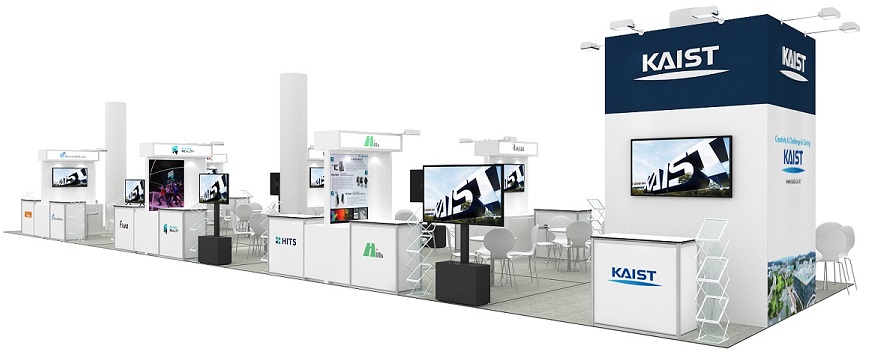 KAIST to showcase a pack of KAIST Start-ups at CES 2023
- KAIST is to run an Exclusive Booth at the Venetian Expo (Hall G) in Eureka Park, at CES 2023, to be held in Las Vegas from Thursday, January 5th through Sunday, the 8th.
- Twelve businesses recently put together by KAIST faculty, alumni, and the start-ups given legal usage of KAIST technologies will be showcased.
- Out of the participating start-ups, the products by Fluiz and Hills Robotics were selected as the “CES Innovation Award 2023 Honoree”, scoring top in their respective categories.
On January 3, KAIST announced that there will be a KAIST booth at Consumer Electronics Show (CES) 2023, the most influential tech event in the world, to be held in Las Vegas from January 3 to 8.
At this exclusive corner, KAIST will introduce the technologies of KAIST start-ups over the exhibition period.
KAIST first started holding its exclusive booth in CES 2019 with five start-up businesses, following up at CES 2020 with 12 start-ups and at CES 2022 with 10 start-ups. At CES 2023, which would be KAIST’s fourth conference, KAIST will be accompanying 12 businesses including start-ups by the faculty members, alumni, and technology transfer companies that just began their businesses with technologies from their research findings that stands a head above others.
To maximize the publicity opportunity, KAIST will support each company’s marketing strategies through cooperation with the Korea International Trade Association (KITA), and provide an opportunity for the school and each startup to create global identity and exhibit the excellence of their technologies at the convention.
The following companies will be at the KAIST Booth in Eureka Park:
The twelve startups mentioned above aim to achieve global technology commecialization in their respective fields of expertise spanning from eXtended Reality (XR) and gaming, to AI and robotics, vehicle and transport, mobile platform, smart city, autonomous driving, healthcare, internet of thing (IoT), through joint research and development, technology transfer and investment attraction from world’s leading institutions and enterprises.
In particular, Fluiz and Hills Robotics won the CES Innovation Award as 2023 Honorees and is expected to attain greater achievements in the future.
A staff member from the KAIST Institute of Technology Value Creation said, “The KAIST Showcase for CES 2023 has prepared a new pitching space for each of the companies for their own IR efforts, and we hope that KAIST startups will actively and effectively market their products and technologies while they are at the convention. We hope it will help them utilize their time here to establish their name in presence here which will eventually serve as a good foothold for them and their predecessors to further global commercialization goals.”
2023.01.04 View 39851
KAIST to showcase a pack of KAIST Start-ups at CES 2023
- KAIST is to run an Exclusive Booth at the Venetian Expo (Hall G) in Eureka Park, at CES 2023, to be held in Las Vegas from Thursday, January 5th through Sunday, the 8th.
- Twelve businesses recently put together by KAIST faculty, alumni, and the start-ups given legal usage of KAIST technologies will be showcased.
- Out of the participating start-ups, the products by Fluiz and Hills Robotics were selected as the “CES Innovation Award 2023 Honoree”, scoring top in their respective categories.
On January 3, KAIST announced that there will be a KAIST booth at Consumer Electronics Show (CES) 2023, the most influential tech event in the world, to be held in Las Vegas from January 3 to 8.
At this exclusive corner, KAIST will introduce the technologies of KAIST start-ups over the exhibition period.
KAIST first started holding its exclusive booth in CES 2019 with five start-up businesses, following up at CES 2020 with 12 start-ups and at CES 2022 with 10 start-ups. At CES 2023, which would be KAIST’s fourth conference, KAIST will be accompanying 12 businesses including start-ups by the faculty members, alumni, and technology transfer companies that just began their businesses with technologies from their research findings that stands a head above others.
To maximize the publicity opportunity, KAIST will support each company’s marketing strategies through cooperation with the Korea International Trade Association (KITA), and provide an opportunity for the school and each startup to create global identity and exhibit the excellence of their technologies at the convention.
The following companies will be at the KAIST Booth in Eureka Park:
The twelve startups mentioned above aim to achieve global technology commecialization in their respective fields of expertise spanning from eXtended Reality (XR) and gaming, to AI and robotics, vehicle and transport, mobile platform, smart city, autonomous driving, healthcare, internet of thing (IoT), through joint research and development, technology transfer and investment attraction from world’s leading institutions and enterprises.
In particular, Fluiz and Hills Robotics won the CES Innovation Award as 2023 Honorees and is expected to attain greater achievements in the future.
A staff member from the KAIST Institute of Technology Value Creation said, “The KAIST Showcase for CES 2023 has prepared a new pitching space for each of the companies for their own IR efforts, and we hope that KAIST startups will actively and effectively market their products and technologies while they are at the convention. We hope it will help them utilize their time here to establish their name in presence here which will eventually serve as a good foothold for them and their predecessors to further global commercialization goals.”
2023.01.04 View 39851 -
 Dr. Dong-Hyun Cho at KARI Receives the 16th Jeong Hun Cho Award
Dr. Dong-Hyun Cho, a senior researcher at the Korea Aerospace Research Institute (KARI), was honored as the recipient of the 16th Jeong Hun Cho Award. The award recognizes young scientists in the field of aerospace engineering.
Dr. Cho earned his MS and PhD degrees from the KAIST Department of Aerospace Engineering in 2012, and served as a researcher at the Satellite Technology Research Center (SaTReC) at KAIST, before joining the Future Convergence Research Division at KARI. He won this year’s award and received 25 million KRW in prize money.
Jeong Hun Cho, who was a PhD candidate in the Department of Aerospace Engineering at KAIST, passed away in a tragic lab accident in May 2003 and was awarded an honorary doctorate posthumously. His family endowed the award and scholarship in his memory. Since 2005, the scholarship has selected three young scholars every year who specialize in aerospace engineering from Cho’s alma maters of KAIST, Korea University, and Kongju National University High School.
Dr. Dong-Hyun Cho was selected as this year’s awardee in recognition of his studies on the development and operation of KARISMA, a comprehensive software package for space debris collision risk management. Dr. Cho built a terrestrial testbed and produced a model for the development of a space debris elimination algorithm. He published six papers in SCI-level journals and wrote 35 symposium papers in the field of space development. He also applied or registered approximately 40 patents both in Korea and internationally.
The Award Committee also selected three students as scholarship recipients: PhD candidate Yongtae Yun from the Department of Aerospace Engineering at KAIST received 4 million KRW, MS-PhD candidate Haun-Min Lee from the School of Mechanical Engineering at Korea University received 4 million KRW, and Seonju Yim from Kongju National University High School received 3 million KRW.
(END)
2020.05.13 View 21202
Dr. Dong-Hyun Cho at KARI Receives the 16th Jeong Hun Cho Award
Dr. Dong-Hyun Cho, a senior researcher at the Korea Aerospace Research Institute (KARI), was honored as the recipient of the 16th Jeong Hun Cho Award. The award recognizes young scientists in the field of aerospace engineering.
Dr. Cho earned his MS and PhD degrees from the KAIST Department of Aerospace Engineering in 2012, and served as a researcher at the Satellite Technology Research Center (SaTReC) at KAIST, before joining the Future Convergence Research Division at KARI. He won this year’s award and received 25 million KRW in prize money.
Jeong Hun Cho, who was a PhD candidate in the Department of Aerospace Engineering at KAIST, passed away in a tragic lab accident in May 2003 and was awarded an honorary doctorate posthumously. His family endowed the award and scholarship in his memory. Since 2005, the scholarship has selected three young scholars every year who specialize in aerospace engineering from Cho’s alma maters of KAIST, Korea University, and Kongju National University High School.
Dr. Dong-Hyun Cho was selected as this year’s awardee in recognition of his studies on the development and operation of KARISMA, a comprehensive software package for space debris collision risk management. Dr. Cho built a terrestrial testbed and produced a model for the development of a space debris elimination algorithm. He published six papers in SCI-level journals and wrote 35 symposium papers in the field of space development. He also applied or registered approximately 40 patents both in Korea and internationally.
The Award Committee also selected three students as scholarship recipients: PhD candidate Yongtae Yun from the Department of Aerospace Engineering at KAIST received 4 million KRW, MS-PhD candidate Haun-Min Lee from the School of Mechanical Engineering at Korea University received 4 million KRW, and Seonju Yim from Kongju National University High School received 3 million KRW.
(END)
2020.05.13 View 21202 -
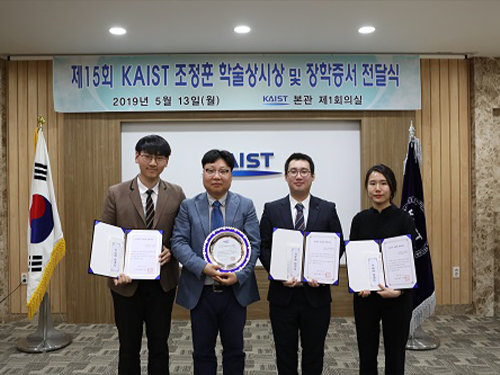 Professor Park at UPC-Barcelona Tech Receives Jeong Hun Cho Award
Professor Hyuk Park was honored to be the recipient of the Jeong Hun Cho Award which was presented at the Universitat Politècnica de Catalunya Barcelona Tech. The award recognizes young scientists in the field of aerospace engineering.
Professor Park, a graduate of KAIST’s Department of Mechanical Engineering in 2001, earned his MS and PhD at the Gwangju Institute of Science and Technology, and works at the Castelldefels School of Telecommunications and Aerospace Engineering at UPC-Barcelona Tech. He won this year’s award, which honors former PhD candidate Jeong Hun Cho at the Aerospace Engineering Department who died in a lab accident in 2003. Professor Park also received 25 million KRW prize money. Cho’s family endowed the award and scholarship in his memory. Since 2005, the scholarship has selected three young scholars every year who specialize in aerospace engineering from Cho’s alma maters of KAIST, Korea University, and Kongju National University High School.
Professor Park was selected as this year’s awardee in recognition of his studies of synthetic-aperture radar (SAR) satellite radiometer system, remote sensing radio frequency interference reduction system development, and 3CAT series research.
The Award Committee also chose three students for scholarships: PhD candidate Sang-Woo Chung from the Department of Aerospace Engineering at KAIST with 4 million KRW, PhD candidate Eun-Hee Kang from the School of Mechanical Engineering at Korea University with 4 million KRW, and Chan-Ho Song from Kongju National University High School with 3 million KRW.
2019.05.14 View 16250
Professor Park at UPC-Barcelona Tech Receives Jeong Hun Cho Award
Professor Hyuk Park was honored to be the recipient of the Jeong Hun Cho Award which was presented at the Universitat Politècnica de Catalunya Barcelona Tech. The award recognizes young scientists in the field of aerospace engineering.
Professor Park, a graduate of KAIST’s Department of Mechanical Engineering in 2001, earned his MS and PhD at the Gwangju Institute of Science and Technology, and works at the Castelldefels School of Telecommunications and Aerospace Engineering at UPC-Barcelona Tech. He won this year’s award, which honors former PhD candidate Jeong Hun Cho at the Aerospace Engineering Department who died in a lab accident in 2003. Professor Park also received 25 million KRW prize money. Cho’s family endowed the award and scholarship in his memory. Since 2005, the scholarship has selected three young scholars every year who specialize in aerospace engineering from Cho’s alma maters of KAIST, Korea University, and Kongju National University High School.
Professor Park was selected as this year’s awardee in recognition of his studies of synthetic-aperture radar (SAR) satellite radiometer system, remote sensing radio frequency interference reduction system development, and 3CAT series research.
The Award Committee also chose three students for scholarships: PhD candidate Sang-Woo Chung from the Department of Aerospace Engineering at KAIST with 4 million KRW, PhD candidate Eun-Hee Kang from the School of Mechanical Engineering at Korea University with 4 million KRW, and Chan-Ho Song from Kongju National University High School with 3 million KRW.
2019.05.14 View 16250 -
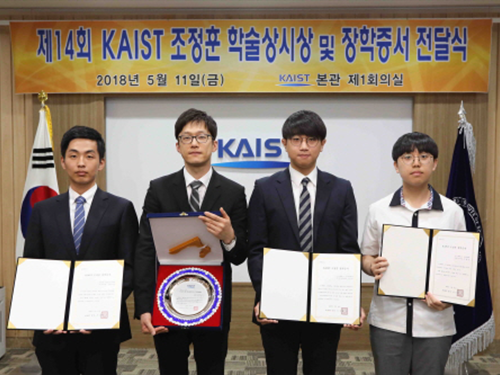 Yoon Ki Hong Named 2018 Jeong Hun Cho Awardee
(From left: PhD candidate Seungkwan Baek from the Department of Aerospace Engineering, Dr. Yoon Ki Hong from ADD, PhD candidate Wonhee Choi from the School of Mechanical Engineering at Korea University, and Jaehun Lee from Kongju National University High School)
Dr. Yoon Ki Hong from the Agency of Defense Development (ADD) was named the 2018 recipient of the Jong-Hoon Cho Award. The award recognizes outstanding young scientists in the field of aerospace engineering annually. The recipient of this award receives a 25 million KRW prize.
The Award Committee said that Dr. Hong has achieved outstanding work in the field of aerospace engineering. In particular, he conducted research on designing an air heating device which is the crucial component for ground experimental equipment. It is required for testing and evaluating supersonic vehicles’ structural strength tests using technology cannot be imported. In cooperation with his colleagues, he succeeded in developing an air heating device, a feat that has only been accomplished by developed countries. He also verified its operational performance.
Moreover, he received the best paper award from Korean Federation of Science and Minister of Defense Acquisition Program Administration’s Prize.
The award was endowed by the family of the late PhD candidate Jeong Hun Cho, who died in a rocket lab accident in the Department of Aerospace Engineering in 2003. Cho was posthumously conferred an honorary doctorate degree.
In Cho’s memory, his father established the ‘Jeong Hun Cho Award and Scholarship’. Since 2005, the scholarship annually selects three young scholars specializing in aerospace engineering from Cho’s alma maters of KAIST, Korea University, and Kongju National University High School.
In addition to Dr. Hong, the Award Committee chose three students for scholarships: PhD candidate Seungkwan Baek from the Department of Aerospace Engineering, PhD candidate Wonhee Choi from the School of Mechanical Engineering at Korea University, and Jaehun Lee from Kongju National University High School.
2018.05.11 View 19063
Yoon Ki Hong Named 2018 Jeong Hun Cho Awardee
(From left: PhD candidate Seungkwan Baek from the Department of Aerospace Engineering, Dr. Yoon Ki Hong from ADD, PhD candidate Wonhee Choi from the School of Mechanical Engineering at Korea University, and Jaehun Lee from Kongju National University High School)
Dr. Yoon Ki Hong from the Agency of Defense Development (ADD) was named the 2018 recipient of the Jong-Hoon Cho Award. The award recognizes outstanding young scientists in the field of aerospace engineering annually. The recipient of this award receives a 25 million KRW prize.
The Award Committee said that Dr. Hong has achieved outstanding work in the field of aerospace engineering. In particular, he conducted research on designing an air heating device which is the crucial component for ground experimental equipment. It is required for testing and evaluating supersonic vehicles’ structural strength tests using technology cannot be imported. In cooperation with his colleagues, he succeeded in developing an air heating device, a feat that has only been accomplished by developed countries. He also verified its operational performance.
Moreover, he received the best paper award from Korean Federation of Science and Minister of Defense Acquisition Program Administration’s Prize.
The award was endowed by the family of the late PhD candidate Jeong Hun Cho, who died in a rocket lab accident in the Department of Aerospace Engineering in 2003. Cho was posthumously conferred an honorary doctorate degree.
In Cho’s memory, his father established the ‘Jeong Hun Cho Award and Scholarship’. Since 2005, the scholarship annually selects three young scholars specializing in aerospace engineering from Cho’s alma maters of KAIST, Korea University, and Kongju National University High School.
In addition to Dr. Hong, the Award Committee chose three students for scholarships: PhD candidate Seungkwan Baek from the Department of Aerospace Engineering, PhD candidate Wonhee Choi from the School of Mechanical Engineering at Korea University, and Jaehun Lee from Kongju National University High School.
2018.05.11 View 19063 -
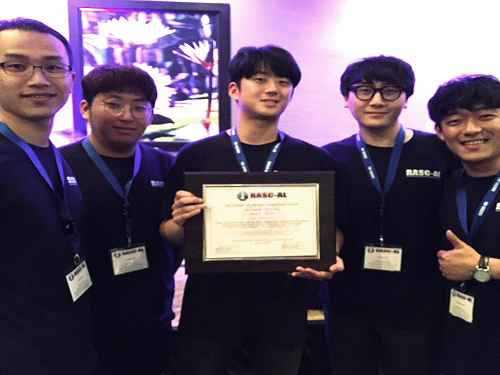 Winning Best in Theme Award in NASA RASC-AL
A students team from the Department of Aerospace Engineering won the Best in Theme Award for moon exploration system design at Revolutionary Aerospace Systems Concepts - Academic Linkage (RASC-AL), an aerospace mission system design competition organized by NASA in the USA.
The KAIST team, consisting of Jaeyoul Ko, Jongeun Suh, Juseong Lee, Sukmin Choi, and Eunkwang Lee, and supervised by Professor Jaemyung Ahn, competed as a joint team with Texas Tech University and the Royal Melbourne Institute of Technology in Australia,
The joint team was selected as one of the 14 finalists after two preliminary rounds. The finals of RASC-AL Forum took place from May 30 to June 3 in Florida. The team received the top prize with their design entitled ‘Earth to Lunar Interchangeable Transportation Environment (ELITE) for Logistics Delivery Systems’, one of the four themes of the competition.
Since 2002, RASC-AL competitions, managed by NASA, have been held with themes on innovative aerospace system and missions, in which world-class undergraduate and graduate students have participated.
This year’s themes were ▲ Lightweight Exercise Suite ▲ Airlock Design ▲ Commercially Enabled LEO/Mars Habitable Module and ▲ Logistics Delivery System.
Moon exploration requires a great deal of time and supplies. The KAIST team has been researching supply delivery systems in space for long-term manned moon exploration with their joint team for the last eight months. In particular, incidents can occur during the initial stages of long-term manned moon exploration missions that are unpredictable during system design and planning. Therefore, to cope with such unpredictability in the mission, the KAIST team deduced a system and an operational concept with increased flexibility to maximize the cost effectiveness of the supply transport.
The spacecraft was divided into propulsion and transport modules based on their functionalities, and can allow the flexibility by switching the transport module according to the demands of the moon base. The operational flexibility and cost effectiveness are further increased by introducing multiple departure orbits from the Earth (e.g. low Earth orbit vs. geosynchronous Earth orbit) enabled by utilization of various launch vehicles.
Professor Ahn, the advisor for the team, said, “I am proud of the students who collaborated with the international joint teams and achieved great result.” He continued, “I believe this to be the result of continuous efforts and initiatives of the department for system design-centered education. We will keep providing high-quality system design and education through various opportunities such as international cooperation in design education.”
(Photo caption: KAIST team of the Department of Aerospace Engineering poses after winning the Best in Theme Award in NASA's RASC-AL)
2017.06.22 View 17377
Winning Best in Theme Award in NASA RASC-AL
A students team from the Department of Aerospace Engineering won the Best in Theme Award for moon exploration system design at Revolutionary Aerospace Systems Concepts - Academic Linkage (RASC-AL), an aerospace mission system design competition organized by NASA in the USA.
The KAIST team, consisting of Jaeyoul Ko, Jongeun Suh, Juseong Lee, Sukmin Choi, and Eunkwang Lee, and supervised by Professor Jaemyung Ahn, competed as a joint team with Texas Tech University and the Royal Melbourne Institute of Technology in Australia,
The joint team was selected as one of the 14 finalists after two preliminary rounds. The finals of RASC-AL Forum took place from May 30 to June 3 in Florida. The team received the top prize with their design entitled ‘Earth to Lunar Interchangeable Transportation Environment (ELITE) for Logistics Delivery Systems’, one of the four themes of the competition.
Since 2002, RASC-AL competitions, managed by NASA, have been held with themes on innovative aerospace system and missions, in which world-class undergraduate and graduate students have participated.
This year’s themes were ▲ Lightweight Exercise Suite ▲ Airlock Design ▲ Commercially Enabled LEO/Mars Habitable Module and ▲ Logistics Delivery System.
Moon exploration requires a great deal of time and supplies. The KAIST team has been researching supply delivery systems in space for long-term manned moon exploration with their joint team for the last eight months. In particular, incidents can occur during the initial stages of long-term manned moon exploration missions that are unpredictable during system design and planning. Therefore, to cope with such unpredictability in the mission, the KAIST team deduced a system and an operational concept with increased flexibility to maximize the cost effectiveness of the supply transport.
The spacecraft was divided into propulsion and transport modules based on their functionalities, and can allow the flexibility by switching the transport module according to the demands of the moon base. The operational flexibility and cost effectiveness are further increased by introducing multiple departure orbits from the Earth (e.g. low Earth orbit vs. geosynchronous Earth orbit) enabled by utilization of various launch vehicles.
Professor Ahn, the advisor for the team, said, “I am proud of the students who collaborated with the international joint teams and achieved great result.” He continued, “I believe this to be the result of continuous efforts and initiatives of the department for system design-centered education. We will keep providing high-quality system design and education through various opportunities such as international cooperation in design education.”
(Photo caption: KAIST team of the Department of Aerospace Engineering poses after winning the Best in Theme Award in NASA's RASC-AL)
2017.06.22 View 17377 -
 Aerospace Engineering Students Win the Minister's Award
On November 11, 2016, students from KAIST’s Aerospace Engineering Department won the Minister’s Award of Trade, Industry and Energy of Korea at the 14th Research Paper Competition hosted by Korea Aerospace Industries (KAI). The award came with a cash prize of USD 1,200 as well as opportunities to visit international airshows held abroad.
The KAIST students' paper introduced a novel design concept for "a virtual-fighter-pilot system for unmanned combat aerial vehicles to enable them to engage in mass aerial combat."
This was one of the two highest honors given to contestants. A group of students from Korea Aerospace University received the other grand prize from the Minister of Land, Infrastructure and Transport of Korea.
The KAIST team consisted of two doctoral students, Hee-Min Shin and Jae-Hyun Lee, and one Master’s student, Hyun-Gi Kim. Their advisor, Professor “David” Hyunchul Shim, received the Special Achievement Award for his contribution to the paper.
KAI’s competition was established in 2003 to spur academic interest and research in aerospace engineering. Over the past 14 years, contestants have submitted 376 papers, and KAI has published 88 papers. KAI has positioned itself as the host of one of the most prestigious research paper competitions held in Korea in the area of aerospace engineering.
The Korean Society for Aeronautical and Space Sciences, the Korea Aerospace Industries Association, and the Korea Civil Aviation Development Association also sponsored the competition, with the Ministries of Trade, Industry and Energy and of Land, Infrastructure and Transport.
Professor Shim said, “This represents a great honor for our students. In recent years, research in unmanned aerial systems has increased tremendously throughout the world, and I hope KAIST will continue to inspire and innovate research in this field.”
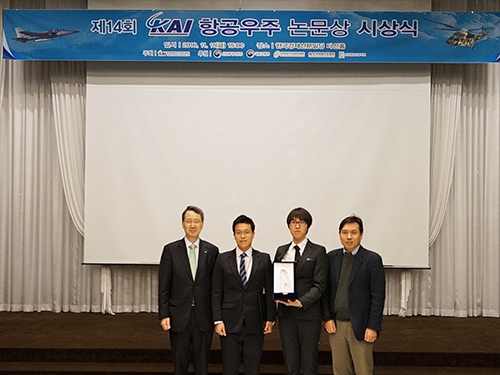
Pictured from left to right are Hee-Min Shin, Jae-Hyun Lee, and Hyun-Gi Kim.
Pictured from right to left are Professor Hyunchul Shim, Hyun-Gi Kim, Hee-Min Shin, and Vice President Sung-Sup Chang of Korea Aerospace Industries.
2016.11.22 View 20432
Aerospace Engineering Students Win the Minister's Award
On November 11, 2016, students from KAIST’s Aerospace Engineering Department won the Minister’s Award of Trade, Industry and Energy of Korea at the 14th Research Paper Competition hosted by Korea Aerospace Industries (KAI). The award came with a cash prize of USD 1,200 as well as opportunities to visit international airshows held abroad.
The KAIST students' paper introduced a novel design concept for "a virtual-fighter-pilot system for unmanned combat aerial vehicles to enable them to engage in mass aerial combat."
This was one of the two highest honors given to contestants. A group of students from Korea Aerospace University received the other grand prize from the Minister of Land, Infrastructure and Transport of Korea.
The KAIST team consisted of two doctoral students, Hee-Min Shin and Jae-Hyun Lee, and one Master’s student, Hyun-Gi Kim. Their advisor, Professor “David” Hyunchul Shim, received the Special Achievement Award for his contribution to the paper.
KAI’s competition was established in 2003 to spur academic interest and research in aerospace engineering. Over the past 14 years, contestants have submitted 376 papers, and KAI has published 88 papers. KAI has positioned itself as the host of one of the most prestigious research paper competitions held in Korea in the area of aerospace engineering.
The Korean Society for Aeronautical and Space Sciences, the Korea Aerospace Industries Association, and the Korea Civil Aviation Development Association also sponsored the competition, with the Ministries of Trade, Industry and Energy and of Land, Infrastructure and Transport.
Professor Shim said, “This represents a great honor for our students. In recent years, research in unmanned aerial systems has increased tremendously throughout the world, and I hope KAIST will continue to inspire and innovate research in this field.”
Pictured from left to right are Hee-Min Shin, Jae-Hyun Lee, and Hyun-Gi Kim.
Pictured from right to left are Professor Hyunchul Shim, Hyun-Gi Kim, Hee-Min Shin, and Vice President Sung-Sup Chang of Korea Aerospace Industries.
2016.11.22 View 20432 -
 KAIST to Participate in Summer Davos Forum 2016 in China
A group of KAIST researchers will share their insights on the future and challenges of the current technological innovations impacting all aspects of society, while showcasing their research excellence in artificial intelligence and robotics.
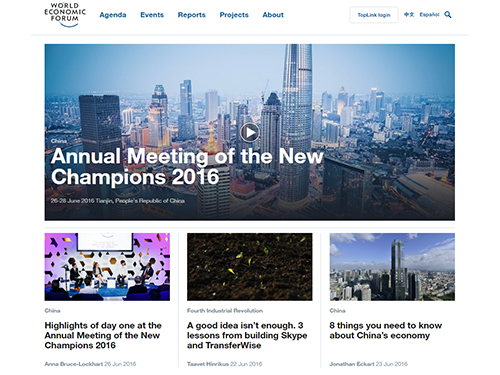
Scientific and technological breakthroughs are more important than ever as key agents to drive social, economic, and political changes and advancements in today’s world. The World Economic Forum (WEF), an international organization that provides one of the broadest engagement platforms to address issues of major concern to the global community, will discuss the effects of these breakthroughs at its 10th Annual Meeting of the New Champions, a.k.a., the Summer Davos Forum, in Tianjin, China, June 26-28, 2016.
Three professors from the Korea Advanced Institute of Science and Technology (KAIST) will join the Annual Meeting and offer their expertise in the fields of biotechnology, artificial intelligence, and robotics to explore the conference theme, “The Fourth Industrial Revolution and Its Transformational Impact.” The Fourth Industrial Revolution, a term coined by WEF founder, Klaus Schwab, is characterized by a range of new technologies that fuse the physical, digital, and biological worlds, such as the Internet of Things, cloud computing, and automation.
Distinguished Professor Sang Yup Lee of the Chemical and Biomolecular Engineering Department will speak at the Experts Reception to be held on June 25, 2016 on the topic of “The Summer Davos Forum and Science and Technology in Asia.” On June 27, 2016, he will participate in two separate discussion sessions.
In the first session entitled “What If Drugs Are Printed from the Internet?,” Professor Lee will discuss the impacts of advancements in biotechnology and 3D printing technology on the future of medicine with Nita A. Farahany, a Duke University professor. Clare Matterson, the Director of Strategy at Wellcome Trust in the United Kingdom, will serve as the moderator. The discussants will note recent developments made in the way patients receive their medicine, for example, downloading drugs directly from the internet and the production of yeast strains to make opioids for pain treatment through systems metabolic engineering. They will also suggest how these emerging technologies will transform the landscape of the pharmaceutical industry in the years to come.
In the second session, “Lessons for Life,” Professor Lee will talk about how to nurture life-long learning and creativity to support personal and professional growth necessary in an era of the new industrial revolution.
During the Annual Meeting, Professors Jong-Hwan Kim of the Electrical Engineering School and David Hyunchul Shim of the Aerospace Department will host, together with researchers from Carnegie Mellon University and AnthroTronix, an engineering research and development company, a technological exhibition on robotics. Professor Kim, the founder of the internally renowned Robot World Cup, will showcase his humanoid soccer-playing micro-robots and display their various cutting-edge technologies such as imaging processing, artificial intelligence, walking, and balancing. Professor Shim will present a human-like robotic piloting system, PIBOT, which autonomously operates a simulated flight program by employing control sticks and guiding an airplane from takeoff to landing.
In addition, the two professors will join Professor Lee, who is also a moderator, to host a KAIST-led session on June 26, 2016, entitled “Science in Depth: From Deep Learning to Autonomous Machines.” Professors Kim and Shim will explore new opportunities and challenges in their fields from machine learning to autonomous robotics, including unmanned vehicles and drones.
Since 2011, KAIST has participated in the World Economic Forum’s two flagship conferences, the January and June Davos Forums, to introduce outstanding talents, share their latest research achievements, and interact with global leaders.
KAIST President Steve Kang said, “It is important for KAIST to be involved in global forums that identify issues critical to humanity and seek answers to solve them, and where our skills and knowledge in science and technology can play a meaningful role. The Annual Meeting in China will become another venue to accomplish this.”
2016.06.27 View 19901
KAIST to Participate in Summer Davos Forum 2016 in China
A group of KAIST researchers will share their insights on the future and challenges of the current technological innovations impacting all aspects of society, while showcasing their research excellence in artificial intelligence and robotics.
Scientific and technological breakthroughs are more important than ever as key agents to drive social, economic, and political changes and advancements in today’s world. The World Economic Forum (WEF), an international organization that provides one of the broadest engagement platforms to address issues of major concern to the global community, will discuss the effects of these breakthroughs at its 10th Annual Meeting of the New Champions, a.k.a., the Summer Davos Forum, in Tianjin, China, June 26-28, 2016.
Three professors from the Korea Advanced Institute of Science and Technology (KAIST) will join the Annual Meeting and offer their expertise in the fields of biotechnology, artificial intelligence, and robotics to explore the conference theme, “The Fourth Industrial Revolution and Its Transformational Impact.” The Fourth Industrial Revolution, a term coined by WEF founder, Klaus Schwab, is characterized by a range of new technologies that fuse the physical, digital, and biological worlds, such as the Internet of Things, cloud computing, and automation.
Distinguished Professor Sang Yup Lee of the Chemical and Biomolecular Engineering Department will speak at the Experts Reception to be held on June 25, 2016 on the topic of “The Summer Davos Forum and Science and Technology in Asia.” On June 27, 2016, he will participate in two separate discussion sessions.
In the first session entitled “What If Drugs Are Printed from the Internet?,” Professor Lee will discuss the impacts of advancements in biotechnology and 3D printing technology on the future of medicine with Nita A. Farahany, a Duke University professor. Clare Matterson, the Director of Strategy at Wellcome Trust in the United Kingdom, will serve as the moderator. The discussants will note recent developments made in the way patients receive their medicine, for example, downloading drugs directly from the internet and the production of yeast strains to make opioids for pain treatment through systems metabolic engineering. They will also suggest how these emerging technologies will transform the landscape of the pharmaceutical industry in the years to come.
In the second session, “Lessons for Life,” Professor Lee will talk about how to nurture life-long learning and creativity to support personal and professional growth necessary in an era of the new industrial revolution.
During the Annual Meeting, Professors Jong-Hwan Kim of the Electrical Engineering School and David Hyunchul Shim of the Aerospace Department will host, together with researchers from Carnegie Mellon University and AnthroTronix, an engineering research and development company, a technological exhibition on robotics. Professor Kim, the founder of the internally renowned Robot World Cup, will showcase his humanoid soccer-playing micro-robots and display their various cutting-edge technologies such as imaging processing, artificial intelligence, walking, and balancing. Professor Shim will present a human-like robotic piloting system, PIBOT, which autonomously operates a simulated flight program by employing control sticks and guiding an airplane from takeoff to landing.
In addition, the two professors will join Professor Lee, who is also a moderator, to host a KAIST-led session on June 26, 2016, entitled “Science in Depth: From Deep Learning to Autonomous Machines.” Professors Kim and Shim will explore new opportunities and challenges in their fields from machine learning to autonomous robotics, including unmanned vehicles and drones.
Since 2011, KAIST has participated in the World Economic Forum’s two flagship conferences, the January and June Davos Forums, to introduce outstanding talents, share their latest research achievements, and interact with global leaders.
KAIST President Steve Kang said, “It is important for KAIST to be involved in global forums that identify issues critical to humanity and seek answers to solve them, and where our skills and knowledge in science and technology can play a meaningful role. The Annual Meeting in China will become another venue to accomplish this.”
2016.06.27 View 19901 -
 KAIST student wins Aerospace Student Papers Grand Prize
Dong-Il Yoo, a doctoral candidate under Professor Hyun-Chul Shim, at the Department of Aerospace Engineering, KAIST, has been awarded the Second Prize Award at the 11th Korea Aerospace Industries (KAI) Paper Contest. The award ceremony was held on October 30th at the media conference room at the KINTEX ADEX 2013 Exhibition in Seoul.
Yoo"s paper, titled "A Study on Virtual Pursuit Point-based Autonomous Air Combat Guidance Law for UCAV," is highly regarded for originality and creativity. The Field Robotics Center at the KAIST Institute, where Yoo conducted his research, also received the first prize at the 7th KAI Paper Contest.
The KAI Paper Contest was first organized in 2003 to promote academic interest and advance research and development in aerospace engineering among university students.
The KAI Paper Contest is one of the most prestigious contests in Korea. It is sponsored by the Ministry of Trade, Industry and Energy, the Ministry of Land, Infrastructure and Transport, the Korean Society for Aeronautical and Space Sciences, the Korea Aerospace Industries Association, and the Korea Civil Aviation Development Association.
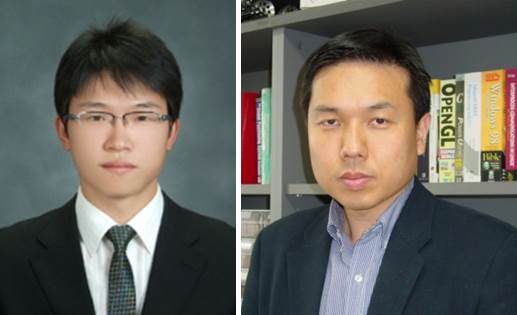
Dong-Il Yoo (left) and Professor Hyun-Chul Shim (right)
2013.11.11 View 21734
KAIST student wins Aerospace Student Papers Grand Prize
Dong-Il Yoo, a doctoral candidate under Professor Hyun-Chul Shim, at the Department of Aerospace Engineering, KAIST, has been awarded the Second Prize Award at the 11th Korea Aerospace Industries (KAI) Paper Contest. The award ceremony was held on October 30th at the media conference room at the KINTEX ADEX 2013 Exhibition in Seoul.
Yoo"s paper, titled "A Study on Virtual Pursuit Point-based Autonomous Air Combat Guidance Law for UCAV," is highly regarded for originality and creativity. The Field Robotics Center at the KAIST Institute, where Yoo conducted his research, also received the first prize at the 7th KAI Paper Contest.
The KAI Paper Contest was first organized in 2003 to promote academic interest and advance research and development in aerospace engineering among university students.
The KAI Paper Contest is one of the most prestigious contests in Korea. It is sponsored by the Ministry of Trade, Industry and Energy, the Ministry of Land, Infrastructure and Transport, the Korean Society for Aeronautical and Space Sciences, the Korea Aerospace Industries Association, and the Korea Civil Aviation Development Association.
Dong-Il Yoo (left) and Professor Hyun-Chul Shim (right)
2013.11.11 View 21734 -
 First Annual CanSat Idea Exhibition held
The Ministry of Education, Science, and Technology held the ‘CanSat’ Exhibition in order to increase interest and understanding of satellites in primary, secondary, and high school level students.
The exhibition, hosted by KAIST Satellite Research Center and funded by Korea Aerospace Institute, was held in SaeJeong City.
90 primary, secondary school teams, 57 high school teams, and 14 university teams submitted their applications for participation. Of these teams 20 primary, secondary school teams, 5 high school teams, and 5 university teams were selected after thorough document valuation and presentation assessment.
The 20 primary, secondary school teams participated in the science camp to gain firsthand experience in the construction and launch of a simple satellite system.
The high school and university teams were evaluated by the level of completion of the task given and the level of creativity involved.
The CanSat Exhibition has been held in aerospace powerhouses and this was the first time such an exhibition was held in Korea.
2012.08.21 View 15535
First Annual CanSat Idea Exhibition held
The Ministry of Education, Science, and Technology held the ‘CanSat’ Exhibition in order to increase interest and understanding of satellites in primary, secondary, and high school level students.
The exhibition, hosted by KAIST Satellite Research Center and funded by Korea Aerospace Institute, was held in SaeJeong City.
90 primary, secondary school teams, 57 high school teams, and 14 university teams submitted their applications for participation. Of these teams 20 primary, secondary school teams, 5 high school teams, and 5 university teams were selected after thorough document valuation and presentation assessment.
The 20 primary, secondary school teams participated in the science camp to gain firsthand experience in the construction and launch of a simple satellite system.
The high school and university teams were evaluated by the level of completion of the task given and the level of creativity involved.
The CanSat Exhibition has been held in aerospace powerhouses and this was the first time such an exhibition was held in Korea.
2012.08.21 View 15535 -
 KAIST hosts the first Can Satellite (Cansat) competition
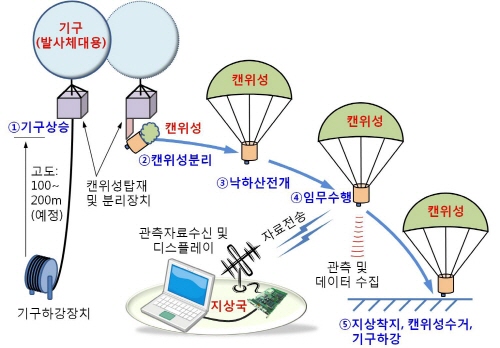
Figure: The cansat is sent up into the air using a balloon and then separated at a certain height. The cansat slowly descends and sends terrestrial observation or atmospheric information back to earth.
KAIST will host the first ever Cansat Competition Korea, in which students from different age groups can participate in building and testing the performance of their custom satellites.
The Satellite Technology Research Center (SaTReC) at KAIST announced that it will take applications for the Cansat Competition Korea until May 25th. A cansat is a can-sized educational satellite that contains the basic elements of a real satellite. It is fired up to a few hundred meters in the air using balloons or small rockets and then separated like a real satellite, collecting data and sending the information back to earth. Cansat competitions are regularly held in the United States or Europe, where they have advanced space development programs, but this is the first time this competition will be held in Korea.
The competition caters to different age groups through a cansat experience science camp for elementary and middle school students and a cansat competition for high school and college students.
The science camp will be held from August 7th to 9th at KAIST and Sejong City and will include satellite education, visits to space development centers (KAIST Satellite Technology Research Center and the Korea Aerospace Research Institute), hand-on experience with basic cansat kits, and other various programs.
The science camp will consist of a maximum of 20 teams comprised of students from fifth to ninth grade. Each team will have an advisory teacher and 3 to 4 students and can apply for the competition at no cost.
The cansat competition will test high school and college students on their personally designed and built can satellites along with the creativity of their mission and developmental outcome.
The preliminary review will choose a maximum of 15 teams, while the secondary review will select the 5 teams that will make the final competition based on their design presentation. On August 9th, these 5 teams will be evaluated on their technical ability, mission capacity and presentation skills. The winning team will be given the KAIST presidential award along with a trophy and prize money.
Doctor Park from KAIST SaTReC explained that countries with advanced space technology actively support cansat competitions to expand the base of the field. He emphasized Korea’s need for regular cansat competitions to actively promote potential space researchers.
More information on the competition can be found on the homepage (http://cansat.kaist.ac.kr) or at the KAIST SaTReC (042-350-8613~4)
2012.05.14 View 17656
KAIST hosts the first Can Satellite (Cansat) competition
Figure: The cansat is sent up into the air using a balloon and then separated at a certain height. The cansat slowly descends and sends terrestrial observation or atmospheric information back to earth.
KAIST will host the first ever Cansat Competition Korea, in which students from different age groups can participate in building and testing the performance of their custom satellites.
The Satellite Technology Research Center (SaTReC) at KAIST announced that it will take applications for the Cansat Competition Korea until May 25th. A cansat is a can-sized educational satellite that contains the basic elements of a real satellite. It is fired up to a few hundred meters in the air using balloons or small rockets and then separated like a real satellite, collecting data and sending the information back to earth. Cansat competitions are regularly held in the United States or Europe, where they have advanced space development programs, but this is the first time this competition will be held in Korea.
The competition caters to different age groups through a cansat experience science camp for elementary and middle school students and a cansat competition for high school and college students.
The science camp will be held from August 7th to 9th at KAIST and Sejong City and will include satellite education, visits to space development centers (KAIST Satellite Technology Research Center and the Korea Aerospace Research Institute), hand-on experience with basic cansat kits, and other various programs.
The science camp will consist of a maximum of 20 teams comprised of students from fifth to ninth grade. Each team will have an advisory teacher and 3 to 4 students and can apply for the competition at no cost.
The cansat competition will test high school and college students on their personally designed and built can satellites along with the creativity of their mission and developmental outcome.
The preliminary review will choose a maximum of 15 teams, while the secondary review will select the 5 teams that will make the final competition based on their design presentation. On August 9th, these 5 teams will be evaluated on their technical ability, mission capacity and presentation skills. The winning team will be given the KAIST presidential award along with a trophy and prize money.
Doctor Park from KAIST SaTReC explained that countries with advanced space technology actively support cansat competitions to expand the base of the field. He emphasized Korea’s need for regular cansat competitions to actively promote potential space researchers.
More information on the competition can be found on the homepage (http://cansat.kaist.ac.kr) or at the KAIST SaTReC (042-350-8613~4)
2012.05.14 View 17656