policy
- Industry-Academy cooperation program for enhancing global competitiveness and for obtaining new growth momentum
- Two research institutes - Power Electronics Institute and Packaging Institute - open in KAIST
- Fostering customized experts through researcher reeducation, field experiences, etc.
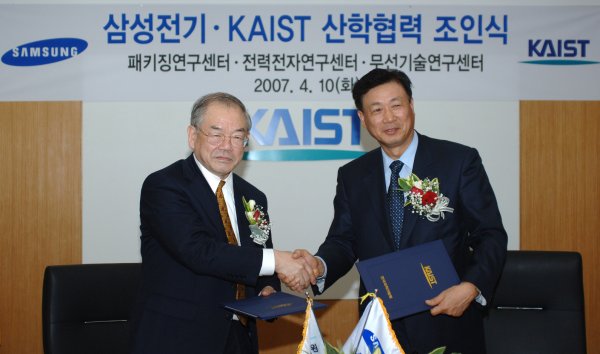
KAIST (President Nam-Pyo Suh) and Samsung Electronics (President Ho-Moon Kang) will be promoting industry-academy cooperative activities to enhance their global competitiveness and to obtain new growth momentum.
The both parties singed the agreement at KAIST conference room 1 on April 10, Tuesday, and two new research institutes - Power Electronics Institute (PEI) and Packaging Institute (PI) -opened this day. As a result, KAIST holds three research institutes managed in cooperation with Samsung Electronics, including the Radio Technology Institute (RTI) which was opened in 2005.
The PEI aims to develop power supply devices for high-efficiency and high-power servers of flat display power supply, and will foster customized experts through researcher reeducation and field experiences.
The PI will foster experts for improving packaging qualities and for developing next-generation technologies. Packing technologies are in the core field of electronics part industries which is going for integrating, systemizing and modulization.
“I’m sure outstanding industry-academy researches and student education will raise the standings of the both bodies, and I promise generous support to produce further significant research results,” said KAIST President Suh.
“This cooperation program will become an example of successful industry-academy cooperation. I’m expecting KAIST will become a trustworthy partner for Samsung Electronics to jump into one of the world’s top-class enterprises,” said Samsung Electronics President Kang.
-
event A heated battle of science and sports, who is the winner of this year's KA-PO War?
< Photos from KAIST-POSTECH Science War (photographed by Student Junhyeok Park of KAIST Freshman Course) > The future leaders of science at KAIST and POSTECH (President Seong Keun Kim) held their annual science and sporting event at POSTECH for two days from September 20th to 21st. The 'KAIST-POSTECH Science War (hereafter KA-PO War)' is a festival consisting of science and sports games and various side events to promote exchange and cooperation between the two universities. It is als
2024-09-19 -
event The 3rd Global Entrepreneurship Summer School (GESS 2024) Successfully Completed in Silicon Valley
The 2024 Global Entrepreneurship Summer School (2024 KAIST GESS), hosted by the Office of Global Initiatives under the KAIST International Office (Director Man-Sung Yim), was held for the third time. This program allows students to visit Silicon Valley, a global startup hub, to directly experience its famous startup ecosystem and develop their capabilities for global expansion. A total of 20 students were selected through applications, interviews, final presentations, mentoring, and peer evaluat
2024-07-03 -
people Dr. Bong-Joon Jung Elected as Interim President of KAIST U.S. Alumni Association
On April 29th, 2024, the Office of Global Initiative at KAIST, led by Vice President Man-Sung Yim, successfully conducted the election for the interim president of the KAIST U.S. Alumni Association. The authority to organize and operate the election was delegated by the KAIST U.S. Alumni Interim President Selection Committee Foundation, consisting of Je Woo Kim, Director of KAIST U.S. Foundation; Terri Kim, Director of KAIST U.S. Foundation; and Myungjin Yim, President of the KAIST Silicon Valle
2024-04-29 -
event Center for Global Strategies and Planning Hosts Successful Virtual KAIST U.S. Alumni Connection Event
< Screen capture of the KAIST U.S. Alumni meeting held online on December 8 > On December 8th, the Center for Global Strategies and Planning at KAIST, led by Vice President Man-Sung Yim of the International Office, conducted a virtual event to bring together KAIST alumni in the United States. The purpose of this event was to showcase KAIST's current initiatives in the U.S., facilitate information exchanges among U.S. alumni, and foster networking opportunities. Over 130 KAIST alumni b
2023-12-08 -
event NYU-KAIST Global AI & Digital Governance Conference Held
< Photo 1. Opening of NYU-KAIST Global AI & Digital Governance Conference > In attendance of the Minister of Science and ICT Jong-ho Lee, NYU President Linda G. Mills, and KAIST President Kwang Hyung Lee, KAIST co-hosted the NYU-KAIST Global AI & Digital Governance Conference at the Paulson Center of New York University (NYU) in New York City, USA on September 21st, 9:30 pm. At the conference, KAIST and NYU discussed the direction and policies for ‘global AI and digit
2023-09-22