%45%64%75%63%61%74%69%6f%6e
-
 KAIST Secures Top Ranking of Korean Universities
KAIST won the No. 1 position for the second year in a row in the daily JoongAng Ilbo"s university rankings for 2009. Seoul National University took back the No. 2 spot, followed in order by POSTECH, Korea and Yonsei universities.
The survey was conducted in the four categories, educational environment/finance, professors" research, general reputation/social advancement and globalization. KAIST scored 293 points out of possible 400 this year, while the second-ranking SNU and third-ranking POSTECH earned 234 and 226 points, respectively.
The daily noted that KAIST particularly excelled in the category of educational environment/finance. It observed that donations to KAIST surged almost 100 times for the past three years since 2006 when President Suh took office.
In specific rankings of universities by academic disciplines, SNU came in first overall. KAIST topped in the science and engineering field, while Korea University ranked first in liberal arts studies.
This year, 88 four-year universities participated in the survey. The daily JoongAng Ilbo started its annual evaluation of Koran universities in 1994 to stimulate productive competition among institutions of higher learning and to provide objective standards for students and their parents to select schools for application.
For more information, news.joins.com/article/391/3789391.html
2009.09.24 View 22736
KAIST Secures Top Ranking of Korean Universities
KAIST won the No. 1 position for the second year in a row in the daily JoongAng Ilbo"s university rankings for 2009. Seoul National University took back the No. 2 spot, followed in order by POSTECH, Korea and Yonsei universities.
The survey was conducted in the four categories, educational environment/finance, professors" research, general reputation/social advancement and globalization. KAIST scored 293 points out of possible 400 this year, while the second-ranking SNU and third-ranking POSTECH earned 234 and 226 points, respectively.
The daily noted that KAIST particularly excelled in the category of educational environment/finance. It observed that donations to KAIST surged almost 100 times for the past three years since 2006 when President Suh took office.
In specific rankings of universities by academic disciplines, SNU came in first overall. KAIST topped in the science and engineering field, while Korea University ranked first in liberal arts studies.
This year, 88 four-year universities participated in the survey. The daily JoongAng Ilbo started its annual evaluation of Koran universities in 1994 to stimulate productive competition among institutions of higher learning and to provide objective standards for students and their parents to select schools for application.
For more information, news.joins.com/article/391/3789391.html
2009.09.24 View 22736 -
World Research University Heads to Discuss Challenges in Global Financial Turmoil
About 70 leaders of the world"s major research universities will discuss how to better contribute to continued development of human society in global financial turmoil at a symposium organized by KAIST Monday (Sept. 21) at the Westin Chosun Hotel in Seoul.
Participants of the 2nd International Presidential Forum on Global Research Universities are from 40 universities in 25 countries, including Stanford University and Georgia Institute of Technology of the United States, Berlin Institute of Technology of Germany, Paris Institute of Technology of France, Technical University of Denmark, National University of Singapore and Tokyo Institute of Technology. They include 20 presidents of Korean universities and two dozens of leaders from industry and the government.
Under the main subject of "Challenges to Global Research Universities," the international symposium will proceed in four panel sessions. The subjects of each session and their keynote speakers are:
-- "Institutional Management in Times of Financial Crisis" by Kurt Kutzler, President of Berlin Institute of Technology
-- "Innovations in Education & Research" by Brian Cantor, Vice Chancellor of University of York
-- "Globalization of Institutes of Higher Learning" by Gary Schuster, Provost and Executive Vice President of Georgia Institute of Technology
-- "The Roles of Government, University and Industry in Green Technology Development" by KAIST President Nam-Pyo Suh
KAIST President Suh said of the purpose of the conference: "The world has witnessed a global financial turmoil of unseen magnitude and many nations are still struggling under the devastating impacts. While universities were no exception in facing economic turmoil, they have realized renewed pressures and expectations from their respective communities to provide answers to the great challenges."
"The conference will serve as an opportunity for the representatives of research universities to compare their visions of networking among theier institutions and initiate steps for new relationships. The conference I am sure will have a far-reaching influence on the course our research universities will take to shoulder greater responsibilities for building a better future of the mankind."
For more information, visit forum.kaist.ac.kr
2009.09.16 View 26415
-
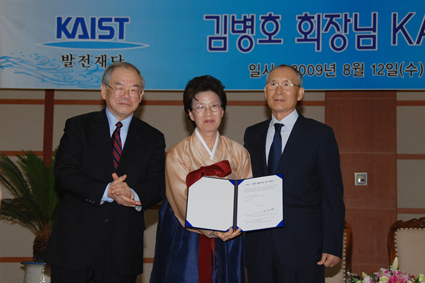 Self-Made Businessman Donates $24 Mil. Worth of Property to KAIST
Byeong-Ho Kim, a self-made businessman, has donated land worth 30 billion won ($25 million) to KAIST, the university"s authorities said on Thursday (Aug. 13).
The 68-year-old businessman said his aim is to give students from lower-income families a chance at a decent education and, ultimately, make Korea richer and powerful through development of science and technology. He runs the Seojeon Farm in Yongin, Gyeonggi Province.
Kim visited KAIST on Wednesday (Aug. 12) with his wife and 36-year-old son to finalize details of the donation with KAIST President Nam-Pyo Suh. He signed papers to certify the deed to donate 94,380 square meters of land in a ceremony.
"I promised my family I"d invest our money for a good purpose. Now I hope KAIST can educate students who can"t afford to pay tuition fees. I wasn"t able to study
further than elementary school due to poverty," Kim said, wishing that his donation could be used in fostering talented students and great scholars from around the world.
Kim"s wife, Sam-Yeol Kim, 60, sent an e-mail to KAIST last July 27, on behalf of her husband who suffered a stroke in 2004, to inform the university of her husband"s intent to make the donation.
Kim had pledged to his wife and son that some day he would return all his assets to society before his death. He began to look for the right beneficiary five years ago and chose KAIST as he was impressed by reformatory and innovative efforts at the university where its president was donating all his extra earnings to the university.
“I believe that KAIST can make my dream come true. It is to have advanced science and technology education turn Korea into a country where everyone can live happily,” said Kim at the ceremony.
He recalled his early life, saying, “I left for Seoul when I was 17 years old with just 76 won. I had to save money so much it was scary. Even when the weather was stifling, I refused to buy myself cold soft drinks just to save 1 more won.”
Even though he grew up in a difficult environment, Mr. Kim maintained a firm conviction in familial ties and education. Being the oldest of seven children, he had to support his younger siblings’ education, but never complained about his own lack of opportunity. When his father died, he took money that had been left over from funeral expenses and donated it to relatives as scholarships for their children. He believed that such kindness was the best way to make his father’s passing meaningful. In addition, he donated one billion won to a scholarship fund that helps those like him, who never had a chance to study or learn.
Mr. Kim’s favorite phrase is, “Earning money takes skill, but to spend it is an art.” This mirrors his philosophy of saving and economizing in order to make as much money as possible, then donating generously to the upbringing of future generations.
The decision to donate was also heavily influenced by the support of his wife, and his family. When he first hinted at his intention to donate, his family simply accepted the decision, saying that they were proud of him. Kim had always emphasized that wealth should be given back to society, and as such, his son Se-Yoon Kim donated to the United Nations Children’s Fund (UNICEF) and other charity organizations every month, saying that his actions were an obvious duty.
KAIST officials said they were emotionally moved to learn that Mr. Kim donated the fortune to a university, which is completely unrelated to him or anyone in his family, simply for the sake of the nation’s future. They said that Kim is a figure that all of Korean society should follow, and that everyone in KAIST will etch his wish into their hearts, and try their hardest to make sure future generations will prosper.
2009.08.18 View 15637
Self-Made Businessman Donates $24 Mil. Worth of Property to KAIST
Byeong-Ho Kim, a self-made businessman, has donated land worth 30 billion won ($25 million) to KAIST, the university"s authorities said on Thursday (Aug. 13).
The 68-year-old businessman said his aim is to give students from lower-income families a chance at a decent education and, ultimately, make Korea richer and powerful through development of science and technology. He runs the Seojeon Farm in Yongin, Gyeonggi Province.
Kim visited KAIST on Wednesday (Aug. 12) with his wife and 36-year-old son to finalize details of the donation with KAIST President Nam-Pyo Suh. He signed papers to certify the deed to donate 94,380 square meters of land in a ceremony.
"I promised my family I"d invest our money for a good purpose. Now I hope KAIST can educate students who can"t afford to pay tuition fees. I wasn"t able to study
further than elementary school due to poverty," Kim said, wishing that his donation could be used in fostering talented students and great scholars from around the world.
Kim"s wife, Sam-Yeol Kim, 60, sent an e-mail to KAIST last July 27, on behalf of her husband who suffered a stroke in 2004, to inform the university of her husband"s intent to make the donation.
Kim had pledged to his wife and son that some day he would return all his assets to society before his death. He began to look for the right beneficiary five years ago and chose KAIST as he was impressed by reformatory and innovative efforts at the university where its president was donating all his extra earnings to the university.
“I believe that KAIST can make my dream come true. It is to have advanced science and technology education turn Korea into a country where everyone can live happily,” said Kim at the ceremony.
He recalled his early life, saying, “I left for Seoul when I was 17 years old with just 76 won. I had to save money so much it was scary. Even when the weather was stifling, I refused to buy myself cold soft drinks just to save 1 more won.”
Even though he grew up in a difficult environment, Mr. Kim maintained a firm conviction in familial ties and education. Being the oldest of seven children, he had to support his younger siblings’ education, but never complained about his own lack of opportunity. When his father died, he took money that had been left over from funeral expenses and donated it to relatives as scholarships for their children. He believed that such kindness was the best way to make his father’s passing meaningful. In addition, he donated one billion won to a scholarship fund that helps those like him, who never had a chance to study or learn.
Mr. Kim’s favorite phrase is, “Earning money takes skill, but to spend it is an art.” This mirrors his philosophy of saving and economizing in order to make as much money as possible, then donating generously to the upbringing of future generations.
The decision to donate was also heavily influenced by the support of his wife, and his family. When he first hinted at his intention to donate, his family simply accepted the decision, saying that they were proud of him. Kim had always emphasized that wealth should be given back to society, and as such, his son Se-Yoon Kim donated to the United Nations Children’s Fund (UNICEF) and other charity organizations every month, saying that his actions were an obvious duty.
KAIST officials said they were emotionally moved to learn that Mr. Kim donated the fortune to a university, which is completely unrelated to him or anyone in his family, simply for the sake of the nation’s future. They said that Kim is a figure that all of Korean society should follow, and that everyone in KAIST will etch his wish into their hearts, and try their hardest to make sure future generations will prosper.
2009.08.18 View 15637 -
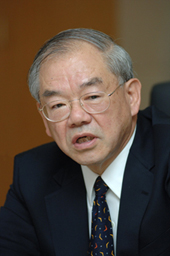 KAIST President Suh Honored with 2009 ASME Medal
KAIST President Nam-Pyo Suh has chosen as the 2009 winner of the ASME Medal presented by the American Society of Mechanical Engineers, university authorities said on Thursday (July 2).
President Suh received the honor for "seminal contributions to the advancement of engineering through research in tribology, polymer processing, metal processing, design and manufacturing, as well as contributions to engineering education and research infrastructure."
The selection of President Suh was unanimously approved by the 13-member Board of Governors of the ASME. Suh became the first scientist of Asian descent in the award"s 89-year-long history.
Founded in 1880, the ASME is a non-profit professional organization promoting the art, science and practice of mechanical and multidisciplinary engineering and allied sciences. The organization is known for setting codes and standards for mechanical devices. As of 2009, it has 120,000 members worldwide.
Only one ASME medal is awarded annually to recognize "eminently distinguished achievement." The award consists of a $17,000 honorarium, a gold medal, certificate and travel supplement for two days. It will be presented to President Suh during the 2009 International Mechanical Engineering Congress and Exposition, which will be held in Lake Buena Vista, Florida, November 13-10, 2009.
President Suh is an internationally known educator, engineer and inventor. Born in Korea, he immigrated to the U.S. in 1954 to join his father, who was teaching at Harvard. He earned both his bachelor"s and master"s degrees from MIT before coming to Carnegie Tech for his doctoral education in mechanical engineering.
While teaching at MIT, he founded the MIT-Industry Polymer Processing Program in 1973 and the Laboratory for Manufacturing and Productivity. He left these positions in 1984 to serve with the U.S. National Science Foundation as its assistant director for engineering, until 1988.
He invented many new materials, products and manufacturing processes, earning more than 60 U. S. patents and founding several companies. He has written seven books and more than 300 scholarly papers. Among dozens of honors throughout his career, President Suh most recently received the 2007 Lifetime Achievement from the Society of Plastics Engineers.
The ASME conducts one of the world"s largest technical publishing operations through its ASME Press, holds numerous technical conferences and hundreds of professional development courses each year, and sponsors numerous outreach and educational programs.
2009.07.02 View 20202
KAIST President Suh Honored with 2009 ASME Medal
KAIST President Nam-Pyo Suh has chosen as the 2009 winner of the ASME Medal presented by the American Society of Mechanical Engineers, university authorities said on Thursday (July 2).
President Suh received the honor for "seminal contributions to the advancement of engineering through research in tribology, polymer processing, metal processing, design and manufacturing, as well as contributions to engineering education and research infrastructure."
The selection of President Suh was unanimously approved by the 13-member Board of Governors of the ASME. Suh became the first scientist of Asian descent in the award"s 89-year-long history.
Founded in 1880, the ASME is a non-profit professional organization promoting the art, science and practice of mechanical and multidisciplinary engineering and allied sciences. The organization is known for setting codes and standards for mechanical devices. As of 2009, it has 120,000 members worldwide.
Only one ASME medal is awarded annually to recognize "eminently distinguished achievement." The award consists of a $17,000 honorarium, a gold medal, certificate and travel supplement for two days. It will be presented to President Suh during the 2009 International Mechanical Engineering Congress and Exposition, which will be held in Lake Buena Vista, Florida, November 13-10, 2009.
President Suh is an internationally known educator, engineer and inventor. Born in Korea, he immigrated to the U.S. in 1954 to join his father, who was teaching at Harvard. He earned both his bachelor"s and master"s degrees from MIT before coming to Carnegie Tech for his doctoral education in mechanical engineering.
While teaching at MIT, he founded the MIT-Industry Polymer Processing Program in 1973 and the Laboratory for Manufacturing and Productivity. He left these positions in 1984 to serve with the U.S. National Science Foundation as its assistant director for engineering, until 1988.
He invented many new materials, products and manufacturing processes, earning more than 60 U. S. patents and founding several companies. He has written seven books and more than 300 scholarly papers. Among dozens of honors throughout his career, President Suh most recently received the 2007 Lifetime Achievement from the Society of Plastics Engineers.
The ASME conducts one of the world"s largest technical publishing operations through its ASME Press, holds numerous technical conferences and hundreds of professional development courses each year, and sponsors numerous outreach and educational programs.
2009.07.02 View 20202 -
 U.S. and Korean Researchers Unveil Newest Research Team Member: Jaemi the Humanoid
- Project aims to enable humanoids to interact with people and their environment
June 1, 2009-- A Drexel University-led research team late last week unveiled the newest, most central member of its collaboration with a team of Korean researchers: Jaemi, a humanoid (HUBO). Jaemi HUBO embodies efforts to advance humanoid development and enhance the concept of human-robotic interaction. The project"s goal is to enable humanoids to interact with their environment, and enhancement plans include enabling the humanoid to move over rugged terrain, in unstructured environments and to interact socially with humans and handle objects.
The five-year project, funded through the National Science Foundation (NSF) Partnership for International Research and Education (PIRE) program, seeks transformative models to catalyze discovery through international research collaboration and train U.S. students and junior researchers to effectively think and work in global teams.
"The field of robotics is among the top 10 technology areas considered engines for economic growth. Korea understands this and is aggressively pursuing robotics. To stay competitive, the U.S. must do the same," said Mark Suskin, acting deputy director of NSF"s Office of International Science and Engineering. "NSF"s PIRE program and this robotics collaboration in particular, enable the U.S. to capitalize on research in other countries and remain competitive."
The PIRE research team is composed of researchers at The University of Pennsylvania, Colby College, Bryn Mawr College and Virginia Tech in the United States; and Korea Advanced Institute of Science and Technology (KAIST), Korea University and Seoul National University in Korea.
The team obtained a version of KAIST"s HUBO humanoid, which it named Jaemi HUBO and decided to house it at Drexel University. KAIST HUBO lab has become a model of cutting advance humanoid research by relatively small teams working on tight budgets.
KAIST excels in humanoid leg and body design, biped gait (walking, running, kicking), balance (modeling and control system design), and hardware integration. U.S. robotics researchers tend to enjoy an edge in locomotion over rugged, unstructured terrain; manipulation/grasping; cognition, perception and human-robot interaction; and vision (image, understanding, navigation).
This collaboration of American and Korean researchers will seek to draw on the expertise of each researcher and take Jaemi HUBO to the next level of development--that is, to improve Jaemi"s capabilities to navigate and manipulate objects and interact with people in unstructured environments. Such capabilities demand information technologies like cognition, perception and networking areas. Targeted enhancement features include a capability to move over rugged terrain and in unstructured environments and to handle objects and interact socially with humans.
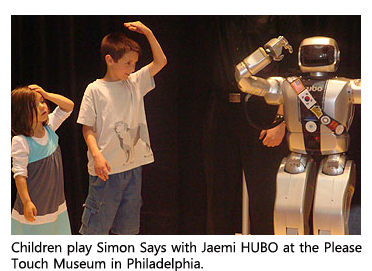
Jaemi HUBO will also educate the American public, particularly young people, about the science of robotics. This education process began at the Please Touch Museum in Philadelphia on May 28, 2009, when Jaemi HUBO was unveiled and introduced to a crowded audience of children and a few adults. Neither male nor female,Jaemi connected with the children, boys and girls alike. Guided by a Drexel University graduate student, Jamei moved, spoke, danced, shook hands and lead the children in a game of Simon Says. Such access to Jaemi HUBO starkly contrasts with that afforded by other high-profile humanoids that are often protected trade secrets, largely inaccessible to the public.
Museum curators are pleased to have had Jaemi visit and entertain kids during the weekend. "At the Please Touch Museum, we promote learning through a variety of senses," said J. Willard Whitson,the museum"s vice president for exhibits and education. "A humanoid not only embodies our goal of building layers of knowledge in young people, but Jaemi helps all of us celebrate the playful side of technology."
Jaemi HUBO is now at its permanent home at Drexel University, from which travel and guest appearances may be arranged by appointment. Journalists interested in meeting and interviewing Jaemi HUBO and other research team members are encouraged to contact Lisa-Joy Zgorski at lisajoy@nsf.gov. (Press Release of U.S. National Science Foundation)
2009.06.19 View 21589
U.S. and Korean Researchers Unveil Newest Research Team Member: Jaemi the Humanoid
- Project aims to enable humanoids to interact with people and their environment
June 1, 2009-- A Drexel University-led research team late last week unveiled the newest, most central member of its collaboration with a team of Korean researchers: Jaemi, a humanoid (HUBO). Jaemi HUBO embodies efforts to advance humanoid development and enhance the concept of human-robotic interaction. The project"s goal is to enable humanoids to interact with their environment, and enhancement plans include enabling the humanoid to move over rugged terrain, in unstructured environments and to interact socially with humans and handle objects.
The five-year project, funded through the National Science Foundation (NSF) Partnership for International Research and Education (PIRE) program, seeks transformative models to catalyze discovery through international research collaboration and train U.S. students and junior researchers to effectively think and work in global teams.
"The field of robotics is among the top 10 technology areas considered engines for economic growth. Korea understands this and is aggressively pursuing robotics. To stay competitive, the U.S. must do the same," said Mark Suskin, acting deputy director of NSF"s Office of International Science and Engineering. "NSF"s PIRE program and this robotics collaboration in particular, enable the U.S. to capitalize on research in other countries and remain competitive."
The PIRE research team is composed of researchers at The University of Pennsylvania, Colby College, Bryn Mawr College and Virginia Tech in the United States; and Korea Advanced Institute of Science and Technology (KAIST), Korea University and Seoul National University in Korea.
The team obtained a version of KAIST"s HUBO humanoid, which it named Jaemi HUBO and decided to house it at Drexel University. KAIST HUBO lab has become a model of cutting advance humanoid research by relatively small teams working on tight budgets.
KAIST excels in humanoid leg and body design, biped gait (walking, running, kicking), balance (modeling and control system design), and hardware integration. U.S. robotics researchers tend to enjoy an edge in locomotion over rugged, unstructured terrain; manipulation/grasping; cognition, perception and human-robot interaction; and vision (image, understanding, navigation).
This collaboration of American and Korean researchers will seek to draw on the expertise of each researcher and take Jaemi HUBO to the next level of development--that is, to improve Jaemi"s capabilities to navigate and manipulate objects and interact with people in unstructured environments. Such capabilities demand information technologies like cognition, perception and networking areas. Targeted enhancement features include a capability to move over rugged terrain and in unstructured environments and to handle objects and interact socially with humans.
Jaemi HUBO will also educate the American public, particularly young people, about the science of robotics. This education process began at the Please Touch Museum in Philadelphia on May 28, 2009, when Jaemi HUBO was unveiled and introduced to a crowded audience of children and a few adults. Neither male nor female,Jaemi connected with the children, boys and girls alike. Guided by a Drexel University graduate student, Jamei moved, spoke, danced, shook hands and lead the children in a game of Simon Says. Such access to Jaemi HUBO starkly contrasts with that afforded by other high-profile humanoids that are often protected trade secrets, largely inaccessible to the public.
Museum curators are pleased to have had Jaemi visit and entertain kids during the weekend. "At the Please Touch Museum, we promote learning through a variety of senses," said J. Willard Whitson,the museum"s vice president for exhibits and education. "A humanoid not only embodies our goal of building layers of knowledge in young people, but Jaemi helps all of us celebrate the playful side of technology."
Jaemi HUBO is now at its permanent home at Drexel University, from which travel and guest appearances may be arranged by appointment. Journalists interested in meeting and interviewing Jaemi HUBO and other research team members are encouraged to contact Lisa-Joy Zgorski at lisajoy@nsf.gov. (Press Release of U.S. National Science Foundation)
2009.06.19 View 21589 -
 KAIST Collaborating with U.S. Universities to Advance Humanoid Robotics
Hubo, a life-size walking bipedal humanoid robot, is perhaps the best-known character in Korea that KAIST has ever produced. It was shown to the government heads of the Asia-Pacific region during the APEC held in Busan, Korea, in 2005 and appeared at the hit concerts of the pop singer Jang-Hoon Kim. The humanoid robot is soon likely to catch the fancy of Americans as a U.S. government-funded project seeks to create a Hubo that can work and interact with people in collaboration with Korean scientists.
"We are going to give the brains to Hubo. (Japanese) Asimo can do only pre-programmed actions. We want to create a Hubo that can help people, interact with people," said Prof. Paul Oh of the Department of Mechanical Engineering & Mechanics at Drexel University in Philadelphia and leader of the five-year international project which was launched in November 2007.
The U.S.$2.5 million project is funded through the Partnership for International Research and Education (PIRE) Program of the National Science Foundation (NSF) of the United States. It brings together world-renowned experts in humanoid design and information technologies.
"Dr. Jun-Ho Oh"s lab at KAIST (that has created Hubo) is the world"s leader in humanoid design and the U.S. has advanced technologies in the areas such as artificial intelligence, mechanical learning and robot vision. Combining the strengths of the two countries can create a synergy effect and develop a more advanced humanoid robot," said Paul Oh. He is currently serving as Program Director of Robotics of the NSF which is overseeing robotics research (non-military) in the U.S. consisting over 150 robotics faculty.
Paul Oh"s research team consists of experts from five U.S. universities -- Drexel, Bryn Mawr College, Colby College, the University of Pennsylvania and Virginia Tech -- and KAIST.
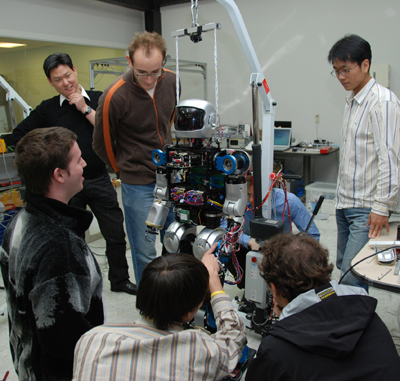
Leading a delegation of six professors and eight students, Dr. Paul Oh made a two-day visit to KAIST on Nov. 18-19 to review the progress of the project and have a technical meeting with participants.
"The U.S. universities participating in this program are scattered across the nation. So we decided to have a technical meeting here in Korea," he said.
Asked the reason why he chose KAIST as a partner for the program, Dr. Oh said that KAIST is willing to open Hugo to international researchers, whereas in Japan only Honda engineers are allowed to touch Asimo, which is a humanoid robot created by Honda Motor Company.
The project is to establish no barrier for roboticists anywhere in the world to pursue the humanoid research; a suite of humanoid platforms will be available for researchers to develop and advance capabilities like locomotion and human-robot interaction.
The team has been initially involved in development of three tools, all of which are based on the Hubo platform, in order to kick-start humanoid research in the U.S. They are the Mini-Hubo (a small, light-weight and affordable humanoid purchasable at the price lower than $8,000), On-Line Hubo (a program to operate Hubo online) and Virtual Hubo (a simulation program to do researches in cyberspace). As the first outcome of the project, the Mini-Hubo is expected to be released in the U.S. around next April.
Another important purpose of the PIRE program is to seek transformative models to train scientists and engineers to effectively work in global multi-disciplined design teams. To this end, an aggregate number of 20 students from U.S. universities are to stay at the KAIST during the next five years, with two students taking turns on a six-month term.
"I was really amazed how much work is done with small funding here. This is really an excellent example to learn," said Roy Gross, an undergraduate from Drexel who has been staying at Prof. Oh"s Lab for the past three months.
2008.11.21 View 29214
KAIST Collaborating with U.S. Universities to Advance Humanoid Robotics
Hubo, a life-size walking bipedal humanoid robot, is perhaps the best-known character in Korea that KAIST has ever produced. It was shown to the government heads of the Asia-Pacific region during the APEC held in Busan, Korea, in 2005 and appeared at the hit concerts of the pop singer Jang-Hoon Kim. The humanoid robot is soon likely to catch the fancy of Americans as a U.S. government-funded project seeks to create a Hubo that can work and interact with people in collaboration with Korean scientists.
"We are going to give the brains to Hubo. (Japanese) Asimo can do only pre-programmed actions. We want to create a Hubo that can help people, interact with people," said Prof. Paul Oh of the Department of Mechanical Engineering & Mechanics at Drexel University in Philadelphia and leader of the five-year international project which was launched in November 2007.
The U.S.$2.5 million project is funded through the Partnership for International Research and Education (PIRE) Program of the National Science Foundation (NSF) of the United States. It brings together world-renowned experts in humanoid design and information technologies.
"Dr. Jun-Ho Oh"s lab at KAIST (that has created Hubo) is the world"s leader in humanoid design and the U.S. has advanced technologies in the areas such as artificial intelligence, mechanical learning and robot vision. Combining the strengths of the two countries can create a synergy effect and develop a more advanced humanoid robot," said Paul Oh. He is currently serving as Program Director of Robotics of the NSF which is overseeing robotics research (non-military) in the U.S. consisting over 150 robotics faculty.
Paul Oh"s research team consists of experts from five U.S. universities -- Drexel, Bryn Mawr College, Colby College, the University of Pennsylvania and Virginia Tech -- and KAIST.
Leading a delegation of six professors and eight students, Dr. Paul Oh made a two-day visit to KAIST on Nov. 18-19 to review the progress of the project and have a technical meeting with participants.
"The U.S. universities participating in this program are scattered across the nation. So we decided to have a technical meeting here in Korea," he said.
Asked the reason why he chose KAIST as a partner for the program, Dr. Oh said that KAIST is willing to open Hugo to international researchers, whereas in Japan only Honda engineers are allowed to touch Asimo, which is a humanoid robot created by Honda Motor Company.
The project is to establish no barrier for roboticists anywhere in the world to pursue the humanoid research; a suite of humanoid platforms will be available for researchers to develop and advance capabilities like locomotion and human-robot interaction.
The team has been initially involved in development of three tools, all of which are based on the Hubo platform, in order to kick-start humanoid research in the U.S. They are the Mini-Hubo (a small, light-weight and affordable humanoid purchasable at the price lower than $8,000), On-Line Hubo (a program to operate Hubo online) and Virtual Hubo (a simulation program to do researches in cyberspace). As the first outcome of the project, the Mini-Hubo is expected to be released in the U.S. around next April.
Another important purpose of the PIRE program is to seek transformative models to train scientists and engineers to effectively work in global multi-disciplined design teams. To this end, an aggregate number of 20 students from U.S. universities are to stay at the KAIST during the next five years, with two students taking turns on a six-month term.
"I was really amazed how much work is done with small funding here. This is really an excellent example to learn," said Roy Gross, an undergraduate from Drexel who has been staying at Prof. Oh"s Lab for the past three months.
2008.11.21 View 29214 -
KAIST Ranks 95th among World Universities
Oct. 13, 2008 --KAIST is ranked 95th among Top 200 Universities of the World this year, scoring a notable increase from last year"s ranking of 132nd. KAIST, Seoul National University which was placed 50th, and POSTECH ranked 188th became the only three institutions of higher education in Korea to make it to the list, called "The Times Higher Education -- QS World University Rankings."
KAIST"s advancement was more conspicuous in specific area evaluations. In the area of Engineering and Information Technology, it is ranked 34th (49th last year), in Natural Sciences 46th (86th last year), and in Biological Sciences and Biotechnology 134th (166th last year).
While North America dominates the ranking with 42 universities on the list, Europe and Asia Pacific are also well represented with 36 and 22 institutions, respectively.
The list, compiled by The Times (of London) newspaper annually, is topped by Harvard University (USA), followed by Yale University (USA) and University of Cambridge (United Kingdom).
Last year, only KAIST and SNU were included in the top 200 list. This year, Yonsei University raised its ranking to 203rd from last year"s 223rd while Korea University improved from 243rd to 236th, showing overall improvement of universities in Korea.
Again this year, Japan and China had most of the top ranked universities in Asia, each sharing three in the top 50. University of Tokyo, ranked 19th, led all Japanese universities; Kyoto University was placed 25th and Osaka University 44th. University of Hong Kong was listed 26th, followed by Hong Kong University of Science and Technology on 39th and the Chinese University of Hong Kong on 42nd.
The Times Higher Education--QS World University Rankings evaluates four main categories: quality of research, globalization, and quality of education and work of graduates in society. The evaluation also considers academic peer review, citations per faculty, recruiter review, international faculty, international students and faculty-student ratio.
QS Top 100 Universities 2008
Source: QS Quacquarelli Symonds (www.topuniversities.com)
Copyright?004-2008QSQuacquarelliSymondsLtd.
1
HARVARD University
United States
2
YALE University
United States
3
University of CAMBRIDGE
United Kingdom
4
University of OXFORD
United Kingdom
5
CALIFORNIA Institute of Technology (Calt...
United States
6
IMPERIAL College London
United Kingdom
7
UCL (University College London)
United Kingdom
8
University of CHICAGO
United States
9
MASSACHUSETTS Institute of Technology (M...
United States
10
COLUMBIA University
United States
11
University of PENNSYLVANIA
United States
12
PRINCETON University
United States
13=
DUKE University
United States
13=
JOHNS HOPKINS University
United States
15
CORNELL University
United States
16
AUSTRALIAN National University
Australia
17
STANFORD University
United States
18
University of MICHIGAN
United States
19
University of TOKYO
Japan
20
MCGILL University
Canada
21
CARNEGIE MELLON University
United States
22
KING"S College London
United Kingdom
23
University of EDINBURGH
United Kingdom
24
ETH Zurich (Swiss Federal Institute of T...
Switzerland
25
KYOTO University
Japan
26
University of HONG KONG
Hong Kong
27
BROWN University
United States
28
?ole Normale Sup?ieure, PARIS
France
29
University of MANCHESTER
United Kingdom
30=
National University of SINGAPORE(NUS)
Singapore
30=
University of CALIFORNIA, Los Angeles (U...
United States
32
University of BRISTOL
United Kingdom
33
NORTHWESTERN University
United States
34=
?OLE POLYTECHNIQUE
France
34=
University of BRITISH COLUMBIA
Canada
36
University of California, BERKELEY
United States
37
The University of SYDNEY
Australia
38
The University of MELBOURNE
Australia
39
HONG KONG University of Science & Techno...
Hong Kong
40
NEW YORK University (NYU)
United States
41
University of TORONTO
Canada
42
The CHINESE University of Hong Kong
Hong Kong
43
University of QUEENSLAND
Australia
44
OSAKA University
Japan
45
University of NEW SOUTH WALES
Australia
46
BOSTON University
United States
47
MONASH University
Australia
48
University of COPENHAGEN
Denmark
49
TRINITY College Dublin
Ireland
50=
Ecole Polytechnique F??ale de LAUSANNE...
Switzerland
50=
PEKING University
China
50=
SEOUL National University
Korea, South
53
University of AMSTERDAM
Netherlands
54
DARTMOUTH College
United States
55
University of WISCONSIN-Madison
United States
56
TSINGHUA University
China
57
HEIDELBERG Universit?
Germany
58
University of CALIFORNIA, San Diego
United States
59
University of WASHINGTON
United States
60
WASHINGTON University in St. Louis
United States
61
TOKYO Institute of Technology
Japan
62
EMORY University
United States
63
UPPSALA University
Sweden
64
LEIDEN University
Netherlands
65
The University of AUCKLAND
New Zealand
66
LONDON School of Economics and Political...
United Kingdom
67
UTRECHT University
Netherlands
68
University of GENEVA
Switzerland
69
University of WARWICK
United Kingdom
70
University of TEXAS at Austin
United States
71
University of ILLINOIS
United States
72
Katholieke Universiteit LEUVEN
Belgium
73
University of GLASGOW
United Kingdom
74
University of ALBERTA
Canada
75
University of BIRMINGHAM
United Kingdom
76
University of SHEFFIELD
United Kingdom
77
NANYANG Technological University
Singapore
78=
DELFT University of Technology
Netherlands
78=
RICE University
United States
78=
Technische Universit? M?CHEN
Germany
81=
University of AARHUS
Denmark
81=
University of YORK
United Kingdom
83=
GEORGIA Institute of Technology
United States
83=
The University of WESTERN AUSTRALIA
Australia
83=
University of ST ANDREWS
United Kingdom
86
University of NOTTINGHAM
United Kingdom
87
University of MINNESOTA
United States
88
LUND University
Sweden
89
University of CALIFORNIA, Davis
United States
90
CASE WESTERN RESERVE University
United States
91=
Universit?de Montr?l
Canada
91=
University of HELSINKI
Finland
93=
Hebrew University of JERUSALEM
Israel
93=
Ludwig-Maximilians-Universit? M?chen
Germany
95
KAIST - Korea Advanced Institute of Scie...
Korea, South
96
University of VIRGINIA
United States
97
University of PITTSBURGH
United States
98
University of CALIFORNIA, Santa Barbara
United States
99=
PURDUE University
United States
99=
University of SOUTHAMPTON
United Kingdom
2008.10.14 View 22534
-
 Super-Fast Internet Data Chip Developed
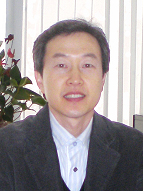
A KAIST research team led by Prof. Kyoung-Hoon Yang of the Electrical Engineering & Computer Science Department developed a super-fast chip that could lead to huge advancements in broadband Internet technology, the Korean Ministry of Education, Science and Technology said on Thursday (June 26).
The multiplexer chip is the first of its kind to be developed using the quantum effect of resonant tunnelling diode, according to the Ministry.
The integrated circuit chip built at the university laboratory has an operating speed of 45 gigabits per second (Gb/s), while using roughly 75 percent less energy than the previous version. The speed enables the transfer of about 4 full-length movies in one second.
The best operational broadband Internet services provide users with data transfer speed of 40 Gb/s, while most other high-speed online connections offer 10 Gb/s.
"Besides speed, the greatest achievement is low energy use," Prof. Yang said. He stressed that energy use in chips is a crucial factor because power creates heat that can melt circuits and make them inoperable.
"By cutting down on energy use, the new chips can be made smaller and with faster data transfer speed," the scientist said.
He added that efforts are underway to increase operational speed to 100 Gb/s, with energy consumption to be cut to 10 percent of current chips like the high electron mobility transistor, the heterojunction bipolar transistor and the complementary metal oxide semiconductor.
The researcher speculated that such revolutionary chips could be developed in 1-2 years and become the new benchmark in this field since existing chips have limited development capabilities.
The project has received funding from the Education-Science-Technology Ministry since 2000. The Ministry"s financial support will last until 2010.
2008.06.26 View 18594
Super-Fast Internet Data Chip Developed
A KAIST research team led by Prof. Kyoung-Hoon Yang of the Electrical Engineering & Computer Science Department developed a super-fast chip that could lead to huge advancements in broadband Internet technology, the Korean Ministry of Education, Science and Technology said on Thursday (June 26).
The multiplexer chip is the first of its kind to be developed using the quantum effect of resonant tunnelling diode, according to the Ministry.
The integrated circuit chip built at the university laboratory has an operating speed of 45 gigabits per second (Gb/s), while using roughly 75 percent less energy than the previous version. The speed enables the transfer of about 4 full-length movies in one second.
The best operational broadband Internet services provide users with data transfer speed of 40 Gb/s, while most other high-speed online connections offer 10 Gb/s.
"Besides speed, the greatest achievement is low energy use," Prof. Yang said. He stressed that energy use in chips is a crucial factor because power creates heat that can melt circuits and make them inoperable.
"By cutting down on energy use, the new chips can be made smaller and with faster data transfer speed," the scientist said.
He added that efforts are underway to increase operational speed to 100 Gb/s, with energy consumption to be cut to 10 percent of current chips like the high electron mobility transistor, the heterojunction bipolar transistor and the complementary metal oxide semiconductor.
The researcher speculated that such revolutionary chips could be developed in 1-2 years and become the new benchmark in this field since existing chips have limited development capabilities.
The project has received funding from the Education-Science-Technology Ministry since 2000. The Ministry"s financial support will last until 2010.
2008.06.26 View 18594 -
KAIST, ICU Agree to Merge
KAIST and the Information and Communications University, a state-run institution, decided to merge as they signed a memorandum of understanding for unification at the Westin Chosun Hotel in Seoul on May 23.
The MOU signing ceremony was attended by representatives of the two universities and related high-ranking government officials from the Ministry of Knowledge Economy and the Ministry of Education, Science and Technology.
Under the agreement, the two universities will form a joint committee to complete the merger process by the end of this year. According to the MOU, ICU will become the "IT Convergence Campus" (ICC) which will include KAIST"s IT related departments and research institutes. The projected ICC will be headed by a KAIST vice president, KAIST authorities said.
With the merger, the number of KAIST students in the IT area will increase to 2,850 from 1,951, while the number of IT-related faculty members will rise to 157 from 99.
ICU was established in 1997 by the Korean Ministry of Information and Communication, the Electronics and Telecommunications Research Institute, and some major Korean IT companies. Located in Daedeok Science Town in Daejeon where KAIST is also situated, ICU started as a graduate school and added the undergraduate course in 2002. It currently has a total enrollment of 1,121 students -- 481undergraduate students, 324 graduate students and 316 doctorate students.
KAIST said that it will treat ICU professors and staff equally after the merger. This year, the two universities will separately conduct freshmen recruitment procedures for 2009, but will then unify recruitment.
The unification of the two institutions is expected to give KAIST the competitive edge through a larger faculty, student body, and expanded facilities.
The agreement put an end to extended negotiations for merger which started in July 2006. The talk of merging the two universities surfaced when the Board of Audit and Inspection concluded that the government"s direct financial support for ICU was unlawful as ICU was established as a private school. When ICU was established in 1997, the Ministry of Information and Communication provided 200 billion won as the basic endowment and has continually provided 10 billion won in operating funds each year.
2008.05.22 View 20209
-
 KAIST and Carnegie Mellon University establish a Dual Degree Program
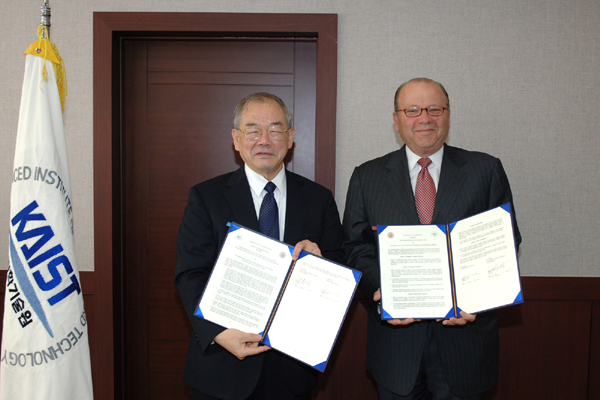
Korea Advanced Institute of Science and Technology (KAIST) and Carnegie Mellon University make an agreement on collaboration in research and education, and a dual degree program.
KAIST and Carnegie Mellon make an agreement on ▲Exchange of Faculty Members ▲Exchange of Students ▲Dual Degree Program and ▲ Exploring cooperation in education and research. Presidents of both Universities had a signing ceremony at 11 A.M on Friday, Oct. 5th, 2007.
▲Lectures, joint research and exchange of faculty members ▲Undergraduate/graduate student exchange up to five students from one University each year ▲Dual degree program at the Ph. D. level ▲Opportunities for joint research projects and conferences will be explored according to the agreement between the two Universities.
KAIST and Carnegie Mellon have created a new dual degree program for Ph.D. students in civil and environmental engineering. Students admitted through the dual degree program are required to spend minimum 2 academic years in residence at each University. The total number of the student candidates participating in this program shall not exceed five in any given academic year initially. The students who met the graduation requirements shall be awarded two PhD degrees, one from KAIST and the other from Carnegie Mellon. All of its courses at KAIST are taught in English, which is the case starting in Fall 2007. Both Universities will explore the concept of sharing courses taught in English using videoconferencing technologies.
KAIST President Nam Pyo Suh said “We are delighted to have President Jared L. Cohon of Carnegie Mellon visit KAIST. I am looking forward to discussing various issues related to higher education and signing the Memorandum of Understanding between the two universities for student/faculty exchange programs, joint research, and the Carnegie Mellon- KAIST dual-degree program in civil and environment engineering. The dual degree program will initially begin in civil and environment engineering, and we hope to expand this to other areas in the future. Our goal is to generate future leaders who are able to lead global enterprises and conduct interdisciplinary research. This can be done through collaboration among leading scholars at Carnegie Mellon and KAIST. Our hope is that we can solve serious problems of the 21st century through the collaboration between our two institutions. I am especially excited to establish such a collaboration with Carnegie Mellon, my alma mater."
“Carnegie Mellon is well-suited to collaborate with KAIST. We believe this agreement will be a catalyst for future educational and research opportunities. I am especially pleased that this partnership is with an institution of KAIST"s stature” said Cohon.
About Carnegie Mellon:
Carnegie Mellon is a private research university with a distinctive mix of programs in engineering, computer science, robotics, business, public policy, fine arts and the humanities. More than 10,000 undergraduate and graduate students receive an education characterized by its focus on creating and implementing solutions for real problems, interdisciplinary collaboration, and innovation. A small student-to-faculty ratio provides an opportunity for close interaction between students and professors. While technology is pervasive on its 144-acre Pittsburgh campus, Carnegie Mellon is also distinctive among leading research universities for the world-renowned programs in its College of Fine Arts. A global university, Carnegie Mellon has campuses in Silicon Valley, Calif., and Qatar, and programs in Asia, Australia and Europe. For more, see www.cmu.edu ..
2007.10.09 View 25402
KAIST and Carnegie Mellon University establish a Dual Degree Program
Korea Advanced Institute of Science and Technology (KAIST) and Carnegie Mellon University make an agreement on collaboration in research and education, and a dual degree program.
KAIST and Carnegie Mellon make an agreement on ▲Exchange of Faculty Members ▲Exchange of Students ▲Dual Degree Program and ▲ Exploring cooperation in education and research. Presidents of both Universities had a signing ceremony at 11 A.M on Friday, Oct. 5th, 2007.
▲Lectures, joint research and exchange of faculty members ▲Undergraduate/graduate student exchange up to five students from one University each year ▲Dual degree program at the Ph. D. level ▲Opportunities for joint research projects and conferences will be explored according to the agreement between the two Universities.
KAIST and Carnegie Mellon have created a new dual degree program for Ph.D. students in civil and environmental engineering. Students admitted through the dual degree program are required to spend minimum 2 academic years in residence at each University. The total number of the student candidates participating in this program shall not exceed five in any given academic year initially. The students who met the graduation requirements shall be awarded two PhD degrees, one from KAIST and the other from Carnegie Mellon. All of its courses at KAIST are taught in English, which is the case starting in Fall 2007. Both Universities will explore the concept of sharing courses taught in English using videoconferencing technologies.
KAIST President Nam Pyo Suh said “We are delighted to have President Jared L. Cohon of Carnegie Mellon visit KAIST. I am looking forward to discussing various issues related to higher education and signing the Memorandum of Understanding between the two universities for student/faculty exchange programs, joint research, and the Carnegie Mellon- KAIST dual-degree program in civil and environment engineering. The dual degree program will initially begin in civil and environment engineering, and we hope to expand this to other areas in the future. Our goal is to generate future leaders who are able to lead global enterprises and conduct interdisciplinary research. This can be done through collaboration among leading scholars at Carnegie Mellon and KAIST. Our hope is that we can solve serious problems of the 21st century through the collaboration between our two institutions. I am especially excited to establish such a collaboration with Carnegie Mellon, my alma mater."
“Carnegie Mellon is well-suited to collaborate with KAIST. We believe this agreement will be a catalyst for future educational and research opportunities. I am especially pleased that this partnership is with an institution of KAIST"s stature” said Cohon.
About Carnegie Mellon:
Carnegie Mellon is a private research university with a distinctive mix of programs in engineering, computer science, robotics, business, public policy, fine arts and the humanities. More than 10,000 undergraduate and graduate students receive an education characterized by its focus on creating and implementing solutions for real problems, interdisciplinary collaboration, and innovation. A small student-to-faculty ratio provides an opportunity for close interaction between students and professors. While technology is pervasive on its 144-acre Pittsburgh campus, Carnegie Mellon is also distinctive among leading research universities for the world-renowned programs in its College of Fine Arts. A global university, Carnegie Mellon has campuses in Silicon Valley, Calif., and Qatar, and programs in Asia, Australia and Europe. For more, see www.cmu.edu ..
2007.10.09 View 25402 -
 Cooperation Agreement with Ajou Motor College
KAIST Graduate School of Automobile Technology to sign a cooperation agreement with Ajou Motor College
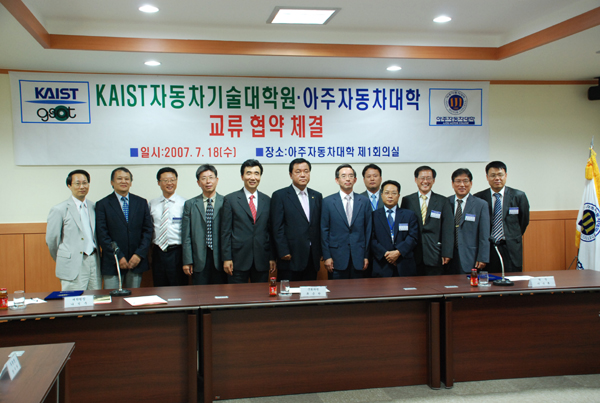
KAIST Graduate School of Automobile Technology (GSAT) signed a cooperation agreement with Ajou Motor College (AMC) on July 18th.
Under the agreement, the both schools will share education and research facilities and promote mutual cooperation for joint education and researches.
Lawmaker Geun-Chan Ryu, KAIST Vice President of Budget & Planning Ji-Won Yang, GSAT Dean Suck-Joo Na, AMC Dean Soo-Hoon Lee, etc. attended the ceremony.
2007.07.24 View 20104
Cooperation Agreement with Ajou Motor College
Cooperation Agreement with Ajou Motor College
KAIST Graduate School of Automobile Technology to sign a cooperation agreement with Ajou Motor College
KAIST Graduate School of Automobile Technology (GSAT) signed a cooperation agreement with Ajou Motor College (AMC) on July 18th.
Under the agreement, the both schools will share education and research facilities and promote mutual cooperation for joint education and researches.
Lawmaker Geun-Chan Ryu, KAIST Vice President of Budget & Planning Ji-Won Yang, GSAT Dean Suck-Joo Na, AMC Dean Soo-Hoon Lee, etc. attended the ceremony.
2007.07.24 View 20104 -
 Emeritus Professor Lee Dies
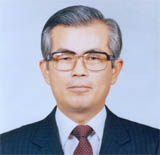
Jeong-Oh Lee, Emeritus Professor of Mechanical Engineering, died of his chronic disease on June 15, 2007 at his age of 76.
The late Lee began his lecturing career at Mechanical Engineering Department in 1973 and had made considerable devotions to the education and development of mechanical engineering for 24 years. As the former Minister of Science and Technology, former President of Korea Institute of Science and Technology, and former President of Korea Advanced Institute of Science and Technology, he also has made significant contributions to the development of Korean science and technology.
Particularly, he played key roles in vitalizing Daeduk Research Complex (DRC) by planning and executing the movement of government-funded institutes despite the inactive research atmosphere in the early 1980s. He also set up the Extended Council for Technology Promotion, consisting of many distinguished persons from diverse fields under the supervision of the President, to make significant contributions to the promotion and spread of technology innovation among governmental and civil enterprises. He received Cheongjo Geunjeong Medal in 1985 and never stopped his devotion to the education of young students even after his retirement in 1997.
<Funeral Notice>- Date: Sunday, June 17, 2007 at 7 am.- Place: Eulji University Hospital, Daejeon- Graveyard: Cheonan graveyard- Bereaved family Wife Ok-Hyang Kang Son Jong-Sun Lee, Professor of Handong University Han-Sun Lee, LG Chemicals Daughter Myung-Ae Lee Son-in-law Young-Soo Lee, Korea Institute of Industrial Technology- Contact Point: C.P. 019.480.2451 (Han-Sun Lee)
2007.06.18 View 22950
Emeritus Professor Lee Dies
Jeong-Oh Lee, Emeritus Professor of Mechanical Engineering, died of his chronic disease on June 15, 2007 at his age of 76.
The late Lee began his lecturing career at Mechanical Engineering Department in 1973 and had made considerable devotions to the education and development of mechanical engineering for 24 years. As the former Minister of Science and Technology, former President of Korea Institute of Science and Technology, and former President of Korea Advanced Institute of Science and Technology, he also has made significant contributions to the development of Korean science and technology.
Particularly, he played key roles in vitalizing Daeduk Research Complex (DRC) by planning and executing the movement of government-funded institutes despite the inactive research atmosphere in the early 1980s. He also set up the Extended Council for Technology Promotion, consisting of many distinguished persons from diverse fields under the supervision of the President, to make significant contributions to the promotion and spread of technology innovation among governmental and civil enterprises. He received Cheongjo Geunjeong Medal in 1985 and never stopped his devotion to the education of young students even after his retirement in 1997.
<Funeral Notice>- Date: Sunday, June 17, 2007 at 7 am.- Place: Eulji University Hospital, Daejeon- Graveyard: Cheonan graveyard- Bereaved family Wife Ok-Hyang Kang Son Jong-Sun Lee, Professor of Handong University Han-Sun Lee, LG Chemicals Daughter Myung-Ae Lee Son-in-law Young-Soo Lee, Korea Institute of Industrial Technology- Contact Point: C.P. 019.480.2451 (Han-Sun Lee)
2007.06.18 View 22950