Efficient Quantum Process Tomography for Enabling Scalable Optical Quantum Computing
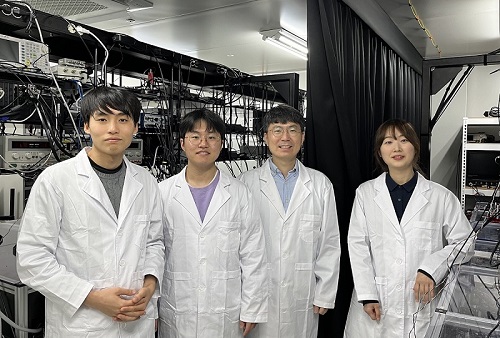
<(From Left) Ph.D candidate Geunhee Gwak, Professor Young-Sik Ra, Dr. Chan Roh, Ph.D candidate Young-Do Yoon from KAIST, (Top Left) Professor M.S Kim from Imperial College London>
Optical quantum computers are gaining attention as a next-generation computing technology with high speed and scalability. However, accurately characterizing complex optical processes, where multiple optical modes interact to generate quantum entanglement, has been considered an extremely challenging task. KAIST research team has overcome this limitation, developing a highly efficient technique that enables complete characterization of complex multimode quantum operations in experiment. This technology, which can analyze large-scale operations with less data, represents an important step toward scalable quantum computing and quantum communication technologies.
KAIST announced on November 17th that a research team led by Professor Young-Sik Ra from the Department of Physics has developed a Multimode Quantum Process Tomography technique capable of efficiently identifying the characteristics of second-order nonlinear optical quantum processes that are essential for optical quantum computing.
Efficient 'CT Scan' Technology for Quantum Computers
'Tomography' is a technique, similar to a medical CT scan, that reconstructs an invisible internal structure from diverse measurements. Similarly, quantum computing requires a method that reconstructs the internal workings of quantum operations using various measurement data. To outperform conventional computers, a quantum computer must be capable of manipulating a large number of quantum units (qubits or qumodes) at the same time. However, as the number of qubits or quantum optical modes (qumodes) increases, the resources required for tomography grows exponentially, making existing technologies unable to analyze systems with even five or more optical modes.
With the newly developed technique, the research team is now able to clearly determine what actually happens inside an optical quantum computer, as if taking a CT scan.
Introducing a New Mathematical Framework Based on Amplification and Noise Matrices
Inside a quantum computer, multiple optical modes interact in a highly complex and entangled way. The research team has introduced a new mathematical framework that precisely describes multimode second-order nonlinear optical quantum processes.
This method analyzes how input states change under a given operation using two key components: the 'Amplification matrix,' which describes how the mean fields of light are transformed, and the 'Noise matrix,' which captures the noise or loss introduced through environmental interactions.
Together, these components create a 'quantum state map' that enables accurate and simultaneous observation of both the ideal quantum evolution of light (unitary changes) and the unavoidable noise (non-unitary changes) present in real devices. This leads to a much more realistic characterization of how an optical quantum computer actually operates.
Reducing the Required Measurement Data and Expanding Analysis to 16 Modes
To determine how a quantum operation works, the research team input several types of quantum states and observed how the outputs changed. They then applied a statistical method known as Maximum Likelihood Estimation to reconstruct the internal operation that most accurately explains the collected data while satisfying the necessary physical conditions.
Using this approach, the research team dramatically reduced the amount of measurement data required. Whereas existing methods quickly become impractical—requiring enormous datasets even for systems with slightly more than a few modes and typically limiting analysis to about five modes—the new technique overcomes this bottleneck. The team successfully performed the world’s first experimental characterization of a large-scale optical quantum operation involving 16 modes, an unprecedented milestone in the field.
<Figure1.Experimental scheme. (Left) Various coherent states are used as input probes to determine the amplification matrix. (Right) A vacuum input state is used to additionally determine the noise matrix.>
<Figure2.Characterization results. (a) 16-mode second-order nonlinear optical quantum process. (b) Cluster state generation. (c) Mode-dependent loss with nonlinear interaction. (d) Quantum noise channel. Left and right columns show the amplification and noise matrices, respectively>
Professor Young-Sik Ra stated, "This research significantly increases the efficiency of Quantum Process Tomography, a foundational technology essential for quantum computing. The acquired technology will greatly contribute to enhancing the scalability and reliability of various quantum technologies, including quantum computing, quantum communication, and quantum sensing."
The study, in which Geunhee Gwak (Integrated M.S, Ph.D. Candidate, Department of Physics) participated as the first author, and Dr. Chan Roh (Postdoctoral Researcher), Young-Do Yoon (Integrated M.S./Ph.D. Candidate), and Professor Myungshik Kim (Imperial College London) participated as co-authors, was formally published online in the prominent international academic journal 'Nature Photonics' on November 11, 2025.
※ Article Title: Completely characterizing multimode second-order nonlinear optical quantum processes, DOI:10.1038/s41566-025-01787-x
This research was supported by the National Research Foundation of Korea (Quantum Computing Technology Development Project, Mid-career Researcher Support Project, Quantum Simulator Development for Material Innovation Project, Quantum Technology R&D Flagship Project, Basic Research Lab Support Project), the Institute of Information & Communications Technology Planning & Evaluation (Core Source Technology for Quantum Internet Project, University ICT Research Center Support Project), and the US Air Force Research Laboratory.
KAIST achieves quantum entanglement essential for quantum error correction
Quantum computing is a technology capable of solving complex problems that classical computers struggle with. To perform accurate computations, quantum computers must correct errors that arise during operations. However, generating the quantum entanglement necessary for quantum error correction has long been considered a major challenge.
< Photo 1. (From left) Students Young-Do Yoon and Chan Roh of the Master's and Doctoral Integrated Program of the Department of Physics poses with Professor Young-Sik Ra and Student Geunhee Gwak of the same program >
KAIST (represented by President Kwang Hyung Lee) announced on the 25th of February that a research team led by Professor Young-Sik Ra from the Department of Physics has successfully implemented a three-dimensional cluster quantum entangled state, a key component for quantum error correction, through experimental demonstration.
Measurement-based quantum computing is an emerging paradigm that implements quantum computations by measuring specially entangled cluster states. The core of this approach lies in the generation of these cluster quantum entangled states, with two-dimensional cluster states commonly used for universal quantum computing.
However, to advance towards fault-tolerant quantum computing, which can correct quantum errors occurring during computations, a more complex three-dimensional cluster state is required. While previous studies have reported the generation of two-dimensional cluster states, experimental implementation of the three-dimensional cluster states necessary for fault-tolerant quantum computing had remained elusive due to the extreme complexity of their entanglement structure.
< Figure 1. (a) Experimental schematic. A pulse laser with a wavelength of 800 nm is converted into a pulse laser with a wavelength of 400 nm through second harmonic generation, and this is incident on a nonlinear crystal (PPKTP) to generate multiple quantum entanglement sources. (b) Generation of a 3D cluster state through optical mode basis change >
The research team overcame this challenge by developing a technique to control femtosecond time-frequency modes, successfully generating a three-dimensional cluster quantum entangled state for the first time.
The team directed a femtosecond laser into a nonlinear crystal, simultaneously generating quantum light sources across multiple frequency modes. (A femtosecond laser is a device that emits ultrashort, high-intensity light pulses.) Using this approach, they successfully created a three-dimensional cluster quantum entangled state.
Professor Young-Sik Ra noted, “This study marks the first successful demonstration of a three-dimensional cluster quantum entangled state, which was previously difficult to achieve with existing technology. This breakthrough is expected to serve as a crucial stepping stone for future research in measurement-based and fault-tolerant quantum computing.”
< Figure 2. Results of 3D cluster state generation. (a) Nullifier measurement of the cluster state. (b) 3D cluster state reconstructed using quantum state tomography. (c) Confirmation of quantum entanglement characteristics of the 3D cluster state >
The study was published online in Nature Photonics on February 24, 2025. The first author is Chan Roh, a Ph.D. candidate in KAIST’s integrated master’s and doctoral program, with Geunhee Gwak and Youngdo Yoon contributing as co-authors. (Paper title: “Generation of Three-Dimensional Cluster Entangled State”, DOI: 10.1038/s41566-025-01631-2)
This research was supported by the National Research Foundation of Korea (Quantum Computing Technology Development Program, Mid-Career Researcher Support Program, and Quantum Simulator for Materials Innovation Program), the Institute for Information & Communications Technology Planning & Evaluation (Quantum Internet Core Technology Program, University ICT Research Center Support Program), and the U.S. Air Force Research Laboratory.