본문 바로가기
대메뉴 바로가기
KAIST
Newsletter Vol.28
Receive KAIST news by email!
View
Subscribe
Close
Type your e-mail address here.
Subscribe
Close
KAIST
NEWS
유틸열기
홈페이지 통합검색
-
검색
KOREAN
메뉴 열기
Tae-Hyun+Oh
by recently order
by view order
Soul-Searching & Odds-Defying Determination: A Commencement Story of Dr. Tae-Hyun Oh
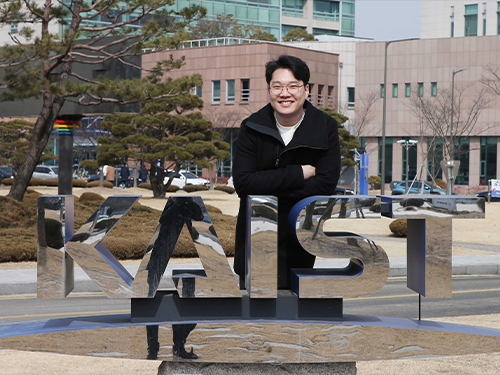
(Dr. Tae-Hyun Oh, one of the 2736 graduates of the 2018) Each and every one of the 2,736 graduates has come a long way to the 2018 Commencement. Tae-Hyun Oh, who just started his new research career at MIT after completing his Ph.D. at KAIST, is no exception. Unlike the most KAIST freshmen straight out of the ingenious science academies of Korea, he is among the many who endured very challenging and turbulent adolescent years. Buffeted by family instability and struggling during his time at school, he saw himself trapped by seemingly impenetrable barriers. His mother, who hated to see his struggling, advised him to take a break to reflect on who he is and what he wanted to do. After dropping out of high school in his first year, ways to make money and support his family occupied his thoughts. He took on odd jobs from a car body shop to a gas station, but the real world was very tough and sometimes even cruel to the high school dropout. Bias and prejudice stigmatizing dropouts hurt him so much. He often overheard a parent who dropped by the body shop that he worked in saying, “If you do not study hard, you will end up like this guy.” Hearing such things terrified him and awoke his sense of purpose. So he decided to do something meaningful and be a better man than he was. “I didn’t like the person I was growing up to become. I needed to find myself and get away from the place I was growing up. It was my adventure and it was the best decision I ever made,” says Oh. After completing his high school diploma national certificate, he planned to apply to an engineering college. On his second try, he gained admission into the Department of Electrical Engineering at Kwang Woon University with a full scholarship. He was so thrilled for this opportunity and hoped he could do well at college. Signal processing and image processing became the interest of his research and he finished his undergraduate degree summa cum laude. Gaining confidence in his studies, he searched around graduate school department websites in Korea to select the path he was interested in. Among others, the Robotics and Computer Vision Lab of Professor In-So Kweon at the Department of Electrical Engineering at KAIST was attractive to him. Professor Kweon’s lab is globally renowned for robot vision technology. Their technologies were applied into HUBO, the KAIST-developed bimodal humanoid robot that won the 2015 DARPA Challenges. “I am so appreciate of Professor Kweon, who accepted and guided me,” he said. Under Professor Kweon’s advising, he could finish his Master’s and Ph.D. courses in seven years. The mathematical modeling on fundamental computer algorithms became his main research topic. While at KAIST, his academic research has blossomed. He won a total of 13 research prizes sponsored by corporations at home and abroad such as Kolon, Samsung, Hyundai Motors, and Qualcomm. In 2015, he won the Microsoft Research Asia Fellowship as the sole Korean among 13 Ph.D. candidates in the Asian region. With the MSRA fellowship, he could intern at the MS Research Beijing Office for half a year and then in Redmond, Washington in the US. “Professor Kweon’s lab filled me up with knowledge. Whenever I presented our team’s paper at an international conference, I was amazed by the strong interest shown by foreign experts, researchers, and professors. Their strong support and interest encouraged me a lot. I was fully charged with the belief that I could go abroad and explore more opportunities,” he said. Dr. Oh, who completed his dissertation last fall, now works at the Department of Electrical Engineering and Computer Science at MIT under Professor Wojciech Matusik. “I think the research environment at KAIST is on par with MIT. I have very rich resources for my studies and research at both schools, but at MIT the working culture is a little different and it remains a big challenge for me. I am still not familiar with collaborative work with colleagues from very diverse backgrounds and countries, and to persuade them and communicate with them is very tough. But I think I am getting better and better,” he said. Oh, who is an avid computer game player as well, said life seems to be a game. The level of the game will be upgraded to the next level after something is accomplished. He feels great joy when he is moving up and he believes such diverse experiences have helped him become a better person day by day. Once he identified what gave him a strong sense of purpose, he wasn’t stressed out by his studies any more. He was so excited to be able to follow his passion and is ready for the next challenge.
2018.02.23
View 12492
<<
첫번째페이지
<
이전 페이지
1
>
다음 페이지
>>
마지막 페이지 1