Seong
-
 KAIST Develops a Multifunctional Structural Battery Capable of Energy Storage and Load Support
Structural batteries are used in industries such as eco-friendly, energy-based automobiles, mobility, and aerospace, and they must simultaneously meet the requirements of high energy density for energy storage and high load-bearing capacity. Conventional structural battery technology has struggled to enhance both functions concurrently. However, KAIST researchers have succeeded in developing foundational technology to address this issue.
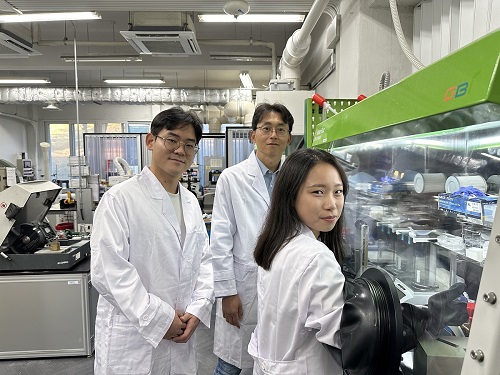
< Photo 1. (From left) Professor Seong Su Kim, PhD candidates Sangyoon Bae and Su Hyun Lim of the Department of Mechanical Engineering >
< Photo 2. (From left) Professor Seong Su Kim and Master's Graduate Mohamad A. Raja of KAIST Department of Mechanical Engineering >
KAIST (represented by President Kwang Hyung Lee) announced on the 19th of November that Professor Seong Su Kim's team from the Department of Mechanical Engineering has developed a thin, uniform, high-density, multifunctional structural carbon fiber composite battery* capable of supporting loads, and that is free from fire risks while offering high energy density.
*Multifunctional structural batteries: Refers to the ability of each material in the composite to simultaneously serve as a load-bearing structure and an energy storage element.
Early structural batteries involved embedding commercial lithium-ion batteries into layered composite materials. These batteries suffered from low integration of their mechanical and electrochemical properties, leading to challenges in material processing, assembly, and design optimization, making commercialization difficult.
To overcome these challenges, Professor Kim's team explored the concept of "energy-storing composite materials," focusing on interface and curing properties, which are critical in traditional composite design. This led to the development of high-density multifunctional structural carbon fiber composite batteries that maximize multifunctionality.
The team analyzed the curing mechanisms of epoxy resin, known for its strong mechanical properties, combined with ionic liquid and carbonate electrolyte-based solid polymer electrolytes. By controlling temperature and pressure, they were able to optimize the curing process.
The newly developed structural battery was manufactured through vacuum compression molding, increasing the volume fraction of carbon fibers—serving as both electrodes and current collectors—by over 160% compared to previous carbon-fiber-based batteries.
This greatly increased the contact area between electrodes and electrolytes, resulting in a high-density structural battery with improved electrochemical performance. Furthermore, the team effectively controlled air bubbles within the structural battery during the curing process, simultaneously enhancing the battery's mechanical properties.
Professor Seong Su Kim, the lead researcher, explained, “We proposed a framework for designing solid polymer electrolytes, a core material for high-stiffness, ultra-thin structural batteries, from both material and structural perspectives. These material-based structural batteries can serve as internal components in cars, drones, airplanes, and robots, significantly extending their operating time with a single charge. This represents a foundational technology for next-generation multifunctional energy storage applications.”
< Figure 2. Supplementary cover of ACS Applied Materials & Interfaces >
Mohamad A. Raja, a master’s graduate of KAIST’s Department of Mechanical Engineering, participated as the first author of this research, which was published in the prestigious journal ACS Applied Materials & Interfaces on September 10. The paper was recognized for its excellence and selected as a supplementary cover article. (Paper title: “Thin, Uniform, and Highly Packed Multifunctional Structural Carbon Fiber Composite Battery Lamina Informed by Solid Polymer Electrolyte Cure Kinetics.” https://doi.org/10.1021/acsami.4c08698)
This research was supported by the National Research Foundation of Korea’s Mid-Career Researcher Program and the National Semiconductor Research Laboratory Development Program.
2024.11.27 View 5829
KAIST Develops a Multifunctional Structural Battery Capable of Energy Storage and Load Support
Structural batteries are used in industries such as eco-friendly, energy-based automobiles, mobility, and aerospace, and they must simultaneously meet the requirements of high energy density for energy storage and high load-bearing capacity. Conventional structural battery technology has struggled to enhance both functions concurrently. However, KAIST researchers have succeeded in developing foundational technology to address this issue.
< Photo 1. (From left) Professor Seong Su Kim, PhD candidates Sangyoon Bae and Su Hyun Lim of the Department of Mechanical Engineering >
< Photo 2. (From left) Professor Seong Su Kim and Master's Graduate Mohamad A. Raja of KAIST Department of Mechanical Engineering >
KAIST (represented by President Kwang Hyung Lee) announced on the 19th of November that Professor Seong Su Kim's team from the Department of Mechanical Engineering has developed a thin, uniform, high-density, multifunctional structural carbon fiber composite battery* capable of supporting loads, and that is free from fire risks while offering high energy density.
*Multifunctional structural batteries: Refers to the ability of each material in the composite to simultaneously serve as a load-bearing structure and an energy storage element.
Early structural batteries involved embedding commercial lithium-ion batteries into layered composite materials. These batteries suffered from low integration of their mechanical and electrochemical properties, leading to challenges in material processing, assembly, and design optimization, making commercialization difficult.
To overcome these challenges, Professor Kim's team explored the concept of "energy-storing composite materials," focusing on interface and curing properties, which are critical in traditional composite design. This led to the development of high-density multifunctional structural carbon fiber composite batteries that maximize multifunctionality.
The team analyzed the curing mechanisms of epoxy resin, known for its strong mechanical properties, combined with ionic liquid and carbonate electrolyte-based solid polymer electrolytes. By controlling temperature and pressure, they were able to optimize the curing process.
The newly developed structural battery was manufactured through vacuum compression molding, increasing the volume fraction of carbon fibers—serving as both electrodes and current collectors—by over 160% compared to previous carbon-fiber-based batteries.
This greatly increased the contact area between electrodes and electrolytes, resulting in a high-density structural battery with improved electrochemical performance. Furthermore, the team effectively controlled air bubbles within the structural battery during the curing process, simultaneously enhancing the battery's mechanical properties.
Professor Seong Su Kim, the lead researcher, explained, “We proposed a framework for designing solid polymer electrolytes, a core material for high-stiffness, ultra-thin structural batteries, from both material and structural perspectives. These material-based structural batteries can serve as internal components in cars, drones, airplanes, and robots, significantly extending their operating time with a single charge. This represents a foundational technology for next-generation multifunctional energy storage applications.”
< Figure 2. Supplementary cover of ACS Applied Materials & Interfaces >
Mohamad A. Raja, a master’s graduate of KAIST’s Department of Mechanical Engineering, participated as the first author of this research, which was published in the prestigious journal ACS Applied Materials & Interfaces on September 10. The paper was recognized for its excellence and selected as a supplementary cover article. (Paper title: “Thin, Uniform, and Highly Packed Multifunctional Structural Carbon Fiber Composite Battery Lamina Informed by Solid Polymer Electrolyte Cure Kinetics.” https://doi.org/10.1021/acsami.4c08698)
This research was supported by the National Research Foundation of Korea’s Mid-Career Researcher Program and the National Semiconductor Research Laboratory Development Program.
2024.11.27 View 5829 -
 Hydrogel-Based Flexible Brain-Machine Interface
The interface is easy to insert into the body when dry, but behaves ‘stealthily’ inside the brain when wet
Professor Seongjun Park’s research team and collaborators revealed a newly developed hydrogel-based flexible brain-machine interface. To study the structure of the brain or to identify and treat neurological diseases, it is crucial to develop an interface that can stimulate the brain and detect its signals in real time. However, existing neural interfaces are mechanically and chemically different from real brain tissue. This causes foreign body response and forms an insulating layer (glial scar) around the interface, which shortens its lifespan.
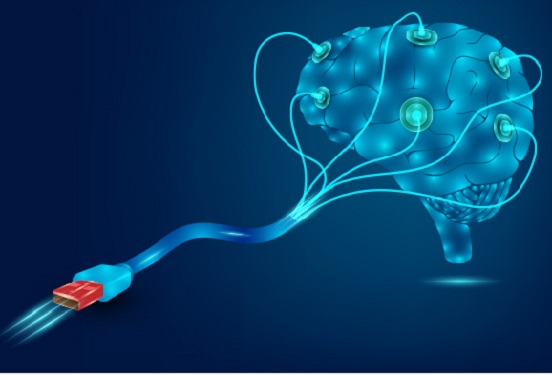
To solve this problem, the research team developed a ‘brain-mimicking interface’ by inserting a custom-made multifunctional fiber bundle into the hydrogel body. The device is composed not only of an optical fiber that controls specific nerve cells with light in order to perform optogenetic procedures, but it also has an electrode bundle to read brain signals and a microfluidic channel to deliver drugs to the brain.
The interface is easy to insert into the body when dry, as hydrogels become solid. But once in the body, the hydrogel will quickly absorb body fluids and resemble the properties of its surrounding tissues, thereby minimizing foreign body response.
The research team applied the device on animal models, and showed that it was possible to detect neural signals for up to six months, which is far beyond what had been previously recorded. It was also possible to conduct long-term optogenetic and behavioral experiments on freely moving mice with a significant reduction in foreign body responses such as glial and immunological activation compared to existing devices.
“This research is significant in that it was the first to utilize a hydrogel as part of a multifunctional neural interface probe, which increased its lifespan dramatically,” said Professor Park. “With our discovery, we look forward to advancements in research on neurological disorders like Alzheimer’s or Parkinson’s disease that require long-term observation.”
The research was published in Nature Communications on June 8, 2021. (Title: Adaptive and multifunctional hydrogel hybrid probes for long-term sensing and modulation of neural activity) The study was conducted jointly with an MIT research team composed of Professor Polina Anikeeva, Professor Xuanhe Zhao, and Dr. Hyunwoo Yook.
This research was supported by the National Research Foundation (NRF) grant for emerging research, Korea Medical Device Development Fund, KK-JRC Smart Project, KAIST Global Initiative Program, and Post-AI Project.
-PublicationPark, S., Yuk, H., Zhao, R. et al. Adaptive and multifunctional hydrogel hybrid probes for long-term sensing and modulation of neural activity. Nat Commun 12, 3435 (2021). https://doi.org/10.1038/s41467-021-23802-9
-ProfileProfessor Seongjun ParkBio and Neural Interfaces LaboratoryDepartment of Bio and Brain EngineeringKAIST
2021.07.13 View 12972
Hydrogel-Based Flexible Brain-Machine Interface
The interface is easy to insert into the body when dry, but behaves ‘stealthily’ inside the brain when wet
Professor Seongjun Park’s research team and collaborators revealed a newly developed hydrogel-based flexible brain-machine interface. To study the structure of the brain or to identify and treat neurological diseases, it is crucial to develop an interface that can stimulate the brain and detect its signals in real time. However, existing neural interfaces are mechanically and chemically different from real brain tissue. This causes foreign body response and forms an insulating layer (glial scar) around the interface, which shortens its lifespan.
To solve this problem, the research team developed a ‘brain-mimicking interface’ by inserting a custom-made multifunctional fiber bundle into the hydrogel body. The device is composed not only of an optical fiber that controls specific nerve cells with light in order to perform optogenetic procedures, but it also has an electrode bundle to read brain signals and a microfluidic channel to deliver drugs to the brain.
The interface is easy to insert into the body when dry, as hydrogels become solid. But once in the body, the hydrogel will quickly absorb body fluids and resemble the properties of its surrounding tissues, thereby minimizing foreign body response.
The research team applied the device on animal models, and showed that it was possible to detect neural signals for up to six months, which is far beyond what had been previously recorded. It was also possible to conduct long-term optogenetic and behavioral experiments on freely moving mice with a significant reduction in foreign body responses such as glial and immunological activation compared to existing devices.
“This research is significant in that it was the first to utilize a hydrogel as part of a multifunctional neural interface probe, which increased its lifespan dramatically,” said Professor Park. “With our discovery, we look forward to advancements in research on neurological disorders like Alzheimer’s or Parkinson’s disease that require long-term observation.”
The research was published in Nature Communications on June 8, 2021. (Title: Adaptive and multifunctional hydrogel hybrid probes for long-term sensing and modulation of neural activity) The study was conducted jointly with an MIT research team composed of Professor Polina Anikeeva, Professor Xuanhe Zhao, and Dr. Hyunwoo Yook.
This research was supported by the National Research Foundation (NRF) grant for emerging research, Korea Medical Device Development Fund, KK-JRC Smart Project, KAIST Global Initiative Program, and Post-AI Project.
-PublicationPark, S., Yuk, H., Zhao, R. et al. Adaptive and multifunctional hydrogel hybrid probes for long-term sensing and modulation of neural activity. Nat Commun 12, 3435 (2021). https://doi.org/10.1038/s41467-021-23802-9
-ProfileProfessor Seongjun ParkBio and Neural Interfaces LaboratoryDepartment of Bio and Brain EngineeringKAIST
2021.07.13 View 12972 -
 Professor Poong Hyun Seong Elected INSC Chair
Professor Emeritus Poong Hyun Seong from the Department of Nuclear and Quantum Engineering was elected as the Chairman of the International Nuclear Societies Council (INSC). His two-year term began on January 1.
The INSC is an organization made up of nuclear societies all over the world, representing more than 80,000 nuclear professionals. The INSC founded in 1990 acts as a global forum to establish common goals of nuclear power usage, delivering the views and ideas of professionals throughout their regional societies.
The INSC has advocated for nuclear power to be deemed an indispensable clean energy resources that can mitigate the climate change. The council has engaged in public awareness and publicity activities promoting the advantages of nuclear energy for developing next-generation power plants such as small nuclear reactors, local heating system, seawater desalination, and fair production of energy.
Professor Seong is a globally renowned scholar in the fields of nuclear instrumentation control and human factor engineering. He retired last year after 30-year career at KAIST. He took on leadership roles in the Korea Nuclear Society and served as a member of the Korea Nuclear Safety and Security Commission as well as Atomic Energy Commission. A fellow at the America Nuclear Society, Professor Seong served as the first vice chair of the INSC and he received the Don Miller Award in 2019. The award established in 2009 by the American Nuclear Society in honor of former ANS President Don Miller is given to an individual who has made a significant contribution to the advancement of nuclear instrumentation and control of human-machine interfaces.
He led the leadership role to help the Korean government steered into efficient and reasonable energy policymaking. More recently, as the Korean government decided to abandon nuclear energy, he actively opposed the government’s pivot. Professor Seong said, “Advanced countries like the US, UK, France, and Japan push forward the production of renewable energy by driving nuclear power plant under their pledges toward carbon neutrality by 2050. However, we are very concerned about the government’s policy shift to decrease the number of nuclear power plants while increasing the fossil fuel usage. I don’t think we can realize carbon neutrality by 2050 with the current policy.”
(END)
2021.01.13 View 7763
Professor Poong Hyun Seong Elected INSC Chair
Professor Emeritus Poong Hyun Seong from the Department of Nuclear and Quantum Engineering was elected as the Chairman of the International Nuclear Societies Council (INSC). His two-year term began on January 1.
The INSC is an organization made up of nuclear societies all over the world, representing more than 80,000 nuclear professionals. The INSC founded in 1990 acts as a global forum to establish common goals of nuclear power usage, delivering the views and ideas of professionals throughout their regional societies.
The INSC has advocated for nuclear power to be deemed an indispensable clean energy resources that can mitigate the climate change. The council has engaged in public awareness and publicity activities promoting the advantages of nuclear energy for developing next-generation power plants such as small nuclear reactors, local heating system, seawater desalination, and fair production of energy.
Professor Seong is a globally renowned scholar in the fields of nuclear instrumentation control and human factor engineering. He retired last year after 30-year career at KAIST. He took on leadership roles in the Korea Nuclear Society and served as a member of the Korea Nuclear Safety and Security Commission as well as Atomic Energy Commission. A fellow at the America Nuclear Society, Professor Seong served as the first vice chair of the INSC and he received the Don Miller Award in 2019. The award established in 2009 by the American Nuclear Society in honor of former ANS President Don Miller is given to an individual who has made a significant contribution to the advancement of nuclear instrumentation and control of human-machine interfaces.
He led the leadership role to help the Korean government steered into efficient and reasonable energy policymaking. More recently, as the Korean government decided to abandon nuclear energy, he actively opposed the government’s pivot. Professor Seong said, “Advanced countries like the US, UK, France, and Japan push forward the production of renewable energy by driving nuclear power plant under their pledges toward carbon neutrality by 2050. However, we are very concerned about the government’s policy shift to decrease the number of nuclear power plants while increasing the fossil fuel usage. I don’t think we can realize carbon neutrality by 2050 with the current policy.”
(END)
2021.01.13 View 7763 -
 Hydrogel-Based Flexible Brain-Machine Interface
The interface is easy to insert into the body when dry, but behaves ‘stealthily’ inside the brain when wet
Professor Seongjun Park’s research team and collaborators revealed a newly developed hydrogel-based flexible brain-machine interface. To study the structure of the brain or to identify and treat neurological diseases, it is crucial to develop an interface that can stimulate the brain and detect its signals in real time. However, existing neural interfaces are mechanically and chemically different from real brain tissue. This causes foreign body response and forms an insulating layer (glial scar) around the interface, which shortens its lifespan.
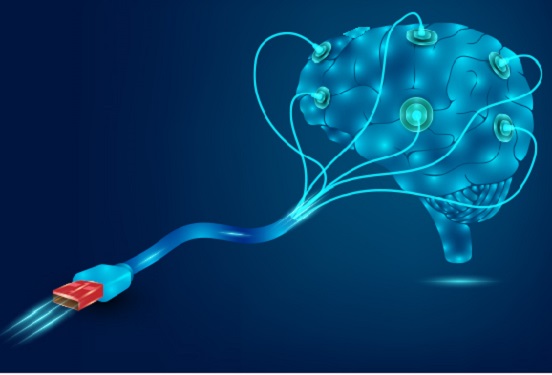
To solve this problem, the research team developed a ‘brain-mimicking interface’ by inserting a custom-made multifunctional fiber bundle into the hydrogel body. The device is composed not only of an optical fiber that controls specific nerve cells with light in order to perform optogenetic procedures, but it also has an electrode bundle to read brain signals and a microfluidic channel to deliver drugs to the brain.
The interface is easy to insert into the body when dry, as hydrogels become solid. But once in the body, the hydrogel will quickly absorb body fluids and resemble the properties of its surrounding tissues, thereby minimizing foreign body response.
The research team applied the device on animal models, and showed that it was possible to detect neural signals for up to six months, which is far beyond what had been previously recorded. It was also possible to conduct long-term optogenetic and behavioral experiments on freely moving mice with a significant reduction in foreign body responses such as glial and immunological activation compared to existing devices.
“This research is significant in that it was the first to utilize a hydrogel as part of a multifunctional neural interface probe, which increased its lifespan dramatically,” said Professor Park. “With our discovery, we look forward to advancements in research on neurological disorders like Alzheimer’s or Parkinson’s disease that require long-term observation.”
The research was published in Nature Communications on June 8, 2021. (Title: Adaptive and multifunctional hydrogel hybrid probes for long-term sensing and modulation of neural activity) The study was conducted jointly with an MIT research team composed of Professor Polina Anikeeva, Professor Xuanhe Zhao, and Dr. Hyunwoo Yook.
This research was supported by the National Research Foundation (NRF) grant for emerging research, Korea Medical Device Development Fund, KK-JRC Smart Project, KAIST Global Initiative Program, and Post-AI Project.
-Publication
Park, S., Yuk, H., Zhao, R. et al. Adaptive and multifunctional hydrogel hybrid probes for long-term sensing and modulation of neural activity. Nat Commun 12, 3435 (2021). https://doi.org/10.1038/s41467-021-23802-9
-Profile
Professor Seongjun Park
Bio and Neural Interfaces Laboratory
Department of Bio and Brain Engineering
KAIST
2020.07.13 View 8871
Hydrogel-Based Flexible Brain-Machine Interface
The interface is easy to insert into the body when dry, but behaves ‘stealthily’ inside the brain when wet
Professor Seongjun Park’s research team and collaborators revealed a newly developed hydrogel-based flexible brain-machine interface. To study the structure of the brain or to identify and treat neurological diseases, it is crucial to develop an interface that can stimulate the brain and detect its signals in real time. However, existing neural interfaces are mechanically and chemically different from real brain tissue. This causes foreign body response and forms an insulating layer (glial scar) around the interface, which shortens its lifespan.
To solve this problem, the research team developed a ‘brain-mimicking interface’ by inserting a custom-made multifunctional fiber bundle into the hydrogel body. The device is composed not only of an optical fiber that controls specific nerve cells with light in order to perform optogenetic procedures, but it also has an electrode bundle to read brain signals and a microfluidic channel to deliver drugs to the brain.
The interface is easy to insert into the body when dry, as hydrogels become solid. But once in the body, the hydrogel will quickly absorb body fluids and resemble the properties of its surrounding tissues, thereby minimizing foreign body response.
The research team applied the device on animal models, and showed that it was possible to detect neural signals for up to six months, which is far beyond what had been previously recorded. It was also possible to conduct long-term optogenetic and behavioral experiments on freely moving mice with a significant reduction in foreign body responses such as glial and immunological activation compared to existing devices.
“This research is significant in that it was the first to utilize a hydrogel as part of a multifunctional neural interface probe, which increased its lifespan dramatically,” said Professor Park. “With our discovery, we look forward to advancements in research on neurological disorders like Alzheimer’s or Parkinson’s disease that require long-term observation.”
The research was published in Nature Communications on June 8, 2021. (Title: Adaptive and multifunctional hydrogel hybrid probes for long-term sensing and modulation of neural activity) The study was conducted jointly with an MIT research team composed of Professor Polina Anikeeva, Professor Xuanhe Zhao, and Dr. Hyunwoo Yook.
This research was supported by the National Research Foundation (NRF) grant for emerging research, Korea Medical Device Development Fund, KK-JRC Smart Project, KAIST Global Initiative Program, and Post-AI Project.
-Publication
Park, S., Yuk, H., Zhao, R. et al. Adaptive and multifunctional hydrogel hybrid probes for long-term sensing and modulation of neural activity. Nat Commun 12, 3435 (2021). https://doi.org/10.1038/s41467-021-23802-9
-Profile
Professor Seongjun Park
Bio and Neural Interfaces Laboratory
Department of Bio and Brain Engineering
KAIST
2020.07.13 View 8871 -
 A Single, Master Switch for Sugar Levels?
When a fly eats sugar, a single brain cell sends simultaneous messages to stimulate one hormone and inhibit another to control glucose levels in the body. Further research into this control system with remarkable precision could shed light on the neural mechanisms of diabetes and obesity in humans .
A single neuron appears to monitor and control sugar levels in the fly body, according to research published this week in Nature. This new insight into the mechanisms in the fly brain that maintain a balance of two key hormones controlling glucose levels, insulin and glucagon, can provide a framework for understanding diabetes and obesity in humans.
Neurons that sense and respond to glucose were identified more than 50 years ago, but what they do in our body has remained unclear. Researchers at the Korea Advanced Institute of Science and Technology (KAIST) and New York University School of Medicine have now found a single “glucose-sensing neuron” that appears to be the master controller in Drosophila, the vinegar fly, for maintaining an ideal glucose balance, called homeostasis.
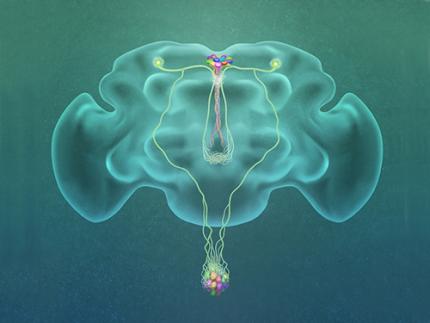
Professor Greg Seong-Bae Suh, Dr. Yangkyun Oh and colleagues identified a key neuron that is excited by glucose, which they called CN neuron. This CN neuron has a unique shape – it has an axon (which is used to transmit information to downstream cells) that is bifurcated. One branch projects to insulin-producing cells, and sends a signal triggering the secretion of the insulin equivalent in flies. The other branch projects to glucagon-producing cells and sends a signal inhibiting the secretion of the glucagon equivalent.
When flies consume food, the levels of glucose in their body increase; this excites the CN neuron, which fires the simultaneous signals to stimulate insulin and inhibit glucagon secretion, thereby maintaining the appropriate balance between the hormones and sugar in the blood. The researchers were able to see this happening in the brain in real time by using a combination of cutting-edge fluorescent calcium imaging technology, as well as measuring hormone and sugar levels and applying highly sophisticated molecular genetic techniques.
When flies were not fed, however, the researchers observed a reduction in the activity of CN neuron, a reduction in insulin secretion and an increase in glucagon secretion. These findings indicate that these key hormones are under the direct control of the glucose-sensing neuron. Furthermore, when they silenced the CN neuron rendering dysfunctional CN neuron in flies, these animals experienced an imbalance, resulting in hyperglycemia – high levels of sugars in the blood, similar to what is observed in diabetes in humans. This further suggests that the CN neuron is critical to maintaining glucose homeostasis in animals.
While further research is required to investigate this process in humans, Suh notes this is a significant step forward in the fields of both neurobiology and endocrinology.
“This work lays the foundation for translational research to better understand how this delicate regulatory process is affected by diabetes, obesity, excessive nutrition and diets high in sugar,” Suh said.
Profile: Greg Seong-Bae Suh
seongbaesuh@kaist.ac.kr
Professor Department of Biological Sciences
KAIST
(Figure: A single glucose-excited CN neuron extends bifurcated axonal branches,
one of which innervates insulin producing cells and stimulates their activity an the other axonal branch projects to glucagon producing cells and inhibits their activity.)
2019.10.24 View 18755
A Single, Master Switch for Sugar Levels?
When a fly eats sugar, a single brain cell sends simultaneous messages to stimulate one hormone and inhibit another to control glucose levels in the body. Further research into this control system with remarkable precision could shed light on the neural mechanisms of diabetes and obesity in humans .
A single neuron appears to monitor and control sugar levels in the fly body, according to research published this week in Nature. This new insight into the mechanisms in the fly brain that maintain a balance of two key hormones controlling glucose levels, insulin and glucagon, can provide a framework for understanding diabetes and obesity in humans.
Neurons that sense and respond to glucose were identified more than 50 years ago, but what they do in our body has remained unclear. Researchers at the Korea Advanced Institute of Science and Technology (KAIST) and New York University School of Medicine have now found a single “glucose-sensing neuron” that appears to be the master controller in Drosophila, the vinegar fly, for maintaining an ideal glucose balance, called homeostasis.
Professor Greg Seong-Bae Suh, Dr. Yangkyun Oh and colleagues identified a key neuron that is excited by glucose, which they called CN neuron. This CN neuron has a unique shape – it has an axon (which is used to transmit information to downstream cells) that is bifurcated. One branch projects to insulin-producing cells, and sends a signal triggering the secretion of the insulin equivalent in flies. The other branch projects to glucagon-producing cells and sends a signal inhibiting the secretion of the glucagon equivalent.
When flies consume food, the levels of glucose in their body increase; this excites the CN neuron, which fires the simultaneous signals to stimulate insulin and inhibit glucagon secretion, thereby maintaining the appropriate balance between the hormones and sugar in the blood. The researchers were able to see this happening in the brain in real time by using a combination of cutting-edge fluorescent calcium imaging technology, as well as measuring hormone and sugar levels and applying highly sophisticated molecular genetic techniques.
When flies were not fed, however, the researchers observed a reduction in the activity of CN neuron, a reduction in insulin secretion and an increase in glucagon secretion. These findings indicate that these key hormones are under the direct control of the glucose-sensing neuron. Furthermore, when they silenced the CN neuron rendering dysfunctional CN neuron in flies, these animals experienced an imbalance, resulting in hyperglycemia – high levels of sugars in the blood, similar to what is observed in diabetes in humans. This further suggests that the CN neuron is critical to maintaining glucose homeostasis in animals.
While further research is required to investigate this process in humans, Suh notes this is a significant step forward in the fields of both neurobiology and endocrinology.
“This work lays the foundation for translational research to better understand how this delicate regulatory process is affected by diabetes, obesity, excessive nutrition and diets high in sugar,” Suh said.
Profile: Greg Seong-Bae Suh
seongbaesuh@kaist.ac.kr
Professor Department of Biological Sciences
KAIST
(Figure: A single glucose-excited CN neuron extends bifurcated axonal branches,
one of which innervates insulin producing cells and stimulates their activity an the other axonal branch projects to glucagon producing cells and inhibits their activity.)
2019.10.24 View 18755 -
 "It’s a Blessing": Lawyer Couple Donates 82 Acres of Land
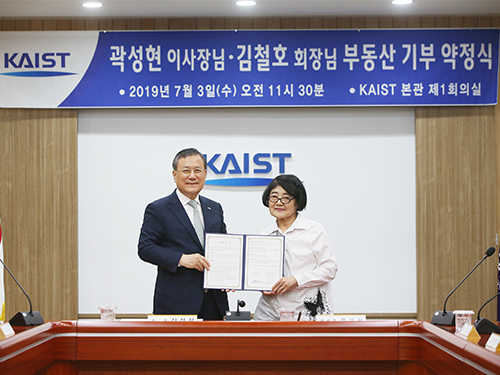
Korea Abraham Lincoln Society Founder Kwak Sung-hyun and International IP Alternative Dispute Resolution Center (IIPAC) Chairman Kim Cheol-ho have committed to donate a large tract of land to KAIST during a ceremony on July 3. The couple will donate about 82 acres of land located in Seongnam City, Gyeonggi Province. The value of the property is estimated at over 10 billion won.
Kim, a lawyer who taught at the Moon Soul Graduate School of Future Strategy from 2009 to 2014, said, “It is a real blessing to make a gift to KAIST."
The property is a part of family inheritance that has been passed down for generations. “We’ve thought about the right way to give back to society from a long-term perspective. KAIST will be the best place to honor my father’s generosity and spirit to help young students,” Kwak said at the ceremony.
Kwak’s late father who was also a lawyer was a big landowner in Seongnam City back in the 1970s. But he also had to buy nearby parcels of land because he could not refuse the local farmers asking him to buy their land when they urgently needed to sell their property to pay their children’s college tuition fees. So, he bought the land, paying more than double the asking price.
The couple finalized their donation plan after having a meeting with President Sung-Chul Shin earlier this year. President Shin personally guided them on a campus tour and presented his vision to make KAIST a world-class university.
“We were quite moved by President Shin and the faculty members’ passion and hard work. And we really wanted to help KAIST be the real top university in the world by educating young talents needed for the new era,” Kim said.
President Shin said the university will use the land to establish a new campus for entrepreneurship that combines education, research, and technology commercialization so that it can become an advance base in the Fourth Industrial Revolution era.
2019.07.03 View 5628
"It’s a Blessing": Lawyer Couple Donates 82 Acres of Land
Korea Abraham Lincoln Society Founder Kwak Sung-hyun and International IP Alternative Dispute Resolution Center (IIPAC) Chairman Kim Cheol-ho have committed to donate a large tract of land to KAIST during a ceremony on July 3. The couple will donate about 82 acres of land located in Seongnam City, Gyeonggi Province. The value of the property is estimated at over 10 billion won.
Kim, a lawyer who taught at the Moon Soul Graduate School of Future Strategy from 2009 to 2014, said, “It is a real blessing to make a gift to KAIST."
The property is a part of family inheritance that has been passed down for generations. “We’ve thought about the right way to give back to society from a long-term perspective. KAIST will be the best place to honor my father’s generosity and spirit to help young students,” Kwak said at the ceremony.
Kwak’s late father who was also a lawyer was a big landowner in Seongnam City back in the 1970s. But he also had to buy nearby parcels of land because he could not refuse the local farmers asking him to buy their land when they urgently needed to sell their property to pay their children’s college tuition fees. So, he bought the land, paying more than double the asking price.
The couple finalized their donation plan after having a meeting with President Sung-Chul Shin earlier this year. President Shin personally guided them on a campus tour and presented his vision to make KAIST a world-class university.
“We were quite moved by President Shin and the faculty members’ passion and hard work. And we really wanted to help KAIST be the real top university in the world by educating young talents needed for the new era,” Kim said.
President Shin said the university will use the land to establish a new campus for entrepreneurship that combines education, research, and technology commercialization so that it can become an advance base in the Fourth Industrial Revolution era.
2019.07.03 View 5628 -
 Chair Professor Seong Honored with Don Miller Award
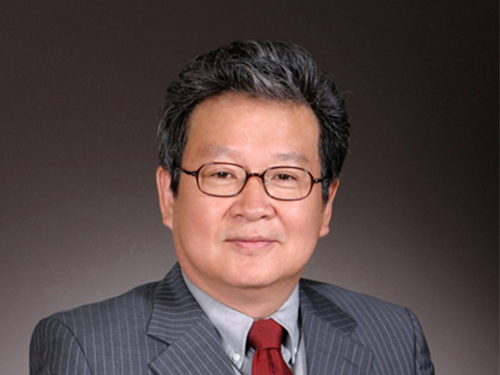
(Professor Poong-Hyun Seong)
Chair Professor Poong-Hyun Seong from the Department of Nuclear & Quantum Engineering was selected as the recipient of the Don Miller Award by the American Nuclear Society.
The award, established in 2009 by the American Nuclear Society in honor of former ANS President Don Miller, is given to an individual or team who has made a significant contribution to the advancement of one or both of the fields of nuclear instrumentation and control of human-machine interfaces through individual or combined activities. The award ceremony will be held on June 10 during the 2019 annual meeting of the ANS in Minneapolis in the US.
Professor Seong is being recognized for his pioneering research and training in the fields of nuclear instrumentation control and human factor engineering at Korea. His research significantly contributed to safety improvements in nuclear power plants and have been recognized worldwide. Professor Seong, a fellow of the ANS, now serves as the first vice chair of the International Nuclear Societies Council and will take up the role of chair in 2021.
Professor Seong said that, “ Korea is one of the most outstanding countries working on research in the fields of nuclear instrumentation control and human factors. KAIST PhDs are teaching at many universities at home and abroad. I look forward this award bringing new hope to our nuclear research and the domestic nuclear industry, which is now in difficult times.”
2019.04.11 View 6087
Chair Professor Seong Honored with Don Miller Award
(Professor Poong-Hyun Seong)
Chair Professor Poong-Hyun Seong from the Department of Nuclear & Quantum Engineering was selected as the recipient of the Don Miller Award by the American Nuclear Society.
The award, established in 2009 by the American Nuclear Society in honor of former ANS President Don Miller, is given to an individual or team who has made a significant contribution to the advancement of one or both of the fields of nuclear instrumentation and control of human-machine interfaces through individual or combined activities. The award ceremony will be held on June 10 during the 2019 annual meeting of the ANS in Minneapolis in the US.
Professor Seong is being recognized for his pioneering research and training in the fields of nuclear instrumentation control and human factor engineering at Korea. His research significantly contributed to safety improvements in nuclear power plants and have been recognized worldwide. Professor Seong, a fellow of the ANS, now serves as the first vice chair of the International Nuclear Societies Council and will take up the role of chair in 2021.
Professor Seong said that, “ Korea is one of the most outstanding countries working on research in the fields of nuclear instrumentation control and human factors. KAIST PhDs are teaching at many universities at home and abroad. I look forward this award bringing new hope to our nuclear research and the domestic nuclear industry, which is now in difficult times.”
2019.04.11 View 6087 -
 Seong-Tae Kim Wins Robert-Wagner All-Conference Best Paper Award
(Ph.D. candidate Seong-Tae Kim)
Ph.D. candidate Seong-Tae Kim from the School of Electrical Engineering won the Robert Wagner All-Conference Best Student Paper Award during the 2018 International Society for Optics and Photonics (SPIE) Medical Imaging Conference, which was held in Houston last month.
Kim, supervised by Professor Yong Man Ro, received the award for his paper in the category of computer-aided diagnosis. His paper, titled “ICADx: Interpretable Computer-Aided Diagnosis of Breast Masses”, was selected as the best paper out of 900 submissions. The conference selects the best paper in nine different categories. His research provides new insights on diagnostic technology to detect breast cancer powered by deep learning.
2018.03.15 View 12300
Seong-Tae Kim Wins Robert-Wagner All-Conference Best Paper Award
(Ph.D. candidate Seong-Tae Kim)
Ph.D. candidate Seong-Tae Kim from the School of Electrical Engineering won the Robert Wagner All-Conference Best Student Paper Award during the 2018 International Society for Optics and Photonics (SPIE) Medical Imaging Conference, which was held in Houston last month.
Kim, supervised by Professor Yong Man Ro, received the award for his paper in the category of computer-aided diagnosis. His paper, titled “ICADx: Interpretable Computer-Aided Diagnosis of Breast Masses”, was selected as the best paper out of 900 submissions. The conference selects the best paper in nine different categories. His research provides new insights on diagnostic technology to detect breast cancer powered by deep learning.
2018.03.15 View 12300 -
 Professor Poong Hyun Seong Selected as Fellow of the ANS
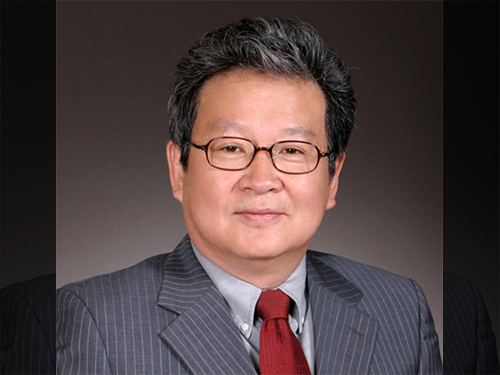
Professor Poong Hyun Seong of the Department of Nuclear and Quantum Engineering was selected as a fellow of the American Nuclear Society.
The selection was announced at their annual meeting held in San Francisco on June 12, in recognition of Professor Seong's contributions to the field of nuclear instrumentation, control andhuman factors engineering.
Founded in 1954, the American Nuclear Society selects scholars who have made outstanding achievements and contributions to the development of the nuclear engineering field each year.
Professor Seong's researches in the field of nuclear instrumentation, control and human factors engineering have contributed to the safe operation of nuclear power plants, to the development of systems to maintain nuclear power plants safely in the event of emergency and to the enhancement of effective response capabilities of nuclear power plant operators. His researches significantly contributed to the safety improvement of nuclear power plants and have been recognized worldwide.
Professor Seong said, "Korea has emerged as a nuclear powerhouse. I think not only my academic career but our national reputation in the field of nuclear research has been well recognized by our global peers.” Professor Seong has served as president of the Korean Nuclear Society, editor in chief of Nuclear Engineering and Technology, and as a commissioner of the Korean Nuclear Safety Commission. He is currently working as a commissioner of the Korean Atomic Energy Commission.
2017.06.29 View 8988
Professor Poong Hyun Seong Selected as Fellow of the ANS
Professor Poong Hyun Seong of the Department of Nuclear and Quantum Engineering was selected as a fellow of the American Nuclear Society.
The selection was announced at their annual meeting held in San Francisco on June 12, in recognition of Professor Seong's contributions to the field of nuclear instrumentation, control andhuman factors engineering.
Founded in 1954, the American Nuclear Society selects scholars who have made outstanding achievements and contributions to the development of the nuclear engineering field each year.
Professor Seong's researches in the field of nuclear instrumentation, control and human factors engineering have contributed to the safe operation of nuclear power plants, to the development of systems to maintain nuclear power plants safely in the event of emergency and to the enhancement of effective response capabilities of nuclear power plant operators. His researches significantly contributed to the safety improvement of nuclear power plants and have been recognized worldwide.
Professor Seong said, "Korea has emerged as a nuclear powerhouse. I think not only my academic career but our national reputation in the field of nuclear research has been well recognized by our global peers.” Professor Seong has served as president of the Korean Nuclear Society, editor in chief of Nuclear Engineering and Technology, and as a commissioner of the Korean Nuclear Safety Commission. He is currently working as a commissioner of the Korean Atomic Energy Commission.
2017.06.29 View 8988 -
 K-Glass 3 Offers Users a Keyboard to Type Text
KAIST researchers upgraded their smart glasses with a low-power multicore processor to employ stereo vision and deep-learning algorithms, making the user interface and experience more intuitive and convenient.
K-Glass, smart glasses reinforced with augmented reality (AR) that were first developed by KAIST in 2014, with the second version released in 2015, is back with an even stronger model. The latest version, which KAIST researchers are calling K-Glass 3, allows users to text a message or type in key words for Internet surfing by offering a virtual keyboard for text and even one for a piano.
Currently, most wearable head-mounted displays (HMDs) suffer from a lack of rich user interfaces, short battery lives, and heavy weight. Some HMDs, such as Google Glass, use a touch panel and voice commands as an interface, but they are considered merely an extension of smartphones and are not optimized for wearable smart glasses. Recently, gaze recognition was proposed for HMDs including K-Glass 2, but gaze cannot be realized as a natural user interface (UI) and experience (UX) due to its limited interactivity and lengthy gaze-calibration time, which can be up to several minutes.
As a solution, Professor Hoi-Jun Yoo and his team from the Electrical Engineering Department recently developed K-Glass 3 with a low-power natural UI and UX processor. This processor is composed of a pre-processing core to implement stereo vision, seven deep-learning cores to accelerate real-time scene recognition within 33 milliseconds, and one rendering engine for the display.
The stereo-vision camera, located on the front of K-Glass 3, works in a manner similar to three dimension (3D) sensing in human vision. The camera’s two lenses, displayed horizontally from one another just like depth perception produced by left and right eyes, take pictures of the same objects or scenes and combine these two different images to extract spatial depth information, which is necessary to reconstruct 3D environments. The camera’s vision algorithm has an energy efficiency of 20 milliwatts on average, allowing it to operate in the Glass more than 24 hours without interruption.
The research team adopted deep-learning-multi core technology dedicated for mobile devices. This technology has greatly improved the Glass’s recognition accuracy with images and speech, while shortening the time needed to process and analyze data. In addition, the Glass’s multi-core processor is advanced enough to become idle when it detects no motion from users. Instead, it executes complex deep-learning algorithms with a minimal power to achieve high performance.
Professor Yoo said, “We have succeeded in fabricating a low-power multi-core processer that consumes only 126 milliwatts of power with a high efficiency rate. It is essential to develop a smaller, lighter, and low-power processor if we want to incorporate the widespread use of smart glasses and wearable devices into everyday life. K-Glass 3’s more intuitive UI and convenient UX permit users to enjoy enhanced AR experiences such as a keyboard or a better, more responsive mouse.”
Along with the research team, UX Factory, a Korean UI and UX developer, participated in the K-Glass 3 project.
These research results entitled “A 126.1mW Real-Time Natural UI/UX Processor with Embedded Deep-Learning Core for Low-Power Smart Glasses” (lead author: Seong-Wook Park, a doctoral student in the Electrical Engineering Department, KAIST) were presented at the 2016 IEEE (Institute of Electrical and Electronics Engineers) International Solid-State Circuits Conference (ISSCC) that took place January 31-February 4, 2016 in San Francisco, California.
YouTube Link: https://youtu.be/If_anx5NerQ
Figure 1: K-Glass 3
K-Glass 3 is equipped with a stereo camera, dual microphones, a WiFi module, and eight batteries to offer higher recognition accuracy and enhanced augmented reality experiences than previous models.
Figure 2: Architecture of the Low-Power Multi-Core Processor
K-Glass 3’s processor is designed to include several cores for pre-processing, deep-learning, and graphic rendering.
Figure 3: Virtual Text and Piano Keyboard
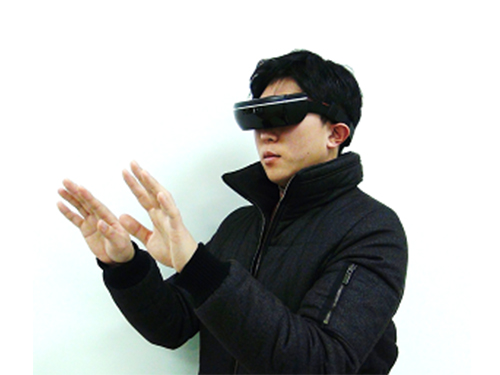
K-Glass 3 can detect hands and recognize their movements to provide users with such augmented reality applications as a virtual text or piano keyboard.
2016.02.26 View 14253
K-Glass 3 Offers Users a Keyboard to Type Text
KAIST researchers upgraded their smart glasses with a low-power multicore processor to employ stereo vision and deep-learning algorithms, making the user interface and experience more intuitive and convenient.
K-Glass, smart glasses reinforced with augmented reality (AR) that were first developed by KAIST in 2014, with the second version released in 2015, is back with an even stronger model. The latest version, which KAIST researchers are calling K-Glass 3, allows users to text a message or type in key words for Internet surfing by offering a virtual keyboard for text and even one for a piano.
Currently, most wearable head-mounted displays (HMDs) suffer from a lack of rich user interfaces, short battery lives, and heavy weight. Some HMDs, such as Google Glass, use a touch panel and voice commands as an interface, but they are considered merely an extension of smartphones and are not optimized for wearable smart glasses. Recently, gaze recognition was proposed for HMDs including K-Glass 2, but gaze cannot be realized as a natural user interface (UI) and experience (UX) due to its limited interactivity and lengthy gaze-calibration time, which can be up to several minutes.
As a solution, Professor Hoi-Jun Yoo and his team from the Electrical Engineering Department recently developed K-Glass 3 with a low-power natural UI and UX processor. This processor is composed of a pre-processing core to implement stereo vision, seven deep-learning cores to accelerate real-time scene recognition within 33 milliseconds, and one rendering engine for the display.
The stereo-vision camera, located on the front of K-Glass 3, works in a manner similar to three dimension (3D) sensing in human vision. The camera’s two lenses, displayed horizontally from one another just like depth perception produced by left and right eyes, take pictures of the same objects or scenes and combine these two different images to extract spatial depth information, which is necessary to reconstruct 3D environments. The camera’s vision algorithm has an energy efficiency of 20 milliwatts on average, allowing it to operate in the Glass more than 24 hours without interruption.
The research team adopted deep-learning-multi core technology dedicated for mobile devices. This technology has greatly improved the Glass’s recognition accuracy with images and speech, while shortening the time needed to process and analyze data. In addition, the Glass’s multi-core processor is advanced enough to become idle when it detects no motion from users. Instead, it executes complex deep-learning algorithms with a minimal power to achieve high performance.
Professor Yoo said, “We have succeeded in fabricating a low-power multi-core processer that consumes only 126 milliwatts of power with a high efficiency rate. It is essential to develop a smaller, lighter, and low-power processor if we want to incorporate the widespread use of smart glasses and wearable devices into everyday life. K-Glass 3’s more intuitive UI and convenient UX permit users to enjoy enhanced AR experiences such as a keyboard or a better, more responsive mouse.”
Along with the research team, UX Factory, a Korean UI and UX developer, participated in the K-Glass 3 project.
These research results entitled “A 126.1mW Real-Time Natural UI/UX Processor with Embedded Deep-Learning Core for Low-Power Smart Glasses” (lead author: Seong-Wook Park, a doctoral student in the Electrical Engineering Department, KAIST) were presented at the 2016 IEEE (Institute of Electrical and Electronics Engineers) International Solid-State Circuits Conference (ISSCC) that took place January 31-February 4, 2016 in San Francisco, California.
YouTube Link: https://youtu.be/If_anx5NerQ
Figure 1: K-Glass 3
K-Glass 3 is equipped with a stereo camera, dual microphones, a WiFi module, and eight batteries to offer higher recognition accuracy and enhanced augmented reality experiences than previous models.
Figure 2: Architecture of the Low-Power Multi-Core Processor
K-Glass 3’s processor is designed to include several cores for pre-processing, deep-learning, and graphic rendering.
Figure 3: Virtual Text and Piano Keyboard
K-Glass 3 can detect hands and recognize their movements to provide users with such augmented reality applications as a virtual text or piano keyboard.
2016.02.26 View 14253 -
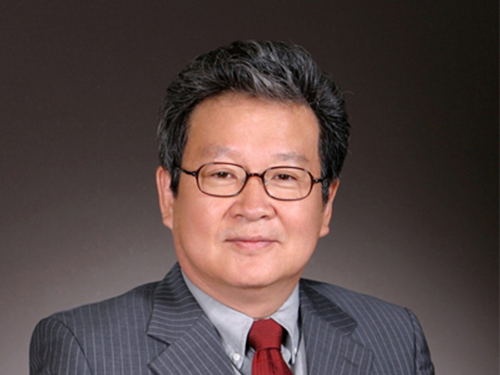 Professor Poong-Hyun Seong Appointed as the New President of the Korean Nuclear Society
Professor Poong-Hyun Seong of the Department of Nuclear and Quantum Engineering has been appointed as the 28th President of the Korean Nuclear Society (KNS). His presidency began on September 1, 2015 and will last one year.
Professor Seong graduated from the Department of Nuclear Engineering at Seoul National University, Korea, and received his master’s and doctoral degree at the Massachusetts Institute of Technology (MIT) in the United States.
He has filled various positions in the field of nuclear engineering, including a commissioner of the Nuclear Safety and Security Commission of Korea, manager of the Korean branch of the American Nuclear Society (ANS), and head of the Human Factors and Instrumentation and Controls Division of ANS.
At KNS, he served as the vice president as well as the Editor-in-Chief of its academic journal Nuclear Engineering and Technology.
The Korean Nuclear Society was established in 1969 to promote academic and technical research in nuclear engineering and develop safe and sustainable nuclear power. It is composed of more than 4,200 active members from ten research fields and has published the journal Nuclear Engineering and Technology since 2007.
2015.09.01 View 6918
Professor Poong-Hyun Seong Appointed as the New President of the Korean Nuclear Society
Professor Poong-Hyun Seong of the Department of Nuclear and Quantum Engineering has been appointed as the 28th President of the Korean Nuclear Society (KNS). His presidency began on September 1, 2015 and will last one year.
Professor Seong graduated from the Department of Nuclear Engineering at Seoul National University, Korea, and received his master’s and doctoral degree at the Massachusetts Institute of Technology (MIT) in the United States.
He has filled various positions in the field of nuclear engineering, including a commissioner of the Nuclear Safety and Security Commission of Korea, manager of the Korean branch of the American Nuclear Society (ANS), and head of the Human Factors and Instrumentation and Controls Division of ANS.
At KNS, he served as the vice president as well as the Editor-in-Chief of its academic journal Nuclear Engineering and Technology.
The Korean Nuclear Society was established in 1969 to promote academic and technical research in nuclear engineering and develop safe and sustainable nuclear power. It is composed of more than 4,200 active members from ten research fields and has published the journal Nuclear Engineering and Technology since 2007.
2015.09.01 View 6918 -
 College of Cultural Science selects 'Best English Paper' Recipients
KAIST’s College of Cultural Science (Dean Kim Dong Won) announced the winners of ‘2010 Fall Semester Best English Paper Award’: Excellence Award went to Kwak Ah Young (department of Biology), Seong Du Hyun (undeclared major), Ahn Da In (Biological Chemical Engineering), and nine other students received the Participation Award.
Ahn Da In discussed ‘Joyce and Chopin on use of epiphany’, Seong Du Hyun discussed ‘On Kant’s Groundwork for the metaphysics of Morals, its Achievements, and Implications’, and Kwak Ah Young discussed ‘Fact Pattern of Environmental Law’.
The ‘Best English Paper’ Award has been awarded to undergraduates since 2009 Fall semester in the Humanities and Social Science Department’s efforts to increase creativity and English writing skills of students attending KAIST.
For the 2010 fall semester, each professor in charge went through 1 to 2 papers (among 610 papers admitted across human science subjects) and recommended 29 papers to be discussed with great scrutiny. The evaluation took place throughout January and the 3 papers discussing English Literature, Scientific Philosophy, and Environmental Law were awarded the Excellence Award, and 9 other papers were awarded the Participation Award.
Dean of Cultural Science College Kim Dong Won commented, ‘I am very encouraged by the level of papers and is becoming a very large art of the College of Cultural Science’.
The chairman of the screening committee, Professor Kim Eun Kyung also commented, ‘the best paper award is helping students better their English levels’ and that ‘in order to form and encourage a sound and structured English paper writing environment, a anti-plagiarism program will be implemented amongst implementing other judging standards’.
2011.02.21 View 12887
College of Cultural Science selects 'Best English Paper' Recipients
KAIST’s College of Cultural Science (Dean Kim Dong Won) announced the winners of ‘2010 Fall Semester Best English Paper Award’: Excellence Award went to Kwak Ah Young (department of Biology), Seong Du Hyun (undeclared major), Ahn Da In (Biological Chemical Engineering), and nine other students received the Participation Award.
Ahn Da In discussed ‘Joyce and Chopin on use of epiphany’, Seong Du Hyun discussed ‘On Kant’s Groundwork for the metaphysics of Morals, its Achievements, and Implications’, and Kwak Ah Young discussed ‘Fact Pattern of Environmental Law’.
The ‘Best English Paper’ Award has been awarded to undergraduates since 2009 Fall semester in the Humanities and Social Science Department’s efforts to increase creativity and English writing skills of students attending KAIST.
For the 2010 fall semester, each professor in charge went through 1 to 2 papers (among 610 papers admitted across human science subjects) and recommended 29 papers to be discussed with great scrutiny. The evaluation took place throughout January and the 3 papers discussing English Literature, Scientific Philosophy, and Environmental Law were awarded the Excellence Award, and 9 other papers were awarded the Participation Award.
Dean of Cultural Science College Kim Dong Won commented, ‘I am very encouraged by the level of papers and is becoming a very large art of the College of Cultural Science’.
The chairman of the screening committee, Professor Kim Eun Kyung also commented, ‘the best paper award is helping students better their English levels’ and that ‘in order to form and encourage a sound and structured English paper writing environment, a anti-plagiarism program will be implemented amongst implementing other judging standards’.
2011.02.21 View 12887