KAIST Professor Jinjoon Lee’s 10-Meter Hanji Scroll PhD Thesis from Oxford Enters the Permanent Collection of the World’s Oldest Museum, First Work by a Contemporary Korean Artist
<A ten-metre scroll doctoral thesis reinterpreting the 15th-century Joseon landscape painting scroll tradition, Empty Garden, exhibited at the University Church of St Mary the Virgin, Oxford, founded in the 15th century. 2020>
- Media artist and KAIST professor Jinjoon Lee's doctoral thesis 'Empty Garden' officially acquired by the Ashmolean Museum, UK, for permanent collection
- Korean artistic and academic achievement recognized as public cultural heritage at a museum predating the Louvre by 110 years — the 'heart of Western intellectual history'
- Blending Eastern aesthetics of 'wandering' (거닐기) and 'emptiness' with data technology in the AI era — awarded Oxford's unanimous 'No Corrections' in just 2.5 years in 2020
- First work by a contemporary Korean artist to enter the Ashmolean's permanent collection — officially confirmed by the museum's curator
- Korean artistic and academic achievement officially recognised as intellectual cultural heritage — permanently preserved, researched, and exhibited within the Western public knowledge system
A doctoral thesis is often imagined as a dense, bound volume. Yet a 10-meter-long hanji scroll- traditional Korean mulberry paper prized for its durability across centuries- is now drawing global attention from the art world and academia alike.
KAIST (President Kwang Hyung Lee) announced on the 26th that Empty Garden – A Liminoid Journey to Nowhere in Somewhere (2020), a doctoral thesis by media artist and KAIST Graduate School of Culture Technology Professor Jinjoon Lee, has been officially acquired by the Ashmolean Museum, University of Oxford, for its permanent collection and exhibition — through formal purchase, not donation.
Founded in 1683, the Ashmolean Museum is the world's first university museum, operated by the University of Oxford with over 340 years of history. It predates the Louvre (1793) by 110 years and the British Museum (1759) by 76 years, and is regarded as the starting point of European Enlightenment scholarship. Its collections include masterworks by Raphael, Michelangelo, Leonardo da Vinci, and Turner, alongside ancient artefacts and East Asian ceramics and paintings — over one million objects in total.
The Ashmolean is not simply an exhibition venue but an academic institution integrating collection, research, and education. Unlike Tate Modern, which engages with the contemporary art market, or the British Museum, which displays national heritage, the Ashmolean's core mission is scholarly preservation and research. The acquisition of Professor Lee's doctoral thesis here signifies that Korean aesthetics and philosophical thought have entered the public record of European intellectual history.
Professor Lee's PhD thesis Empty Garden reinterprets the concept of uiwon (意園) — an imaginary garden cultivated in the mind by Joseon-era scholars — through contemporary data and media language, proposing 'data gardening' as a methodology for tending to the philosophy of emptiness. It is a work that continues to ask fundamental questions about human sensation, memory, and existence, even within an environment dominated by AI and data.
The 10-meter hanji scroll format is itself a central feature of the thesis. As readers engage with the text, they are naturally led to move through space — physically enacting the East Asian garden tradition of 'wandering' (거닐기). The work is designed not merely to be read but to be experienced through movement and contemplation. The thesis was produced as nine hanji scrolls in total; one of these has been acquired by the Ashmolean for its permanent collection.
This thesis received unanimous 'No Corrections' approval at its DPhil in Fine Art examination at the University of Oxford in 2020, recognising its academic rigour and originality — an achievement completed in just two and a half years, where the process typically takes over four. It is an extremely rare distinction even within Oxford's 900-year history, and drew significant attention at the time.
Oxford doctoral theses are typically archived at the Bodleian Library as academic records. This acquisition is entirely separate from that process: the museum conducted an independent five-year review following the award of the degree, assessed the work on its artistic and scholarly merits, and made a formal purchase. The inclusion of a living artist's doctoral thesis in the permanent collection of the world's oldest university museum through purchase — not donation — is exceptionally rare.
Professor Shelagh Vainker, Alice King Curator of Chinese and Korean Art at the Ashmolean Museum, University of Oxford, stated:
"I am delighted that the Ashmolean Museum has been able to acquire Dr Jinjoon Lee's Empty Garden for our permanent collection. The long, contemplative scroll breaks new ground in so many ways: in the materials and techniques employed, in the breadth and depth of cultural and intellectual knowledge embedded in it, and in the complexity of the presentation of different spaces — all providing the viewer with multiple perspectives and experiences. Empty Garden is the first piece by a contemporary Korean artist to enter the collection; when not on display it will be available for viewing by appointment."
— Shelagh Vainker, Alice King Curator of Chinese and Korean Art, Ashmolean Museum, University of Oxford
<Dr Shelagh Vainker, Professor at the University of Oxford and Alice King Curator of Chinese and Korean Art at the Ashmolean Museum, reviewing the doctoral thesis Empty Garden in the Eastern Art Study Room, Ashmolean Museum. 2026>
Professor Lee noted that during his doctoral research at Oxford, a serious leg injury left him using a wheelchair for an extended period, during which he reflected deeply on the relationship between movement, stillness, and thought. He stated: "In the age of AI, art cannot remain confined to immaterial images on screens. Data and images can only acquire depth through material forms capable of enduring time and preservation."
He further expressed his hope that Empty Garden, now housed within the public collection of Western intellectual history, would "serve as a continuing reference point connecting East Asian thought — including that of Korea — with new sensory frameworks for the age of artificial intelligence."
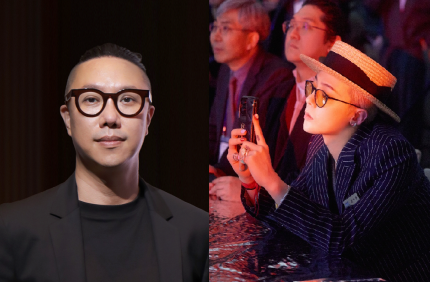
The first practicing artist to be appointed as a tenure-track professor at KAIST, Professor Lee currently holds concurrent positions as Visiting Fellow at Exeter College, University of Oxford, Visiting Senior Researcher at Tokyo University of the Arts, and Adjunct Professor at New York University, continuing interdisciplinary research across art, technology, and the humanities. Most recently, his work has drawn international attention from arts community, including Good Morning, Mr. G-Dragon, a space art project based on the iris data of K-pop artist G-Dragon, and Cine Forest: Awakening Bloom, an AI-based media symphony at Bundang Central Park in S. Korea.
<Jinjoon Lee, artist's studio, Seoul. 2025>
This acquisition is an exceptionally rare case of a doctoral thesis entering the permanent collection of the world's oldest university museum through formal purchase, and a historic event in which a work by a contemporary Korean artist has entered the Ashmolean's collection for the first time. Korean research that poses new questions about the role of art and the humanities in the post-AI era has now found a permanent place within the public record of Western intellectual history.
KAIST sends out Music and Bio-Signs of Professor Kwon Ji-yong, a.k.a. G-Dragon, into Space to Pulsate through Universe and Resonate among Stars
KAIST (President Kwang-Hyung Lee) announced on the 10th of April that it successfully promoted the world’s first ‘Space Sound Source Transmission Project’ based on media art at the KAIST Space Research Institute on April 9th through collaboration between Professor Jinjoon Lee of the Graduate School of Culture Technology, a world-renowned media artist, and the global K-Pop artist, G-Dragon.
This project was proposed as part of the ‘AI Entertech Research Center’ being promoted by KAIST and Galaxy Corporation. It is a project to transmit the message and sound of G-Dragon (real name, Kwon Ji-yong), a singer/song writer affiliated with Galaxy Corporation and a visiting professor in the Department of Mechanical Engineering at KAIST, to space for the first time in the world.
This is a convergence project that combines science, technology, art, and popular music, and is a new form of ‘space culture content’ experiment that connects KAIST’s cutting-edge space technology, Professor Jinjoon Lee’s media art work, and G-Dragon’s voice and sound source containing his latest digital single, "HOME SWEET HOME".
< Photo 1. Professor Jinjoon Lee's Open Your Eyes Project "Iris"'s imagery projected on the 13m space antenna at the Space Research Institute >
This collaboration was planned with the theme of ‘emotional signals that expand the inner universe of humans to the outer universe.’ The image of G-Dragon’s iris was augmented through AI as a window into soul symbolizing his uniqueness and identity, and the new song “Home Sweet Home” was combined as an audio message containing the vibration of that emotion.
This was actually transmitted into space using a next-generation small satellite developed by KAIST Space Research Institute, completing a symbolic performance in which an individual’s inner universe is transmitted to outer space.
Professor Jinjoon Lee’s cinematic media art work “Iris” was unveiled at the site. This work was screened in the world’s first projection mapping method* on KAIST Space Research Institute’s 13m space antenna. This video was created using generative artificial intelligence (AI) technology based on the image of G-Dragon's iris, and combined with sound using the data of the sounds of Emile Bell rings – the bell that holds a thousand years of history, it presented an emotional art experience that transcends time and space.
*Projection Mapping: A technology that projects light and images onto actual structures to create visual changes, and is a method of expression that artistically reinterprets space.
This work is one of the major research achievements of KAIST TX Lab and Professor Lee based on new media technology based on biometric data such as iris, heartbeat, and brain waves.
Professor Jinjoon Lee said, "The iris is a symbol that reflects inner emotions and identity, so much so that it is called the 'mirror of the soul,' and this work sought to express 'the infinite universe seen from the inside of humanity' through G-Dragon's gaze."
< Photo 2. (From left) Professor Jinjoon Lee of the Graduate School of Culture Technology and G-Dragon (Visiting Professor Kwon Ji-yong of the Department of Mechanical Engineering) >
He continued, "The universe is a realm of technology as well as a stage for imagination and emotion, and I look forward to an encounter with the unknown through a new attempt to speak of art in the language of science including AI and imagine science in the form of art." “G-Dragon’s voice and music have now begun their journey to space,” said Yong-ho Choi, Galaxy Corporation’s Chief Happiness Officer (CHO). “This project is an act of leaving music as a legacy for humanity, while also having an important meaning of attempting to communicate with space.” He added, “This is a pioneering step to introduce human culture to space, and it will remain as a monumental performance that opens a new chapter in the history of music comparable to the Beatles.”
Galaxy Corporation is leading the future entertainment technology industry through its collaboration with KAIST, and was recently selected as the only entertainment technology company in a private meeting with Microsoft CEO Nadella. In particular, it is promoting the globalization of AI entertainment technology, receiving praise as a “pioneer of imagination” for new forms of AI entertainment content, including the AI contents for the deceased.
< Photo 3. Photo of G-Dragon's Home Sweet Home being sent into the space via Professor Jinjoon Lee's Space Sound Source Transmission Project >
Through this project, KAIST Space Research Institute presented new possibilities for utilizing satellite technology, and showed a model for science to connect with society in a more popular way.
KAIST President Kwang-Hyung Lee said, “KAIST is a place that always supports new imaginations and challenges,” and added, “We will continue to strive to continue creative research that no one has ever thought of, like this project that combines science, technology, and art.”
In the meantime, Galaxy Corporation, the agency of G-Dragon’s Professor Kwon Ji-yong, is an AI entertainment company that presents a new paradigm based on IP, media, tech, and entertainment convergence technology.