%53%61%6e%67%20%4f%75%6b%20%4b%69%6d
-
 KAIST Develops a Beetle-Inspired Soft Robot That Operates with Artificial Muscles and Sensory Feedback
Researchers have developed a technology that lets a user move a small robot by bending and straightening a finger. The user can also pick up and move objects while checking the images and contact information that the robot sends back. The system combines artificial muscles, a camera, and tactile sensors in a small soft robot modeled on a beetle. It is expected to be used in remote tasks, such as inspecting narrow spaces that are difficult for people to reach and retrieving small objects.
KAIST (President Choongsik Bae) announced on October 13 that a research team led by Professor Sang Ouk Kim from the Department of Materials Science and Engineering has developed a small soft robot called “BeetleBot.” The team worked with the research groups of Professor Wei Gao at the California Institute of Technology (Caltech) and Professor Hirotaka Sato at NTU.
When people grasp an object, they use their eyes to find where it is and the sensation in their fingertips to check the contact. A robot that adjusts its work to its surroundings also needs its movement and sensing functions to be connected. Soft robots are built from soft, deformable materials. In these robots, however, actuation, sensing, and control are often built as separate parts or depend on complex devices. This has made it difficult to integrate several functions into a small robot.
The researchers designed the robot to walk and grip objects using artificial muscles that contract in a similar way to biological muscles. They linked these muscles with a camera, a pressure sensor, and a stretchable sensor patch worn on the finger. With this setup, the user can control the robot while checking its surroundings and its contact with objects.
The team first analyzed how the leg muscles of a beetle relate to the movement of its joints. They used the results to decide where to place BeetleBot’s artificial muscles and how to design its legs. The artificial muscles were made by 3D printing a liquid crystal elastomer (LCE), a polymer that contracts when heated. They were combined with an actuation module that produces heat from electricity. The muscles in each part of the robot can be operated independently, and the order in which they operate can be adjusted. This allows the robot to walk forward and turn left or right.
The researchers also built a soft gripper based on the mandibles that beetles use to hold their prey. The gripper combines artificial muscles with a capacitive pressure sensor, so it can grip an object and detect the contact. When the artificial muscles contract, the gripper closes around the object. The pressure sensor then detects the pressure applied during contact. When the object presses on the sensor, the distance between its internal electrodes changes, and so does its capacitance. The sensor uses this change to determine the contact state.
To control the robot, the team used a stretchable sensor patch whose electrical resistance changes as the finger moves. When the finger bends and stretches the patch, the conductive paths formed by carbon nanotubes (CNTs) inside it change, which changes the resistance signal. The researchers sorted these signals into four commands: move forward, turn left, turn right, and grip an object. The commands are sent to BeetleBot over Bluetooth Low Energy, and the robot carries out the matching action.
The user views the robot’s surroundings through a small onboard camera and checks contact with objects using data from the pressure sensor in the gripper. Based on this information, the user decides on the next action and sends a command with a finger movement. In this way, the system provides bidirectional feedback. Commands go from the user to the robot, and the information the robot detects goes back to the user.
Using this control method, the researchers showed that BeetleBot could avoid obstacles, approach a target object, and then grip and carry it. By connecting artificial muscle-based walking and gripping, visual and tactile sensing, and user control in a single system, the study shows that small soft robots can carry out practical tasks.
The results are expected to support the development of soft robots for remote tasks, such as checking conditions and retrieving small objects in spaces that are hard for people to access. Before the robot can be used more widely, for example in environmental exploration or industrial equipment inspection, the actuation speed, energy efficiency, and power supply of the artificial muscles will need to be improved. Its performance will also need to be tested in real working environments.
“This study expands the potential uses of soft robots by connecting the movement of artificial muscles, sensing, and user control in a single system,” said Professor Sang Ouk Kim. He added that he expects the joint research with Caltech and other partners to contribute to soft robots that can work in spaces that are difficult for people to access.
“A key feature of this work is the bidirectional feedback, which links the information detected by the robot to the user’s next action,” said Professor Inho Kim of Sungkyunkwan University, the first author. He added that he plans to increase the actuation speed and energy efficiency of the artificial muscles and improve control methods that use sensory information, so that the robot can be developed into a soft robot that works in a variety of environments.
Professor Inho Kim earned his Ph.D. from the KAIST Department of Materials Science and Engineering. He is now an assistant professor in the Department of Chemistry at Sungkyunkwan University, and he took part in the study as first author while working as a postdoctoral researcher at Caltech. Professor Sang Ouk Kim of KAIST and Professor Wei Gao of Caltech are co-corresponding authors. The results were published in Science Advances on August 19, 2026.
Paper title: BeetleBot: An integrated bioinspired soft robot for multimodal sensing and adaptive interaction,
DOI: 10.1126/sciadv.aeg8849
This research was supported by the Heritage Medical Research Institute, the Meta Caltech Research Award, the National Research Foundation of Korea (RS-2024-00411904, RS-2025-00521316, RS-2025-25442577), and the Singapore Ministry of Education (RG140/20, RG82/24).
2026.10.13 View 2635
-
 KAIST Technology Behind Toothbrushes and Sportswear Advances into High-Performance Graphene Fiber Research
KAIST’s discovery of graphene oxide liquid crystals in 2011 has laid the foundation for 15 years of research worldwide, leading to technologies for producing graphene fibers with high strength and thermal conductivity. The fundamental materials research that helped bring antibacterial toothbrushes and functional sportswear to market is now advancing into materials for thermal management.
KAIST (President Choongsik Bae) announced on September 18 that Professor Sang Ouk Kim’s team in the Department of Materials Science and Engineering has published a commentary in the News & Views section of Nature Materials, highlighting recent advances in high-performance graphene fibers based on graphene oxide liquid crystals and their scientific significance.
Graphene oxide consists of graphene, a single layer of carbon atoms arranged in a honeycomb structure, with oxygen functional groups attached. Graphene is strong and conducts heat and electricity well, but its poor dispersibility in common solvent makes it difficult to process in liquid form. By contrast, the oxygen functional groups allow graphene oxide to disperse readily in water and other solvents, making it easier to formulate into inks, apply as coatings, or spin into fibers.
In 2011, Professor Kim’s team was the first in the world to report that graphene oxide dispersed in water above a certain concentration spontaneously forms a liquid-crystalline state in which its thin sheets align in a common direction.
Above critical concentration conditions, graphene oxide sheets randomly dispersed in water align like a scattered deck of cards arranged to face the same direction. This alignment allows graphene oxide to be drawn into long fibers while maintaining the sheets’ orientation along the fiber axis.
Following this discovery, researchers worldwide have developed methods for producing graphene fibers from graphene oxide liquid crystals. Conventional methods, however, have faced problems such as breaks in the liquid filament during drawing and insufficiently aligned or loosely packed graphene sheets, which leave voids and defects within the fibers. These problems have limited efforts to improve strength and thermal conductivity simultaneously.
In their commentary, Professor Kim’s team discussed recent research addressing these limitations and analyzed how research on graphene oxide liquid crystals could lead to technologies for manufacturing high-performance fibers.
Researchers at Zhejiang University in China recently dispersed graphene oxide in highly viscous glycerol, giving the dispersion viscoelastic properties similar to those of a polymer solution. This enabled “ultrahigh-ratio drawing” during wet spinning, allowing the graphene oxide dispersion to be stretched much further than before.
During this process, the graphene oxide sheets become more closely aligned along the fiber axis, reducing internal voids and defects. Subsequent heat treatment at high temperatures promotes the growth of large, aligned graphitic crystallites, producing lightweight, strong graphene fibers with high thermal and electrical conductivity.
The graphene fibers produced in this recent study were reported to have a tensile strength of up to 5.9 gigapascals (GPa) and a thermal conductivity of up to 1,720 watts per meter per kelvin (W/(m·K)). In simple terms, the fibers resist breaking when pulled and transfer heat quickly. These results show how denser packing and better alignment of graphene oxide sheets can improve both strength and thermal conductivity.
In the commentary, Professor Kim’s team highlighted how research on graphene oxide liquid crystals has progressed from observing a fundamental phenomenon to processing a two-dimensional material through flow and stretching, much like a polymer solution.
KAIST's core technology related to graphene oxide liquid crystals has already moved beyond the laboratory into consumer products. Antibacterial graphene toothbrushes incorporating technology from Materials CreationCo., Ltd., a faculty startup founded by Professor Kim, have sold more than 14 million units since their 2023 launch. Functional fibers made with GrapheneTex material were used in the uniforms of the Taekwondo demonstration team at the 2024 Paris Olympics. More recently, the material has been applied to functional golf apparel, other sportswear, and bedding, as the company pursues expansion into global markets.
“Since its discovery in 2011, graphene oxide liquid crystal has provided a foundation for research over worldwide that has now led to strong, high-performance graphene fibers that conduct heat efficiently,” said Professor Kim. “What makes this significant is that a single line of basic research has led to applications ranging from consumer products such as toothbrushes and functional clothing to advanced materials for electronics, mobility, and aerospace.”
The commentary was written by PhD candidates Jin Hyo Kim and Sujin Cha and Professor Sang Ouk Kim, all of KAIST’s Department of Materials Science and Engineering, and was published in the News & Views section of Nature Materials on September 8. (END)
Commentary title: Processing graphene fibres by viscous flow
DOI: 10.1038/s41563-026-02735-y
2026.09.18 View 4339
-
 KAIST Uses Light to Distinguish Real from Fake with Hard-to-Replicate “Artificial Fingerprints”
Shine a light, and the real can be distinguished from the fake. KAIST researchers have developed a security technology that uses unique “artificial fingerprints” created by the random assembly of nanoparticles. Although extremely difficult to replicate, these fingerprints can be conveniently authenticated using only a smartphone flashlight and a laser pointer, opening up potential applications in anti-counterfeiting and electronic device authentication.
KAIST announced on August 26 that a research team led by Professor Sang Ouk Kim from the Department of Materials Science and Engineering, in collaboration with a team led by Professor Seok Joon Kwon of Sungkyunkwan University, has developed a new foundational security technology based on randomly assembled colloidal nanopatterns—unique microscopic patterns formed by particles too small to be seen with the naked eye. The technology enables authentication using everyday light sources such as smartphone flashlights and laser pointers.
Recent advances in artificial intelligence have made cyberattacks increasingly sophisticated, while future quantum computers may pose a threat to conventional cryptographic systems. As a result, growing attention is being paid to technologies that use the unique physical characteristics of products or devices themselves for security, in addition to software-based encryption.
A physical unclonable function, or PUF, is a security technology that uses minute physical differences naturally generated during the manufacturing process as security information. Just as every person has a unique fingerprint, microscopic particles form a different arrangement each time they assemble. Even when the same materials and process are used, reproducing the exact positions and orientations of the particles is extremely difficult. The researchers used these differences as “artificial fingerprints” for authenticating products and devices.
However, conventional high-security PUFs typically require expensive microscopes, spectroscopic equipment, or imaging systems to read information from their tiny and complex structures, making them difficult to use conveniently in everyday settings.
The research team focused on solving this dilemma between high security and easy authentication. By using the self-assembly of spherical particles hundreds of nanometers in size on a water surface, the team created unique structures composed of many small crystalline domains with different sizes and orientations. These structures are different every time they are made, making them difficult to replicate, while also producing clear optical signals when illuminated.
The research team implemented an authentication method in which the two patterns generated by each product are registered in advance and subsequently compared with those observed from the actual product. In other words, a single “nanofingerprint” is authenticated using two different light sources: a flashlight and a laser. Much like identifying a person using both their face and fingerprint, verifying one nanostructure in two independent ways strengthens security.
When illuminated with ordinary light, such as a smartphone flashlight, the nanostructure produces a unique color and reflection pattern depending on the particle arrangement. When illuminated with a laser pointer, the microscopic particle structure scatters the light in multiple directions, producing a second distinctive optical pattern.
To create a counterfeit, a forger would have to reproduce not only the nanoparticle structure itself, but also the exact color and reflection pattern produced under a flashlight and the optical pattern generated under laser illumination—making replication extremely difficult.
The researchers also successfully transferred the nanostructures onto a variety of surfaces, including flexible plastics, metals, transparent films, and hydrogels—soft, gel-like materials capable of retaining large amounts of water.
The technology could be used to assign a unique “hardware ID” to electronic products and Internet of Things devices for product authentication. It could also serve as an anti-counterfeiting label for luxury goods, artworks, and pharmaceuticals. Because it can be applied to transparent films, it may also be developed into security stickers that do not obscure a product’s design or appearance.
Professor Sang Ouk Kim of KAIST’s Department of Materials Science and Engineering said, “The key achievement of this study is that it combines randomly formed structures that are extremely difficult to replicate with a simple authentication method using readily available tools such as a flashlight or laser pointer.” He added, “We expect the technology to develop into a next-generation security solution that can be readily used in everyday applications, including electronic device authentication and anti-counterfeiting labels.”
Dr. Geon Gug Yang of KAIST’s Department of Materials Science and Engineering and Ph.D. student Seong-Gyun Im of Sungkyunkwan University’s Department of Chemical Engineering contributed equally as co-first authors. Professors Sang Ouk Kim of KAIST and Seok Joon Kwon of Sungkyunkwan University served as co-corresponding authors. The results were published online on July 23 in the international journal Nature Communications.
Paper title: “Dual-space visible light authentication toward high security physical unclonable function”
DOI: https://doi.org/10.1038/s41467-026-75781-4
This research was supported by the Mid-Career Researcher Program and the InnoCORE Program funded by the Ministry of Science and ICT, as well as by the Samsung Research Funding & Incubation Center for Future Technology.
2026.08.26 View 3463
-
 KAIST Researchers Unveil Technical Principles Behind Antibacterial Graphene Toothbrushes with 10 Million Units Sold
< (From left) Professor Hyun Jung Chung , Ph.D candidate Ju Yeon Chung, Ph.D candidate Sujin Cha, Professor Sang Ouk Kim >
Hygiene in everyday items that touch the body—such as clothing, masks, and toothbrushes—is critically important. The underlying principle of how graphene selectively eliminates only bacteria has now been revealed. A KAIST research team has presented the potential for a next-generation antibacterial material that is safe for the human body and capable of replacing antibiotics.
KAIST announced on March 25th that a joint research team, led by Professor Sang Ouk Kim from the Department of Materials Science and Engineering and Professor Hyun Jung Chung from the Department of Biological Sciences, has identified the mechanism by which Graphene Oxide (GO) exhibits powerful antibacterial effects against bacteria while remaining harmless to human cells. Graphene oxide is a nanomaterial consisting of an atomic level carbon layer (graphene) with oxygen attached; it is characterized by its ability to mix well with water and implement various functions.
This study is highly significant as it provides molecular-level proof of graphene's antibacterial action, which had not been clearly understood until now.
The research team confirmed that graphene oxide performs "selective antibacterial action" by attaching to and destroying only the membranes of bacteria, much like a magnet attaches only to specific metals, while leaving human cells untouched. This occurs because the oxygen functional groups on the surface of graphene oxide selectively bind with a specific component (POPG) found only in bacterial cell membranes. Simply put, it recognizes a "target" present only in bacterial membranes to attach and destroy the structure. In this context, phospholipids are fatty components that make up the membrane surrounding a cell, and POPG is a component primarily present in bacteria.
< Schematic diagram of the selective interaction between graphene oxide and cell membranes >
< Identification of selective interaction mechanisms at the molecular level through microscopic and chemical analysis of artificial lipid vesicles mimicking cell membranes >
Nanofibers applying this principle effectively inhibited the growth of various pathogenic bacteria, including superbugs resistant to antibiotics. Animal experiments also confirmed its effectiveness in promoting wound healing without inducing inflammation.
< Verification of antibacterial and wound healing enhancement effects in a porcine infected wound model >
Furthermore, fibers using this material maintained their antibacterial functions even after multiple washes, showing potential for use in various industrial fields such as apparel and medical textiles.
This technology is already being applied to consumer products. The graphene antibacterial toothbrush, released through the original patents of the faculty-led startup 'Materials Creation Co., Ltd.,' has sold over 10 million units, proving its commercial viability. Additionally, GrapheneTex—textile materiala incorporating this technology—was used in the uniforms of the Taekwondo demonstration team at the 2024 Paris Olympics and is expected to play an active role in functional sportswear at upcoming international sporting events like the 2026 Asian Games.
< Commercially available graphene toothbrush >
< Graphene material image (AI-generated image) >
Professor Sang Ouk Kim explained, "This study is an example of scientifically uncovering why graphene can selectively kill bacteria while remaining safe for the human body." He emphasized, "By utilizing this principle, we can expand beyond safe clothing without harsh chemicals to an infinite range of applications, including wearable devices and medical textile systems."
Sujin Cha (PhD program, Department of Materials Science and Engineering) and Ju Yeon Chung (Integrated MS/PhD program, Department of Biological Sciences) participated as first authors. Professor Hyun Jung Chung participated as a co-corresponding author. The research was published on March 2nd in the prestigious materials science journal, Advanced Functional Materials.
※ Paper Title: Biocompatible but Antibacterial Mechanism of Graphene Oxide for Sustainable Antibiotics, DOI: 10.1002/adfm.202313583
Additionally, Nanowerk (http://www.nanowerk.com/), a global portal for nanotechnology, featured these findings as a 'Spotlight' titled "Graphene oxide destroys bacteria without harming human tissue."
This research was conducted with support from the 'Nano/Material Technology Development (R&D)' program, the 'Individual Basic Research' program, and the 'Mid-Career Researcher Support Program' funded by the Ministry of Science and ICT.
2026.03.26 View 7786
-
 Chemical Scissors Snip 2D Transition Metal Dichalcogenides into Nanoribbon
New ‘nanoribbon’ catalyst should slash cost of hydrogen production for clean fuels
Researchers have identified a potential catalyst alternative – and an innovative way to produce them using chemical ‘scissors’ – that could make hydrogen production more economical.
The research team led by Professor Sang Ouk Kim at the Department of Materials Science and Engineering published their work in Nature Communications.
Hydrogen is likely to play a key role in the clean transition away from fossil fuels and other processes that produce greenhouse gas emissions. There is a raft of transportation sectors such as long-haul shipping and aviation that are difficult to electrify and so will require cleanly produced hydrogen as a fuel or as a feedstock for other carbon-neutral synthetic fuels. Likewise, fertilizer production and the steel sector are unlikely to be “de-carbonized” without cheap and clean hydrogen.
The problem is that the cheapest methods by far of producing hydrogen gas is currently from natural gas, a process that itself produces the greenhouse gas carbon dioxide–which defeats the purpose.
Alternative techniques of hydrogen production, such as electrolysis using an electric current between two electrodes plunged into water to overcome the chemical bonds holding water together, thereby splitting it into its constituent elements, oxygen and hydrogen are very well established. But one of the factors contributing to the high cost, beyond being extremely energy-intensive, is the need for the very expensive precious and relatively rare metal platinum. The platinum is used as a catalyst–a substance that kicks off or speeds up a chemical reaction–in the hydrogen production process.
As a result, researchers have long been on the hunt for a substitution for platinum -- another catalyst that is abundant in the earth and thus much cheaper.
Transition metal dichalcogenides, or TMDs, in a nanomaterial form, have for some time been considered a good candidate as a catalyst replacement for platinum. These are substances composed of one atom of a transition metal (the elements in the middle part of the periodic table) and two atoms of a chalcogen element (the elements in the third-to-last column in the periodic table, specifically sulfur, selenium and tellurium).
What makes TMDs a good bet as a platinum replacement is not just that they are much more abundant, but also their electrons are structured in a way that gives the electrodes a boost.
In addition, a TMD that is a nanomaterial is essentially a two-dimensional super-thin sheet only a few atoms thick, just like graphene. The ultrathin nature of a 2-D TMD nanosheet allows for a great many more TMD molecules to be exposed during the catalysis process than would be the case in a block of the stuff, thus kicking off and speeding up the hydrogen-making chemical reaction that much more.
However, even here the TMD molecules are only reactive at the four edges of a nanosheet. In the flat interior, not much is going on. In order to increase the chemical reaction rate in the production of hydrogen, the nanosheet would need to be cut into very thin – almost one-dimensional strips, thereby creating many edges.
In response, the research team developed what are in essence a pair of chemical scissors that can snip TMD into tiny strips.
“Up to now, the only substances that anyone has been able to turn into these ‘nano-ribbons’ are graphene and phosphorene,” said Sang Professor Kim, one of the researchers involved in devising the process.
“But they’re both made up of just one element, so it’s pretty straightforward. Figuring out how to do it for TMD, which is made of two elements was going to be much harder.”
The ‘scissors’ involve a two-step process involving first inserting lithium ions into the layered structure of the TMD sheets, and then using ultrasound to cause a spontaneous ‘unzipping’ in straight lines.
“It works sort of like how when you split a plank of plywood: it breaks easily in one direction along the grain,” Professor Kim continued. “It’s actually really simple.”
The researchers then tried it with various types of TMDs, including those made of molybdenum, selenium, sulfur, tellurium and tungsten. All worked just as well, with a catalytic efficiency as effective as platinum’s.
Because of the simplicity of the procedure, this method should be able to be used not just in the large-scale production of TMD nanoribbons, but also to make similar nanoribbons from other multi-elemental 2D materials for purposes beyond just hydrogen production.
-ProfileProfessor Sang Ouk KimSoft Nanomaterials Laboratory (http://snml.kaist.ac.kr)Department of Materials Science and EngineeringKAIST
2020.10.29 View 15316
-
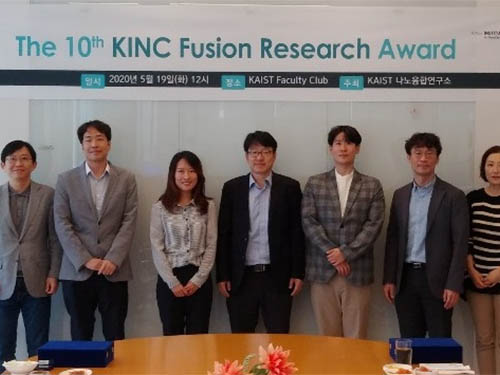 The 10th KINC Fusion Research Awardees
The KAIST Institute for NanoCentury (KINC) recognized three distinguished researchers whose convergence studies made significant impacts. The KINC presented the 10th KINC Fusion Research Awards during a ceremony that took place at KAIST’s main campus in Daejeon on May 19.
This year’s ‘best’ convergence research award went to a joint research group led by Professor Hee Tak Kim from the Department of Chemical and Biomolecular Engineering and Professor Sang Ouk Kim from the Department of Materials Science and Engineering. Their research, featured in the December 27 issue of Advanced Materials as a front cover article last year, introduced the world’s first high-energy efficiency, membraneless, flowless, zinc-bromine battery. This study, in which research professor Gyoung Hwa Jeong, postdoctoral researcher Yearin Byun, and PhD candidate Ju-Hyuck Lee took part as co-lead authors, is deemed as an example of a best practice in convergence research in which two groups’ respective expertise in the fields of carbon materials and electrochemical analysis created a synergistic effect.
Professor Bumjoon Kim from the Department of Chemical and Biomolecular Engineering was also recognized for having published the most interdisciplinary research papers on polymer electronics and nanomaterials at home and abroad.
Professor Hee-Tae Jung, the Director of KINC and the host of the KINC Fusion Research Awards, said, “The KINC is happy to announce the 10th awardees in nano-fusion research this year. Since convergence is crucial for making revolutionary changes, the importance of convergence studies should be recognized. Our institute will spare no effort to create a research environment suitable for convergence studies, which will be crucial for making a significant difference.”
The KINC was established in June 2006 under the KAIST Institute with the mission of facilitating convergence studies by tearing down boarders among departments and carrying out interdisciplinary joint research. Currently, the institute is comprised of approximately 90 professors from 13 departments. It aims to become a hub of university institutes for nano-fusion research.
(END)
2020.05.19 View 27277
-
 Professor Sang Ouk Kim Receives the POSCO Academic Award
Professor Sang Ouk Kim of KAIST’s Department of Materials Science and Engineering received the 2015 POSCO Academic Award. The award ceremony took place at the annual conference of the Korean Institute of Metals and Materials on April 23, 2015.
The POSCO Academic Award has been presented to the Institute's researchers and academics in recognition of their contributions to the advancement of metals and materials engineering in Korea.
Professor Kim is known for his pioneering work in manipulating the properties (work function, conductivity, surface energy, chemo-responsiveness, etc.) of carbon-based materials using double-element doping. Through his research, Professor Kim showed that carbon materials could be extremely useful in various areas including solar batteries and flexible devices. His work has been recognized and published in such journals as Advanced Materials, which invited him to write a review paper on his research in its 25th anniversary issue in 2014, along with world-renowned scholars including the Nobel laureate Alan Heeger.
Professor Kim has published a total of 143 Science Citation Index papers in journals like Nature, Science, Nature Materials, Nature Communications, Advanced Materials, Nano Letters, and Physical Review Letters. According to Scopus, a bibliographic database containing abstracts and citations for academic journal articles, he has been cited 6,456 times and has the h-index of 44, an index describing the scientific productivity and impact of a researcher.
2015.04.22 View 15184