%75%72%62%61%6e
-
 AI Finds Urban Commercial Districts Resilient to Climate Risk
< (From left) Integrated M.S.-Ph.D candidate Keonhee Jang, Postdoctoral Researcher Namwoo Kim, Professor Yoonjin Yoon, Researcher Seok-woo Yoon, Postdoctoral Researcher Young-jun Park, (Top) M.S candidate Juneyoung Ro >
KAIST announced on October 29th that its Urban AI Research Institute (Director, Distinguished Professor Yoonjin Yoon of Civil and Environmental Engineering conducted joint research in the field of 'Urban AI' with MIT's Senseable City Lab (Director, Professor Carlo Ratti) and disclosed the results at the 'Smart Life Week 2025' exhibition held at COEX, Seoul, in late September.
KAIST and MIT have been pursuing the 'Urban AI Joint Research Program' to interpret major urban problems using artificial intelligence. At this exhibition, the research results were presented in a form that citizens could directly experience, focusing on three themes: ▲Urban Climate Change, ▲Green Environment, and ▲Data Inclusivity.
Through this collaboration, the two institutions demonstrated that AI technology can expand beyond a tool for calculating urban problems to a new intelligence that promotes social understanding and empathy. They carried out three projects: ▲Urban Heat and Sales, ▲Nature That Heals, Seoul, and ▲Data Sonification.
The first project, 'Urban Heat and Sales,' is a study that analyzes the impact of climate change on urban commercial areas and the small business ecosystem using AI. An AI model was trained on over 300 million data points, including sales and weather for 96 business categories across 426 administrative dong (neighborhoods) in Seoul, to quantify the effect of climatic factors, such as temperature and humidity, on sales by industry type.
The results were visualized into 40,896 'Urban Heat Resilience' indicators, which score how well each region and business category can adapt to and recover from climate change. This allows the level of commercial area resilience to climate risk to be grasped at a glance, showing which areas are strong against temperature risks.
According to the study, for the convenience store sector, 64.7% of the total 426 dong were analyzed as 'climate-neutral areas,' which are relatively stable against climate change, while the remaining 35.3% belong to 'climate-sensitive areas,' which are significantly affected by climate change. This suggests that the operating environment for convenience stores varies significantly by region in terms of climate impact, and the data can be utilized for future location strategy planning from an urban resilience perspective.
< '3D Mesh Structure' that visually represents sales data for 426 regions in Seoul. The height and color of each region indicate the scale of sales. The left shows the distribution of sales in Seoul under actual temperature conditions, and the right shows the sales change predicted by AI when the temperature rises by 5 degrees. >
Visitors to the exhibition could select a region and business type on a real Seoul map and experience a system where the AI predicted sales changes in real-time based on future temperature rise scenarios.
This prediction model is a proprietary technology developed by KAIST, and plans are underway to expand cooperation with other major global cities, such as Boston and London. This research is expected to propose a new direction for establishing opening strategies for small business owners and developing urban climate risk response policies.
< Numerous visitors listening to explanations and experiencing the KAIST-MIT exhibition space >
The second project, 'Nature That Heals, Seoul,' is an extension of MIT's global project 'Feeling Nature' to Seoul. It combines urban environment data (Street View, maps, satellite images, etc.) with citizen survey data to train an AI to estimate the 'psychological green'—the actual psychological experience of green spaces felt by Seoul citizens.
This approach goes beyond simply calculating the area of trees or parks, offering new urban design directions that reflect citizens' emotional resilience and well-being. This research is expected to provide scientific evidence for future Seoul green space policies and locally tailored urban design.
The final project, 'Data Sonification,' is the world's first AI technology that translates over 300 million data points into sounds, like music, to be 'heard.' The AI uses data such as temperature, humidity, and sales to represent information through sound: for example, the pitch rises when the temperature goes up, and the sound lowers when sales decrease. This provides a new sensory experience of 'listening' to urban data through sound instead of sight.
This technology is a prime example of 'Barrier-Free AI' (AI for All), an inclusive AI technology that helps people with visual impairments or children—who may have difficulty accessing visual information—to intuitively understand data.
< A visitor experiencing Data Sonification, the world's first AI technology that converts data into sound >
Man-ki Kim, Chairman of the Seoul AI Hub (Seoul AI Foundation), which sponsored this research, stated, "We have achieved meaningful results by analyzing the urban environment and citizens' lives with artificial intelligence through collaboration with world-class research institutions like KAIST and MIT," adding, "This research has laid the groundwork for understanding urban change from the perspective of citizens and connecting it to policy and daily life."
Director Yoonjin Yoon remarked, "This exhibition demonstrated that artificial intelligence can evolve beyond a technology that merely calculates the city to an intelligence that understands and empathizes with people and the city," and concluded, "We will create data and experiences together with citizens, and collaborate with various cities worldwide to open a more inclusive and sustainable urban future."
This achievement is a global collaborative research project in the AI sector involving the KAIST Urban AI Research Institute and the MIT Senseable City Lab, and was conducted with sponsorship from the Seoul AI Hub.
※Research Results Images/Videos: https://05970c0c.slw-6vy.pages.dev/
2025.10.29 View 6119
AI Finds Urban Commercial Districts Resilient to Climate Risk
< (From left) Integrated M.S.-Ph.D candidate Keonhee Jang, Postdoctoral Researcher Namwoo Kim, Professor Yoonjin Yoon, Researcher Seok-woo Yoon, Postdoctoral Researcher Young-jun Park, (Top) M.S candidate Juneyoung Ro >
KAIST announced on October 29th that its Urban AI Research Institute (Director, Distinguished Professor Yoonjin Yoon of Civil and Environmental Engineering conducted joint research in the field of 'Urban AI' with MIT's Senseable City Lab (Director, Professor Carlo Ratti) and disclosed the results at the 'Smart Life Week 2025' exhibition held at COEX, Seoul, in late September.
KAIST and MIT have been pursuing the 'Urban AI Joint Research Program' to interpret major urban problems using artificial intelligence. At this exhibition, the research results were presented in a form that citizens could directly experience, focusing on three themes: ▲Urban Climate Change, ▲Green Environment, and ▲Data Inclusivity.
Through this collaboration, the two institutions demonstrated that AI technology can expand beyond a tool for calculating urban problems to a new intelligence that promotes social understanding and empathy. They carried out three projects: ▲Urban Heat and Sales, ▲Nature That Heals, Seoul, and ▲Data Sonification.
The first project, 'Urban Heat and Sales,' is a study that analyzes the impact of climate change on urban commercial areas and the small business ecosystem using AI. An AI model was trained on over 300 million data points, including sales and weather for 96 business categories across 426 administrative dong (neighborhoods) in Seoul, to quantify the effect of climatic factors, such as temperature and humidity, on sales by industry type.
The results were visualized into 40,896 'Urban Heat Resilience' indicators, which score how well each region and business category can adapt to and recover from climate change. This allows the level of commercial area resilience to climate risk to be grasped at a glance, showing which areas are strong against temperature risks.
According to the study, for the convenience store sector, 64.7% of the total 426 dong were analyzed as 'climate-neutral areas,' which are relatively stable against climate change, while the remaining 35.3% belong to 'climate-sensitive areas,' which are significantly affected by climate change. This suggests that the operating environment for convenience stores varies significantly by region in terms of climate impact, and the data can be utilized for future location strategy planning from an urban resilience perspective.
< '3D Mesh Structure' that visually represents sales data for 426 regions in Seoul. The height and color of each region indicate the scale of sales. The left shows the distribution of sales in Seoul under actual temperature conditions, and the right shows the sales change predicted by AI when the temperature rises by 5 degrees. >
Visitors to the exhibition could select a region and business type on a real Seoul map and experience a system where the AI predicted sales changes in real-time based on future temperature rise scenarios.
This prediction model is a proprietary technology developed by KAIST, and plans are underway to expand cooperation with other major global cities, such as Boston and London. This research is expected to propose a new direction for establishing opening strategies for small business owners and developing urban climate risk response policies.
< Numerous visitors listening to explanations and experiencing the KAIST-MIT exhibition space >
The second project, 'Nature That Heals, Seoul,' is an extension of MIT's global project 'Feeling Nature' to Seoul. It combines urban environment data (Street View, maps, satellite images, etc.) with citizen survey data to train an AI to estimate the 'psychological green'—the actual psychological experience of green spaces felt by Seoul citizens.
This approach goes beyond simply calculating the area of trees or parks, offering new urban design directions that reflect citizens' emotional resilience and well-being. This research is expected to provide scientific evidence for future Seoul green space policies and locally tailored urban design.
The final project, 'Data Sonification,' is the world's first AI technology that translates over 300 million data points into sounds, like music, to be 'heard.' The AI uses data such as temperature, humidity, and sales to represent information through sound: for example, the pitch rises when the temperature goes up, and the sound lowers when sales decrease. This provides a new sensory experience of 'listening' to urban data through sound instead of sight.
This technology is a prime example of 'Barrier-Free AI' (AI for All), an inclusive AI technology that helps people with visual impairments or children—who may have difficulty accessing visual information—to intuitively understand data.
< A visitor experiencing Data Sonification, the world's first AI technology that converts data into sound >
Man-ki Kim, Chairman of the Seoul AI Hub (Seoul AI Foundation), which sponsored this research, stated, "We have achieved meaningful results by analyzing the urban environment and citizens' lives with artificial intelligence through collaboration with world-class research institutions like KAIST and MIT," adding, "This research has laid the groundwork for understanding urban change from the perspective of citizens and connecting it to policy and daily life."
Director Yoonjin Yoon remarked, "This exhibition demonstrated that artificial intelligence can evolve beyond a technology that merely calculates the city to an intelligence that understands and empathizes with people and the city," and concluded, "We will create data and experiences together with citizens, and collaborate with various cities worldwide to open a more inclusive and sustainable urban future."
This achievement is a global collaborative research project in the AI sector involving the KAIST Urban AI Research Institute and the MIT Senseable City Lab, and was conducted with sponsorship from the Seoul AI Hub.
※Research Results Images/Videos: https://05970c0c.slw-6vy.pages.dev/
2025.10.29 View 6119 -
 KAIST develops ‘Hoverbike’ to roam the future skies
< Photo 1. A group photo of the research team >
Hoverbike is a kind of next-generation mobility that can complement the existing transportation system and can be used as an air transportation means without traffic congestion through high-weight payloads and long-distance flights. It is expected that domestic researchers will contribute to the development of the domestic PAV* and UAM markets by developing a domestically developed manned/unmanned hybrid aircraft that escapes dependence on foreign technology through the development of a high-performance hoverbike.
*PAV: Personal Aerial Vehicle. It is a key element of future urban air mobility (UAM, Urban Air Mobility) and constitutes an important part of the next-generation transportation system.
KAIST (President Kwang-Hyung Lee) announced on the 27th of December that the research team of Professor Hyochoong Bang of the Department of Aerospace Engineering successfully developed the core technology of a highly reliable multipurpose vertical takeoff and landing hoverbike that can be operated by both manned and unmanned vehicles.
This research was participated by the research teams of Professor Jae-Hung Han, Professor Ji-yun Lee, Professor Jae-myung Ahn, Professor Han-Lim Choi, and Professor Chang-Hun Lee of the Department of Aerospace Engineering at KAIST, Professor Dongjin Lee of the Department of Unmanned Aerial Vehicles at Hanseo University, and Professor Jong-Oh Park of the Department of Electronics Engineering at Dong-A University.
The research team secured key technologies related to the optimal design of a multipurpose aircraft, hybrid propulsion system, highly reliable precision navigation and flight control system, autonomous flight, and fault detection for the development of a high-performance hoverbike.
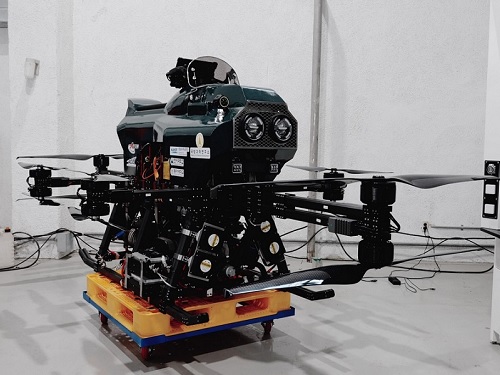
< Figure 1. Key features of high-reliability multi-purpose hoverbike >
The hoverbike platform introduced a gasoline engine-based hybrid system to overcome the shortcomings of battery-based drones, achieving approximately 60% better performance and maximum payload weight compared to overseas technology levels. Through this, it is expected to be utilized in various fields such as emergency supply delivery, logistics, and rescue activities for civilian use, and military transport and mission support for military use.
The navigation system was applied by implementing multi-sensor fusion technology based on DGPS/INS* to enable stable flight even in environments without GPS or with weak signals using high-reliability precision navigation technology.
*DGPS/INS: Navigation solution combining high accuracy of Differential GPS (DGPS) and Inertial Navigation System (INS)
In addition, high-reliability flight control technology was developed to enable reliable maneuvering even under external factors such as payload and wind, and model uncertainty, and fault detection technology was also developed.
A guidance technique to automatically land on a helipad after selecting a safe automatic landing area by configuring a high-reliability autonomous flight system was implemented with high accuracy. Stable operation is possible even in complex environments through obstacle avoidance and automatic landing autonomous flight technology.
< Figure 2. Hoverbike prototype model >
Professor Hyochoong Bang, the research director, emphasized, “We have proven the high practicality of the hoverbike in various environments through high-reliability flight control and precision navigation technology.” He added, “The hoverbike is a promising research result that can not only provide a major path leading to PAVs and future aircraft, but also surpass existing drone technology by several levels. This achievement is even more meaningful because it is the result of five years of effort by eight joint research teams, including the project’s practitioners, PhD students Kwangwoo Jang and Hyungjoo Ahn.”
This study aims to secure core technologies for manned/unmanned multipurpose hoverbikes that can be utilized as new concept aircraft in the defense and civilian sectors. It started as the Defense Acquisition Program Administration’s Defense Technology for Future Challenge Research and Development Project in 2019 and was completed in 2024 under the management of the Agency for Defense Development. It is scheduled to be exhibited for the first time at the 2025 Drone Show Korea (DSK2025), which will be held at BEXCO in Busan from February 26 to 28, 2025.
2024.12.27 View 16742
KAIST develops ‘Hoverbike’ to roam the future skies
< Photo 1. A group photo of the research team >
Hoverbike is a kind of next-generation mobility that can complement the existing transportation system and can be used as an air transportation means without traffic congestion through high-weight payloads and long-distance flights. It is expected that domestic researchers will contribute to the development of the domestic PAV* and UAM markets by developing a domestically developed manned/unmanned hybrid aircraft that escapes dependence on foreign technology through the development of a high-performance hoverbike.
*PAV: Personal Aerial Vehicle. It is a key element of future urban air mobility (UAM, Urban Air Mobility) and constitutes an important part of the next-generation transportation system.
KAIST (President Kwang-Hyung Lee) announced on the 27th of December that the research team of Professor Hyochoong Bang of the Department of Aerospace Engineering successfully developed the core technology of a highly reliable multipurpose vertical takeoff and landing hoverbike that can be operated by both manned and unmanned vehicles.
This research was participated by the research teams of Professor Jae-Hung Han, Professor Ji-yun Lee, Professor Jae-myung Ahn, Professor Han-Lim Choi, and Professor Chang-Hun Lee of the Department of Aerospace Engineering at KAIST, Professor Dongjin Lee of the Department of Unmanned Aerial Vehicles at Hanseo University, and Professor Jong-Oh Park of the Department of Electronics Engineering at Dong-A University.
The research team secured key technologies related to the optimal design of a multipurpose aircraft, hybrid propulsion system, highly reliable precision navigation and flight control system, autonomous flight, and fault detection for the development of a high-performance hoverbike.
< Figure 1. Key features of high-reliability multi-purpose hoverbike >
The hoverbike platform introduced a gasoline engine-based hybrid system to overcome the shortcomings of battery-based drones, achieving approximately 60% better performance and maximum payload weight compared to overseas technology levels. Through this, it is expected to be utilized in various fields such as emergency supply delivery, logistics, and rescue activities for civilian use, and military transport and mission support for military use.
The navigation system was applied by implementing multi-sensor fusion technology based on DGPS/INS* to enable stable flight even in environments without GPS or with weak signals using high-reliability precision navigation technology.
*DGPS/INS: Navigation solution combining high accuracy of Differential GPS (DGPS) and Inertial Navigation System (INS)
In addition, high-reliability flight control technology was developed to enable reliable maneuvering even under external factors such as payload and wind, and model uncertainty, and fault detection technology was also developed.
A guidance technique to automatically land on a helipad after selecting a safe automatic landing area by configuring a high-reliability autonomous flight system was implemented with high accuracy. Stable operation is possible even in complex environments through obstacle avoidance and automatic landing autonomous flight technology.
< Figure 2. Hoverbike prototype model >
Professor Hyochoong Bang, the research director, emphasized, “We have proven the high practicality of the hoverbike in various environments through high-reliability flight control and precision navigation technology.” He added, “The hoverbike is a promising research result that can not only provide a major path leading to PAVs and future aircraft, but also surpass existing drone technology by several levels. This achievement is even more meaningful because it is the result of five years of effort by eight joint research teams, including the project’s practitioners, PhD students Kwangwoo Jang and Hyungjoo Ahn.”
This study aims to secure core technologies for manned/unmanned multipurpose hoverbikes that can be utilized as new concept aircraft in the defense and civilian sectors. It started as the Defense Acquisition Program Administration’s Defense Technology for Future Challenge Research and Development Project in 2019 and was completed in 2024 under the management of the Agency for Defense Development. It is scheduled to be exhibited for the first time at the 2025 Drone Show Korea (DSK2025), which will be held at BEXCO in Busan from February 26 to 28, 2025.
2024.12.27 View 16742 -
 KAIST Civil Engineering Students named Runner-up at the 2023 ULI Hines Student Competition - Asia Pacific
A team of five students from the Korea Advanced Institute of Science and Technology (KAIST) were awarded second place in a premier urban design student competition hosted by the Urban Land Institute and Hines, 2023 ULI Hines Student Competition - Asia Pacific.
The competition, which was held for the first time in the Asia-Pacific region, is an internationally recognized event which typically attract hundreds of applicants.
Jonah Remigio, Sojung Noh, Estefania Rodriguez, Jihyun Kang, and Ayantu Teshome, who joined forces under the name of “Team Hashtag Development”, were supported by faculty advisors Dr. Albert Han and Dr. Youngchul Kim of the Department of Civil and Environmental Engineering to imagine a more sustainable and enriched way of living in the Jurong district of Singapore.
Their submission, titled “Proposal: The Nest”, analyzed the big data within Singapore, using the data to determine which real estate business strategies would best enhance the quality of living and economy of the region.
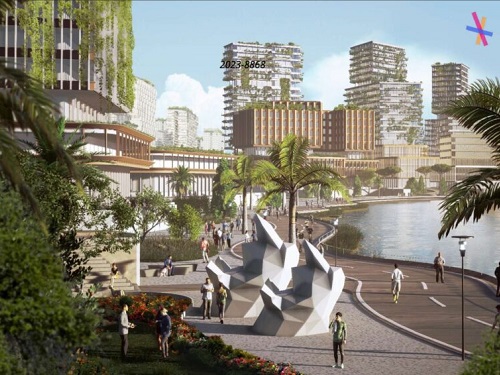
Their final design, "The Nest" utilized mixed-use zoning to integrate the site’s scenic waterfront with homes, medical innovation, and sustainable technology, altogether creating a place to innovate, inhabit, and immerse.
< The Nest by Team Hashtag Development (Jonah Remigio, Ayantu Teshome Mossisa, Estefania Ayelen Rodriguez del Puerto, Sojung Noh, Jihyun Kang) ©2023 Urban Land Institute >
Ultimately, the team was recognized for their hard work and determination, imprinting South Korea’s indelible footprint in the arena of international scholastic achievement as they were named to be one of the Finalists on April 13th.
< Members of Team Hashtag Development >
Team Hashtag Development gave a virtual presentation to a jury of six ULI members on April 20th along with the "Team The REAL" from the University of Economics Ho Chi Minh City of Vietnam and "Team Omusubi" from the Waseda University of Japan, the team that submitted the proposal "Jurong Urban Health Campus" which was announced to be the winner on the 31st of May, after the virtual briefing by the top three finalists.
2023.06.26 View 19683
KAIST Civil Engineering Students named Runner-up at the 2023 ULI Hines Student Competition - Asia Pacific
A team of five students from the Korea Advanced Institute of Science and Technology (KAIST) were awarded second place in a premier urban design student competition hosted by the Urban Land Institute and Hines, 2023 ULI Hines Student Competition - Asia Pacific.
The competition, which was held for the first time in the Asia-Pacific region, is an internationally recognized event which typically attract hundreds of applicants.
Jonah Remigio, Sojung Noh, Estefania Rodriguez, Jihyun Kang, and Ayantu Teshome, who joined forces under the name of “Team Hashtag Development”, were supported by faculty advisors Dr. Albert Han and Dr. Youngchul Kim of the Department of Civil and Environmental Engineering to imagine a more sustainable and enriched way of living in the Jurong district of Singapore.
Their submission, titled “Proposal: The Nest”, analyzed the big data within Singapore, using the data to determine which real estate business strategies would best enhance the quality of living and economy of the region.
Their final design, "The Nest" utilized mixed-use zoning to integrate the site’s scenic waterfront with homes, medical innovation, and sustainable technology, altogether creating a place to innovate, inhabit, and immerse.
< The Nest by Team Hashtag Development (Jonah Remigio, Ayantu Teshome Mossisa, Estefania Ayelen Rodriguez del Puerto, Sojung Noh, Jihyun Kang) ©2023 Urban Land Institute >
Ultimately, the team was recognized for their hard work and determination, imprinting South Korea’s indelible footprint in the arena of international scholastic achievement as they were named to be one of the Finalists on April 13th.
< Members of Team Hashtag Development >
Team Hashtag Development gave a virtual presentation to a jury of six ULI members on April 20th along with the "Team The REAL" from the University of Economics Ho Chi Minh City of Vietnam and "Team Omusubi" from the Waseda University of Japan, the team that submitted the proposal "Jurong Urban Health Campus" which was announced to be the winner on the 31st of May, after the virtual briefing by the top three finalists.
2023.06.26 View 19683 -
 KAIST’s unmanned racing car to race in the Indy Autonomous Challenge @ CES 2023 as the only contender representing Asia
- Professor David Hyunchul Shim of the School of Electrical Engineering, is at the Las Vegas Motor Speedway in Las Vegas, Nevada with his students of the Unmanned Systems Research Group (USRG), participating in the Indy Autonomous Challenge (IAC) @ CES as the only Asian team in the race.
Photo 1. Nine teams that competed at the first Indy Autonomous Challenge on October 23, 2021. (KAIST team is the right most team in the front row)
- The EE USRG team won the slot to race in the IAC @ CES 2023 rightly as the semifinals entree of the IAC @ CES 2022’ held in January of last year
- Through the partnership with Hyundai Motor Company, USRG received support to participate in the competition, and is to share the latest developments and trends of the technology with the company researchers
- With upgrades from last year, USRG is to race with a high-speed Indy racing car capable of driving up to 300 km/h and the technology developed in the process is to be used in further advancement of the high-speed autonomous vehicle technology of the future.
KAIST (President Kwang Hyung Lee) announced on the 5th that it will participate in the “Indy Autonomous Challenge (IAC) @ CES 2023”, an official event of the world's largest electronics and information technology exhibition held every year in Las Vegas, Nevada, of the United States from January 5th to 8th.
Photo 2. KAIST Racing Team participating in the Indy Autonomous Challenge @ CES 2023 (Team Leader: Sungwon Na, Team Members: Seongwoo Moon, Hyunwoo Nam, Chanhoe Ryu, Jaeyoung Kang)
“IAC @ CES 2023”, which is to be held at the Las Vegas Motor Speedway (LVMS) on January 7, seeks to advance technology developed as the result of last year's competition to share the results of such advanced high-speed autonomous vehicle technology with the public.
This competition is the 4th competition following the “Indy Autonomous Challenge (IAC)” held for the first time in Indianapolis, USA on October 23, 2021. At the IAC @ CES 2022 following the first IAC competition, the Unmmaned Systems Research Group (USRG) team led by Professor David Hyunchul Shim advanced to the semifinals out of a total of nine teams and won a spot to participate in CES 2023. As a result, the USRG comes into the challenge as the only Asian team to compete with other teams comprised of students and researchers of American and European backgrounds where the culture of motorsports is more deep-rooted.
For CES 2022, Professor David Hyunchul Shim’s research team was able to successfully develop a software that controlled the racing car to comply with the race flags and regulations while going up to 240 km/h all on its on.
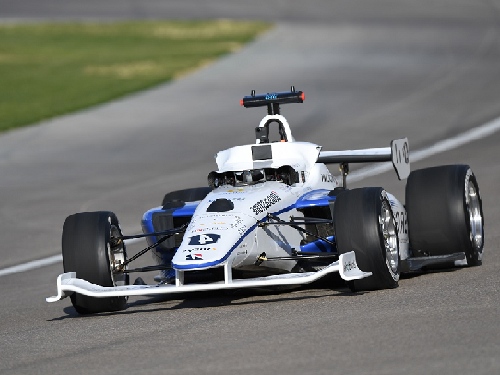
Photo 3. KAIST Team’s vehicle on Las Vegas Motor Speedway during the IAC @ CES 2022
In the IAC @ CES 2023, the official racing vehicle AV-23, is a converted version of IL-15, the official racing car for Indy 500, fully automated while maintaining the optimal design for high-speed racing, and was upgraded from the last year’s competition taking up the highest speed up to 300 km/h.
This year’s competition, will develop on last year’s head-to-head autonomous racing and take the form of the single elimination tournament to have the cars overtake the others without any restrictions on the driving course, which would have the team that constantly drives at the fastest speed will win the competition.
Photo 4. KAIST Team’s vehicle overtaking the Italian team, PoliMOVE’s vehicle during one of the race in the IAC @ CES 2022
Professor Shim's team further developed on the CES 2022 certified software to fine tune the external recognition mechanisms and is now focused on precise positioning and driving control technology that factors into maintaining stability even when driving at high speed.
Professor Shim's research team won the Autonomous Driving Competition hosted by Hyundai Motor Company in 2021. Starting with this CES 2023 competition, they signed a partnership contract with Hyundai to receive financial support to participate in the CES competition and share the latest developments and trends of autonomous driving technology with Hyundai Motor's research team.
During CES 2023, the research team will also participate in other events such as the exhibition by the KAIST racing team at the IAC’s official booth located in the West Hall.
Professor David Hyunchul Shim said, “With these competitions being held overseas, there were many difficulties having to keep coming back, but the students took part in it diligently, for which I am deeply grateful. Thanks to their efforts, we were able to continue in this competition, which will be a way to verify the autonomous driving technology that we developed ourselves over the past 13 years, and I highly appreciate that.”
“While high-speed autonomous driving technology is a technology that is not yet sought out in Korea, but it can be applied most effectively for long-distance travel in the Korea,” he went on to add. “It has huge advantages in that it does not require constructions for massive infrastructure that costs enormous amount of money such as high-speed rail or urban aviation and with our design, it is minimally affected by weather conditions.” he emphasized.
On a different note, the IAC @ CES 2023 is co-hosted by the Consumer Technology Association (CTA) and Energy Systems Network (ESN), the organizers of CES. Last year’s IAC winner, Technische Universität München of Germany, and MIT-PITT-RW, a team of Massachusetts Institute of Technology (Massachusetts), University of Pittsburgh (Pennsylvania), Rochester Institute of Technology (New York), University of Waterloo (Canada), with and the University of Waterloo, along with TII EuroRacing - University of Modena and Reggio Emilia (Italy), Technology Innovation Institute (United Arab Emirates), and five other teams are in the race for the win against KAIST.
Photo 5. KAIST Team’s vehicle on the track during the IAC @ CES 2022
The Indy Autonomous Challenge is scheduled to hold its fifth competition at the Monza track in Italy in June 2023 and the sixth competition at CES 2024.
2023.01.05 View 22488
KAIST’s unmanned racing car to race in the Indy Autonomous Challenge @ CES 2023 as the only contender representing Asia
- Professor David Hyunchul Shim of the School of Electrical Engineering, is at the Las Vegas Motor Speedway in Las Vegas, Nevada with his students of the Unmanned Systems Research Group (USRG), participating in the Indy Autonomous Challenge (IAC) @ CES as the only Asian team in the race.
Photo 1. Nine teams that competed at the first Indy Autonomous Challenge on October 23, 2021. (KAIST team is the right most team in the front row)
- The EE USRG team won the slot to race in the IAC @ CES 2023 rightly as the semifinals entree of the IAC @ CES 2022’ held in January of last year
- Through the partnership with Hyundai Motor Company, USRG received support to participate in the competition, and is to share the latest developments and trends of the technology with the company researchers
- With upgrades from last year, USRG is to race with a high-speed Indy racing car capable of driving up to 300 km/h and the technology developed in the process is to be used in further advancement of the high-speed autonomous vehicle technology of the future.
KAIST (President Kwang Hyung Lee) announced on the 5th that it will participate in the “Indy Autonomous Challenge (IAC) @ CES 2023”, an official event of the world's largest electronics and information technology exhibition held every year in Las Vegas, Nevada, of the United States from January 5th to 8th.
Photo 2. KAIST Racing Team participating in the Indy Autonomous Challenge @ CES 2023 (Team Leader: Sungwon Na, Team Members: Seongwoo Moon, Hyunwoo Nam, Chanhoe Ryu, Jaeyoung Kang)
“IAC @ CES 2023”, which is to be held at the Las Vegas Motor Speedway (LVMS) on January 7, seeks to advance technology developed as the result of last year's competition to share the results of such advanced high-speed autonomous vehicle technology with the public.
This competition is the 4th competition following the “Indy Autonomous Challenge (IAC)” held for the first time in Indianapolis, USA on October 23, 2021. At the IAC @ CES 2022 following the first IAC competition, the Unmmaned Systems Research Group (USRG) team led by Professor David Hyunchul Shim advanced to the semifinals out of a total of nine teams and won a spot to participate in CES 2023. As a result, the USRG comes into the challenge as the only Asian team to compete with other teams comprised of students and researchers of American and European backgrounds where the culture of motorsports is more deep-rooted.
For CES 2022, Professor David Hyunchul Shim’s research team was able to successfully develop a software that controlled the racing car to comply with the race flags and regulations while going up to 240 km/h all on its on.
Photo 3. KAIST Team’s vehicle on Las Vegas Motor Speedway during the IAC @ CES 2022
In the IAC @ CES 2023, the official racing vehicle AV-23, is a converted version of IL-15, the official racing car for Indy 500, fully automated while maintaining the optimal design for high-speed racing, and was upgraded from the last year’s competition taking up the highest speed up to 300 km/h.
This year’s competition, will develop on last year’s head-to-head autonomous racing and take the form of the single elimination tournament to have the cars overtake the others without any restrictions on the driving course, which would have the team that constantly drives at the fastest speed will win the competition.
Photo 4. KAIST Team’s vehicle overtaking the Italian team, PoliMOVE’s vehicle during one of the race in the IAC @ CES 2022
Professor Shim's team further developed on the CES 2022 certified software to fine tune the external recognition mechanisms and is now focused on precise positioning and driving control technology that factors into maintaining stability even when driving at high speed.
Professor Shim's research team won the Autonomous Driving Competition hosted by Hyundai Motor Company in 2021. Starting with this CES 2023 competition, they signed a partnership contract with Hyundai to receive financial support to participate in the CES competition and share the latest developments and trends of autonomous driving technology with Hyundai Motor's research team.
During CES 2023, the research team will also participate in other events such as the exhibition by the KAIST racing team at the IAC’s official booth located in the West Hall.
Professor David Hyunchul Shim said, “With these competitions being held overseas, there were many difficulties having to keep coming back, but the students took part in it diligently, for which I am deeply grateful. Thanks to their efforts, we were able to continue in this competition, which will be a way to verify the autonomous driving technology that we developed ourselves over the past 13 years, and I highly appreciate that.”
“While high-speed autonomous driving technology is a technology that is not yet sought out in Korea, but it can be applied most effectively for long-distance travel in the Korea,” he went on to add. “It has huge advantages in that it does not require constructions for massive infrastructure that costs enormous amount of money such as high-speed rail or urban aviation and with our design, it is minimally affected by weather conditions.” he emphasized.
On a different note, the IAC @ CES 2023 is co-hosted by the Consumer Technology Association (CTA) and Energy Systems Network (ESN), the organizers of CES. Last year’s IAC winner, Technische Universität München of Germany, and MIT-PITT-RW, a team of Massachusetts Institute of Technology (Massachusetts), University of Pittsburgh (Pennsylvania), Rochester Institute of Technology (New York), University of Waterloo (Canada), with and the University of Waterloo, along with TII EuroRacing - University of Modena and Reggio Emilia (Italy), Technology Innovation Institute (United Arab Emirates), and five other teams are in the race for the win against KAIST.
Photo 5. KAIST Team’s vehicle on the track during the IAC @ CES 2022
The Indy Autonomous Challenge is scheduled to hold its fifth competition at the Monza track in Italy in June 2023 and the sixth competition at CES 2024.
2023.01.05 View 22488 -
 ‘Urban Green Space Affects Citizens’ Happiness’
Study finds the relationship between green space, the economy, and happiness
A recent study revealed that as a city becomes more economically developed, its citizens’ happiness becomes more directly related to the area of urban green space.
A joint research project by Professor Meeyoung Cha of the School of Computing and her collaborators studied the relationship between green space and citizen happiness by analyzing big data from satellite images of 60 different countries.
Urban green space, including parks, gardens, and riversides not only provides aesthetic pleasure, but also positively affects our health by promoting physical activity and social interactions. Most of the previous research attempting to verify the correlation between urban green space and citizen happiness was based on few developed countries. Therefore, it was difficult to identify whether the positive effects of green space are global, or merely phenomena that depended on the economic state of the country. There have also been limitations in data collection, as it is difficult to visit each location or carry out investigations on a large scale based on aerial photographs.
The research team used data collected by Sentinel-2, a high-resolution satellite operated by the European Space Agency (ESA) to investigate 90 green spaces from 60 different countries around the world. The subjects of analysis were cities with the highest population densities (cities that contain at least 10% of the national population), and the images were obtained during the summer of each region for clarity. Images from the northern hemisphere were obtained between June and September of 2018, and those from the southern hemisphere were obtained between December of 2017 and February of 2018.
The areas of urban green space were then quantified and crossed with data from the World Happiness Report and GDP by country reported by the United Nations in 2018. Using these data, the relationships between green space, the economy, and citizen happiness were analyzed.
The results showed that in all cities, citizen happiness was positively correlated with the area of urban green space regardless of the country’s economic state. However, out of the 60 countries studied, the happiness index of the bottom 30 by GDP showed a stronger correlation with economic growth. In countries whose gross national income (GDP per capita) was higher than 38,000 USD, the area of green space acted as a more important factor affecting happiness than economic growth. Data from Seoul was analyzed to represent South Korea, and showed an increased happiness index with increased green areas compared to the past.
The authors point out their work has several policy-level implications. First, public green space should be made accessible to urban dwellers to enhance social support. If public safety in urban parks is not guaranteed, its positive role in social support and happiness may diminish. Also, the meaning of public safety may change; for example, ensuring biological safety will be a priority in keeping urban parks accessible during the COVID-19 pandemic.
Second, urban planning for public green space is needed for both developed and developing countries. As it is challenging or nearly impossible to secure land for green space after the area is developed, urban planning for parks and green space should be considered in developing economies where new cities and suburban areas are rapidly expanding.
Third, recent climate changes can present substantial difficulty in sustaining urban green space. Extreme events such as wildfires, floods, droughts, and cold waves could endanger urban forests while global warming could conversely accelerate tree growth in cities due to the urban heat island effect. Thus, more attention must be paid to predict climate changes and discovering their impact on the maintenance of urban green space.
“There has recently been an increase in the number of studies using big data from satellite images to solve social conundrums,” said Professor Cha. “The tool developed for this investigation can also be used to quantify the area of aquatic environments like lakes and the seaside, and it will now be possible to analyze the relationship between citizen happiness and aquatic environments in future studies,” she added.
Professor Woo Sung Jung from POSTECH and Professor Donghee Wohn from the New Jersey Institute of Technology also joined this research. It was reported in the online issue of EPJ Data Science on May 30.
-PublicationOh-Hyun Kwon, Inho Hong, Jeasurk Yang, Donghee Y. Wohn, Woo-Sung Jung, andMeeyoung Cha, 2021. Urban green space and happiness in developed countries. EPJ Data Science. DOI: https://doi.org/10.1140/epjds/s13688-021-00278-7
-ProfileProfessor Meeyoung ChaData Science Labhttps://ds.ibs.re.kr/
School of Computing
KAIST
2021.06.21 View 24642
‘Urban Green Space Affects Citizens’ Happiness’
Study finds the relationship between green space, the economy, and happiness
A recent study revealed that as a city becomes more economically developed, its citizens’ happiness becomes more directly related to the area of urban green space.
A joint research project by Professor Meeyoung Cha of the School of Computing and her collaborators studied the relationship between green space and citizen happiness by analyzing big data from satellite images of 60 different countries.
Urban green space, including parks, gardens, and riversides not only provides aesthetic pleasure, but also positively affects our health by promoting physical activity and social interactions. Most of the previous research attempting to verify the correlation between urban green space and citizen happiness was based on few developed countries. Therefore, it was difficult to identify whether the positive effects of green space are global, or merely phenomena that depended on the economic state of the country. There have also been limitations in data collection, as it is difficult to visit each location or carry out investigations on a large scale based on aerial photographs.
The research team used data collected by Sentinel-2, a high-resolution satellite operated by the European Space Agency (ESA) to investigate 90 green spaces from 60 different countries around the world. The subjects of analysis were cities with the highest population densities (cities that contain at least 10% of the national population), and the images were obtained during the summer of each region for clarity. Images from the northern hemisphere were obtained between June and September of 2018, and those from the southern hemisphere were obtained between December of 2017 and February of 2018.
The areas of urban green space were then quantified and crossed with data from the World Happiness Report and GDP by country reported by the United Nations in 2018. Using these data, the relationships between green space, the economy, and citizen happiness were analyzed.
The results showed that in all cities, citizen happiness was positively correlated with the area of urban green space regardless of the country’s economic state. However, out of the 60 countries studied, the happiness index of the bottom 30 by GDP showed a stronger correlation with economic growth. In countries whose gross national income (GDP per capita) was higher than 38,000 USD, the area of green space acted as a more important factor affecting happiness than economic growth. Data from Seoul was analyzed to represent South Korea, and showed an increased happiness index with increased green areas compared to the past.
The authors point out their work has several policy-level implications. First, public green space should be made accessible to urban dwellers to enhance social support. If public safety in urban parks is not guaranteed, its positive role in social support and happiness may diminish. Also, the meaning of public safety may change; for example, ensuring biological safety will be a priority in keeping urban parks accessible during the COVID-19 pandemic.
Second, urban planning for public green space is needed for both developed and developing countries. As it is challenging or nearly impossible to secure land for green space after the area is developed, urban planning for parks and green space should be considered in developing economies where new cities and suburban areas are rapidly expanding.
Third, recent climate changes can present substantial difficulty in sustaining urban green space. Extreme events such as wildfires, floods, droughts, and cold waves could endanger urban forests while global warming could conversely accelerate tree growth in cities due to the urban heat island effect. Thus, more attention must be paid to predict climate changes and discovering their impact on the maintenance of urban green space.
“There has recently been an increase in the number of studies using big data from satellite images to solve social conundrums,” said Professor Cha. “The tool developed for this investigation can also be used to quantify the area of aquatic environments like lakes and the seaside, and it will now be possible to analyze the relationship between citizen happiness and aquatic environments in future studies,” she added.
Professor Woo Sung Jung from POSTECH and Professor Donghee Wohn from the New Jersey Institute of Technology also joined this research. It was reported in the online issue of EPJ Data Science on May 30.
-PublicationOh-Hyun Kwon, Inho Hong, Jeasurk Yang, Donghee Y. Wohn, Woo-Sung Jung, andMeeyoung Cha, 2021. Urban green space and happiness in developed countries. EPJ Data Science. DOI: https://doi.org/10.1140/epjds/s13688-021-00278-7
-ProfileProfessor Meeyoung ChaData Science Labhttps://ds.ibs.re.kr/
School of Computing
KAIST
2021.06.21 View 24642 -
 Visit by the President of the University of Illinois at Urbana-Champaign, US
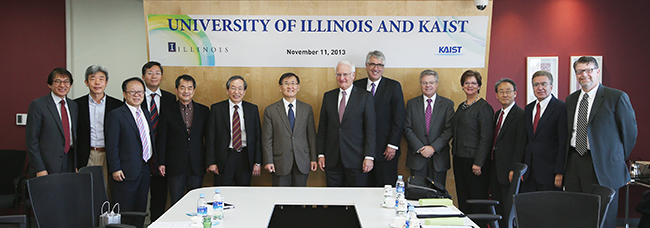
A delegation from the University of Illinois at Urbana-Champaign (UIUC) in the United States visited KAIST on November 11, 2013.
The delegation consisted of senior administrators from the university, the president, vice president for research, dean of engineering college, dean of nursing college, and associate chancellor for corporate and international relations. The managing director of the State of Illinois Far East Office also joined the delegation.
They met with President Steve Kang, including vice presidents and deans of KAIST, and discussed forming a possible partnership between KAIST and UIUC.
Robert A. Easter, the president of UIUC, said, “Higher education institutions today are bearing a critical responsibility to increase the awareness, knowledge, skills, and values needed to create a sustainable future. I hope KAIST and the University of Illinois will join forces to lead innovation in higher education and to stay connected and relevant in a global marketplace.”
President Steve Kang responded, “There would be many opportunities for the two universities to collaborate and achieve global preeminence in such field as biotechnology, engineering, and convergence research.”
The University of Illinois, with three distinct campuses in Chicago, Springfield, and Urbana-Champaign, is one of the most prestigious universities in the world. The university has an annual operating budget of more than USD 5 billion, collectively enrolls more than 78,000 students, awards nearly 20,000 degrees each year, and has more than 665,000 alumni around the world.
2013.11.18 View 12671
Visit by the President of the University of Illinois at Urbana-Champaign, US
A delegation from the University of Illinois at Urbana-Champaign (UIUC) in the United States visited KAIST on November 11, 2013.
The delegation consisted of senior administrators from the university, the president, vice president for research, dean of engineering college, dean of nursing college, and associate chancellor for corporate and international relations. The managing director of the State of Illinois Far East Office also joined the delegation.
They met with President Steve Kang, including vice presidents and deans of KAIST, and discussed forming a possible partnership between KAIST and UIUC.
Robert A. Easter, the president of UIUC, said, “Higher education institutions today are bearing a critical responsibility to increase the awareness, knowledge, skills, and values needed to create a sustainable future. I hope KAIST and the University of Illinois will join forces to lead innovation in higher education and to stay connected and relevant in a global marketplace.”
President Steve Kang responded, “There would be many opportunities for the two universities to collaborate and achieve global preeminence in such field as biotechnology, engineering, and convergence research.”
The University of Illinois, with three distinct campuses in Chicago, Springfield, and Urbana-Champaign, is one of the most prestigious universities in the world. The university has an annual operating budget of more than USD 5 billion, collectively enrolls more than 78,000 students, awards nearly 20,000 degrees each year, and has more than 665,000 alumni around the world.
2013.11.18 View 12671 -
 KAIST unveils foldable micro electric car, Armadillo-T
The small and light electric car completely folds in half when parking, making it a perfect fit for public or private transportation in an urban environment.
Looking for a parking space for hours at a busy shopping mall or being stuck on roads jammed with cars releasing large amounts of carbon dioxide are all-too-familiar scenes for city dwellers.
A group of researchers at the Korea Advanced Institute of Science and Technology (KAIST) recently developed a possible solution to such problems: a foldable, compact electric vehicle that can be utilized either as a personal car or part of the public transit system to connect major transportation routes within a city.
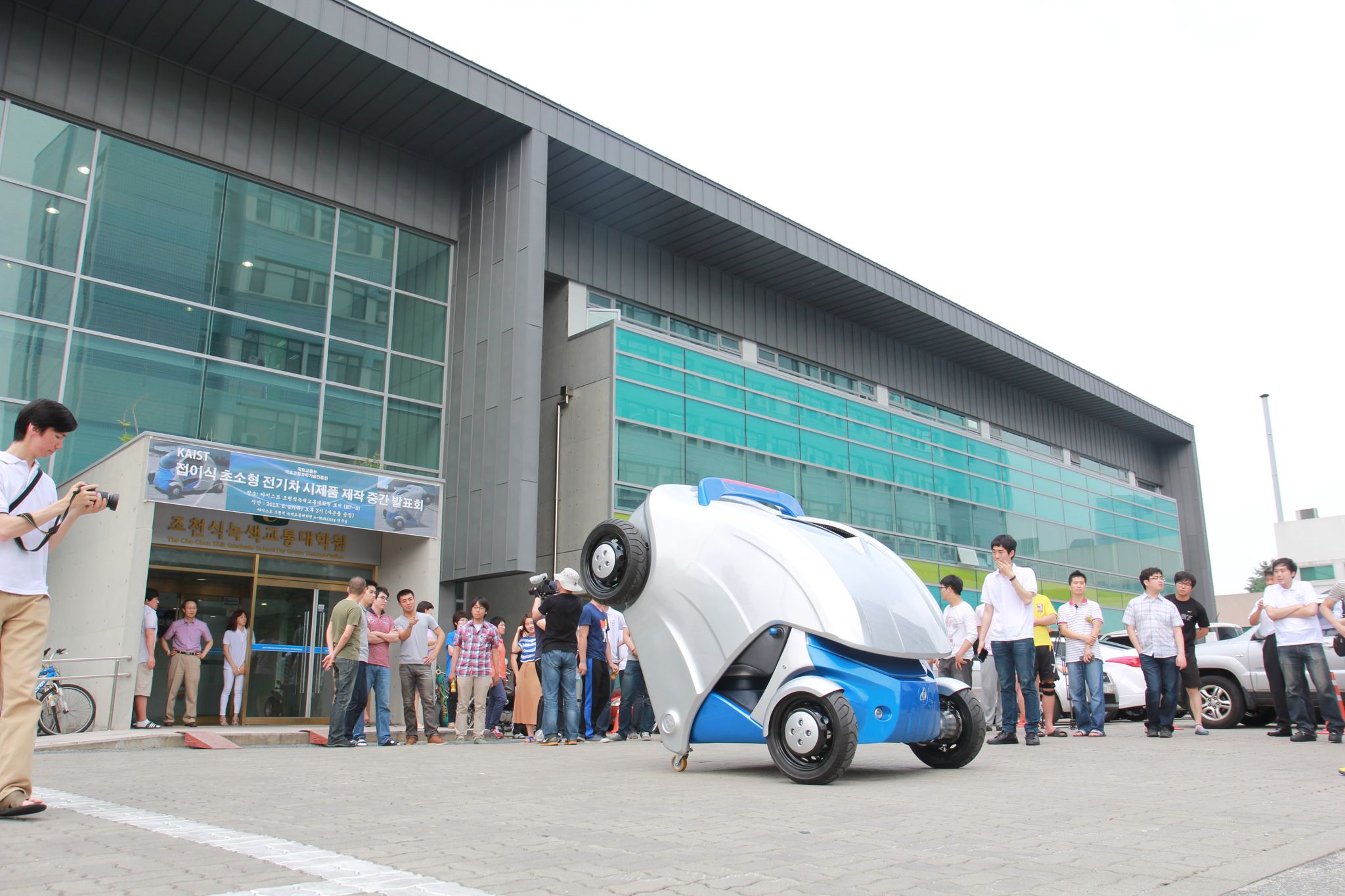
In-Soo Suh, associate professor of the Graduate School for Green Transportation at KAIST, and his research team introduced a prototype micro electric car called "Armadillo-T," whose design is based on a native animal of South America, the armadillo, a placental mammal with a leathery armor shell.
The research team imitated the animal"s distinctive protection characteristic of rolling up into a ball when facing with threat from predators. Just as armadillos hide themselves inside the shell, Armadillo-T tucks its rear body away, shrinking its original size of 2.8 meters (110 inches) down to almost half, 1.65 meters (65 inches), when folding.
Armadillo-T is a four-wheel-drive, all-electric car with two seats and four in-wheel motors. Since the motors are installed inside the wheels, and the 13.6 kWh capacity of lithium-ion battery pack is housed on the front side, the battery and motors do not have to change their positions when the car folds. This not only optimizes the energy efficiency but also provides stability and ample room to drivers and passengers.
Once folded, the small and light (weighs 450 kg) electric vehicle takes up only one-third of a 5-meter parking space, the standard parking size in Korea, allowing three of its kind to be parked. With a smartphone-interfaced remote control on the wheels, the vehicle can turn 360 degrees, enhancing drivers" convenience to park the car, even in an odd space in a parking lot, the corner of a building, for example.
Professor In-Soo Suh said, "I expect that people living in cities will eventually shift their preferences from bulky, petro-engine cars to smaller and lighter electric cars. Armadillo-T can be one of the alternatives city drivers can opt for. Particularly, this car is ideal for urban travels, including car-sharing and transit transfer, to offer major transportation links in a city. In addition to the urban application, local near-distance travels such as tourist zones or large buildings can be another example of application."
The concept car has loads of smart features on board, too: the cameras installed inside the car eliminate the need for side mirrors and increase the driver"s ability to see the car"s right and left side, thereby reducing blind spots. With a smartphone, the driver can control Armadillo-T and enable remote folding control. The car has a maximum speed of 60 km/h, and with a ten-minute fast charge, it can run up to 100 km.
Professor Suh explained that the concept of Armadillo-T was originally initiated in 2011 as he focused his research interest on the sub-A segment of personal mobility vehicles (PMVs), which are smaller and lighter than the current compact cars, as a new personalized transport mode.
"In coming years, we will see more mega-size cities established and face more serious environmental problems. Throughout the world, the aging population is rapidly growing as well. To cope with climate, energy, and limited petroleum resources, we really need to think outside the box, once again, to find more convenient and eco-friendly transportation, just as the Ford Model T did in the early 1920s. A further level of R&D, technical standards, and regulatory reviews are required to have these types of micro vehicles or PMVs on the market through test-bed evaluations, but we believe that Armadillo-T is an icon toward the future transport system with technology innovation."
The research project has been supported by the Korean government, the Ministry of Land, Infrastructure and Transport and the Korea Agency for Infrastructure Technology Advancement, since December 2012.Youtube Link: http://www.youtube.com/watch?v=8DoZH7Y-sR0
2013.08.21 View 24008
KAIST unveils foldable micro electric car, Armadillo-T
The small and light electric car completely folds in half when parking, making it a perfect fit for public or private transportation in an urban environment.
Looking for a parking space for hours at a busy shopping mall or being stuck on roads jammed with cars releasing large amounts of carbon dioxide are all-too-familiar scenes for city dwellers.
A group of researchers at the Korea Advanced Institute of Science and Technology (KAIST) recently developed a possible solution to such problems: a foldable, compact electric vehicle that can be utilized either as a personal car or part of the public transit system to connect major transportation routes within a city.
In-Soo Suh, associate professor of the Graduate School for Green Transportation at KAIST, and his research team introduced a prototype micro electric car called "Armadillo-T," whose design is based on a native animal of South America, the armadillo, a placental mammal with a leathery armor shell.
The research team imitated the animal"s distinctive protection characteristic of rolling up into a ball when facing with threat from predators. Just as armadillos hide themselves inside the shell, Armadillo-T tucks its rear body away, shrinking its original size of 2.8 meters (110 inches) down to almost half, 1.65 meters (65 inches), when folding.
Armadillo-T is a four-wheel-drive, all-electric car with two seats and four in-wheel motors. Since the motors are installed inside the wheels, and the 13.6 kWh capacity of lithium-ion battery pack is housed on the front side, the battery and motors do not have to change their positions when the car folds. This not only optimizes the energy efficiency but also provides stability and ample room to drivers and passengers.
Once folded, the small and light (weighs 450 kg) electric vehicle takes up only one-third of a 5-meter parking space, the standard parking size in Korea, allowing three of its kind to be parked. With a smartphone-interfaced remote control on the wheels, the vehicle can turn 360 degrees, enhancing drivers" convenience to park the car, even in an odd space in a parking lot, the corner of a building, for example.
Professor In-Soo Suh said, "I expect that people living in cities will eventually shift their preferences from bulky, petro-engine cars to smaller and lighter electric cars. Armadillo-T can be one of the alternatives city drivers can opt for. Particularly, this car is ideal for urban travels, including car-sharing and transit transfer, to offer major transportation links in a city. In addition to the urban application, local near-distance travels such as tourist zones or large buildings can be another example of application."
The concept car has loads of smart features on board, too: the cameras installed inside the car eliminate the need for side mirrors and increase the driver"s ability to see the car"s right and left side, thereby reducing blind spots. With a smartphone, the driver can control Armadillo-T and enable remote folding control. The car has a maximum speed of 60 km/h, and with a ten-minute fast charge, it can run up to 100 km.
Professor Suh explained that the concept of Armadillo-T was originally initiated in 2011 as he focused his research interest on the sub-A segment of personal mobility vehicles (PMVs), which are smaller and lighter than the current compact cars, as a new personalized transport mode.
"In coming years, we will see more mega-size cities established and face more serious environmental problems. Throughout the world, the aging population is rapidly growing as well. To cope with climate, energy, and limited petroleum resources, we really need to think outside the box, once again, to find more convenient and eco-friendly transportation, just as the Ford Model T did in the early 1920s. A further level of R&D, technical standards, and regulatory reviews are required to have these types of micro vehicles or PMVs on the market through test-bed evaluations, but we believe that Armadillo-T is an icon toward the future transport system with technology innovation."
The research project has been supported by the Korean government, the Ministry of Land, Infrastructure and Transport and the Korea Agency for Infrastructure Technology Advancement, since December 2012.Youtube Link: http://www.youtube.com/watch?v=8DoZH7Y-sR0
2013.08.21 View 24008 -
 Cancer detection from an implantable, flexible LED
Professor Keon Jae Lee
A KAIST research team has developed a new type of biocompatible and bendable GaN LED biosensor.
Daejeon, the Republic of Korea, August 8, 2011—Can a flexible LED conformably placed on the human heart, situated on the corrugated surface of the human brain, or rolled upon the blood vessels, diagnose or even treat various diseases? These things might be a reality in the near future.
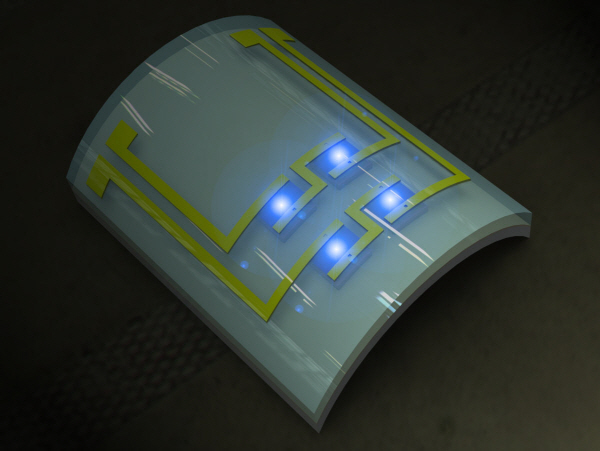
The team of Professor Keon Jae Lee (Department of Materials Science and Engineering, KAIST) has developed a new concept: a biocompatible, flexible Gallium Nitride (GaN) LED that can detect prostate cancer.
GaN LED, a highly efficient light emitting device, has been commercialized in LED TVs and in the lighting industry. Until now, it has been difficult to use this semiconductor material to fabricate flexible electronic systems due to its brittleness. The research team, however, has succeeded in developing a highly efficient, flexible GaN LED and in detecting cancer using a flexible LED biosensor.
Prof. Lee was involved in the first co-invention of "High Performance Flexible Single Crystal GaN" during his PhD course at the University of Illinois at Urbana-Champaign (UIUC). This flexible GaN LED biosensor utilized a similar protocol to transfer thin GaN LED films onto flexible substrates, followed by a biocompatible packaging process; the system’s overall potential for use in implantable biomedical applications was demonstrated.
Professor John Roger (Department of Materials Science and Engineering, UIUC) said,
“Bio-integrated LEDs represent an exciting, new technology with strong potential to address important challenges in human health. This present work represents a very nice contribution to this emerging field.”
This paper was published in the online issue of Nano Energy Elsevier Journal (Editor, Prof. Zhong Lin Wang) dated September 16, 2011.
Flexible GaN LED produces blue light.
2011.09.20 View 19013
Cancer detection from an implantable, flexible LED
Professor Keon Jae Lee
A KAIST research team has developed a new type of biocompatible and bendable GaN LED biosensor.
Daejeon, the Republic of Korea, August 8, 2011—Can a flexible LED conformably placed on the human heart, situated on the corrugated surface of the human brain, or rolled upon the blood vessels, diagnose or even treat various diseases? These things might be a reality in the near future.
The team of Professor Keon Jae Lee (Department of Materials Science and Engineering, KAIST) has developed a new concept: a biocompatible, flexible Gallium Nitride (GaN) LED that can detect prostate cancer.
GaN LED, a highly efficient light emitting device, has been commercialized in LED TVs and in the lighting industry. Until now, it has been difficult to use this semiconductor material to fabricate flexible electronic systems due to its brittleness. The research team, however, has succeeded in developing a highly efficient, flexible GaN LED and in detecting cancer using a flexible LED biosensor.
Prof. Lee was involved in the first co-invention of "High Performance Flexible Single Crystal GaN" during his PhD course at the University of Illinois at Urbana-Champaign (UIUC). This flexible GaN LED biosensor utilized a similar protocol to transfer thin GaN LED films onto flexible substrates, followed by a biocompatible packaging process; the system’s overall potential for use in implantable biomedical applications was demonstrated.
Professor John Roger (Department of Materials Science and Engineering, UIUC) said,
“Bio-integrated LEDs represent an exciting, new technology with strong potential to address important challenges in human health. This present work represents a very nice contribution to this emerging field.”
This paper was published in the online issue of Nano Energy Elsevier Journal (Editor, Prof. Zhong Lin Wang) dated September 16, 2011.
Flexible GaN LED produces blue light.
2011.09.20 View 19013