startup
-
 KAIST Office of Global Initiative Hosts 2024 Global Startup Internship Seminar
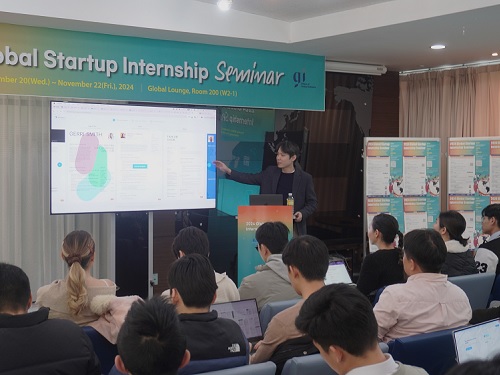
< Photo of ImpriMed CEO Sungwon Lim’s lecture >
The Office of Global Initiative at KAIST successfully hosted the 2024 Global Startup Internship Seminar (GSIS) from Wednesday, November 20, to Friday, November 22.
Now in its third year, following the 2022 Global Startup Internship Fair, the GSIS aims to introduce KAIST students to internship opportunities at U.S.-based startups and encourage participation in global internship programs, particularly for students with entrepreneurial aspirations. This year’s seminar featured notable startups including ImpriMed, a precision medical AI company; Klleon, an AI culture tech firm; and Bear Robotics, renowned for its autonomous serving robots. Approximately 80 KAIST students attended the event through prior registration.
A key highlight of this year’s seminar was the participation of the CEOs from Bear Robotics and ImpriMed, two prominent Silicon Valley startups. Both CEOs, who had previously participated in the 2024 Global Entrepreneurship Summer School (GESS) last June, offered insights into their companies, provided one-on-one career counseling sessions, and discussed the concept of global entrepreneurship with students interested in U.S. startup internships.
In addition to company presentations, the seminar offered practical workshops on resume and email writing tailored for U.S. internships, testimonials from current KAIST students and alumni who interned at Silicon Valley startups, and a J1 Visa Information Session, all aimed at preparing students for internships in the United States.
So Young Kim, Vice President of the International Office and Director of the Office of Global Initiative, expressed her hopes for the event, stating, “through this event, KAIST students will be inspired by the global entrepreneurial spirit of mentors who have started businesses abroad, and that it will help further spread a culture of challenging adversity and overcoming the risks of failure.” She further added that KAIST is committed to continuously developing programs that cultivate a global entrepreneurial mindset among its students.
The 2024 Global Startup Internship Seminar successfully concluded, providing KAIST students with vision and opportunities in global entrepreneurship.
2024.11.25 View 1889
KAIST Office of Global Initiative Hosts 2024 Global Startup Internship Seminar
< Photo of ImpriMed CEO Sungwon Lim’s lecture >
The Office of Global Initiative at KAIST successfully hosted the 2024 Global Startup Internship Seminar (GSIS) from Wednesday, November 20, to Friday, November 22.
Now in its third year, following the 2022 Global Startup Internship Fair, the GSIS aims to introduce KAIST students to internship opportunities at U.S.-based startups and encourage participation in global internship programs, particularly for students with entrepreneurial aspirations. This year’s seminar featured notable startups including ImpriMed, a precision medical AI company; Klleon, an AI culture tech firm; and Bear Robotics, renowned for its autonomous serving robots. Approximately 80 KAIST students attended the event through prior registration.
A key highlight of this year’s seminar was the participation of the CEOs from Bear Robotics and ImpriMed, two prominent Silicon Valley startups. Both CEOs, who had previously participated in the 2024 Global Entrepreneurship Summer School (GESS) last June, offered insights into their companies, provided one-on-one career counseling sessions, and discussed the concept of global entrepreneurship with students interested in U.S. startup internships.
In addition to company presentations, the seminar offered practical workshops on resume and email writing tailored for U.S. internships, testimonials from current KAIST students and alumni who interned at Silicon Valley startups, and a J1 Visa Information Session, all aimed at preparing students for internships in the United States.
So Young Kim, Vice President of the International Office and Director of the Office of Global Initiative, expressed her hopes for the event, stating, “through this event, KAIST students will be inspired by the global entrepreneurial spirit of mentors who have started businesses abroad, and that it will help further spread a culture of challenging adversity and overcoming the risks of failure.” She further added that KAIST is committed to continuously developing programs that cultivate a global entrepreneurial mindset among its students.
The 2024 Global Startup Internship Seminar successfully concluded, providing KAIST students with vision and opportunities in global entrepreneurship.
2024.11.25 View 1889 -
 KAIST holds its first ‘KAIST Tech Fair’ in New York, USA
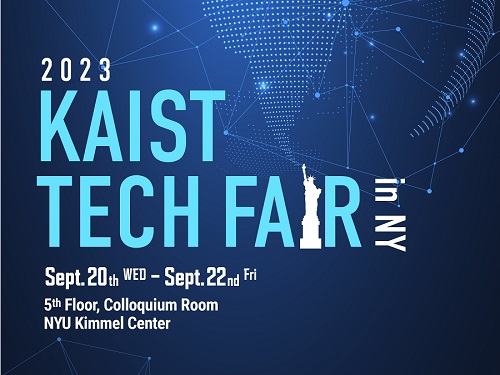
< Photo 1. 2023 KAIST Tech Fair in New York >
KAIST (President Kwang-Hyung Lee) announced on the 11th that it will hold the ‘2023 KAIST Tech Fair in New York’ at the Kimmel Center at New York University in Manhattan, USA, on the 22nd of this month. It is an event designed to be the starting point for KAIST to expand its startup ecosystem into the global stage, and it is to attract investments and secure global customers in New York by demonstrating the technological value of KAIST startup companies directly at location.
< Photo 2. President Kwang Hyung Lee at the 2023 KAIST Tech Fair in New York >
KAIST has been holding briefing sessions for technology transfer in Korea every year since 2018, and this year is the first time to hold a tech fair overseas for global companies.
KAIST Institute of Technology Value Creation (Director Sung-Yool Choi) has prepared for this event over the past six months with the Korea International Trade Association (hereinafter KITA, CEO Christopher Koo) to survey customer base and investment companies to conduct market analysis.
Among the companies founded with the technologies developed by the faculty and students of KAIST and their partners, 7 companies were selected to be matched with companies overseas that expressed interests in these technologies. Global multinational companies in the fields of IT, artificial intelligence, environment, logistics, distribution, and retail are participating as demand agencies and are testing the marketability of the start-up's technology as of September.
Daim Research, founded by Professor Young Jae Jang of the Department of Industrial and Systems Engineering, is a company specializing in smart factory automation solutions and is knocking on the door of the global market with a platform technology optimized for automated logistics systems.
< Photo 3. Presentation by Professor Young Jae Jang for DAIM Research >
It is a ‘collaborative intelligence’ solution that maximizes work productivity by having a number of robots used in industrial settings collaborate with one another. The strength of their solution is that logistics robots equipped with AI reinforced learning technology can respond to processes and environmental changes on their own, minimizing maintenance costs and the system can achieve excellent performance even with a small amount of data when it is combined with the digital twin technology the company has developed on its own.
A student startup, ‘Aniai’, is entering the US market, the home of hamburgers, with hamburger patty automation equipments and solutions. This is a robot kitchen startup founded by its CEO Gunpil Hwang, a graduate of KAIST’s School of Electrical Engineering which gathered together the experts in the fields of robot control, design, and artificial intelligence and cognitive technology to develop technology to automatically cook hamburger patties.
At the touch of a button, both sides of the patty are cooked simultaneously for consistent taste and quality according to the set condition. Since it can cook about 200 dishes in an hour, it is attracting attention as a technology that can not only solve manpower shortages but also accelerate the digital transformation of the restaurant industry.
Also, at the tech fair to be held at the Kimmel Center of New York University on the 22nd, the following startups who are currently under market verification in the U.S. will be participating: ▴'TheWaveTalk', which developed a water quality management system that can measure external substances and metal ions by transferring original technology from KAIST; ▴‘VIRNECT’, which helps workers improve their skills by remotely managing industrial sites using XR*; ▴‘Datumo’, a solution that helps process and analyze artificial intelligence big data, ▴‘VESSL AI’, the provider of a solution to eliminate the overhead** of machine learning systems; and ▴ ‘DolbomDream’, which developed an inflatable vest that helps the psychological stability of people with developmental disabilities.
* XR (eXtended Reality): Ultra-realistic technology that enhances immersion by utilizing augmented reality, virtual reality, and mixed reality technologies
** Overhead: Additional time required for stable processing of the program
In addition, two companies (Plasmapp and NotaAI) that are participating in the D-Unicorn program with the support of the Daejeon City and two companies (Enget and ILIAS Biologics) that are receiving support from the Scale Up Tips of the Ministry of SMEs and Startups, three companies (WiPowerOne, IDK Lab, and Artificial Photosynthesis Lab) that are continuing to realize the sustainable development goals for a total of 14 KAIST startups, will hold a corporate information session with about 100 invited guests from global companies and venture capital.
< Photo 4. Presentation for AP Lab >
Prior to this event, participating startups will be visiting the New York Economic Development Corporation and large law firms to receive advice on U.S. government support programs and on their attemps to enter the U.S. market. In addition, the participating companies plan to visit a startup support investment institution pursuing sustainable development goals and the Leslie eLab, New York University's one-stop startup support space, to lay the foundation for KAIST's leap forward in global technology commercialization.
< Photo 5. Sung-Yool Choi, the Director of KAIST Institute of Technology Value Creation (left) at the 2023 KAIST Tech Fair in New York with the key participants >
Sung-Yool Choi, the Director of KAIST Institute of Technology Value Creation, said, “KAIST prepared this event to realize its vision of being a leading university in creating global value.” He added, “We hope that our startups founded with KAIST technology would successfully completed market verification to be successful in securing global demands and in attracting investments for their endeavors.”
2023.09.11 View 15582
KAIST holds its first ‘KAIST Tech Fair’ in New York, USA
< Photo 1. 2023 KAIST Tech Fair in New York >
KAIST (President Kwang-Hyung Lee) announced on the 11th that it will hold the ‘2023 KAIST Tech Fair in New York’ at the Kimmel Center at New York University in Manhattan, USA, on the 22nd of this month. It is an event designed to be the starting point for KAIST to expand its startup ecosystem into the global stage, and it is to attract investments and secure global customers in New York by demonstrating the technological value of KAIST startup companies directly at location.
< Photo 2. President Kwang Hyung Lee at the 2023 KAIST Tech Fair in New York >
KAIST has been holding briefing sessions for technology transfer in Korea every year since 2018, and this year is the first time to hold a tech fair overseas for global companies.
KAIST Institute of Technology Value Creation (Director Sung-Yool Choi) has prepared for this event over the past six months with the Korea International Trade Association (hereinafter KITA, CEO Christopher Koo) to survey customer base and investment companies to conduct market analysis.
Among the companies founded with the technologies developed by the faculty and students of KAIST and their partners, 7 companies were selected to be matched with companies overseas that expressed interests in these technologies. Global multinational companies in the fields of IT, artificial intelligence, environment, logistics, distribution, and retail are participating as demand agencies and are testing the marketability of the start-up's technology as of September.
Daim Research, founded by Professor Young Jae Jang of the Department of Industrial and Systems Engineering, is a company specializing in smart factory automation solutions and is knocking on the door of the global market with a platform technology optimized for automated logistics systems.
< Photo 3. Presentation by Professor Young Jae Jang for DAIM Research >
It is a ‘collaborative intelligence’ solution that maximizes work productivity by having a number of robots used in industrial settings collaborate with one another. The strength of their solution is that logistics robots equipped with AI reinforced learning technology can respond to processes and environmental changes on their own, minimizing maintenance costs and the system can achieve excellent performance even with a small amount of data when it is combined with the digital twin technology the company has developed on its own.
A student startup, ‘Aniai’, is entering the US market, the home of hamburgers, with hamburger patty automation equipments and solutions. This is a robot kitchen startup founded by its CEO Gunpil Hwang, a graduate of KAIST’s School of Electrical Engineering which gathered together the experts in the fields of robot control, design, and artificial intelligence and cognitive technology to develop technology to automatically cook hamburger patties.
At the touch of a button, both sides of the patty are cooked simultaneously for consistent taste and quality according to the set condition. Since it can cook about 200 dishes in an hour, it is attracting attention as a technology that can not only solve manpower shortages but also accelerate the digital transformation of the restaurant industry.
Also, at the tech fair to be held at the Kimmel Center of New York University on the 22nd, the following startups who are currently under market verification in the U.S. will be participating: ▴'TheWaveTalk', which developed a water quality management system that can measure external substances and metal ions by transferring original technology from KAIST; ▴‘VIRNECT’, which helps workers improve their skills by remotely managing industrial sites using XR*; ▴‘Datumo’, a solution that helps process and analyze artificial intelligence big data, ▴‘VESSL AI’, the provider of a solution to eliminate the overhead** of machine learning systems; and ▴ ‘DolbomDream’, which developed an inflatable vest that helps the psychological stability of people with developmental disabilities.
* XR (eXtended Reality): Ultra-realistic technology that enhances immersion by utilizing augmented reality, virtual reality, and mixed reality technologies
** Overhead: Additional time required for stable processing of the program
In addition, two companies (Plasmapp and NotaAI) that are participating in the D-Unicorn program with the support of the Daejeon City and two companies (Enget and ILIAS Biologics) that are receiving support from the Scale Up Tips of the Ministry of SMEs and Startups, three companies (WiPowerOne, IDK Lab, and Artificial Photosynthesis Lab) that are continuing to realize the sustainable development goals for a total of 14 KAIST startups, will hold a corporate information session with about 100 invited guests from global companies and venture capital.
< Photo 4. Presentation for AP Lab >
Prior to this event, participating startups will be visiting the New York Economic Development Corporation and large law firms to receive advice on U.S. government support programs and on their attemps to enter the U.S. market. In addition, the participating companies plan to visit a startup support investment institution pursuing sustainable development goals and the Leslie eLab, New York University's one-stop startup support space, to lay the foundation for KAIST's leap forward in global technology commercialization.
< Photo 5. Sung-Yool Choi, the Director of KAIST Institute of Technology Value Creation (left) at the 2023 KAIST Tech Fair in New York with the key participants >
Sung-Yool Choi, the Director of KAIST Institute of Technology Value Creation, said, “KAIST prepared this event to realize its vision of being a leading university in creating global value.” He added, “We hope that our startups founded with KAIST technology would successfully completed market verification to be successful in securing global demands and in attracting investments for their endeavors.”
2023.09.11 View 15582 -
 KAIST gearing up to train physician-scientists and BT Professionals joining hands with Boston-based organizations
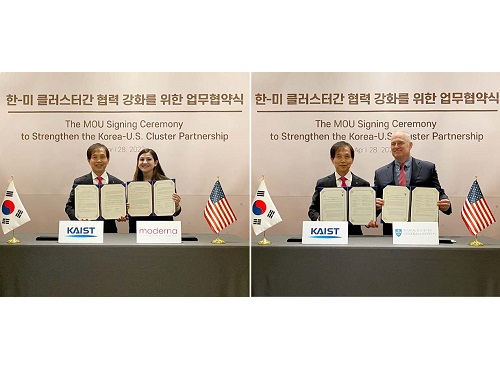
KAIST (President Kwang Hyung Lee) announced on the 29th that it has signed MOUs with Massachusetts General Hospital, a founding member of the Mass General Brigham health care system and a world-class research-oriented hospital, and Moderna, a biotechnology company that developed a COVID-19 vaccine at the Langham Hotel in Boston, MA, USA on the morning of April 28th (local time). The signing ceremony was attended by officials from each institution joined by others headed by Minister LEE Young of the Korean Ministry of SMEs and Startups (MSS), and Commissioner LEE Insil of the Korean Intellectual Property Office.
< Photo 1. Photo from the Signing of MOU between KAIST-Harvard University Massachusetts General Hospital and KAIST-Moderna >
Mass General is the first and largest teaching hospital of Harvard Medical School in Boston, USA, and it is one of the most innovative hospitals in the world being the alma mater of more than 13 Nobel Prize winners and the home of the Mass General Research Institute, the world’s largest hospital-based research program that utilizes an annual research budget of more than $1.3 billion.
KAIST signed a general agreement to explore research and academic exchange with Mass General in September of last year and this MOU is a part of its follow-ups.
Mass General works with Harvard and the Massachusetts Institute of Technology (MIT), as well as local hospitals, to support students learn the theories of medicine and engineering, and gain rich clinical research experience.
Through this MOU, KAIST will explore cooperation with an innovative ecosystem created through the convergence of medicine and engineering. In particular, KAIST’s goal is to develop a Korean-style training program and implement a differentiated educational program when establishing the science and technology-oriented medical school in the future by further strengthening the science and engineering part of the training including a curriculum on artificial intelligence (AI) and the likes there of.
Also, in order to foster innovative physician-scientists, KAIST plans to pursue cooperation to develop programs for exchange of academic and human resources including programs for student and research exchanges and a program for students of the science and technology-oriented medical school at KAIST to have a chance to take part in practical training at Mass General.
David F.M. Brown, MD, Mass General President, said, “The collaboration with KAIST has a wide range of potentials, including advice on training of physician-scientists, academic and human resource exchanges, and vitalization of joint research by faculty from both institutions. Through this agreement, we will be able to actively contribute to global cooperation and achieve mutual goals.”
Meanwhile, an MOU between KAIST and Moderna was also held on the same day. Its main focus is to foster medical experts in cooperation with KAIST Graduate School of Medical Science and Engineering (GSMSE), and plans to cooperate in various ways in the future, including collaborating for development of vaccine and new drugs, virus research, joint mRNA research, and facilitation of technology commercialization.
In over 10 years since its inception, Moderna has transformed from a research-stage company advancing programs in the field of messenger RNA (mRNA) to an enterprise with a diverse clinical portfolio of vaccines and therapeutics across seven modalities. The Company has 48 programs in development across 45 development candidates, of which 38 are currently in active clinical trials.
“We are grateful to have laid a foundation for collaboration to foster industry experts with the Korea Advanced Institute of Science and Technology, a leader of science and technology innovation in Korea,” said Arpa Garay, Chief Commercial Officer, Moderna. “Based on our leadership and expertise in developing innovative mRNA vaccines and therapeutics, we hope to contribute to educating and collaborating with professionals in the bio-health field of Korea.“
President Kwang Hyung Lee of KAIST, said, “We deem this occasion to be of grave significance to be able to work closely with Massachusetts General Hospital, one of the world's best research-oriented hospitals, and Moderna, one of the most influential biomedical companies.”
President Lee continued, "On the basis of the collaboration with the two institutions, we will be able to bring up qualified physician-scientists and global leaders of the biomedical business who will solve problems of human health and their progress will in turn, accelerate the national R&D efforts in general and diversify the industry."
2023.04.29 View 14096
KAIST gearing up to train physician-scientists and BT Professionals joining hands with Boston-based organizations
KAIST (President Kwang Hyung Lee) announced on the 29th that it has signed MOUs with Massachusetts General Hospital, a founding member of the Mass General Brigham health care system and a world-class research-oriented hospital, and Moderna, a biotechnology company that developed a COVID-19 vaccine at the Langham Hotel in Boston, MA, USA on the morning of April 28th (local time). The signing ceremony was attended by officials from each institution joined by others headed by Minister LEE Young of the Korean Ministry of SMEs and Startups (MSS), and Commissioner LEE Insil of the Korean Intellectual Property Office.
< Photo 1. Photo from the Signing of MOU between KAIST-Harvard University Massachusetts General Hospital and KAIST-Moderna >
Mass General is the first and largest teaching hospital of Harvard Medical School in Boston, USA, and it is one of the most innovative hospitals in the world being the alma mater of more than 13 Nobel Prize winners and the home of the Mass General Research Institute, the world’s largest hospital-based research program that utilizes an annual research budget of more than $1.3 billion.
KAIST signed a general agreement to explore research and academic exchange with Mass General in September of last year and this MOU is a part of its follow-ups.
Mass General works with Harvard and the Massachusetts Institute of Technology (MIT), as well as local hospitals, to support students learn the theories of medicine and engineering, and gain rich clinical research experience.
Through this MOU, KAIST will explore cooperation with an innovative ecosystem created through the convergence of medicine and engineering. In particular, KAIST’s goal is to develop a Korean-style training program and implement a differentiated educational program when establishing the science and technology-oriented medical school in the future by further strengthening the science and engineering part of the training including a curriculum on artificial intelligence (AI) and the likes there of.
Also, in order to foster innovative physician-scientists, KAIST plans to pursue cooperation to develop programs for exchange of academic and human resources including programs for student and research exchanges and a program for students of the science and technology-oriented medical school at KAIST to have a chance to take part in practical training at Mass General.
David F.M. Brown, MD, Mass General President, said, “The collaboration with KAIST has a wide range of potentials, including advice on training of physician-scientists, academic and human resource exchanges, and vitalization of joint research by faculty from both institutions. Through this agreement, we will be able to actively contribute to global cooperation and achieve mutual goals.”
Meanwhile, an MOU between KAIST and Moderna was also held on the same day. Its main focus is to foster medical experts in cooperation with KAIST Graduate School of Medical Science and Engineering (GSMSE), and plans to cooperate in various ways in the future, including collaborating for development of vaccine and new drugs, virus research, joint mRNA research, and facilitation of technology commercialization.
In over 10 years since its inception, Moderna has transformed from a research-stage company advancing programs in the field of messenger RNA (mRNA) to an enterprise with a diverse clinical portfolio of vaccines and therapeutics across seven modalities. The Company has 48 programs in development across 45 development candidates, of which 38 are currently in active clinical trials.
“We are grateful to have laid a foundation for collaboration to foster industry experts with the Korea Advanced Institute of Science and Technology, a leader of science and technology innovation in Korea,” said Arpa Garay, Chief Commercial Officer, Moderna. “Based on our leadership and expertise in developing innovative mRNA vaccines and therapeutics, we hope to contribute to educating and collaborating with professionals in the bio-health field of Korea.“
President Kwang Hyung Lee of KAIST, said, “We deem this occasion to be of grave significance to be able to work closely with Massachusetts General Hospital, one of the world's best research-oriented hospitals, and Moderna, one of the most influential biomedical companies.”
President Lee continued, "On the basis of the collaboration with the two institutions, we will be able to bring up qualified physician-scientists and global leaders of the biomedical business who will solve problems of human health and their progress will in turn, accelerate the national R&D efforts in general and diversify the industry."
2023.04.29 View 14096 -
 2022 Global Startup Internship Fair (GSIF)
From November 30 to December 1, 2022, the Center for Global Strategies and Planning at KAIST held the 2022 Global Startup Internship Fair (GSIF) on-line and off-line, as well.
Including the globally acknowledged unicorn companies such as PsiQuantum and Moloco, eleven startups — ImpriMed, Vessel AI, Genedit, Medic Life Sciences, Bringko, Brave Turtles, Neozips, Luckmon and CUPIX — joined the fair. Among the eleven invited companies, six were founded by KAIST Alumni representatives. The invited companies sought student interns in the field of AI, biotechnology, quantum, logistics, games, advertisement, real estate, and e-commerce. In response, about 100 KAIST students with various backgrounds have shown their interest in the event through pre-reservation.
Participating companies at this fair introduced their companies and conducted recruitment and career counseling with KAIST students. Sungwon Lim, the CEO of ImpriMed and a KAIST alumni, said, “It was very meaningful to introduce ImpriMed to junior students and share my experiences that I gained while pioneering and operating startups in the United States.” To share his journey as a global startup CEO, Lim has been invited as an off-line speaker during this event.
< ImpriMed CEO, Sungwon Lim >
In addition to the recruiting sessions, the fair held information sessions offering guidelines and useful tips on seeking opportunities overseas including information on obtaining a J1 visa, applying to U.S. internships, relocating to Silicon Valley, and writing CVs, cover letters, and business emails.
Professor Man-Sung Yim, the Associate Vice President of the International Office at KAIST, stressed, “A growing number of students at KAIST want to become a global entrepreneur, and hands-on experience gained from U.S. startups is absolutely necessary to achieve their goals.” He added, “the 2022 GSIF was one of those opportunities for KAIST students to further their dream of becoming global leaders.”
2022.12.01 View 6887
2022 Global Startup Internship Fair (GSIF)
From November 30 to December 1, 2022, the Center for Global Strategies and Planning at KAIST held the 2022 Global Startup Internship Fair (GSIF) on-line and off-line, as well.
Including the globally acknowledged unicorn companies such as PsiQuantum and Moloco, eleven startups — ImpriMed, Vessel AI, Genedit, Medic Life Sciences, Bringko, Brave Turtles, Neozips, Luckmon and CUPIX — joined the fair. Among the eleven invited companies, six were founded by KAIST Alumni representatives. The invited companies sought student interns in the field of AI, biotechnology, quantum, logistics, games, advertisement, real estate, and e-commerce. In response, about 100 KAIST students with various backgrounds have shown their interest in the event through pre-reservation.
Participating companies at this fair introduced their companies and conducted recruitment and career counseling with KAIST students. Sungwon Lim, the CEO of ImpriMed and a KAIST alumni, said, “It was very meaningful to introduce ImpriMed to junior students and share my experiences that I gained while pioneering and operating startups in the United States.” To share his journey as a global startup CEO, Lim has been invited as an off-line speaker during this event.
< ImpriMed CEO, Sungwon Lim >
In addition to the recruiting sessions, the fair held information sessions offering guidelines and useful tips on seeking opportunities overseas including information on obtaining a J1 visa, applying to U.S. internships, relocating to Silicon Valley, and writing CVs, cover letters, and business emails.
Professor Man-Sung Yim, the Associate Vice President of the International Office at KAIST, stressed, “A growing number of students at KAIST want to become a global entrepreneur, and hands-on experience gained from U.S. startups is absolutely necessary to achieve their goals.” He added, “the 2022 GSIF was one of those opportunities for KAIST students to further their dream of becoming global leaders.”
2022.12.01 View 6887 -
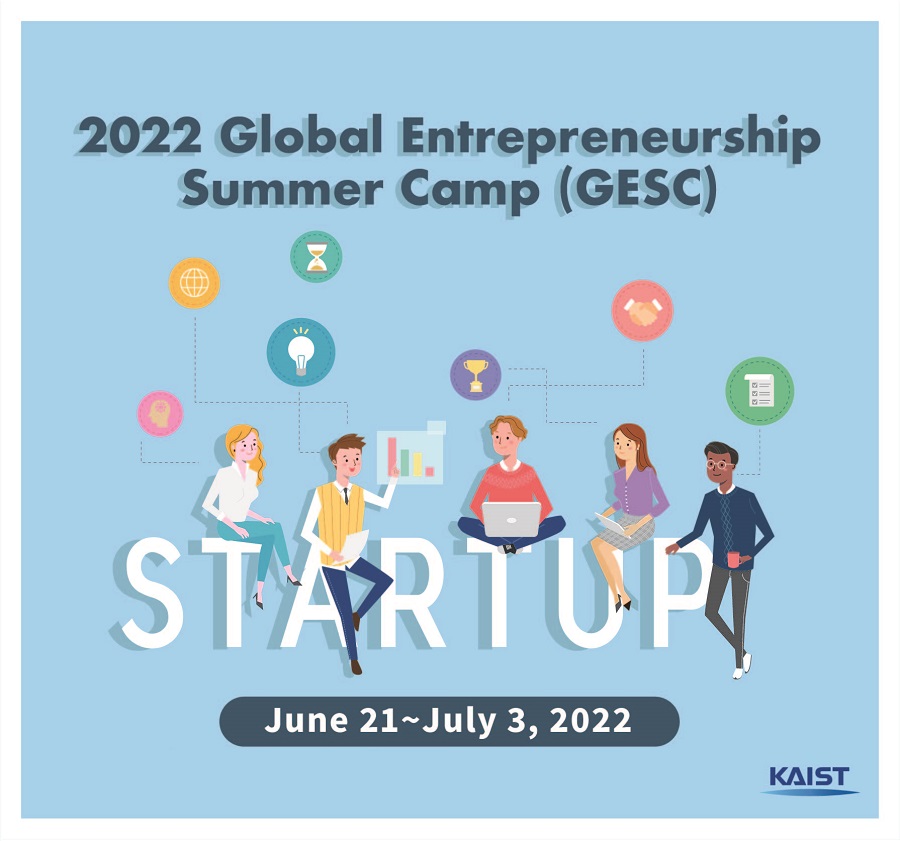 The 1st Global Entrepreneurship Summer Camp bridges KAIST and Silicon Valley, US
Twenty KAIST students gave a go at selling their business ideas to investors at Silicon Valley on the “Pitch Day” at 2022 Global Entrepreneurship Summer Camp.
From Tuesday, June 21 to Monday, July 4, 2022, KAIST held the first Global Entrepreneurship Summer Camp (GESC).
The 2022 GESC, which was organized in collaboration with Stanford Technology Ventures Program (STVP), KOTRA Silicon Valley IT Center, and KAIST Alumni at Silicon Valley, was a pilot program that offered opportunities of experiencing and learning about the cases of startup companies in Silicon Valley and a chance to expand businesses to Silicon Valley through networking.
Twenty KAIST students, including pre-startup entrepreneurs and students interested in global entrepreneurship with less than one year of business experience were selected. The first week of the program was organized by Startup KAIST while the second week program was organized by the Center for Global Strategies and Planning (GSP) at KAIST in collaboration with the Stanford Technology Venture Program (STVP), KAIST Alumni at Silicon Valley, and KOTRA at Silicon Valley.
Dr. Mo-Yun Lei Fong, the Executive Director of STVP, said, “The program offered an opportunity for us to realize our vision of empowering aspiring entrepreneurs to become global citizens who create and scale responsible innovation. By collaborating with KAIST and offering entrepreneurial insights to Korean students, we are able to have a positive impact on a global scale.” Mo added, “The program also enabled STVP to build bridges, learn from the students, and refine our culturally relevant curriculum by understanding Korean culture and ideas.”
On the “Pitch Day” on July 1, following a special talk by Dr. Chong-Moon Lee, the Chairman of AmBex Venture Partners, the students presented their team business ideas such as an AI-assisted, noise-canceling pillow devised for better sleep, a metaverse dating application, an XR virtual conferencing system, and an AI language tutoring application to the entice global investors’ curiosity. The invited investors, majorly based in Silicon Valley, commented that all the presentation was very exciting, and the level of pitches was beyond the expectation considering that the students have given only two weeks.
Ms. Seunghee Lee of the team “Bored KAIST Yacht Club”, which was awarded the first prize, explained, “our item, called ‘Meta-Everland’, is a service that offers real-time dating experiences similar to off-line dates. The GESC taught me that anybody can launch a startup as long as they are willing. Developing a business model from ideation and taking it to the actual pitching was challenging, but it was a very thrilling experience at the same time.” Lee added, “Most importantly, over the course of the program and the final pitch, I found out that an interesting idea can attract investors interest even at a very early stage of the launching.”
Mr. Byunghoon Hwang, a student who attended the program said, “Having learned the thoughts and attitudes the people at the front line of Silicon Valley, my views on career and launching of a start-up have been expanded a lot.”
Ms. Marina Mondragon, another attendee at the program, also said that the program was very meaningful because she was able to learn the difference between the ecosystem for the new start-up businesses at Korea and at Silicon Valley through her talks with the CEOs at Silicon Valley.
The program was co-organized by the Center for Global Strategies and Planning at KAIST International Office and Startup of KAIST. Dr. Man-Sung Yim, the Associate Vice President for KAIST International Office, who guided students in Silicon Valley, said, “I believe the GESC program broadened the views and entrepreneurial mindset of students. After joining this program, students stepped forward to become a founder of startups.” In addition, Dr. Young-Tae Kim, the Associate Vice President of the Institute for Startup KAIST, addressed “Startup KAIST will support business items founded via the program through various other programs in order to enhance their competitiveness in the global market.”
The GSP and Startup KAIST will continuously revamp the program by selecting distinguished fellows to join the program and coming up with innovative startup items.
Profile:
Sooa Lee, Ph.D.
Research Assistant Professor
slee900@kaist.ac.kr
Center for Global Strategies and Planning
Office of Global Initiatives
KAIST International Office
https://io.kaist.ac.kr
Korea Advanced Institute of Science and Technology (KAIST)Daejeon, Republic of Korea
2022.07.05 View 11972
The 1st Global Entrepreneurship Summer Camp bridges KAIST and Silicon Valley, US
Twenty KAIST students gave a go at selling their business ideas to investors at Silicon Valley on the “Pitch Day” at 2022 Global Entrepreneurship Summer Camp.
From Tuesday, June 21 to Monday, July 4, 2022, KAIST held the first Global Entrepreneurship Summer Camp (GESC).
The 2022 GESC, which was organized in collaboration with Stanford Technology Ventures Program (STVP), KOTRA Silicon Valley IT Center, and KAIST Alumni at Silicon Valley, was a pilot program that offered opportunities of experiencing and learning about the cases of startup companies in Silicon Valley and a chance to expand businesses to Silicon Valley through networking.
Twenty KAIST students, including pre-startup entrepreneurs and students interested in global entrepreneurship with less than one year of business experience were selected. The first week of the program was organized by Startup KAIST while the second week program was organized by the Center for Global Strategies and Planning (GSP) at KAIST in collaboration with the Stanford Technology Venture Program (STVP), KAIST Alumni at Silicon Valley, and KOTRA at Silicon Valley.
Dr. Mo-Yun Lei Fong, the Executive Director of STVP, said, “The program offered an opportunity for us to realize our vision of empowering aspiring entrepreneurs to become global citizens who create and scale responsible innovation. By collaborating with KAIST and offering entrepreneurial insights to Korean students, we are able to have a positive impact on a global scale.” Mo added, “The program also enabled STVP to build bridges, learn from the students, and refine our culturally relevant curriculum by understanding Korean culture and ideas.”
On the “Pitch Day” on July 1, following a special talk by Dr. Chong-Moon Lee, the Chairman of AmBex Venture Partners, the students presented their team business ideas such as an AI-assisted, noise-canceling pillow devised for better sleep, a metaverse dating application, an XR virtual conferencing system, and an AI language tutoring application to the entice global investors’ curiosity. The invited investors, majorly based in Silicon Valley, commented that all the presentation was very exciting, and the level of pitches was beyond the expectation considering that the students have given only two weeks.
Ms. Seunghee Lee of the team “Bored KAIST Yacht Club”, which was awarded the first prize, explained, “our item, called ‘Meta-Everland’, is a service that offers real-time dating experiences similar to off-line dates. The GESC taught me that anybody can launch a startup as long as they are willing. Developing a business model from ideation and taking it to the actual pitching was challenging, but it was a very thrilling experience at the same time.” Lee added, “Most importantly, over the course of the program and the final pitch, I found out that an interesting idea can attract investors interest even at a very early stage of the launching.”
Mr. Byunghoon Hwang, a student who attended the program said, “Having learned the thoughts and attitudes the people at the front line of Silicon Valley, my views on career and launching of a start-up have been expanded a lot.”
Ms. Marina Mondragon, another attendee at the program, also said that the program was very meaningful because she was able to learn the difference between the ecosystem for the new start-up businesses at Korea and at Silicon Valley through her talks with the CEOs at Silicon Valley.
The program was co-organized by the Center for Global Strategies and Planning at KAIST International Office and Startup of KAIST. Dr. Man-Sung Yim, the Associate Vice President for KAIST International Office, who guided students in Silicon Valley, said, “I believe the GESC program broadened the views and entrepreneurial mindset of students. After joining this program, students stepped forward to become a founder of startups.” In addition, Dr. Young-Tae Kim, the Associate Vice President of the Institute for Startup KAIST, addressed “Startup KAIST will support business items founded via the program through various other programs in order to enhance their competitiveness in the global market.”
The GSP and Startup KAIST will continuously revamp the program by selecting distinguished fellows to join the program and coming up with innovative startup items.
Profile:
Sooa Lee, Ph.D.
Research Assistant Professor
slee900@kaist.ac.kr
Center for Global Strategies and Planning
Office of Global Initiatives
KAIST International Office
https://io.kaist.ac.kr
Korea Advanced Institute of Science and Technology (KAIST)Daejeon, Republic of Korea
2022.07.05 View 11972 -
 President-Elect Suk-Yeol Yoon Meets and Talks with KAIST Students
President-Elect Yoon stresses science and technology-powered economic growth during his visit to KAIST
Korean President-elect Suk-Yeol Yoon stressed that semiconductors are the key strategical industry that will take the lead during the fourth industrial revolution powered by AI and data during a meeting with KAIST graduate students on April 29. President-elect Yoon promised systemic policy support for making science and technology breakthroughs possible and better rewarding young researchers who are devoted to advances in R&D during his meeting at KAIST.
Before he met with the students, he toured the National Nanofab Center, which is affiliated with KAIST, and was briefed on the center’s role and responsibilities.
President-elect Yoon, who will take office on May 10, said that the best way to ensure prompt growth in Korea’s aging society hinges on advances in science and technology. “All-out investments in science and technology will help us move forward to improve people’s quality of life and lessen the social divide,” he explained.
Eight Master’s and PhD candidates majoring in nuclear engineering, AI robotics, semiconductors, electrical engineering, aerospace, and bioengineering attended the meeting with President-elect Yoon. The students asked for help dealing with the challenges they are experiencing while researching and called for deregulation in the process of forming startups.
PhD candidate Jae Wan Cho from the Department Nuclear and Quantum Engineering stressed the importance of energy security. He asked for the prompt development of new types of nuclear reactors such as small modular reactors, adding, “Korea has very excellent technologies in nuclear plant construction and parts manufacturing, but lags behind in the new types of nuclear reactors. This sector will develop new energy markets and create synergy along with the shipbuilding industry, which will emerge as new pillars of our export.”
Student entrepreneurs such as PhD candidate Kwang Min Kim from the Department of Bio and Brain Engineering and PhD candidate Dong Yoon Shin from the Department of Mechanical and Aerospace Engineering asked for more deregulation in the process of creating startups. PhD candidate Dong Hon Lee from the School of Electrical Engineering pointed out the insecure future caused by the ‘special research fellow system,’ where the number of fellows who have been designated alternative military service has drastically decreased.
2022.05.02 View 6237
President-Elect Suk-Yeol Yoon Meets and Talks with KAIST Students
President-Elect Yoon stresses science and technology-powered economic growth during his visit to KAIST
Korean President-elect Suk-Yeol Yoon stressed that semiconductors are the key strategical industry that will take the lead during the fourth industrial revolution powered by AI and data during a meeting with KAIST graduate students on April 29. President-elect Yoon promised systemic policy support for making science and technology breakthroughs possible and better rewarding young researchers who are devoted to advances in R&D during his meeting at KAIST.
Before he met with the students, he toured the National Nanofab Center, which is affiliated with KAIST, and was briefed on the center’s role and responsibilities.
President-elect Yoon, who will take office on May 10, said that the best way to ensure prompt growth in Korea’s aging society hinges on advances in science and technology. “All-out investments in science and technology will help us move forward to improve people’s quality of life and lessen the social divide,” he explained.
Eight Master’s and PhD candidates majoring in nuclear engineering, AI robotics, semiconductors, electrical engineering, aerospace, and bioengineering attended the meeting with President-elect Yoon. The students asked for help dealing with the challenges they are experiencing while researching and called for deregulation in the process of forming startups.
PhD candidate Jae Wan Cho from the Department Nuclear and Quantum Engineering stressed the importance of energy security. He asked for the prompt development of new types of nuclear reactors such as small modular reactors, adding, “Korea has very excellent technologies in nuclear plant construction and parts manufacturing, but lags behind in the new types of nuclear reactors. This sector will develop new energy markets and create synergy along with the shipbuilding industry, which will emerge as new pillars of our export.”
Student entrepreneurs such as PhD candidate Kwang Min Kim from the Department of Bio and Brain Engineering and PhD candidate Dong Yoon Shin from the Department of Mechanical and Aerospace Engineering asked for more deregulation in the process of creating startups. PhD candidate Dong Hon Lee from the School of Electrical Engineering pointed out the insecure future caused by the ‘special research fellow system,’ where the number of fellows who have been designated alternative military service has drastically decreased.
2022.05.02 View 6237 -
 President Lee Presents Plans to Nurture Next-Generation Talents
President Lee stressed that nurturing medical scientists, semiconductor R&D personnel, startup entrepreneurs, and global innovators are key missions he will continue to pursue during a news conference
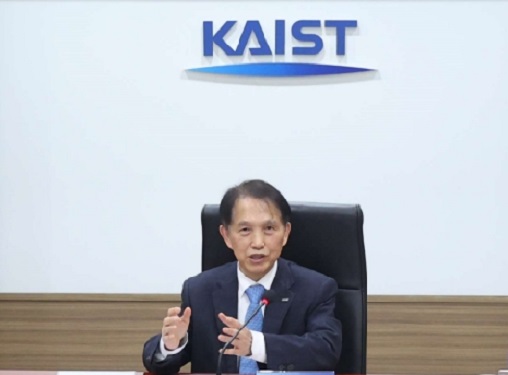
KAIST President Kwang Hyung Lee said that nurturing medical scientists, semiconductor R&D personnel, startup entrepreneurs, and global innovators are key missions he will continue to pursue during an online news conference marking the 1st anniversary of him becoming the president on February 15.
He said that nurturing physician-scientists is the most critical mission for KAIST to help the nation create a new growth engine. He said KAIST will help the nation drive the bio-industry and provide medical science resources for the nation’s health sector. To this end, he said that KAIST will open its Medical Science and Technology School by 2026.
“We plan to expand the current Graduate School of Medical Science and Engineering into a new Medical Science and Technology School that will focus entirely on a condensed MD-PhD course converging the fields of AI, bio, and physics,” he said.
The school aims to foster medical scientists whose research results will eventually be commercialized. He said that the university is now discussing revisions to related laws and regulations with the government and other universities.
To supply human resources to the semiconductor industry, President Lee said the university will add a campus in Pyongtaek City that will serve as an advanced convergence research hub in the field of next generation semiconductors in collaboration with Samsung Electronics and the city of Pyongtaek. The three-stage opening plan projected the final opening of the campus by 2036. During the first stage, which will be completed by 2026, it will construct the campus infrastructure in Pyongtaek city where Samsung Semiconductors runs two massive semiconductor complexes. By 2031, it plans to launch the open research platform including a future cities research center and future vehicles research center. The campus will open the global industrial collaboration cluster hub by 2036.
In the global arena, President Lee said he is working to open the New York campus with stakeholders in the United States. He announced the plan last December that was endorsed by New York-based entrepreneur Hee-Nam Bae, the chairman of Big Continent Inc. President Lee and Chairman Lee signed an MOU for the funding to open the campus in New York.
“We are discussing how to facilitate the plan and best accommodate the interests and potential of our students. Many ideas and plans are on the table and we think it will take longer than expected to finalize the plan,” explained President Lee.
However, he added that the basic idea is to offer art tech and health technology programs as well as an AI-based finance MBA at the New York campus, in addition to it serving as the startup accelerator of KAIST.
President Lee stressed the importance of technology commercialization when successfully launching KAIST Holdings last month to help spinoffs of KAIST labs accelerate their end results. He said that KAIST Holdings will build a virtuous supporting system to commercialize the technology startups coming from KAIST.
“We plan to list at least 10 KAIST startups on the KOSDAQ and two on the NASDAQ by 2031. KAIST Holdings also aims to nurture companies valued at a total of one billion KRW and earn 100 billion KRW in technology fees by 2031.
2022.02.17 View 11038
President Lee Presents Plans to Nurture Next-Generation Talents
President Lee stressed that nurturing medical scientists, semiconductor R&D personnel, startup entrepreneurs, and global innovators are key missions he will continue to pursue during a news conference
KAIST President Kwang Hyung Lee said that nurturing medical scientists, semiconductor R&D personnel, startup entrepreneurs, and global innovators are key missions he will continue to pursue during an online news conference marking the 1st anniversary of him becoming the president on February 15.
He said that nurturing physician-scientists is the most critical mission for KAIST to help the nation create a new growth engine. He said KAIST will help the nation drive the bio-industry and provide medical science resources for the nation’s health sector. To this end, he said that KAIST will open its Medical Science and Technology School by 2026.
“We plan to expand the current Graduate School of Medical Science and Engineering into a new Medical Science and Technology School that will focus entirely on a condensed MD-PhD course converging the fields of AI, bio, and physics,” he said.
The school aims to foster medical scientists whose research results will eventually be commercialized. He said that the university is now discussing revisions to related laws and regulations with the government and other universities.
To supply human resources to the semiconductor industry, President Lee said the university will add a campus in Pyongtaek City that will serve as an advanced convergence research hub in the field of next generation semiconductors in collaboration with Samsung Electronics and the city of Pyongtaek. The three-stage opening plan projected the final opening of the campus by 2036. During the first stage, which will be completed by 2026, it will construct the campus infrastructure in Pyongtaek city where Samsung Semiconductors runs two massive semiconductor complexes. By 2031, it plans to launch the open research platform including a future cities research center and future vehicles research center. The campus will open the global industrial collaboration cluster hub by 2036.
In the global arena, President Lee said he is working to open the New York campus with stakeholders in the United States. He announced the plan last December that was endorsed by New York-based entrepreneur Hee-Nam Bae, the chairman of Big Continent Inc. President Lee and Chairman Lee signed an MOU for the funding to open the campus in New York.
“We are discussing how to facilitate the plan and best accommodate the interests and potential of our students. Many ideas and plans are on the table and we think it will take longer than expected to finalize the plan,” explained President Lee.
However, he added that the basic idea is to offer art tech and health technology programs as well as an AI-based finance MBA at the New York campus, in addition to it serving as the startup accelerator of KAIST.
President Lee stressed the importance of technology commercialization when successfully launching KAIST Holdings last month to help spinoffs of KAIST labs accelerate their end results. He said that KAIST Holdings will build a virtuous supporting system to commercialize the technology startups coming from KAIST.
“We plan to list at least 10 KAIST startups on the KOSDAQ and two on the NASDAQ by 2031. KAIST Holdings also aims to nurture companies valued at a total of one billion KRW and earn 100 billion KRW in technology fees by 2031.
2022.02.17 View 11038 -
 Perigee-KAIST Rocket Research Center Launches Scientific Rocket
Undergraduate startup Perigree Aerospace develops suborbital rocket called Blue Whale 0.1
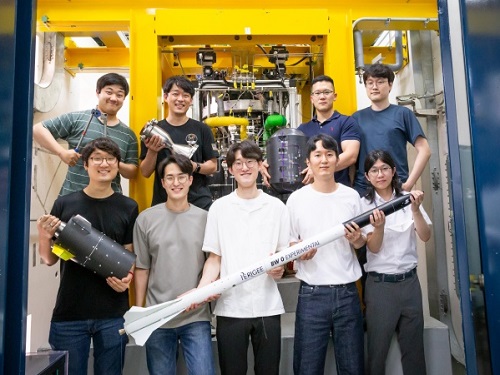
On December 29, Perigee Aerospace, an undergraduate startup, launched a test rocket with a length of 3.2 m, a diameter of 19 cm, and a weight of 51 kg, using ethanol and liquid oxygen as fuel. The launch took place off Jeju Island. It was aimed at building experience and checking the combustion of a liquid propulsion engine and the performance of pre-set flight and trajectory, communication, and navigation devices. It was also one of the projects marking the 50th anniversary of KAIST in 2021.
However, after flying for several seconds, the rocket lost its track due to a gust of wind that activated the rocket’s automatic flight suspension system. "At the moment the rocket took off, there was a much stronger gust than expected," Dong-Yoon Shin, CEO of Perigee said. "The wind sent it flying off course and the automatic flight suspension system stopped its engine." However, Shin was not disappointed, saying the launch, which was conducted in collaboration with Perigee-KAIST Rocket Research Center provided a good experience.
"Some people say that Blue Whale 0.1 is like a toy because of its small size. Of course, it's much smaller than the rockets I’ve dreamed of, but like other rockets, it has all the technology needed for launch," said Shin, who established his company in 2018 as a KAIST aerospace engineering student to develop small liquid-propellant orbital rockets. Perigee Aerospace aims to develop the world’s lightest launch vehicle using high-powered engines, with a goal of leading the global market for small launch vehicles in the new space generation.
Perigee-KAIST Rocket Research Center was founded in 2019 for the research and development of rocket propellants and has been testing the combustion of rocket engines of various sizes in their liquid propellant rocket combustion lab located on the KAIST Munji Campus.
The research center initiated the 50th anniversary rocket launch project in late April of last year, finished the examination of their preliminary design in late May, and secured a tentative launching site through the KAIST-Jejudo agreement in early July.
The ethanol engine combustion was tested in late July, and an examination meeting regarding the detailed design that took place in late August was followed by two months of static firing tests of the assembled rocket in October and November.
This was a very meaningful trial in which a domestic private enterprise founded by a college student collaborated with a university to successfully develop and launch a technically challenging liquid propellant rocket.
Shin's near-term goal is to launch a two-stage orbital rocket that uses liquid methane as fuel and weighs 1.8 tons. To secure competitiveness in the small projectile market, KAIST and Perigee Aerospace have set up a joint research center to test various rocket engine sizes and develop the world's lightest projectile using a high-performance engine.
Professor Jae-Hung Han, head of the Department of Aerospace Engineering, said, “The scientific rocket system secured through the launch of the celebratory rocket will be utilized for design and system-oriented education, and for carrying out various scientific missions.” He added, “It is very rare both domestically and globally that a scientific rocket designed by the initiatives of a department should be incorporated as part of a regular aerospace system design curriculum. This will be an exemplary case we can boast about to the rest of the world.”
Perigee Aerospace will improve the technology they have developed through the course of this project to develop subminiature vehicles they may use to launch small satellites into the low Earth orbit.
Shin said, “I am happy just with the fact that we have participated in a rocket project to celebrate the 50th anniversary of KAIST, and I would like to thank the engineers at my company and members of the KAIST Department of Aerospace Engineering.” He added, “I’m looking forward to the day that we develop a space launch vehicle that can deliver satellites even higher.”
2022.01.14 View 9066
Perigee-KAIST Rocket Research Center Launches Scientific Rocket
Undergraduate startup Perigree Aerospace develops suborbital rocket called Blue Whale 0.1
On December 29, Perigee Aerospace, an undergraduate startup, launched a test rocket with a length of 3.2 m, a diameter of 19 cm, and a weight of 51 kg, using ethanol and liquid oxygen as fuel. The launch took place off Jeju Island. It was aimed at building experience and checking the combustion of a liquid propulsion engine and the performance of pre-set flight and trajectory, communication, and navigation devices. It was also one of the projects marking the 50th anniversary of KAIST in 2021.
However, after flying for several seconds, the rocket lost its track due to a gust of wind that activated the rocket’s automatic flight suspension system. "At the moment the rocket took off, there was a much stronger gust than expected," Dong-Yoon Shin, CEO of Perigee said. "The wind sent it flying off course and the automatic flight suspension system stopped its engine." However, Shin was not disappointed, saying the launch, which was conducted in collaboration with Perigee-KAIST Rocket Research Center provided a good experience.
"Some people say that Blue Whale 0.1 is like a toy because of its small size. Of course, it's much smaller than the rockets I’ve dreamed of, but like other rockets, it has all the technology needed for launch," said Shin, who established his company in 2018 as a KAIST aerospace engineering student to develop small liquid-propellant orbital rockets. Perigee Aerospace aims to develop the world’s lightest launch vehicle using high-powered engines, with a goal of leading the global market for small launch vehicles in the new space generation.
Perigee-KAIST Rocket Research Center was founded in 2019 for the research and development of rocket propellants and has been testing the combustion of rocket engines of various sizes in their liquid propellant rocket combustion lab located on the KAIST Munji Campus.
The research center initiated the 50th anniversary rocket launch project in late April of last year, finished the examination of their preliminary design in late May, and secured a tentative launching site through the KAIST-Jejudo agreement in early July.
The ethanol engine combustion was tested in late July, and an examination meeting regarding the detailed design that took place in late August was followed by two months of static firing tests of the assembled rocket in October and November.
This was a very meaningful trial in which a domestic private enterprise founded by a college student collaborated with a university to successfully develop and launch a technically challenging liquid propellant rocket.
Shin's near-term goal is to launch a two-stage orbital rocket that uses liquid methane as fuel and weighs 1.8 tons. To secure competitiveness in the small projectile market, KAIST and Perigee Aerospace have set up a joint research center to test various rocket engine sizes and develop the world's lightest projectile using a high-performance engine.
Professor Jae-Hung Han, head of the Department of Aerospace Engineering, said, “The scientific rocket system secured through the launch of the celebratory rocket will be utilized for design and system-oriented education, and for carrying out various scientific missions.” He added, “It is very rare both domestically and globally that a scientific rocket designed by the initiatives of a department should be incorporated as part of a regular aerospace system design curriculum. This will be an exemplary case we can boast about to the rest of the world.”
Perigee Aerospace will improve the technology they have developed through the course of this project to develop subminiature vehicles they may use to launch small satellites into the low Earth orbit.
Shin said, “I am happy just with the fact that we have participated in a rocket project to celebrate the 50th anniversary of KAIST, and I would like to thank the engineers at my company and members of the KAIST Department of Aerospace Engineering.” He added, “I’m looking forward to the day that we develop a space launch vehicle that can deliver satellites even higher.”
2022.01.14 View 9066 -
 Startup Elice Donates 300 Million KRW to School of Computing
Elice hopes to create a virtuous circle that bridges the educational gap
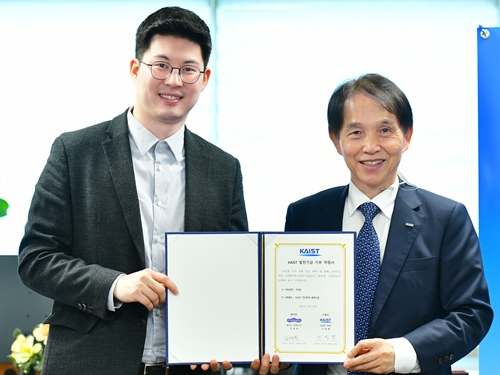
Elice, a student startup from the School of Computing has committed to donate 300 million KRW to KAIST. Jae-Won Kim, CEO of the coding education company, established the startup with his colleagues in 2015. Since then, more than 100 companies, including 17 of Korea’s top 20 companies such as SK and LG have used Elice' digital coding platform to educate employees. More than 200,000 employees have completed the online training with completion rates over 80%.
Kim said during the donation ceremony that he hopes to fund the renovation of the School of Computing building and that he will continue to work on expanding platforms that will help make communication between educators and students more interactive. He explained, “We are making this contribution to create a virtuous circle that bridges the educational gap and improves the quality of education."
President Kwang Hyung Lee was pleased to welcome the student startup’s donation, saying, "Software talent is one of the most precious resources we should foster for the nation’s future. I am thrilled to see that a startup that was founded here on the KAIST campus has grown into a great company that provides excellent coding education for our society.”
Professor Alice Oh, who was the advisor for Kim and his colleagues when they launched the startup, joined the ceremony along with the founding members from KAIST including CPO Su-In Kim, CTO Chong-Kuk Park, and team leader Chang-Hyun Lee.
2021.12.13 View 5356
Startup Elice Donates 300 Million KRW to School of Computing
Elice hopes to create a virtuous circle that bridges the educational gap
Elice, a student startup from the School of Computing has committed to donate 300 million KRW to KAIST. Jae-Won Kim, CEO of the coding education company, established the startup with his colleagues in 2015. Since then, more than 100 companies, including 17 of Korea’s top 20 companies such as SK and LG have used Elice' digital coding platform to educate employees. More than 200,000 employees have completed the online training with completion rates over 80%.
Kim said during the donation ceremony that he hopes to fund the renovation of the School of Computing building and that he will continue to work on expanding platforms that will help make communication between educators and students more interactive. He explained, “We are making this contribution to create a virtuous circle that bridges the educational gap and improves the quality of education."
President Kwang Hyung Lee was pleased to welcome the student startup’s donation, saying, "Software talent is one of the most precious resources we should foster for the nation’s future. I am thrilled to see that a startup that was founded here on the KAIST campus has grown into a great company that provides excellent coding education for our society.”
Professor Alice Oh, who was the advisor for Kim and his colleagues when they launched the startup, joined the ceremony along with the founding members from KAIST including CPO Su-In Kim, CTO Chong-Kuk Park, and team leader Chang-Hyun Lee.
2021.12.13 View 5356 -
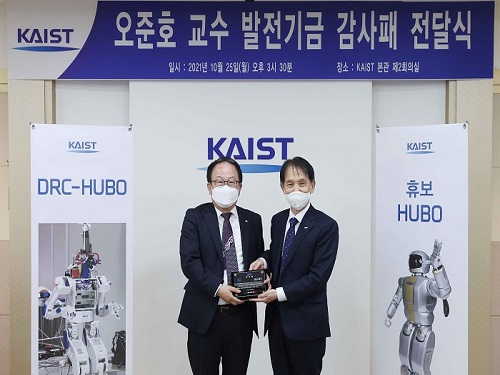 Hubo Professor Jun-Ho Oh Donates Startup Shares Worth 5 Billion KRW
Rainbow Robotics stock used to endow the development fund
Emeritus Professor Jun-Ho Oh, who developed the 2015 DARPA Challenge winning humanoid robot DRC-Hubo, donated 5 billion KRW on October 25 during a ceremony held at the KAIST campus in Daejeon.
Professor Oh donated his 20% share (400 shares) of his startup Rainbow Robotics, which was established in 2011. Rainbow Robotics was listed on the KOSDAQ this February. The 400 shares were converted to 200,000 shares with a value of approximately 5 billion KRW when listed this year.
KAIST sold the stocks and endowed the Jun-Ho Oh Fund, which will be used for the development of the university. He was the 39th faculty member who launched a startup with technology from his lab and became the biggest faculty entrepreneur donor.
“I have received huge support and funding for my research. Fortunately, the research had a good result and led to the startup. Now I am very delighted to pay back the university. I feel that I have played a part in building the school’s startup ecosystem and creating a virtuous circle,” said Professor Oh during the ceremony.
KAIST President Kwang Hyung Lee declared, “Professor Oh has been a very impressive exemplary model for our aspiring faculty and student tech startups. We will spare no effort to support startups at KAIST.”
Professor Oh, who retired from the Department of Mechanical Engineering last year, now serves as the CTO at Rainbow Robotics. The company is developing humanoid bipedal robots and collaborative robots, and advancing robot technology including parts for astronomical observations.
Professor Hae-Won Park and Professor Je Min Hwangbo, who are now responsible for the Hubo Lab, also joined the ceremony along with employees of Rainbow Robotics.
2021.10.26 View 9638
Hubo Professor Jun-Ho Oh Donates Startup Shares Worth 5 Billion KRW
Rainbow Robotics stock used to endow the development fund
Emeritus Professor Jun-Ho Oh, who developed the 2015 DARPA Challenge winning humanoid robot DRC-Hubo, donated 5 billion KRW on October 25 during a ceremony held at the KAIST campus in Daejeon.
Professor Oh donated his 20% share (400 shares) of his startup Rainbow Robotics, which was established in 2011. Rainbow Robotics was listed on the KOSDAQ this February. The 400 shares were converted to 200,000 shares with a value of approximately 5 billion KRW when listed this year.
KAIST sold the stocks and endowed the Jun-Ho Oh Fund, which will be used for the development of the university. He was the 39th faculty member who launched a startup with technology from his lab and became the biggest faculty entrepreneur donor.
“I have received huge support and funding for my research. Fortunately, the research had a good result and led to the startup. Now I am very delighted to pay back the university. I feel that I have played a part in building the school’s startup ecosystem and creating a virtuous circle,” said Professor Oh during the ceremony.
KAIST President Kwang Hyung Lee declared, “Professor Oh has been a very impressive exemplary model for our aspiring faculty and student tech startups. We will spare no effort to support startups at KAIST.”
Professor Oh, who retired from the Department of Mechanical Engineering last year, now serves as the CTO at Rainbow Robotics. The company is developing humanoid bipedal robots and collaborative robots, and advancing robot technology including parts for astronomical observations.
Professor Hae-Won Park and Professor Je Min Hwangbo, who are now responsible for the Hubo Lab, also joined the ceremony along with employees of Rainbow Robotics.
2021.10.26 View 9638 -
 KAIST Entrepreneurial Partnership to Accelerate Startups and Venture Ecosystem
KAIST will launch the KAIST Entrepreneurial Partnership (KEP) program, which connects faculty members who own technology with those who want to launch startup.
The program encourages open innovation startups using strategies tailored to market-client demand requirements. This is also one of efforts to help realize ‘one startup per lab,’ initiated by President Kwang Hyung Lee’s new innovation strategy. KEP also aims to introduce the best technologies developing at KAIST to startups and to raise the success rate of technology commercialization.
The program will match KAIST faculty and student entrepreneur candidates with parties enrolled in the new Entrepreneur in Residence and Entrepreneurial Partner programs. Each team will be given a six-month test period with funding support.
KAIST will invite entrepreneurial experts from both technology and management fields to support the program participants. Around 30 experts with experience in developing new businesses, startups, and investments in large corporations or venture companies will be recruited as entrepreneurial partners. They will offer support for research and business development (R&BD), technology marketing, attracting venture investment from corporations, mergers and acquisitions, and business openings.
A survey showed that KAIST members who are interested in starting a business are experiencing difficulties finding an entrepreneurial expert (72.2%), with the complicated startup approval procedures (33.3%), and their lack of knowledge on entrepreneurship and funding (27.8%). The KEP program hopes to encourage KAIST faculty members and students who have well-developed business ideas and the appropriate technology but lack the capabilities to realize and develop them into a business.
Associate Vice President of Startups Young-Tae Kim said, “We will develop KEP into KAIST’s distinct entrepreneurial support system and produce exemplary outcomes of faculty and student startups. We will spread the startup DNA and lead the building of a virtuous cycle between entrepreneurship and the venture ecosystem.”
2021.10.14 View 6528
KAIST Entrepreneurial Partnership to Accelerate Startups and Venture Ecosystem
KAIST will launch the KAIST Entrepreneurial Partnership (KEP) program, which connects faculty members who own technology with those who want to launch startup.
The program encourages open innovation startups using strategies tailored to market-client demand requirements. This is also one of efforts to help realize ‘one startup per lab,’ initiated by President Kwang Hyung Lee’s new innovation strategy. KEP also aims to introduce the best technologies developing at KAIST to startups and to raise the success rate of technology commercialization.
The program will match KAIST faculty and student entrepreneur candidates with parties enrolled in the new Entrepreneur in Residence and Entrepreneurial Partner programs. Each team will be given a six-month test period with funding support.
KAIST will invite entrepreneurial experts from both technology and management fields to support the program participants. Around 30 experts with experience in developing new businesses, startups, and investments in large corporations or venture companies will be recruited as entrepreneurial partners. They will offer support for research and business development (R&BD), technology marketing, attracting venture investment from corporations, mergers and acquisitions, and business openings.
A survey showed that KAIST members who are interested in starting a business are experiencing difficulties finding an entrepreneurial expert (72.2%), with the complicated startup approval procedures (33.3%), and their lack of knowledge on entrepreneurship and funding (27.8%). The KEP program hopes to encourage KAIST faculty members and students who have well-developed business ideas and the appropriate technology but lack the capabilities to realize and develop them into a business.
Associate Vice President of Startups Young-Tae Kim said, “We will develop KEP into KAIST’s distinct entrepreneurial support system and produce exemplary outcomes of faculty and student startups. We will spread the startup DNA and lead the building of a virtuous cycle between entrepreneurship and the venture ecosystem.”
2021.10.14 View 6528 -
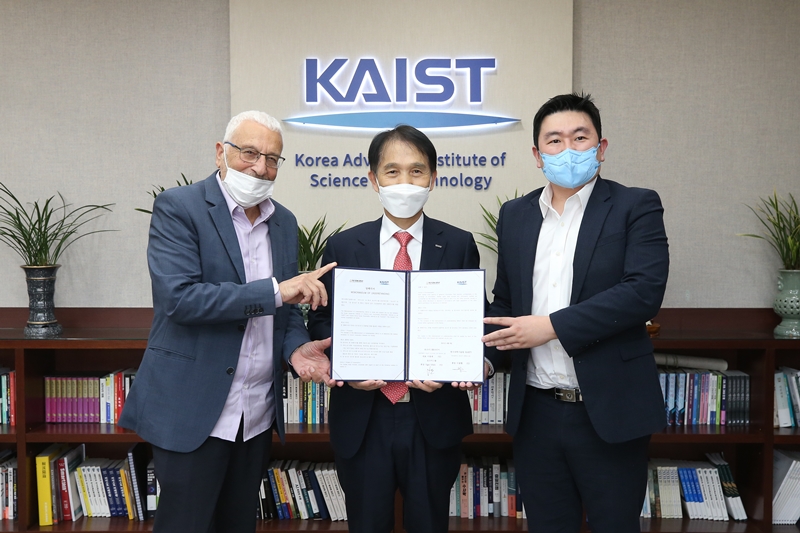 KAIST Teams Up with Yozma Group to Nurture Startups
KAIST has joined hands with Israeli venture capital investor Yozma Group to help campus-based startups grow and build success. The two signed a memorandum of understanding (MOU) on joint technology value creation initiatives at the signing ceremony that was held at KAIST’s main campus in Daejeon on April 8.
Under the MOU, Yozma Group will make investments and implement acceleration programs for startups established by KAIST professors, graduates, and students, as well as those invested in by the university.
Yozma Group already launched a $70 million fund to help grow companies in Korea and Israel. Yozma Group will use the fund as well as its global acceleration know-how and network of over 400 R&D centers across Israel to help promising KAIST startups enter overseas markets.
Moreover, Yozma Group also plans to discover and support KAIST startups that need technology from the Weizmann Institute of Science, Israel’s leading multidisciplinary basic research institution in natural and exact sciences.
KAIST is also in talks to locate Yozma Group’s branch office on the university’s campus to ensure seamless collaborations.
KAIST President Kwang Hyung Lee explained to Yozma Group’s Founder and Chairman Yigal Erlich and Head of Asia Pacific Won-Jae Lee at the MOU signing ceremony that “startup and technology commercialization are the crucial areas where KAIST will make innovations.”
“Cooperation with Yozma Group will help KAIST startups transform their ideas and technologies into real businesses and build a global presence,” he added.
Yozma Group started as Yozma Fund, created in conjunction with the Israeli government in 1993 to support the globalization of Israeli startups and to foster the growth of Israel’s venture capital industry. The Fund, which was privatized in 1998, has supported 97 Israeli tech ventures joining the Nasdaq, leading Israel to become a global innovation hub that has the third-most companies listed on the Nasdaq.
(END)
2021.04.20 View 7851
KAIST Teams Up with Yozma Group to Nurture Startups
KAIST has joined hands with Israeli venture capital investor Yozma Group to help campus-based startups grow and build success. The two signed a memorandum of understanding (MOU) on joint technology value creation initiatives at the signing ceremony that was held at KAIST’s main campus in Daejeon on April 8.
Under the MOU, Yozma Group will make investments and implement acceleration programs for startups established by KAIST professors, graduates, and students, as well as those invested in by the university.
Yozma Group already launched a $70 million fund to help grow companies in Korea and Israel. Yozma Group will use the fund as well as its global acceleration know-how and network of over 400 R&D centers across Israel to help promising KAIST startups enter overseas markets.
Moreover, Yozma Group also plans to discover and support KAIST startups that need technology from the Weizmann Institute of Science, Israel’s leading multidisciplinary basic research institution in natural and exact sciences.
KAIST is also in talks to locate Yozma Group’s branch office on the university’s campus to ensure seamless collaborations.
KAIST President Kwang Hyung Lee explained to Yozma Group’s Founder and Chairman Yigal Erlich and Head of Asia Pacific Won-Jae Lee at the MOU signing ceremony that “startup and technology commercialization are the crucial areas where KAIST will make innovations.”
“Cooperation with Yozma Group will help KAIST startups transform their ideas and technologies into real businesses and build a global presence,” he added.
Yozma Group started as Yozma Fund, created in conjunction with the Israeli government in 1993 to support the globalization of Israeli startups and to foster the growth of Israel’s venture capital industry. The Fund, which was privatized in 1998, has supported 97 Israeli tech ventures joining the Nasdaq, leading Israel to become a global innovation hub that has the third-most companies listed on the Nasdaq.
(END)
2021.04.20 View 7851