%73%6f%63%69%61%6c
-
 “It’s Okay to Disagree”: KAIST Suggests That a Secure Sense of Attachment Can Help Groups Make Better Decisions
When everyone in a meeting voices the same opinion, an organization can miss important warning signs and new ideas. A research team from KAIST suggests that when members feel securely accepted within their group, they can express dissenting opinions in greater detail and more persuasively, and other members may be more willing to use those opinions in decision-making.
KAIST (President Choongsik Bae) announced on September 27 that a research team led by Professors Sujin Lee and Seungwon Jeong from the School of Business and Technology Management, working jointly with Professor Zoe Kinias from the Ivey Business School at Western University in Canada, presented research findings suggesting that “group attachment security” can promote the expression and acceptance of minority opinions within groups.
Group attachment security refers to a psychological state where a person perceives the group they belong to as a secure source of support. Members develop group attachment security when they receive emotional and relational support from the group and feel recognized as valued members. The more secure this attachment, the more members come to believe that voicing a different opinion will not lead to rejection or exclusion within the group.
People with dissenting opinions often hesitate to speak up due to potential backlash, even when holding crucial insights. This difficulty can be even greater within one’s own organization, where members face stronger expectations to align with the majority view.
The researchers reasoned that when feeling secure in a group calms relationship worries, members focus on the best outcome instead of other people's reactions. To test this, the team conducted two experiments using hypothetical decision-making scenarios, examining the perspectives of both minority opinion holders and the majority members who receive their opinions.
In the first experiment, participants were assigned to a group primed with attachment security or one that was not, and then asked to express their opinions in a scenario where they held a minority view.
The results showed that participants primed with group attachment security produced more elaborated and persuasive arguments than those in the neutral condition. The research team also confirmed that this difference occurred because the participants focused more on the problem and the content of their opinion itself.
In the second experiment, participants took the perspective of a majority member and evaluated selected arguments written by minority opinion holders in the first experiment. The research team found that participants rated arguments from the secure attachment condition as more persuasive than those from the neutral condition. Overall, participants reported less perceived expectancy violation and a greater willingness to use minority opinions from the secure condition.
In both experiments, the research team further distinguished minority members as either ingroup or outgroup members based on whether they shared a group identity with the majority opinion holders. This exploratory analysis was designed to examine whether group attachment security reduces relational concerns in expressing dissent. The researchers reasoned that minority members who shared a group identity with the majority might be less likely to dissent than outgroup minority members, because ingroup members are generally expected to share similar opinions.
Most interactions between group attachment security and ingroup/outgroup membership were not statistically significant, with expectancy violation in the second experiment being the only exception. Exploratory analyses, however, revealed a consistent pattern only among ingroup minorities; group attachment security shaped the quality of minority opinions through greater task focus in the first experiment, and the majority’s higher willingness to use minority opinions through both reduced expectancy violation and greater perceived persuasiveness in the second experiment.
This finding suggests that belonging to the same organization does not necessarily make it easier to voice dissenting opinions. In fact, ingroup members may feel greater pressure to conform to the group’s shared assumptions or majority opinion, making it harder for them to point out problems with current practices or offer negative feedback. In such cases, confidence that expressing a different opinion will not jeopardize one’s relationships or standing within the group can help ease this burden.
This research also has practical implications for organizations that rely on external consulting or audits because members do not speak up enough about problems or suggest improvements. If members who are closest to an organization’s problems remain silent out of concern for damaged relationships or negative evaluations, the organization cannot fully draw on their knowledge or act on the warning signs they identify. To encourage members to speak up, organizations need to provide opportunities for members to speak and build an environment in which those members a stable, secure attachment to the group.
The findings also suggest that simply gathering members from diverse backgrounds into one organization is not enough to realize the benefits of diversity. Diversity can contribute to decision-making and innovation only when members can safely express opinions that differ from the majority, and when other members treat those opinions as useful information rather than as conflict or a challenge to the organization.
These findings could inform efforts to develop organizational cultures and leadership practices that reduce groupthink and make better use of members’ knowledge and perspectives at companies, research institutions, and public organizations. Examples include leaders openly inviting counterarguments, recognizing the contributions of minority opinions, and consistently reassuring members that voicing a different opinion will not harm their relationships or result in unfavorable evaluations within the organization.
Professor Sujin Lee and Seungwon Jeong explained, “Simply giving members the opportunity to voice a different opinion is not enough. Members need to be confident that they won’t be excluded from the organization for holding a different opinion, so they can explain their thoughts in greater detail and more persuasively, and the majority can receive that opinion as useful information for reaching a better decision rather than as conflict.”
The study, with Tae Hyun Kim, a doctoral candidate in the School of Business and Technology Management, as first author, was published online in the international journal Scientific Reports on August 4.
Paper title: The role of group attachment security in minority opinion expression in decision making groups,
DOI: 10.1038/s41598-026-65147-7
Paper link: https://www.nature.com/articles/s41598-026-65147-7
This research was supported by the Institute of Information & Communications Technology Planning & Evaluation (IITP) grant funded by the Korean government (MSIT) (No. RS-2024-00397663 and No. IITP-2022(2026)-RS-2022-00156435), and by Samsung Electronics (No. IO251218-14849-01).
2026.09.28 View 995
“It’s Okay to Disagree”: KAIST Suggests That a Secure Sense of Attachment Can Help Groups Make Better Decisions
When everyone in a meeting voices the same opinion, an organization can miss important warning signs and new ideas. A research team from KAIST suggests that when members feel securely accepted within their group, they can express dissenting opinions in greater detail and more persuasively, and other members may be more willing to use those opinions in decision-making.
KAIST (President Choongsik Bae) announced on September 27 that a research team led by Professors Sujin Lee and Seungwon Jeong from the School of Business and Technology Management, working jointly with Professor Zoe Kinias from the Ivey Business School at Western University in Canada, presented research findings suggesting that “group attachment security” can promote the expression and acceptance of minority opinions within groups.
Group attachment security refers to a psychological state where a person perceives the group they belong to as a secure source of support. Members develop group attachment security when they receive emotional and relational support from the group and feel recognized as valued members. The more secure this attachment, the more members come to believe that voicing a different opinion will not lead to rejection or exclusion within the group.
People with dissenting opinions often hesitate to speak up due to potential backlash, even when holding crucial insights. This difficulty can be even greater within one’s own organization, where members face stronger expectations to align with the majority view.
The researchers reasoned that when feeling secure in a group calms relationship worries, members focus on the best outcome instead of other people's reactions. To test this, the team conducted two experiments using hypothetical decision-making scenarios, examining the perspectives of both minority opinion holders and the majority members who receive their opinions.
In the first experiment, participants were assigned to a group primed with attachment security or one that was not, and then asked to express their opinions in a scenario where they held a minority view.
The results showed that participants primed with group attachment security produced more elaborated and persuasive arguments than those in the neutral condition. The research team also confirmed that this difference occurred because the participants focused more on the problem and the content of their opinion itself.
In the second experiment, participants took the perspective of a majority member and evaluated selected arguments written by minority opinion holders in the first experiment. The research team found that participants rated arguments from the secure attachment condition as more persuasive than those from the neutral condition. Overall, participants reported less perceived expectancy violation and a greater willingness to use minority opinions from the secure condition.
In both experiments, the research team further distinguished minority members as either ingroup or outgroup members based on whether they shared a group identity with the majority opinion holders. This exploratory analysis was designed to examine whether group attachment security reduces relational concerns in expressing dissent. The researchers reasoned that minority members who shared a group identity with the majority might be less likely to dissent than outgroup minority members, because ingroup members are generally expected to share similar opinions.
Most interactions between group attachment security and ingroup/outgroup membership were not statistically significant, with expectancy violation in the second experiment being the only exception. Exploratory analyses, however, revealed a consistent pattern only among ingroup minorities; group attachment security shaped the quality of minority opinions through greater task focus in the first experiment, and the majority’s higher willingness to use minority opinions through both reduced expectancy violation and greater perceived persuasiveness in the second experiment.
This finding suggests that belonging to the same organization does not necessarily make it easier to voice dissenting opinions. In fact, ingroup members may feel greater pressure to conform to the group’s shared assumptions or majority opinion, making it harder for them to point out problems with current practices or offer negative feedback. In such cases, confidence that expressing a different opinion will not jeopardize one’s relationships or standing within the group can help ease this burden.
This research also has practical implications for organizations that rely on external consulting or audits because members do not speak up enough about problems or suggest improvements. If members who are closest to an organization’s problems remain silent out of concern for damaged relationships or negative evaluations, the organization cannot fully draw on their knowledge or act on the warning signs they identify. To encourage members to speak up, organizations need to provide opportunities for members to speak and build an environment in which those members a stable, secure attachment to the group.
The findings also suggest that simply gathering members from diverse backgrounds into one organization is not enough to realize the benefits of diversity. Diversity can contribute to decision-making and innovation only when members can safely express opinions that differ from the majority, and when other members treat those opinions as useful information rather than as conflict or a challenge to the organization.
These findings could inform efforts to develop organizational cultures and leadership practices that reduce groupthink and make better use of members’ knowledge and perspectives at companies, research institutions, and public organizations. Examples include leaders openly inviting counterarguments, recognizing the contributions of minority opinions, and consistently reassuring members that voicing a different opinion will not harm their relationships or result in unfavorable evaluations within the organization.
Professor Sujin Lee and Seungwon Jeong explained, “Simply giving members the opportunity to voice a different opinion is not enough. Members need to be confident that they won’t be excluded from the organization for holding a different opinion, so they can explain their thoughts in greater detail and more persuasively, and the majority can receive that opinion as useful information for reaching a better decision rather than as conflict.”
The study, with Tae Hyun Kim, a doctoral candidate in the School of Business and Technology Management, as first author, was published online in the international journal Scientific Reports on August 4.
Paper title: The role of group attachment security in minority opinion expression in decision making groups,
DOI: 10.1038/s41598-026-65147-7
Paper link: https://www.nature.com/articles/s41598-026-65147-7
This research was supported by the Institute of Information & Communications Technology Planning & Evaluation (IITP) grant funded by the Korean government (MSIT) (No. RS-2024-00397663 and No. IITP-2022(2026)-RS-2022-00156435), and by Samsung Electronics (No. IO251218-14849-01).
2026.09.28 View 995 -
 KAIST Develops Ultrafast Photothermal Process Achieving 3,000 °C in 0.02 Seconds, Boosting Hydrogen Production Efficiency Sixfold
< (from left) Ph.D. candidate Seohak Park, Dr. Jaewan Ahn, Ph.D. candidate Dogyeong Jeon, Prof. Sung-Yool Choi, Prof. Il-Doo Kim, Dr. Chungseong Park, Ph.D. candidate Euichul Shin (top left) Dr. Hamin Shin, Dr. Jun-Hwe Cha i>
The rapid and energy-efficient synthesis of high-performance catalysts is a critical hurdle in advancing clean energy technologies like hydrogen production. Addressing this challenge, a research team at KAIST has now developed a novel platform technology that utilizes a 0.02-second flash of light to generate an ultrahigh temperature of 3,000 °C, enabling the highly efficient synthesis of catalysts. This breakthrough process reduces energy consumption by more than a thousandfold compared to conventional methods while increasing hydrogen production efficiency by up to six times, marking a significant step toward the commercialization of clean energy.
KAIST (President Kwang Hyung Lee) announced on October 20 that a joint research team, co-led by Professor Il-Doo Kim from the Department of Materials Science and Engineering and Professor Sung-Yool Choi from the School of Electrical Engineering, has developed a “direct-contact photothermal annealing” platform. This technique synthesizes high-performance nanomaterials through brief exposure to intense light, generating a transient temperature of 3,000 °C in just 0.02 seconds.
Using this intense photothermal energy, the researchers successfully converted chemically inert nanodiamond (ND) precursors into highly conductive and catalytically active carbon nanoonions (CNOs).
More impressively, the method simultaneously functionalizes the surface of the newly formed CNOs with single atoms. This integrated, one-step process restructures the support material and embeds catalytic functionality in a single light pulse, representing a significant innovation in catalyst synthesis.
CNOs, composed of concentric graphitic shells, are ideal catalyst supports due to their high conductivity, large specific surface area, and chemical stability. However, traditional CNO synthesis has been hindered by complex, multi-step post-processing required to load metal catalysts and by reliance on energy-intensive, time-consuming thermal treatments that limit scalability.
< Schematic Illustration of the Limitations of Conventional Thermal-Radiation Synthesis and the Carbon Nano-Onion Conversion via Direct-Contact Photothermal Treatment >
To overcome these limitations, the KAIST team leveraged the photothermal effect. They devised a method of mixing ND precursors with light-absorbing carbon black (CB) and applying an intense pulse from a xenon lamp. This approach triggers the transformation of NDs into CNOs in just 0.02 seconds, a phenomenon validated by molecular dynamics simulations.
A key innovation of this platform is the simultaneous synthesis of CNOs and functionalization of single-atom catalysts (SACs). When metal precursors, such as platinum (Pt), are included in the mixture, they decompose and anchor onto the surface of the nascent CNOs as individual atoms. The subsequent rapid cooling prevents atomic aggregation, resulting in a perfectly integrated one-step process for both synthesis and functionalization. The team has successfully synthesized eight different high-density SACs, including platinum (Pt), cobalt (Co), and nickel (Ni). The resulting Pt-CNO demonstrated a sixfold enhancement in hydrogen evolution efficiency compared to conventional catalysts, achieving high performance with significantly smaller quantities of precious metals. This highlights the technology's potential for scalable and sustainable hydrogen production.
“We have developed, for the first time, a direct-contact photothermal annealing process that reaches 3,000°C in under 0.02 seconds,” said Professor Il-Doo Kim. “This ultrafast synthesis and single-atom functionalization platform reduces energy consumption by more than a thousandfold compared to traditional methods. We expect it to accelerate the commercialization of technologies in hydrogen energy, gas sensing, and environmental catalysis.”
The study’s first authors are Dogyeong Jeon (Ph.D. candidate, Department of Materials Science and Engineering, KAIST), Dr. Hamin Shin (an alumnus of the Department of Materials Science and Engineering and a current postdoctoral researcher at ETH Zurich), and Dr. Jun-Hwe Cha (an alumnus of the School of Electrical Engineering, now at SK hynix). Professors Sung-Yool Choi and Il-Doo Kim are the corresponding authors.\
< Inside Cover Image of the September Issue of ACS >
The research was published as a Supplementary Cover Article in the September issue of ACS Nano, a leading international journal of the American Chemical Society (ACS).
※ Paper title: “Photothermal Annealing-Enabled Millisecond Synthesis of Carbon Nanoonions and Simultaneous Single-Atom Functionalization,” DOI: 10.1021/acsnano.5c11229
This research was supported by the Global R&D Infrastructure Program and the Leading Research Center Program of the National Research Foundation of Korea (NRF), funded by the Ministry of Science and ICT, and the Nano Convergence Technology Center’s Semiconductor–Battery Interfacing Platform Development Project.
2025.10.21 View 5728
KAIST Develops Ultrafast Photothermal Process Achieving 3,000 °C in 0.02 Seconds, Boosting Hydrogen Production Efficiency Sixfold
< (from left) Ph.D. candidate Seohak Park, Dr. Jaewan Ahn, Ph.D. candidate Dogyeong Jeon, Prof. Sung-Yool Choi, Prof. Il-Doo Kim, Dr. Chungseong Park, Ph.D. candidate Euichul Shin (top left) Dr. Hamin Shin, Dr. Jun-Hwe Cha i>
The rapid and energy-efficient synthesis of high-performance catalysts is a critical hurdle in advancing clean energy technologies like hydrogen production. Addressing this challenge, a research team at KAIST has now developed a novel platform technology that utilizes a 0.02-second flash of light to generate an ultrahigh temperature of 3,000 °C, enabling the highly efficient synthesis of catalysts. This breakthrough process reduces energy consumption by more than a thousandfold compared to conventional methods while increasing hydrogen production efficiency by up to six times, marking a significant step toward the commercialization of clean energy.
KAIST (President Kwang Hyung Lee) announced on October 20 that a joint research team, co-led by Professor Il-Doo Kim from the Department of Materials Science and Engineering and Professor Sung-Yool Choi from the School of Electrical Engineering, has developed a “direct-contact photothermal annealing” platform. This technique synthesizes high-performance nanomaterials through brief exposure to intense light, generating a transient temperature of 3,000 °C in just 0.02 seconds.
Using this intense photothermal energy, the researchers successfully converted chemically inert nanodiamond (ND) precursors into highly conductive and catalytically active carbon nanoonions (CNOs).
More impressively, the method simultaneously functionalizes the surface of the newly formed CNOs with single atoms. This integrated, one-step process restructures the support material and embeds catalytic functionality in a single light pulse, representing a significant innovation in catalyst synthesis.
CNOs, composed of concentric graphitic shells, are ideal catalyst supports due to their high conductivity, large specific surface area, and chemical stability. However, traditional CNO synthesis has been hindered by complex, multi-step post-processing required to load metal catalysts and by reliance on energy-intensive, time-consuming thermal treatments that limit scalability.
< Schematic Illustration of the Limitations of Conventional Thermal-Radiation Synthesis and the Carbon Nano-Onion Conversion via Direct-Contact Photothermal Treatment >
To overcome these limitations, the KAIST team leveraged the photothermal effect. They devised a method of mixing ND precursors with light-absorbing carbon black (CB) and applying an intense pulse from a xenon lamp. This approach triggers the transformation of NDs into CNOs in just 0.02 seconds, a phenomenon validated by molecular dynamics simulations.
A key innovation of this platform is the simultaneous synthesis of CNOs and functionalization of single-atom catalysts (SACs). When metal precursors, such as platinum (Pt), are included in the mixture, they decompose and anchor onto the surface of the nascent CNOs as individual atoms. The subsequent rapid cooling prevents atomic aggregation, resulting in a perfectly integrated one-step process for both synthesis and functionalization. The team has successfully synthesized eight different high-density SACs, including platinum (Pt), cobalt (Co), and nickel (Ni). The resulting Pt-CNO demonstrated a sixfold enhancement in hydrogen evolution efficiency compared to conventional catalysts, achieving high performance with significantly smaller quantities of precious metals. This highlights the technology's potential for scalable and sustainable hydrogen production.
“We have developed, for the first time, a direct-contact photothermal annealing process that reaches 3,000°C in under 0.02 seconds,” said Professor Il-Doo Kim. “This ultrafast synthesis and single-atom functionalization platform reduces energy consumption by more than a thousandfold compared to traditional methods. We expect it to accelerate the commercialization of technologies in hydrogen energy, gas sensing, and environmental catalysis.”
The study’s first authors are Dogyeong Jeon (Ph.D. candidate, Department of Materials Science and Engineering, KAIST), Dr. Hamin Shin (an alumnus of the Department of Materials Science and Engineering and a current postdoctoral researcher at ETH Zurich), and Dr. Jun-Hwe Cha (an alumnus of the School of Electrical Engineering, now at SK hynix). Professors Sung-Yool Choi and Il-Doo Kim are the corresponding authors.\
< Inside Cover Image of the September Issue of ACS >
The research was published as a Supplementary Cover Article in the September issue of ACS Nano, a leading international journal of the American Chemical Society (ACS).
※ Paper title: “Photothermal Annealing-Enabled Millisecond Synthesis of Carbon Nanoonions and Simultaneous Single-Atom Functionalization,” DOI: 10.1021/acsnano.5c11229
This research was supported by the Global R&D Infrastructure Program and the Leading Research Center Program of the National Research Foundation of Korea (NRF), funded by the Ministry of Science and ICT, and the Nano Convergence Technology Center’s Semiconductor–Battery Interfacing Platform Development Project.
2025.10.21 View 5728 -
 KAIST Launches Student Led ESG Research Platform with Brand Revenue
KAIST (President Kwang Hyung Lee) announced on the 19th of October that it is launching a new action-oriented ESG program, 'PDSP (Problem Definition to Solution Program),' which returns brand revenue to students to support research aimed at solving social problems. Brand revenue refers to profits from the sale of branded products, such as 'Nubjuk-i,' and the brand shop that KAIST operates near the campus's duck pond.
This initiative is the first model to concretize KAIST's brand value and social responsibility through a student-centric approach, serving as an innovative starting point that connects 'research–startup–social contribution.'
The project is funded by dividends from Brand KAIST, a subsidiary of KAIST Holdings (CEO Hyunmin Bae), led by co-CEOs Hyun Jung Suk and Byeongjun Bok (CEO of KAI Patent Law Firm, and KAIST Industrial Design alumni).
By reinvesting brand revenue into student research activities, KAIST aims to implement a KAIST-style virtuous cycle ESG structure: 'Brand->Revenue->Student->Social Contribution.'
PDSP is a research program where KAIST undergraduate students voluntarily form teams to explore social and technological problems and propose solutions. The program name, 'Problem Definition to Solution Program,' signifies that students directly define the problem and design the solution, aiming to become a practical research platform that connects learned knowledge to solving social issues.
Through the PDSP, KAIST is expanding the concept of ESG beyond Environment, Society, and Governance to 'Practicing Social Responsibility through Education and Science.'
The process of students proactively defining social problems and proposing solutions is itself a form of ESG value realization, and KAIST seeks to build a science and technology-based, action-oriented ESG model through this.
The PDSP operates with two research tracks: Deep Tech and ESG. The 'Deep Tech Track' supports fundamental technology research that will lead future industries, leveraging KAIST's advanced science and technology capabilities in areas such as Artificial Intelligence (AI), semiconductors, robotics, biotechnology, new materials, and energy. The 'ESG Track' focuses on research on social issues such as climate change, carbon neutrality, and aging, concentrating on realizing a sustainable society through science and technology.
<KAIST PDSP (Problem Definition to Solution Program) Poster>
This program is regarded not merely as an idea contest but as a 'student-led Deep Tech incubation program' that promotes substantial technological innovation originating from research labs.
Participation is open to approximately 20 teams, each composed of three to five undergraduate students. Each team can choose to apply for either the Deep Tech Track or the ESG Track. A maximum of 1.5 million KRW in research activity expenses will be provided per team for three months, with the funding executed according to KAIST's internal research project standards. Applications are accepted through the KAIST portal site from September 29 until midnight on November 5. Selected teams, after being reviewed by an evaluation committee, will go through stages including orientation, interim check, and performance presentation.
Hyeonmin Bae, CEO of KAIST Holdings (Professor of Electrical Engineering), stated, "The PDSP will be the starting point for KAIST-style autonomous research culture where students define problems and design solutions themselves," adding, "We plan to actively consider providing initial investments and commercialization support for outstanding research teams to develop their ideas into startups."
Hyeong-Jeong Suk, CEO of Brand KAIST (Professor of Industrial Design), said, "This program, where Brand KAIST's revenue is reinvested into student research, shows that the KAIST brand is evolving beyond a mere symbol to a platform for creating social value. I believe the true power of the KAIST brand lies in students creating new change that bridges technology and society through creative research."
A student who submitted an application for the program commented, "I wanted to explore social topics like environmental issues or technological inequality through research, and I am excited that this program offers such an opportunity," adding, "I feel a sense of pride as a KAIST student to be able to give back the knowledge I've gained to society."
KAIST President Kwang Hyung Lee emphasized, "Creating a co-prosperity innovation model that returns the value generated by the KAIST brand to our students is also KAIST's strength," and "I hope that the problems defined by the students themselves will contribute to the progress of humanity, and that creative research will become the driving force for social change."
Since its establishment in 1971, leading South Korea's scientific and technological development and industrial innovation, KAIST is realizing the 'virtuous cycle of brand value' through its PDSP, presenting a new ESG paradigm that combines student-led social contribution and technological innovation.
2025.10.20 View 4392
KAIST Launches Student Led ESG Research Platform with Brand Revenue
KAIST (President Kwang Hyung Lee) announced on the 19th of October that it is launching a new action-oriented ESG program, 'PDSP (Problem Definition to Solution Program),' which returns brand revenue to students to support research aimed at solving social problems. Brand revenue refers to profits from the sale of branded products, such as 'Nubjuk-i,' and the brand shop that KAIST operates near the campus's duck pond.
This initiative is the first model to concretize KAIST's brand value and social responsibility through a student-centric approach, serving as an innovative starting point that connects 'research–startup–social contribution.'
The project is funded by dividends from Brand KAIST, a subsidiary of KAIST Holdings (CEO Hyunmin Bae), led by co-CEOs Hyun Jung Suk and Byeongjun Bok (CEO of KAI Patent Law Firm, and KAIST Industrial Design alumni).
By reinvesting brand revenue into student research activities, KAIST aims to implement a KAIST-style virtuous cycle ESG structure: 'Brand->Revenue->Student->Social Contribution.'
PDSP is a research program where KAIST undergraduate students voluntarily form teams to explore social and technological problems and propose solutions. The program name, 'Problem Definition to Solution Program,' signifies that students directly define the problem and design the solution, aiming to become a practical research platform that connects learned knowledge to solving social issues.
Through the PDSP, KAIST is expanding the concept of ESG beyond Environment, Society, and Governance to 'Practicing Social Responsibility through Education and Science.'
The process of students proactively defining social problems and proposing solutions is itself a form of ESG value realization, and KAIST seeks to build a science and technology-based, action-oriented ESG model through this.
The PDSP operates with two research tracks: Deep Tech and ESG. The 'Deep Tech Track' supports fundamental technology research that will lead future industries, leveraging KAIST's advanced science and technology capabilities in areas such as Artificial Intelligence (AI), semiconductors, robotics, biotechnology, new materials, and energy. The 'ESG Track' focuses on research on social issues such as climate change, carbon neutrality, and aging, concentrating on realizing a sustainable society through science and technology.
<KAIST PDSP (Problem Definition to Solution Program) Poster>
This program is regarded not merely as an idea contest but as a 'student-led Deep Tech incubation program' that promotes substantial technological innovation originating from research labs.
Participation is open to approximately 20 teams, each composed of three to five undergraduate students. Each team can choose to apply for either the Deep Tech Track or the ESG Track. A maximum of 1.5 million KRW in research activity expenses will be provided per team for three months, with the funding executed according to KAIST's internal research project standards. Applications are accepted through the KAIST portal site from September 29 until midnight on November 5. Selected teams, after being reviewed by an evaluation committee, will go through stages including orientation, interim check, and performance presentation.
Hyeonmin Bae, CEO of KAIST Holdings (Professor of Electrical Engineering), stated, "The PDSP will be the starting point for KAIST-style autonomous research culture where students define problems and design solutions themselves," adding, "We plan to actively consider providing initial investments and commercialization support for outstanding research teams to develop their ideas into startups."
Hyeong-Jeong Suk, CEO of Brand KAIST (Professor of Industrial Design), said, "This program, where Brand KAIST's revenue is reinvested into student research, shows that the KAIST brand is evolving beyond a mere symbol to a platform for creating social value. I believe the true power of the KAIST brand lies in students creating new change that bridges technology and society through creative research."
A student who submitted an application for the program commented, "I wanted to explore social topics like environmental issues or technological inequality through research, and I am excited that this program offers such an opportunity," adding, "I feel a sense of pride as a KAIST student to be able to give back the knowledge I've gained to society."
KAIST President Kwang Hyung Lee emphasized, "Creating a co-prosperity innovation model that returns the value generated by the KAIST brand to our students is also KAIST's strength," and "I hope that the problems defined by the students themselves will contribute to the progress of humanity, and that creative research will become the driving force for social change."
Since its establishment in 1971, leading South Korea's scientific and technological development and industrial innovation, KAIST is realizing the 'virtuous cycle of brand value' through its PDSP, presenting a new ESG paradigm that combines student-led social contribution and technological innovation.
2025.10.20 View 4392 -
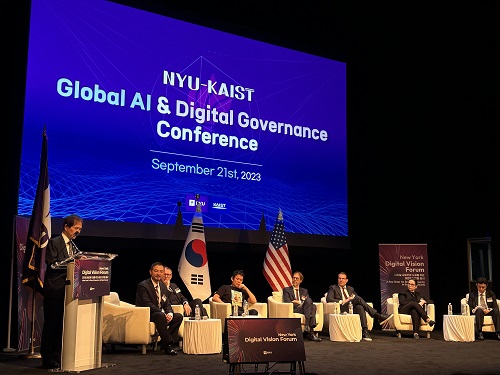 NYU-KAIST Global AI & Digital Governance Conference Held
< Photo 1. Opening of NYU-KAIST Global AI & Digital Governance Conference >
In attendance of the Minister of Science and ICT Jong-ho Lee, NYU President Linda G. Mills, and KAIST President Kwang Hyung Lee, KAIST co-hosted the NYU-KAIST Global AI & Digital Governance Conference at the Paulson Center of New York University (NYU) in New York City, USA on September 21st, 9:30 pm.
At the conference, KAIST and NYU discussed the direction and policies for ‘global AI and digital governance’ with participants of upto 300 people which includes scholars, professors, and students involved in the academic field of AI and digitalization from both Korea and the United States and other international backgrounds. This conference was a forum of an international discussion that sought new directions for AI and digital technology take in the future and gathered consensus on regulations.
Following a welcoming address by KAIST President, Kwang Hyung Lee and a congratulatory message from the Minister of Science and ICT, Jong-ho Lee, a panel discussion was held, moderated by Professor Matthew Liao, a graduate of Princeton and Oxford University, currently serving as a professor at NYU and the director at the Center for Bioethics of the NYU School of Global Public Health.
Six prominent scholars took part in the panel discussion. Prof. Kyung-hyun Cho of NYU Applied Mathematics and Data Science Center, a KAIST graduate who has joined the ranks of the world-class in AI language models and Professor Jong Chul Ye, the Director of Promotion Council for Digital Health at KAIST, who is leading innovative research in the field of medical AI working in collaboration with major hospitals at home and abroad was on the panel. Additionally, Professor Luciano Floridi, a founding member of the Yale University Center for Digital Ethics, Professor Shannon Vallor, the Baillie Gifford Professor in the Ethics of Data and Artificial Intelligence at the University of Edinburgh of the UK, Professor Stefaan Verhulst, a Co-Founder and the DIrector of GovLab‘s Data Program at NYU’s Tandon School of Engineering, and Professor Urs Gasser, who is in charge of public policy, governance and innovative technology at the Technical University of Munich, also participated.
Professor Matthew Liao from NYU led the discussion on various topics such as the ways to to regulate AI and digital technologies; the concerns about how deep learning technology being developed in medicinal purposes could be used in warfare; the scope of responsibilities Al scientists' responsibility should carry in ensuring the usage of AI are limited to benign purposes only; the effects of external regulation on the AI model developers and the research they pursue; and on the lessons that can be learned from the regulations in other fields.
During the panel discussion, there was an exchange of ideas about a system of standards that could harmonize digital development and regulatory and social ethics in today’s situation in which digital transformation accelerates technological development at a global level, there is a looming concern that while such advancements are bringing economic vitality it may create digital divides and probles like manipulation of public opinion. Professor Jong-cheol Ye of KAIST (Director of the Promotion Council for Digital Health), in particular, emphasized that it is important to find a point of balance that does not hinder the advancements rather than opting to enforcing strict regulations.
< Photo 2. Panel Discussion in Session at NYU-KAIST Global AI & Digital Governance Conference >
KAIST President Kwang Hyung Lee explained, “At the Digital Governance Forum we had last October, we focused on exploring new governance to solve digital challenges in the time of global digital transition, and this year’s main focus was on regulations.”
“This conference served as an opportunity of immense value as we came to understand that appropriate regulations can be a motivation to spur further developments rather than a hurdle when it comes to technological advancements, and that it is important for us to clearly understand artificial intelligence and consider what should and can be regulated when we are to set regulations on artificial intelligence,” he continued.
Earlier, KAIST signed a cooperation agreement with NYU to build a joint campus, June last year and held a plaque presentation ceremony for the KAIST NYU Joint Campus last September to promote joint research between the two universities. KAIST is currently conducting joint research with NYU in nine fields, including AI and digital research. The KAIST-NYU Joint Campus was conceived with the goal of building an innovative sandbox campus centering aroung science, technology, engineering, and mathematics (STEM) combining NYU's excellent humanities and arts as well as basic science and convergence research capabilities with KAIST's science and technology.
KAIST has contributed to the development of Korea's industry and economy through technological innovation aiding in the nation’s transformation into an innovative nation with scientific and technological prowess. KAIST will now pursue an anchor/base strategy to raise KAIST's awareness in New York through the NYU Joint Campus by establishing a KAIST campus within the campus of NYU, the heart of New York.
2023.09.22 View 26634
NYU-KAIST Global AI & Digital Governance Conference Held
< Photo 1. Opening of NYU-KAIST Global AI & Digital Governance Conference >
In attendance of the Minister of Science and ICT Jong-ho Lee, NYU President Linda G. Mills, and KAIST President Kwang Hyung Lee, KAIST co-hosted the NYU-KAIST Global AI & Digital Governance Conference at the Paulson Center of New York University (NYU) in New York City, USA on September 21st, 9:30 pm.
At the conference, KAIST and NYU discussed the direction and policies for ‘global AI and digital governance’ with participants of upto 300 people which includes scholars, professors, and students involved in the academic field of AI and digitalization from both Korea and the United States and other international backgrounds. This conference was a forum of an international discussion that sought new directions for AI and digital technology take in the future and gathered consensus on regulations.
Following a welcoming address by KAIST President, Kwang Hyung Lee and a congratulatory message from the Minister of Science and ICT, Jong-ho Lee, a panel discussion was held, moderated by Professor Matthew Liao, a graduate of Princeton and Oxford University, currently serving as a professor at NYU and the director at the Center for Bioethics of the NYU School of Global Public Health.
Six prominent scholars took part in the panel discussion. Prof. Kyung-hyun Cho of NYU Applied Mathematics and Data Science Center, a KAIST graduate who has joined the ranks of the world-class in AI language models and Professor Jong Chul Ye, the Director of Promotion Council for Digital Health at KAIST, who is leading innovative research in the field of medical AI working in collaboration with major hospitals at home and abroad was on the panel. Additionally, Professor Luciano Floridi, a founding member of the Yale University Center for Digital Ethics, Professor Shannon Vallor, the Baillie Gifford Professor in the Ethics of Data and Artificial Intelligence at the University of Edinburgh of the UK, Professor Stefaan Verhulst, a Co-Founder and the DIrector of GovLab‘s Data Program at NYU’s Tandon School of Engineering, and Professor Urs Gasser, who is in charge of public policy, governance and innovative technology at the Technical University of Munich, also participated.
Professor Matthew Liao from NYU led the discussion on various topics such as the ways to to regulate AI and digital technologies; the concerns about how deep learning technology being developed in medicinal purposes could be used in warfare; the scope of responsibilities Al scientists' responsibility should carry in ensuring the usage of AI are limited to benign purposes only; the effects of external regulation on the AI model developers and the research they pursue; and on the lessons that can be learned from the regulations in other fields.
During the panel discussion, there was an exchange of ideas about a system of standards that could harmonize digital development and regulatory and social ethics in today’s situation in which digital transformation accelerates technological development at a global level, there is a looming concern that while such advancements are bringing economic vitality it may create digital divides and probles like manipulation of public opinion. Professor Jong-cheol Ye of KAIST (Director of the Promotion Council for Digital Health), in particular, emphasized that it is important to find a point of balance that does not hinder the advancements rather than opting to enforcing strict regulations.
< Photo 2. Panel Discussion in Session at NYU-KAIST Global AI & Digital Governance Conference >
KAIST President Kwang Hyung Lee explained, “At the Digital Governance Forum we had last October, we focused on exploring new governance to solve digital challenges in the time of global digital transition, and this year’s main focus was on regulations.”
“This conference served as an opportunity of immense value as we came to understand that appropriate regulations can be a motivation to spur further developments rather than a hurdle when it comes to technological advancements, and that it is important for us to clearly understand artificial intelligence and consider what should and can be regulated when we are to set regulations on artificial intelligence,” he continued.
Earlier, KAIST signed a cooperation agreement with NYU to build a joint campus, June last year and held a plaque presentation ceremony for the KAIST NYU Joint Campus last September to promote joint research between the two universities. KAIST is currently conducting joint research with NYU in nine fields, including AI and digital research. The KAIST-NYU Joint Campus was conceived with the goal of building an innovative sandbox campus centering aroung science, technology, engineering, and mathematics (STEM) combining NYU's excellent humanities and arts as well as basic science and convergence research capabilities with KAIST's science and technology.
KAIST has contributed to the development of Korea's industry and economy through technological innovation aiding in the nation’s transformation into an innovative nation with scientific and technological prowess. KAIST will now pursue an anchor/base strategy to raise KAIST's awareness in New York through the NYU Joint Campus by establishing a KAIST campus within the campus of NYU, the heart of New York.
2023.09.22 View 26634 -
 Professor Sung-Ju Lee’s Team Wins the Best Paper and the Methods Recognition Awards at the ACM CSCW
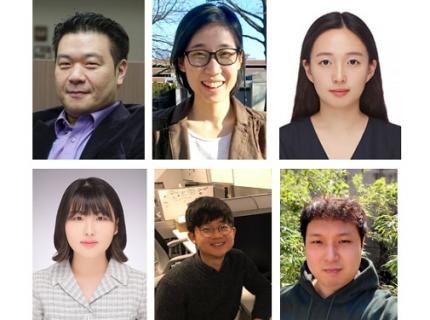
A research team led by Professor Sung-Ju Lee at the School of Electrical Engineering won the Best Paper Award and the Methods Recognition Award from ACM CSCW (International Conference on Computer-Supported Cooperative Work and Social Computing) 2021 for their paper “Reflect, not Regret: Understanding Regretful Smartphone Use with App Feature-Level Analysis”.
Founded in 1986, CSCW has been a premier conference on HCI (Human Computer Interaction) and Social Computing. This year, 340 full papers were presented and the best paper awards are given to the top 1% papers of the submitted. Methods Recognition, which is a new award, is given “for strong examples of work that includes well developed, explained, or implemented methods, and methodological innovation.”
Hyunsung Cho (KAIST alumus and currently a PhD candidate at Carnegie Mellon University), Daeun Choi (KAIST undergraduate researcher), Donghwi Kim (KAIST PhD Candidate), Wan Ju Kang (KAIST PhD Candidate), and Professor Eun Kyoung Choe (University of Maryland and KAIST alumna) collaborated on this research.
The authors developed a tool that tracks and analyzes which features of a mobile app (e.g., Instagram’s following post, following story, recommended post, post upload, direct messaging, etc.) are in use based on a smartphone’s User Interface (UI) layout. Utilizing this novel method, the authors revealed which feature usage patterns result in regretful smartphone use.
Professor Lee said, “Although many people enjoy the benefits of smartphones, issues have emerged from the overuse of smartphones. With this feature level analysis, users can reflect on their smartphone usage based on finer grained analysis and this could contribute to digital wellbeing.”
2021.11.22 View 17293
Professor Sung-Ju Lee’s Team Wins the Best Paper and the Methods Recognition Awards at the ACM CSCW
A research team led by Professor Sung-Ju Lee at the School of Electrical Engineering won the Best Paper Award and the Methods Recognition Award from ACM CSCW (International Conference on Computer-Supported Cooperative Work and Social Computing) 2021 for their paper “Reflect, not Regret: Understanding Regretful Smartphone Use with App Feature-Level Analysis”.
Founded in 1986, CSCW has been a premier conference on HCI (Human Computer Interaction) and Social Computing. This year, 340 full papers were presented and the best paper awards are given to the top 1% papers of the submitted. Methods Recognition, which is a new award, is given “for strong examples of work that includes well developed, explained, or implemented methods, and methodological innovation.”
Hyunsung Cho (KAIST alumus and currently a PhD candidate at Carnegie Mellon University), Daeun Choi (KAIST undergraduate researcher), Donghwi Kim (KAIST PhD Candidate), Wan Ju Kang (KAIST PhD Candidate), and Professor Eun Kyoung Choe (University of Maryland and KAIST alumna) collaborated on this research.
The authors developed a tool that tracks and analyzes which features of a mobile app (e.g., Instagram’s following post, following story, recommended post, post upload, direct messaging, etc.) are in use based on a smartphone’s User Interface (UI) layout. Utilizing this novel method, the authors revealed which feature usage patterns result in regretful smartphone use.
Professor Lee said, “Although many people enjoy the benefits of smartphones, issues have emerged from the overuse of smartphones. With this feature level analysis, users can reflect on their smartphone usage based on finer grained analysis and this could contribute to digital wellbeing.”
2021.11.22 View 17293 -
 Recipe for Success: Reputations Start from Inner Circles
A study on social network data of EDM DJs finds the relationship between social standing and identity building
If you would like to succeed in your career, carve out your own distinctiveness, then break your boundaries along with collaborators. This sounds very common. However, a study on social networks has proven that is the recipe for success.
A recent research on electric dance music DJs’ music identity and their reputation found that music DJs with a distinct genre identity as well as network positions combining brokerage and cohesion tend to place higher in terms of their social standing.
What do Calvin Harris, the star of Electro house, Diplo, the icon of Moombahton & Trap, Sebastian Ingrosso, the master of Progressive House, and Armin Van Buuren, the leader of Trance have in common? One commonality of these star DJs in the electronic music market is that they are the leaders who build their genres with solid musical identities and are artists who constantly try experimental and innovative connections with other genres.
Professor Wonjae Lee and Dr. Hyeongseok Wi from the Graduate School of Culture and Technology analyzed the playlist data performed by electronic dance music (EDM) DJs at several EDM festivals that were popular around the world before COVID-19 and the track data that they released during that period.
“This study investigates how social standing is attained within a professional group of artists whose members play a key role in evaluating their artistic products in the EDM market,” said Professor Lee.
Particularly, the team considered DJs' social standing as an effective means of ensuring the quality of their artwork in emerging music markets such as EDM and identified two important factors, the musical identity and the social position within the professional DJ’s group.
They analyzed the data from 3,164 playlists of 815 DJs who performed at nine festivals held from 2013 to 2016 as a sort of citation network among DJs, and transformed it into network data to measure social positions among the DJs. They considered the DJs who received a lot of citations from other DJs as having a high social standing. In addition, the genre, beats per minute (BPM), and key scale data of the songs released during the period were quantified to analyze the association with the musical identity.
First, the results of analysis of the released track data demonstrated that focused distinct musical identity is correlated with social standing among EDM DJs. The EDM market is an emerging specialist market that is constantly developing and differentiating new styles and genres. It includes artists who establish value criteria and demarcate categorical space into separate identity positions reflecting the artistic forms of a similar type.
Second, this study focuses on the two advantages of two types of social positioning, brokerage and cohesive, which can effectively reduce uncertainty in the market. The results show that DJs with a hybrid position, combining elements of both brokerage and cohesion, have higher social standing. This hybrid position is the most advantageous position for controlling new opportunities and inflows of resources and for utilizing them. Unlike existing studies that divide the merits of the two positions into a dichotomy, this study follows the practice of recent studies that show that the two positions can generate synergy in a complementary manner.
The remix culture prominent in EDM provides a convincing explanation for this phenomenon. Because constructing playlist sets represents a DJ’s main specialty, the ability to creatively combine a variety of tracks using one’s own artistic style is crucial. To showcase their remix skills, DJs skillfully select tracks to maximize the displays of their talent. Recognized DJs prefer to select tracks from other genres, borrowing from existing contexts and creating new reinterpretations while drawing upon their own musical backgrounds.
“Acquiring social acknowledgement within a professional group is an effective way to ensure the quality of products they produce and a strong reputation,” explained Professor Lee.
The research team also pointed out the unique case of Techno DJs, who are showing Galápagos syndrome by avoiding crossover between genres and sticking to their own musical identity, unlike most genres in EDM. This research was reported in PLos ONE on Aug. 25 and funded by KAIST and the BK21 Plus Postgraduate Organization for Content Science.
-ProfileProfessor Wonjae LeeGraduate School of Culture TechnologyKAIST
-PublicationHyeongseok Wi, Wonjae Lee “Stars inside have reached outside: The effects of electronic dance music DJ’s social standing and musical identity on track success,” Aug.25, 2021 PLosONE (https://doi.org/10.1371/journal.pone.0254618)
2021.09.09 View 13009
Recipe for Success: Reputations Start from Inner Circles
A study on social network data of EDM DJs finds the relationship between social standing and identity building
If you would like to succeed in your career, carve out your own distinctiveness, then break your boundaries along with collaborators. This sounds very common. However, a study on social networks has proven that is the recipe for success.
A recent research on electric dance music DJs’ music identity and their reputation found that music DJs with a distinct genre identity as well as network positions combining brokerage and cohesion tend to place higher in terms of their social standing.
What do Calvin Harris, the star of Electro house, Diplo, the icon of Moombahton & Trap, Sebastian Ingrosso, the master of Progressive House, and Armin Van Buuren, the leader of Trance have in common? One commonality of these star DJs in the electronic music market is that they are the leaders who build their genres with solid musical identities and are artists who constantly try experimental and innovative connections with other genres.
Professor Wonjae Lee and Dr. Hyeongseok Wi from the Graduate School of Culture and Technology analyzed the playlist data performed by electronic dance music (EDM) DJs at several EDM festivals that were popular around the world before COVID-19 and the track data that they released during that period.
“This study investigates how social standing is attained within a professional group of artists whose members play a key role in evaluating their artistic products in the EDM market,” said Professor Lee.
Particularly, the team considered DJs' social standing as an effective means of ensuring the quality of their artwork in emerging music markets such as EDM and identified two important factors, the musical identity and the social position within the professional DJ’s group.
They analyzed the data from 3,164 playlists of 815 DJs who performed at nine festivals held from 2013 to 2016 as a sort of citation network among DJs, and transformed it into network data to measure social positions among the DJs. They considered the DJs who received a lot of citations from other DJs as having a high social standing. In addition, the genre, beats per minute (BPM), and key scale data of the songs released during the period were quantified to analyze the association with the musical identity.
First, the results of analysis of the released track data demonstrated that focused distinct musical identity is correlated with social standing among EDM DJs. The EDM market is an emerging specialist market that is constantly developing and differentiating new styles and genres. It includes artists who establish value criteria and demarcate categorical space into separate identity positions reflecting the artistic forms of a similar type.
Second, this study focuses on the two advantages of two types of social positioning, brokerage and cohesive, which can effectively reduce uncertainty in the market. The results show that DJs with a hybrid position, combining elements of both brokerage and cohesion, have higher social standing. This hybrid position is the most advantageous position for controlling new opportunities and inflows of resources and for utilizing them. Unlike existing studies that divide the merits of the two positions into a dichotomy, this study follows the practice of recent studies that show that the two positions can generate synergy in a complementary manner.
The remix culture prominent in EDM provides a convincing explanation for this phenomenon. Because constructing playlist sets represents a DJ’s main specialty, the ability to creatively combine a variety of tracks using one’s own artistic style is crucial. To showcase their remix skills, DJs skillfully select tracks to maximize the displays of their talent. Recognized DJs prefer to select tracks from other genres, borrowing from existing contexts and creating new reinterpretations while drawing upon their own musical backgrounds.
“Acquiring social acknowledgement within a professional group is an effective way to ensure the quality of products they produce and a strong reputation,” explained Professor Lee.
The research team also pointed out the unique case of Techno DJs, who are showing Galápagos syndrome by avoiding crossover between genres and sticking to their own musical identity, unlike most genres in EDM. This research was reported in PLos ONE on Aug. 25 and funded by KAIST and the BK21 Plus Postgraduate Organization for Content Science.
-ProfileProfessor Wonjae LeeGraduate School of Culture TechnologyKAIST
-PublicationHyeongseok Wi, Wonjae Lee “Stars inside have reached outside: The effects of electronic dance music DJ’s social standing and musical identity on track success,” Aug.25, 2021 PLosONE (https://doi.org/10.1371/journal.pone.0254618)
2021.09.09 View 13009 -
 Image Analysis to Automatically Quantify Gender Bias in Movies
Many commercial films worldwide continue to express womanhood in a stereotypical manner, a recent study using image analysis showed. A KAIST research team developed a novel image analysis method for automatically quantifying the degree of gender bias in films.
The ‘Bechdel Test’ has been the most representative and general method of evaluating gender bias in films. This test indicates the degree of gender bias in a film by measuring how active the presence of women is in a film. A film passes the Bechdel Test if the film (1) has at least two female characters, (2) who talk to each other, and (3) their conversation is not related to the male characters.
However, the Bechdel Test has fundamental limitations regarding the accuracy and practicality of the evaluation. Firstly, the Bechdel Test requires considerable human resources, as it is performed subjectively by a person. More importantly, the Bechdel Test analyzes only a single aspect of the film, the dialogues between characters in the script, and provides only a dichotomous result of passing the test, neglecting the fact that a film is a visual art form reflecting multi-layered and complicated gender bias phenomena. It is also difficult to fully represent today’s various discourse on gender bias, which is much more diverse than in 1985 when the Bechdel Test was first presented.
Inspired by these limitations, a KAIST research team led by Professor Byungjoo Lee from the Graduate School of Culture Technology proposed an advanced system that uses computer vision technology to automatically analyzes the visual information of each frame of the film. This allows the system to more accurately and practically evaluate the degree to which female and male characters are discriminatingly depicted in a film in quantitative terms, and further enables the revealing of gender bias that conventional analysis methods could not yet detect.
Professor Lee and his researchers Ji Yoon Jang and Sangyoon Lee analyzed 40 films from Hollywood and South Korea released between 2017 and 2018. They downsampled the films from 24 to 3 frames per second, and used Microsoft’s Face API facial recognition technology and object detection technology YOLO9000 to verify the details of the characters and their surrounding objects in the scenes.
Using the new system, the team computed eight quantitative indices that describe the representation of a particular gender in the films. They are: emotional diversity, spatial staticity, spatial occupancy, temporal occupancy, mean age, intellectual image, emphasis on appearance, and type and frequency of surrounding objects.
Figure 1. System Diagram
Figure 2. 40 Hollywood and Korean Films Analyzed in the Study
According to the emotional diversity index, the depicted women were found to be more prone to expressing passive emotions, such as sadness, fear, and surprise. In contrast, male characters in the same films were more likely to demonstrate active emotions, such as anger and hatred.
Figure 3. Difference in Emotional Diversity between Female and Male Characters
The type and frequency of surrounding objects index revealed that female characters and automobiles were tracked together only 55.7 % as much as that of male characters, while they were more likely to appear with furniture and in a household, with 123.9% probability.
In cases of temporal occupancy and mean age, female characters appeared less frequently in films than males at the rate of 56%, and were on average younger in 79.1% of the cases. These two indices were especially conspicuous in Korean films.
Professor Lee said, “Our research confirmed that many commercial films depict women from a stereotypical perspective. I hope this result promotes public awareness of the importance of taking prudence when filmmakers create characters in films.”
This study was supported by KAIST College of Liberal Arts and Convergence Science as part of the Venture Research Program for Master’s and PhD Students, and will be presented at the 22nd ACM Conference on Computer-Supported Cooperative Work and Social Computing (CSCW) on November 11 to be held in Austin, Texas.
Publication:
Ji Yoon Jang, Sangyoon Lee, and Byungjoo Lee. 2019. Quantification of Gender Representation Bias in Commercial Films based on Image Analysis. In Proceedings of the 22nd ACM Conference on Computer-Supported Cooperative Work and Social Computing (CSCW). ACM, New York, NY, USA, Article 198, 29 pages. https://doi.org/10.1145/3359300
Link to download the full-text paper:
https://files.cargocollective.com/611692/cscw198-jangA--1-.pdf
Profile: Prof. Byungjoo Lee, MD, PhD
byungjoo.lee@kaist.ac.kr
http://kiml.org/
Assistant Professor
Graduate School of Culture Technology (CT)
Korea Advanced Institute of Science and Technology (KAIST)
https://www.kaist.ac.kr Daejeon 34141, Korea
Profile: Ji Yoon Jang, M.S.
yoone3422@kaist.ac.kr
Interactive Media Lab
Graduate School of Culture Technology (CT)
Korea Advanced Institute of Science and Technology (KAIST)
https://www.kaist.ac.kr Daejeon 34141, Korea
Profile: Sangyoon Lee, M.S. Candidate
sl2820@kaist.ac.kr
Interactive Media Lab
Graduate School of Culture Technology (CT)
Korea Advanced Institute of Science and Technology (KAIST)
https://www.kaist.ac.kr Daejeon 34141, Korea
(END)
2019.10.17 View 41447
Image Analysis to Automatically Quantify Gender Bias in Movies
Many commercial films worldwide continue to express womanhood in a stereotypical manner, a recent study using image analysis showed. A KAIST research team developed a novel image analysis method for automatically quantifying the degree of gender bias in films.
The ‘Bechdel Test’ has been the most representative and general method of evaluating gender bias in films. This test indicates the degree of gender bias in a film by measuring how active the presence of women is in a film. A film passes the Bechdel Test if the film (1) has at least two female characters, (2) who talk to each other, and (3) their conversation is not related to the male characters.
However, the Bechdel Test has fundamental limitations regarding the accuracy and practicality of the evaluation. Firstly, the Bechdel Test requires considerable human resources, as it is performed subjectively by a person. More importantly, the Bechdel Test analyzes only a single aspect of the film, the dialogues between characters in the script, and provides only a dichotomous result of passing the test, neglecting the fact that a film is a visual art form reflecting multi-layered and complicated gender bias phenomena. It is also difficult to fully represent today’s various discourse on gender bias, which is much more diverse than in 1985 when the Bechdel Test was first presented.
Inspired by these limitations, a KAIST research team led by Professor Byungjoo Lee from the Graduate School of Culture Technology proposed an advanced system that uses computer vision technology to automatically analyzes the visual information of each frame of the film. This allows the system to more accurately and practically evaluate the degree to which female and male characters are discriminatingly depicted in a film in quantitative terms, and further enables the revealing of gender bias that conventional analysis methods could not yet detect.
Professor Lee and his researchers Ji Yoon Jang and Sangyoon Lee analyzed 40 films from Hollywood and South Korea released between 2017 and 2018. They downsampled the films from 24 to 3 frames per second, and used Microsoft’s Face API facial recognition technology and object detection technology YOLO9000 to verify the details of the characters and their surrounding objects in the scenes.
Using the new system, the team computed eight quantitative indices that describe the representation of a particular gender in the films. They are: emotional diversity, spatial staticity, spatial occupancy, temporal occupancy, mean age, intellectual image, emphasis on appearance, and type and frequency of surrounding objects.
Figure 1. System Diagram
Figure 2. 40 Hollywood and Korean Films Analyzed in the Study
According to the emotional diversity index, the depicted women were found to be more prone to expressing passive emotions, such as sadness, fear, and surprise. In contrast, male characters in the same films were more likely to demonstrate active emotions, such as anger and hatred.
Figure 3. Difference in Emotional Diversity between Female and Male Characters
The type and frequency of surrounding objects index revealed that female characters and automobiles were tracked together only 55.7 % as much as that of male characters, while they were more likely to appear with furniture and in a household, with 123.9% probability.
In cases of temporal occupancy and mean age, female characters appeared less frequently in films than males at the rate of 56%, and were on average younger in 79.1% of the cases. These two indices were especially conspicuous in Korean films.
Professor Lee said, “Our research confirmed that many commercial films depict women from a stereotypical perspective. I hope this result promotes public awareness of the importance of taking prudence when filmmakers create characters in films.”
This study was supported by KAIST College of Liberal Arts and Convergence Science as part of the Venture Research Program for Master’s and PhD Students, and will be presented at the 22nd ACM Conference on Computer-Supported Cooperative Work and Social Computing (CSCW) on November 11 to be held in Austin, Texas.
Publication:
Ji Yoon Jang, Sangyoon Lee, and Byungjoo Lee. 2019. Quantification of Gender Representation Bias in Commercial Films based on Image Analysis. In Proceedings of the 22nd ACM Conference on Computer-Supported Cooperative Work and Social Computing (CSCW). ACM, New York, NY, USA, Article 198, 29 pages. https://doi.org/10.1145/3359300
Link to download the full-text paper:
https://files.cargocollective.com/611692/cscw198-jangA--1-.pdf
Profile: Prof. Byungjoo Lee, MD, PhD
byungjoo.lee@kaist.ac.kr
http://kiml.org/
Assistant Professor
Graduate School of Culture Technology (CT)
Korea Advanced Institute of Science and Technology (KAIST)
https://www.kaist.ac.kr Daejeon 34141, Korea
Profile: Ji Yoon Jang, M.S.
yoone3422@kaist.ac.kr
Interactive Media Lab
Graduate School of Culture Technology (CT)
Korea Advanced Institute of Science and Technology (KAIST)
https://www.kaist.ac.kr Daejeon 34141, Korea
Profile: Sangyoon Lee, M.S. Candidate
sl2820@kaist.ac.kr
Interactive Media Lab
Graduate School of Culture Technology (CT)
Korea Advanced Institute of Science and Technology (KAIST)
https://www.kaist.ac.kr Daejeon 34141, Korea
(END)
2019.10.17 View 41447 -
 The Center for Anthropocene Studies (CAS) Opens
KAIST will start Anthropocene research, a convergence field of study, to address issues related to the commencement of human activities that have had scientific, industrial, and economic impacts on the Earth’s ecosystem. The National Research Foundation (NRF) of Korea endorsed the KAIST Center for Anthropocene Studies as its Convergence Research Center project.
Anthropocene refers to a new geological age in which various polluting materials that humans have made during the post-industrial revolution era have made a significant impact on the Earth and the lives of humankind. The studies expand the diverse socio-economic and environmental sectors for responding to climate change, natural disasters, ecological destruction, the polarization of the inequality and wealth, and many others.
The KAIST research group at the center, in collaboration with the Graduate School of Science and Technology Policy, the Graduate School of Culture Technology, the School of Humanities & Social Sciences, the Department of Industrial Design, the School of Electrical Engineering, the Satellite Technology Research Center (SaRTec), and the KAIST Initiative for Disaster Studies will conduct multidisciplinary research to address intriguing challenges with complex but creative approaches incorporating the fields of engineering, socioeconomics, and art.
The group will investigate topics such as▲ surface and marine changes to the Earth by applying satellite data ▲disaster prediction and governance system building through AI modeling ▲sustainable housing, transportation, and lifestyles ▲ engineering and artistic approaches for envisioning a new future for humankind and the Earth.
Professor Buhm Soon Park, who is in charge of the center, said, “This pioneering research work will inspire the re-creation of a new paradigm of convergence studies in science, engineering, humanities, and social science. We will contribute to making the world better by designing new technologies and social policies.
2018.06.05 View 24351
The Center for Anthropocene Studies (CAS) Opens
KAIST will start Anthropocene research, a convergence field of study, to address issues related to the commencement of human activities that have had scientific, industrial, and economic impacts on the Earth’s ecosystem. The National Research Foundation (NRF) of Korea endorsed the KAIST Center for Anthropocene Studies as its Convergence Research Center project.
Anthropocene refers to a new geological age in which various polluting materials that humans have made during the post-industrial revolution era have made a significant impact on the Earth and the lives of humankind. The studies expand the diverse socio-economic and environmental sectors for responding to climate change, natural disasters, ecological destruction, the polarization of the inequality and wealth, and many others.
The KAIST research group at the center, in collaboration with the Graduate School of Science and Technology Policy, the Graduate School of Culture Technology, the School of Humanities & Social Sciences, the Department of Industrial Design, the School of Electrical Engineering, the Satellite Technology Research Center (SaRTec), and the KAIST Initiative for Disaster Studies will conduct multidisciplinary research to address intriguing challenges with complex but creative approaches incorporating the fields of engineering, socioeconomics, and art.
The group will investigate topics such as▲ surface and marine changes to the Earth by applying satellite data ▲disaster prediction and governance system building through AI modeling ▲sustainable housing, transportation, and lifestyles ▲ engineering and artistic approaches for envisioning a new future for humankind and the Earth.
Professor Buhm Soon Park, who is in charge of the center, said, “This pioneering research work will inspire the re-creation of a new paradigm of convergence studies in science, engineering, humanities, and social science. We will contribute to making the world better by designing new technologies and social policies.
2018.06.05 View 24351 -
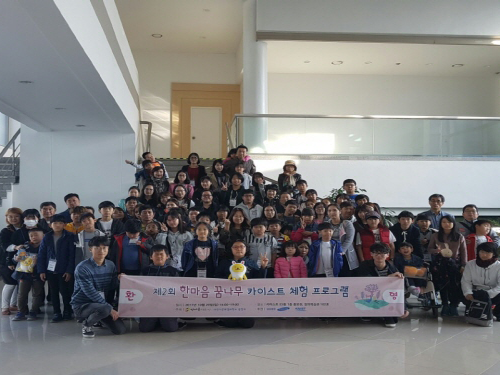 Hanmaeum Education Corps Invites Multicultural Families
About 100 graduates from the Multicultural Mother Schools and their families visited the KAIST campus on October 29 at the invitation of the Hanmaeum Education Corps of KAIST. The Hanmanum Education Corps is a volunteering organization composed of KAIST faculty and students. Many retired KAIST faculties are also members of the corps. Byong Kyu Choi, an Emeritus Professor from the Department of Industrial and Systems Engineering, is the director of the corps and has been leading the event since 2015.
With the support of a KAIST educational volunteering organization called SEED(Social Education Embracing Diversity), this year’s event offered various activities including a treasure hunt and convergent science programs. Participants had the opportunity to experience KAIST’s educational environment and enjoyed the perfect autumn weather during outdoor activities with student volunteers.
Children enjoyed making illumination-music stickers with the KAIST students, even though it was tough to learn at first.
While the children engaged themselves in the science program, parents visited the chrysanthemum fair and some of KAIST’s cafeterias.
Hanmaeum Education Corps opened the Multicultural Mother Schools to support multicultural mothers so that they can have more interest in and help their children more with their education. Since its establishment in 2015, the Multicultural Mother Schools have been expanding throughout the country.
The corporation hopes that visiting a renowned university will encourage children from multicultural families to study hard in addition to offering self-enrichment opportunities through career exploration and science activities.
2017.10.30 View 9746
Hanmaeum Education Corps Invites Multicultural Families
About 100 graduates from the Multicultural Mother Schools and their families visited the KAIST campus on October 29 at the invitation of the Hanmaeum Education Corps of KAIST. The Hanmanum Education Corps is a volunteering organization composed of KAIST faculty and students. Many retired KAIST faculties are also members of the corps. Byong Kyu Choi, an Emeritus Professor from the Department of Industrial and Systems Engineering, is the director of the corps and has been leading the event since 2015.
With the support of a KAIST educational volunteering organization called SEED(Social Education Embracing Diversity), this year’s event offered various activities including a treasure hunt and convergent science programs. Participants had the opportunity to experience KAIST’s educational environment and enjoyed the perfect autumn weather during outdoor activities with student volunteers.
Children enjoyed making illumination-music stickers with the KAIST students, even though it was tough to learn at first.
While the children engaged themselves in the science program, parents visited the chrysanthemum fair and some of KAIST’s cafeterias.
Hanmaeum Education Corps opened the Multicultural Mother Schools to support multicultural mothers so that they can have more interest in and help their children more with their education. Since its establishment in 2015, the Multicultural Mother Schools have been expanding throughout the country.
The corporation hopes that visiting a renowned university will encourage children from multicultural families to study hard in addition to offering self-enrichment opportunities through career exploration and science activities.
2017.10.30 View 9746 -
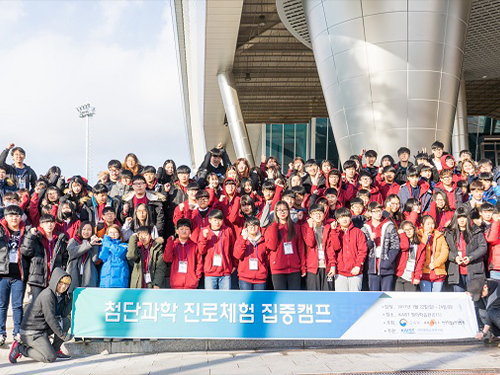 KAIST Intensive Science Camp for Middle-High School Students
The KAIST Global Institute of Talented Education (Director: Dong-Soo Kwon) invited around 90 middle and high school students for an advanced science intensive camp from January 22 to 24.
This camp targeted middle and high school students in community centers or child-care institutions. It aims to increase students’ interest in science and engineering, and assist them with their career paths through programs such as special lectures on science, advanced science projects, and career mentoring.
Participating students were divided into groups of seven or eight with a KAIST student as a mentor to conduct advanced science projects such as VR controller production and robot arm programming. The camp included exploring future career options and science and engineering college admission counselling.
Jiyoung Ryu, Research Professor for the KAIST Global Institute of Talented Education, said, “KAIST started the science and engineering career experience program in 2016 with the Ministry of Education and Korea Research Institute for Vocational Education and Training (KRIVET). So far, 6000 middle and high school students from around the country have participated. The camp is more meaningful since it educates students in social responsibility, in addition to the fields of science and engineering, both of which are missions and goals that KAIST strives for.” She continued to say, “We plan to continue to expand the program in the future.”
The KAIST Global Institute of Talented Education is actively conducting research and projects on national education for talented youth such as policy research concerning gifted education, science and engineering career education, advanced science camps, training for gifted education teachers, and cyber gifted education programs.
2017.02.01 View 16423
KAIST Intensive Science Camp for Middle-High School Students
The KAIST Global Institute of Talented Education (Director: Dong-Soo Kwon) invited around 90 middle and high school students for an advanced science intensive camp from January 22 to 24.
This camp targeted middle and high school students in community centers or child-care institutions. It aims to increase students’ interest in science and engineering, and assist them with their career paths through programs such as special lectures on science, advanced science projects, and career mentoring.
Participating students were divided into groups of seven or eight with a KAIST student as a mentor to conduct advanced science projects such as VR controller production and robot arm programming. The camp included exploring future career options and science and engineering college admission counselling.
Jiyoung Ryu, Research Professor for the KAIST Global Institute of Talented Education, said, “KAIST started the science and engineering career experience program in 2016 with the Ministry of Education and Korea Research Institute for Vocational Education and Training (KRIVET). So far, 6000 middle and high school students from around the country have participated. The camp is more meaningful since it educates students in social responsibility, in addition to the fields of science and engineering, both of which are missions and goals that KAIST strives for.” She continued to say, “We plan to continue to expand the program in the future.”
The KAIST Global Institute of Talented Education is actively conducting research and projects on national education for talented youth such as policy research concerning gifted education, science and engineering career education, advanced science camps, training for gifted education teachers, and cyber gifted education programs.
2017.02.01 View 16423 -
 Public Lectures on the Korean Language and Alphabet
The School of Humanities and Social Sciences at KAIST will offer public lectures on the Korean language and alphabet, Hangul, from March 22, 2016 to April 26, 2016.
The lectures, which are entitled “The Riddle of Hangul,” will take place on campus in Daejeon.
A total of six lectures will be held on such topics as the origin of Korean, the grammar of ancient Korean in the Chosun Dynasty (1392-1897), and subsequent developments in contemporary Korean.
Professor Jung-Hoon Kim, who is responsible for organizing the public lecture program, said, “The audience will have an interesting opportunity to understand the history of Korean and its mechanism, while reviewing the unique spelling system of Hangul. I hope many people will show up for these wonderful classes.”
For further information and registration, please visit: http://hss.kaist.ac.kr. All lectures, available only in Korean, are free and open to the public.
2016.03.15 View 15259
Public Lectures on the Korean Language and Alphabet
The School of Humanities and Social Sciences at KAIST will offer public lectures on the Korean language and alphabet, Hangul, from March 22, 2016 to April 26, 2016.
The lectures, which are entitled “The Riddle of Hangul,” will take place on campus in Daejeon.
A total of six lectures will be held on such topics as the origin of Korean, the grammar of ancient Korean in the Chosun Dynasty (1392-1897), and subsequent developments in contemporary Korean.
Professor Jung-Hoon Kim, who is responsible for organizing the public lecture program, said, “The audience will have an interesting opportunity to understand the history of Korean and its mechanism, while reviewing the unique spelling system of Hangul. I hope many people will show up for these wonderful classes.”
For further information and registration, please visit: http://hss.kaist.ac.kr. All lectures, available only in Korean, are free and open to the public.
2016.03.15 View 15259 -
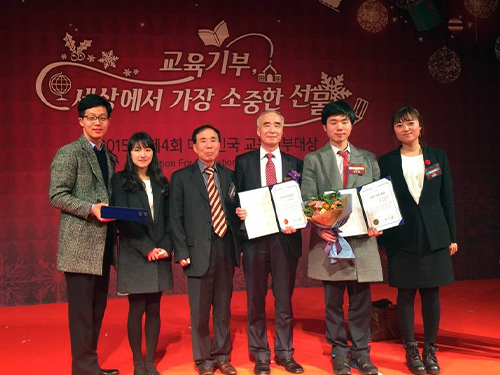 KAIST Wins the Korea Donation for Education Awards 2015
KAIST received the grand prize for the university section at the Korea Donation for Education Awards 2015. The award ceremony took place at Seoul Plaza Hotel on December 15, 2015.
The Ministry of Education created the award in 2012 to raise awareness about the need for charitable donations for education and to encourage the public’s participation in such endeavors. Recipients have included private companies, public institutions, non-profit organizations, universities, and individuals who have made notable contributions to education, for example, by offering educational programs or fundraising for such programs throughout a year.
Many organizations within KAIST, including the KAIST Center of Donation for Education, the Midam Scholarship Committee, the Donation for Software Education Group, the Chalk Academy, KAIST Student Volunteers, and K-LET, have been collectively recognized for their efforts to develop educational materials and managing academic camps and programs.
In addition to the grand prize which KAIST won, the Ministry of Education gave Neung-In Jang, a student pursuing a social entrepreneurship MBA at KAIST, an award for his efforts to provide quality education to teenagers by establishing the Midam Scholarship Committee in 2009. The Scholarship aims to revitalize the culture of donation for education by offering free math and science classes to high school students who are less privileged and by inspiring other universities in Korea to follow suit the committee’s volunteering activities.
2015.12.22 View 17749
KAIST Wins the Korea Donation for Education Awards 2015
KAIST received the grand prize for the university section at the Korea Donation for Education Awards 2015. The award ceremony took place at Seoul Plaza Hotel on December 15, 2015.
The Ministry of Education created the award in 2012 to raise awareness about the need for charitable donations for education and to encourage the public’s participation in such endeavors. Recipients have included private companies, public institutions, non-profit organizations, universities, and individuals who have made notable contributions to education, for example, by offering educational programs or fundraising for such programs throughout a year.
Many organizations within KAIST, including the KAIST Center of Donation for Education, the Midam Scholarship Committee, the Donation for Software Education Group, the Chalk Academy, KAIST Student Volunteers, and K-LET, have been collectively recognized for their efforts to develop educational materials and managing academic camps and programs.
In addition to the grand prize which KAIST won, the Ministry of Education gave Neung-In Jang, a student pursuing a social entrepreneurship MBA at KAIST, an award for his efforts to provide quality education to teenagers by establishing the Midam Scholarship Committee in 2009. The Scholarship aims to revitalize the culture of donation for education by offering free math and science classes to high school students who are less privileged and by inspiring other universities in Korea to follow suit the committee’s volunteering activities.
2015.12.22 View 17749