%72%75%74%68%65%6e%69%75%6d
-
 KAIST Develops Ruthenium Catalyst that Matches Platinum in Hydrogen Production
Lowering the cost of green hydrogen production requires catalysts that produce hydrogen efficiently while using smaller amounts of expensive precious metals. A Korean research team has developed a catalyst that brings three or four ruthenium (Ru) atoms together so they can work cooperatively. The catalyst achieved hydrogen production performance comparable to that of a commercial platinum catalyst while using only one-quarter as much precious metal, potentially helping to lower the cost of green hydrogen production.
KAIST (President Choongsik Bae) announced on October 28 that a research team led by Professor Jinwoo Lee from the Department of Chemical and Biomolecular Engineering has developed a high-performance water electrolysis catalyst based on an “atom-layer neighbor” structure. The work was carried out in collaboration with Professor Hyungjun Kim from the Department of Chemistry, Professor Jang Yong Lee from Konkuk University, Dr. Joonhee Moon from the Korea Basic Science Institute (KBSI), and Dr. Sungjun Kim from the Korea Research Institute of Chemical Technology (KRICT).
Water electrolysis uses electricity to split water into hydrogen and oxygen. When powered by renewable energy sources such as solar and wind, the process produces “green hydrogen” with low carbon emissions. However, catalysts for the hydrogen-producing reaction rely on expensive precious metals, creating a need for technologies that maintain performance while reducing precious metal use.
In conventional precious metal nanoparticle catalysts, many atoms are clustered together, leaving those buried inside the particles largely unable to participate in the reaction. As a result, only a fraction of the precious metal is actively used. To address this problem, researchers have explored “single-atom catalysts,” in which individual metal atoms are dispersed across a support. However, their isolated arrangement can limit performance in reactions that require several atoms to work together.
The research team sought to maximize the use of each atom while enabling neighboring atoms to cooperate. The team created “atom-layer neighbors,” small groups of ruthenium atoms arranged in a layer just one atom thick. This structure keeps the atoms close enough to work together in the reaction without forming large particles.
Maintaining this arrangement requires a support—a base material that holds the ruthenium atoms in place. During the initial stage of catalyst synthesis, the researchers used molecular interactions to prevent the atoms from aggregating into large particles. During subsequent heat treatment, strong metal–support interactions anchored the atoms to a tungsten carbide (WCₓ) support. The team also varied the number of atoms in each group to identify the most effective structure for hydrogen production.
The researchers also optimized the local environment surrounding the active atoms. Hydroxyl species (OH) on the support surface strengthened the hydrogen-bond network among water molecules, facilitating faster proton (hydrogen ion) transfer. By controlling both the arrangement of the catalytically active atoms and the interactions among surrounding water molecules, the team enabled the reaction to proceed efficiently.
When tested in an anion-exchange membrane water electrolyzer (AEMWE) cell, the catalyst achieved a current density of 9.82 amperes per square centimeter (A/cm²) at 2.0 volts (V) and 80°C. Current density measures the current flowing per unit of electrode area and indicates the rate of hydrogen production over that area. The catalyst delivered performance comparable to that of a commercial platinum catalyst while using 75% less precious metal. Its catalytic activity per unit mass of precious metal was approximately four times that of the platinum catalyst.
The team also evaluated the catalyst’s durability during extended operation. In a 500-hour continuous operation test, its performance loss was about half that of the platinum catalyst used for comparison. The results demonstrate that the catalyst can deliver high performance with a small amount of precious metal while maintaining stability over extended operation times.
The findings could help reduce precious metal use in hydrogen production equipment and lower catalyst replacement and maintenance costs. If the performance is validated at a larger scale and over longer operating periods, the catalyst could help lower the cost of green hydrogen production.
“In this study, we brought small groups of precious metal atoms together and optimized the surrounding environment for water reactions, enabling efficient and sustained hydrogen production with a small amount of precious metal,” said Research Professor Seongbeen Kim, a co-first author of the study. He added that the team hopes the findings will help reduce precious metal use in hydrogen production equipment and guide efforts to improve other catalysts.
Professor Kim and researchers Hyunwoo Jun and Jihye Park of KAIST, together with Dr. Sungjun Kim of KRICT, contributed as co-first authors. The findings were published online in Nature Communications on September 22 (Vol. 17, Article No. 11021).
Paper title: Stabilizing ruthenium atom layer neighbors through molecular and metal support interactions for water electrolyzers
DOI: https://doi.org/10.1038/s41467-026-78037-3
This research was supported by National Research Foundation of Korea (NRF) grants funded by the Ministry of Science and ICT (MSIT) (RS-2023-00235596, RS-2026-25474505, RS-2026-25477690, and RS-2024-00466554) and by the Basic Science Research Program of the Korea Basic Science Institute (KBSI) (C526111).
2026.10.28 View 1398
-
 KAIST Develops World-Leading Ammonia Catalyst for Hydrogen Economy
Hydrogen production using renewable energy is a key technology for eco-friendly energy and chemical production. However, storing and transporting hydrogen remains a challenge. To address this, researchers worldwide are investigating methods to store hydrogen in the form of ammonia (NH₃), which is carbon-free and easier to liquify. A research team at KAIST has successfully developed a high-performance catalyst that enables ammonia synthesis at very low temperatures and pressures without energy loss.
KAIST (represented by President Kwang Hyung Lee) announced on the 11th of March that a research team led by Professor Minkee Choi from the Department of Chemical and Biomolecular Engineering has developed an innovative catalytic system that significantly enhances ammonia production while drastically reducing energy consumption and CO₂ emissions.
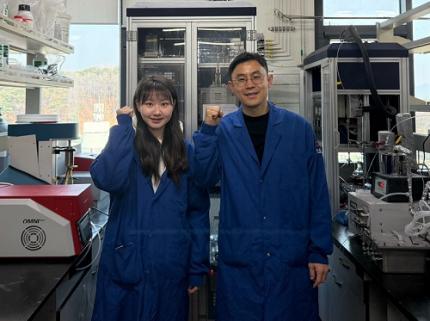
< (From left) Baek Ye-jun, Ph.D. candidate in the Department of Biochemical Engineering, Professor Choi Min-ki >
Currently, ammonia is produced using the Haber-Bosch process, a technology over a century old that relies on iron (Fe)-based catalysts. This method requires extreme conditions—temperatures above 500°C and pressures exceeding 100 atmospheres—resulting in enormous energy consumption and contributing significantly to global CO₂ emissions. Additionally, ammonia is primarily produced in large-scale industrial plants, leading to high distribution costs.
As an alternative, there is growing interest in an eco-friendly process that synthesizes ammonia using green hydrogen—produced via water electrolysis—under mild conditions (300°C, 10 atmospheres). However, developing catalysts that can achieve high ammonia productivity at such low temperatures and pressures is essential, as current technologies struggle to maintain efficiency under these conditions.
The research team developed a novel catalyst by incorporating ruthenium (Ru) nanoparticles and highly basic barium oxide (BaO) particles onto a conductive carbon surface, allowing it to function like a chemical capacitor*.
*Capacitor: A device that stores electrical energy by separating positive and negative charges.
During ammonia synthesis, hydrogen molecules (H₂) first dissociate into hydrogen atoms (H) on the ruthenium catalyst. These hydrogen atoms are further split into protons (H⁺) and electrons (e⁻). The study revealed that the acidic protons are stored in the strongly basic BaO, while the remaining electrons are separated and stored in ruthenium and carbon.
This unique chemical capacitor effect significantly enhances the ruthenium catalyst's electron density, accelerating nitrogen (N₂) dissociation—the rate-limiting step of ammonia synthesis—thereby dramatically increasing catalytic activity.
Furthermore, the team discovered that optimizing the nanostructure of the carbon material further boosts the electron density of ruthenium, maximizing catalytic performance. As a result, the new catalyst demonstrated over seven times higher ammonia synthesis performance compared to state-of-the-art catalysts under mild conditions (300°C, 10 atm).
< Schematic diagram showing the mechanism of ruthenium catalyst activity enhancement by barium oxide cocatalyst >
Professor Minkee Choi stated, “This research has garnered significant attention for demonstrating that catalytic activity can be greatly enhanced by controlling electron transfer within a thermal catalytic reaction system, not just in electrochemical processes.”
He further explained, “Our findings confirm that high-performance catalysts can enable efficient ammonia synthesis under low-temperature and low-pressure conditions. This could shift ammonia production from centralized, large-scale industrial plants to decentralized, small-scale production, making the hydrogen economy more sustainable and flexible.”
The study was led by Professor Minkee Choi as corresponding author and Yaejun Baik, a Ph.D. candidate, as first author. The research findings were published in Nature Catalysis on February 24.
(Paper title: “Electron and proton storage on separate Ru and BaO domains mediated by conductive low-work-function carbon to accelerate ammonia synthesis,” https://doi.org/10.1038/s41929-025-01302-z)
This research was supported by the Korea Institute of Energy Research and the National Research Foundation of Korea.
2025.03.11 View 12484
-
 A KAIST Research Team Develops Diesel Reforming Catalyst Enabling Hydrogen Production for Future Mobile Fuel Cells
This catalyst capability allowing stable hydrogen production from commercial diesel is expected to be applied in mobile fuel cell systems in the future hydrogen economy
On August 16, a joint research team led by Professors Joongmyeon Bae and Kang Taek Lee of KAIST’s Department of Mechanical Engineering and Dr. Chan-Woo Lee of Korea Institute of Energy Research (KIER) announced the successful development of a highly active and durable reforming catalyst allowing hydrogen production from commercial diesel.
Fuel reforming is a hydrogen production technique that extracts hydrogen from hydrocarbons through catalytic reactions. Diesel, being a liquid fuel, has a high storage density for hydrogen and is easy to transport and store. There have therefore been continuous research efforts to apply hydrogel supply systems using diesel reformation in mobile fuel cells, such as for auxiliary power in heavy trucks or air-independent propulsion (AIP) systems in submarines.
However, diesel is a mixture of high hydrocarbons including long-chained paraffin, double-bonded olefin, and aromatic hydrocarbons with benzene groups, and it requires a highly active catalyst to effectively break them down. In addition, the catalyst must be extremely durable against caulking and sintering, as they are often the main causes of catalyst degradation. Such challenges have limited the use of diesel reformation technologies to date.
The joint research team successfully developed a highly active and durable diesel reforming catalyst through elution (a heat treatment method used to uniformly grow active metals retained in an oxide support as ions in the form of metal nanoparticles), forming alloy nanoparticles. The design was based on the fact that eluted nanoparticles strongly interact with the support, allowing a high degree of dispersion at high temperatures, and that producing an alloy from dissimilar metals can increase the performance of catalysts through a synergistic effect.
The research team introduced a solution combustion synthesis method to produce a multi-component catalyst with a trace amount of platinum (Pt) and ruthenium (Ru) penetrated into a ceria (CeO2) lattice, which is a structure commonly used as a support for catalysts in redox reactions. When exposed to a diesel reforming reaction environment, the catalyst induces Pt-Ru alloy nanoparticle formation upon Pt and Ru elution onto the support surface.
In addition to the catalyst analysis, the research team also succeeded in characterizing the behaviour of active metal elution and alloy formation from an energetic perspective using a density functional theory-based calculation. In a performance comparison test between the Pt-Ru alloy catalyst against existing single-metal catalysts, the reforming activity was shown to have improved, as it showed a 100% fuel conversion rate even at a low temperature (600oC, compared to the original 800oC). In a long-term durability test (800oC, 200 hours), the catalyst showed commercial stability by successfully producing hydrogen from commercial diesel without performance degradation.
The study was conducted by Ph.D. candidate Jaemyung Lee of KAIST’s Department of Mechanical Engineering as the first author. Ph.D. candidate Changho Yeon of KIER, Dr. Jiwoo Oh of KAIST’s Department of Mechanical Engineering, Dr. Gwangwoo Han of KIER, Ph.D. candidate Jeong Do Yoo of KAIST’s Department of Mechanical Engineering, and Dr. Hyung Joong Yun of the Korea Basic Science Institute contributed as co-authors. Dr. Chan-Woo Lee of KIER and Professors Kang Taek Lee and Joongmyeon Bae of KAIST’s Department of Mechanical Engineering contributed as corresponding authors. The research was published in the online version of Applied Catalysis B: Environmental (IF 24.319, JCR 0.93%) on June 17, under the title “Highly Active and Stable Catalyst with Exsolved PtRu Alloy Nanoparticles for Hydrogen Production via Commercial Diesel Reforming”.
Professor Joongmyeon Bae said, “The fact that hydrogen can be stably produced from commercial diesel makes this a very meaningful achievement, and we look forward to this technology contributing to the active introduction of mobile fuel cell systems in the early hydrogen economy.” He added, “Our approach to catalyst design may be applied not only to reforming reactions, but also in various other fields.”
This research was supported by the National Research Foundation of Korea through funding from the Ministry of Science, ICT and Future Planning.
Figure. Schematic diagram of high-performance diesel reforming catalyst with eluted platinum-ruthenium alloy nanoparticles and long-term durability verification experiment results for commercial diesel reforming reaction
2022.09.07 View 30996