본문 바로가기
대메뉴 바로가기
KAIST
Newsletter Vol.28
Receive KAIST news by email!
View
Subscribe
Close
Type your e-mail address here.
Subscribe
Close
KAIST
NEWS
유틸열기
홈페이지 통합검색
-
검색
KOREAN
메뉴 열기
quantum+technology
by recently order
by view order
Quantum Technology: the Next Game Changer?
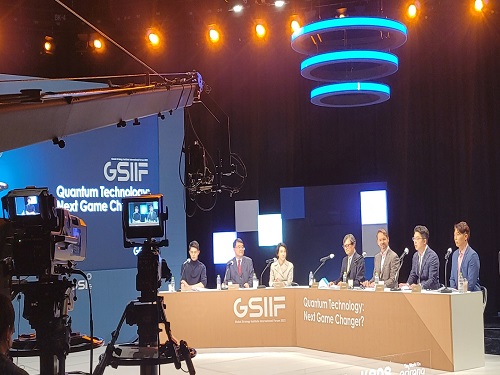
The 6th KAIST Global Strategy Institute Forum explores how quantum technology has evolved into a new growth engine for the future The participants of the 6th KAIST Global Strategy Institute (GSI) Forum on April 20 agreed that the emerging technology of quantum computing will be a game changer of the future. As KAIST President Kwang Hyung Lee said in his opening remarks, the future is quantum and that future is rapidly approaching. Keynote speakers and panelists presented their insights on the disruptive innovations we are already experiencing. The three keynote speakers included Dr. Jerry M. Chow, IBM fellow and director of quantum infrastructure, Professor John Preskill from Caltech, and Professor Jungsang Kim from Duke University. They discussed the academic impact and industrial applications of quantum technology, and its prospects for the future. Dr. Chow leads IBM Quantum’s hardware system development efforts, focusing on research and system deployment. Professor Preskill is one of the leading quantum information science and quantum computation scholars. He coined the term “quantum supremacy.” Professor Kim is the co-founder and CTO of IonQ Inc., which develops general-purpose trapped ion quantum computers and software to generate, optimize, and execute quantum circuits. Two leading quantum scholars from KAIST, Professor June-Koo Kevin Rhee and Professor Youngik Sohn, and Professor Andreas Heinrich from the IBS Center for Quantum Nanoscience also participated in the forum as panelists. Professor Rhee is the founder of the nation’s first quantum computing software company and leads the AI Quantum Computing IT Research Center at KAIST. During the panel session, Professor Rhee said that although it is undeniable the quantum computing will be a game changer, there are several challenges. For instance, the first actual quantum computer is NISQ (Noisy intermediate-scale quantum era), which is still incomplete. However, it is expected to outperform a supercomputer. Until then, it is important to advance the accuracy of quantum computation in order to offer super computation speeds. Professor Sohn, who worked at PsiQuantum, detailed how quantum computers will affect our society. He said that PsiQuantum is developing silicon photonics that will control photons. We can’t begin to imagine how silicon photonics will transform our society. Things will change slowly but the scale would be massive. The keynote speakers presented how quantum cryptography communications and its sensing technology will serve as disruptive innovations. Dr. Chow stressed that to realize the potential growth and innovation, additional R&D is needed. More research groups and scholars should be nurtured. Only then will the rich R&D resources be able to create breakthroughs in quantum-related industries. Lastly, the commercialization of quantum computing must be advanced, which will enable the provision of diverse services. In addition, more technological and industrial infrastructure must be built to better accommodate quantum computing. Professor Preskill believes that quantum computing will benefit humanity. He cited two basic reasons for his optimistic prediction: quantum complexity and quantum error corrections. He explained why quantum computing is so powerful: quantum computer can easily solve the problems classically considered difficult, such as factorization. In addition, quantum computer has the potential to efficiently simulate all of the physical processes taking place in nature. Despite such dramatic advantages, why does it seem so difficult? Professor Preskill believes this is because we want qubits (quantum bits or ‘qubits’ are the basic unit of quantum information) to interact very strongly with each other. Because computations can fail, we don’t want qubits to interact with the environment unless we can control and predict them. As for quantum computing in the NISQ era, he said that NISQ will be an exciting tool for exploring physics. Professor Preskill does not believe that NISQ will change the world alone, rather it is a step forward toward more powerful quantum technologies in the future. He added that a potentially transformable, scalable quantum computer could still be decades away. Professor Preskill said that a large number of qubits, higher accuracy, and better quality will require a significant investment. He said if we expand with better ideas, we can make a better system. In the longer term, quantum technology will bring significant benefits to the technological sectors and society in the fields of materials, physics, chemistry, and energy production. Professor Kim from Duke University presented on the practical applications of quantum computing, especially in the startup environment. He said that although there is no right answer for the early applications of quantum computing, developing new approaches to solve difficult problems and raising the accessibility of the technology will be important for ensuring the growth of technology-based startups.
2022.04.21
View 14028
<<
첫번째페이지
<
이전 페이지
1
>
다음 페이지
>>
마지막 페이지 1