World’s First AI-Managed Unmanned Factory Implemented... Construction of Physical AI KAIROS
< Integrated Operation of Heterogeneous Logistics Robot Systems >
KAIST announced on March 23rd that Professor Young Jae Jang's team from the Department of Industrial and Systems Engineering has constructed ‘KAIROS’ (KAIST AI Robot Orchestration Systems), a physical AI testbed that integrates and controls heterogeneous robots, sensors, facilities, and digital twins into a single system.
KAIROS is a 100% unmanned factory platform based on physical AI and is the first integrated testbed of its kind in Korea, developed with support from the Ministry of Science and ICT (MSIT). It is particularly noteworthy as a domestic integrated solution aimed at exporting "Dark Factories" in the future.
The most significant feature of KAIROS is its structure, which integrates and controls various factory equipment through a single AI agent-based Operating System (OS). While existing factory automation was operated around individual devices, KAIROS integrates Autonomous Mobile Robots (AMR), humanoid robots, collaborative robots, and automation facilities into a single intelligent platform. Through this, the concept of ‘Physical AI-based factory operation’—where the entire factory is operated like a single AI system—has been realized.
The core of this testbed is the 100% domestic integration of the entire process from sensors and control to data processing. By integrating key elements of a Dark Factory—including logistics robots (AMR), OHT, 3D shuttles, humanoid robots, collaborative robots, industrial sensors and PC controllers, wireless charging systems, digital twins and simulations, and AI-based integrated control and safety management systems—using domestic technology, the project has replaced factory automation equipment and software that were heavily dependent on foreign technology and laid the foundation for a ‘K-Manufacturing Factory Export Model.’
As part of the Physical AI Pre-verification Project, the MSIT has supported the establishment of a demonstration lab within the KAIST Industrial Management Building. On March 23, Vice Minister Bae Gyeong-hoon (Minister of Science and ICT) visited KAIST to announce the National Physical AI Strategy (Draft) and unveil the KAIROS-based Dark Factory demonstration site.
At the event, the factory operating system of the KAIST demonstration lab, joint physical AI demonstration results with Chonbuk National University, and the direction of the ‘Team Korea Physical AI (TK-PAI)’ alliance—a cooperative structure of domestic companies—were discussed.
< KAIROS Operation Plan Announcement >
< KAIROS Demonstration >
< KAIROS Factory Site >
KAIST plans to further advance the next-generation factory operating system (OS), covering the design, construction, and operation of Dark Factories through KAIROS, and to develop simulation and virtual verification environments.
In addition, the university intends to utilize the platform as a testing and evaluation site where domestic robot and automation companies can pre-verify highly reliable equipment, thereby increasing industrial applicability. Furthermore, the goal is to develop physical AI-based Dark Factory solutions capable of competing with global companies such as Siemens (Germany), FANUC (Japan), and Yaskawa (Japan) to pursue entry into the global market.
Kwang Hyung Lee, President of KAIST, stated, “KAIROS is the beginning of a new industrial paradigm where AI directly operates factories. KAIST will lead manufacturing innovation based on physical AI and contribute to ensuring South Korea’s leadership in global industrial competition.”
Professor Young Jae Jang, who led the construction of KAIROS, explained, “KAIROS goes beyond individual automation technologies to implement the concept of a factory operating system (OS) that integrates diverse robots and facilities into one system. It will serve as a foundation for domestic companies to verify physical AI technologies applicable to actual industrial sites and expand into the global market.”
KAIST Launches Deep-Tech Scale-up Valley, Unveils Execution Strategies for Physical AI
< Progress Report Meeting of the Deep-Tech Scale-up Valley Project >
KAIST announced on February 27th that it held the "Deep-Tech Scale-up Valley Project Progress Report Meeting" at its main campus in Daejeon on the 26th. During the meeting, the university unveiled its Physical AI strategies and execution structures, currently being developed with a focus on robotics.
The Deep-Tech Scale-up Valley Promotion Project is a joint initiative by the Ministry of Science and ICT, Daejeon Metropolitan City, and KAIST. KAIST has secured a total budget of 13.65 billion KRW for a period of three years and six months, starting from 2025. The project aims to commercialize KAIST's deep-tech capabilities in robotics to build a robust robot innovation ecosystem. A "Robot Alliance" has been formed, led by KAIST (headed by Professor Jung Kim) and including KAIST Holdings, Daejeon Techno Park, Daejeon Center for Creative Economy & Innovation, Angel Robotics, and Eurobotics.
The project seeks to foster a virtuous cycle ecosystem and nurture future "Unicorn" companies based on a three-pillar framework: Technology Commercialization, Deep-Tech R&D, and Commercialization Scale-up. In its first year (2025), the project achieved 230 billion KRW in technology transfers and investment attraction through Physical AI lectures, startup pitching sessions, and investment networking.
Physical AI refers to technology that combines robotics with artificial intelligence, allowing machines to make autonomous decisions and act in the real world. While it is gaining traction as a core field of next-generation industry—with increasing government R&D, corporate investment, and startup activity—critics have noted that successful business models applicable to actual industrial sites remain limited.
This report meeting is significant in that it redefined Physical AI not merely as a competition of AI technology, but as a matter of "industrial structure." It emphasized that commercialization is difficult unless R&D, industrial sites, and the investment ecosystem are organically linked.
Specifically, the report stated that for Physical AI to be applied to industrial sites, "meaningful data" generated from real-world operations is required, going beyond virtual environments. The strategy involves collaborating with skilled experts in manufacturing processes to accumulate data reflecting physical sensations and judgment, and establishing an execution system where robots can continuously cooperate with humans without obstructing their tasks.
Professor Kyoungchul Kong of the KAIST Department of Mechanical Engineering stated, "It is now crucial to clarify the mixed concepts of Physical AI and create a concrete platform that anyone can utilize." He added, "For AI learned in virtual environments to function properly with actual robots in the real world, we must not only improve the accuracy of virtual technologies but also ensure that physical variables in the real world are predictable and stably managed." In simpler terms, technology is needed to ensure that a robot's performance in a simulation translates seamlessly to the real world.
Professor Hyun Myung of the KAIST School of Electrical Engineering highlighted, "In the field of AI, research on Physics-Informed Neural Networks (PINN), which incorporate physical laws into the learning process, is actively underway." He emphasized, "The completion of Physical AI is possible only when hardware researchers, who understand actual physical systems, and AI researchers, who implement these into learning structures, are organically integrated. We need AI that understands physical principles, going beyond simply learning massive amounts of data."
Based on this execution structure, KAIST plans to establish a clear Value Chain connecting researchers, industrial experts, and corporations. The strategy is to expand Physical AI from lab-scale demonstrations to technologies that solve real-world industrial problems.
Jung Kim, Head of the KAIST Department of Mechanical Engineering, stated, "We have moved past the era of competing on data volume; now is the time to contemplate how to execute AI in the physical world. Based on KAIST's specific preparations and execution strategies, we will support startups and companies to succeed in the commercialization of Physical AI."
Meanwhile, the Deep-Tech Scale-up Valley Project plans to step-by-step promote the establishment of a Physical AI platform, startup discovery and investment expansion, the creation of verification testbeds, and the expansion of cooperation networks with global robotics companies.
KAIST Wins Bid for ‘Physical AI Core Technology Demonstration’ Pilot Project
KAIST (President Kwang Hyung Lee) announced on the 28th of August that, together with Jeonbuk State, Jeonbuk National University, and Sungkyunkwan University, it has jointly won the Ministry of Science and ICT’s pilot project for the “Physical AI Core Technology Proof of Concept (PoC)”, with KAIST serving as the overall research lead. The consortium also plans to participate in a full-scale demonstration project that is expected to reach a total scale of 1 trillion KRW in the future.
In this project, KAIST led the research planning under the theme of “Collaborative Intelligence Physical AI.” Based on this, Jeonbuk National University and Jeonbuk State will carry out joint research and establish a collaborative intelligence physical AI industrial ecosystem within the province. The pilot project will begin on September 1 this year and will run until the end of the year over the next five years. Through this effort, Jeonbuk State aims to be built into a global hub for physical AI.
KAIST will take charge of developing original research technologies, creating a research environment through the establishment of a testbed, and promoting industrial diffusion. Professor Young Jae Jang of the Department of Industrial and Systems Engineering at KAIST, who is the overall project director, has been leading research on collaborative intelligence physical AI since 2016. His “Collaborative Intelligence-Based Smart Manufacturing Innovation Technology” was selected as one of KAIST’s “Top 10 Research Achievements” in 2019.
“Physical AI” refers to cutting-edge artificial intelligence technology that enables physical devices such as robots, autonomous vehicles, and factory automation equipment to perform tasks without human instruction by understanding spatiotemporal concepts.
In particular, collaborative intelligence physical AI is a technology in which numerous robots and automated devices in a factory environment work together to achieve goals. It is attracting attention as a key foundation for realizing “dark factories” in industries such as semiconductors, secondary batteries, and automobile manufacturing.
Unlike existing manufacturing AI, this technology does not necessarily require massive amounts of historical data. Through real-time, simulation-based learning, it can quickly adapt even to manufacturing environments with frequent changes and has been deemed a next-generation technology that overcomes the limitations of data dependency.
Currently, the global AI industry is led by LLMs that simulate linguistic intelligence. However, physical AI must go beyond linguistic intelligence to include spatial intelligence and virtual environment learning, requiring the organic integration of hardware such as robots, sensors, and motors with software. As a manufacturing powerhouse, Korea is well-positioned to build such an ecosystem and seize the opportunity to lead global competition.
In fact, in April 2025, KAIST won first place at INFORMS (Institute for Operations Research and the Management Sciences), the world’s largest industrial engineering society, with its case study on collaborative intelligence physical AI, beating MIT and Amazon. This achievement is recognized as proof of Korea’s global competitiveness in the physical AI technology realm.
Professor Young Jae Jang, KAIST’s overall project director, said, “Winning this large-scale national project is the result of KAIST’s collaborative intelligence physical AI research capabilities accumulated over the past decade being recognized both domestically and internationally. This will be a turning point for establishing Korea’s manufacturing industry as a global leading ‘Physical AI Manufacturing Innovation Model.’”
KAIST President Kwang Hyung Lee emphasized that “KAIST is taking on the role of leading not only academic research but also the practical industrialization of national strategic technologies. Building on this achievement, we will collaborate with Jeonbuk National University and Jeonbuk State to develop Korea into a world-class hub for physical AI innovation.”
Through this project, KAIST, Jeonbuk National University, and Jeonbuk State plan to develop Korea into a global industrial hub for physical AI.
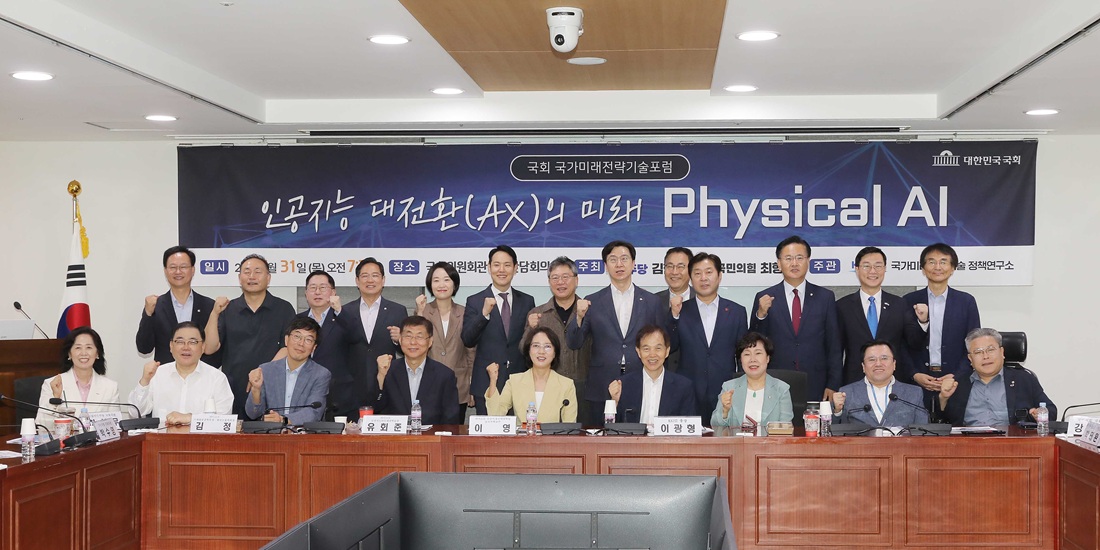
KAIST Successfully Presents the Future of AI Transformation and Physical AI Strategy at the 1st National Strategic Technology Forum
<(Front row, fourth from the right) President Kwang Hyung Lee of KAIST, (back row, fifth from the right) Forum co-host Representative Hyung-Doo Choi, (back row, sixth from the left) Forum co-host Representative Han-Kyu Kim, along with ruling and opposition party members of the Science, ICT, Broadcasting, and Communications Committee and the Trade, Industry, Energy, SMEs, and Startups Committee, as well as Professors Hoe-Jun Yoo and Jung Kim from KAIST)>
KAIST (President Kwang Hyung Lee) announced on July that it had successfully held the “1st National Strategic Technology Forum” at the National Assembly Members' Office Building that day under the theme “The Future of Artificial Intelligence Transformation (AX): Physical AI.” This bipartisan policy forum aimed to discuss strategies for technology hegemony by leveraging Korea’s strengths in AI semiconductors and manufacturing.
The forum was hosted by KAIST and co-organized by Representative Hyung-Du Choi (People Power Party), the secretary of the National Assembly's Science, ICT, Broadcasting, and Communications Committee, and Representative Han-Kyu Kim (Democratic Party), a member of the Trade, Industry, Energy, SMEs, and Startups Committee. It marks the beginning of a five-part forum series, scheduled monthly through the rest of the year except for October.
The overarching theme, “Artificial Intelligence Transformation (AX),” was designed to address the structural changes reshaping industry, the economy, and society due to the spread of generative AI.
< KAIST President Kwang Hyung Lee delivering his remarks >
The first session focused on “Physical AI,” reflecting how AI innovation—sparked by the proliferation of large language models (LLMs)—is rapidly expanding into the physical realm through ultra-low-power, ultra-lightweight semiconductors. This includes applications in robotics, sensors, and edge devices. Physical AI refers to technologies that interact directly with the real world through AI integration with robotics, autonomous driving, and smart factories. It is drawing attention as a promising next-generation field where Korea can secure a strategic edge, given its strengths in semiconductors and manufacturing.
<Hoi-Jun Yoo, Dean of the KAIST Graduate School of AI Semiconductor>
Hoi-Jun Yoo, Dean of the KAIST Graduate School of AI Semiconductor, gave a presentation titled “The Second AI Innovation Enabled by Ultra-Low-Power AI Semiconductors and Lightweight AI Models,” covering semiconductor trends for implementing Physical AI, academic and industrial strategies for robotics and semiconductors, and Korea’s development direction for “K-Physical AI.”
<Professor Jung Kim, the head of KAIST’s Department of Mechanical and Aerospace Engineering>
Following that, Professor Jung Kim, the head of KAIST’s Department of Mechanical and Aerospace Engineering gave a talk on “Trends in Physical AI and Humanoid Robots,” predicting a new industrial paradigm shaped by AI-robot convergence. He presented global trends, Korea’s development trajectory, and survival strategies for humanoid robots that can supplement or replace human intellectual and physical functions.
During the open discussion that followed, participating lawmakers and experts engaged in in-depth conversations about the need for bipartisan strategies and collaboration.
Representative Hyung-Du Choi (People Power Party) stated, “Through this forum as a platform for public discourse, I will work to ensure that legislation and policy align with the direction of the science and technology field, and that necessary measures are taken promptly to strengthen national competitiveness.”
Representative Han-Kyu Kim (Democratic Party) emphasized, “As strategic planning in science and technology accelerates, it becomes more difficult to coordinate policies involving multiple ministries. Forums like this, which enable ongoing communication among stakeholders, are instrumental in finding effective solutions.”
KAIST President Kwang Hyung Lee remarked, “Although Korea is a latecomer in the generative AI field, we have a unique opportunity to gain strategic superiority in Physical AI, thanks to our technological capabilities in manufacturing, semiconductors, and robotics.” He added, “I hope lawmakers from both the ruling and opposition parties, along with experts, will come together regularly to devise practical policies and contribute to the advancement of Korea’s science and technology.”
<Poster of National Strategic Technology Forum>
This forum series aims to explore policy and institutional solutions to help Korea gain technological leadership in a global context where strategic technologies—such as AI, semiconductors, biotechnology, and energy—directly influence national security and economic sovereignty. Lawmakers from both the Science, ICT, Broadcasting, and Communications Committee and the Trade, Industry, Energy, SMEs, and Startups Committee will continue to participate, fostering bipartisan dialogue. The forums are coordinated by the KAIST Policy Research Institute for National Strategic Technologies.