%6e%65%78%74%20%67%65%6e%65%72%61%74%69%6f%6e
-
 Zero-Crease Foldable Technology to Shift the Paradigm of Next-Generation Displays
< Professor Phil-Seung Lee (center), Master’s graduate Jun-han Bae (top left) >
The "crease," long considered the biggest weakness of foldable smartphones, has been pointed out as a major obstacle to market expansion, causing screen distortion and reduced durability over repeated use. A research team at KAIST has presented a solution to this problem, marking a turning point for foldables to leap forward as the standard for next-generation smartphones. Furthermore, the technology is expected to establish itself as a core component of the future mobile industry, expanding into various devices such as laptops.
KAIST announced on April 20th that a research team led by Professor Phil-Seung Lee of the Department of Mechanical Engineering has developed an original technology capable of fundamentally solving the crease issue that occurs at the folding area of foldable smartphone displays and has registered a patent for it. The team has secured global technological competitiveness by filing patent applications in the United States, China, and the European Union (EU), in addition to South Korea.
While global smartphone companies have attempted to solve this issue through massive R&D investments for years, they have yet to achieve the complete removal of the crease. Consequently, the industry has identified the crease problem as the single greatest barrier to the widespread adoption of the foldable smartphone market.
The research team began their study to resolve the inconveniences they personally experienced while using mobile foldable phones. After disassembling dozens of used foldable phones and repeating various experiments, they derived a solution by innovatively redesigning the "adhesive area" between the display and the supporting plate. The core of the design is ensuring that deformation is not concentrated in a specific folding area but is instead distributed to the surrounding sections. Through this, they perfectly demonstrated the feasibility of a "crease-free foldable" while maintaining normal smartphone functionality.
To verify performance, the team shone a straight-line LED light onto the screen. Unlike commercial products where the light refracts and the straight line appears curved at the fold, the prototype maintained a sharp, straight reflection without any distortion. Notably, no visual distortion appeared even under conditions sensitive enough to detect minute curves with a crease depth of less than 0.1mm.
< Display surface reflecting a straight-line LED lamp >
This technology presents a new design paradigm that surpasses the limitations faced by the current industry. It not only fundamentally suppresses the formation of creases but also ensures superior durability by minimizing deformation even after tens of thousands of folding cycles.
Furthermore, because the structure is intuitive and simple, it can be easily integrated into existing manufacturing processes. It is expected to have high industrial utility, as it can be expanded beyond smartphones to various foldable display devices, including tablets and laptops.
< Core idea of the invention: (a) Adhesive and non-adhesive areas of a conventional foldable smartphone, (b) Adhesive and non-adhesive areas in this invention, (c) Stress distribution in a conventional foldable smartphone display, (d) Stress distribution in a foldable smartphone display applying this technology >
Industry experts anticipate that the commercialization of this technology will encourage global companies—which have been hesitant to enter the market due to crease issues—to participate. This is projected to significantly improve consumer satisfaction and accelerate the growth of the stagnating foldable market.
Professor Phil-Seung Lee stated, "We have solved a challenge that global giants could not resolve, using a relatively simple and clear method. We expect this technology to spread across next-generation displays, including laptops and tablets, further strengthening Korea's technological competitiveness."
Meanwhile, this research was conducted with support from the "2022 Daedeok Innopolis Campus Project," and the patent for the related original technology was registered on September 9, 2025.
2026.04.21 View 734
Zero-Crease Foldable Technology to Shift the Paradigm of Next-Generation Displays
< Professor Phil-Seung Lee (center), Master’s graduate Jun-han Bae (top left) >
The "crease," long considered the biggest weakness of foldable smartphones, has been pointed out as a major obstacle to market expansion, causing screen distortion and reduced durability over repeated use. A research team at KAIST has presented a solution to this problem, marking a turning point for foldables to leap forward as the standard for next-generation smartphones. Furthermore, the technology is expected to establish itself as a core component of the future mobile industry, expanding into various devices such as laptops.
KAIST announced on April 20th that a research team led by Professor Phil-Seung Lee of the Department of Mechanical Engineering has developed an original technology capable of fundamentally solving the crease issue that occurs at the folding area of foldable smartphone displays and has registered a patent for it. The team has secured global technological competitiveness by filing patent applications in the United States, China, and the European Union (EU), in addition to South Korea.
While global smartphone companies have attempted to solve this issue through massive R&D investments for years, they have yet to achieve the complete removal of the crease. Consequently, the industry has identified the crease problem as the single greatest barrier to the widespread adoption of the foldable smartphone market.
The research team began their study to resolve the inconveniences they personally experienced while using mobile foldable phones. After disassembling dozens of used foldable phones and repeating various experiments, they derived a solution by innovatively redesigning the "adhesive area" between the display and the supporting plate. The core of the design is ensuring that deformation is not concentrated in a specific folding area but is instead distributed to the surrounding sections. Through this, they perfectly demonstrated the feasibility of a "crease-free foldable" while maintaining normal smartphone functionality.
To verify performance, the team shone a straight-line LED light onto the screen. Unlike commercial products where the light refracts and the straight line appears curved at the fold, the prototype maintained a sharp, straight reflection without any distortion. Notably, no visual distortion appeared even under conditions sensitive enough to detect minute curves with a crease depth of less than 0.1mm.
< Display surface reflecting a straight-line LED lamp >
This technology presents a new design paradigm that surpasses the limitations faced by the current industry. It not only fundamentally suppresses the formation of creases but also ensures superior durability by minimizing deformation even after tens of thousands of folding cycles.
Furthermore, because the structure is intuitive and simple, it can be easily integrated into existing manufacturing processes. It is expected to have high industrial utility, as it can be expanded beyond smartphones to various foldable display devices, including tablets and laptops.
< Core idea of the invention: (a) Adhesive and non-adhesive areas of a conventional foldable smartphone, (b) Adhesive and non-adhesive areas in this invention, (c) Stress distribution in a conventional foldable smartphone display, (d) Stress distribution in a foldable smartphone display applying this technology >
Industry experts anticipate that the commercialization of this technology will encourage global companies—which have been hesitant to enter the market due to crease issues—to participate. This is projected to significantly improve consumer satisfaction and accelerate the growth of the stagnating foldable market.
Professor Phil-Seung Lee stated, "We have solved a challenge that global giants could not resolve, using a relatively simple and clear method. We expect this technology to spread across next-generation displays, including laptops and tablets, further strengthening Korea's technological competitiveness."
Meanwhile, this research was conducted with support from the "2022 Daedeok Innopolis Campus Project," and the patent for the related original technology was registered on September 9, 2025.
2026.04.21 View 734 -
 Jaewook Myung, First Korean Selected as '40 Under 40 Recognition Program' Next Generation Environmental Engineering Leader
< Professor Jaewook Myung of KAIST Department of Civil and Environmental Engineering >
KAIST announced on December 12th that Professor Jaewook Myung of the Department of Civil and Environmental Engineering was selected as the first Korean recipient of the '40 Under 40 Recognition Program' for Next Generation Environmental Engineering Leaders, organized by the American Academy of Environmental Engineers and Scientists (AAEES).
< The '40 Under 40 Recognition Program' is an international award program selecting next-generation leaders in the field of Environmental Engineering and Science >
This award is presented annually by AAEES to select next-generation environmental engineering researchers who demonstrate innovative research achievements, social contribution, and educational leadership. Professor Myung's selection is particularly significant as he is the first Korean to be chosen since the program's inception. The award ceremony is scheduled to be held in Washington D.C. in April 2026.
AAEES is the world's highest-authority professional organization leading the global environmental engineering sector through operating the Professional Environmental Engineer (PEE) certification system, policy consultation, and international academic exchange. This award is highly regarded for greatly enhancing the international standing of domestic environmental engineering and sustainability research.
Amid the deepening problems of plastic waste increase and greenhouse gas emissions, where existing technologies are showing limitations in providing solutions, Professor Jaewook Myung has garnered significant attention from academia and industry by developing technology to convert greenhouse gases such as methane ($CH_4$) and carbon dioxide ($CO_2$) into biodegradable plastics. His research is highly praised for presenting a new industrial paradigm that fuses environmental microbiology and materials science to convert greenhouse gases into high-value bio-materials.
Professor Myung's research team secured microbial metabolic control technology to transform greenhouse gases into materials, an accelerated process that simultaneously enhances the synthesis and decomposition efficiency of plastics, and pilot process design and engineering technology applicable in industrial settings. This established a sustainable circular technology model capable of simultaneously addressing greenhouse gas reduction and plastic pollution issues.
Furthermore, the research team expanded these foundational technologies to develop various application products, such as biodegradable coating materials that naturally decompose in the ocean, biocompatible bio-based electronic materials, and industrial 3D printing filaments, realizing full-cycle innovation from basic research to application and industrialization. These achievements are recognized as world-class sustainable technology alternatives that can simultaneously overcome the problems of plastic downcycling and the economic limitations of greenhouse gas utilization technology.
Professor Myung also shows excellent performance in nurturing talent. His advised students are growing into next-generation environmental and sustainability researchers, having won major awards both domestically and internationally, including the American Chemical Society (ACS) Environmental Chemistry Graduate Student Award, the Presidential Science Scholarship, the Merck Innovation Cup Prize, and the Republic of Korea Talent Award. He is also establishing himself as a leading researcher in the commercialization of sustainable technology by expanding his research achievements into the social and industrial ecosystem through technology collaboration with industries, patents, and consultation with public institutions.
The AAEES Selection Committee evaluated Professor Jaewook Myung as "a researcher possessing technical excellence, social responsibility, and educational leadership, and an innovator who has pioneered new areas of environmental engineering." Professor Myung expressed his thoughts, saying, "This award is a result made possible by the students who researched and challenged alongside me and the collaborative research culture of KAIST," and added, "I will contribute to brightening the future of humanity and the planet through sustainable resource circulation technology."
2025.12.12 View 1981
Jaewook Myung, First Korean Selected as '40 Under 40 Recognition Program' Next Generation Environmental Engineering Leader
< Professor Jaewook Myung of KAIST Department of Civil and Environmental Engineering >
KAIST announced on December 12th that Professor Jaewook Myung of the Department of Civil and Environmental Engineering was selected as the first Korean recipient of the '40 Under 40 Recognition Program' for Next Generation Environmental Engineering Leaders, organized by the American Academy of Environmental Engineers and Scientists (AAEES).
< The '40 Under 40 Recognition Program' is an international award program selecting next-generation leaders in the field of Environmental Engineering and Science >
This award is presented annually by AAEES to select next-generation environmental engineering researchers who demonstrate innovative research achievements, social contribution, and educational leadership. Professor Myung's selection is particularly significant as he is the first Korean to be chosen since the program's inception. The award ceremony is scheduled to be held in Washington D.C. in April 2026.
AAEES is the world's highest-authority professional organization leading the global environmental engineering sector through operating the Professional Environmental Engineer (PEE) certification system, policy consultation, and international academic exchange. This award is highly regarded for greatly enhancing the international standing of domestic environmental engineering and sustainability research.
Amid the deepening problems of plastic waste increase and greenhouse gas emissions, where existing technologies are showing limitations in providing solutions, Professor Jaewook Myung has garnered significant attention from academia and industry by developing technology to convert greenhouse gases such as methane ($CH_4$) and carbon dioxide ($CO_2$) into biodegradable plastics. His research is highly praised for presenting a new industrial paradigm that fuses environmental microbiology and materials science to convert greenhouse gases into high-value bio-materials.
Professor Myung's research team secured microbial metabolic control technology to transform greenhouse gases into materials, an accelerated process that simultaneously enhances the synthesis and decomposition efficiency of plastics, and pilot process design and engineering technology applicable in industrial settings. This established a sustainable circular technology model capable of simultaneously addressing greenhouse gas reduction and plastic pollution issues.
Furthermore, the research team expanded these foundational technologies to develop various application products, such as biodegradable coating materials that naturally decompose in the ocean, biocompatible bio-based electronic materials, and industrial 3D printing filaments, realizing full-cycle innovation from basic research to application and industrialization. These achievements are recognized as world-class sustainable technology alternatives that can simultaneously overcome the problems of plastic downcycling and the economic limitations of greenhouse gas utilization technology.
Professor Myung also shows excellent performance in nurturing talent. His advised students are growing into next-generation environmental and sustainability researchers, having won major awards both domestically and internationally, including the American Chemical Society (ACS) Environmental Chemistry Graduate Student Award, the Presidential Science Scholarship, the Merck Innovation Cup Prize, and the Republic of Korea Talent Award. He is also establishing himself as a leading researcher in the commercialization of sustainable technology by expanding his research achievements into the social and industrial ecosystem through technology collaboration with industries, patents, and consultation with public institutions.
The AAEES Selection Committee evaluated Professor Jaewook Myung as "a researcher possessing technical excellence, social responsibility, and educational leadership, and an innovator who has pioneered new areas of environmental engineering." Professor Myung expressed his thoughts, saying, "This award is a result made possible by the students who researched and challenged alongside me and the collaborative research culture of KAIST," and added, "I will contribute to brightening the future of humanity and the planet through sustainable resource circulation technology."
2025.12.12 View 1981 -
 KAIST K HERO Rides Nuri Rocket, Next Generation Micro Hall Thruster Technology Verified in Space
< (From left) Ph.D candidate Jaehong Park, COSMOVY researcher Yoonsoo Kim, Professor Wonho Choe, Ph.D candidate Dongha Park, M.S candidate Seungbeom Heo >
KAIST announced on the November 26th that the CubeSat 'K-HERO (KAIST Hall Effect Rocket Orbiter)', developed by the research team of Professor Wonho Choe from the Department of Nuclear and Quantum Engineering, is scheduled to launch into space aboard the 4th Nuri rocket launch vehicle on November 27th from the Naro Space Center in Goheung, Jeollanam-do.
This 4th Nuri launch is the first to be managed by the private company Hanwha Aerospace, which received technology transfer from the Korea Aerospace Research Institute (KARI), marking a significant milestone in the transformation of the domestic space industry. Along with the main payload, the Next-Generation Medium Satellite 3, twelve CubeSats developed by industry, academia, and research institutions will be onboard, with K-HERO being one of them.
The development of K-HERO was officially initiated when Professor Wonho Choe's research team was selected as the basic satellite development team in the '2022 CubeSat Competition' organized by KARI.
The basic satellite is a technology verification satellite designed to confirm whether the design and core components operate normally in the space environment before proceeding with the flight model (FM) production. K-HERO is a 3U standard CubeSat with dimensions of $10\text{ cm}$ (width) $\times$ $10\text{ cm}$ (length) $\times$ $30\text{ cm}$ (height) and a weight of $3.9\text{ kg}$. It was designed to satisfy all stability, electrical specifications, and interface conditions with the launch vehicle.
The core mission of K-HERO is to directly verify the in-space operation of the 150 W class micro-satellite Hall thruster developed by the research team.
The Hall thruster can be simply described as a 'space engine powered by electricity'. It is an electric propulsion engine that moves the satellite slowly but very efficiently using electricity.
Instead of burning a lot of fuel to generate instantaneous thrust, like a rocket, it works by using electricity to turn gas (Xenon) into a plasma state and rapidly accelerating it backward to push the satellite forward. Hall thrusters are considered a core technology for the era of small and constellation satellites due to their high fuel efficiency.
< Image of plasma generation in the micro-satellite Hall thruster mounted on the K-HERO CubeSat >
Hall thrusters are already a proven technology, having been used in large satellites and deep-space probes for over 20-30 years. However, their size and power requirements were large, so in the past, they were mainly operated on large geostationary (GEO) communication/broadcasting satellites and used by NASA and ESA deep-space probes for long-distance flights.
Recently, the emergence of the SpaceX Starlink satellite constellation has led to a surge in demand for small and micro electric thrusters. As the global space industry shifts towards satellite constellations, 'small and efficient thrusters' have become essential technology.
K-HERO is the first case of direct in-space demonstration of a micro Hall thruster made with domestic technology, and it is expected to be an important milestone in enhancing domestic technological competitiveness.
Professor Wonho Choe's research team began research on Hall thrusters in Korea in 2003, securing original technology based on plasma physics. In 2013, they successfully mounted a 200 W class Hall thruster on the 'KAIST Science and Technology Satellite 3,' proving its practical utility. This time, they have improved the design to operate even at a lower power of 30 W, developing a next-generation model aimed at micro-satellites.
COSMOVY Inc, a laboratory startup founded by Professor Wonho Choe's research team, also participated in the development of K-HERO, further strengthening the foundation for technology commercialization.
< K-HERO CubeSat being loaded into the Nuri rocket's CubeSat dispenser (Photo source: Korea Aerospace Research Institute) >
Professor Wonho Choe stated, "Starting with K-HERO, the number of small satellites equipped with electric thrusters will increase significantly in Korea. The Hall thruster being verified this time can be utilized for various missions, including low-Earth orbit constellation surveillance and reconnaissance satellites, 6G communication satellites, very-low-Earth orbit high-resolution satellites, and asteroid probes."
President Kwang Hyung Lee stated, "The launch of K-HERO is a significant opportunity to directly verify KAIST's electric propulsion technology on a micro-satellite platform once again in space, and it will be an important turning point that will further enhance the technological competitiveness of small satellites in Korea. KAIST will continue to contribute to the development of our country's space technology.
2025.11.26 View 2779
KAIST K HERO Rides Nuri Rocket, Next Generation Micro Hall Thruster Technology Verified in Space
< (From left) Ph.D candidate Jaehong Park, COSMOVY researcher Yoonsoo Kim, Professor Wonho Choe, Ph.D candidate Dongha Park, M.S candidate Seungbeom Heo >
KAIST announced on the November 26th that the CubeSat 'K-HERO (KAIST Hall Effect Rocket Orbiter)', developed by the research team of Professor Wonho Choe from the Department of Nuclear and Quantum Engineering, is scheduled to launch into space aboard the 4th Nuri rocket launch vehicle on November 27th from the Naro Space Center in Goheung, Jeollanam-do.
This 4th Nuri launch is the first to be managed by the private company Hanwha Aerospace, which received technology transfer from the Korea Aerospace Research Institute (KARI), marking a significant milestone in the transformation of the domestic space industry. Along with the main payload, the Next-Generation Medium Satellite 3, twelve CubeSats developed by industry, academia, and research institutions will be onboard, with K-HERO being one of them.
The development of K-HERO was officially initiated when Professor Wonho Choe's research team was selected as the basic satellite development team in the '2022 CubeSat Competition' organized by KARI.
The basic satellite is a technology verification satellite designed to confirm whether the design and core components operate normally in the space environment before proceeding with the flight model (FM) production. K-HERO is a 3U standard CubeSat with dimensions of $10\text{ cm}$ (width) $\times$ $10\text{ cm}$ (length) $\times$ $30\text{ cm}$ (height) and a weight of $3.9\text{ kg}$. It was designed to satisfy all stability, electrical specifications, and interface conditions with the launch vehicle.
The core mission of K-HERO is to directly verify the in-space operation of the 150 W class micro-satellite Hall thruster developed by the research team.
The Hall thruster can be simply described as a 'space engine powered by electricity'. It is an electric propulsion engine that moves the satellite slowly but very efficiently using electricity.
Instead of burning a lot of fuel to generate instantaneous thrust, like a rocket, it works by using electricity to turn gas (Xenon) into a plasma state and rapidly accelerating it backward to push the satellite forward. Hall thrusters are considered a core technology for the era of small and constellation satellites due to their high fuel efficiency.
< Image of plasma generation in the micro-satellite Hall thruster mounted on the K-HERO CubeSat >
Hall thrusters are already a proven technology, having been used in large satellites and deep-space probes for over 20-30 years. However, their size and power requirements were large, so in the past, they were mainly operated on large geostationary (GEO) communication/broadcasting satellites and used by NASA and ESA deep-space probes for long-distance flights.
Recently, the emergence of the SpaceX Starlink satellite constellation has led to a surge in demand for small and micro electric thrusters. As the global space industry shifts towards satellite constellations, 'small and efficient thrusters' have become essential technology.
K-HERO is the first case of direct in-space demonstration of a micro Hall thruster made with domestic technology, and it is expected to be an important milestone in enhancing domestic technological competitiveness.
Professor Wonho Choe's research team began research on Hall thrusters in Korea in 2003, securing original technology based on plasma physics. In 2013, they successfully mounted a 200 W class Hall thruster on the 'KAIST Science and Technology Satellite 3,' proving its practical utility. This time, they have improved the design to operate even at a lower power of 30 W, developing a next-generation model aimed at micro-satellites.
COSMOVY Inc, a laboratory startup founded by Professor Wonho Choe's research team, also participated in the development of K-HERO, further strengthening the foundation for technology commercialization.
< K-HERO CubeSat being loaded into the Nuri rocket's CubeSat dispenser (Photo source: Korea Aerospace Research Institute) >
Professor Wonho Choe stated, "Starting with K-HERO, the number of small satellites equipped with electric thrusters will increase significantly in Korea. The Hall thruster being verified this time can be utilized for various missions, including low-Earth orbit constellation surveillance and reconnaissance satellites, 6G communication satellites, very-low-Earth orbit high-resolution satellites, and asteroid probes."
President Kwang Hyung Lee stated, "The launch of K-HERO is a significant opportunity to directly verify KAIST's electric propulsion technology on a micro-satellite platform once again in space, and it will be an important turning point that will further enhance the technological competitiveness of small satellites in Korea. KAIST will continue to contribute to the development of our country's space technology.
2025.11.26 View 2779 -
 KAIST Develops Sodium Battery Capable of Rapid Charging in Just a Few Seconds
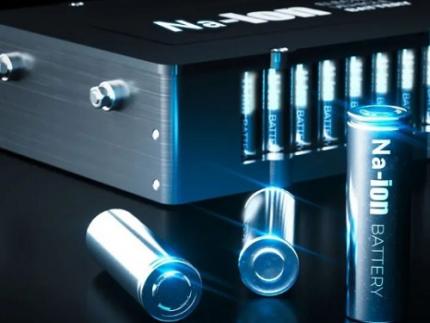
Sodium (Na), which is over 500 times more abundant than lithium (Li), has recently garnered significant attention for its potential in sodium-ion battery technologies. However, existing sodium-ion batteries face fundamental limitations, including lower power output, constrained storage properties, and longer charging times, necessitating the development of next-generation energy storage materials.
On the 11th of April, KAIST (represented by President Kwang Hyung Lee) announced that a research team led by Professor Jeung Ku Kang from the Department of Materials Science and Engineering had developed a high-energy, high-power hybrid sodium-ion battery capable of rapid charging.
The innovative hybrid energy storage system integrates anode materials typically used in batteries with cathodes suitable for supercapacitors. This combination allows the device to achieve both high storage capacities and rapid charge-discharge rates, positioning it as a viable next-generation alternative to lithium-ion batteries.
However, the development of a hybrid battery with high energy and high power density requires an improvement to the slow energy storage rate of battery-type anodes as well as the enhancement of the relatively low capacity of supercapacitor-type cathode materials.
< Figure 1. Schematic synthetic procedures of high-capacity/high-rate anode and cathode materials for a sodium-ion hybrid energy storages (SIHES) and their proposed energy storage mechanisms. Synthetic procedures for (a) ultrafine iron sulfide-embedded S-doped carbon/graphene (FS/C/G) anode and (b) zeolitic imidazolate framework-derived porous carbon (ZDPC) cathode materials. (c) Proposed energy storage mechanisms of Na+ ions in FS/C/G anode and ClO-4 ions in ZDPC cathode for an SIHES. >
To account for this, Professor Kang's team utilized two distinct metal-organic frameworks for the optimized synthesis of hybrid batteries. This approach led to the development of an anode material with improved kinetics through the inclusion of fine active materials in porous carbon derived from metal-organic frameworks. Additionally, a high-capacity cathode material was synthesized, and the combination of the cathode and anode materials allowed for the development of a sodium-ion storage system optimizing the balance and minimizing the disparities in energy storage rates between the electrodes.
The assembled full cell, comprising the newly developed anode and cathode, forms a high-performance hybrid sodium-ion energy storage device. This device surpasses the energy density of commercial lithium-ion batteries and exhibits the characteristics of supercapacitors' power density. It is expected to be suitable for rapid charging applications ranging from electric vehicles to smart electronic devices and aerospace technologies.
< Figure 2. Electrochemical characterizations of FS/C/G-20//ZDPC SIHES full cells (left). Ragone plots for FS/C/G-20//ZDPC (this work) and other previously reported sodium-ion electrochemical energy storage devices (right). >
Professor Kang noted that the hybrid sodium-ion energy storage device, capable of rapid charging and achieving an energy density of 247 Wh/kg and a power density of 34,748 W/kg, represents a breakthrough in overcoming the current limitations of energy storage systems. He anticipates broader applications across various electronic devices, including electric vehicles.
This research, co-authored by KAIST doctoral candidates Jong Hui Choi and Dong Won Kim, was published in the international journal Energy Storage Materials on March 29 with the title "Low-crystallinity conductive multivalence iron sulfide-embedded S-doped anode and high-surface-area O-doped cathode of 3D porous N-rich graphitic carbon frameworks for high-performance sodium-ion hybrid energy storages."
The study was conducted with support from the Ministry of Science and ICT and the National Research Foundation of Korea through the Nanomaterial Technology Development Project.
2024.04.18 View 26268
KAIST Develops Sodium Battery Capable of Rapid Charging in Just a Few Seconds
Sodium (Na), which is over 500 times more abundant than lithium (Li), has recently garnered significant attention for its potential in sodium-ion battery technologies. However, existing sodium-ion batteries face fundamental limitations, including lower power output, constrained storage properties, and longer charging times, necessitating the development of next-generation energy storage materials.
On the 11th of April, KAIST (represented by President Kwang Hyung Lee) announced that a research team led by Professor Jeung Ku Kang from the Department of Materials Science and Engineering had developed a high-energy, high-power hybrid sodium-ion battery capable of rapid charging.
The innovative hybrid energy storage system integrates anode materials typically used in batteries with cathodes suitable for supercapacitors. This combination allows the device to achieve both high storage capacities and rapid charge-discharge rates, positioning it as a viable next-generation alternative to lithium-ion batteries.
However, the development of a hybrid battery with high energy and high power density requires an improvement to the slow energy storage rate of battery-type anodes as well as the enhancement of the relatively low capacity of supercapacitor-type cathode materials.
< Figure 1. Schematic synthetic procedures of high-capacity/high-rate anode and cathode materials for a sodium-ion hybrid energy storages (SIHES) and their proposed energy storage mechanisms. Synthetic procedures for (a) ultrafine iron sulfide-embedded S-doped carbon/graphene (FS/C/G) anode and (b) zeolitic imidazolate framework-derived porous carbon (ZDPC) cathode materials. (c) Proposed energy storage mechanisms of Na+ ions in FS/C/G anode and ClO-4 ions in ZDPC cathode for an SIHES. >
To account for this, Professor Kang's team utilized two distinct metal-organic frameworks for the optimized synthesis of hybrid batteries. This approach led to the development of an anode material with improved kinetics through the inclusion of fine active materials in porous carbon derived from metal-organic frameworks. Additionally, a high-capacity cathode material was synthesized, and the combination of the cathode and anode materials allowed for the development of a sodium-ion storage system optimizing the balance and minimizing the disparities in energy storage rates between the electrodes.
The assembled full cell, comprising the newly developed anode and cathode, forms a high-performance hybrid sodium-ion energy storage device. This device surpasses the energy density of commercial lithium-ion batteries and exhibits the characteristics of supercapacitors' power density. It is expected to be suitable for rapid charging applications ranging from electric vehicles to smart electronic devices and aerospace technologies.
< Figure 2. Electrochemical characterizations of FS/C/G-20//ZDPC SIHES full cells (left). Ragone plots for FS/C/G-20//ZDPC (this work) and other previously reported sodium-ion electrochemical energy storage devices (right). >
Professor Kang noted that the hybrid sodium-ion energy storage device, capable of rapid charging and achieving an energy density of 247 Wh/kg and a power density of 34,748 W/kg, represents a breakthrough in overcoming the current limitations of energy storage systems. He anticipates broader applications across various electronic devices, including electric vehicles.
This research, co-authored by KAIST doctoral candidates Jong Hui Choi and Dong Won Kim, was published in the international journal Energy Storage Materials on March 29 with the title "Low-crystallinity conductive multivalence iron sulfide-embedded S-doped anode and high-surface-area O-doped cathode of 3D porous N-rich graphitic carbon frameworks for high-performance sodium-ion hybrid energy storages."
The study was conducted with support from the Ministry of Science and ICT and the National Research Foundation of Korea through the Nanomaterial Technology Development Project.
2024.04.18 View 26268 -
 KAIST Holds 'Wearable Computer Contest'
Application for ‘2014 Wearable Computer Contest’ until May 23rd
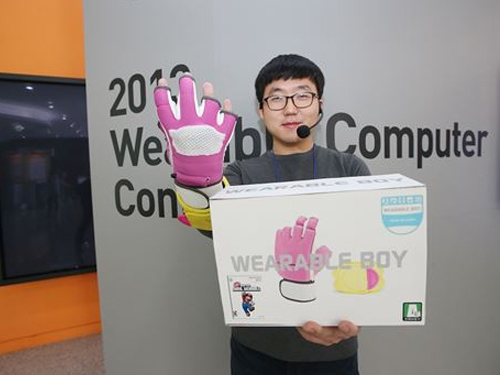
KAIST is holding the 2014 Wearable Computer Contest (WCC) sponsored by Samsung Electronics in November and is currently receiving applications until May 23rd.
Wearable Computer is a device that can be worn on body or clothing, which allows users to be connected while on the move. It is currently receiving attention as the next generation of computer industry that will replace smart phones.
The Wearable Computer Contest will be held under the topic “Smart Fashion to Simple Life” and will be divided into a designated topic contest and an idea contest.
In the “designated topic contest,” each group will compete with their prototypes based on their own ideas about a wearable computer that combines IT and fashion. A total of 15 teams that enter the finals after a document review will be provided with USD 1,400 for a prototype production, Samsung's smart IT devices, and a systematic training program.
For the “idea contest,” competitors will present their ideas for a wearable computer in a poster format. The teams qualified to continue onto the finals will be given an opportunity to create and exhibit a life-sized model.
Chairman of the Wearable Computer Contest (WCC), Professor Hoejun Yoo from the KAIST Department of Electrical Engineering said, “Wearable Computer is the major future growth industry that will lead IT industry after smart phones. I hope WCC will help nurture the future professionals in the field of wearable computer industry.”
The applications for the Wearable Computer Contest can be found on the main website (http://www.ufcom.org) until May 23rd. Both undergraduate and graduate students can participate as a team for the “designated topic contest,” and there are no qualifications required for those who enter the “idea contest.”
Last year, a total of 104 teams from universities all around Korea has participated in the Wearable Computer Contest. The finalist, team 'Jump' from Chungnam University, received the Award of the Minister of Science, ICT and Future Planning, Republic of Korea.
2014.03.28 View 14742
KAIST Holds 'Wearable Computer Contest'
Application for ‘2014 Wearable Computer Contest’ until May 23rd
KAIST is holding the 2014 Wearable Computer Contest (WCC) sponsored by Samsung Electronics in November and is currently receiving applications until May 23rd.
Wearable Computer is a device that can be worn on body or clothing, which allows users to be connected while on the move. It is currently receiving attention as the next generation of computer industry that will replace smart phones.
The Wearable Computer Contest will be held under the topic “Smart Fashion to Simple Life” and will be divided into a designated topic contest and an idea contest.
In the “designated topic contest,” each group will compete with their prototypes based on their own ideas about a wearable computer that combines IT and fashion. A total of 15 teams that enter the finals after a document review will be provided with USD 1,400 for a prototype production, Samsung's smart IT devices, and a systematic training program.
For the “idea contest,” competitors will present their ideas for a wearable computer in a poster format. The teams qualified to continue onto the finals will be given an opportunity to create and exhibit a life-sized model.
Chairman of the Wearable Computer Contest (WCC), Professor Hoejun Yoo from the KAIST Department of Electrical Engineering said, “Wearable Computer is the major future growth industry that will lead IT industry after smart phones. I hope WCC will help nurture the future professionals in the field of wearable computer industry.”
The applications for the Wearable Computer Contest can be found on the main website (http://www.ufcom.org) until May 23rd. Both undergraduate and graduate students can participate as a team for the “designated topic contest,” and there are no qualifications required for those who enter the “idea contest.”
Last year, a total of 104 teams from universities all around Korea has participated in the Wearable Computer Contest. The finalist, team 'Jump' from Chungnam University, received the Award of the Minister of Science, ICT and Future Planning, Republic of Korea.
2014.03.28 View 14742 -
 Great Success!: 2011 Wearable Computer Contest
The 2011 Wearable Computer Contest (WCC) was held on the 28th and 29th of November at Seoul COEX. The WCC is hosted by KAIST and Korea Next Generation Computing Society and is an annual event.
A wearable computer allows the user to freely use the computer even a moving environment and involves the miniaturization, weight lightening to incorporate the computer into clothing. It is the fusion of IT technology and fashion and is opening new fields like entertainment, healthcare and other forms of fashion culture.
The competition selected 10 teams out of the 57 teams that applied that will participate in the finals.
The selected teams have to use smartphones to create a wearable computer that detects and uses the biorhythm of the wearer. A staff member commented that the requirement to use biorhythm reflected in many teams entering products related to health and safety, and body and entertainment.
The most notable of the products entered was the outfit that prevents bicycle accidents. The LED attached on the back shows the direction the bicycle is traveling, or if it is stopping and uses the smartphone as a camera to show the cyclist what’s going on behind him.
Other interesting products included a product that turned clothes into a movie theater. Whilst watching movies on the smartphone, sensors attached to the clothing give out vibrations, water vapor, smoke effect; essentially brining the 4D movie experience to each person.
In addition products like ▲LED jacket that turns music into light and vibration ▲a prosthetic arm using an electromyogram to move it ▲an exercise suit that detects regional exercise load and helps design a balanced exercise regime.
Kolon Industries Ltd. Provide the clothing for the finalists and the team that receives Kolon Special Award will be given the opportunity to commercialize the product.
2012.01.31 View 11385
Great Success!: 2011 Wearable Computer Contest
The 2011 Wearable Computer Contest (WCC) was held on the 28th and 29th of November at Seoul COEX. The WCC is hosted by KAIST and Korea Next Generation Computing Society and is an annual event.
A wearable computer allows the user to freely use the computer even a moving environment and involves the miniaturization, weight lightening to incorporate the computer into clothing. It is the fusion of IT technology and fashion and is opening new fields like entertainment, healthcare and other forms of fashion culture.
The competition selected 10 teams out of the 57 teams that applied that will participate in the finals.
The selected teams have to use smartphones to create a wearable computer that detects and uses the biorhythm of the wearer. A staff member commented that the requirement to use biorhythm reflected in many teams entering products related to health and safety, and body and entertainment.
The most notable of the products entered was the outfit that prevents bicycle accidents. The LED attached on the back shows the direction the bicycle is traveling, or if it is stopping and uses the smartphone as a camera to show the cyclist what’s going on behind him.
Other interesting products included a product that turned clothes into a movie theater. Whilst watching movies on the smartphone, sensors attached to the clothing give out vibrations, water vapor, smoke effect; essentially brining the 4D movie experience to each person.
In addition products like ▲LED jacket that turns music into light and vibration ▲a prosthetic arm using an electromyogram to move it ▲an exercise suit that detects regional exercise load and helps design a balanced exercise regime.
Kolon Industries Ltd. Provide the clothing for the finalists and the team that receives Kolon Special Award will be given the opportunity to commercialize the product.
2012.01.31 View 11385 -
2011 Wearable Computer Competition Participant Registration Started
The registration process for the ‘Wearable Computer Contest’ (WCC) held by KAST and Korea Next Generation Computing Institute.
The contest is the only contest that designs wearable computers in Korea. This year’s theme is ‘Smart Wear for the Smart Life’ in response to the spread of smartphones. In 2010 the contest was run cooperatively with International Symposium on Wearable Computer (ISWC) and is fast becoming an international even with students from foreign universities attending.
The participants will be putting forth an idea on wearable computers that have IT and fashion fused into it and actually produces such an outfit. The cost of producing a prototype will be provided by the holders and education of basics needed in producing a prototype like ubiquitous computing, wearable computer platform, human-computer interface, fashion and design.
The restriction of theme was taken out of the equation and in its place, an idea tank involving handing in ideas in poster format was put into place. In addition the competition is no longer limited to undergraduates or graduate students.
Detailed information on registration and of the contest itself can be found at www.ufcom.org .
2011.03.26 View 14337
-
 KAIST was invited to the World Economic Forum's fourth "Summer Davos."
KAIST attended the World Economic Forum’s “Summer Davos Forum” held from September 13 to 15 in Tianjin, China. The Summer Davos Forum hosted various sessions and meetings with international dignitaries from governments, business and public organizations, and academia on the main theme of “Driving Growth through Sustainability.”
On September 14, four subjects including “Electric Vehicles,” “Humanoid Robotics,” “Next Generation of Biomaterials,” and “New Developments in Neuroengineering” were presented by KAIST, followed by discussions with forum participants.
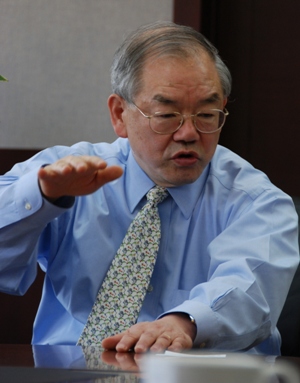
Professor Jae-Seung Jeong of the Bio and Brain Engineering Department, Sang-Yup Lee of the Chemical and Biomolecular Engineering Department, Joon-Ho Oh of the Mechanical Engineering Department, and President Nam-Pyo Suh participated in the forum as presenters of the topic. Of these speakers, Professors Jae-Seung Jeong and Sang-Yup Lee were nominated by the World Economic Forum (WEF) as members of the “Young Global Leader” and “Global Agenda Council on Emerging Technologies,” respectively.
President Suh was also invited to the CEO Insight Group and delivered an opening speech on OLEV (Online Electric Vehicle) and the Mobile Harbor. President Suh plans to sign an MOU for research cooperation with Jong-Hoo Kim of Bell Lab and Shirley Jackson of the Rensselaer Polytechnic Institute in the near future, respectively.
Since 2007, the WEF, in charge of the world’s largest international conference called “Davos Forum” has hosted a “Summer Davos Forum,” also called as the “Annual Meeting of New Champions.” The Summer Davos Forum consists of nations, rising global companies, next generation of global leaders, and cities or nations that lead technological innovations. Unlike the annual Davos Forum held in January, the “Annual Meeting of New Champions” is held in September of each year in Tianjin and Dalian, China.
Since 2009, the WEF has added a special session called IdeasLab in the Davos and Summer Davos Forums. Through IdeasLab, prominent universities from all over the world, research organizations, venture businesses, NGOs, and NPOs are invited to exchange and discuss innovative and creative ideas that can contribute to the development of mankind. Until now, universities including INSEAD, EPFL-ETH, MIT, Oxford, Yale, Harvard, Rensselaer Polytechnic Institute, Tsinghua University, and Keio University have been invited to the IdeasLab. KAIST is the first Korean university to attend this session.
2010.09.17 View 32581
KAIST was invited to the World Economic Forum's fourth "Summer Davos."
KAIST attended the World Economic Forum’s “Summer Davos Forum” held from September 13 to 15 in Tianjin, China. The Summer Davos Forum hosted various sessions and meetings with international dignitaries from governments, business and public organizations, and academia on the main theme of “Driving Growth through Sustainability.”
On September 14, four subjects including “Electric Vehicles,” “Humanoid Robotics,” “Next Generation of Biomaterials,” and “New Developments in Neuroengineering” were presented by KAIST, followed by discussions with forum participants.
Professor Jae-Seung Jeong of the Bio and Brain Engineering Department, Sang-Yup Lee of the Chemical and Biomolecular Engineering Department, Joon-Ho Oh of the Mechanical Engineering Department, and President Nam-Pyo Suh participated in the forum as presenters of the topic. Of these speakers, Professors Jae-Seung Jeong and Sang-Yup Lee were nominated by the World Economic Forum (WEF) as members of the “Young Global Leader” and “Global Agenda Council on Emerging Technologies,” respectively.
President Suh was also invited to the CEO Insight Group and delivered an opening speech on OLEV (Online Electric Vehicle) and the Mobile Harbor. President Suh plans to sign an MOU for research cooperation with Jong-Hoo Kim of Bell Lab and Shirley Jackson of the Rensselaer Polytechnic Institute in the near future, respectively.
Since 2007, the WEF, in charge of the world’s largest international conference called “Davos Forum” has hosted a “Summer Davos Forum,” also called as the “Annual Meeting of New Champions.” The Summer Davos Forum consists of nations, rising global companies, next generation of global leaders, and cities or nations that lead technological innovations. Unlike the annual Davos Forum held in January, the “Annual Meeting of New Champions” is held in September of each year in Tianjin and Dalian, China.
Since 2009, the WEF has added a special session called IdeasLab in the Davos and Summer Davos Forums. Through IdeasLab, prominent universities from all over the world, research organizations, venture businesses, NGOs, and NPOs are invited to exchange and discuss innovative and creative ideas that can contribute to the development of mankind. Until now, universities including INSEAD, EPFL-ETH, MIT, Oxford, Yale, Harvard, Rensselaer Polytechnic Institute, Tsinghua University, and Keio University have been invited to the IdeasLab. KAIST is the first Korean university to attend this session.
2010.09.17 View 32581 -
 KAIST has developed a powerless and wireless keyboard that can be folded and easily carried around.
The KAIST Institute for Information Technology Convergence (KIITC) has developed the next generation keyboard that does not need power and wires.
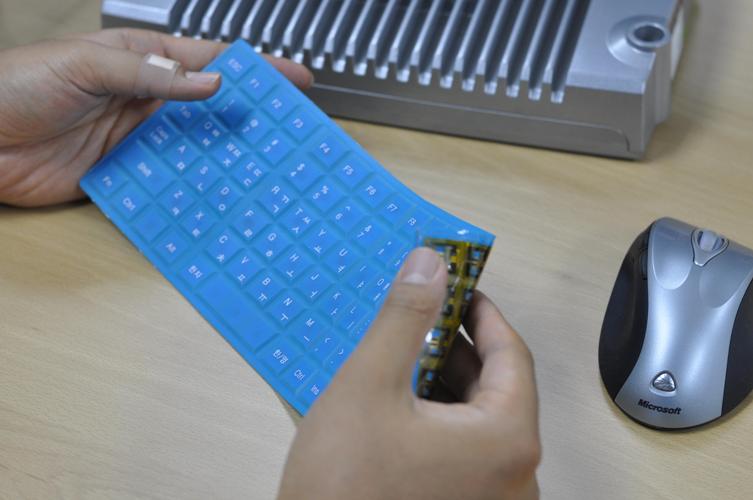
The powerless/wireless keyboard developed by KIITC is flexible, foldable, portable, and compact, making the possession of keyboard easier and more convenient.
The idea of this technology was derived from "Idea Contest for Future Device" opened by KIITC in 2007, and Future Device Team (Team Leader: Dr. Sungkwan Jung) of KIITC embodied the idea and developed full-flexible powerless/wireless keyboard by using the passive Radio Frequency Identification (RFID) technology to support the convenient data input for daily mobile life.
Through the technology, KAIST expects to realize ubiquitous computing and communication environment, open a new market for foldable keyboards, and secure the competitiveness of mobile devices industries in the world market.
KIITC has also successfully transferred the technology of powerless/wireless keyboard to Hanyang Demitech for commercialization.
2010.08.12 View 17880
KAIST has developed a powerless and wireless keyboard that can be folded and easily carried around.
The KAIST Institute for Information Technology Convergence (KIITC) has developed the next generation keyboard that does not need power and wires.
The powerless/wireless keyboard developed by KIITC is flexible, foldable, portable, and compact, making the possession of keyboard easier and more convenient.
The idea of this technology was derived from "Idea Contest for Future Device" opened by KIITC in 2007, and Future Device Team (Team Leader: Dr. Sungkwan Jung) of KIITC embodied the idea and developed full-flexible powerless/wireless keyboard by using the passive Radio Frequency Identification (RFID) technology to support the convenient data input for daily mobile life.
Through the technology, KAIST expects to realize ubiquitous computing and communication environment, open a new market for foldable keyboards, and secure the competitiveness of mobile devices industries in the world market.
KIITC has also successfully transferred the technology of powerless/wireless keyboard to Hanyang Demitech for commercialization.
2010.08.12 View 17880 -
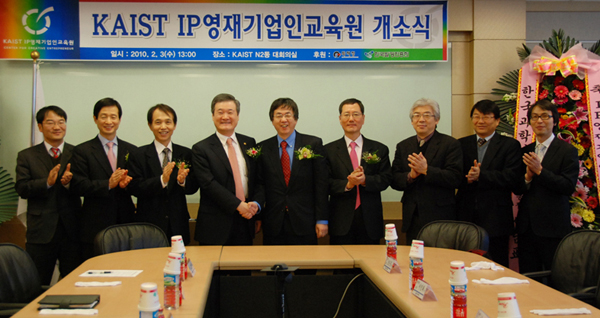 Opening Ceremony Held on February 3, 2010 for Intellectual Property Training Center
KAIST Opened Training Center for Young Entrepreneurs
Commissioner Jung-Sik Koh of Korean Intellectual Property Office (KIPO) and KAIST faculty members including Soon-Hong Jang, Vice President of Operations and Kwang-Hyung Lee, Dean of Academic Affairs Office, joined an opening ceremony held on February 3rd, 2010 to launch a training center for the next generation entrepreneurs who will lead the intellectual property (IP) industry in Korea.
The training center was built in cooperation with KIPO to educate and support young entrepreneurs and prepare them to become tomorrow’s IP business leaders like Bill Gates of Microsoft and Google’s founders, Larry Page and Sergey Brin.
Going through a vigorous selection process, a total of 101 students (51 for intermediate and 50 for advanced level) were chosen last December for an orientation program that will begin February 3rd and continue through February 5th. In addition to the training center at KAIST, KIPO supported to launch another training center at the Pohang University of Science and Technology (POSTECH), which has been up and running since January 27th, 2010.
2010.02.04 View 21260
Opening Ceremony Held on February 3, 2010 for Intellectual Property Training Center
KAIST Opened Training Center for Young Entrepreneurs
Commissioner Jung-Sik Koh of Korean Intellectual Property Office (KIPO) and KAIST faculty members including Soon-Hong Jang, Vice President of Operations and Kwang-Hyung Lee, Dean of Academic Affairs Office, joined an opening ceremony held on February 3rd, 2010 to launch a training center for the next generation entrepreneurs who will lead the intellectual property (IP) industry in Korea.
The training center was built in cooperation with KIPO to educate and support young entrepreneurs and prepare them to become tomorrow’s IP business leaders like Bill Gates of Microsoft and Google’s founders, Larry Page and Sergey Brin.
Going through a vigorous selection process, a total of 101 students (51 for intermediate and 50 for advanced level) were chosen last December for an orientation program that will begin February 3rd and continue through February 5th. In addition to the training center at KAIST, KIPO supported to launch another training center at the Pohang University of Science and Technology (POSTECH), which has been up and running since January 27th, 2010.
2010.02.04 View 21260 -
Workshop on Biomedical IC to Be Held on March 26
KAIST will hold a workshop on "biomedical IC for future healthcare system" on March 26 at a lecture room of the School of Electrical Engineering & Computer Science. The workshop is organized by SEECS and the Korean Institute of Next Generation Computing.
At the workshop, a variety of new technologies expected to expedite the development of biomedical systems will be presented. KAIST Prof. Hoi-Jun Yoo will speak on the "body channel communication" using the human body as the signal transmission medium and Dr. Seung-Hwan Kim of Electronics and Telecommunications Research Institute (ETRI) on a wearable vital sign monitoring system.
Other subjects are CMOS (complementary metal-oxide semiconductor) fully electronic biosensor for biomolecular detection to be presented by KAIST Prof. Gyu-Hyeong Cho; nerve interface and IC (integrated circuit) system design by KAIST Prof. Yoon-gi Nam; design of neural recording and stimulation IC using time-varying magnetic field by KAIST Prof. Seong-Hwan Cho; low power multi-core digital signal processor for hearing aid by Dong-Wook Kim, senior researcher at the Samsung Advanced Institute of Technology; and a non-contact cardiac sensor by KAIST Prof. Seung-Chul Hong.
With the advent of the ageing society, medical expenses of the elderly people are rapidly increasing. As a way to address the issue, interests are growing in "ubiquitous healthcare," a technology that uses a large number of environmental and patient sensors and actuators to monitor and improve patients’ physical and mental condition.
The upcoming workshop is the first academic event on biomedical integrated chips to be held in Korea. The workshop will provide a valuable opportunity for experts in biomedical area to get together and examine the present status of Korean biomedical area and discuss about its future, KAIST officials said.
2009.03.20 View 26578