launch
-
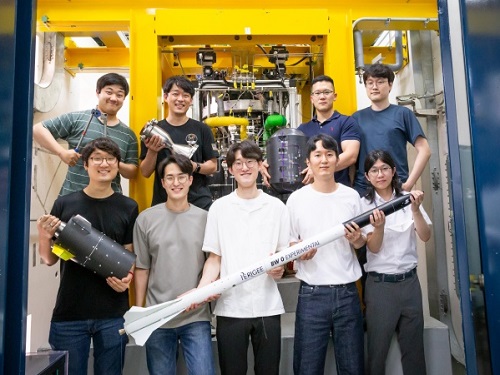 Perigee-KAIST Rocket Research Center Launches Scientific Rocket
Undergraduate startup Perigree Aerospace develops suborbital rocket called Blue Whale 0.1
On December 29, Perigee Aerospace, an undergraduate startup, launched a test rocket with a length of 3.2 m, a diameter of 19 cm, and a weight of 51 kg, using ethanol and liquid oxygen as fuel. The launch took place off Jeju Island. It was aimed at building experience and checking the combustion of a liquid propulsion engine and the performance of pre-set flight and trajectory, communication, and navigation devices. It was also one of the projects marking the 50th anniversary of KAIST in 2021.
However, after flying for several seconds, the rocket lost its track due to a gust of wind that activated the rocket’s automatic flight suspension system. "At the moment the rocket took off, there was a much stronger gust than expected," Dong-Yoon Shin, CEO of Perigee said. "The wind sent it flying off course and the automatic flight suspension system stopped its engine." However, Shin was not disappointed, saying the launch, which was conducted in collaboration with Perigee-KAIST Rocket Research Center provided a good experience.
"Some people say that Blue Whale 0.1 is like a toy because of its small size. Of course, it's much smaller than the rockets I’ve dreamed of, but like other rockets, it has all the technology needed for launch," said Shin, who established his company in 2018 as a KAIST aerospace engineering student to develop small liquid-propellant orbital rockets. Perigee Aerospace aims to develop the world’s lightest launch vehicle using high-powered engines, with a goal of leading the global market for small launch vehicles in the new space generation.
Perigee-KAIST Rocket Research Center was founded in 2019 for the research and development of rocket propellants and has been testing the combustion of rocket engines of various sizes in their liquid propellant rocket combustion lab located on the KAIST Munji Campus.
The research center initiated the 50th anniversary rocket launch project in late April of last year, finished the examination of their preliminary design in late May, and secured a tentative launching site through the KAIST-Jejudo agreement in early July.
The ethanol engine combustion was tested in late July, and an examination meeting regarding the detailed design that took place in late August was followed by two months of static firing tests of the assembled rocket in October and November.
This was a very meaningful trial in which a domestic private enterprise founded by a college student collaborated with a university to successfully develop and launch a technically challenging liquid propellant rocket.
Shin's near-term goal is to launch a two-stage orbital rocket that uses liquid methane as fuel and weighs 1.8 tons. To secure competitiveness in the small projectile market, KAIST and Perigee Aerospace have set up a joint research center to test various rocket engine sizes and develop the world's lightest projectile using a high-performance engine.
Professor Jae-Hung Han, head of the Department of Aerospace Engineering, said, “The scientific rocket system secured through the launch of the celebratory rocket will be utilized for design and system-oriented education, and for carrying out various scientific missions.” He added, “It is very rare both domestically and globally that a scientific rocket designed by the initiatives of a department should be incorporated as part of a regular aerospace system design curriculum. This will be an exemplary case we can boast about to the rest of the world.”
Perigee Aerospace will improve the technology they have developed through the course of this project to develop subminiature vehicles they may use to launch small satellites into the low Earth orbit.
Shin said, “I am happy just with the fact that we have participated in a rocket project to celebrate the 50th anniversary of KAIST, and I would like to thank the engineers at my company and members of the KAIST Department of Aerospace Engineering.” He added, “I’m looking forward to the day that we develop a space launch vehicle that can deliver satellites even higher.”
2022.01.14 View 11167
Perigee-KAIST Rocket Research Center Launches Scientific Rocket
Undergraduate startup Perigree Aerospace develops suborbital rocket called Blue Whale 0.1
On December 29, Perigee Aerospace, an undergraduate startup, launched a test rocket with a length of 3.2 m, a diameter of 19 cm, and a weight of 51 kg, using ethanol and liquid oxygen as fuel. The launch took place off Jeju Island. It was aimed at building experience and checking the combustion of a liquid propulsion engine and the performance of pre-set flight and trajectory, communication, and navigation devices. It was also one of the projects marking the 50th anniversary of KAIST in 2021.
However, after flying for several seconds, the rocket lost its track due to a gust of wind that activated the rocket’s automatic flight suspension system. "At the moment the rocket took off, there was a much stronger gust than expected," Dong-Yoon Shin, CEO of Perigee said. "The wind sent it flying off course and the automatic flight suspension system stopped its engine." However, Shin was not disappointed, saying the launch, which was conducted in collaboration with Perigee-KAIST Rocket Research Center provided a good experience.
"Some people say that Blue Whale 0.1 is like a toy because of its small size. Of course, it's much smaller than the rockets I’ve dreamed of, but like other rockets, it has all the technology needed for launch," said Shin, who established his company in 2018 as a KAIST aerospace engineering student to develop small liquid-propellant orbital rockets. Perigee Aerospace aims to develop the world’s lightest launch vehicle using high-powered engines, with a goal of leading the global market for small launch vehicles in the new space generation.
Perigee-KAIST Rocket Research Center was founded in 2019 for the research and development of rocket propellants and has been testing the combustion of rocket engines of various sizes in their liquid propellant rocket combustion lab located on the KAIST Munji Campus.
The research center initiated the 50th anniversary rocket launch project in late April of last year, finished the examination of their preliminary design in late May, and secured a tentative launching site through the KAIST-Jejudo agreement in early July.
The ethanol engine combustion was tested in late July, and an examination meeting regarding the detailed design that took place in late August was followed by two months of static firing tests of the assembled rocket in October and November.
This was a very meaningful trial in which a domestic private enterprise founded by a college student collaborated with a university to successfully develop and launch a technically challenging liquid propellant rocket.
Shin's near-term goal is to launch a two-stage orbital rocket that uses liquid methane as fuel and weighs 1.8 tons. To secure competitiveness in the small projectile market, KAIST and Perigee Aerospace have set up a joint research center to test various rocket engine sizes and develop the world's lightest projectile using a high-performance engine.
Professor Jae-Hung Han, head of the Department of Aerospace Engineering, said, “The scientific rocket system secured through the launch of the celebratory rocket will be utilized for design and system-oriented education, and for carrying out various scientific missions.” He added, “It is very rare both domestically and globally that a scientific rocket designed by the initiatives of a department should be incorporated as part of a regular aerospace system design curriculum. This will be an exemplary case we can boast about to the rest of the world.”
Perigee Aerospace will improve the technology they have developed through the course of this project to develop subminiature vehicles they may use to launch small satellites into the low Earth orbit.
Shin said, “I am happy just with the fact that we have participated in a rocket project to celebrate the 50th anniversary of KAIST, and I would like to thank the engineers at my company and members of the KAIST Department of Aerospace Engineering.” He added, “I’m looking forward to the day that we develop a space launch vehicle that can deliver satellites even higher.”
2022.01.14 View 11167 -
 KAIST Launches Woorisae II
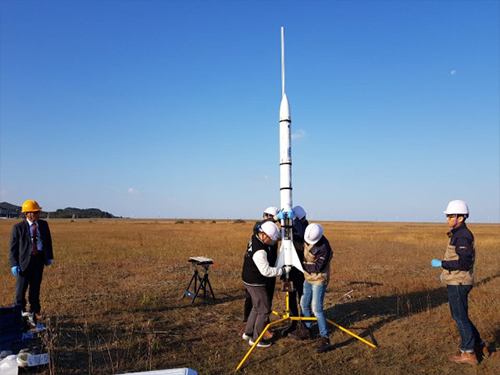
Professor Sejin Kwon from the Department of Aerospace Engineering and his team succeeded in launching a science rocket, named ‘Woorisae II’ at Saemanguem reclamation. This rocket was developed in collaboration with the Satellite Technology Research Lab (SaRTec).
The test-firing was conducted at 10:43 am on Sunday October 28, 2018 (35°N 42’ 06” 126°E 33’ 36”, Radius of 0.6NM). This launch was the follow-up to the previous launch that was cancelled due to not gaining approval for using the airspace.
Professor Kwon’s team put a great deal of effort into securing the land for the rocket launch. As a result, they got approval from the Saemangeum Development and Investment Agency for the land and the Ministry of Land, Infrastructure and Transport for the use of the airspace. The Republic of Korea Air Force and United States Air Force also approved the use of the airspace for the launch of the science rocket for research purposes.
Woorisae II is 2.2 meters long with a diameter of 20cm, and weighs 13kg without a payload. The rocket is powered by a hybrid rocket with hydrogen peroxide oxidizer producing 100 kg of force. The Woorisae II sounding rocket was designed to burn for five seconds and then continue inertial flight for 20 seconds. The target altitude of Woorisae II was set at 3,300 feet to comply with the airspace approval.
The team developed the core components, including a hybrid rocket propulsion system, flight computer and parachute recovery system, as well as a ground control station. The flight data was transmitted to the ground station and recorded to onboard computer memory.
When a malfunction occurs during the flight, Woorisae II was designed to terminate the power flight for safety by shutting the propellant valve and deploying the recovery parachute. All the rocket subsystems and components were developed and supplied by domestic startup companies such as INOCOM and NARA SPACE TEHCNOLOGY.
Generally, sounding rockets reach an altitude beyond 30km and are widely used for testing rocket engines and reentry materials as well as for conducting microgravity experiments. Instruments for atmospheric science can also be installed to measure fine dust and high altitude atmosphere. Besides these science and technology purposes, most advanced spacefaring countries have sounding rocket programs to train and educate young people in the field of space science.
Professor Kwon said, “We will plan to launch upgraded rockets on November 4 and December 6 because we already received approval from the related agencies for using this land and airspace. Based on the experiment, we are planning to develop a cost-efficient small launch vehicle that is capable of delivering a cube satellite into Earth’s orbit.”
(Photos of preparing the rocket launch)
2018.10.29 View 13401
KAIST Launches Woorisae II
Professor Sejin Kwon from the Department of Aerospace Engineering and his team succeeded in launching a science rocket, named ‘Woorisae II’ at Saemanguem reclamation. This rocket was developed in collaboration with the Satellite Technology Research Lab (SaRTec).
The test-firing was conducted at 10:43 am on Sunday October 28, 2018 (35°N 42’ 06” 126°E 33’ 36”, Radius of 0.6NM). This launch was the follow-up to the previous launch that was cancelled due to not gaining approval for using the airspace.
Professor Kwon’s team put a great deal of effort into securing the land for the rocket launch. As a result, they got approval from the Saemangeum Development and Investment Agency for the land and the Ministry of Land, Infrastructure and Transport for the use of the airspace. The Republic of Korea Air Force and United States Air Force also approved the use of the airspace for the launch of the science rocket for research purposes.
Woorisae II is 2.2 meters long with a diameter of 20cm, and weighs 13kg without a payload. The rocket is powered by a hybrid rocket with hydrogen peroxide oxidizer producing 100 kg of force. The Woorisae II sounding rocket was designed to burn for five seconds and then continue inertial flight for 20 seconds. The target altitude of Woorisae II was set at 3,300 feet to comply with the airspace approval.
The team developed the core components, including a hybrid rocket propulsion system, flight computer and parachute recovery system, as well as a ground control station. The flight data was transmitted to the ground station and recorded to onboard computer memory.
When a malfunction occurs during the flight, Woorisae II was designed to terminate the power flight for safety by shutting the propellant valve and deploying the recovery parachute. All the rocket subsystems and components were developed and supplied by domestic startup companies such as INOCOM and NARA SPACE TEHCNOLOGY.
Generally, sounding rockets reach an altitude beyond 30km and are widely used for testing rocket engines and reentry materials as well as for conducting microgravity experiments. Instruments for atmospheric science can also be installed to measure fine dust and high altitude atmosphere. Besides these science and technology purposes, most advanced spacefaring countries have sounding rocket programs to train and educate young people in the field of space science.
Professor Kwon said, “We will plan to launch upgraded rockets on November 4 and December 6 because we already received approval from the related agencies for using this land and airspace. Based on the experiment, we are planning to develop a cost-efficient small launch vehicle that is capable of delivering a cube satellite into Earth’s orbit.”
(Photos of preparing the rocket launch)
2018.10.29 View 13401 -
 News Article: Naro space rocket getting ready for second launch, April 12, 2010
News Article on KIAST published on April 12, 2010
The Korea Herald, 2010-04-12 17:07
Naro space rocket getting ready for second launch
By Bae Hyun-jung (tellme@heraldm.com)
The Ministry of Education, Science and Technology is checking on the second launch of Naro, Korea’s first space rocket, as all the necessary parts were transferred to the launch center last week.
The Science Technology Satellite No. 2 was transferred last Thursday from the KAIST Satellite Technology Research Center in Daejeon to the Naro Space Center in South Jeolla Province, said ministry officials.
The solid-fuel second-stage rocket reached the center last Monday and the liquid-fuel first-stage rocket did so on March 23. The latter was manufactured in Russia’s Khrunichev State Space Science and Production Center.
The satellite, a small one weighing 100 kilograms, was co-developed by the Korea Aerospace Research Institute, KAIST SaTReC and the Gwangju Institute of Science and Technology.
It is to revolve around the Earth for two years collecting data on climate change by gauging the hydrogen content in the atmosphere, said officials.
“With all the crucial parts ready here in the center, we have officially kicked off our final investigation before setting the details of the second Naro launch,” said a ministry official.
Second Vice Minister Kim Joong-hyun last week visited the Naro center to attend the overall inspection on all facilities related to the rocket launch.
The date has not yet been set for the second launch but will be fixed within this month, said officials.
With the general inspection completed on the facilities, the first-stage rocket and the satellite will be assembled and the combination will be joined by the second-stage rocket in May.
The first launching attempt ended in failure in August due to faulty electrical wiring or a mechanical problem in the fairing separation mechanism, according to panels.
The two fairings -- used to cover and protect the satellite placed on top of the Naro -- failed to separate timely and thus stopped the satellite from gaining sufficient velocity to reach its planned orbit.
Korea has so far spent 502.4 billion won ($428.1 million) on the Naro project since it began in August 2002.
2010.04.13 View 17595
News Article: Naro space rocket getting ready for second launch, April 12, 2010
News Article on KIAST published on April 12, 2010
The Korea Herald, 2010-04-12 17:07
Naro space rocket getting ready for second launch
By Bae Hyun-jung (tellme@heraldm.com)
The Ministry of Education, Science and Technology is checking on the second launch of Naro, Korea’s first space rocket, as all the necessary parts were transferred to the launch center last week.
The Science Technology Satellite No. 2 was transferred last Thursday from the KAIST Satellite Technology Research Center in Daejeon to the Naro Space Center in South Jeolla Province, said ministry officials.
The solid-fuel second-stage rocket reached the center last Monday and the liquid-fuel first-stage rocket did so on March 23. The latter was manufactured in Russia’s Khrunichev State Space Science and Production Center.
The satellite, a small one weighing 100 kilograms, was co-developed by the Korea Aerospace Research Institute, KAIST SaTReC and the Gwangju Institute of Science and Technology.
It is to revolve around the Earth for two years collecting data on climate change by gauging the hydrogen content in the atmosphere, said officials.
“With all the crucial parts ready here in the center, we have officially kicked off our final investigation before setting the details of the second Naro launch,” said a ministry official.
Second Vice Minister Kim Joong-hyun last week visited the Naro center to attend the overall inspection on all facilities related to the rocket launch.
The date has not yet been set for the second launch but will be fixed within this month, said officials.
With the general inspection completed on the facilities, the first-stage rocket and the satellite will be assembled and the combination will be joined by the second-stage rocket in May.
The first launching attempt ended in failure in August due to faulty electrical wiring or a mechanical problem in the fairing separation mechanism, according to panels.
The two fairings -- used to cover and protect the satellite placed on top of the Naro -- failed to separate timely and thus stopped the satellite from gaining sufficient velocity to reach its planned orbit.
Korea has so far spent 502.4 billion won ($428.1 million) on the Naro project since it began in August 2002.
2010.04.13 View 17595