KAIST launches "Junior KAIST" for future scientists who will change the world
KAIST (President Kwang Hyung Lee) announced on the 27th of August that it is relaunching its online gifted education program, KAIST Cyber Gifted Education, from the KAIST Center for Gifted Education, into "Junior KAIST," an open science and engineering exploration platform in which any elementary, middle, or high school student can participate.
This reorganization was carried out to respond to the declining school-age population, the tendency to avoid science and engineering fields, and the acceleration of digital transformation, with the aim of establishing a national talent development model that supports the early discovery and systematic growth of future science and technology talent. Through this, KAIST plans to expand the base of science and technology talent, reduce regional and social educational gaps, and realize inclusive science and technology education.
"Junior KAIST" is a step-by-step inquiry-based online curriculum designed to help students develop interest in science and technology fields and deepen their exploration of areas of interest. In the long term, it aims to discover outstanding science and engineering talent and strengthen connections to higher education and career pathways.
In particular, for students from the 4th grade of elementary school to the 2nd year of high school, it operates a grade-specific customized learning curriculum—Enjoy, Dive, Challenge, Boost, and ACE (Achieve Complete Exploration)—to support learning suited to individual levels and interests, while intensively strengthening core STEM (Science, Technology, Engineering, Mathematics) competencies such as mathematics, science, future technology, AI, and data-based problem solving.
In addition, the program will expand its Question-Based Learning (QBL) model, where students create and investigate their own questions. Outstanding students will also be given opportunities for real career experience, including mentoring with KAIST professors and university (graduate) students, participation in laboratory-based projects, and the presentation of research outcomes. KAIST plans to establish a virtuous cycle talent development system that will, in the long term, connect to admission into science high schools, gifted high schools, and KAIST itself.
In the second semester of the 2025 academic year, various courses such as "Enjoy Mathematics," "Enjoy Robots," and "Enjoy AI" will be offered, and registration is available until August 31 through the official website (junior.kaist.ac.kr).
Sijong Kwak, Director of the KAIST Center for Gifted Education Research, said, “Junior KAIST is not just gifted education, but a platform for fostering future science and technology talent that grows through curiosity, inquiry, and creativity. We will do our utmost to ensure that KAIST establishes itself as a representative model for national science and technology talent development.”
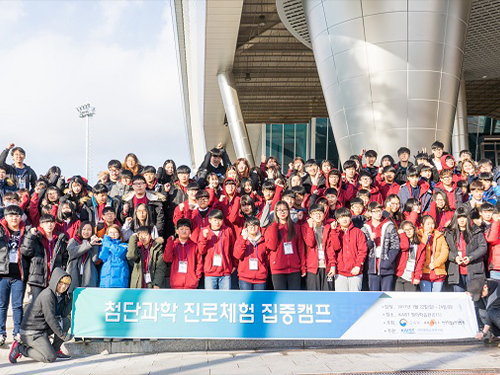
KAIST Intensive Science Camp for Middle-High School Students
The KAIST Global Institute of Talented Education (Director: Dong-Soo Kwon) invited around 90 middle and high school students for an advanced science intensive camp from January 22 to 24.
This camp targeted middle and high school students in community centers or child-care institutions. It aims to increase students’ interest in science and engineering, and assist them with their career paths through programs such as special lectures on science, advanced science projects, and career mentoring.
Participating students were divided into groups of seven or eight with a KAIST student as a mentor to conduct advanced science projects such as VR controller production and robot arm programming. The camp included exploring future career options and science and engineering college admission counselling.
Jiyoung Ryu, Research Professor for the KAIST Global Institute of Talented Education, said, “KAIST started the science and engineering career experience program in 2016 with the Ministry of Education and Korea Research Institute for Vocational Education and Training (KRIVET). So far, 6000 middle and high school students from around the country have participated. The camp is more meaningful since it educates students in social responsibility, in addition to the fields of science and engineering, both of which are missions and goals that KAIST strives for.” She continued to say, “We plan to continue to expand the program in the future.”
The KAIST Global Institute of Talented Education is actively conducting research and projects on national education for talented youth such as policy research concerning gifted education, science and engineering career education, advanced science camps, training for gifted education teachers, and cyber gifted education programs.