%66%65%6d%74%6f%73%65%63%6f%6e%64
-
 KAIST Identifies an “Electron Waiting Room” That Holds Light Energy Longer
To produce hydrogen using sunlight, the energy obtained from light must be retained until it can be used in a chemical reaction. However, if an electron that has gained energy from light quickly returns to its original position, it becomes difficult to make use of that energy. A KAIST-led research team has uncovered how tiny vacant sites inside a material that uses light to drive chemical reactions act like an “electron waiting room,” providing more time for light energy to be utilized.
KAIST (President Choongsik Bae) announced on October 25 that a research team led by Professor Tae Kyu Kim of the Department of Chemistry, in collaboration with research teams led by Professor Tae Wu Kim of Kyung Hee University, Professor Joonghan Kim of The Catholic University of Korea, and Dr. Jae Hyuk Lee of the Pohang Accelerator Laboratory, identified the mechanism by which “oxygen vacancies” in titanium dioxide help retain electrons for longer periods. Oxygen vacancies are empty sites created when oxygen atoms are missing from a material.
Titanium dioxide is a representative photocatalytic material that promotes chemical reactions when exposed to light. It has been studied in the fields of clean energy and environmental technology because it can be used to produce hydrogen using sunlight, convert carbon dioxide into useful substances, and decompose pollutants.
When light strikes onto this material, electrons gain energy and move, leaving behind “holes”. Simply put, a hole is a site vacated by an electron. Electrons and holes can each participate in chemical reactions, but if an electron fills the hole again before taking part in a reaction, the opportunity to use the energy obtained from light is lost. This process is called “recombination”. Therefore, it is important to prevent electrons and holes from recombining too quickly and to secure enough time for them to participate in reactions.
The research team focused on “blue titanium dioxide (blue TiO₂)”, which has a bluish color due to the absence of some oxygen atoms. The oxygen vacancies in this material can serve as temporary sites where electrons remain. While a hole is a “site vacated by an electron”, an oxygen vacancy is a “site vacated by an oxygen atom”, meaning the two are different. In this study, the researchers investigated how oxygen vacancies trap electrons and delay recombination.
To do so, the team used the X-ray Free Electron Laser at the Pohang Accelerator Laboratory, a fourth-generation light-source facility. Much like an ultrafast camera captures instantaneous motion, the system uses extremely short X-ray pulses to track changes inside a material after it absorbs light. The researchers observed changes around titanium atoms on the femtosecond timescale, equivalent to one quadrillionth of a second. They also combined these observations with optical analyses that measure changes in light absorption and with computational calculations.
The results showed that immediately after light absorption, electrons in both conventional titanium dioxide and blue titanium dioxide rapidly lost some of their energy and became temporarily trapped. The difference emerged in what happened next. In blue titanium dioxide, oxygen vacancies caused the electrons to enter a more stable “deep trap state.”
This can be compared to a ball being less likely to roll out of a deep hollow than a shallow dip. However, this does not mean that an actual deep hole forms inside the material. Rather, it means that the electron occupies an energy state from which it is more difficult to escape. This state acts as an “electron waiting room,” delaying recombination with holes.
In blue titanium dioxide, the electrons moved into the more stable deep trap state over approximately 1.5 nanoseconds. One nanosecond is one billionth of a second, meaning that the electrons settle into this “waiting room” in a period far shorter than the blink of an eye. Afterward, electron-hole recombination occurred approximately 2.5 times more slowly than in conventional titanium dioxide. This means that electrons retain the energy obtained from light for longer, potentially increasing the opportunity for that energy to be used in chemical reactions.
In blue titanium dioxide, the electrons moved into the more stable deep trap state over approximately 1.5 nanoseconds. One nanosecond is one billionth of a second, meaning that the electrons settle into this “waiting room” in a period far shorter than the blink of an eye. Afterward, electron-hole recombination occurred approximately 2.5 times more slowly than in conventional titanium dioxide. This means that electrons retain the energy obtained from light for longer, potentially increasing the opportunity for that energy to be used in chemical reactions.
The significance of this study lies in connecting the entire process, from the trapping of electrons by oxygen vacancies to changes in the surrounding atomic structure and the resulting delay in recombination. The findings could be used in the future to design photocatalysts that retain electrons for longer periods by controlling the amount and distribution of oxygen vacancies.
The research team expects the findings to contribute to the development of highly efficient photocatalysts for applications such as solar hydrogen production, carbon dioxide conversion, and pollutant decomposition. To improve actual performance, however, follow-up studies will be needed to determine whether the electrons that remain trapped for longer periods can also participate effectively in chemical reactions.
Professor Tae Kyu Kim said, “This study shows that vacancies created by missing oxygen atoms in a material are not simply defects, but play an important role in helping electrons remain for longer periods,” adding, “We expect these findings to contribute to the design of photocatalysts that utilize light energy more effectively by controlling the microscopic structure of materials.”
Tae Gyun Woo, a Ph.D. student in the KAIST Department of Chemistry, participated in the study as the first author. Professor Tae Kyu Kim of KAIST, Professor Tae Wu Kim of Kyung Hee University, Professor Joonghan Kim of The Catholic University of Korea, and Dr. Jae Hyuk Lee of the Pohang Accelerator Laboratory participated as co-corresponding authors. The research findings were published online on September 17, 2026, in the Journal of the American Chemical Society (JACS).
Paper title: Femtosecond X-ray Tracking of Oxygen Vacancy-Driven Shallow-to-Deep Trap Transition and Its Impact on Charge Carrier Dynamics in Blue TiO₂,
DOI: 10.1021/jacs.6c10078
Key author information: Tae Gyun Woo (Ph.D. student, Department of Chemistry, KAIST; first author), Tae Kyu Kim (Professor, Department of Chemistry, KAIST; corresponding author), Tae Wu Kim (Professor, Kyung Hee University; corresponding author), Joonghan Kim (Professor, The Catholic University of Korea; corresponding author), Jae Hyuk Lee (Senior Scientist, Pohang Accelerator Laboratory; corresponding author)
This research was supported by the Mid-Career Researcher Program of the National Research Foundation of Korea, the InnoCORE Program of the Ministry of Science and ICT, the Samsung Science & Technology Foundation, and the KAIST Cross-Generation Collaborative Lab Project. The experiments were conducted using the X-ray Free Electron Laser facility at the Pohang Accelerator Laboratory, supported by the Ministry of Science and ICT.
2026.10.26 View 1983
-
 Every Moment of Ultrafast Chemical Bonding Now Captured on Film
- The emerging moment of bond formation, two separate bonding steps, and subsequent vibrational motions were visualized. -
< Emergence of molecular vibrations and the evolution to covalent bonds observed in the research. Video Credit: KEK IMSS >
A team of South Korean researchers led by Professor Hyotcherl Ihee from the Department of Chemistry at KAIST reported the direct observation of the birthing moment of chemical bonds by tracking real-time atomic positions in the molecule. Professor Ihee, who also serves as Associate Director of the Center for Nanomaterials and Chemical Reactions at the Institute for Basic Science (IBS), conducted this study in collaboration with scientists at the Institute of Materials Structure Science of High Energy Accelerator Research Organization (KEK IMSS, Japan), RIKEN (Japan), and Pohang Accelerator Laboratory (PAL, South Korea). This work was published in Nature on June 24.
Targeted cancer drugs work by striking a tight bond between cancer cell and specific molecular targets that are involved in the growth and spread of cancer. Detailed images of such chemical bonding sites or pathways can provide key information necessary for maximizing the efficacy of oncogene treatments. However, atomic movements in a molecule have never been captured in the middle of the action, not even for an extremely simple molecule such as a triatomic molecule, made of only three atoms.
Professor Ihee's group and their international collaborators finally succeeded in capturing the ongoing reaction process of the chemical bond formation in the gold trimer. "The femtosecond-resolution images revealed that such molecular events took place in two separate stages, not simultaneously as previously assumed," says Professor Ihee, the corresponding author of the study. "The atoms in the gold trimer complex atoms remain in motion even after the chemical bonding is complete. The distance between the atoms increased and decreased periodically, exhibiting the molecular vibration. These visualized molecular vibrations allowed us to name the characteristic motion of each observed vibrational mode." adds Professor Ihee.
Atoms move extremely fast at a scale of femtosecond (fs) ― quadrillionths (or millionths of a billionth) of a second. Its movement is minute in the level of angstrom equal to one ten-billionth of a meter. They are especially elusive during the transition state where reaction intermediates are transitioning from reactants to products in a flash. The KAIST-IBS research team made this experimentally challenging task possible by using femtosecond x-ray liquidography (solution scattering). This experimental technique combines laser photolysis and x-ray scattering techniques. When a laser pulse strikes the sample, X-rays scatter and initiate the chemical bond formation reaction in the gold trimer complex. Femtosecond x-ray pulses obtained from a special light source called an x-ray free-electron laser (XFEL) were used to interrogate the bond-forming process. The experiments were performed at two XFEL facilities (4th generation linear accelerator) that are PAL-XFEL in South Korea and SACLA in Japan, and this study was conducted in collaboration with researchers from KEK IMSS, PAL, RIKEN, and the Japan Synchrotron Radiation Research Institute (JASRI).
Scattered waves from each atom interfere with each other and thus their x-ray scattering images are characterized by specific travel directions. The KAIST-IBS research team traced real-time positions of the three gold atoms over time by analyzing x-ray scattering images, which are determined by a three-dimensional structure of a molecule. Structural changes in the molecule complex resulted in multiple characteristic scattering images over time. When a molecule is excited by a laser pulse, multiple vibrational quantum states are simultaneously excited. The superposition of several excited vibrational quantum states is called a wave packet. The researchers tracked the wave packet in three-dimensional nuclear coordinates and found that the first half round of chemical bonding was formed within 35 fs after photoexcitation. The second half of the reaction followed within 360 fs to complete the entire reaction dynamics.
They also accurately illustrated molecular vibration motions in both temporal- and spatial-wise. This is quite a remarkable feat considering that such an ultrafast speed and a minute length of motion are quite challenging conditions for acquiring precise experimental data.
In this study, the KAIST-IBS research team improved upon their 2015 study published by Nature. In the previous study in 2015, the speed of the x-ray camera (time resolution) was limited to 500 fs, and the molecular structure had already changed to be linear with two chemical bonds within 500 fs. In this study, the progress of the bond formation and bent-to-linear structural transformation could be observed in real time, thanks to the improvement time resolution down to 100 fs. Thereby, the asynchronous bond formation mechanism in which two chemical bonds are formed in 35 fs and 360 fs, respectively, and the bent-to-linear transformation completed in 335 fs were visualized. In short, in addition to observing the beginning and end of chemical reactions, they reported every moment of the intermediate, ongoing rearrangement of nuclear configurations with dramatically improved experimental and analytical methods.
They will push this method of 'real-time tracking of atomic positions in a molecule and molecular vibration using femtosecond x-ray scattering' to reveal the mechanisms of organic and inorganic catalytic reactions and reactions involving proteins in the human body. "By directly tracking the molecular vibrations and real-time positions of all atoms in a molecule in the middle of reaction, we will be able to uncover mechanisms of various unknown organic and inorganic catalytic reactions and biochemical reactions," notes Dr. Jong Goo Kim, the lead author of the study.
Publications:
Kim, J. G., et al. (2020) ‘Mapping the emergence of molecular vibrations mediating bond formation’. Nature. Volume 582. Page 520-524. Available online at https://doi.org/10.1038/s41586-020-2417-3
Profile: Hyotcherl Ihee, Ph.D.
Professor
hyotcherl.ihee@kaist.ac.kr
http://time.kaist.ac.kr/
Ihee Laboratory
Department of Chemistry
KAIST
https://www.kaist.ac.kr
Daejeon 34141, Korea
(END)
2020.06.24 View 35000
-
 Nature Photonics, a peer-reviewed scientific journal, released a paper written by a KAIST research team on the time-of-flight measurement.
Professor Seung-Woo Kim of the Mechanical Engineering Department, KAIST, and his research team published the result of their study on the measurement of 1 nanometer (nm) precision.
“The time-of-flight of light pulses has long been used as a direct measure of distance, but state-of-the-art measurement precision using conventional light pulses or microwaves peaks at only several hundreds of micrometers. Here, we improve the time-of-flight precision to the nanometer regime by timing femtosecond pulses through phase-locking control of the pulse repetition rate using the optical cross-correlation technique,” Professor Kim said.
According to the experiment conducted by the research team, “An Allan deviation of 117 nm in measuring a 700m distance in air at a sampling rate of 5 millisecond (ms) once the pulse repetition is phased-locked, which reduces to 7 nm as the averaging time increases to 1 second (s).”
When measuring an object located in a far distance, a laser beam is projected to the object, and the reflected light is analyzed; the light is then converted into an electric signal to calculate the distance. In so doing, Professor Kim said, the conventional method of measurement creates at least 1 mm of deviation.
He argues, “This enhanced capability is maintained at long range without periodic ambiguity, and is well suited to lidar applications. This method could also be applied to future space missions involving formation-flying satellites for synthetic aperture imaging and remote experiments related to general relativity theory."
Nature Photonics published the article online on August 8, 2010.
2010.08.18 View 21800
-
 Two KAIST Professors Elected Fellows of APS
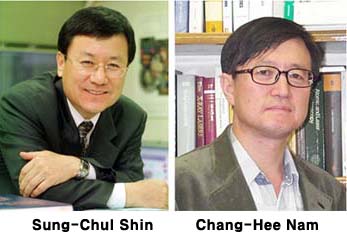
Profs. Sung-Chul Shin and Chang-Hee Nam of the Department of Physics, KAIST, have recently been elected the 2009 fellows of the American Physical Society (APS), university officials said on Tuesday (Dec. 2).
The APS fellowship is a prestigious recognition of the two professors" outstanding academic achievements in the field of physics, the officials said. The selection criteria are known to be extremely stringent and only a small fraction of APS members become fellows.
Prof. Shin was cited for his pioneering contributions to the understanding of magnetization reversal dynamics, in particular critical scaling behavior of Barkhausen avalanches of 2D ferromagnets, and discovery of novel magnetic thin films and multilayers for high-density data storage.
Prof. Nam was recognized for his contributions to the theory and experiments of physical processes of high harmonic generation for the development of attosecond coherent x-ray sources and related femtosecond laser technology.
The American Physical Society, founded in 1899, is the world"s second largest organization of physicists, behind the Deutsche Physikalische Gesellschaft. It has 46,000 members across the world.
2008.12.04 View 24475
-
 New System to Generate Extreme-Ultraviolet Light Developed
A KAIST research team led by Prof. Seung-Woo Kim of the Mechanical Engineering Department developed a new system for generating coherent extreme-ultraviolet (EUV) light, school authorities announced on June 5.
The new system comes in a metallic nano-structure consisting of a two-dimensional array of gold "bow tie" elements on a sapphire plate. The new process was featured in the British journal Nature on June 5.
The properties of coherent EUV light make it a prime candidate for exciting technological applications. But, at present, the equipment needed to generate the short-wavelength light is costly and bulky. The system developed by Prof. Kim"s research team is expected to reduce both cost and bulk.
The new system uses the conventional principle of high-harmonic generation via the interaction of a femtosecond laser pulse with a gas, but adopts the novel concept of amplifying light by way of local plasmon field enhancement, according to the research team.
2008.06.10 View 21112