%65%6c%65%63%74%72%6f%6e%20%6d%6f%74%69%6f%6e
-
 KAIST Reveals the Orbital Principle of Electron Motion for Realizing Memory of Dreams
<(From Left) Dr. Geun-Hee Lee, Professor Kyung-Jin Lee, Professor Kyoung-Whan Kim>
Research is actively underway to develop a “dream memory” that can reduce heat generation in smartphones and laptops while delivering faster performance and lower power consumption. Korean researchers have now proposed a new possibility for controlling magnetism using the exchange interaction of electron orbitals—the motion of electrons orbiting around an atomic nucleus—rather than relying on the conventional exchange interaction of electron spin, the rotational property of electrons inside semiconductors.
KAIST (President Kwang Hyung Lee) announced on the 16th of March that a joint research team led by Professor Kyung-Jin Lee of the Department of Physics at KAIST and Professor Kyoung-Whan Kim of the Department of Physics at Yonsei University (President Dong-Sup Yoon) has established, for the first time in the world, a new theoretical framework enabling magnetism to be freely controlled through orbital exchange interaction*, surpassing the limitations of conventional technologies that control magnetism using electric currents.*Orbital exchange interaction: a phenomenon in which the orbitals formed by electrons moving around an atomic nucleus interact with one another, thereby influencing the direction or properties of magnetism.
Until now, next-generation memory research has mainly focused on the spin of electrons. Spin refers to the property of electrons that rotate on their own axis like tiny spinning tops, and information can be stored by using the direction of this rotation. However, electrons simultaneously move around the atomic nucleus along paths known as orbitals. In this study, the research team theoretically demonstrated that when electric current flows, the orbital energy of electrons interacts directly with the orbitals of magnetic materials, enabling the transmission of information. Through this mechanism, they confirmed that the properties of magnets can be altered much more efficiently than with conventional spin-based approaches.
The most significant outcome of this research is the discovery that electric current does not merely change the direction of a magnet but can also modify the intrinsic properties of the magnet itself, such as the magnetic anisotropy (a magnet’s preferred direction) and rotational characteristics.
In particular, calculations by the research team showed that orbital-based control effects could be significantly stronger than existing spin-based methods. This finding suggests the possibility of a future era of orbital-based electronic devices, in which orbitals rather than spin play the central role in semiconductor components. The researchers also proposed practical experimental methods to measure these effects, which is expected to increase the potential for industrial applications.
The principle may also apply to altermagnetic materials, which have recently attracted significant attention in academia. Altermagnetism refers to a new form of magnetic material in which electron spins within atoms are arranged in alternating directions in an ordered pattern. Although these materials do not appear magnetic externally, they strongly influence electron motion. Because of this property, they allow precise control of electron states and are considered promising for high-speed, low-power semiconductor devices and next-generation memory technologies. The study therefore provides a strong theoretical foundation for developing future logic and memory devices.
Dr. Geun-Hee Lee stated, “This study demonstrates that controlling magnetism with electric current does not necessarily have to rely solely on spin. A new perspective—understanding and controlling magnetism using the orbital motion of electrons—will become an important milestone for the development of next-generation ultra-fast, low-power memory.”
In this research, Dr. Geun-Hee Lee (KAIST) participated as the first author, while Professor Kyoung-Whan Kim (Yonsei University) and Professor Kyung-Jin Lee (KAIST) served as co-corresponding authors. The results were published on February 2 in the internationally renowned journal Nature Communications, recognizing the academic significance of the work.
※ Paper title: “Orbital exchange-mediated current control of magnetism,” DOI: https://doi.org/10.1038/s41467-026-68846-x
This research was supported by the Frontier Challenge R&D Project, the Mid-Career Researcher Program, the Science Research Center (SRC) program, the Early Career Researcher Program of the National Research Foundation of Korea, and Samsung Electronics.
2026.03.16 View 955
KAIST Reveals the Orbital Principle of Electron Motion for Realizing Memory of Dreams
<(From Left) Dr. Geun-Hee Lee, Professor Kyung-Jin Lee, Professor Kyoung-Whan Kim>
Research is actively underway to develop a “dream memory” that can reduce heat generation in smartphones and laptops while delivering faster performance and lower power consumption. Korean researchers have now proposed a new possibility for controlling magnetism using the exchange interaction of electron orbitals—the motion of electrons orbiting around an atomic nucleus—rather than relying on the conventional exchange interaction of electron spin, the rotational property of electrons inside semiconductors.
KAIST (President Kwang Hyung Lee) announced on the 16th of March that a joint research team led by Professor Kyung-Jin Lee of the Department of Physics at KAIST and Professor Kyoung-Whan Kim of the Department of Physics at Yonsei University (President Dong-Sup Yoon) has established, for the first time in the world, a new theoretical framework enabling magnetism to be freely controlled through orbital exchange interaction*, surpassing the limitations of conventional technologies that control magnetism using electric currents.*Orbital exchange interaction: a phenomenon in which the orbitals formed by electrons moving around an atomic nucleus interact with one another, thereby influencing the direction or properties of magnetism.
Until now, next-generation memory research has mainly focused on the spin of electrons. Spin refers to the property of electrons that rotate on their own axis like tiny spinning tops, and information can be stored by using the direction of this rotation. However, electrons simultaneously move around the atomic nucleus along paths known as orbitals. In this study, the research team theoretically demonstrated that when electric current flows, the orbital energy of electrons interacts directly with the orbitals of magnetic materials, enabling the transmission of information. Through this mechanism, they confirmed that the properties of magnets can be altered much more efficiently than with conventional spin-based approaches.
The most significant outcome of this research is the discovery that electric current does not merely change the direction of a magnet but can also modify the intrinsic properties of the magnet itself, such as the magnetic anisotropy (a magnet’s preferred direction) and rotational characteristics.
In particular, calculations by the research team showed that orbital-based control effects could be significantly stronger than existing spin-based methods. This finding suggests the possibility of a future era of orbital-based electronic devices, in which orbitals rather than spin play the central role in semiconductor components. The researchers also proposed practical experimental methods to measure these effects, which is expected to increase the potential for industrial applications.
The principle may also apply to altermagnetic materials, which have recently attracted significant attention in academia. Altermagnetism refers to a new form of magnetic material in which electron spins within atoms are arranged in alternating directions in an ordered pattern. Although these materials do not appear magnetic externally, they strongly influence electron motion. Because of this property, they allow precise control of electron states and are considered promising for high-speed, low-power semiconductor devices and next-generation memory technologies. The study therefore provides a strong theoretical foundation for developing future logic and memory devices.
Dr. Geun-Hee Lee stated, “This study demonstrates that controlling magnetism with electric current does not necessarily have to rely solely on spin. A new perspective—understanding and controlling magnetism using the orbital motion of electrons—will become an important milestone for the development of next-generation ultra-fast, low-power memory.”
In this research, Dr. Geun-Hee Lee (KAIST) participated as the first author, while Professor Kyoung-Whan Kim (Yonsei University) and Professor Kyung-Jin Lee (KAIST) served as co-corresponding authors. The results were published on February 2 in the internationally renowned journal Nature Communications, recognizing the academic significance of the work.
※ Paper title: “Orbital exchange-mediated current control of magnetism,” DOI: https://doi.org/10.1038/s41467-026-68846-x
This research was supported by the Frontier Challenge R&D Project, the Mid-Career Researcher Program, the Science Research Center (SRC) program, the Early Career Researcher Program of the National Research Foundation of Korea, and Samsung Electronics.
2026.03.16 View 955 -
 Ultrafast Quantum Motion in a Nanoscale Trap Detected
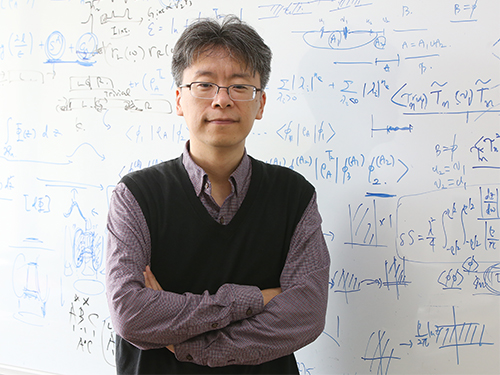
< Professor Heung-Sun Sim (left) and Co-author Dr. Sungguen Ryu (right) >
KAIST researchers have reported the detection of a picosecond electron motion in a silicon transistor. This study has presented a new protocol for measuring ultrafast electronic dynamics in an effective time-resolved fashion of picosecond resolution. The detection was made in collaboration with Nippon Telegraph and Telephone Corp. (NTT) in Japan and National Physical Laboratory (NPL) in the UK and is the first report to the best of our knowledge.
When an electron is captured in a nanoscale trap in solids, its quantum mechanical wave function can exhibit spatial oscillation at sub-terahertz frequencies. Time-resolved detection of such picosecond dynamics of quantum waves is important, as the detection provides a way of understanding the quantum behavior of electrons in nano-electronics. It also applies to quantum information technologies such as the ultrafast quantum-bit operation of quantum computing and high-sensitivity electromagnetic-field sensing. However, detecting picosecond dynamics has been a challenge since the sub-terahertz scale is far beyond the latest bandwidth measurement tools.
A KAIST team led by Professor Heung-Sun Sim developed a theory of ultrafast electron dynamics in a nanoscale trap, and proposed a scheme for detecting the dynamics, which utilizes a quantum-mechanical resonant state formed beside the trap. The coupling between the electron dynamics and the resonant state is switched on and off at a picosecond so that information on the dynamics is read out on the electric current being generated when the coupling is switched on.
NTT realized, together with NPL, the detection scheme and applied it to electron motions in a nanoscale trap formed in a silicon transistor. A single electron was captured in the trap by controlling electrostatic gates, and a resonant state was formed in the potential barrier of the trap.
The switching on and off of the coupling between the electron and the resonant state was achieved by aligning the resonance energy with the energy of the electron within a picosecond. An electric current from the trap through the resonant state to an electrode was measured at only a few Kelvin degrees, unveiling the spatial quantum-coherent oscillation of the electron with 250 GHz frequency inside the trap.
Professor Sim said, “This work suggests a scheme of detecting picosecond electron motions in submicron scales by utilizing quantum resonance. It will be useful in dynamical control of quantum mechanical electron waves for various purposes in nano-electronics, quantum sensing, and quantum information”.
This work was published online at Nature Nanotechnology on November 4. It was partly supported by the Korea National Research Foundation through the SRC Center for Quantum Coherence in Condensed Matter. For more on the NTT news release this article, please visit https://www.ntt.co.jp/news2019/1911e/191105a.html
-ProfileProfessor Heung-Sun Sim
Department of PhysicsDirector, SRC Center for Quantum Coherence in Condensed Matterhttps://qet.kaist.ac.kr KAIST
-Publication:Gento Yamahata, Sungguen Ryu, Nathan Johnson, H.-S. Sim, Akira Fujiwara, and Masaya Kataoka. 2019. Picosecond coherent electron motion in a silicon single-electron source. Nature Nanotechnology (Online Publication). 6 pages. https://doi.org/10.1038/s41565-019-0563-2
2019.11.05 View 25302
Ultrafast Quantum Motion in a Nanoscale Trap Detected
< Professor Heung-Sun Sim (left) and Co-author Dr. Sungguen Ryu (right) >
KAIST researchers have reported the detection of a picosecond electron motion in a silicon transistor. This study has presented a new protocol for measuring ultrafast electronic dynamics in an effective time-resolved fashion of picosecond resolution. The detection was made in collaboration with Nippon Telegraph and Telephone Corp. (NTT) in Japan and National Physical Laboratory (NPL) in the UK and is the first report to the best of our knowledge.
When an electron is captured in a nanoscale trap in solids, its quantum mechanical wave function can exhibit spatial oscillation at sub-terahertz frequencies. Time-resolved detection of such picosecond dynamics of quantum waves is important, as the detection provides a way of understanding the quantum behavior of electrons in nano-electronics. It also applies to quantum information technologies such as the ultrafast quantum-bit operation of quantum computing and high-sensitivity electromagnetic-field sensing. However, detecting picosecond dynamics has been a challenge since the sub-terahertz scale is far beyond the latest bandwidth measurement tools.
A KAIST team led by Professor Heung-Sun Sim developed a theory of ultrafast electron dynamics in a nanoscale trap, and proposed a scheme for detecting the dynamics, which utilizes a quantum-mechanical resonant state formed beside the trap. The coupling between the electron dynamics and the resonant state is switched on and off at a picosecond so that information on the dynamics is read out on the electric current being generated when the coupling is switched on.
NTT realized, together with NPL, the detection scheme and applied it to electron motions in a nanoscale trap formed in a silicon transistor. A single electron was captured in the trap by controlling electrostatic gates, and a resonant state was formed in the potential barrier of the trap.
The switching on and off of the coupling between the electron and the resonant state was achieved by aligning the resonance energy with the energy of the electron within a picosecond. An electric current from the trap through the resonant state to an electrode was measured at only a few Kelvin degrees, unveiling the spatial quantum-coherent oscillation of the electron with 250 GHz frequency inside the trap.
Professor Sim said, “This work suggests a scheme of detecting picosecond electron motions in submicron scales by utilizing quantum resonance. It will be useful in dynamical control of quantum mechanical electron waves for various purposes in nano-electronics, quantum sensing, and quantum information”.
This work was published online at Nature Nanotechnology on November 4. It was partly supported by the Korea National Research Foundation through the SRC Center for Quantum Coherence in Condensed Matter. For more on the NTT news release this article, please visit https://www.ntt.co.jp/news2019/1911e/191105a.html
-ProfileProfessor Heung-Sun Sim
Department of PhysicsDirector, SRC Center for Quantum Coherence in Condensed Matterhttps://qet.kaist.ac.kr KAIST
-Publication:Gento Yamahata, Sungguen Ryu, Nathan Johnson, H.-S. Sim, Akira Fujiwara, and Masaya Kataoka. 2019. Picosecond coherent electron motion in a silicon single-electron source. Nature Nanotechnology (Online Publication). 6 pages. https://doi.org/10.1038/s41565-019-0563-2
2019.11.05 View 25302