%64%69%73%63%6f%76%65%72%79
-
 “AI,” the New Language of Materials Science and Engineering Spoken at KAIST
<(From Left) M.S candidate Chaeyul Kang, Professor Seumgbum Hong, Ph. D candidate Benediktus Madika, Ph.D candidate Batzorig Buyantogtokh, Ph.D candiate Aditi Saha, >
Collaborating authors include Professor Joshua Agar (Drexel University), Professors Chris Wolverton and Peter Voorhees (Northwestern University), Professor Peter Littlewood (University of St Andrews), and Professor Sergei Kalinin (University of Tennessee).
Paper Title: Artificial Intelligence for Materials Discovery, Development, and Optimization
The era has arrived in which artificial intelligence (AI) autonomously imagines and predicts the structures and properties of new materials. Today, AI functions as a researcher’s “second brain,” actively participating in every stage of research, from idea generation to experimental validation.
KAIST (President Kwang Hyung Lee) announced on October 26 that a comprehensive review paper analyzing the impact of AI, Machine Learning (ML), and Deep Learning (DL) technologies across materials science and engineering has been published in ACS Nano (Impact Factor = 18.7). The paper was co-authored by Professor Seungbum Hong and his team from the Department of Materials Science and Engineering at KAIST, in collaboration with researchers from Drexel University, Northwestern University, the University of St Andrews, and the University of Tennessee in the United States.
The research team proposed a full-cycle utilization strategy for materials innovation through an AI-based catalyst search platform, which embodies the concept of a Self-Driving Lab—a system in which robots autonomously perform materials synthesis and optimization experiments.
Professor Hong’s team categorized materials research into three major stages—Discovery, Development, and Optimization—and detailed the distinctive role of AI in each phase:
In the Discovery Stage, AI designs new structures, predicts properties, and rapidly identifies the most promising materials among vast candidate pools.
In the Development Stage, AI analyzes experimental data and autonomously adjusts experimental processes through Self-Driving Lab systems, significantly shortening research timelines.
In the Optimization Stage, AI employs Reinforcement Learning, which identifies optimal conditions through Bayesian Optimization, which efficiently finds superior results with minimal experimentation, to fine-tune designs and process conditions for maximum performance.
In essence, AI serves as a “smart assistant” that narrows down the most promising materials, reduces experimental trial and error, and autonomously optimizes experimental conditions to achieve the best-performing outcomes.
The paper further highlights how cutting-edge technologies such as Generative AI, Graph Neural Networks (GNNs), and Transformer models are transforming AI from a computational tool into a “thinking researcher.” Nonetheless, the team cautions that AI’s predictions are not error-proof and that key challenges persist, such as imbalanced data quality, limited interpretability of AI predictions, and integration of heterogeneous datasets.
To address these limitations, the authors emphasize the importance of developing AI systems capable of autonomously understanding physical principles and ensuring transparent, verifiable decision-making processes for researchers.
The review also explores the concept of the Self-Driving Lab, where AI autonomously designs experimental plans, analyzes results, and determines the next experimental steps—without manual operation by researchers. The AI-Based Catalyst Search Platform exemplifies this concept, enabling robots to automatically design, execute, and optimize catalyst synthesis experiments.
In particular, the study presents cases in which AI-driven experimentation has dramatically accelerated catalyst development, suggesting that similar approaches could revolutionize research in battery and energy materials.
<AI Driving Innovation Across the Entire Cycle of New Material Discovery, Development, and Optimization>
“This review demonstrates that artificial intelligence is emerging as the new language of materials science and engineering, transcending its role as a mere tool,” said Professor Seungbum Hong. “The roadmap presented by the KAIST team will serve as a valuable guide for researchers in Korea’s national core industries including batteries, semiconductors, and energy materials.”
Benediktus Madika (Ph.D. candidate), Aditi Saha (Ph.D. candidate), Chaeyul Kang (M.S. candidate), and Batzorig Buyantogtokh (Ph.D. candidate) from KAIST’s Department of Materials Science and Engineering contributed as co-first authors.
Collaborating authors include Professor Joshua Agar (Drexel University), Professors Chris Wolverton and Peter Voorhees (Northwestern University), Professor Peter Littlewood (University of St Andrews), and Professor Sergei Kalinin (University of Tennessee).
Paper Title: Artificial Intelligence for Materials Discovery, Development, and Optimization
DOI: 10.1021/acsnano.5c04200
This work was supported by the National Research Foundation of Korea (NRF) with funding from the Ministry of Science and ICT (RS-2023-00247245).
2025.10.27 View 2906
“AI,” the New Language of Materials Science and Engineering Spoken at KAIST
<(From Left) M.S candidate Chaeyul Kang, Professor Seumgbum Hong, Ph. D candidate Benediktus Madika, Ph.D candidate Batzorig Buyantogtokh, Ph.D candiate Aditi Saha, >
Collaborating authors include Professor Joshua Agar (Drexel University), Professors Chris Wolverton and Peter Voorhees (Northwestern University), Professor Peter Littlewood (University of St Andrews), and Professor Sergei Kalinin (University of Tennessee).
Paper Title: Artificial Intelligence for Materials Discovery, Development, and Optimization
The era has arrived in which artificial intelligence (AI) autonomously imagines and predicts the structures and properties of new materials. Today, AI functions as a researcher’s “second brain,” actively participating in every stage of research, from idea generation to experimental validation.
KAIST (President Kwang Hyung Lee) announced on October 26 that a comprehensive review paper analyzing the impact of AI, Machine Learning (ML), and Deep Learning (DL) technologies across materials science and engineering has been published in ACS Nano (Impact Factor = 18.7). The paper was co-authored by Professor Seungbum Hong and his team from the Department of Materials Science and Engineering at KAIST, in collaboration with researchers from Drexel University, Northwestern University, the University of St Andrews, and the University of Tennessee in the United States.
The research team proposed a full-cycle utilization strategy for materials innovation through an AI-based catalyst search platform, which embodies the concept of a Self-Driving Lab—a system in which robots autonomously perform materials synthesis and optimization experiments.
Professor Hong’s team categorized materials research into three major stages—Discovery, Development, and Optimization—and detailed the distinctive role of AI in each phase:
In the Discovery Stage, AI designs new structures, predicts properties, and rapidly identifies the most promising materials among vast candidate pools.
In the Development Stage, AI analyzes experimental data and autonomously adjusts experimental processes through Self-Driving Lab systems, significantly shortening research timelines.
In the Optimization Stage, AI employs Reinforcement Learning, which identifies optimal conditions through Bayesian Optimization, which efficiently finds superior results with minimal experimentation, to fine-tune designs and process conditions for maximum performance.
In essence, AI serves as a “smart assistant” that narrows down the most promising materials, reduces experimental trial and error, and autonomously optimizes experimental conditions to achieve the best-performing outcomes.
The paper further highlights how cutting-edge technologies such as Generative AI, Graph Neural Networks (GNNs), and Transformer models are transforming AI from a computational tool into a “thinking researcher.” Nonetheless, the team cautions that AI’s predictions are not error-proof and that key challenges persist, such as imbalanced data quality, limited interpretability of AI predictions, and integration of heterogeneous datasets.
To address these limitations, the authors emphasize the importance of developing AI systems capable of autonomously understanding physical principles and ensuring transparent, verifiable decision-making processes for researchers.
The review also explores the concept of the Self-Driving Lab, where AI autonomously designs experimental plans, analyzes results, and determines the next experimental steps—without manual operation by researchers. The AI-Based Catalyst Search Platform exemplifies this concept, enabling robots to automatically design, execute, and optimize catalyst synthesis experiments.
In particular, the study presents cases in which AI-driven experimentation has dramatically accelerated catalyst development, suggesting that similar approaches could revolutionize research in battery and energy materials.
<AI Driving Innovation Across the Entire Cycle of New Material Discovery, Development, and Optimization>
“This review demonstrates that artificial intelligence is emerging as the new language of materials science and engineering, transcending its role as a mere tool,” said Professor Seungbum Hong. “The roadmap presented by the KAIST team will serve as a valuable guide for researchers in Korea’s national core industries including batteries, semiconductors, and energy materials.”
Benediktus Madika (Ph.D. candidate), Aditi Saha (Ph.D. candidate), Chaeyul Kang (M.S. candidate), and Batzorig Buyantogtokh (Ph.D. candidate) from KAIST’s Department of Materials Science and Engineering contributed as co-first authors.
Collaborating authors include Professor Joshua Agar (Drexel University), Professors Chris Wolverton and Peter Voorhees (Northwestern University), Professor Peter Littlewood (University of St Andrews), and Professor Sergei Kalinin (University of Tennessee).
Paper Title: Artificial Intelligence for Materials Discovery, Development, and Optimization
DOI: 10.1021/acsnano.5c04200
This work was supported by the National Research Foundation of Korea (NRF) with funding from the Ministry of Science and ICT (RS-2023-00247245).
2025.10.27 View 2906 -
 KAIST Changes the Paradigm of Drug Discovery with World's First Atomic Editing
In pioneering drug development, the new technology that enables the easy and rapid editing of key atoms responsible for drug efficacy has been regarded as a fundamental and "dream" technology, revolutionizing the process of discovering potential drug candidates. KAIST researchers have become the first in the world to successfully develop single-atom editing technology that maximizes drug efficacy.
On October 8th, KAIST (represented by President Kwang-Hyung Lee) announced that Professor Yoonsu Park’s research team from the Department of Chemistry successfully developed technology that enables the easy editing and correction of oxygen atoms in furan compounds into nitrogen atoms, directly converting them into pyrrole frameworks, which are widely used in pharmaceuticals.
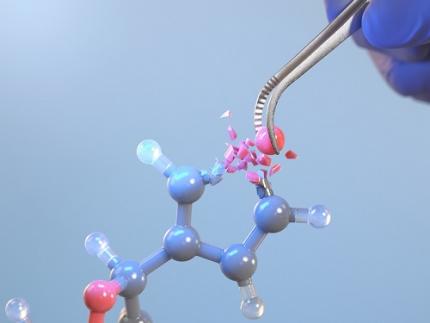
< Image. Conceptual image illustrating the main idea of the research >
This research was published in the prestigious scientific journal Science on October 3rd under the title "Photocatalytic Furan-to-Pyrrole Conversion."
Many drugs have complex chemical structures, but their efficacy is often determined by a single critical atom. Atoms like oxygen and nitrogen play a central role in enhancing the pharmacological effects of these drugs, particularly against viruses.
This phenomenon, where the introduction of specific atoms into a drug molecule dramatically affects its efficacy, is known as the "Single Atom Effect." In leading-edge drug development, discovering atoms that maximize drug efficacy is key.
However, evaluating the Single Atom Effect has traditionally required multi-step, costly synthesis processes, as it has been difficult to selectively edit single atoms within stable ring structures containing oxygen or nitrogen.
Professor Park’s team overcame this challenge by introducing a photocatalyst that uses light energy. They developed a photocatalyst that acts as a “molecular scissor,” freely cutting and attaching five-membered rings, enabling single-atom editing at room temperature and atmospheric pressure—a world first.
The team discovered a new reaction mechanism in which the excited molecular scissor removes oxygen from furan via single-electron oxidation and then sequentially adds a nitrogen atom.
Donghyeon Kim and Jaehyun You, the study's first authors and candidates in KAIST’s integrated master's and doctoral program in the Department of Chemistry, explained that this technique offers high versatility by utilizing light energy to replace harsh conditions. They further noted that the technology enables selective editing, even when applied to complex natural products or pharmaceuticals. Professor Yoonsu Park, who led the research, remarked, "This breakthrough, which allows for the selective editing of five-membered organic ring structures, will open new doors for building libraries of drug candidates, a key challenge in pharmaceuticals. I hope this foundational technology will be used to revolutionize the drug development process."
The significance of this research was highlighted in the Perspective section of Science, a feature where a peer scientist of prominence outside of the project group provides commentary on an impactful research.
This research was supported by the National Research Foundation of Korea’s Creative Research Program, the Cross-Generation Collaborative Lab Project at KAIST, and the POSCO Science Fellowship of the POSCO TJ Park Foundation.
2024.10.11 View 11026
KAIST Changes the Paradigm of Drug Discovery with World's First Atomic Editing
In pioneering drug development, the new technology that enables the easy and rapid editing of key atoms responsible for drug efficacy has been regarded as a fundamental and "dream" technology, revolutionizing the process of discovering potential drug candidates. KAIST researchers have become the first in the world to successfully develop single-atom editing technology that maximizes drug efficacy.
On October 8th, KAIST (represented by President Kwang-Hyung Lee) announced that Professor Yoonsu Park’s research team from the Department of Chemistry successfully developed technology that enables the easy editing and correction of oxygen atoms in furan compounds into nitrogen atoms, directly converting them into pyrrole frameworks, which are widely used in pharmaceuticals.
< Image. Conceptual image illustrating the main idea of the research >
This research was published in the prestigious scientific journal Science on October 3rd under the title "Photocatalytic Furan-to-Pyrrole Conversion."
Many drugs have complex chemical structures, but their efficacy is often determined by a single critical atom. Atoms like oxygen and nitrogen play a central role in enhancing the pharmacological effects of these drugs, particularly against viruses.
This phenomenon, where the introduction of specific atoms into a drug molecule dramatically affects its efficacy, is known as the "Single Atom Effect." In leading-edge drug development, discovering atoms that maximize drug efficacy is key.
However, evaluating the Single Atom Effect has traditionally required multi-step, costly synthesis processes, as it has been difficult to selectively edit single atoms within stable ring structures containing oxygen or nitrogen.
Professor Park’s team overcame this challenge by introducing a photocatalyst that uses light energy. They developed a photocatalyst that acts as a “molecular scissor,” freely cutting and attaching five-membered rings, enabling single-atom editing at room temperature and atmospheric pressure—a world first.
The team discovered a new reaction mechanism in which the excited molecular scissor removes oxygen from furan via single-electron oxidation and then sequentially adds a nitrogen atom.
Donghyeon Kim and Jaehyun You, the study's first authors and candidates in KAIST’s integrated master's and doctoral program in the Department of Chemistry, explained that this technique offers high versatility by utilizing light energy to replace harsh conditions. They further noted that the technology enables selective editing, even when applied to complex natural products or pharmaceuticals. Professor Yoonsu Park, who led the research, remarked, "This breakthrough, which allows for the selective editing of five-membered organic ring structures, will open new doors for building libraries of drug candidates, a key challenge in pharmaceuticals. I hope this foundational technology will be used to revolutionize the drug development process."
The significance of this research was highlighted in the Perspective section of Science, a feature where a peer scientist of prominence outside of the project group provides commentary on an impactful research.
This research was supported by the National Research Foundation of Korea’s Creative Research Program, the Cross-Generation Collaborative Lab Project at KAIST, and the POSCO Science Fellowship of the POSCO TJ Park Foundation.
2024.10.11 View 11026 -
 System Approach Using Metabolite Structural Similarity Toward TOM Suggested
A Korean research team at KAIST suggests that a system approach using metabolite structural similarity helps to elucidate the mechanisms of action of traditional oriental medicine.
Traditional oriental medicine (TOM) has been practiced in Asian countries for centuries, and is gaining increasing popularity around the world. Despite its efficacy in various symptoms, TOM has been practiced without precise knowledge of its mechanisms of action. Use of TOM largely comes from empirical knowledge practiced over a long period of time. The fact that some of the compounds found in TOM have led to successful modern drugs such as artemisinin for malaria and taxol (Paclitaxel) for cancer has spurred modernization of TOM.
A research team led by Sang-Yup Lee at KAIST has focused on structural similarities between compounds in TOM and human metabolites to help explain TOM’s mechanisms of action. This systems approach using structural similarities assumes that compounds which are structurally similar to metabolites could affect relevant metabolic pathways and reactions by biosynthesizing structurally similar metabolites.
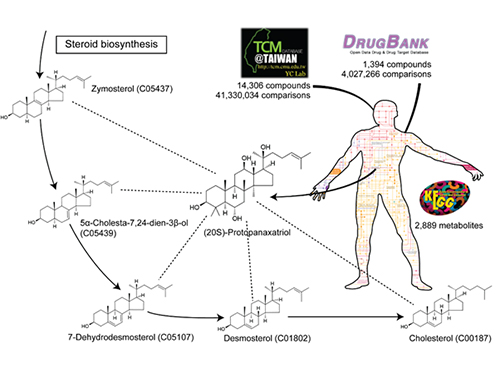
Structural similarity analysis has helped to identify mechanisms of action of TOM. This is described in a recent study entitled “A systems approach to traditional oriental medicine,” published online in Nature Biotechnology on March 6, 2015. In this study, the research team conducted structural comparisons of all the structurally known compounds in TOM and human metabolites on a large-scale. As a control, structures of all available approved drugs were also compared against human metabolites. This structural analysis provides two important results. First, the identification of metabolites structurally similar to TOM compounds helped to narrow down the candidate target pathways and reactions for the effects from TOM compounds. Second, it suggested that a greater fraction of all the structurally known TOM compounds appeared to be more similar to human metabolites than the approved drugs. This second finding indicates that TOM has a great potential to interact with diverse metabolic pathways with strong efficacy. This finding, in fact, shows that TOM compounds might be advantageous for the multitargeting required to cure complex diseases. “Once we have narrowed down candidate target pathways and reactions using this structural similarity approach, additional in silico tools will be necessary to characterize the mechanisms of action of many TOM compounds at a molecular level,” said Hyun Uk Kim, a research professor at KAIST.
TOM’s multicomponent, multitarget approach wherein multiple components show synergistic effects to treat symptoms is highly distinctive. The researchers investigated previously observed effects recorded since 2000 of a set of TOM compounds with known mechanisms of action. TOM compounds’ synergistic combinations largely consist of a major compound providing the intended efficacy to the target site and supporting compounds which maximize the efficacy of the major compound. In fact, such combination designs appear to mirror the Kun-Shin-Choa-Sa design principle of TOM.
That principle, Kun-Shin-Choa-Sa (君臣佐使 or Jun-Chen-Zuo-Shi in Chinese) literally means “king-minister-assistant-ambassador.” In ancient East Asian medicine, treating human diseases and taking good care of the human body are analogous to the politics of governing a nation. Just as good governance requires that a king be supported by ministers, assistants and/or ambassadors, treating diseases or good care of the body required the combined use of herbal medicines designed based on the concept of Kun-Shin-Choa-Sa. Here, the Kun (king or the major component) indicates the major medicine (or herb) conveying the major drug efficacy, and is supported by three different types of medicines: the Shin (minister or the complementary component) for enhancing and/or complementing the efficacy of the Kun, Choa (assistant or the neutralizing component) for reducing any side effects caused by the Kun and reducing the minor symptoms accompanying major symptom, and Sa (ambassador or the delivery/retaining component) which facilitated the delivery of the Kun to the target site, and retaining the Kun for prolonged availability in the cells.
The synergistic combinations of TOM compounds reported in the literature showed four different types of synergisms: complementary action (similar to Kun-Shin), neutralizing action (similar to Kun-Choa), facilitating action or pharmacokinetic potentiation (both similar to Kun-Choa or Kun-Sa). Additional structural analyses for these compounds with synergism show that they appeared to affect metabolism of amino acids, co-factors and vitamins as major targets.
Professor Sang Yup Lee remarks, “This study lays a foundation for the integration of traditional oriental medicine with modern drug discovery and development. The systems approach taken in this analysis will be used to elucidate mechanisms of action of unknown TOM compounds which will then be subjected to rigorous validation through clinical and in silico experiments.”
Sources: Kim, H.U. et al. “A systems approach to traditional oriental medicine.” Nature Biotechnology. 33: 264-268 (2015).
This work was supported by the Bio-Synergy Research Project (2012M3A9C4048759) of the Ministry of Science, ICT and Future Planning through the National Research Foundation. This work was also supported by the Novo Nordisk Foundation.
The picture below presents the structural similarity analysis of comparing compounds in traditional oriental medicine and those in all available approved drugs against the structures of human metabolites.
2015.03.09 View 13697
System Approach Using Metabolite Structural Similarity Toward TOM Suggested
A Korean research team at KAIST suggests that a system approach using metabolite structural similarity helps to elucidate the mechanisms of action of traditional oriental medicine.
Traditional oriental medicine (TOM) has been practiced in Asian countries for centuries, and is gaining increasing popularity around the world. Despite its efficacy in various symptoms, TOM has been practiced without precise knowledge of its mechanisms of action. Use of TOM largely comes from empirical knowledge practiced over a long period of time. The fact that some of the compounds found in TOM have led to successful modern drugs such as artemisinin for malaria and taxol (Paclitaxel) for cancer has spurred modernization of TOM.
A research team led by Sang-Yup Lee at KAIST has focused on structural similarities between compounds in TOM and human metabolites to help explain TOM’s mechanisms of action. This systems approach using structural similarities assumes that compounds which are structurally similar to metabolites could affect relevant metabolic pathways and reactions by biosynthesizing structurally similar metabolites.
Structural similarity analysis has helped to identify mechanisms of action of TOM. This is described in a recent study entitled “A systems approach to traditional oriental medicine,” published online in Nature Biotechnology on March 6, 2015. In this study, the research team conducted structural comparisons of all the structurally known compounds in TOM and human metabolites on a large-scale. As a control, structures of all available approved drugs were also compared against human metabolites. This structural analysis provides two important results. First, the identification of metabolites structurally similar to TOM compounds helped to narrow down the candidate target pathways and reactions for the effects from TOM compounds. Second, it suggested that a greater fraction of all the structurally known TOM compounds appeared to be more similar to human metabolites than the approved drugs. This second finding indicates that TOM has a great potential to interact with diverse metabolic pathways with strong efficacy. This finding, in fact, shows that TOM compounds might be advantageous for the multitargeting required to cure complex diseases. “Once we have narrowed down candidate target pathways and reactions using this structural similarity approach, additional in silico tools will be necessary to characterize the mechanisms of action of many TOM compounds at a molecular level,” said Hyun Uk Kim, a research professor at KAIST.
TOM’s multicomponent, multitarget approach wherein multiple components show synergistic effects to treat symptoms is highly distinctive. The researchers investigated previously observed effects recorded since 2000 of a set of TOM compounds with known mechanisms of action. TOM compounds’ synergistic combinations largely consist of a major compound providing the intended efficacy to the target site and supporting compounds which maximize the efficacy of the major compound. In fact, such combination designs appear to mirror the Kun-Shin-Choa-Sa design principle of TOM.
That principle, Kun-Shin-Choa-Sa (君臣佐使 or Jun-Chen-Zuo-Shi in Chinese) literally means “king-minister-assistant-ambassador.” In ancient East Asian medicine, treating human diseases and taking good care of the human body are analogous to the politics of governing a nation. Just as good governance requires that a king be supported by ministers, assistants and/or ambassadors, treating diseases or good care of the body required the combined use of herbal medicines designed based on the concept of Kun-Shin-Choa-Sa. Here, the Kun (king or the major component) indicates the major medicine (or herb) conveying the major drug efficacy, and is supported by three different types of medicines: the Shin (minister or the complementary component) for enhancing and/or complementing the efficacy of the Kun, Choa (assistant or the neutralizing component) for reducing any side effects caused by the Kun and reducing the minor symptoms accompanying major symptom, and Sa (ambassador or the delivery/retaining component) which facilitated the delivery of the Kun to the target site, and retaining the Kun for prolonged availability in the cells.
The synergistic combinations of TOM compounds reported in the literature showed four different types of synergisms: complementary action (similar to Kun-Shin), neutralizing action (similar to Kun-Choa), facilitating action or pharmacokinetic potentiation (both similar to Kun-Choa or Kun-Sa). Additional structural analyses for these compounds with synergism show that they appeared to affect metabolism of amino acids, co-factors and vitamins as major targets.
Professor Sang Yup Lee remarks, “This study lays a foundation for the integration of traditional oriental medicine with modern drug discovery and development. The systems approach taken in this analysis will be used to elucidate mechanisms of action of unknown TOM compounds which will then be subjected to rigorous validation through clinical and in silico experiments.”
Sources: Kim, H.U. et al. “A systems approach to traditional oriental medicine.” Nature Biotechnology. 33: 264-268 (2015).
This work was supported by the Bio-Synergy Research Project (2012M3A9C4048759) of the Ministry of Science, ICT and Future Planning through the National Research Foundation. This work was also supported by the Novo Nordisk Foundation.
The picture below presents the structural similarity analysis of comparing compounds in traditional oriental medicine and those in all available approved drugs against the structures of human metabolites.
2015.03.09 View 13697 -
 Professor Kyu-Young Whang receives the PAKDD Distinguished Contributions Award
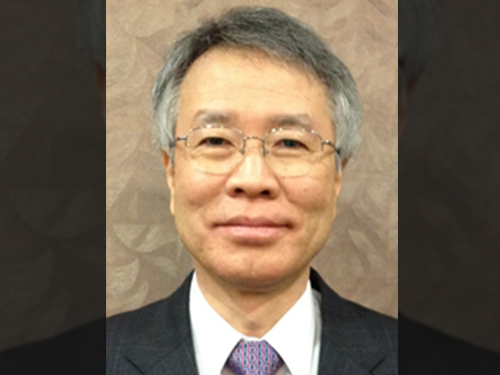
Professor Kyu-Young Whag
Dr. Kyu-Young Whang, Distinguished Professor from the Department of Computer Science, KAIST, has received the 2014 Distinguished Contributions Award from the Pacific-Asia Conference on Knowledge Discovery and Data Mining (PAKDD). PAKDD is the leading academic international conference on data mining held in Asia/Pacific. This year’s international conference was held from 13th to 15th May at Tainan, Taiwan.
As a life member of the PAKDD Steering Committee, Professor Whang worked for the development of the data mining field in the Asia-Pacific region, and his contribution to the international database and data-mining field has been widely recognized.
The PAKDD Distinguished Contributions Award has been awarded to a total of six people until now, including Professor Whang, and he is the first Korean to receive this award.
Professor Whang has also a history of receiving the Outstanding Contributions Award in 2011 from the Database Systems for Advanced Applications (DASFAA), the prestigious database academic conference in the Asia-Pacific region. The database and data mining field in the region was barren 20 years ago, but through the efforts and contributions of many researchers, including Professor Whang, it has now leapt to the level of being the equal of North American and European researchers.
In fact, three academic organizations in the current international database field are led by professors in the Asia-Pacific region. The IEEE ICDE (Institute of Electrical and Electronics Engineers Technical Committee on Data Engineering) is led by Professor Whang; the VLDB (Very Large Data Base) Endowment by Professor Beng Chin Ooi from National University of Singapore (NUS); and the ACM SIGMOD (Association for Computing Machinery Special Interest Group on Management of Data) by Professor Don Kossmann from ETH Zurich.
2014.05.26 View 12557
Professor Kyu-Young Whang receives the PAKDD Distinguished Contributions Award
Professor Kyu-Young Whag
Dr. Kyu-Young Whang, Distinguished Professor from the Department of Computer Science, KAIST, has received the 2014 Distinguished Contributions Award from the Pacific-Asia Conference on Knowledge Discovery and Data Mining (PAKDD). PAKDD is the leading academic international conference on data mining held in Asia/Pacific. This year’s international conference was held from 13th to 15th May at Tainan, Taiwan.
As a life member of the PAKDD Steering Committee, Professor Whang worked for the development of the data mining field in the Asia-Pacific region, and his contribution to the international database and data-mining field has been widely recognized.
The PAKDD Distinguished Contributions Award has been awarded to a total of six people until now, including Professor Whang, and he is the first Korean to receive this award.
Professor Whang has also a history of receiving the Outstanding Contributions Award in 2011 from the Database Systems for Advanced Applications (DASFAA), the prestigious database academic conference in the Asia-Pacific region. The database and data mining field in the region was barren 20 years ago, but through the efforts and contributions of many researchers, including Professor Whang, it has now leapt to the level of being the equal of North American and European researchers.
In fact, three academic organizations in the current international database field are led by professors in the Asia-Pacific region. The IEEE ICDE (Institute of Electrical and Electronics Engineers Technical Committee on Data Engineering) is led by Professor Whang; the VLDB (Very Large Data Base) Endowment by Professor Beng Chin Ooi from National University of Singapore (NUS); and the ACM SIGMOD (Association for Computing Machinery Special Interest Group on Management of Data) by Professor Don Kossmann from ETH Zurich.
2014.05.26 View 12557 -
 The hereditary factor of autism revealed
Korean researchers have successfully investigated the causes and hereditary factors for autistic behavior and proposed a new treatment method with fewer side effects.
This research was jointly supported by the Ministry of Education, Science and Technology and the National Research Foundation as part of the Leading Researcher and Science Research Center Program
The research findings were publishing in the June edition of Nature magazine and will also be introduced in the July edition of Nature Reviews Drug Discovery, under the title ‘Autistic-like social behavior in Shank2-mutant mice improved by restoring NMDA receptor function’.
The research team found that lack of Shank2 genes in mice, which are responsible for the production of synapse proteins, caused autistic-like behavior. The results strongly suggested that the Shank2 gene was linked to autistic behavior and that Shank2 deficiency induced autistic behaviors.
Autism is a neural development disorder characterized by impaired social interaction, repetitive behavior, mental retardation, anxiety and hyperactivity. Around 100 million people worldwide display symptoms of autistic behavior. Recent studies conducted by the University of Washington revealed that 1 out of 3 young adults who display autistic behavior do not fit into the workplace or get accepted to college, a much higher rate than any other disorder. However, an effective cure has not yet been developed and current treatments are limited to reducing repetitive behavior.
The research team confirmed autistic-like social behavior in mice without the Shank2 genes and that the mice had decreased levels of neurotransmission in the NMDA receptor. The mice also showed damaged synaptic plasticity* in the hippocampus**.
* Plasticity: ability of the connectionbetween two neurons to change in strength in response to transmission of information
**Hippocampus: part of the brain responsible for short-term and long-term memory as well as spatial navigation.
The research team also found out that, to restore the function of the NMDA receptor, the passive stimulation of certain receptors, such as the mGLuR5, yielded better treatment results than the direct stimulation of the NMDA. This greatly reduces the side effects associated with the direct stimulation of receptors, resulting in a more effective treatment method.
This research successfully investigated the function of the Shank2 gene in the nerve tissue and showed how the reduced function of the NMDA receptor, due to the lack of the gene, resulted in autistic behavior. It also provided new possibilities for the treatment of autistic behavior and impaired social interaction
2012.06.24 View 18592
The hereditary factor of autism revealed
Korean researchers have successfully investigated the causes and hereditary factors for autistic behavior and proposed a new treatment method with fewer side effects.
This research was jointly supported by the Ministry of Education, Science and Technology and the National Research Foundation as part of the Leading Researcher and Science Research Center Program
The research findings were publishing in the June edition of Nature magazine and will also be introduced in the July edition of Nature Reviews Drug Discovery, under the title ‘Autistic-like social behavior in Shank2-mutant mice improved by restoring NMDA receptor function’.
The research team found that lack of Shank2 genes in mice, which are responsible for the production of synapse proteins, caused autistic-like behavior. The results strongly suggested that the Shank2 gene was linked to autistic behavior and that Shank2 deficiency induced autistic behaviors.
Autism is a neural development disorder characterized by impaired social interaction, repetitive behavior, mental retardation, anxiety and hyperactivity. Around 100 million people worldwide display symptoms of autistic behavior. Recent studies conducted by the University of Washington revealed that 1 out of 3 young adults who display autistic behavior do not fit into the workplace or get accepted to college, a much higher rate than any other disorder. However, an effective cure has not yet been developed and current treatments are limited to reducing repetitive behavior.
The research team confirmed autistic-like social behavior in mice without the Shank2 genes and that the mice had decreased levels of neurotransmission in the NMDA receptor. The mice also showed damaged synaptic plasticity* in the hippocampus**.
* Plasticity: ability of the connectionbetween two neurons to change in strength in response to transmission of information
**Hippocampus: part of the brain responsible for short-term and long-term memory as well as spatial navigation.
The research team also found out that, to restore the function of the NMDA receptor, the passive stimulation of certain receptors, such as the mGLuR5, yielded better treatment results than the direct stimulation of the NMDA. This greatly reduces the side effects associated with the direct stimulation of receptors, resulting in a more effective treatment method.
This research successfully investigated the function of the Shank2 gene in the nerve tissue and showed how the reduced function of the NMDA receptor, due to the lack of the gene, resulted in autistic behavior. It also provided new possibilities for the treatment of autistic behavior and impaired social interaction
2012.06.24 View 18592 -
New drug targeting method for microbial pathogens developed using in silico cell
A ripple effect is expected on the new antibacterial discovery using “in silico” cells
Featured as a journal cover paper of Molecular BioSystems
A research team of Distinguished Professor Sang Yup Lee at KAIST recently constructed an in silico cell of a microbial pathogen that is resistant to antibiotics and developed a new drug targeting method that could effectively disrupt the pathogen"s growth using the in silico cell.
Hyun Uk Kim, a graduate research assistant at the Department of Chemical and Biomolecular Engineering, KAIST, conducted this study as a part of his thesis research, and the study was featured as a journal cover paper in the February issue of Molecular BioSystems this year, published by The Royal Society of Chemistry based in Europe.
It was relatively easy to treat infectious microbes using antibiotics in the past. However, the overdose of antibiotics has caused pathogens to increase their resistance to various antibiotics, and it has become more difficult to cure infectious diseases these days.
A representative microbial pathogen is Acinetobacter baumannaii. Originally isolated from soils and water, this microorganism did not have resistance to antibiotics, and hence it was easy to eradicate them if infected. However, within a decade, this miroorganism has transformed into a dreadful super-bacterium resistant to antibiotics and caused many casualties among the U.S. and French soldiers who were injured from the recent Iraqi war and infected with Acinetobacter baumannaii.
Professor Lee’s group constructed an in silico cell of this A. baumannii by computationally collecting, integrating, and analyzing the biological information of the bacterium, scattered over various databases and literatures, in order to study this organism"s genomic features and system-wide metabolic characteristics. Furthermore, they employed this in silico cell for integrative approaches, including several network analysis and analysis of essential reactions and metabolites, to predict drug targets that effectively disrupt the pathogen"s growth. Final drug targets are the ones that selectively kill pathogens without harming human body.
Here, essential reactions refer to enzymatic reactions required for normal metabolic functioning in organisms, while essential metabolites indicate chemical compounds required in the metabolism for proper functioning, and their removal brings about the effect of simultaneously disrupting their associated enzymes that interact with them.
This study attempted to predict highly reliable drug targets by systematically scanning biological components, including metabolic genes, enzymatic reactions, that constitute an in silico cell in a short period of time.
This research achievement is highly regarded as it, for the first time, systematically scanned essential metabolites for the effective drug targets using the concept of systems biology, and paved the way for a new antibacterial discovery. This study is also expected to contribute to elucidating the infectious mechanism caused by pathogens.
"Although tons of genomic information is poured in at this moment, application research that efficiently converts this preliminary information into actually useful information is still lagged behind. In this regard, this study is meaningful in that medically useful information is generated from the genomic information of Acinetobacter baumannii," says Professor Lee. "In particular, development of this organism"s in silico cell allows generation of new knowledge regarding essential genes and enzymatic reactions under specific conditions," he added.
This study was supported by the Korean Systems Biology Project of the Ministry of Education, Science and Technology, and the patent for the development of in silico cells of microbial pathogens and drug targeting methods has been filed.
[Picture 1 Cells in silico]
[Picture 2 A process of generating drug targets without harming human body while effectively disrupting the growth of a pathogen, after predicting metabolites from in silico cells]
2010.04.05 View 25313
-
 Two KAIST Professors Elected Fellows of APS
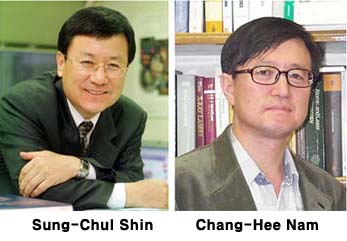
Profs. Sung-Chul Shin and Chang-Hee Nam of the Department of Physics, KAIST, have recently been elected the 2009 fellows of the American Physical Society (APS), university officials said on Tuesday (Dec. 2).
The APS fellowship is a prestigious recognition of the two professors" outstanding academic achievements in the field of physics, the officials said. The selection criteria are known to be extremely stringent and only a small fraction of APS members become fellows.
Prof. Shin was cited for his pioneering contributions to the understanding of magnetization reversal dynamics, in particular critical scaling behavior of Barkhausen avalanches of 2D ferromagnets, and discovery of novel magnetic thin films and multilayers for high-density data storage.
Prof. Nam was recognized for his contributions to the theory and experiments of physical processes of high harmonic generation for the development of attosecond coherent x-ray sources and related femtosecond laser technology.
The American Physical Society, founded in 1899, is the world"s second largest organization of physicists, behind the Deutsche Physikalische Gesellschaft. It has 46,000 members across the world.
2008.12.04 View 21300
Two KAIST Professors Elected Fellows of APS
Profs. Sung-Chul Shin and Chang-Hee Nam of the Department of Physics, KAIST, have recently been elected the 2009 fellows of the American Physical Society (APS), university officials said on Tuesday (Dec. 2).
The APS fellowship is a prestigious recognition of the two professors" outstanding academic achievements in the field of physics, the officials said. The selection criteria are known to be extremely stringent and only a small fraction of APS members become fellows.
Prof. Shin was cited for his pioneering contributions to the understanding of magnetization reversal dynamics, in particular critical scaling behavior of Barkhausen avalanches of 2D ferromagnets, and discovery of novel magnetic thin films and multilayers for high-density data storage.
Prof. Nam was recognized for his contributions to the theory and experiments of physical processes of high harmonic generation for the development of attosecond coherent x-ray sources and related femtosecond laser technology.
The American Physical Society, founded in 1899, is the world"s second largest organization of physicists, behind the Deutsche Physikalische Gesellschaft. It has 46,000 members across the world.
2008.12.04 View 21300 -
Best Academic Award to Prof. Huen Lee
Professor Huen Lee, Department of Chemical and Biomolecular Engineering, received the Best Prize of KAIST Academic Awards at the 36th anniversary ceremony of KAIST.
Professor Lee has published 43 international papers and 12 domestic papers for the past five years and achieved world’s distinguished academic performances such as the development of hydrogen storage technologies, the discovery of the principle on carbon dioxide-methane hydrate swapping, etc.
Professor Lee published his paper on methane hydrate at Science in 2003, and Nature introduced his paper on hydrate storage technologies as ‘highlight research’ in 2005, commenting his research as a landmark performance to pave ways for the development of future hydrogen energy. His discovery on ‘the principle of carbon dioxide-methane hydrate swapping’, published by PNAS in 2006, also gained huge attraction across the world as one of the promising technologies that can solve energy problem and global warming crisis simultaneously.
Meanwhile, the rest of the awardees of 2007 are as follows:
- Academic Award: Professor Jongkyeong Chung, Dep. of Biological SciencesAssociate professor Changok Lee, Dep. of MathematicsAssociate professor Sangkyu Kim, Dep. of ChemistryProfessor Dae-gab Gweon, Dep. of Mechanical Engineering
- Creative Lecture Award: Associate professor Jaehung Han, Dep. of Aerospace Engineering
- Excellent Lecture Award: Assistant profess Bong Gwan Jun, School of Humanities & Social Science Professor Joonho Choe, Dep. of Biological Sciences Professor Changwon Kang, Dep. of Biological Sciences Professor Seunghyup Yoo, Div. of Electrical Engineering Associate professor Otfried Cheong, Div. of Computer Science Professor Hoe Kyung Lee, Graduate School of Finance
- Contribution Award: Professor Sung Chul Shin, Dep. of Physics Professor Bowon Kim, Graduate School of Culture Technology Professor Jisoo Kim, Graduate School of Finance
- International Cooperation Best Award: Professor Hyung Suck Cho, Dep. of Mechanical Engineering
- International Cooperation Award: Professor Kunpyo Lee, Dep. of Industrial Design Professor Soon Hyung Hong, Dep. of Materials Science & Engineering Professor Sungjoo Park, Graduate School of Culture Technology
2007.03.19 View 25683