%63%65%72%65%6d%6f%6e%79
-
 See You at KAIST: Freshman Keeps His Promise as 2026 Matriculation Ceremony Begins
<2026 Undergraduate Matriculation Ceremony>
KAIST announced that it will hold the 2026 Undergraduate Matriculation Ceremony today, February 25, at 10:00 AM in the Auditorium of the Main Campus in Daejeon. The event marks the first step for freshmen who will lead the future of South Korea’s science and technology.
In his welcoming remarks, President Kwang Hyung Lee plans to emphasize that “KAIST is a university built upon a spirit of inquiry that never stops questioning and a drive for challenge that does not fear failure.” He will encourage the students, stating, “I hope you challenge yourselves to your heart's content, and even if you fall, stand back up to blaze new trails that the world has never seen before.”
President Lee will also highlight that the role of talent in science and technology is more critical than ever in this era of massive transformation driven by Artificial Intelligence (AI) and digital transition. He plans to urge students to grow into responsible scientists and engineers who contribute to humanity and society through cooperation and communication, adding, “KAIST will spare no effort in supporting you to ensure your challenges become a reality.”
Marking the 40th class of incoming freshmen, this year’s ceremony will be attended by approximately 1,500 people, including students, parents, and distinguished guests, to celebrate this new beginning.
The speech by Junseop Shin, the student representative taking the podium, begins with the theme of a “promise.” He plans to share how the words “See you at KAIST,” spoken to him by President Kwang Hyung Lee at a defense industry forum three years ago, turned a vague dream into a definitive goal.
<Student Representative Junseop Shin delivering his speech>
Having contemplated his role in an era where science and technology dictate national competitiveness, Shin chose the challenging path of researching “small drone detection technology” instead of a more stable route. Despite numerous failures, frustrations, and discouragement from those around him, he persevered by remembering that promise, eventually achieving a technical breakthrough that garnered attention from international academic societies.
“I learned that keeping a promise isn't about never falling, but about getting back up every time you do,” Shin plans to say, vowing that his new beginning at KAIST will be a journey of fearless challenge.
The ceremony will also introduce the KAIST AI Future Challenge, themed “New and Innovative Ideas for the Future AI Era.” Any KAIST student can participate individually or as a team to tackle future societal issues with creative and feasible ideas. The winning teams will be honored at the “Education Innovation Day” ceremony in May.
<Students taking the matriculation oath>
Following the matriculation ceremony, an orientation will be held to assist students with their first steps into university life. This will include introductions to freshman programs, as well as essential training on community guidelines, mental health services, violence prevention, and safety education to support the students' stable transition into their studies and research.
Furthermore, the three-day “Freshman Start-up (Saenaegi Saerobaumteo)” will feature a diverse range of programs, including club performances, fairs, campus tours, and a welcoming broadcast festival. Freshmen will have the opportunity to experience KAIST culture firsthand and socialize with seniors and peers to shape their vision for university life.
2026.02.25 View 1287
See You at KAIST: Freshman Keeps His Promise as 2026 Matriculation Ceremony Begins
<2026 Undergraduate Matriculation Ceremony>
KAIST announced that it will hold the 2026 Undergraduate Matriculation Ceremony today, February 25, at 10:00 AM in the Auditorium of the Main Campus in Daejeon. The event marks the first step for freshmen who will lead the future of South Korea’s science and technology.
In his welcoming remarks, President Kwang Hyung Lee plans to emphasize that “KAIST is a university built upon a spirit of inquiry that never stops questioning and a drive for challenge that does not fear failure.” He will encourage the students, stating, “I hope you challenge yourselves to your heart's content, and even if you fall, stand back up to blaze new trails that the world has never seen before.”
President Lee will also highlight that the role of talent in science and technology is more critical than ever in this era of massive transformation driven by Artificial Intelligence (AI) and digital transition. He plans to urge students to grow into responsible scientists and engineers who contribute to humanity and society through cooperation and communication, adding, “KAIST will spare no effort in supporting you to ensure your challenges become a reality.”
Marking the 40th class of incoming freshmen, this year’s ceremony will be attended by approximately 1,500 people, including students, parents, and distinguished guests, to celebrate this new beginning.
The speech by Junseop Shin, the student representative taking the podium, begins with the theme of a “promise.” He plans to share how the words “See you at KAIST,” spoken to him by President Kwang Hyung Lee at a defense industry forum three years ago, turned a vague dream into a definitive goal.
<Student Representative Junseop Shin delivering his speech>
Having contemplated his role in an era where science and technology dictate national competitiveness, Shin chose the challenging path of researching “small drone detection technology” instead of a more stable route. Despite numerous failures, frustrations, and discouragement from those around him, he persevered by remembering that promise, eventually achieving a technical breakthrough that garnered attention from international academic societies.
“I learned that keeping a promise isn't about never falling, but about getting back up every time you do,” Shin plans to say, vowing that his new beginning at KAIST will be a journey of fearless challenge.
The ceremony will also introduce the KAIST AI Future Challenge, themed “New and Innovative Ideas for the Future AI Era.” Any KAIST student can participate individually or as a team to tackle future societal issues with creative and feasible ideas. The winning teams will be honored at the “Education Innovation Day” ceremony in May.
<Students taking the matriculation oath>
Following the matriculation ceremony, an orientation will be held to assist students with their first steps into university life. This will include introductions to freshman programs, as well as essential training on community guidelines, mental health services, violence prevention, and safety education to support the students' stable transition into their studies and research.
Furthermore, the three-day “Freshman Start-up (Saenaegi Saerobaumteo)” will feature a diverse range of programs, including club performances, fairs, campus tours, and a welcoming broadcast festival. Freshmen will have the opportunity to experience KAIST culture firsthand and socialize with seniors and peers to shape their vision for university life.
2026.02.25 View 1287 -
 2026 KAIST Commencement: Shining Their Own Light on Their Respective Stages
KAIST (President Kwang Hyung Lee) announced that it held its 2026 Commencement Ceremony at 2 p.m. on February 20th at the Sports Complex on its Main Campus in Daejeon.
At this year’s ceremony, a total of 3,334 graduates received degrees, including 817 doctoral, 1,792 master’s, and 725 bachelor’s degrees. Since its founding in 1971, KAIST has now produced a total of 84,490 highly qualified science and technology professionals, including 18,130 Ph.D. recipients, 43,358 master’s graduates, and 23,002 bachelor’s graduates.
KAIST selected three representative graduates who embody the university’s vision of talent. They are Seunghyun Ryu (Department of Bio and Brain Engineering), the doctoral representative known as the “pianist neuroscientist” for his interdisciplinary research bridging brain science and piano performance; Jeanne Choi (School of Computing), the master’s representative who has pursued warm and inclusive technologies for socially vulnerable groups under the themes of accessibility and inclusion; and Mert Yakup Baykan (Department of Aerospace Engineering), the bachelor’s representative from Cyprus holding Turkish nationality, who became the first international recipient of the KAIST Presidential Scholarship.
Seunghyun Ryu, selected as both the doctoral representative and one of the notable graduates, spent 14 years at KAIST completing his undergraduate through doctoral studies while balancing research and music. He organized and managed performances through the campus piano club “PIAST,” expanding artistic activities within the campus community. His research explored the inverse relationship between Alzheimer’s disease and cancer, revealing how disease-related proteins and anticancer drugs act in neurons and offering new perspectives on inter-disease connections.
Jeanne Choi, the master’s representative and another notable graduate, presented research at AAATE 2023 in Paris, analyzing the experiences of visually impaired users engaging with the metaverse and artificial intelligence. Accompanying a visually impaired professor during the conference, Choi gained firsthand insight into mobility and safety challenges, which further expanded the scope of her research. Choi has since continued field-based research, including serving as a teaching assistant at AI and coding camps for visually impaired youth, and plans to pursue a doctoral degree while continuing research for socially vulnerable communities.
Bachelor’s representative Mert Yakup Baykan actively participated in research during his undergraduate studies, publishing four SCI-indexed papers and delivering five conference presentations. He was also selected as a visiting student researcher at King Abdullah University of Science and Technology (KAUST) in Saudi Arabia, gaining international collaborative research experience. As the first international KAIST Presidential Scholar, he plans to pursue a Ph.D. at Stanford University and grow into a leading researcher in space propulsion and combustion.
Awards for outstanding graduates were also presented. Seohyeon Kang (B.S., Brain and Cognitive Sciences) received the Minister of Science and ICT Award (Deputy Prime Minister’s Award). The Chairman of the Board Award was presented to Thai international student Punn Lertjaturaphat (B.S., Industrial Design). The President’s Award went to Kyeongmin Yeo (B.S., School of Computing), while the Alumni Association President’s Award and the KAIST Development Foundation Chairman’s Award were presented to Wonwoo Yoo (B.S., Aerospace Engineering) and Sungbeen Park (B.S., Nuclear and Quantum Engineering), respectively. Hyuk-chae Koo, 1st Vice Minister of Science and ICT, presented the awards on behalf of the Deputy Prime Minister and Minister of Science and ICT.
Seohyeon Kang developed a technology to measure key proteins related to Parkinson’s disease without surgery or tissue damage, opening new possibilities in brain disease research, and was recognized as a model graduate who combined academic excellence with community service. Punn Lertjaturaphat gained recognition at prestigious international conferences such as ACM CHI and co-founded a startup addressing rural elderly care issues, demonstrating creativity in solving social problems through technology and design.
Kyeongmin Yeo published six research papers at leading AI conferences including NeurIPS, ICLR, and CVPR, proposing new theoretical approaches to image generation and demonstrating outstanding academic achievement as a young researcher.
Wonwoo Yoo led the overseas volunteer corps and served as student representative, combining leadership with academic excellence, including winning a grand prize in a rocket launch competition. Sungbeen Park proposed a next-generation beta battery concept, linking it to patents and entrepreneurship, while contributing to public communication and outreach in nuclear technology as student council president and university ambassador.
Commencement addresses were delivered by Dongjae Kang (B.S., Industrial and Systems Engineering) and Gul Osman (Ph.D., Mechanical Engineering), an international student from Türkiye. Kang reflected on how he learned science not merely as an avenue for problem-solving but as a process for exploring the deeper meaning behind phenomena, pledging to remain attentive to unseen challenges faced by others. Osman shared his journey of nurturing his passion for science while working in a factory under difficult economic circumstances, emphasizing that opportunities open to those who persist without giving up. He began his academic journey in Korea through the Korean Government Scholarship Program.
This year, KAIST also spotlighted three notable graduates who forged their own paths encompassing research, the arts, and social value: Seunghyun Ryu, Jeanne Choi, and Daehui Kim (B.S., Civil and Environmental Engineering). Kim led campus environmental organizations and community-based environmental campaigns, earning an Environmental Contribution Award. He plans to pursue a master’s degree focusing on carbon dioxide geological storage research. He also performs as the vocalist of the KAIST metal band “INFINITE,” continuing to balance music and research.
During the ceremony, an Honorary Doctorate in Business Administration was conferred upon uey-Yu Wang, Executive Management Committee Member of Formosa Group and Chairman of Formosa Biomedical Technology Corporation.
President Kwang Hyung Lee encouraged the graduates, saying, “Cherish your dreams, seize opportunities, do not fear failure, and continue to challenge yourselves. I hope you will shine in your own way on your own stage and contribute to society as proud members of the KAIST community.”
2026.02.21 View 2857
2026 KAIST Commencement: Shining Their Own Light on Their Respective Stages
KAIST (President Kwang Hyung Lee) announced that it held its 2026 Commencement Ceremony at 2 p.m. on February 20th at the Sports Complex on its Main Campus in Daejeon.
At this year’s ceremony, a total of 3,334 graduates received degrees, including 817 doctoral, 1,792 master’s, and 725 bachelor’s degrees. Since its founding in 1971, KAIST has now produced a total of 84,490 highly qualified science and technology professionals, including 18,130 Ph.D. recipients, 43,358 master’s graduates, and 23,002 bachelor’s graduates.
KAIST selected three representative graduates who embody the university’s vision of talent. They are Seunghyun Ryu (Department of Bio and Brain Engineering), the doctoral representative known as the “pianist neuroscientist” for his interdisciplinary research bridging brain science and piano performance; Jeanne Choi (School of Computing), the master’s representative who has pursued warm and inclusive technologies for socially vulnerable groups under the themes of accessibility and inclusion; and Mert Yakup Baykan (Department of Aerospace Engineering), the bachelor’s representative from Cyprus holding Turkish nationality, who became the first international recipient of the KAIST Presidential Scholarship.
Seunghyun Ryu, selected as both the doctoral representative and one of the notable graduates, spent 14 years at KAIST completing his undergraduate through doctoral studies while balancing research and music. He organized and managed performances through the campus piano club “PIAST,” expanding artistic activities within the campus community. His research explored the inverse relationship between Alzheimer’s disease and cancer, revealing how disease-related proteins and anticancer drugs act in neurons and offering new perspectives on inter-disease connections.
Jeanne Choi, the master’s representative and another notable graduate, presented research at AAATE 2023 in Paris, analyzing the experiences of visually impaired users engaging with the metaverse and artificial intelligence. Accompanying a visually impaired professor during the conference, Choi gained firsthand insight into mobility and safety challenges, which further expanded the scope of her research. Choi has since continued field-based research, including serving as a teaching assistant at AI and coding camps for visually impaired youth, and plans to pursue a doctoral degree while continuing research for socially vulnerable communities.
Bachelor’s representative Mert Yakup Baykan actively participated in research during his undergraduate studies, publishing four SCI-indexed papers and delivering five conference presentations. He was also selected as a visiting student researcher at King Abdullah University of Science and Technology (KAUST) in Saudi Arabia, gaining international collaborative research experience. As the first international KAIST Presidential Scholar, he plans to pursue a Ph.D. at Stanford University and grow into a leading researcher in space propulsion and combustion.
Awards for outstanding graduates were also presented. Seohyeon Kang (B.S., Brain and Cognitive Sciences) received the Minister of Science and ICT Award (Deputy Prime Minister’s Award). The Chairman of the Board Award was presented to Thai international student Punn Lertjaturaphat (B.S., Industrial Design). The President’s Award went to Kyeongmin Yeo (B.S., School of Computing), while the Alumni Association President’s Award and the KAIST Development Foundation Chairman’s Award were presented to Wonwoo Yoo (B.S., Aerospace Engineering) and Sungbeen Park (B.S., Nuclear and Quantum Engineering), respectively. Hyuk-chae Koo, 1st Vice Minister of Science and ICT, presented the awards on behalf of the Deputy Prime Minister and Minister of Science and ICT.
Seohyeon Kang developed a technology to measure key proteins related to Parkinson’s disease without surgery or tissue damage, opening new possibilities in brain disease research, and was recognized as a model graduate who combined academic excellence with community service. Punn Lertjaturaphat gained recognition at prestigious international conferences such as ACM CHI and co-founded a startup addressing rural elderly care issues, demonstrating creativity in solving social problems through technology and design.
Kyeongmin Yeo published six research papers at leading AI conferences including NeurIPS, ICLR, and CVPR, proposing new theoretical approaches to image generation and demonstrating outstanding academic achievement as a young researcher.
Wonwoo Yoo led the overseas volunteer corps and served as student representative, combining leadership with academic excellence, including winning a grand prize in a rocket launch competition. Sungbeen Park proposed a next-generation beta battery concept, linking it to patents and entrepreneurship, while contributing to public communication and outreach in nuclear technology as student council president and university ambassador.
Commencement addresses were delivered by Dongjae Kang (B.S., Industrial and Systems Engineering) and Gul Osman (Ph.D., Mechanical Engineering), an international student from Türkiye. Kang reflected on how he learned science not merely as an avenue for problem-solving but as a process for exploring the deeper meaning behind phenomena, pledging to remain attentive to unseen challenges faced by others. Osman shared his journey of nurturing his passion for science while working in a factory under difficult economic circumstances, emphasizing that opportunities open to those who persist without giving up. He began his academic journey in Korea through the Korean Government Scholarship Program.
This year, KAIST also spotlighted three notable graduates who forged their own paths encompassing research, the arts, and social value: Seunghyun Ryu, Jeanne Choi, and Daehui Kim (B.S., Civil and Environmental Engineering). Kim led campus environmental organizations and community-based environmental campaigns, earning an Environmental Contribution Award. He plans to pursue a master’s degree focusing on carbon dioxide geological storage research. He also performs as the vocalist of the KAIST metal band “INFINITE,” continuing to balance music and research.
During the ceremony, an Honorary Doctorate in Business Administration was conferred upon uey-Yu Wang, Executive Management Committee Member of Formosa Group and Chairman of Formosa Biomedical Technology Corporation.
President Kwang Hyung Lee encouraged the graduates, saying, “Cherish your dreams, seize opportunities, do not fear failure, and continue to challenge yourselves. I hope you will shine in your own way on your own stage and contribute to society as proud members of the KAIST community.”
2026.02.21 View 2857 -
 Vieworks CEO Hu-sik Kim Appointed as 28th KAIST Alumni Association President
< Hu-sik Kim, 28th President of KAIST Alumni Association (CEO of Vieworks) >
KAIST announced on December 23rd that Hu-sik Kim, CEO of Vieworks—a company specializing in medical and industrial imaging solutions—has been appointed as the 28th President of the KAIST Alumni Association.
President-elect Hu-sik Kim, an alumnus with a Master’s degree in Physics (Class of ’95) from KAIST, is a technology-driven leader who has dedicated 26 years to the field of imaging solutions. He is recognized as a "field-oriented innovator" who has pioneered global niche markets with world-first technologies and driven long-term growth by prioritizing people and organizational culture as core competencies.
While working professionally, he enrolled in the KAIST Master’s program to strengthen his theoretical and practical expertise in optics. Later, he played a leading role in co-founding a venture company with fellow alumni, successfully growing Vieworks into a prominent global mid-sized enterprise.
In his inauguration remarks, President Kim stated, “I feel a profound sense of responsibility to give back to the nation and the community for the benefits I have received. I will do my best to ensure that the values of innovation and entrepreneurship are realized through our alumni network, and that the alumni association and our alma mater can prosper together.”
President Kim’s term will span two years starting from January 2026. The inauguration ceremony will be held during the "2026 New Year’s Greeting Ceremony" on January 16, 2026, at the El Tower in Seoul.
2025.12.23 View 1805
Vieworks CEO Hu-sik Kim Appointed as 28th KAIST Alumni Association President
< Hu-sik Kim, 28th President of KAIST Alumni Association (CEO of Vieworks) >
KAIST announced on December 23rd that Hu-sik Kim, CEO of Vieworks—a company specializing in medical and industrial imaging solutions—has been appointed as the 28th President of the KAIST Alumni Association.
President-elect Hu-sik Kim, an alumnus with a Master’s degree in Physics (Class of ’95) from KAIST, is a technology-driven leader who has dedicated 26 years to the field of imaging solutions. He is recognized as a "field-oriented innovator" who has pioneered global niche markets with world-first technologies and driven long-term growth by prioritizing people and organizational culture as core competencies.
While working professionally, he enrolled in the KAIST Master’s program to strengthen his theoretical and practical expertise in optics. Later, he played a leading role in co-founding a venture company with fellow alumni, successfully growing Vieworks into a prominent global mid-sized enterprise.
In his inauguration remarks, President Kim stated, “I feel a profound sense of responsibility to give back to the nation and the community for the benefits I have received. I will do my best to ensure that the values of innovation and entrepreneurship are realized through our alumni network, and that the alumni association and our alma mater can prosper together.”
President Kim’s term will span two years starting from January 2026. The inauguration ceremony will be held during the "2026 New Year’s Greeting Ceremony" on January 16, 2026, at the El Tower in Seoul.
2025.12.23 View 1805 -
 KAIST, National Quantum Fab Research Institute Opening Ceremony and Research Building Groundbreaking Ceremony Held
<Groundbreaking Ceremony Shovel Scene for the KAIST National Quantum Fab Research Building>
KAIST announced on December 3rd that it held the opening ceremony for the National Quantum Fab Research Institute and the groundbreaking ceremony for the Quantum Fab Research Building at the KAIST main campus in Daejeon, officially commencing the construction of the nation's core infrastructure to enhance South Korea's quantum technology competitiveness.
The event began with a progress report and introduction of the institute by Yong Hoon Cho, Director of the Quantum Fab Research Institute, followed by a groundbreaking ceremony to mark the official start of the Quantum Fab Research Building's construction and an unveiling of the plaque. Approximately 50 officials attended the event, including Jang-woo Lee, Mayor of Daejeon, Kwang Hyung Lee, President of KAIST, and the presidents of the National Nanofab Center and the Korea Research Institute of Standards and Science, representing government, local government, and collaborating organizations.
<Plaque-Unveiling Scene at the Opening of the KAIST National Quantum Fab Research Institute>
Since being selected as the lead institution for the Quantum Fab in a competition held by the Ministry of Science and ICT and the Institute for Information & Communications Technology Planning & Evaluation last year, our university secured a commitment of 20 billion KRW from the Daejeon Metropolitan City for construction costs and completed the institute's establishment and design. The new Quantum Fab Research Building, with a total floor area of 2,498 ㎡, is targeted for completion in 2027.
The new building will house South Korea's largest specialized, open-access cleanroom fab for quantum devices. A total of 45 billion KRW or more will be invested by 2031, including national funds, local government funds, and KAIST's budget. Over 37 units of advanced equipment will be installed in the 1st and 3rd-floor FAB cleanrooms in stages, along with stability facilities such as Class 100-1,000 cleanliness standards, constant temperature/humidity, and emergency power supply.
The KAIST Quantum Fab operates on a fully open-access system allowing researchers to directly carry out processes. It will support processing technologies for various quantum platforms, including photons, point defects, and neutral atoms, and will also enhance user programs such as training and workshops. Phase 1 service began in July of this year, and Phase 2 full-scale operation, based on the newly installed equipment, will start in 2028.
Jang-woo Lee, Mayor of Daejeon, stated, "The KAIST open-access Quantum Fab is a core platform that will lead the industrialization of quantum technology in South Korea," adding, "Especially since the US and South Korea have designated quantum computing as a strategic field in their $350 billion technology cooperation package, Daejeon's role is becoming even more crucial."
Director Yong-Hoon Cho said, "Through a user-centric process support system, we will play a central role in the national quantum research ecosystem," adding, "Based on our research capabilities and support system, we will expand industry-academia-research cooperation and aim to leap forward as a pilot quantum fab."
President Kwang Hyung Lee remarked, "Quantum science and technology is a core strategic area that will determine the future technological hegemony," and "We will take this opening and groundbreaking ceremony as an opportunity for industry, academia, research, and government to join forces and strengthen the competitiveness of the national quantum ecosystem."
KAIST plans to focus on establishing a self-sustainable virtuous cycle system centered around the Quantum Fab, and will further dedicate efforts to enhancing national strategic technology competitiveness through the nurturing of specialized talent and the development of processing technologies for each platform.
<Bird’s Eye View of the KAIST National Quantum Fab Research Building>
2025.12.04 View 3003
KAIST, National Quantum Fab Research Institute Opening Ceremony and Research Building Groundbreaking Ceremony Held
<Groundbreaking Ceremony Shovel Scene for the KAIST National Quantum Fab Research Building>
KAIST announced on December 3rd that it held the opening ceremony for the National Quantum Fab Research Institute and the groundbreaking ceremony for the Quantum Fab Research Building at the KAIST main campus in Daejeon, officially commencing the construction of the nation's core infrastructure to enhance South Korea's quantum technology competitiveness.
The event began with a progress report and introduction of the institute by Yong Hoon Cho, Director of the Quantum Fab Research Institute, followed by a groundbreaking ceremony to mark the official start of the Quantum Fab Research Building's construction and an unveiling of the plaque. Approximately 50 officials attended the event, including Jang-woo Lee, Mayor of Daejeon, Kwang Hyung Lee, President of KAIST, and the presidents of the National Nanofab Center and the Korea Research Institute of Standards and Science, representing government, local government, and collaborating organizations.
<Plaque-Unveiling Scene at the Opening of the KAIST National Quantum Fab Research Institute>
Since being selected as the lead institution for the Quantum Fab in a competition held by the Ministry of Science and ICT and the Institute for Information & Communications Technology Planning & Evaluation last year, our university secured a commitment of 20 billion KRW from the Daejeon Metropolitan City for construction costs and completed the institute's establishment and design. The new Quantum Fab Research Building, with a total floor area of 2,498 ㎡, is targeted for completion in 2027.
The new building will house South Korea's largest specialized, open-access cleanroom fab for quantum devices. A total of 45 billion KRW or more will be invested by 2031, including national funds, local government funds, and KAIST's budget. Over 37 units of advanced equipment will be installed in the 1st and 3rd-floor FAB cleanrooms in stages, along with stability facilities such as Class 100-1,000 cleanliness standards, constant temperature/humidity, and emergency power supply.
The KAIST Quantum Fab operates on a fully open-access system allowing researchers to directly carry out processes. It will support processing technologies for various quantum platforms, including photons, point defects, and neutral atoms, and will also enhance user programs such as training and workshops. Phase 1 service began in July of this year, and Phase 2 full-scale operation, based on the newly installed equipment, will start in 2028.
Jang-woo Lee, Mayor of Daejeon, stated, "The KAIST open-access Quantum Fab is a core platform that will lead the industrialization of quantum technology in South Korea," adding, "Especially since the US and South Korea have designated quantum computing as a strategic field in their $350 billion technology cooperation package, Daejeon's role is becoming even more crucial."
Director Yong-Hoon Cho said, "Through a user-centric process support system, we will play a central role in the national quantum research ecosystem," adding, "Based on our research capabilities and support system, we will expand industry-academia-research cooperation and aim to leap forward as a pilot quantum fab."
President Kwang Hyung Lee remarked, "Quantum science and technology is a core strategic area that will determine the future technological hegemony," and "We will take this opening and groundbreaking ceremony as an opportunity for industry, academia, research, and government to join forces and strengthen the competitiveness of the national quantum ecosystem."
KAIST plans to focus on establishing a self-sustainable virtuous cycle system centered around the Quantum Fab, and will further dedicate efforts to enhancing national strategic technology competitiveness through the nurturing of specialized talent and the development of processing technologies for each platform.
<Bird’s Eye View of the KAIST National Quantum Fab Research Building>
2025.12.04 View 3003 -
 Robot-Operated Space Station Construction Goal... 'In-space Servicing and Manufacturing Research Center' Launched
<Plaque Handover Ceremony. (From left) Jae-Hung Han, Director of the Space Research Institute, Ju-won Kang, Head of Engineering Group at the National Research Foundation of Korea Basic Research Headquarters>
KAIST's Space Research Institute announced on the 24th of October that it officially launched the 'Innovative Research Center for the Development of Core Technologies in In-space Servicing and Manufacturing (ISMRC)' at the KAIST Academic Cultural Center on Friday, October 24. About 150 officials from major organizations, including the Korea Aerospace Administration, the National Research Foundation of Korea, and Daejeon Metropolitan City, as well as domestic and foreign space experts, attended the opening ceremony to discuss future cooperation measures. The 'KAIST In-space Servicing and Manufacturing Research Center (ISMRC)' is a large-scale research hub selected for the Ministry of Science and ICT's 2025 Basic Research Project, with a total of 71.2 billion KRW long-term project planned over the next 10 years, including 50 billion KRW in national funding. Daejeon City will also provide a total of 3.6 billion KRW, with 400 million KRW annually starting from 2026. The research goals are to secure core technologies for next-generation space exploration, including: ▲ Construction of Unmanned Space Stations, ▲ Robotics-based In-space Manufacturing, and ▲ Resource Recovery Technology. A team of 14 KAIST professors, led by Director Jae-Hung Han, will spearhead the research, with major domestic and foreign space companies and research institutions participating in joint research. As the 'New Space' era fully commences globally, the In-space Servicing and Manufacturing industry is projected to grow to tens of trillions of Korean won by 2030, driven by the reduction of launch costs and the expansion of private sector participation. This field is evaluated as a core area that will fundamentally change the way humanity engages in space activities, including extending satellite lifespan, on-orbit maintenance and operation, and securing and manufacturing resources in space. Meanwhile, an international symposium was held for two days on October 23-24 at the KAIST Academic Cultural Center and KI Building, coinciding with the opening ceremony.
<Director Jae-Hung Han of the Space Research Institute presenting>
The symposium was composed of a total of six sessions, including: ▲ Exchange Meeting on Additive Manufacturing Tecnology for Aerospace, ▲ International Workshop on Aerospace Composites, ▲ Workshop on Swarm Satellite Development, and ▲ Workshop on In-space Servicing and Manufacturing Robotics. Major domestic and foreign institutions and experts, including the Korea Aerospace Research Institute, Japan Advanced Institute of Science and Technology, and California Institute of Technology (Caltech), attended to discuss the future direction of next-generation space technology development and international cooperation measures. Cheol-woong Son, Director-General of Future Strategy Industry Office at Daejeon City, said, "We will develop the Innovative Research Center into a Daejeon-type space industry innovation platform with KAIST," and "Daejeon City will concentrate its capabilities to help local businesses grow and establish Daejeon as the central city for the Republic of Korea's space industry." Jae-Hung Han, Director of the KAIST Space Research Institute, said, "We will lead the core technologies for in-space servicing and manufacturing through cooperation between industry, academia, research institutes, and government, and contribute to the establishment of a private sector-focused industrial ecosystem," adding, "KAIST will grow into a comprehensive research hub that encompasses R&D, talent nurturing, and technology commercialization."
<Group Photo of Participants at the Opening Ceremony of the In-space Servicing and Manufacturing Research Center>
Kwang Hyung Lee, President of KAIST, said, "The field of in-space servicing and manufacturing is a core area that will change the paradigm of the future space industry," and "KAIST will lead the Republic of Korea to become the center for opening a new era of the space industry through innovative technology development and global cooperation." KAIST plans to perform the role of breaking down the boundaries between academia and industry, focusing on these technologies, and laying the foundation for next-generation space activities.
2025.10.24 View 4050
Robot-Operated Space Station Construction Goal... 'In-space Servicing and Manufacturing Research Center' Launched
<Plaque Handover Ceremony. (From left) Jae-Hung Han, Director of the Space Research Institute, Ju-won Kang, Head of Engineering Group at the National Research Foundation of Korea Basic Research Headquarters>
KAIST's Space Research Institute announced on the 24th of October that it officially launched the 'Innovative Research Center for the Development of Core Technologies in In-space Servicing and Manufacturing (ISMRC)' at the KAIST Academic Cultural Center on Friday, October 24. About 150 officials from major organizations, including the Korea Aerospace Administration, the National Research Foundation of Korea, and Daejeon Metropolitan City, as well as domestic and foreign space experts, attended the opening ceremony to discuss future cooperation measures. The 'KAIST In-space Servicing and Manufacturing Research Center (ISMRC)' is a large-scale research hub selected for the Ministry of Science and ICT's 2025 Basic Research Project, with a total of 71.2 billion KRW long-term project planned over the next 10 years, including 50 billion KRW in national funding. Daejeon City will also provide a total of 3.6 billion KRW, with 400 million KRW annually starting from 2026. The research goals are to secure core technologies for next-generation space exploration, including: ▲ Construction of Unmanned Space Stations, ▲ Robotics-based In-space Manufacturing, and ▲ Resource Recovery Technology. A team of 14 KAIST professors, led by Director Jae-Hung Han, will spearhead the research, with major domestic and foreign space companies and research institutions participating in joint research. As the 'New Space' era fully commences globally, the In-space Servicing and Manufacturing industry is projected to grow to tens of trillions of Korean won by 2030, driven by the reduction of launch costs and the expansion of private sector participation. This field is evaluated as a core area that will fundamentally change the way humanity engages in space activities, including extending satellite lifespan, on-orbit maintenance and operation, and securing and manufacturing resources in space. Meanwhile, an international symposium was held for two days on October 23-24 at the KAIST Academic Cultural Center and KI Building, coinciding with the opening ceremony.
<Director Jae-Hung Han of the Space Research Institute presenting>
The symposium was composed of a total of six sessions, including: ▲ Exchange Meeting on Additive Manufacturing Tecnology for Aerospace, ▲ International Workshop on Aerospace Composites, ▲ Workshop on Swarm Satellite Development, and ▲ Workshop on In-space Servicing and Manufacturing Robotics. Major domestic and foreign institutions and experts, including the Korea Aerospace Research Institute, Japan Advanced Institute of Science and Technology, and California Institute of Technology (Caltech), attended to discuss the future direction of next-generation space technology development and international cooperation measures. Cheol-woong Son, Director-General of Future Strategy Industry Office at Daejeon City, said, "We will develop the Innovative Research Center into a Daejeon-type space industry innovation platform with KAIST," and "Daejeon City will concentrate its capabilities to help local businesses grow and establish Daejeon as the central city for the Republic of Korea's space industry." Jae-Hung Han, Director of the KAIST Space Research Institute, said, "We will lead the core technologies for in-space servicing and manufacturing through cooperation between industry, academia, research institutes, and government, and contribute to the establishment of a private sector-focused industrial ecosystem," adding, "KAIST will grow into a comprehensive research hub that encompasses R&D, talent nurturing, and technology commercialization."
<Group Photo of Participants at the Opening Ceremony of the In-space Servicing and Manufacturing Research Center>
Kwang Hyung Lee, President of KAIST, said, "The field of in-space servicing and manufacturing is a core area that will change the paradigm of the future space industry," and "KAIST will lead the Republic of Korea to become the center for opening a new era of the space industry through innovative technology development and global cooperation." KAIST plans to perform the role of breaking down the boundaries between academia and industry, focusing on these technologies, and laying the foundation for next-generation space activities.
2025.10.24 View 4050 -
 KAIST Holds Opening Ceremony for Advanced Semiconductor Research Equipment
KAIST announced on the 8th of September that its Graduate School of Semiconductor Technology held an opening ceremony for advanced equipment at 3 p.m. on the 8th at the Department of Electrical Engineering (E3-2) in the main campus in Daejeon. The event unveiled state-of-the-art research infrastructure that can be utilized by industry, academia, and research institutions.
The event was attended by approximately 80 people, including KAIST President Kwang Hyung Lee, Daejeon Mayor Jang Woo Lee, and officials from the Ministry of Trade, Industry and Energy, the Korea Institute for Advancement of Technology, companies, and research institutions. The ceremony included a plaque of appreciation presented to Synopsys Korea, congratulatory speeches, and an introduction to the equipment. Attendees toured the newly established equipment and facilities, expressing high expectations for the development of local industries.
<Group photo of attendees at the opening ceremony of advanced equipment at the Graduate School of Semiconductor Technology>
The advanced equipment introduced this time is a key infrastructure for research in semiconductor devices, materials, and packaging. It provides a comprehensive research environment that covers the entire semiconductor development process, from design and simulation to fabrication and evaluation. It is expected to function as a practical hub for collaboration between industry, academia, and research institutions, as it will be open not only to KAIST professors and students but also to local companies and research organizations.
In particular, the Graduate School of Semiconductor Technology is a core institution that simultaneously promotes next-generation technology development and talent cultivation in the semiconductor sector, a national strategic industry. It serves as a hub for strengthening the competitiveness of the Korean semiconductor industry. Semiconductors, which are the foundation of all advanced industries, including artificial intelligence, batteries, autonomous driving, and defense, are in a field of fierce global supply chain competition. Therefore, establishing an educational and research hub where industry, academia, and research can closely cooperate is essential. The opening of this advanced equipment facility holds national significance, extending beyond simple research to support the establishment of a sustainable semiconductor ecosystem.
Daejeon City is actively supporting this project with an investment of 4.9 billion KRW. This reflects the city's commitment to consolidating its excellent research infrastructure and talent in the semiconductor industry to use it as a new growth engine for the local economy. The city's key strategy is to foster Daejeon into a practical hub for the Korean semiconductor industry through cooperation with KAIST.
<KAIST President Kwang Hyung Lee giving a welcoming speech at the opening ceremony of advanced equipment at the Graduate School of Semiconductor Technology>
KAIST also received a donation of a semiconductor process/device simulation software (TCAD) license from Synopsys Korea, a leading global semiconductor design software company, which provides it with world-class semiconductor education and research infrastructure.
The support project for the Graduate School of Semiconductor Technology is being pursued over a five-year period from 2023 to 2028, with a total budget of 21.5 billion KRW (15 billion KRW from the national government, 4.9 billion KRW from the city, and 1.6 billion KRW from KAIST's own funds). A faculty of 34 professors from the Department of Electrical Engineering, Materials Science and Engineering, Physics, Mechanical Engineering, and Chemical and Biomolecular Engineering plan to cultivate more than 225 highly skilled master's and doctoral level professionals. Currently, 123 students are enrolled in the graduate school, and it has achieved tangible results, such as carrying out collaborative projects with about 20 companies in an industry-academia consortium.
Daejeon Mayor Jang Woo Lee emphasized, "I hope that the combination of Daejeon's research infrastructure and talent will lead to the development of local industries. We will continue to strengthen cooperation with and actively support KAIST."
Gyeong-shin So, CEO of Synopsys Korea, stated, "I hope KAIST students will gain advanced simulation experience using TCAD and grow into key talents who will lead the global semiconductor industry."
<Photo of the tour of the Graduate School of Semiconductor Technology's equipment room>
President Kwang Hyung Lee said, "Daejeon is the optimal location for the semiconductor industry, equipped with the best research infrastructure and personnel in Korea. With the opening of this advanced equipment facility as an opportunity, KAIST will further contribute to strengthening national semiconductor competitiveness by creating innovative research results and fostering global talent."
This opening of the advanced equipment facility and the donation from Synopsys Korea are evaluated as important milestones that will lead to the qualitative growth of the Korean semiconductor industry. KAIST plans to cultivate global-level semiconductor talent and contribute to the development of the semiconductor industry on a national scale beyond Daejeon by developing new curricula and textbooks and promoting joint industry-academia projects in the future.
2025.09.09 View 3172
KAIST Holds Opening Ceremony for Advanced Semiconductor Research Equipment
KAIST announced on the 8th of September that its Graduate School of Semiconductor Technology held an opening ceremony for advanced equipment at 3 p.m. on the 8th at the Department of Electrical Engineering (E3-2) in the main campus in Daejeon. The event unveiled state-of-the-art research infrastructure that can be utilized by industry, academia, and research institutions.
The event was attended by approximately 80 people, including KAIST President Kwang Hyung Lee, Daejeon Mayor Jang Woo Lee, and officials from the Ministry of Trade, Industry and Energy, the Korea Institute for Advancement of Technology, companies, and research institutions. The ceremony included a plaque of appreciation presented to Synopsys Korea, congratulatory speeches, and an introduction to the equipment. Attendees toured the newly established equipment and facilities, expressing high expectations for the development of local industries.
<Group photo of attendees at the opening ceremony of advanced equipment at the Graduate School of Semiconductor Technology>
The advanced equipment introduced this time is a key infrastructure for research in semiconductor devices, materials, and packaging. It provides a comprehensive research environment that covers the entire semiconductor development process, from design and simulation to fabrication and evaluation. It is expected to function as a practical hub for collaboration between industry, academia, and research institutions, as it will be open not only to KAIST professors and students but also to local companies and research organizations.
In particular, the Graduate School of Semiconductor Technology is a core institution that simultaneously promotes next-generation technology development and talent cultivation in the semiconductor sector, a national strategic industry. It serves as a hub for strengthening the competitiveness of the Korean semiconductor industry. Semiconductors, which are the foundation of all advanced industries, including artificial intelligence, batteries, autonomous driving, and defense, are in a field of fierce global supply chain competition. Therefore, establishing an educational and research hub where industry, academia, and research can closely cooperate is essential. The opening of this advanced equipment facility holds national significance, extending beyond simple research to support the establishment of a sustainable semiconductor ecosystem.
Daejeon City is actively supporting this project with an investment of 4.9 billion KRW. This reflects the city's commitment to consolidating its excellent research infrastructure and talent in the semiconductor industry to use it as a new growth engine for the local economy. The city's key strategy is to foster Daejeon into a practical hub for the Korean semiconductor industry through cooperation with KAIST.
<KAIST President Kwang Hyung Lee giving a welcoming speech at the opening ceremony of advanced equipment at the Graduate School of Semiconductor Technology>
KAIST also received a donation of a semiconductor process/device simulation software (TCAD) license from Synopsys Korea, a leading global semiconductor design software company, which provides it with world-class semiconductor education and research infrastructure.
The support project for the Graduate School of Semiconductor Technology is being pursued over a five-year period from 2023 to 2028, with a total budget of 21.5 billion KRW (15 billion KRW from the national government, 4.9 billion KRW from the city, and 1.6 billion KRW from KAIST's own funds). A faculty of 34 professors from the Department of Electrical Engineering, Materials Science and Engineering, Physics, Mechanical Engineering, and Chemical and Biomolecular Engineering plan to cultivate more than 225 highly skilled master's and doctoral level professionals. Currently, 123 students are enrolled in the graduate school, and it has achieved tangible results, such as carrying out collaborative projects with about 20 companies in an industry-academia consortium.
Daejeon Mayor Jang Woo Lee emphasized, "I hope that the combination of Daejeon's research infrastructure and talent will lead to the development of local industries. We will continue to strengthen cooperation with and actively support KAIST."
Gyeong-shin So, CEO of Synopsys Korea, stated, "I hope KAIST students will gain advanced simulation experience using TCAD and grow into key talents who will lead the global semiconductor industry."
<Photo of the tour of the Graduate School of Semiconductor Technology's equipment room>
President Kwang Hyung Lee said, "Daejeon is the optimal location for the semiconductor industry, equipped with the best research infrastructure and personnel in Korea. With the opening of this advanced equipment facility as an opportunity, KAIST will further contribute to strengthening national semiconductor competitiveness by creating innovative research results and fostering global talent."
This opening of the advanced equipment facility and the donation from Synopsys Korea are evaluated as important milestones that will lead to the qualitative growth of the Korean semiconductor industry. KAIST plans to cultivate global-level semiconductor talent and contribute to the development of the semiconductor industry on a national scale beyond Daejeon by developing new curricula and textbooks and promoting joint industry-academia projects in the future.
2025.09.09 View 3172 -
 Key Figures in the Establishment of KAIST, Specially Invited to the Presidential Office’s National Appointment Ceremony
KAIST announced on August 6 that Professor Emeritus Jung-Woong Ra from the Department of Electrical Engineering and Won-ki Kwon, former Vice Minister of the Ministry of Science and Technology, who played pivotal roles in the establishment of KAIST, were selected as special guests for the 'National Appointment Ceremony' hosted by the Presidential Office on August 15th.
The Presidential Office selected special invitees across eight categories for the ceremony. These include individuals born in 1945 (referred to as 'Liberation Babies'), those involved in the founding of KAIST in 1971, independence activists and national patriots, overseas workers in Germany and the Middle East, AI industry professionals, residents from regions facing depopulation, leading figures in K-culture, military personnel, firefighters, police officers, families of fallen public servants and victims of social disasters, as well as promising talents in economics, science, culture, and the arts.
Considering the historical significance of its establishment and its symbolic meaning for the development of national science and technology, KAIST Professor Emeritus Jung-Woong Ra, who was a key figure in the establishment of the Department of Electrical Engineering after being appointed as a professor in 1971, and former Vice Minister Kwon Won-ki, who was the first practical leader of the establishment project. Both were officially included on the special invitation list.
Briefing from the Presidential Office regarding the 'National Appointment Ceremony' (2025.07.28) https://www.president.go.kr/newsroom/briefing/grehGMuP
2025.08.06 View 3849
Key Figures in the Establishment of KAIST, Specially Invited to the Presidential Office’s National Appointment Ceremony
KAIST announced on August 6 that Professor Emeritus Jung-Woong Ra from the Department of Electrical Engineering and Won-ki Kwon, former Vice Minister of the Ministry of Science and Technology, who played pivotal roles in the establishment of KAIST, were selected as special guests for the 'National Appointment Ceremony' hosted by the Presidential Office on August 15th.
The Presidential Office selected special invitees across eight categories for the ceremony. These include individuals born in 1945 (referred to as 'Liberation Babies'), those involved in the founding of KAIST in 1971, independence activists and national patriots, overseas workers in Germany and the Middle East, AI industry professionals, residents from regions facing depopulation, leading figures in K-culture, military personnel, firefighters, police officers, families of fallen public servants and victims of social disasters, as well as promising talents in economics, science, culture, and the arts.
Considering the historical significance of its establishment and its symbolic meaning for the development of national science and technology, KAIST Professor Emeritus Jung-Woong Ra, who was a key figure in the establishment of the Department of Electrical Engineering after being appointed as a professor in 1971, and former Vice Minister Kwon Won-ki, who was the first practical leader of the establishment project. Both were officially included on the special invitation list.
Briefing from the Presidential Office regarding the 'National Appointment Ceremony' (2025.07.28) https://www.president.go.kr/newsroom/briefing/grehGMuP
2025.08.06 View 3849 -
 KAIST Kicks Off the Expansion of its Creative Learning Building, a 50th Anniversary Donation Landmark
KAIST announced on July 10th that it held a groundbreaking ceremony on July 9th for the expansion of its Creative Learning Building. This project, which celebrates the university's 50th anniversary, will become a significant donation-funded landmark and marks the official start of its construction.
<(From left) President Kwang Hyung Lee, Former President Sung-Chul Shin>
The groundbreaking ceremony was attended by key donors who graced the occasion, including KAIST President Kwang Hyung Lee, former President Sung-Chul Shin, Alumni Association President Yoon-Tae Lee, as well as parents and faculty member.
The Creative Learning Building serves as a primary space where KAIST undergraduate and graduate students attend lectures, functioning as a central hub for a variety of classes and talks. It also houses student support departments, including the Student Affairs Office, establishing itself as a student-centric complex that integrates educational, counseling, and welfare functions.
This expansion is more than just an increase in educational facilities; it's being developed as a "donation landmark" embodying KAIST's identity and future vision. Designed with a focus on creative convergence education, this project aims to create a new educational hub that organically combines education, exchange, and welfare functions
The campaign included over 230 participants, including KAIST alumni Byung-gyu Chang, Chairman of Krafton, former Alumni Association President Ki-chul Cha, Dr. Kun-mo Chung (former Minister of Science and Technology), as well as faculty members, parents, and current students. They collectively raised 6.5 billion KRW in donations. The total cost for this expansion project is 9 billion KRW, encompassing a gross floor area of 3,222.92㎡ across five above-ground floors, with completion targeted for September 2026.
2025.07.10 View 3913
KAIST Kicks Off the Expansion of its Creative Learning Building, a 50th Anniversary Donation Landmark
KAIST announced on July 10th that it held a groundbreaking ceremony on July 9th for the expansion of its Creative Learning Building. This project, which celebrates the university's 50th anniversary, will become a significant donation-funded landmark and marks the official start of its construction.
<(From left) President Kwang Hyung Lee, Former President Sung-Chul Shin>
The groundbreaking ceremony was attended by key donors who graced the occasion, including KAIST President Kwang Hyung Lee, former President Sung-Chul Shin, Alumni Association President Yoon-Tae Lee, as well as parents and faculty member.
The Creative Learning Building serves as a primary space where KAIST undergraduate and graduate students attend lectures, functioning as a central hub for a variety of classes and talks. It also houses student support departments, including the Student Affairs Office, establishing itself as a student-centric complex that integrates educational, counseling, and welfare functions.
This expansion is more than just an increase in educational facilities; it's being developed as a "donation landmark" embodying KAIST's identity and future vision. Designed with a focus on creative convergence education, this project aims to create a new educational hub that organically combines education, exchange, and welfare functions
The campaign included over 230 participants, including KAIST alumni Byung-gyu Chang, Chairman of Krafton, former Alumni Association President Ki-chul Cha, Dr. Kun-mo Chung (former Minister of Science and Technology), as well as faculty members, parents, and current students. They collectively raised 6.5 billion KRW in donations. The total cost for this expansion project is 9 billion KRW, encompassing a gross floor area of 3,222.92㎡ across five above-ground floors, with completion targeted for September 2026.
2025.07.10 View 3913 -
 KAIST Holds a Ceremony to Declare their Renewed Commitment for Ethical Management
KAIST held a ceremony to declare their renewed "Commitment for Ethical Management" to raise awareness and solidify the commitment its members to faithfully fulfill ethical responsibilities and duties.
Last March, the university established the 'Special Committee for Ethical Management,' chaired by the Provost, and under the leadership of this committee, a new 'Code of Ethics' and 'Code of Conduct' were prepared, containing ethical standards that members must adhere to across all areas of education, research, and administration.
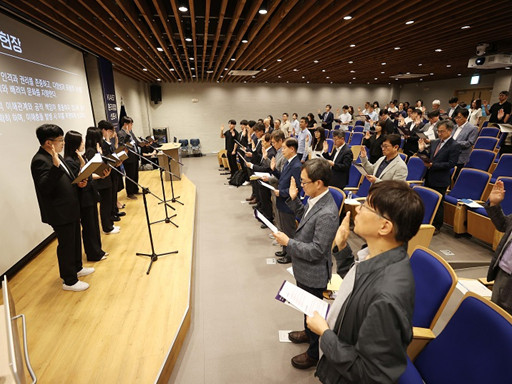
< Photo 1. Attendees pledge to practice ethics during the declaration for the ethical management. >
This ceremony was arranged as an occasion for the president, key executives, and representatives from each university constituent to share the purpose and direction of the newly established ethical standards and to pledge their commitment to practicing them.
The Ethical Management Declaration consisted of: ▲ a progress report by the KAIST Special Committee for Ethical Management, ▲ a commemorative address by the president, ▲ an oath of the Code of Ethics and Code of Conduct, and ▲ the presentation of the 'Excellent Ethics Professor Award' organized by the Graduate Student Human Rights Center. Attendees shared the values and meaning of ethical management pursued by KAIST.
Particularly at this ceremony, six representatives – faculty, staff, and students – selected to reflect KAIST's values encompassing diversity in position, role, gender, and future generations, took the oath for the Code of Ethics and Code of Conduct.
< Photo 2. Attendees pledge to practice ethics during the Ethical Management Declaration. >
Also introduced at the ceremony was the "Ethical Excellence Award for Professors". It is an award that was organized by the Graduate Student Human Rights Center under the KAIST Student Council to recognize the faculty members for their outstanding ethical conduct in the laboratory setting. The 2025 recipients of the newly established award were the honored at the declaration ceremony for added significance.
Taking this declaration ceremony as an example, KAIST plans to actively encourage each departments, divisions and offices to also hold ethical management declarations of their own to establish a trustworthy, healthy, and transparent organizational culture through the daily practice of ethical responsibilities, and to continuously spread the practice of ethical management among all members.
President Kwang Hyung Lee emphasized, "Adhering to research and social ethics must be the foundation for KAIST to become a university trusted globally," and expressed, "I hope this ceremony serves as a turning point for all members to more faithfully practice their ethical responsibilities and duties."
2025.06.16 View 4034
KAIST Holds a Ceremony to Declare their Renewed Commitment for Ethical Management
KAIST held a ceremony to declare their renewed "Commitment for Ethical Management" to raise awareness and solidify the commitment its members to faithfully fulfill ethical responsibilities and duties.
Last March, the university established the 'Special Committee for Ethical Management,' chaired by the Provost, and under the leadership of this committee, a new 'Code of Ethics' and 'Code of Conduct' were prepared, containing ethical standards that members must adhere to across all areas of education, research, and administration.
< Photo 1. Attendees pledge to practice ethics during the declaration for the ethical management. >
This ceremony was arranged as an occasion for the president, key executives, and representatives from each university constituent to share the purpose and direction of the newly established ethical standards and to pledge their commitment to practicing them.
The Ethical Management Declaration consisted of: ▲ a progress report by the KAIST Special Committee for Ethical Management, ▲ a commemorative address by the president, ▲ an oath of the Code of Ethics and Code of Conduct, and ▲ the presentation of the 'Excellent Ethics Professor Award' organized by the Graduate Student Human Rights Center. Attendees shared the values and meaning of ethical management pursued by KAIST.
Particularly at this ceremony, six representatives – faculty, staff, and students – selected to reflect KAIST's values encompassing diversity in position, role, gender, and future generations, took the oath for the Code of Ethics and Code of Conduct.
< Photo 2. Attendees pledge to practice ethics during the Ethical Management Declaration. >
Also introduced at the ceremony was the "Ethical Excellence Award for Professors". It is an award that was organized by the Graduate Student Human Rights Center under the KAIST Student Council to recognize the faculty members for their outstanding ethical conduct in the laboratory setting. The 2025 recipients of the newly established award were the honored at the declaration ceremony for added significance.
Taking this declaration ceremony as an example, KAIST plans to actively encourage each departments, divisions and offices to also hold ethical management declarations of their own to establish a trustworthy, healthy, and transparent organizational culture through the daily practice of ethical responsibilities, and to continuously spread the practice of ethical management among all members.
President Kwang Hyung Lee emphasized, "Adhering to research and social ethics must be the foundation for KAIST to become a university trusted globally," and expressed, "I hope this ceremony serves as a turning point for all members to more faithfully practice their ethical responsibilities and duties."
2025.06.16 View 4034 -
 KAIST, Galaxy Corporation Hold Signboard Ceremony for ‘AI Entertech Research Center’
KAIST (President Kwang-Hyung Lee) announced on the 9th that it will hold a signboard ceremony for the establishment of the ‘AI Entertech Research Center’ with the artificial intelligence entertech company, Galaxy Corporation (CEO Yong-ho Choi) at the main campus of KAIST.
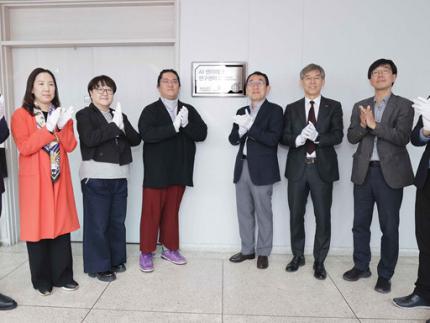
< (Galaxy Corporation, from center to the left) CEO Yongho Choi, Director Hyunjung Kim and related persons / (KAIST, from center to the right) Professor SeungSeob Lee of the Department of Mechanical Engineering, Provost and Executive Vice President Gyun Min Lee, Dean Jung Kim of the Department of Mechanical Engineering and Professor Yong Jin Yoon of the same department >
This collaboration is a part of KAIST’s art convergence research strategy and is an extension of its efforts to lead future K-Culture through the development of creative cultural content based on science and technology. Beyond simple technological development, KAIST has been continuously implementing the convergence model of ‘Tech-Art’ that expands the horizon of the content industry through the fusion of emotional technology and cultural imagination.
Previously, KAIST established the ‘Sumi Jo Performing Arts Research Center’ in collaboration with world-renowned soprano Sumi Jo, a visiting professor, and has been leading the convergence research of art and engineering, such as AI-based interactive performance technology and immersive content. The establishment of the ‘AI Entertech Research Center’ this time is being evaluated as a new challenge for the technological expansion of the K-content industry.
In addition, the role of singer G-Dragon (real name Kwon Ji-yong), an artist affiliated with Galaxy Corporation and a visiting professor in the Department of Mechanical Engineering at KAIST, was also a major factor. Since being appointed to KAIST last year, Professor Kwon has been actively promoting the establishment of a research center and soliciting KAIST research projects through his agency to develop the ‘AI Entertech’ field, which fuses entertainment and cutting-edge technology.
< (Galaxy Corporation, from center to the left) CEO Yongho Choi, Director Hyunjung Kim and related persons / (KAIST, from center to the right) Professor SeungSeob Lee of the Department of Mechanical Engineering, Provost and Executive Vice President Gyun Min Lee, Dean Jung Kim of the Department of Mechanical Engineering and Professor Yong Jin Yoon of the same department >
The AI Entertech Research Center is scheduled to officially launch in the third quarter of this year, and this inauguration ceremony was held in line with Professor Kwon Ji-yong’s schedule to visit KAIST. Galaxy Corporation recently had a private meeting with Microsoft (MS) CEO Nadella as the only entertech company, and is actively promoting the globalization of AI entertech. In addition, since last year, it has established a cooperative relationship with KAIST and plans to actively seek the convergence of entertech and technology that transcends time and space through the establishment of a research center.
Professor Kwon Ji-yong will attend the ‘Innovate Korea 2025’ event co-hosted by KAIST, Herald Media Group, and the National Research Council of Science and Technology, held at the KAIST Lyu Keun-Chul Sports Complex in the afternoon of the same day, and will give a special talk on the topic of ‘The Future of AI Entertech.’ In addition to Professor Kwon, Professor SeungSeob Lee of the Department of Mechanical Engineering at KAIST, Professor Sang-gyun Kim of Kyunghee University, and CEO Yong-ho Choi of Galaxy Corporation will also participate in this talk show.
The two organizations signed an MOU last year to jointly research science and technology for the global spread of K-pop, and the establishment of this research center is the first tangible result of this. Once the research center is fully operational, various projects such as the development of an AI-based entertech platform and joint research on global content technology will be promoted.
< A photo of Professor Kwon Ji-yong (right) from at the talk show with KAIST President Kwang-Hyung Lee (left) from the previous year >
Yong-ho Choi, Galaxy Corporation CHO (Chief Happiness Officer), said, “This collaboration is the starting point for providing a completely new entertainment experience to fans around the world by grafting KAIST AI and cutting-edge technologies onto the fandom platform,” and added, “The convergence of AI and entertech is not just technological advancement; it is a driving force for innovation that enriches human life.”
Kwang-Hyung Lee, KAIST President, said, “I am confident that KAIST’s scientific and technological capabilities, combined with Professor Kwon Ji-yong’s global sensibility, will lead the technological evolution of K-culture,” and added, “I hope that KAIST’s spirit of challenge and research DNA will create a new wave in the entertech market.”
Meanwhile, Galaxy Corporation, the agency of Professor G-Dragon Kwon Ji-yong, is an AI entertainment technology company that presents a new paradigm based on IP, media, tech, and entertainment convergence technology. (End)
2025.04.09 View 11399
KAIST, Galaxy Corporation Hold Signboard Ceremony for ‘AI Entertech Research Center’
KAIST (President Kwang-Hyung Lee) announced on the 9th that it will hold a signboard ceremony for the establishment of the ‘AI Entertech Research Center’ with the artificial intelligence entertech company, Galaxy Corporation (CEO Yong-ho Choi) at the main campus of KAIST.
< (Galaxy Corporation, from center to the left) CEO Yongho Choi, Director Hyunjung Kim and related persons / (KAIST, from center to the right) Professor SeungSeob Lee of the Department of Mechanical Engineering, Provost and Executive Vice President Gyun Min Lee, Dean Jung Kim of the Department of Mechanical Engineering and Professor Yong Jin Yoon of the same department >
This collaboration is a part of KAIST’s art convergence research strategy and is an extension of its efforts to lead future K-Culture through the development of creative cultural content based on science and technology. Beyond simple technological development, KAIST has been continuously implementing the convergence model of ‘Tech-Art’ that expands the horizon of the content industry through the fusion of emotional technology and cultural imagination.
Previously, KAIST established the ‘Sumi Jo Performing Arts Research Center’ in collaboration with world-renowned soprano Sumi Jo, a visiting professor, and has been leading the convergence research of art and engineering, such as AI-based interactive performance technology and immersive content. The establishment of the ‘AI Entertech Research Center’ this time is being evaluated as a new challenge for the technological expansion of the K-content industry.
In addition, the role of singer G-Dragon (real name Kwon Ji-yong), an artist affiliated with Galaxy Corporation and a visiting professor in the Department of Mechanical Engineering at KAIST, was also a major factor. Since being appointed to KAIST last year, Professor Kwon has been actively promoting the establishment of a research center and soliciting KAIST research projects through his agency to develop the ‘AI Entertech’ field, which fuses entertainment and cutting-edge technology.
< (Galaxy Corporation, from center to the left) CEO Yongho Choi, Director Hyunjung Kim and related persons / (KAIST, from center to the right) Professor SeungSeob Lee of the Department of Mechanical Engineering, Provost and Executive Vice President Gyun Min Lee, Dean Jung Kim of the Department of Mechanical Engineering and Professor Yong Jin Yoon of the same department >
The AI Entertech Research Center is scheduled to officially launch in the third quarter of this year, and this inauguration ceremony was held in line with Professor Kwon Ji-yong’s schedule to visit KAIST. Galaxy Corporation recently had a private meeting with Microsoft (MS) CEO Nadella as the only entertech company, and is actively promoting the globalization of AI entertech. In addition, since last year, it has established a cooperative relationship with KAIST and plans to actively seek the convergence of entertech and technology that transcends time and space through the establishment of a research center.
Professor Kwon Ji-yong will attend the ‘Innovate Korea 2025’ event co-hosted by KAIST, Herald Media Group, and the National Research Council of Science and Technology, held at the KAIST Lyu Keun-Chul Sports Complex in the afternoon of the same day, and will give a special talk on the topic of ‘The Future of AI Entertech.’ In addition to Professor Kwon, Professor SeungSeob Lee of the Department of Mechanical Engineering at KAIST, Professor Sang-gyun Kim of Kyunghee University, and CEO Yong-ho Choi of Galaxy Corporation will also participate in this talk show.
The two organizations signed an MOU last year to jointly research science and technology for the global spread of K-pop, and the establishment of this research center is the first tangible result of this. Once the research center is fully operational, various projects such as the development of an AI-based entertech platform and joint research on global content technology will be promoted.
< A photo of Professor Kwon Ji-yong (right) from at the talk show with KAIST President Kwang-Hyung Lee (left) from the previous year >
Yong-ho Choi, Galaxy Corporation CHO (Chief Happiness Officer), said, “This collaboration is the starting point for providing a completely new entertainment experience to fans around the world by grafting KAIST AI and cutting-edge technologies onto the fandom platform,” and added, “The convergence of AI and entertech is not just technological advancement; it is a driving force for innovation that enriches human life.”
Kwang-Hyung Lee, KAIST President, said, “I am confident that KAIST’s scientific and technological capabilities, combined with Professor Kwon Ji-yong’s global sensibility, will lead the technological evolution of K-culture,” and added, “I hope that KAIST’s spirit of challenge and research DNA will create a new wave in the entertech market.”
Meanwhile, Galaxy Corporation, the agency of Professor G-Dragon Kwon Ji-yong, is an AI entertainment technology company that presents a new paradigm based on IP, media, tech, and entertainment convergence technology. (End)
2025.04.09 View 11399 -
 KAIST Holds 2023 Commencement Ceremony
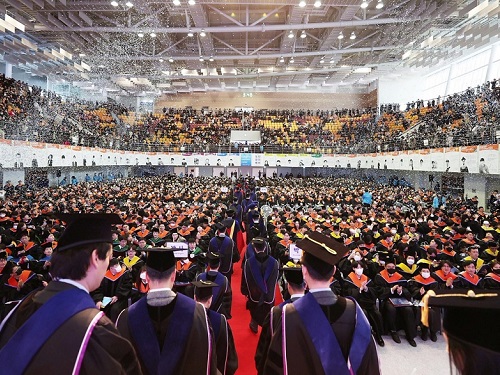
< Photo 1. On the 17th, KAIST held the 2023 Commencement Ceremony for a total of 2,870 students, including 691 doctors. >
KAIST held its 2023 commencement ceremony at the Sports Complex of its main campus in Daejeon at 2 p.m. on February 27. It was the first commencement ceremony to invite all its graduates since the start of COVID-19 quarantine measures.
KAIST awarded a total of 2,870 degrees including 691 PhD degrees, 1,464 master’s degrees, and 715 bachelor’s degrees, which adds to the total of 74,999 degrees KAIST has conferred since its foundation in 1971, which includes 15,772 PhD, 38,360 master’s and 20,867 bachelor’s degrees.
This year’s Cum Laude, Gabin Ryu, from the Department of Mechanical Engineering received the Minister of Science and ICT Award. Seung-ju Lee from the School of Computing received the Chairman of the KAIST Board of Trustees Award, while Jantakan Nedsaengtip, an international student from Thailand received the KAIST Presidential Award, and Jaeyong Hwang from the Department of Physics and Junmo Lee from the Department of Industrial and Systems Engineering each received the President of the Alumni Association Award and the Chairman of the KAIST Development Foundation Award, respectively.
Minister Jong-ho Lee of the Ministry of Science and ICT awarded the recipients of the academic awards and delivered a congratulatory speech.
Yujin Cha from the Department of Bio and Brain Engineering, who received a PhD degree after 19 years since his entrance to KAIST as an undergraduate student in 2004 gave a speech on behalf of the graduates to move and inspire the graduates and the guests.
After Cha received a bachelor’s degree from the Department of Nuclear and Quantum Engineering, he entered a medical graduate school and became a radiation oncology specialist. But after experiencing the death of a young patient who suffered from osteosarcoma, he returned to his alma mater to become a scientist. As he believes that science and technology is the ultimate solution to the limitations of modern medicine, he started as a PhD student at the Department of Bio and Brain Engineering in 2018, hoping to find such solutions.
During his course, he identified the characteristics of the decision-making process of doctors during diagnosis, and developed a brain-inspired AI algorithm. It is an original and challenging study that attempted to develop a fundamental machine learning theory from the data he collected from 200 doctors of different specialties.
Cha said, “Humans and AI can cooperate by humans utilizing the unique learning abilities of AI to develop our expertise, while AIs can mimic us humans’ learning abilities to improve.” He added, “My ultimate goal is to develop technology to a level at which humans and machines influence each other and ‘coevolve’, and applying it not only to medicine, but in all areas.”
Cha, who is currently an assistant professor at the KAIST Biomedical Research Center, has also written Artificial Intelligence for Doctors in 2017 to help medical personnel use AI in clinical fields, and the book was selected as one of the 2018 Sejong Books in the academic category.
During his speech at this year’s commencement ceremony, he shared that “there are so many things in the world that are difficult to solve and many things to solve them with, but I believe the things that can really broaden the horizons of the world and find fundamental solutions to the problems at hand are science and technology.”
Meanwhile, singer-songwriter Sae Byul Park who studied at the KAIST Graduate School of Culture Technology will also receive her PhD degree.
Natural language processing (NLP) is a field in AI that teaches a computer to understand and analyze human language that is actively being studied. An example of NLP is ChatGTP, which recently received a lot of attention. For her research, Park analyzed music rather than language using NLP technology.
To analyze music, which is in the form of sound, using the methods for NLP, it is necessary to rebuild notes and beats into a form of words or sentences as in a language. For this, Park designed an algorithm called Mel2Word and applied it to her research.
She also suggested that by converting melodies into texts for analysis, one would be able to quantitatively express music as sentences or words with meaning and context rather than as simple sounds representing a certain note.
Park said, “music has always been considered as a product of subjective emotion, but this research provides a framework that can calculate and analyze music.”
Park’s study can later be developed into a tool to measure the similarities between musical work, as well as a piece’s originality, artistry and popularity, and it can be used as a clue to explore the fundamental principles of how humans respond to music from a cognitive science perspective.
Park began her Ph.D. program in 2014, while carrying on with her musical activities as well as public and university lectures alongside, and dealing with personally major events including marriage and childbirth during the course of years. She already met the requirements to receive her degree in 2019, but delayed her graduation in order to improve the level of completion of her research, and finally graduated with her current achievements after nine years.
Professor Juhan Nam, who supervised Park’s research, said, “Park, who has a bachelor’s degree in psychology, later learned to code for graduate school, and has complete high-quality research in the field of artificial intelligence.” He added, “Though it took a long time, her attitude of not giving up until the end as a researcher is also excellent.”
Sae Byul Park is currently lecturing courses entitled Culture Technology and Music Information Retrieval at the Underwood International College of Yonsei University.
Park said, “the 10 or so years I’ve spent at KAIST as a graduate student was a time I could learn and prosper not only academically but from all angles of life.” She added, “having received a doctorate degree is not the end, but a ‘commencement’. Therefore, I will start to root deeper from the seeds I sowed and work harder as a both a scholar and an artist.”
< Photo 2. From left) Yujin Cha (Valedictorian, Medical-Scientist Program Ph.D. graduate), Saebyeol Park (a singer-songwriter, Ph.D. graduate from the Graduate School of Culture and Technology), Junseok Moon and Inah Seo (the two highlighted CEO graduates from the Department of Management Engineering's master’s program) >
Young entrepreneurs who dream of solving social problems will also be wearing their graduation caps. Two such graduates are Jun-seok Moon and Inah Seo, receiving their master’s degrees in social entrepreneurship MBA from the KAIST College of Business.
Before entrance, Moon ran a café helping African refugees stand on their own feet. Then, he entered KAIST to later expand his business and learn social entrepreneurship in order to sustainably help refugees in the blind spots of human rights and welfare.
During his master’s course, Moon realized that he could achieve active carbon reduction by changing the coffee alone, and switched his business field and founded Equal Table. The amount of carbon an individual can reduce by refraining from using a single paper cup is 10g, while changing the coffee itself can reduce it by 300g.
1kg of coffee emits 15kg of carbon over the course of its production, distribution, processing, and consumption, but Moon produces nearly carbon-neutral coffee beans by having innovated the entire process. In particular, the company-to-company ESG business solution is Moon’s new start-up area. It provides companies with carbon-reduced coffee made by roasting raw beans from carbon-neutral certified farms with 100% renewable energy, and shows how much carbon has been reduced in its making. Equal Table will launch the service this month in collaboration with SK Telecom, its first partner.
Inah Seo, who also graduated with Moon, founded Conscious Wear to start a fashion business reducing environmental pollution. In order to realize her mission, she felt the need to gain the appropriate expertise in management, and enrolled for the social entrepreneurship MBA.
Out of the various fashion industries, Seo focused on the leather market, which is worth 80 trillion won. Due to thickness or contamination issues, only about 60% of animal skin fabric is used, and the rest is discarded. Heavy metals are used during such processes, which also directly affects the environment.
During the social entrepreneurship MBA course, Seo collaborated with SK Chemicals, which had links through the program, and launched eco-friendly leather bags. The bags used discarded leather that was recycled by grinding and reprocessing into a biomaterial called PO3G. It was the first case in which PO3G that is over 90% biodegradable was applied to regenerated leather. In other words, it can reduce environmental pollution in the processing and disposal stages, while also reducing carbon emissions and water usage by one-tenth compared to existing cowhide products.
The social entrepreneurship MBA course, from which Moon and Seo graduated, will run in integration with the Graduate School of Green Growth as an Impact MBA program starting this year. KAIST plans to steadily foster entrepreneurs who will lead meaningful changes in the environment and society as well as economic values through innovative technologies and ideas.
< Photo 3. NYU President Emeritus John Sexton (left), who received this year's honorary doctorate of science, poses with President Kwang Hyung Lee >
Meanwhile, during this day’s commencement ceremony, KAIST also presented President Emeritus John Sexton of New York University with an honorary doctorate in science. He was recognized for laying the foundation for the cooperation between KAIST and New York University, such as promoting joint campuses.
< Photo 4. At the commencement ceremony of KAIST held on the 17th, President Kwang Hyung Lee is encouraging the graduates with his commencement address. >
President Kwang Hyung Lee emphasized in his commencement speech that, “if you can draw up the future and work hard toward your goal, the future can become a work of art that you create with your own hands,” and added, “Never stop on the journey toward your dreams, and do not give up even when you are met with failure. Failure happens to everyone, all the time. The important thing is to know 'why you failed', and to use those elements of failure as the driving force for the next try.”
2023.02.20 View 35560
KAIST Holds 2023 Commencement Ceremony
< Photo 1. On the 17th, KAIST held the 2023 Commencement Ceremony for a total of 2,870 students, including 691 doctors. >
KAIST held its 2023 commencement ceremony at the Sports Complex of its main campus in Daejeon at 2 p.m. on February 27. It was the first commencement ceremony to invite all its graduates since the start of COVID-19 quarantine measures.
KAIST awarded a total of 2,870 degrees including 691 PhD degrees, 1,464 master’s degrees, and 715 bachelor’s degrees, which adds to the total of 74,999 degrees KAIST has conferred since its foundation in 1971, which includes 15,772 PhD, 38,360 master’s and 20,867 bachelor’s degrees.
This year’s Cum Laude, Gabin Ryu, from the Department of Mechanical Engineering received the Minister of Science and ICT Award. Seung-ju Lee from the School of Computing received the Chairman of the KAIST Board of Trustees Award, while Jantakan Nedsaengtip, an international student from Thailand received the KAIST Presidential Award, and Jaeyong Hwang from the Department of Physics and Junmo Lee from the Department of Industrial and Systems Engineering each received the President of the Alumni Association Award and the Chairman of the KAIST Development Foundation Award, respectively.
Minister Jong-ho Lee of the Ministry of Science and ICT awarded the recipients of the academic awards and delivered a congratulatory speech.
Yujin Cha from the Department of Bio and Brain Engineering, who received a PhD degree after 19 years since his entrance to KAIST as an undergraduate student in 2004 gave a speech on behalf of the graduates to move and inspire the graduates and the guests.
After Cha received a bachelor’s degree from the Department of Nuclear and Quantum Engineering, he entered a medical graduate school and became a radiation oncology specialist. But after experiencing the death of a young patient who suffered from osteosarcoma, he returned to his alma mater to become a scientist. As he believes that science and technology is the ultimate solution to the limitations of modern medicine, he started as a PhD student at the Department of Bio and Brain Engineering in 2018, hoping to find such solutions.
During his course, he identified the characteristics of the decision-making process of doctors during diagnosis, and developed a brain-inspired AI algorithm. It is an original and challenging study that attempted to develop a fundamental machine learning theory from the data he collected from 200 doctors of different specialties.
Cha said, “Humans and AI can cooperate by humans utilizing the unique learning abilities of AI to develop our expertise, while AIs can mimic us humans’ learning abilities to improve.” He added, “My ultimate goal is to develop technology to a level at which humans and machines influence each other and ‘coevolve’, and applying it not only to medicine, but in all areas.”
Cha, who is currently an assistant professor at the KAIST Biomedical Research Center, has also written Artificial Intelligence for Doctors in 2017 to help medical personnel use AI in clinical fields, and the book was selected as one of the 2018 Sejong Books in the academic category.
During his speech at this year’s commencement ceremony, he shared that “there are so many things in the world that are difficult to solve and many things to solve them with, but I believe the things that can really broaden the horizons of the world and find fundamental solutions to the problems at hand are science and technology.”
Meanwhile, singer-songwriter Sae Byul Park who studied at the KAIST Graduate School of Culture Technology will also receive her PhD degree.
Natural language processing (NLP) is a field in AI that teaches a computer to understand and analyze human language that is actively being studied. An example of NLP is ChatGTP, which recently received a lot of attention. For her research, Park analyzed music rather than language using NLP technology.
To analyze music, which is in the form of sound, using the methods for NLP, it is necessary to rebuild notes and beats into a form of words or sentences as in a language. For this, Park designed an algorithm called Mel2Word and applied it to her research.
She also suggested that by converting melodies into texts for analysis, one would be able to quantitatively express music as sentences or words with meaning and context rather than as simple sounds representing a certain note.
Park said, “music has always been considered as a product of subjective emotion, but this research provides a framework that can calculate and analyze music.”
Park’s study can later be developed into a tool to measure the similarities between musical work, as well as a piece’s originality, artistry and popularity, and it can be used as a clue to explore the fundamental principles of how humans respond to music from a cognitive science perspective.
Park began her Ph.D. program in 2014, while carrying on with her musical activities as well as public and university lectures alongside, and dealing with personally major events including marriage and childbirth during the course of years. She already met the requirements to receive her degree in 2019, but delayed her graduation in order to improve the level of completion of her research, and finally graduated with her current achievements after nine years.
Professor Juhan Nam, who supervised Park’s research, said, “Park, who has a bachelor’s degree in psychology, later learned to code for graduate school, and has complete high-quality research in the field of artificial intelligence.” He added, “Though it took a long time, her attitude of not giving up until the end as a researcher is also excellent.”
Sae Byul Park is currently lecturing courses entitled Culture Technology and Music Information Retrieval at the Underwood International College of Yonsei University.
Park said, “the 10 or so years I’ve spent at KAIST as a graduate student was a time I could learn and prosper not only academically but from all angles of life.” She added, “having received a doctorate degree is not the end, but a ‘commencement’. Therefore, I will start to root deeper from the seeds I sowed and work harder as a both a scholar and an artist.”
< Photo 2. From left) Yujin Cha (Valedictorian, Medical-Scientist Program Ph.D. graduate), Saebyeol Park (a singer-songwriter, Ph.D. graduate from the Graduate School of Culture and Technology), Junseok Moon and Inah Seo (the two highlighted CEO graduates from the Department of Management Engineering's master’s program) >
Young entrepreneurs who dream of solving social problems will also be wearing their graduation caps. Two such graduates are Jun-seok Moon and Inah Seo, receiving their master’s degrees in social entrepreneurship MBA from the KAIST College of Business.
Before entrance, Moon ran a café helping African refugees stand on their own feet. Then, he entered KAIST to later expand his business and learn social entrepreneurship in order to sustainably help refugees in the blind spots of human rights and welfare.
During his master’s course, Moon realized that he could achieve active carbon reduction by changing the coffee alone, and switched his business field and founded Equal Table. The amount of carbon an individual can reduce by refraining from using a single paper cup is 10g, while changing the coffee itself can reduce it by 300g.
1kg of coffee emits 15kg of carbon over the course of its production, distribution, processing, and consumption, but Moon produces nearly carbon-neutral coffee beans by having innovated the entire process. In particular, the company-to-company ESG business solution is Moon’s new start-up area. It provides companies with carbon-reduced coffee made by roasting raw beans from carbon-neutral certified farms with 100% renewable energy, and shows how much carbon has been reduced in its making. Equal Table will launch the service this month in collaboration with SK Telecom, its first partner.
Inah Seo, who also graduated with Moon, founded Conscious Wear to start a fashion business reducing environmental pollution. In order to realize her mission, she felt the need to gain the appropriate expertise in management, and enrolled for the social entrepreneurship MBA.
Out of the various fashion industries, Seo focused on the leather market, which is worth 80 trillion won. Due to thickness or contamination issues, only about 60% of animal skin fabric is used, and the rest is discarded. Heavy metals are used during such processes, which also directly affects the environment.
During the social entrepreneurship MBA course, Seo collaborated with SK Chemicals, which had links through the program, and launched eco-friendly leather bags. The bags used discarded leather that was recycled by grinding and reprocessing into a biomaterial called PO3G. It was the first case in which PO3G that is over 90% biodegradable was applied to regenerated leather. In other words, it can reduce environmental pollution in the processing and disposal stages, while also reducing carbon emissions and water usage by one-tenth compared to existing cowhide products.
The social entrepreneurship MBA course, from which Moon and Seo graduated, will run in integration with the Graduate School of Green Growth as an Impact MBA program starting this year. KAIST plans to steadily foster entrepreneurs who will lead meaningful changes in the environment and society as well as economic values through innovative technologies and ideas.
< Photo 3. NYU President Emeritus John Sexton (left), who received this year's honorary doctorate of science, poses with President Kwang Hyung Lee >
Meanwhile, during this day’s commencement ceremony, KAIST also presented President Emeritus John Sexton of New York University with an honorary doctorate in science. He was recognized for laying the foundation for the cooperation between KAIST and New York University, such as promoting joint campuses.
< Photo 4. At the commencement ceremony of KAIST held on the 17th, President Kwang Hyung Lee is encouraging the graduates with his commencement address. >
President Kwang Hyung Lee emphasized in his commencement speech that, “if you can draw up the future and work hard toward your goal, the future can become a work of art that you create with your own hands,” and added, “Never stop on the journey toward your dreams, and do not give up even when you are met with failure. Failure happens to everyone, all the time. The important thing is to know 'why you failed', and to use those elements of failure as the driving force for the next try.”
2023.02.20 View 35560 -
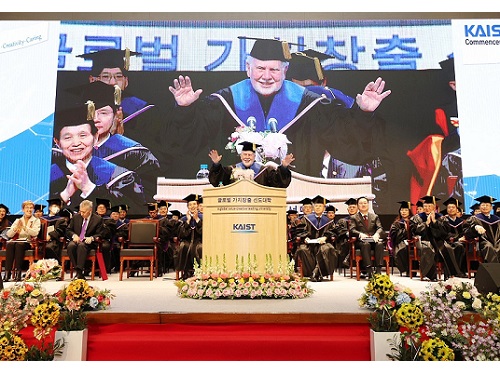 KAIST confers Honorary Doctorate of Science on NYU President Emeritus John Edward Sexton
< Photo 1. NYU President Emeritus John Edward Sexton posing with KAIST President Kwang Hyung Lee holding the Honorary Doctorate at the KAIST Commencement Ceremony >
KAIST (President Kwang Hyung Lee) announced that it conferred an honorary doctorate of science degree on NYU President Emeritus John Edward Sexton at the Commencement Ceremony held on the 17th.
An official from KAIST explained, "KAIST is conferring an honorary doctorate for President Sexton's longstanding leadership in higher education, and for his contributions to the process of establishing the groundwork for collaboration with NYU through which KAIST is to become a leading global value-creating university."
President Emeritus Sexton served as the president of NYU from 2002 to 2015, establishing two degree-granting campuses and several global academic sites of NYU around the world. Because of its steady rise in university rankings, such as its medical school earning the number two position in the United States, not only has NYU joined the ranks of first-class universities, but it has also achieved remarkable growth, with the number of students increasing dramatically from 29,000 to 60,000.
In addition, during his tenure as president at NYU, President Emeritus Sexton successfully expanded fundraising to support the University’s academic goals. During his 14-year tenure as president, he organized initiatives such as 'Raise $1 Million Every Day' and 'Call to Action' to raise $4.9 billion in donations, the largest in NYU history to date.
President Emeritus Sexton is famous for teaching full time even during his presidential tenure and for the anecdotes about his special care for students, addressing the school members as “family”. In particular, he is famous for giving hugs to all graduates at the commencement ceremony. Minister Park Jin of the Ministry of Foreign Affairs of Korea, who graduated from NYU School of Law in 1999 with a Master of Studies in Law, is one of the graduates who received President Sexton's hug.
President Emeritus Sexton, born in 1942, visited KAIST on the 17th to receive the honorary doctorate and to encourage the expedited development of the KAIST-NYU Joint Campus, for which he helped lay the foundation.
President Emeritus Sexton said, "I like the slogan, 'Onward and upward together,'" and added, "I look forward to having the two universities achieve their shared vision of becoming the world-class universities together through cooperation to establish the KAIST-NYU Joint Campus."
< Photo 2. NYU President Emeritus John Edward Sexton giving the acceptance speech at the KAIST Commencement Ceremony >
The US Ambassador to Korea, the Honorable Philip Goldberg, also attended the commencement ceremony at KAIST to congratulate President Emeritus Sexton on the conferment of the honorary doctorate. Ambassador Goldberg has been serving as the US Ambassador to Korea since July of last year.
President Kwang Hyung Lee said, “President Emeritus Sexton was a president best described as an innovator who promoted diversity in education and pursued academic excellence throughout his life.” He went on to say, “The KAIST-NYU Joint Campus, which will be completed on the foundation laid by President Emeritus Sexton, will serve as the focal point that will attract global talents flooding into New York by the driving force created from the synergy of the two universities as well as serving as a starting point for KAIST's outstanding talents to pursue their dreams toward the world.”
KAIST signed a cooperation agreement with NYU in June of 2022 to build a joint campus, and held a presentation of signage for the KAIST-NYU Joint Campus in September. Currently, about 60 faculty members are planning to begin joint research initiatives in seven fields, including robotics, AI, brain sciences, and climate change. In addition, cooperation in the field of education, including student exchange, minors, double majors, and joint degrees, is under discussion.
2023.02.17 View 15914
KAIST confers Honorary Doctorate of Science on NYU President Emeritus John Edward Sexton
< Photo 1. NYU President Emeritus John Edward Sexton posing with KAIST President Kwang Hyung Lee holding the Honorary Doctorate at the KAIST Commencement Ceremony >
KAIST (President Kwang Hyung Lee) announced that it conferred an honorary doctorate of science degree on NYU President Emeritus John Edward Sexton at the Commencement Ceremony held on the 17th.
An official from KAIST explained, "KAIST is conferring an honorary doctorate for President Sexton's longstanding leadership in higher education, and for his contributions to the process of establishing the groundwork for collaboration with NYU through which KAIST is to become a leading global value-creating university."
President Emeritus Sexton served as the president of NYU from 2002 to 2015, establishing two degree-granting campuses and several global academic sites of NYU around the world. Because of its steady rise in university rankings, such as its medical school earning the number two position in the United States, not only has NYU joined the ranks of first-class universities, but it has also achieved remarkable growth, with the number of students increasing dramatically from 29,000 to 60,000.
In addition, during his tenure as president at NYU, President Emeritus Sexton successfully expanded fundraising to support the University’s academic goals. During his 14-year tenure as president, he organized initiatives such as 'Raise $1 Million Every Day' and 'Call to Action' to raise $4.9 billion in donations, the largest in NYU history to date.
President Emeritus Sexton is famous for teaching full time even during his presidential tenure and for the anecdotes about his special care for students, addressing the school members as “family”. In particular, he is famous for giving hugs to all graduates at the commencement ceremony. Minister Park Jin of the Ministry of Foreign Affairs of Korea, who graduated from NYU School of Law in 1999 with a Master of Studies in Law, is one of the graduates who received President Sexton's hug.
President Emeritus Sexton, born in 1942, visited KAIST on the 17th to receive the honorary doctorate and to encourage the expedited development of the KAIST-NYU Joint Campus, for which he helped lay the foundation.
President Emeritus Sexton said, "I like the slogan, 'Onward and upward together,'" and added, "I look forward to having the two universities achieve their shared vision of becoming the world-class universities together through cooperation to establish the KAIST-NYU Joint Campus."
< Photo 2. NYU President Emeritus John Edward Sexton giving the acceptance speech at the KAIST Commencement Ceremony >
The US Ambassador to Korea, the Honorable Philip Goldberg, also attended the commencement ceremony at KAIST to congratulate President Emeritus Sexton on the conferment of the honorary doctorate. Ambassador Goldberg has been serving as the US Ambassador to Korea since July of last year.
President Kwang Hyung Lee said, “President Emeritus Sexton was a president best described as an innovator who promoted diversity in education and pursued academic excellence throughout his life.” He went on to say, “The KAIST-NYU Joint Campus, which will be completed on the foundation laid by President Emeritus Sexton, will serve as the focal point that will attract global talents flooding into New York by the driving force created from the synergy of the two universities as well as serving as a starting point for KAIST's outstanding talents to pursue their dreams toward the world.”
KAIST signed a cooperation agreement with NYU in June of 2022 to build a joint campus, and held a presentation of signage for the KAIST-NYU Joint Campus in September. Currently, about 60 faculty members are planning to begin joint research initiatives in seven fields, including robotics, AI, brain sciences, and climate change. In addition, cooperation in the field of education, including student exchange, minors, double majors, and joint degrees, is under discussion.
2023.02.17 View 15914