%63%65%6c%6c%75%6c%6f%73%65
-
 A KAIST team develops the world's first modular co-culture platform for the one-pot production of rainbow-colored bacterial cellulose.
<(From Left) Distinguished Professor Sang Yup Lee, Ph.D candidate Pingxin Lin, Ph.D candiate Zhou Hengrui>
The integration of systems metabolic engineering with co-culture strategies that couples bacterial cellulose production with natural colorant biosynthesis enabled the one-pot generation of rainbow-colored bacterial cellulose, establishing a sustainable biomanufacturing platform that can replace petroleum-based textiles and eliminate chemical dyeing processes.
A research group at KAIST has successfully developed a modular co-culture platform for the one-pot production of rainbow-colored bacterial cellulose. The team, led by Distinguished Professor Sang Yup Lee from the Department of Chemical and Biomolecular Engineering, engineered Komagataeibacter xylinus for bacterial cellulose synthesis and Escherichia coli for natural colorants overproduction. A co-culture of these engineered strains enabled the in situ coloration of bacterial cellulose. This research offers a versatile platform for producing living materials in multiple colors, and provides new opportunities for sustainable textiles, wearable biomaterials, and functional living materials that combine optical and structural properties beyond the reach of conventional textile technologies.
Bacterial cellulose is an attractive and biodegradable alternative to petroleum-derived fabrics due to its high purity, mechanical strength, and water-retention properties. However, the limited color range of bacterial cellulose, which is typically white, has limited its broader application in the textile industry, where more vibrant colored fabrics are increasingly desired. Conventional dyeing methods rely on petroleum-based colorants and toxic reagents, creating environmental and processing challenges. These challenges have driven the demand for alternative production methods.
To address these issues, KAIST researchers, including Ph.D. Candidate Hengrui Zhou, Ph.D. Candidate Pingxin Lin, Professor Ki Jun Jeong, and Distinguished Professor Sang Yup Lee, combined systems metabolic engineering with co-culture strategies to develop a bio-based route that integrates bacterial cellulose formation with natural pigment synthesis, enabling the production of colored living materials in a single step without additional chemical processing.
The team’s work, entitled “One-pot production of colored bacterial cellulose,” was published in Trends in Biotechnology on November 12,2025.
This research details the one-pot production of multicolored bacterial cellulose using a modular co-culture platform that integrates a bacterial cellulose-overproducing K. xylinus strain with natural colorant-producing E. coli strains. The team focused on addressing the limitations in bacterial cellulose coloration caused by environmental challenges and complex processing requirements. By employing vesicle engineering and optimizing co-culture parameters, the researchers achieved one-pot production of red, orange, yellow, green, blue, navy, and purple bacterial cellulose, eliminating the need for external dyes and toxic chemical treatments.
To enhance dyeing efficiency, E. coli strains were engineered for the overproduction and secretion of natural colorants. It was determined that the intracellular accumulation of these pigments disrupts cellular metabolism and physiology, thereby inhibiting their production. To overcome this limitation, vesicle engineering has emerged as a key strategy to mitigate these cytotoxic effects, including the induction of inner- and outer-membrane vesicles and the modulation of cell morphology, enabling the more efficient secretion of colorants and increased overall production. The engineered E. coli strains were optimized in fed-batch fermentation, achieving record-breaking production of 16.92 ± 0.10 g/L of deoxyviolacein, 8.09 ± 0.17 g/L of violacein, 1.82 ± 0.07 g/L of proviolacein, and 936.25 ± 9.70 mg/L of prodeoxyviolacein, the highest reported titers to date for all four violacein derivatives.
< Figure 1. Rainbow-colored bacterial cellulose (microbial fiber) with applied color >
A co-culture platform combining the K. xylinus with E. coli strains was further developed and optimized, enabling the in situ one-pot coloration of bacterial cellulose in vibrant green, blue, navy, and purple. Fed-batch fermentation further improved the performance of the platform, achieving the world-first one-pot production of multicolored bacterial cellulose on a larger scale. To expand the bacterial cellulose color palette, engineered carotenoid-producing E. coli strains were incorporated, enabling the successful synthesis of red, orange, and yellow bacterial cellulose. This milestone demonstrates the potential of microbial fermentation as a sustainable alternative to petroleum-based textile processes.
“We can anticipate that this microbial cell factory-based one-pot production of rainbow-colored bacterial cellulose has the potential to replace current petroleum-based textile processes,” said Ph.D. Candidate Hengrui Zhou. “The systems metabolic engineering strategies developed in this study could be broadly applied for the production of diverse sustainable textiles, wearable biomaterials, and functional living materials that combine optical and structural properties beyond the capabilities of conventional textile technologies.” He added, “This platform reduces the environmental impact while greatly expanding design possibilities. Beyond serving as a proof-of-concept, this technology offers a promising route toward scalable, eco-friendly fabrics with in situ coloration. Its modular design allows the incorporation of diverse natural colorant pathways, enabling the creation of living materials in multiple colors.”
< Figure 2. Schematic of a microbe-based platform for one-step production of rainbow-colored bacterial cellulose >
“As demand for sustainable textiles and living materials continues to grow, we expect that the integrated biomanufacturing platform developed here will play a pivotal role in producing diverse functional biomaterials with additional design possibilities in a single step, without additional chemical processing,” explained Distinguished Professor Sang Yup Lee.
This work was supported by the Development of Next-generation Biorefinery Platform Technologies for Leading Bio-based Chemicals Industry project (2022M3J5A1056072) and the Development of Platform Technologies of Microbial Cell Factories for the Next-generation Biorefineries project (2022M3J5A1056117) from the National Research Foundation supported by the Korean Ministry of Science and ICT.
Source:
Hengrui Zhou (1st), Pingxin Lin (2nd), Ki Jun Jeong (3rd), and Sang Yup Lee (Corresponding). “One-pot production of colored bacterial cellulose”. Trends in Biotechnology (Published) doi: 10.1016/j.tibtech.2025.09.019
2025.11.19 View 3143
A KAIST team develops the world's first modular co-culture platform for the one-pot production of rainbow-colored bacterial cellulose.
<(From Left) Distinguished Professor Sang Yup Lee, Ph.D candidate Pingxin Lin, Ph.D candiate Zhou Hengrui>
The integration of systems metabolic engineering with co-culture strategies that couples bacterial cellulose production with natural colorant biosynthesis enabled the one-pot generation of rainbow-colored bacterial cellulose, establishing a sustainable biomanufacturing platform that can replace petroleum-based textiles and eliminate chemical dyeing processes.
A research group at KAIST has successfully developed a modular co-culture platform for the one-pot production of rainbow-colored bacterial cellulose. The team, led by Distinguished Professor Sang Yup Lee from the Department of Chemical and Biomolecular Engineering, engineered Komagataeibacter xylinus for bacterial cellulose synthesis and Escherichia coli for natural colorants overproduction. A co-culture of these engineered strains enabled the in situ coloration of bacterial cellulose. This research offers a versatile platform for producing living materials in multiple colors, and provides new opportunities for sustainable textiles, wearable biomaterials, and functional living materials that combine optical and structural properties beyond the reach of conventional textile technologies.
Bacterial cellulose is an attractive and biodegradable alternative to petroleum-derived fabrics due to its high purity, mechanical strength, and water-retention properties. However, the limited color range of bacterial cellulose, which is typically white, has limited its broader application in the textile industry, where more vibrant colored fabrics are increasingly desired. Conventional dyeing methods rely on petroleum-based colorants and toxic reagents, creating environmental and processing challenges. These challenges have driven the demand for alternative production methods.
To address these issues, KAIST researchers, including Ph.D. Candidate Hengrui Zhou, Ph.D. Candidate Pingxin Lin, Professor Ki Jun Jeong, and Distinguished Professor Sang Yup Lee, combined systems metabolic engineering with co-culture strategies to develop a bio-based route that integrates bacterial cellulose formation with natural pigment synthesis, enabling the production of colored living materials in a single step without additional chemical processing.
The team’s work, entitled “One-pot production of colored bacterial cellulose,” was published in Trends in Biotechnology on November 12,2025.
This research details the one-pot production of multicolored bacterial cellulose using a modular co-culture platform that integrates a bacterial cellulose-overproducing K. xylinus strain with natural colorant-producing E. coli strains. The team focused on addressing the limitations in bacterial cellulose coloration caused by environmental challenges and complex processing requirements. By employing vesicle engineering and optimizing co-culture parameters, the researchers achieved one-pot production of red, orange, yellow, green, blue, navy, and purple bacterial cellulose, eliminating the need for external dyes and toxic chemical treatments.
To enhance dyeing efficiency, E. coli strains were engineered for the overproduction and secretion of natural colorants. It was determined that the intracellular accumulation of these pigments disrupts cellular metabolism and physiology, thereby inhibiting their production. To overcome this limitation, vesicle engineering has emerged as a key strategy to mitigate these cytotoxic effects, including the induction of inner- and outer-membrane vesicles and the modulation of cell morphology, enabling the more efficient secretion of colorants and increased overall production. The engineered E. coli strains were optimized in fed-batch fermentation, achieving record-breaking production of 16.92 ± 0.10 g/L of deoxyviolacein, 8.09 ± 0.17 g/L of violacein, 1.82 ± 0.07 g/L of proviolacein, and 936.25 ± 9.70 mg/L of prodeoxyviolacein, the highest reported titers to date for all four violacein derivatives.
< Figure 1. Rainbow-colored bacterial cellulose (microbial fiber) with applied color >
A co-culture platform combining the K. xylinus with E. coli strains was further developed and optimized, enabling the in situ one-pot coloration of bacterial cellulose in vibrant green, blue, navy, and purple. Fed-batch fermentation further improved the performance of the platform, achieving the world-first one-pot production of multicolored bacterial cellulose on a larger scale. To expand the bacterial cellulose color palette, engineered carotenoid-producing E. coli strains were incorporated, enabling the successful synthesis of red, orange, and yellow bacterial cellulose. This milestone demonstrates the potential of microbial fermentation as a sustainable alternative to petroleum-based textile processes.
“We can anticipate that this microbial cell factory-based one-pot production of rainbow-colored bacterial cellulose has the potential to replace current petroleum-based textile processes,” said Ph.D. Candidate Hengrui Zhou. “The systems metabolic engineering strategies developed in this study could be broadly applied for the production of diverse sustainable textiles, wearable biomaterials, and functional living materials that combine optical and structural properties beyond the capabilities of conventional textile technologies.” He added, “This platform reduces the environmental impact while greatly expanding design possibilities. Beyond serving as a proof-of-concept, this technology offers a promising route toward scalable, eco-friendly fabrics with in situ coloration. Its modular design allows the incorporation of diverse natural colorant pathways, enabling the creation of living materials in multiple colors.”
< Figure 2. Schematic of a microbe-based platform for one-step production of rainbow-colored bacterial cellulose >
“As demand for sustainable textiles and living materials continues to grow, we expect that the integrated biomanufacturing platform developed here will play a pivotal role in producing diverse functional biomaterials with additional design possibilities in a single step, without additional chemical processing,” explained Distinguished Professor Sang Yup Lee.
This work was supported by the Development of Next-generation Biorefinery Platform Technologies for Leading Bio-based Chemicals Industry project (2022M3J5A1056072) and the Development of Platform Technologies of Microbial Cell Factories for the Next-generation Biorefineries project (2022M3J5A1056117) from the National Research Foundation supported by the Korean Ministry of Science and ICT.
Source:
Hengrui Zhou (1st), Pingxin Lin (2nd), Ki Jun Jeong (3rd), and Sang Yup Lee (Corresponding). “One-pot production of colored bacterial cellulose”. Trends in Biotechnology (Published) doi: 10.1016/j.tibtech.2025.09.019
2025.11.19 View 3143 -
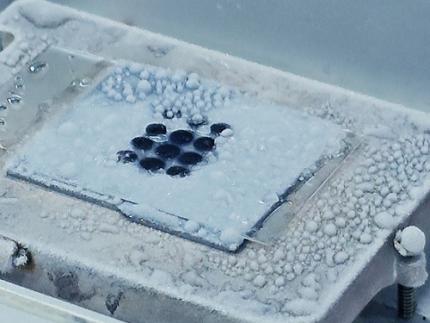 KAIST Research team develops anti-icing film that only requires sunlight
A KAIST research team has developed an anti-icing and de-icing film coating technology that can apply the photothermal effect of gold nanoparticles to industrial sites without the need for heating wires, periodic spray or oil coating of anti-freeze substances, and substrate design alterations.
The group led by Professor Hyoungsoo Kim from the Department of Mechanical Engineering (Fluid & Interface Laboratory) and Professor Dong Ki Yoon from the Department of Chemistry (Soft Material Assembly Group) revealed on January 3 to have together developed an original technique that can uniformly pattern gold nanorod (GNR) particles in quadrants through simple evaporation, and have used this to develop an anti-icing and de-icing surface.
Many scientists in recent years have tried to control substrate surfaces through various coating techniques, and those involving the patterning of functional nanomaterials have gained special attention. In particular, GNR is considered a promising candidate nanomaterial for its biocompatibility, chemical stability, relatively simple synthesis, and its stable and unique property of surface plasmon resonance. To maximize the performance of GNR, it is important to achieve a high uniformity during film deposition, and a high level of rod alignment. However, achieving both criteria has thus far been a difficult challenge.
< Figure 1. Conceptual image to display Hydrodynamic mechanisms for the formation of a homogeneous quadrant cellulose nanocrystal(CNC) matrix. >
To solve this, the joint research team utilized cellulose nanocrystal (CNC), a next-generation functional nanomaterial that can easily be extracted from nature. By co-assembling GNR on CNC quadrant templates, the team could uniformly dry the film and successfully obtain a GNR film with a uniform alignment in a ring-shape. Compared to existing coffee-ring films, the highly uniform and aligned GNR film developed through this research showed enhanced plasmonic photothermal properties, and the team showed that it could carry out anti-icing and de-icing functions by simply irradiating light in the visible wavelength range.
< Figure 2. Optical and thermal performance evaluation results of gold nanorod film and demonstration of plasmonic heater for anti-icing and de-icing. >
Professor Hyoungsoo Kim said, “This technique can be applied to plastic, as well as flexible surfaces. By using it on exterior materials and films, it can generate its own heat energy, which would greatly save energy through voluntary thermal energy harvesting across various applications including cars, aircrafts, and windows in residential or commercial spaces, where frosting becomes a serious issue in the winter.” Professor Dong Ki Yoon added, “This research is significant in that we can now freely pattern the CNC-GNR composite, which was previously difficult to create into films, over a large area. We can utilize this as an anti-icing material, and if we were to take advantage of the plasmonic properties of gold, we can also use it like stained-glass to decorate glass surfaces.”
This research was conducted by Ph.D. candidate Jeongsu Pyeon from the Department of Mechanical Engineering, and his co-first author Dr. Soon Mo Park (a KAIST graduate, currently a post-doctoral associate at Cornell University), and was pushed in the online volume of Nature Communication on December 8, 2023 under the title “Plasmonic Metasurfaces of Cellulose Nanocrystal Matrices with Quadrants of Aligned Gold Nanorods for Photothermal Anti-Icing." Recognized for its achievement, the research was also selected as an editor’s highlight for the journals Materials Science and Chemistry, and Inorganic and Physical Chemistry.
This research was supported by the Individual Basic Mid-Sized Research Fund from the National Research Foundation of Korea and the Center for Multiscale Chiral Architectures.
2024.01.16 View 17762
KAIST Research team develops anti-icing film that only requires sunlight
A KAIST research team has developed an anti-icing and de-icing film coating technology that can apply the photothermal effect of gold nanoparticles to industrial sites without the need for heating wires, periodic spray or oil coating of anti-freeze substances, and substrate design alterations.
The group led by Professor Hyoungsoo Kim from the Department of Mechanical Engineering (Fluid & Interface Laboratory) and Professor Dong Ki Yoon from the Department of Chemistry (Soft Material Assembly Group) revealed on January 3 to have together developed an original technique that can uniformly pattern gold nanorod (GNR) particles in quadrants through simple evaporation, and have used this to develop an anti-icing and de-icing surface.
Many scientists in recent years have tried to control substrate surfaces through various coating techniques, and those involving the patterning of functional nanomaterials have gained special attention. In particular, GNR is considered a promising candidate nanomaterial for its biocompatibility, chemical stability, relatively simple synthesis, and its stable and unique property of surface plasmon resonance. To maximize the performance of GNR, it is important to achieve a high uniformity during film deposition, and a high level of rod alignment. However, achieving both criteria has thus far been a difficult challenge.
< Figure 1. Conceptual image to display Hydrodynamic mechanisms for the formation of a homogeneous quadrant cellulose nanocrystal(CNC) matrix. >
To solve this, the joint research team utilized cellulose nanocrystal (CNC), a next-generation functional nanomaterial that can easily be extracted from nature. By co-assembling GNR on CNC quadrant templates, the team could uniformly dry the film and successfully obtain a GNR film with a uniform alignment in a ring-shape. Compared to existing coffee-ring films, the highly uniform and aligned GNR film developed through this research showed enhanced plasmonic photothermal properties, and the team showed that it could carry out anti-icing and de-icing functions by simply irradiating light in the visible wavelength range.
< Figure 2. Optical and thermal performance evaluation results of gold nanorod film and demonstration of plasmonic heater for anti-icing and de-icing. >
Professor Hyoungsoo Kim said, “This technique can be applied to plastic, as well as flexible surfaces. By using it on exterior materials and films, it can generate its own heat energy, which would greatly save energy through voluntary thermal energy harvesting across various applications including cars, aircrafts, and windows in residential or commercial spaces, where frosting becomes a serious issue in the winter.” Professor Dong Ki Yoon added, “This research is significant in that we can now freely pattern the CNC-GNR composite, which was previously difficult to create into films, over a large area. We can utilize this as an anti-icing material, and if we were to take advantage of the plasmonic properties of gold, we can also use it like stained-glass to decorate glass surfaces.”
This research was conducted by Ph.D. candidate Jeongsu Pyeon from the Department of Mechanical Engineering, and his co-first author Dr. Soon Mo Park (a KAIST graduate, currently a post-doctoral associate at Cornell University), and was pushed in the online volume of Nature Communication on December 8, 2023 under the title “Plasmonic Metasurfaces of Cellulose Nanocrystal Matrices with Quadrants of Aligned Gold Nanorods for Photothermal Anti-Icing." Recognized for its achievement, the research was also selected as an editor’s highlight for the journals Materials Science and Chemistry, and Inorganic and Physical Chemistry.
This research was supported by the Individual Basic Mid-Sized Research Fund from the National Research Foundation of Korea and the Center for Multiscale Chiral Architectures.
2024.01.16 View 17762