%55%43%4c%41
-
 KAIST to Host the ‘6th Emerging Materials Symposium’
KAIST (President Kwang Hyung Lee) announced on the 22nd of August that it will host the 6th KAIST Emerging Materials Symposium on the 26th in the Meta Convergence Hall (W13) on its main Daejeon campus, to explore the latest research trends in next-generation promising nanomaterials and discuss future visions.
Launched in 2020, this symposium marks its sixth year and has established itself as KAIST’s flagship academic event by inviting world-renowned scholars on next-generation materials to share groundbreaking achievements.
The event will feature six speakers from four prestigious overseas universities—the Massachusetts Institute of Technology (MIT), Yale University, UCLA, and Drexel University—providing an overview of cutting-edge global research trends in emerging materials, while also showcasing KAIST’s representative achievements.
Notably, Professor Yury Gogotsi of Drexel University, who gained global recognition for the pioneering development of MXene—an emerging material attracting attention for its high electrical conductivity and electromagnetic shielding capability—will deliver a lecture titled “The Future of MXene.”
In the session “Global Frontier in MIT,” three MIT professors will present the institute’s leading research: ▴Professor Ju Li, an authority on AI-robotics-based materials synthesis, ▴Professor Martin Z. Bazant, an expert in the fields of electrochemistry and electronic transport dynamics, and ▴Professor Jeehwan Kim, a leading researcher tackling the limitations of silicon wafer-based semiconductor manufacturing.
In the session “Emerging Materials and New Possibilities,” ▴Professor Yury Gogotsi of Drexel University, ▴Professor Liangbing Hu of Yale University, a pioneer in nanoparticle synthesis through rapid high-temperature thermal processing, and ▴Professor Jun Chen of UCLA, a key researcher in bioelectronic materials using multifunctional flexible materials, will present the development of core emerging materials and future directions.
Additionally, six professors from KAIST’s Department of Materials Science and Engineering will lead the session “KAIST’s MSE Entrepreneurial Spirit” where they will share the process of founding startups based on KAIST’s advanced materials technologies and how nanomaterials have taken root as foundational industries.
The session will include: ▴Professor Il-Doo Kim, founder of the nanofiber and colorimetric gas sensor company IDKLAB; ▴Professor Kibeom Kang, CEO of TDS Innovation, a company specializing in precursors and equipment for 2D material synthesis; ▴Professor Yeonsik Jeong, co-founder of Pico Foundry, a company producing SERS chips; ▴Professor Sang Wook Kim, founder of Materials Creation, which develops products based on high-quality graphene oxide; ▴Professor Jaebeom Jang, founder of Flashomic Inc., a leader in the commercialization of high-speed multiplexed protein imaging technology; and ▴Professor Steve Park, co-CEO of Aldaver, a company developing artificial cadavers (practice organs) that fully replicate the human body. They will each share their entrepreneurial cases, offering vivid lectures on the journey of scientific technologies into the marketplace.
The symposium will also feature a tour of the automated research lab at the Top-Tier KAIST-MIT Future Energy Initiative Research Center, jointly established by KAIST and MIT. The center, designed to build an AI-robotics-based autonomous research laboratory for the rapid development and application of advanced energy materials to help solve the global climate crisis, will operate for ten years. Overseas scholars will also be given an inside look at research and development using automated infrastructure, with discussions to follow on upcoming international collaborations.
Professor Il-Doo Kim of KAIST’s Department of Materials Science and Engineering, who organized the event, emphasized, “This symposium, featuring six global scholars and six KAIST entrepreneurial professors, will be a valuable opportunity to instill an international perspective and entrepreneurial mindset in students. It will also mark a turning point in KAIST’s innovative materials research and international collaborative research network.”
As part of the program, on Wednesday the 27th, KAIST will hold academic exchange sessions with overseas scholars. These will include discussions on international joint research, as well as sessions where KAIST students and early-career researchers can present their work and interact, opening opportunities for future collaborations.
The 6th KAIST Emerging Materials Symposium is open free of charge to all researchers interested in the latest research trends in chemistry, physics, biology, and materials science-related engineering fields.
Participation on the 26th will be available through on-site registration without prior application. Further details are available on the KAIST Department of Materials Science and Engineering EMS website (https://mse.kaist.ac.kr/index.php?mid=MSE_EMS).
2025.08.22 View 3803
KAIST to Host the ‘6th Emerging Materials Symposium’
KAIST (President Kwang Hyung Lee) announced on the 22nd of August that it will host the 6th KAIST Emerging Materials Symposium on the 26th in the Meta Convergence Hall (W13) on its main Daejeon campus, to explore the latest research trends in next-generation promising nanomaterials and discuss future visions.
Launched in 2020, this symposium marks its sixth year and has established itself as KAIST’s flagship academic event by inviting world-renowned scholars on next-generation materials to share groundbreaking achievements.
The event will feature six speakers from four prestigious overseas universities—the Massachusetts Institute of Technology (MIT), Yale University, UCLA, and Drexel University—providing an overview of cutting-edge global research trends in emerging materials, while also showcasing KAIST’s representative achievements.
Notably, Professor Yury Gogotsi of Drexel University, who gained global recognition for the pioneering development of MXene—an emerging material attracting attention for its high electrical conductivity and electromagnetic shielding capability—will deliver a lecture titled “The Future of MXene.”
In the session “Global Frontier in MIT,” three MIT professors will present the institute’s leading research: ▴Professor Ju Li, an authority on AI-robotics-based materials synthesis, ▴Professor Martin Z. Bazant, an expert in the fields of electrochemistry and electronic transport dynamics, and ▴Professor Jeehwan Kim, a leading researcher tackling the limitations of silicon wafer-based semiconductor manufacturing.
In the session “Emerging Materials and New Possibilities,” ▴Professor Yury Gogotsi of Drexel University, ▴Professor Liangbing Hu of Yale University, a pioneer in nanoparticle synthesis through rapid high-temperature thermal processing, and ▴Professor Jun Chen of UCLA, a key researcher in bioelectronic materials using multifunctional flexible materials, will present the development of core emerging materials and future directions.
Additionally, six professors from KAIST’s Department of Materials Science and Engineering will lead the session “KAIST’s MSE Entrepreneurial Spirit” where they will share the process of founding startups based on KAIST’s advanced materials technologies and how nanomaterials have taken root as foundational industries.
The session will include: ▴Professor Il-Doo Kim, founder of the nanofiber and colorimetric gas sensor company IDKLAB; ▴Professor Kibeom Kang, CEO of TDS Innovation, a company specializing in precursors and equipment for 2D material synthesis; ▴Professor Yeonsik Jeong, co-founder of Pico Foundry, a company producing SERS chips; ▴Professor Sang Wook Kim, founder of Materials Creation, which develops products based on high-quality graphene oxide; ▴Professor Jaebeom Jang, founder of Flashomic Inc., a leader in the commercialization of high-speed multiplexed protein imaging technology; and ▴Professor Steve Park, co-CEO of Aldaver, a company developing artificial cadavers (practice organs) that fully replicate the human body. They will each share their entrepreneurial cases, offering vivid lectures on the journey of scientific technologies into the marketplace.
The symposium will also feature a tour of the automated research lab at the Top-Tier KAIST-MIT Future Energy Initiative Research Center, jointly established by KAIST and MIT. The center, designed to build an AI-robotics-based autonomous research laboratory for the rapid development and application of advanced energy materials to help solve the global climate crisis, will operate for ten years. Overseas scholars will also be given an inside look at research and development using automated infrastructure, with discussions to follow on upcoming international collaborations.
Professor Il-Doo Kim of KAIST’s Department of Materials Science and Engineering, who organized the event, emphasized, “This symposium, featuring six global scholars and six KAIST entrepreneurial professors, will be a valuable opportunity to instill an international perspective and entrepreneurial mindset in students. It will also mark a turning point in KAIST’s innovative materials research and international collaborative research network.”
As part of the program, on Wednesday the 27th, KAIST will hold academic exchange sessions with overseas scholars. These will include discussions on international joint research, as well as sessions where KAIST students and early-career researchers can present their work and interact, opening opportunities for future collaborations.
The 6th KAIST Emerging Materials Symposium is open free of charge to all researchers interested in the latest research trends in chemistry, physics, biology, and materials science-related engineering fields.
Participation on the 26th will be available through on-site registration without prior application. Further details are available on the KAIST Department of Materials Science and Engineering EMS website (https://mse.kaist.ac.kr/index.php?mid=MSE_EMS).
2025.08.22 View 3803 -
 KAIST's Pioneering VR Precision Technology & Choreography Tool Receive Spotlights at CHI 2025
Accurate pointing in virtual spaces is essential for seamless interaction. If pointing is not precise, selecting the desired object becomes challenging, breaking user immersion and reducing overall experience quality. KAIST researchers have developed a technology that offers a vivid, lifelike experience in virtual space, alongside a new tool that assists choreographers throughout the creative process.
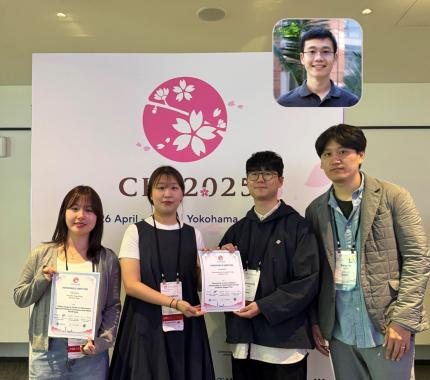
KAIST (President Kwang-Hyung Lee) announced on May 13th that a research team led by Professor Sang Ho Yoon of the Graduate School of Culture Technology, in collaboration with Professor Yang Zhang of the University of California, Los Angeles (UCLA), has developed the ‘T2IRay’ technology and the ‘ChoreoCraft’ platform, which enables choreographers to work more freely and creatively in virtual reality. These technologies received two Honorable Mention awards, recognizing the top 5% of papers, at CHI 2025*, the best international conference in the field of human-computer interaction, hosted by the Association for Computing Machinery (ACM) from April 25 to May 1.
< (From left) PhD candidates Jina Kim and Kyungeun Jung along with Master's candidate, Hyunyoung Han and Professor Sang Ho Yoon of KAIST Graduate School of Culture Technology and Professor Yang Zhang (top) of UCLA >
T2IRay: Enabling Virtual Input with Precision
T2IRay introduces a novel input method that allows for precise object pointing in virtual environments by expanding traditional thumb-to-index gestures. This approach overcomes previous limitations, such as interruptions or reduced accuracy due to changes in hand position or orientation.
The technology uses a local coordinate system based on finger relationships, ensuring continuous input even as hand positions shift. It accurately captures subtle thumb movements within this coordinate system, integrating natural head movements to allow fluid, intuitive control across a wide range.
< Figure 1. T2IRay framework utilizing the delicate movements of the thumb and index fingers for AR/VR pointing >
Professor Sang Ho Yoon explained, “T2IRay can significantly enhance the user experience in AR/VR by enabling smooth, stable control even when the user’s hands are in motion.”
This study, led by first author Jina Kim, was supported by the Excellent New Researcher Support Project of the National Research Foundation of Korea under the Ministry of Science and ICT, as well as the University ICT Research Center (ITRC) Support Project of the Institute of Information and Communications Technology Planning and Evaluation (IITP).
▴ Paper title: T2IRay: Design of Thumb-to-Index Based Indirect Pointing for Continuous and Robust AR/VR Input▴ Paper link: https://doi.org/10.1145/3706598.3713442
▴ T2IRay demo video: https://youtu.be/ElJlcJbkJPY
ChoreoCraft: Creativity Support through VR for Choreographers
In addition, Professor Yoon’s team developed ‘ChoreoCraft,’ a virtual reality tool designed to support choreographers by addressing the unique challenges they face, such as memorizing complex movements, overcoming creative blocks, and managing subjective feedback.
ChoreoCraft reduces reliance on memory by allowing choreographers to save and refine movements directly within a VR space, using a motion-capture avatar for real-time interaction. It also enhances creativity by suggesting movements that naturally fit with prior choreography and musical elements. Furthermore, the system provides quantitative feedback by analyzing kinematic factors like motion stability and engagement, helping choreographers make data-driven creative decisions.
< Figure 2. ChoreoCraft's approaches to encourage creative process >
Professor Yoon noted, “ChoreoCraft is a tool designed to address the core challenges faced by choreographers, enhancing both creativity and efficiency. In user tests with professional choreographers, it received high marks for its ability to spark creative ideas and provide valuable quantitative feedback.”
This research was conducted in collaboration with doctoral candidate Kyungeun Jung and master’s candidate Hyunyoung Han, alongside the Electronics and Telecommunications Research Institute (ETRI) and One Million Co., Ltd. (CEO Hye-rang Kim), with support from the Cultural and Arts Immersive Service Development Project by the Ministry of Culture, Sports and Tourism.
▴ Paper title: ChoreoCraft: In-situ Crafting of Choreography in Virtual Reality through Creativity Support Tools▴ Paper link: https://doi.org/10.1145/3706598.3714220
▴ ChoreoCraft demo video: https://youtu.be/Ms1fwiSBjjw
*CHI (Conference on Human Factors in Computing Systems): The premier international conference on human-computer interaction, organized by the ACM, was held this year from April 25 to May 1, 2025.
2025.05.13 View 11732
KAIST's Pioneering VR Precision Technology & Choreography Tool Receive Spotlights at CHI 2025
Accurate pointing in virtual spaces is essential for seamless interaction. If pointing is not precise, selecting the desired object becomes challenging, breaking user immersion and reducing overall experience quality. KAIST researchers have developed a technology that offers a vivid, lifelike experience in virtual space, alongside a new tool that assists choreographers throughout the creative process.
KAIST (President Kwang-Hyung Lee) announced on May 13th that a research team led by Professor Sang Ho Yoon of the Graduate School of Culture Technology, in collaboration with Professor Yang Zhang of the University of California, Los Angeles (UCLA), has developed the ‘T2IRay’ technology and the ‘ChoreoCraft’ platform, which enables choreographers to work more freely and creatively in virtual reality. These technologies received two Honorable Mention awards, recognizing the top 5% of papers, at CHI 2025*, the best international conference in the field of human-computer interaction, hosted by the Association for Computing Machinery (ACM) from April 25 to May 1.
< (From left) PhD candidates Jina Kim and Kyungeun Jung along with Master's candidate, Hyunyoung Han and Professor Sang Ho Yoon of KAIST Graduate School of Culture Technology and Professor Yang Zhang (top) of UCLA >
T2IRay: Enabling Virtual Input with Precision
T2IRay introduces a novel input method that allows for precise object pointing in virtual environments by expanding traditional thumb-to-index gestures. This approach overcomes previous limitations, such as interruptions or reduced accuracy due to changes in hand position or orientation.
The technology uses a local coordinate system based on finger relationships, ensuring continuous input even as hand positions shift. It accurately captures subtle thumb movements within this coordinate system, integrating natural head movements to allow fluid, intuitive control across a wide range.
< Figure 1. T2IRay framework utilizing the delicate movements of the thumb and index fingers for AR/VR pointing >
Professor Sang Ho Yoon explained, “T2IRay can significantly enhance the user experience in AR/VR by enabling smooth, stable control even when the user’s hands are in motion.”
This study, led by first author Jina Kim, was supported by the Excellent New Researcher Support Project of the National Research Foundation of Korea under the Ministry of Science and ICT, as well as the University ICT Research Center (ITRC) Support Project of the Institute of Information and Communications Technology Planning and Evaluation (IITP).
▴ Paper title: T2IRay: Design of Thumb-to-Index Based Indirect Pointing for Continuous and Robust AR/VR Input▴ Paper link: https://doi.org/10.1145/3706598.3713442
▴ T2IRay demo video: https://youtu.be/ElJlcJbkJPY
ChoreoCraft: Creativity Support through VR for Choreographers
In addition, Professor Yoon’s team developed ‘ChoreoCraft,’ a virtual reality tool designed to support choreographers by addressing the unique challenges they face, such as memorizing complex movements, overcoming creative blocks, and managing subjective feedback.
ChoreoCraft reduces reliance on memory by allowing choreographers to save and refine movements directly within a VR space, using a motion-capture avatar for real-time interaction. It also enhances creativity by suggesting movements that naturally fit with prior choreography and musical elements. Furthermore, the system provides quantitative feedback by analyzing kinematic factors like motion stability and engagement, helping choreographers make data-driven creative decisions.
< Figure 2. ChoreoCraft's approaches to encourage creative process >
Professor Yoon noted, “ChoreoCraft is a tool designed to address the core challenges faced by choreographers, enhancing both creativity and efficiency. In user tests with professional choreographers, it received high marks for its ability to spark creative ideas and provide valuable quantitative feedback.”
This research was conducted in collaboration with doctoral candidate Kyungeun Jung and master’s candidate Hyunyoung Han, alongside the Electronics and Telecommunications Research Institute (ETRI) and One Million Co., Ltd. (CEO Hye-rang Kim), with support from the Cultural and Arts Immersive Service Development Project by the Ministry of Culture, Sports and Tourism.
▴ Paper title: ChoreoCraft: In-situ Crafting of Choreography in Virtual Reality through Creativity Support Tools▴ Paper link: https://doi.org/10.1145/3706598.3714220
▴ ChoreoCraft demo video: https://youtu.be/Ms1fwiSBjjw
*CHI (Conference on Human Factors in Computing Systems): The premier international conference on human-computer interaction, organized by the ACM, was held this year from April 25 to May 1, 2025.
2025.05.13 View 11732 -
 Big Ideas on Emerging Materials Explored at EMS
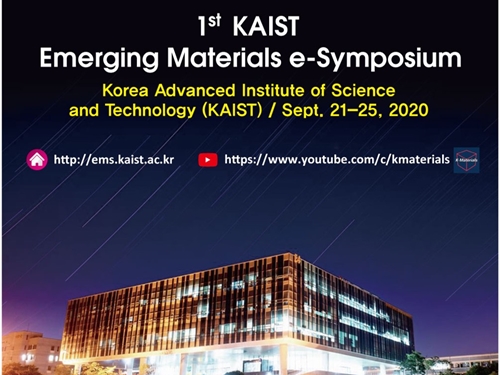
Renowned scholars and editors from academic journals joined the Emerging Materials e-Symposium (EMS) held at KAIST and shared the latest breakthroughs and big ideas in new material development last month. This e-symposium was organized by Professor Il-Doo Kim from the KAIST Department of Materials Sciences and Engineering over five days from September 21 through 25 via Zoom and YouTube. Professor Kim also serves as an associate editor of ACS Nano.
Esteemed scholars and editors of academic journals including ACS Nano, Nano Energy, and Energy Storage Materials made Zoom presentations in three main categories: 1) nanostructures for next-generation applications, 2) chemistry and biotechnology for applications in the fields of environment and industry, and 3) material innovation for technological applications.
During Session I, speakers including Professor John A. Rogers of Northwestern University and Professor Zhenan Bao of Stanford University led the session on Emerging Soft Electronics and 3D printing.
In later sessions, other globally recognized scholars gave talks titled Advanced Nanostructuring for Emerging Materials, Frontiers in Emerging Materials Research, Advanced Energy Materials and Functional Nanomaterials, and Latest Advances in Nanomaterials Research.
These included 2010 Nobel Prize laureate and professor at Manchester University Andre Geim, editor-in-chief of ACS Nano and professor at UCLA Paul S. Weiss, Professor Paul Alivisatos of UC Berkeley, Professor William Chueh of Stanford University, and Professor Mircea Dinca of MIT.
KAIST President Sung-Chul Shin, who is also a materials physicist, said in his opening address, “Innovation in materials science will become an important driving force to change our way of life. All the breakthroughs in materials have extended a new paradigm that has transformed our lives.”
“Creative research projects alongside global collaborators like all of you will allow the breakthroughs that will deliver us from these crises,” he added.
(END)
2020.10.06 View 24524
Big Ideas on Emerging Materials Explored at EMS
Renowned scholars and editors from academic journals joined the Emerging Materials e-Symposium (EMS) held at KAIST and shared the latest breakthroughs and big ideas in new material development last month. This e-symposium was organized by Professor Il-Doo Kim from the KAIST Department of Materials Sciences and Engineering over five days from September 21 through 25 via Zoom and YouTube. Professor Kim also serves as an associate editor of ACS Nano.
Esteemed scholars and editors of academic journals including ACS Nano, Nano Energy, and Energy Storage Materials made Zoom presentations in three main categories: 1) nanostructures for next-generation applications, 2) chemistry and biotechnology for applications in the fields of environment and industry, and 3) material innovation for technological applications.
During Session I, speakers including Professor John A. Rogers of Northwestern University and Professor Zhenan Bao of Stanford University led the session on Emerging Soft Electronics and 3D printing.
In later sessions, other globally recognized scholars gave talks titled Advanced Nanostructuring for Emerging Materials, Frontiers in Emerging Materials Research, Advanced Energy Materials and Functional Nanomaterials, and Latest Advances in Nanomaterials Research.
These included 2010 Nobel Prize laureate and professor at Manchester University Andre Geim, editor-in-chief of ACS Nano and professor at UCLA Paul S. Weiss, Professor Paul Alivisatos of UC Berkeley, Professor William Chueh of Stanford University, and Professor Mircea Dinca of MIT.
KAIST President Sung-Chul Shin, who is also a materials physicist, said in his opening address, “Innovation in materials science will become an important driving force to change our way of life. All the breakthroughs in materials have extended a new paradigm that has transformed our lives.”
“Creative research projects alongside global collaborators like all of you will allow the breakthroughs that will deliver us from these crises,” he added.
(END)
2020.10.06 View 24524