Princeton+University
-
 Solutal Marangoni Flows of Miscible Liquid Drive Transport without Surface Contamination
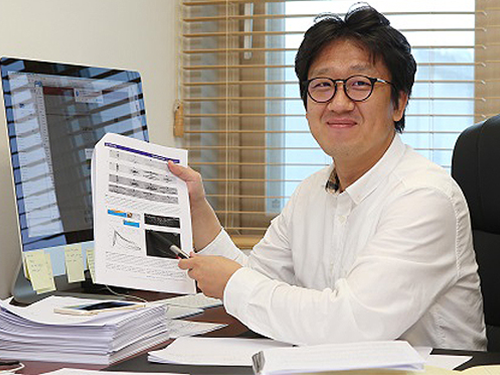
(Professor Hyoungsoo Kim, Department of Mechanical Engineering, KAIST)
A research team led by Hyoungsoo Kim, a professor of Mechanical Engineering at KAIST, succeeded in quantifying the phenomenon called, the Marangoni effect, which occurs at the interface between alcohol and water. It is expected that this finding will be a valuable resource used for effectively removing impurities from a surface fluid without any contamination, and developing materials that can replace surfactants.
This research, co-conducted with a research team led by Professor Howard A. Stone at Princeton University, was published online in Nature Physics on July 31.
The Marangoni effect, also known as tears of wine, is generated when two fluids having a different surface tension meet, causing finite mixing, spreading time and length scale. Typically, people believe that infinitely miscible liquids immediately mix together; however, it is not always true according to this paper.
The typical surface tension of alcohol is three times lower than that of water, and this different surface tension generates the Marangoni-driven convection flow at the interface of the two liquids. In addition, there is a certain amount of time required for them to mix.
This phenomenon has been discussed many times since it was discovered in early the 20th century, yet there was a limit to quantifying and explaining it.
Professor Kim, considering the mixing and spreading mechanism, used various flow visualization techniques and equipment for capturing high speed images in his experiment.
Through the flow visualization methods, the team succeeded in quantifying and explaining the complex, physicochemical phenomenon generated between water and alcohol. Moreover, they developed a theoretical model to predict the physicochemical hydrodynamic phenomena.
The theoretical model can predict the speed of Marangoni-driven convection flow, the area of a drop of alcohol and the time required to develop the flow field. Hence, this model can map out types of materials (e.g., alcohol) and the volume of a drop of liquid as applicable to target a specific situation.
Moreover, the research team believes that the interfacial flow enables the driving of bulk flows and that it can be a source of technology for effectively delivering drugs and removing impurities from a surface of substance without causing secondary contamination.
Above all, the results show a possibility for replacing surfactant with alcohol as a material used for delivering drugs. In the case of the drug delivery, some drugs are encapsulated with a surfactant in order to be effectively transported in vivo; however, the surfactant accumulates in the body, which can cause various side effects, such as heart disease. Therefore, using new materials like alcohol for drug delivery will contribute to preventing the side effects caused by the surfactant.
“The surfactant is used for delivering drugs, but it is difficult to be expelled from the body. This will cause various side effects, such as heart diseases in asthmatic patients,” said Professor Kim. “I hope that using new materials, like alcohol, will free people from these side effects.”
(Marangoni-driven convection flow generated at the interface between water and alcohol, and the flow visualization results)
- A drop of alcohol on a water surface
- Comparison of mixing structures on the surface
- Marangoni mixing flow under the free surface
2017.08.18 View 9657
Solutal Marangoni Flows of Miscible Liquid Drive Transport without Surface Contamination
(Professor Hyoungsoo Kim, Department of Mechanical Engineering, KAIST)
A research team led by Hyoungsoo Kim, a professor of Mechanical Engineering at KAIST, succeeded in quantifying the phenomenon called, the Marangoni effect, which occurs at the interface between alcohol and water. It is expected that this finding will be a valuable resource used for effectively removing impurities from a surface fluid without any contamination, and developing materials that can replace surfactants.
This research, co-conducted with a research team led by Professor Howard A. Stone at Princeton University, was published online in Nature Physics on July 31.
The Marangoni effect, also known as tears of wine, is generated when two fluids having a different surface tension meet, causing finite mixing, spreading time and length scale. Typically, people believe that infinitely miscible liquids immediately mix together; however, it is not always true according to this paper.
The typical surface tension of alcohol is three times lower than that of water, and this different surface tension generates the Marangoni-driven convection flow at the interface of the two liquids. In addition, there is a certain amount of time required for them to mix.
This phenomenon has been discussed many times since it was discovered in early the 20th century, yet there was a limit to quantifying and explaining it.
Professor Kim, considering the mixing and spreading mechanism, used various flow visualization techniques and equipment for capturing high speed images in his experiment.
Through the flow visualization methods, the team succeeded in quantifying and explaining the complex, physicochemical phenomenon generated between water and alcohol. Moreover, they developed a theoretical model to predict the physicochemical hydrodynamic phenomena.
The theoretical model can predict the speed of Marangoni-driven convection flow, the area of a drop of alcohol and the time required to develop the flow field. Hence, this model can map out types of materials (e.g., alcohol) and the volume of a drop of liquid as applicable to target a specific situation.
Moreover, the research team believes that the interfacial flow enables the driving of bulk flows and that it can be a source of technology for effectively delivering drugs and removing impurities from a surface of substance without causing secondary contamination.
Above all, the results show a possibility for replacing surfactant with alcohol as a material used for delivering drugs. In the case of the drug delivery, some drugs are encapsulated with a surfactant in order to be effectively transported in vivo; however, the surfactant accumulates in the body, which can cause various side effects, such as heart disease. Therefore, using new materials like alcohol for drug delivery will contribute to preventing the side effects caused by the surfactant.
“The surfactant is used for delivering drugs, but it is difficult to be expelled from the body. This will cause various side effects, such as heart diseases in asthmatic patients,” said Professor Kim. “I hope that using new materials, like alcohol, will free people from these side effects.”
(Marangoni-driven convection flow generated at the interface between water and alcohol, and the flow visualization results)
- A drop of alcohol on a water surface
- Comparison of mixing structures on the surface
- Marangoni mixing flow under the free surface
2017.08.18 View 9657 -
 FinTech Conference by KAIST, EDHEC-Risk Institute, Princeton, and Tsinghua
KAIST will partner with EDHEC-Risk Institute, Princeton University, and Tsinghua University to host a series of annual rotation conference on FinTech. The inaugural conference will be held in Princeton on April 26 and is entitled ‘Four-University Rotating FinTech Conference: Wealth Management Systems for Individual Investors.’
The conference will facilitate discussion among all interest parties of academics, practitioners, and regulators from around the world. Professor Woo Chang Kim of the Department of Industrial & Systems Engineering will represent KAIST. Professor Kim is also the head of the Center for Wealth Management Technologies at KAIST.
In addition to Professor Kim, leading experts from the US, Asia, and Europe will present at the conference, including Andrew Yao (Turing Award recipient and founder of IIIS FinTech Center at Tsinghua University), John Bogle (founder of the Vanguard Group, and president of the Bogle Financial Markets Research Center), Lionel Martellini (director of EDHEC-Risk Institute), John Mashey (Bell Labs/Silicon Valley computer scientist/corporate executive), and John Mulvey (professor and founding member of the Bendheim Center for Finance at Princeton University).
This year’s conference will feature following sessions:
· Mass-Customization of Goal-Based Investment Solutions: The New Frontier in Digital Wealth Management Services
· Goal-Based Investment via Multi-Stage Stochastic Goal Programming for Robo-Advisor Services
· Big Data – Yesterday, Today and Tomorrow
· Applying Machine Learning Concepts for Asset Allocation and ALM
· FinTech: Drawing Strengths from Computing Theories
· Savings and Investing to Achieve Retirement Goals: An Update Given Current Market Assumptions · The Rise of Robo-Advisors: A Threat or an Opportunity for the Wealth Management Industry?
The conference will include the participation of official partner Samsung Asset Management.
2017.04.20 View 11329
FinTech Conference by KAIST, EDHEC-Risk Institute, Princeton, and Tsinghua
KAIST will partner with EDHEC-Risk Institute, Princeton University, and Tsinghua University to host a series of annual rotation conference on FinTech. The inaugural conference will be held in Princeton on April 26 and is entitled ‘Four-University Rotating FinTech Conference: Wealth Management Systems for Individual Investors.’
The conference will facilitate discussion among all interest parties of academics, practitioners, and regulators from around the world. Professor Woo Chang Kim of the Department of Industrial & Systems Engineering will represent KAIST. Professor Kim is also the head of the Center for Wealth Management Technologies at KAIST.
In addition to Professor Kim, leading experts from the US, Asia, and Europe will present at the conference, including Andrew Yao (Turing Award recipient and founder of IIIS FinTech Center at Tsinghua University), John Bogle (founder of the Vanguard Group, and president of the Bogle Financial Markets Research Center), Lionel Martellini (director of EDHEC-Risk Institute), John Mashey (Bell Labs/Silicon Valley computer scientist/corporate executive), and John Mulvey (professor and founding member of the Bendheim Center for Finance at Princeton University).
This year’s conference will feature following sessions:
· Mass-Customization of Goal-Based Investment Solutions: The New Frontier in Digital Wealth Management Services
· Goal-Based Investment via Multi-Stage Stochastic Goal Programming for Robo-Advisor Services
· Big Data – Yesterday, Today and Tomorrow
· Applying Machine Learning Concepts for Asset Allocation and ALM
· FinTech: Drawing Strengths from Computing Theories
· Savings and Investing to Achieve Retirement Goals: An Update Given Current Market Assumptions · The Rise of Robo-Advisors: A Threat or an Opportunity for the Wealth Management Industry?
The conference will include the participation of official partner Samsung Asset Management.
2017.04.20 View 11329