%4e%65%77%20%6d%61%74%65%72%69%61%6c%73
-
 Physics Informed AI Excels at Large Scale Discovery of New Materials!
<(From left) Ph.D candidates Songho Lee, Donggeun Park, and Hyeonbin Moon, and Professor Seunghwa Ryu from the Department of Mechanical Engineering; (top) Professor Jae Hyuk Lim from Kyung Hee University and Dr. Wabi Demeke from KAIST>
One of the key steps in developing new materials is “property identification,” which has long relied on massive amounts of experimental data and expensive equipment, limiting research efficiency. A KAIST research team has introduced a new technique that combines “physical laws,” which govern deformation and interaction of materials and energy, with artificial intelligence. This approach allows for rapid exploration of new materials even under data-scarce conditions and provides a foundation for accelerating design and verification across multiple engineering fields, including materials, mechanics, energy, and electronics.
KAIST (President Kwang Hyung Lee) announced on the 2nd of October that Professor Seunghwa Ryu’s research group in the Department of Mechanical Engineering, in collaboration with Professor Jae Hyuk Lim’s group at Kyung Hee University (President Jinsang Kim) and Dr. Byungki Ryu at the Korea Electrotechnology Research Institute (President Namkyun Kim), proposed a new method that can accurately determine material properties with only limited data. The method uses Physics-Informed Machine Learning (PIML), which directly incorporates physical laws into the AI learning process.
<Schematic Diagram of a Physics-Based Machine Learning Methodology for Understanding Material Properties>
In the first study, the researchers focused on hyperelastic materials, such as rubber. They presented a Physics-Informed Neural Network (PINN) method that can identify both the deformation behavior and the properties of materials using only a small amount of data obtained from a single experiment. Whereas previous approaches required large, complex datasets, this research demonstrated that material characteristics can be reliably reproduced even when data is scarce, limited, or noisy.
In the second study, the team turned to thermoelectric materials—new materials that convert heat into electricity and electricity into heat. They proposed a PINN-based inverse inference technique that can estimate key indicators, such as thermal conductivity (how well heat is transferred) and the Seebeck coefficient (how efficiently electricity is generated), from just a few measurements.
Going further, the researchers introduced a Physics-Informed Neural Operator (PINO), an AI model that understands the physical laws of nature, and showed that it can generalize to previously unseen materials without requiring retraining.
In fact, after training the system on 20 materials, they tested it on 60 entirely new materials, and in all cases it predicted their properties with high accuracy. This breakthrough points to a future where large-scale, high-speed screening of countless candidate materials becomes possible.
This achievement goes beyond simply reducing the need for experiments. By intricately combining physical laws with AI, the researchers provided the first example of improving experimental efficiency while preserving reliability.
Professor Seunghwa Ryu, who led both studies, stated, “This is the first case of applying AI that understands physical laws to real material research. It enables reliable identification of material properties even when data availability is limited, and it is expected to expand into various engineering fields.”
The first paper, co-first-authored by KAIST Mechanical Engineering PhD candidates Hyeonbin Moon and Donggeun Park, was published on August 13 in Computer Methods in Applied Mechanics and Engineering.
※ Paper title: “Physics-informed neural network-based discovery of hyperelastic constitutive models from extremely scarce data”
※ DOI: https://doi.org/10.1016/j.cma.2025.118258
The second paper, co-first-authored by KAIST Mechanical Engineering PhD candidates Hyeonbin Moon and Songho Lee, and Dr. Wabi Demeke, was published on August 22 in npj Computational Materials.
※ Paper title: “Physics-informed neural operators for generalizable and label-free inference of temperature-dependent thermoelectric properties” ※ DOI: https://doi.org/10.1038/s41524-025-01769-1
Meanwhile, the first study was supported by the Korea Research Foundation and the Ministry of Science and ICT’s INNOCore Program, as well as by a research project from the Ministry of Food and Drug Safety. The second study was carried out with support from the Korea Research Foundation and the Ministry of Science and ICT’s INNOCore Program.
2025.10.10 View 6272
Physics Informed AI Excels at Large Scale Discovery of New Materials!
<(From left) Ph.D candidates Songho Lee, Donggeun Park, and Hyeonbin Moon, and Professor Seunghwa Ryu from the Department of Mechanical Engineering; (top) Professor Jae Hyuk Lim from Kyung Hee University and Dr. Wabi Demeke from KAIST>
One of the key steps in developing new materials is “property identification,” which has long relied on massive amounts of experimental data and expensive equipment, limiting research efficiency. A KAIST research team has introduced a new technique that combines “physical laws,” which govern deformation and interaction of materials and energy, with artificial intelligence. This approach allows for rapid exploration of new materials even under data-scarce conditions and provides a foundation for accelerating design and verification across multiple engineering fields, including materials, mechanics, energy, and electronics.
KAIST (President Kwang Hyung Lee) announced on the 2nd of October that Professor Seunghwa Ryu’s research group in the Department of Mechanical Engineering, in collaboration with Professor Jae Hyuk Lim’s group at Kyung Hee University (President Jinsang Kim) and Dr. Byungki Ryu at the Korea Electrotechnology Research Institute (President Namkyun Kim), proposed a new method that can accurately determine material properties with only limited data. The method uses Physics-Informed Machine Learning (PIML), which directly incorporates physical laws into the AI learning process.
<Schematic Diagram of a Physics-Based Machine Learning Methodology for Understanding Material Properties>
In the first study, the researchers focused on hyperelastic materials, such as rubber. They presented a Physics-Informed Neural Network (PINN) method that can identify both the deformation behavior and the properties of materials using only a small amount of data obtained from a single experiment. Whereas previous approaches required large, complex datasets, this research demonstrated that material characteristics can be reliably reproduced even when data is scarce, limited, or noisy.
In the second study, the team turned to thermoelectric materials—new materials that convert heat into electricity and electricity into heat. They proposed a PINN-based inverse inference technique that can estimate key indicators, such as thermal conductivity (how well heat is transferred) and the Seebeck coefficient (how efficiently electricity is generated), from just a few measurements.
Going further, the researchers introduced a Physics-Informed Neural Operator (PINO), an AI model that understands the physical laws of nature, and showed that it can generalize to previously unseen materials without requiring retraining.
In fact, after training the system on 20 materials, they tested it on 60 entirely new materials, and in all cases it predicted their properties with high accuracy. This breakthrough points to a future where large-scale, high-speed screening of countless candidate materials becomes possible.
This achievement goes beyond simply reducing the need for experiments. By intricately combining physical laws with AI, the researchers provided the first example of improving experimental efficiency while preserving reliability.
Professor Seunghwa Ryu, who led both studies, stated, “This is the first case of applying AI that understands physical laws to real material research. It enables reliable identification of material properties even when data availability is limited, and it is expected to expand into various engineering fields.”
The first paper, co-first-authored by KAIST Mechanical Engineering PhD candidates Hyeonbin Moon and Donggeun Park, was published on August 13 in Computer Methods in Applied Mechanics and Engineering.
※ Paper title: “Physics-informed neural network-based discovery of hyperelastic constitutive models from extremely scarce data”
※ DOI: https://doi.org/10.1016/j.cma.2025.118258
The second paper, co-first-authored by KAIST Mechanical Engineering PhD candidates Hyeonbin Moon and Songho Lee, and Dr. Wabi Demeke, was published on August 22 in npj Computational Materials.
※ Paper title: “Physics-informed neural operators for generalizable and label-free inference of temperature-dependent thermoelectric properties” ※ DOI: https://doi.org/10.1038/s41524-025-01769-1
Meanwhile, the first study was supported by the Korea Research Foundation and the Ministry of Science and ICT’s INNOCore Program, as well as by a research project from the Ministry of Food and Drug Safety. The second study was carried out with support from the Korea Research Foundation and the Ministry of Science and ICT’s INNOCore Program.
2025.10.10 View 6272 -
 Highly Deformable Piezoelectric Nanotruss for Tactile Electronics
With the importance of non-contact environments growing due to COVID-19, tactile electronic devices using haptic technology are gaining traction as new mediums of communication.
Haptic technology is being applied in a wide array of fields such as robotics or interactive displays. haptic gloves are being used for augmented information communication technology. Efficient piezoelectric materials that can convert various mechanical stimuli into electrical signals and vice versa are a prerequisite for advancing high-performing haptic technology.
A research team led by Professor Seungbum Hong confirmed the potential of tactile devices by developing ceramic piezoelectric materials that are three times more deformable. For the fabrication of highly deformable nanomaterials, the research team built a zinc oxide hollow nanostructure using proximity field nanopatterning and atomic layered deposition. The piezoelectric coefficient was measured to be approximately 9.2 pm/V and the nanopillar compression test showed an elastic strain limit of approximately 10%, which is more than three times greater than that of the bulk zinc oxide one.
Piezoelectric ceramics have a high piezoelectric coefficient with a low elastic strain limit, whereas the opposite is true for piezoelectric polymers. Therefore, it has been very challenging to obtain good performance in both high piezoelectric coefficients as well as high elastic strain limits. To break the elastic limit of piezoelectric ceramics, the research team introduced a 3D truss-like hollow nanostructure with nanometer-scale thin walls.
According to the Griffith criterion, the fracture strength of a material is inversely proportional to the square root of the preexisting flaw size. However, a large flaw is less likely to occur in a small structure, which, in turn, enhances the strength of the material. Therefore, implementing the form of a 3D truss-like hollow nanostructure with nanometer-scale thin walls can extend the elastic limit of the material. Furthermore, a monolithic 3D structure can withstand large strains in all directions while simultaneously preventing the loss from the bottleneck. Previously, the fracture property of piezoelectric ceramic materials was difficult to control, owing to the large variance in crack sizes. However, the research team structurally limited the crack sizes to manage the fracture properties.
Professor Hong’s results demonstrate the potential for the development of highly deformable ceramic piezoelectric materials by improving the elastic limit using a 3D hollow nanostructure. Since zinc oxide has a relatively low piezoelectric coefficient compared to other piezoelectric ceramic materials, applying the proposed structure to such components promised better results in terms of the piezoelectric activity.
“With the advent of the non-contact era, the importance of emotional communication is increasing. Through the development of novel tactile interaction technologies, in addition to the current visual and auditory communication, mankind will enter a new era where they can communicate with anyone using all five senses regardless of location as if they are with them in person,” Professor Hong said.
“While additional research must be conducted to realize the application of the proposed designs for haptic enhancement devices, this study holds high value in that it resolves one of the most challenging issues in the use of piezoelectric ceramics, specifically opening new possibilities for their application by overcoming their mechanical constraints.
The research was reported in Nano Energy and supported by the Ministry of Science and ICT, the Korea Research Foundation, and the KAIST Global Singularity Research Project.
-Profile: Professor Seungbum Hong
seungbum@kaist.ac.kr
http://mii.kaist.ac.kr/
Department of Materials Science and Engineering
KAIST
2021.02.02 View 19388
Highly Deformable Piezoelectric Nanotruss for Tactile Electronics
With the importance of non-contact environments growing due to COVID-19, tactile electronic devices using haptic technology are gaining traction as new mediums of communication.
Haptic technology is being applied in a wide array of fields such as robotics or interactive displays. haptic gloves are being used for augmented information communication technology. Efficient piezoelectric materials that can convert various mechanical stimuli into electrical signals and vice versa are a prerequisite for advancing high-performing haptic technology.
A research team led by Professor Seungbum Hong confirmed the potential of tactile devices by developing ceramic piezoelectric materials that are three times more deformable. For the fabrication of highly deformable nanomaterials, the research team built a zinc oxide hollow nanostructure using proximity field nanopatterning and atomic layered deposition. The piezoelectric coefficient was measured to be approximately 9.2 pm/V and the nanopillar compression test showed an elastic strain limit of approximately 10%, which is more than three times greater than that of the bulk zinc oxide one.
Piezoelectric ceramics have a high piezoelectric coefficient with a low elastic strain limit, whereas the opposite is true for piezoelectric polymers. Therefore, it has been very challenging to obtain good performance in both high piezoelectric coefficients as well as high elastic strain limits. To break the elastic limit of piezoelectric ceramics, the research team introduced a 3D truss-like hollow nanostructure with nanometer-scale thin walls.
According to the Griffith criterion, the fracture strength of a material is inversely proportional to the square root of the preexisting flaw size. However, a large flaw is less likely to occur in a small structure, which, in turn, enhances the strength of the material. Therefore, implementing the form of a 3D truss-like hollow nanostructure with nanometer-scale thin walls can extend the elastic limit of the material. Furthermore, a monolithic 3D structure can withstand large strains in all directions while simultaneously preventing the loss from the bottleneck. Previously, the fracture property of piezoelectric ceramic materials was difficult to control, owing to the large variance in crack sizes. However, the research team structurally limited the crack sizes to manage the fracture properties.
Professor Hong’s results demonstrate the potential for the development of highly deformable ceramic piezoelectric materials by improving the elastic limit using a 3D hollow nanostructure. Since zinc oxide has a relatively low piezoelectric coefficient compared to other piezoelectric ceramic materials, applying the proposed structure to such components promised better results in terms of the piezoelectric activity.
“With the advent of the non-contact era, the importance of emotional communication is increasing. Through the development of novel tactile interaction technologies, in addition to the current visual and auditory communication, mankind will enter a new era where they can communicate with anyone using all five senses regardless of location as if they are with them in person,” Professor Hong said.
“While additional research must be conducted to realize the application of the proposed designs for haptic enhancement devices, this study holds high value in that it resolves one of the most challenging issues in the use of piezoelectric ceramics, specifically opening new possibilities for their application by overcoming their mechanical constraints.
The research was reported in Nano Energy and supported by the Ministry of Science and ICT, the Korea Research Foundation, and the KAIST Global Singularity Research Project.
-Profile: Professor Seungbum Hong
seungbum@kaist.ac.kr
http://mii.kaist.ac.kr/
Department of Materials Science and Engineering
KAIST
2021.02.02 View 19388 -
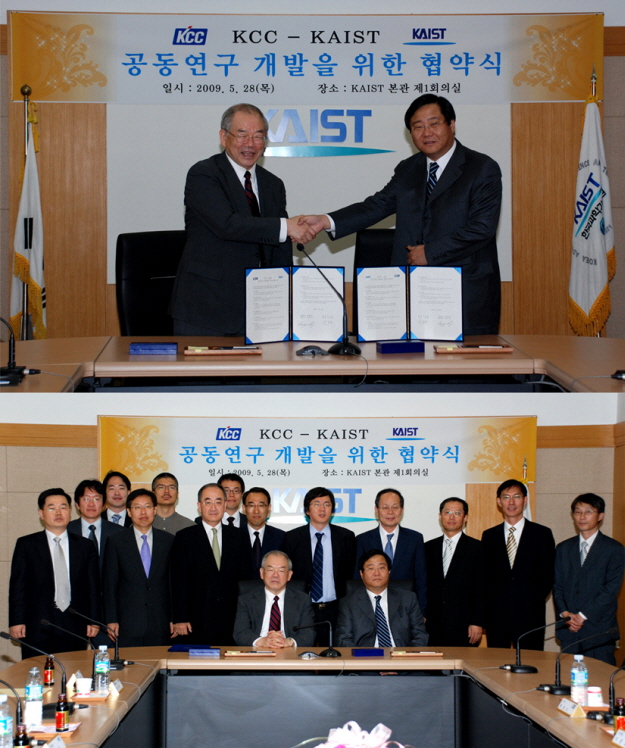 KAIST Signs Agreement for Industry-Academia Cooperation with KCC
KAIST signed an agreement for industry-academia cooperation with KCC, Korea"s leading supplier of building & industrial materials, on May 28, university sources said.
The agreement signed by KAIST President Nam-Pyo Suh and Mong-Jin Chung, Chairman of the KCC Business Group, calls for KAIST and KCC to conduct joint research for the development of new technologies in nano science, new materials areas and interdisciplinary areas.
Under the agreement, KCC will invest 5 billion won into the KAIST Institute for the NanoCentury over the next five years.
KCC Chairman Chung said: "Through this industry-academia cooperation agreement, we are seeking to give part of our profits back to community . We hope this agreement to contribute to the development of core technologies of the future in the new materials field, and nurturing specialized manpower."
2009.05.28 View 21989
KAIST Signs Agreement for Industry-Academia Cooperation with KCC
KAIST signed an agreement for industry-academia cooperation with KCC, Korea"s leading supplier of building & industrial materials, on May 28, university sources said.
The agreement signed by KAIST President Nam-Pyo Suh and Mong-Jin Chung, Chairman of the KCC Business Group, calls for KAIST and KCC to conduct joint research for the development of new technologies in nano science, new materials areas and interdisciplinary areas.
Under the agreement, KCC will invest 5 billion won into the KAIST Institute for the NanoCentury over the next five years.
KCC Chairman Chung said: "Through this industry-academia cooperation agreement, we are seeking to give part of our profits back to community . We hope this agreement to contribute to the development of core technologies of the future in the new materials field, and nurturing specialized manpower."
2009.05.28 View 21989