%4b%6f%72%65%61
-
 KAIST to Chart a Platform-FirstCourse for “Physical AI” Beyond Humanoids
KAIST hosted “Physical AI KOREA 2026” at its Daejeon campus on October 13. At the event, KAIST presented physical AI platform technologies that can be applied not only to manufacturing but also to healthcare, defense, logistics, and everyday life, as well as strategies for research, education, and entrepreneurship that can be utilized by a wide range of companies.
Humanoid robots are beginning to surpass human records in robotic competitions modeled after Olympic events such as track and field, and pilot applications have also begun at some manufacturing sites. Expectations for physical AI are growing, but KAIST’s vision extends beyond stadiums and selected factories. KAIST will announce a vision to expand physical AI into technologies used across diverse industries and everyday life and develop it into a future industry for Korea.
President Choongsik Bae emphasized that “the key competition in physical AI is not about how closely robots resemble humans, but about how widely we can deploy AI that understands and moves within the physical world across diverse environments,” adding, “True to its reputation for strong fundamentals, KAIST will build foundational technologies for sensing, movement, and cooperation among multiple machines so that they can be used across a wide range of robots and industries. We will also foster the talent and companies that will lead this field.”
On the day of the event, President Bae appeared on stage in a wearable robot developed by Professor Kyoungchul Kong’s research team and demonstrated how the movement data measured by the robot could be analyzed. This served as an example of how physical AI can also be used to understand human movement and health.
The wearable robot developed by Professor Kong's research team has primarily been studied as a technology for rehabilitation therapy and for helping people with disabilities walk. When combined with physical AI technology, the robot could be used not only as a walking-assistance device but also as a sensing device that monitors a person's movement. President Bae's demonstration will show KAIST's vision that physical AI can extend beyond manufacturing and industrial robots into people's health and daily lives.
The event opened with a video tracing the development of robotics research at KAIST, followed by an overview of global trends in physical AI technology. The program featured presentations on platform technologies and demonstrations of robots, including humanoid robots and a robot pilot. Speakers then addressed the challenges of industrializing physical AI and the role KAIST can play, and President Bae presented a vision for building a physical AI industrial ecosystem in Korea. The event also included a joint Q&A session with the presenters and media interviews.
The event went beyond the question of “what kind of robot should we build” and presented KAIST’s answer to “what technologies are commonly needed across different robots and industries.” KAIST plans to combine its accumulated research capabilities in robotics, artificial intelligence, sensors, actuators, and data to present a technological framework for physical AI and identify areas of future focus.
At the center of this framework are perceptual intelligence, which enables machines to “sense” the physical world; motor intelligence, which allows them to “move” appropriately according to the situation; and collective intelligence, which enables multiple robots and systems to “make decisions and act together.” Humanoids are one important form through which these capabilities can be realized, but KAIST does not limit the scope of physical AI to humanoids.
Perceptual intelligence is technology that measures physical signals such as force, movement, and position, allowing AI to understand its surroundings and the condition of people. Motor intelligence uses this information to generate movements appropriate to the situation, such as walking or grasping objects. Collective intelligence allows multiple robots and sensors to share information and make decisions and take actions together.
Rather than concentrating its capabilities on perfecting a single specific robot, KAIST plans to secure platform technologies that can be commonly used across multiple robots and industries. Key platform technologies include actuators that move robots with precision; technologies that measure and process physical data from the real world; data center technologies that manage and operate large-scale data; motor intelligence that autonomously generates movement; and sensory intelligence that understands surrounding environments and people.
The event also showcased a variety of implementation examples. Professor Hae-Won Park's research team in the Department of Mechanical Engineering introduced a humanoid robot capable of carrying objects weighing more than 15 kg. Professor Hyunchul Shim's research team in the School of Electrical Engineering demonstrated PIBOT, a humanoid robot pilot that can operate an aircraft, showing the potential for applications in specialized work environments.
Professor Hyun Myung's research team, also in the School of Electrical Engineering, introduced autonomous navigation technology that uses cameras and LiDAR to recognize unfamiliar spaces and determine the robot's own position and path. Professor Hyeon-Min Bae's research team in the same school presented technology that combines motors, sensors, and control systems to move robots with precision. Professor Kyoungchul Kong's research team in the Department of Mechanical Engineering introduced wearable robot technology that identifies the user's intended movements and assists walking. Together, the work of these five research teams shows how the technologies robots need to perceive their surroundings, generate force and movement, and carry out real tasks connect with one another.
Connecting technologies developed in the laboratory to industry is another major pillar of the vision. KAIST faculty startups including Angel Robotics and Raion Robotics are working to develop related technologies into platforms and apply them in real-world environments. President Bae outlined a strategy that connects the university’s foundational technology research with product development by faculty startups so that physical AI platform technologies can be utilized across a wide range of settings.
KAIST is also continuing collaborative research on physical AI that understands human movement. Professors Jung Kim and Kyoungchul Kong serve as co-directors of the Human Physical AI Research Center, which is pursuing related research through collaboration with the NVIDIA AI Technology Center (NVAITC).
Alongside technology development, KAIST also plans to build an ecosystem linking talent development, entrepreneurship, and industrial expansion. It will support education and laboratory-based startups for students and young researchers while expanding retraining programs for personnel working in industry. The goal is to ensure that research outcomes do not remain limited to individual experiments but lead to corporate technology development and real-world applications.
KAIST plans to continue hosting “Physical AI KOREA” to share progress in technology development and remaining challenges and to develop the event into a platform for collaboration between researchers and companies.
The event is open to all members of the public who are interested. Those who wish to attend should register in advance through the online registration page ( https://docs.google.com/forms/d/e/1FAIpQLSdwirZfcNDBxEZogWqpDVgfBKslVRwHuQ-s-2fWtCBZYOTuUQ/viewform). Registration is open until 12 p.m. (KST) on October 12. Because seating is limited and will be allocated on a first-come, first-served basis, registration may close earlier.
2026.10.12 View 604
KAIST to Chart a Platform-FirstCourse for “Physical AI” Beyond Humanoids
KAIST hosted “Physical AI KOREA 2026” at its Daejeon campus on October 13. At the event, KAIST presented physical AI platform technologies that can be applied not only to manufacturing but also to healthcare, defense, logistics, and everyday life, as well as strategies for research, education, and entrepreneurship that can be utilized by a wide range of companies.
Humanoid robots are beginning to surpass human records in robotic competitions modeled after Olympic events such as track and field, and pilot applications have also begun at some manufacturing sites. Expectations for physical AI are growing, but KAIST’s vision extends beyond stadiums and selected factories. KAIST will announce a vision to expand physical AI into technologies used across diverse industries and everyday life and develop it into a future industry for Korea.
President Choongsik Bae emphasized that “the key competition in physical AI is not about how closely robots resemble humans, but about how widely we can deploy AI that understands and moves within the physical world across diverse environments,” adding, “True to its reputation for strong fundamentals, KAIST will build foundational technologies for sensing, movement, and cooperation among multiple machines so that they can be used across a wide range of robots and industries. We will also foster the talent and companies that will lead this field.”
On the day of the event, President Bae appeared on stage in a wearable robot developed by Professor Kyoungchul Kong’s research team and demonstrated how the movement data measured by the robot could be analyzed. This served as an example of how physical AI can also be used to understand human movement and health.
The wearable robot developed by Professor Kong's research team has primarily been studied as a technology for rehabilitation therapy and for helping people with disabilities walk. When combined with physical AI technology, the robot could be used not only as a walking-assistance device but also as a sensing device that monitors a person's movement. President Bae's demonstration will show KAIST's vision that physical AI can extend beyond manufacturing and industrial robots into people's health and daily lives.
The event opened with a video tracing the development of robotics research at KAIST, followed by an overview of global trends in physical AI technology. The program featured presentations on platform technologies and demonstrations of robots, including humanoid robots and a robot pilot. Speakers then addressed the challenges of industrializing physical AI and the role KAIST can play, and President Bae presented a vision for building a physical AI industrial ecosystem in Korea. The event also included a joint Q&A session with the presenters and media interviews.
The event went beyond the question of “what kind of robot should we build” and presented KAIST’s answer to “what technologies are commonly needed across different robots and industries.” KAIST plans to combine its accumulated research capabilities in robotics, artificial intelligence, sensors, actuators, and data to present a technological framework for physical AI and identify areas of future focus.
At the center of this framework are perceptual intelligence, which enables machines to “sense” the physical world; motor intelligence, which allows them to “move” appropriately according to the situation; and collective intelligence, which enables multiple robots and systems to “make decisions and act together.” Humanoids are one important form through which these capabilities can be realized, but KAIST does not limit the scope of physical AI to humanoids.
Perceptual intelligence is technology that measures physical signals such as force, movement, and position, allowing AI to understand its surroundings and the condition of people. Motor intelligence uses this information to generate movements appropriate to the situation, such as walking or grasping objects. Collective intelligence allows multiple robots and sensors to share information and make decisions and take actions together.
Rather than concentrating its capabilities on perfecting a single specific robot, KAIST plans to secure platform technologies that can be commonly used across multiple robots and industries. Key platform technologies include actuators that move robots with precision; technologies that measure and process physical data from the real world; data center technologies that manage and operate large-scale data; motor intelligence that autonomously generates movement; and sensory intelligence that understands surrounding environments and people.
The event also showcased a variety of implementation examples. Professor Hae-Won Park's research team in the Department of Mechanical Engineering introduced a humanoid robot capable of carrying objects weighing more than 15 kg. Professor Hyunchul Shim's research team in the School of Electrical Engineering demonstrated PIBOT, a humanoid robot pilot that can operate an aircraft, showing the potential for applications in specialized work environments.
Professor Hyun Myung's research team, also in the School of Electrical Engineering, introduced autonomous navigation technology that uses cameras and LiDAR to recognize unfamiliar spaces and determine the robot's own position and path. Professor Hyeon-Min Bae's research team in the same school presented technology that combines motors, sensors, and control systems to move robots with precision. Professor Kyoungchul Kong's research team in the Department of Mechanical Engineering introduced wearable robot technology that identifies the user's intended movements and assists walking. Together, the work of these five research teams shows how the technologies robots need to perceive their surroundings, generate force and movement, and carry out real tasks connect with one another.
Connecting technologies developed in the laboratory to industry is another major pillar of the vision. KAIST faculty startups including Angel Robotics and Raion Robotics are working to develop related technologies into platforms and apply them in real-world environments. President Bae outlined a strategy that connects the university’s foundational technology research with product development by faculty startups so that physical AI platform technologies can be utilized across a wide range of settings.
KAIST is also continuing collaborative research on physical AI that understands human movement. Professors Jung Kim and Kyoungchul Kong serve as co-directors of the Human Physical AI Research Center, which is pursuing related research through collaboration with the NVIDIA AI Technology Center (NVAITC).
Alongside technology development, KAIST also plans to build an ecosystem linking talent development, entrepreneurship, and industrial expansion. It will support education and laboratory-based startups for students and young researchers while expanding retraining programs for personnel working in industry. The goal is to ensure that research outcomes do not remain limited to individual experiments but lead to corporate technology development and real-world applications.
KAIST plans to continue hosting “Physical AI KOREA” to share progress in technology development and remaining challenges and to develop the event into a platform for collaboration between researchers and companies.
The event is open to all members of the public who are interested. Those who wish to attend should register in advance through the online registration page ( https://docs.google.com/forms/d/e/1FAIpQLSdwirZfcNDBxEZogWqpDVgfBKslVRwHuQ-s-2fWtCBZYOTuUQ/viewform). Registration is open until 12 p.m. (KST) on October 12. Because seating is limited and will be allocated on a first-come, first-served basis, registration may close earlier.
2026.10.12 View 604 -
 Seeking Innovative Financial Solutions to Help Deep Tech Startups Overcome the Valley of Death
KAIST announced on June 16 that it will co-host 'STARTUP NATION KOREA 2026' (2026 Innovation Entrepreneurship Nation Korea International Forum) with Seoul National University and The JoongAng from June 17 to 18 at the Haedong Advanced Engineering Building on Seoul National University's Gwanak Campus.
Celebrating its 5th anniversary this year, the forum serves as a platform to overcome the so-called 'R&D Paradox'—where outstanding research and development achievements fail to fully connect with entrepreneurship and industry—and to seek solutions for realizing a science and technology-based innovation entrepreneurship nation. Universities, government agencies, research institutions, investment firms, conglomerates, startups, and media will participate to discuss cooperative methods for connecting technological potential to market and industrial value.
In particular, this year's forum focuses on the role of patient capital and innovative finance, which are critical challenges for the growth of deep tech startups, under the theme “Deep Tech: Beyond the Valley of Death.”
Deep tech startups require long-term investment and large-scale funding throughout the entire process from research and development to technology verification, demonstration, and market entry. However, the domestic venture investment market is relatively focused on short-term returns, often causing these startups to face severe difficulties during the commercialization phase. Therefore, this forum will intensively discuss strategies to establish an innovative financial ecosystem where 'patient capital'—which invests based on the long-term growth potential of technology—is organically linked with investments, guarantees, and policy finance required for the entire life cycle of technology commercialization.
Kwang Hyung Lee, President of KAIST, said, “Although Korea possesses world-class R&D capabilities, major barriers still exist in the process of translating research achievements into startups and new industries. I hope this forum serves as a collective effort to seek solutions through patient capital, innovative finance, and a sustainable entrepreneurial ecosystem so that deep tech startups can overcome the valley of death and grow into the global market.”
Hyun Min Bae, Director of the KAIST Startup Institute, stated, “The success of deep tech entrepreneurship cannot be achieved through technology alone. Through this forum, we look forward to discussing the growth ladders and collaborative measures that connect laboratory technologies to markets, investments, and global expansion, thereby discovering a new direction for Korea's deep tech startup ecosystem.”
On the first day of the forum, Professor Jeong Dong Lee of the College of Engineering at Seoul National University, author of The Way of Accumulation and The First Question, will deliver a keynote speech emphasizing the role of finance in accelerating technological innovation and the importance of patient capital. This will be followed by a roundtable featuring domestic and international experts to discuss long-term investment case studies and policy directions for innovative finance.
In addition, the presentation ceremony for the '2026 Korea Innovation Entrepreneurship Awards' will be held simultaneously. This year, a total of 13 awards will be presented across three categories: the Innovation Entrepreneurship Award, the Innovation Entrepreneurship Challenge Award, and the Innovation Entrepreneurship Ecosystem Contribution Award.
The recipients of the Innovation Entrepreneurship Award include Sovagen, EndoRobotics, WIRobotics, Exo Systems, Marine Drone Tech, Daughter, MUSTBIO, IMNEWRUN, and Narnia Labs. These companies are promising deep tech enterprises recognized for their technological innovation and growth potential in national strategic sectors such as AI, robotics, bio/healthcare, drones, and mobility.
The Innovation Entrepreneurship Challenge Award will be presented to Scionic AI, RX, and TDS Innovation, while the Innovation Entrepreneurship Ecosystem Contribution Award will be awarded to the Commercialization Promotion Agency for R&D Outcomes (COMPA).
Kyeong Hwan Kim, Chair of the Evaluation Committee (Dean of the Graduate School of Global Entrepreneurship at Sungkyunkwan University), remarked, “Promising deep tech companies that will lead future industries in fields like AI, robotics, semiconductors, and bio have stood out remarkably. This contest was a meaningful opportunity to confirm the robust growth potential of Korea's innovation entrepreneurship ecosystem.”
An exhibition featuring innovative startups and various programs linked with government ministries will also run throughout the event. Participating companies will showcase their breakthrough technologies in sectors including AI, robotics, bio/healthcare, advanced materials, energy, and mobility, while exploring collaboration opportunities with investment institutions and industry leaders. Notably, WIRobotics plans to exhibit its humanoid robot 'ALLEX', which was previously unveiled at CES 2026.
The forum is co-hosted by KAIST, Seoul National University, and The JoongAng, and sponsored by major agencies including the Ministry of Science and ICT, the Ministry of Trade, Industry and Energy, and the Ministry of SMEs and Startups. The event will be broadcast live via the official YouTube channel and website of STARTUP NATION KOREA 2026.
2026.06.16 View 6388
Seeking Innovative Financial Solutions to Help Deep Tech Startups Overcome the Valley of Death
KAIST announced on June 16 that it will co-host 'STARTUP NATION KOREA 2026' (2026 Innovation Entrepreneurship Nation Korea International Forum) with Seoul National University and The JoongAng from June 17 to 18 at the Haedong Advanced Engineering Building on Seoul National University's Gwanak Campus.
Celebrating its 5th anniversary this year, the forum serves as a platform to overcome the so-called 'R&D Paradox'—where outstanding research and development achievements fail to fully connect with entrepreneurship and industry—and to seek solutions for realizing a science and technology-based innovation entrepreneurship nation. Universities, government agencies, research institutions, investment firms, conglomerates, startups, and media will participate to discuss cooperative methods for connecting technological potential to market and industrial value.
In particular, this year's forum focuses on the role of patient capital and innovative finance, which are critical challenges for the growth of deep tech startups, under the theme “Deep Tech: Beyond the Valley of Death.”
Deep tech startups require long-term investment and large-scale funding throughout the entire process from research and development to technology verification, demonstration, and market entry. However, the domestic venture investment market is relatively focused on short-term returns, often causing these startups to face severe difficulties during the commercialization phase. Therefore, this forum will intensively discuss strategies to establish an innovative financial ecosystem where 'patient capital'—which invests based on the long-term growth potential of technology—is organically linked with investments, guarantees, and policy finance required for the entire life cycle of technology commercialization.
Kwang Hyung Lee, President of KAIST, said, “Although Korea possesses world-class R&D capabilities, major barriers still exist in the process of translating research achievements into startups and new industries. I hope this forum serves as a collective effort to seek solutions through patient capital, innovative finance, and a sustainable entrepreneurial ecosystem so that deep tech startups can overcome the valley of death and grow into the global market.”
Hyun Min Bae, Director of the KAIST Startup Institute, stated, “The success of deep tech entrepreneurship cannot be achieved through technology alone. Through this forum, we look forward to discussing the growth ladders and collaborative measures that connect laboratory technologies to markets, investments, and global expansion, thereby discovering a new direction for Korea's deep tech startup ecosystem.”
On the first day of the forum, Professor Jeong Dong Lee of the College of Engineering at Seoul National University, author of The Way of Accumulation and The First Question, will deliver a keynote speech emphasizing the role of finance in accelerating technological innovation and the importance of patient capital. This will be followed by a roundtable featuring domestic and international experts to discuss long-term investment case studies and policy directions for innovative finance.
In addition, the presentation ceremony for the '2026 Korea Innovation Entrepreneurship Awards' will be held simultaneously. This year, a total of 13 awards will be presented across three categories: the Innovation Entrepreneurship Award, the Innovation Entrepreneurship Challenge Award, and the Innovation Entrepreneurship Ecosystem Contribution Award.
The recipients of the Innovation Entrepreneurship Award include Sovagen, EndoRobotics, WIRobotics, Exo Systems, Marine Drone Tech, Daughter, MUSTBIO, IMNEWRUN, and Narnia Labs. These companies are promising deep tech enterprises recognized for their technological innovation and growth potential in national strategic sectors such as AI, robotics, bio/healthcare, drones, and mobility.
The Innovation Entrepreneurship Challenge Award will be presented to Scionic AI, RX, and TDS Innovation, while the Innovation Entrepreneurship Ecosystem Contribution Award will be awarded to the Commercialization Promotion Agency for R&D Outcomes (COMPA).
Kyeong Hwan Kim, Chair of the Evaluation Committee (Dean of the Graduate School of Global Entrepreneurship at Sungkyunkwan University), remarked, “Promising deep tech companies that will lead future industries in fields like AI, robotics, semiconductors, and bio have stood out remarkably. This contest was a meaningful opportunity to confirm the robust growth potential of Korea's innovation entrepreneurship ecosystem.”
An exhibition featuring innovative startups and various programs linked with government ministries will also run throughout the event. Participating companies will showcase their breakthrough technologies in sectors including AI, robotics, bio/healthcare, advanced materials, energy, and mobility, while exploring collaboration opportunities with investment institutions and industry leaders. Notably, WIRobotics plans to exhibit its humanoid robot 'ALLEX', which was previously unveiled at CES 2026.
The forum is co-hosted by KAIST, Seoul National University, and The JoongAng, and sponsored by major agencies including the Ministry of Science and ICT, the Ministry of Trade, Industry and Energy, and the Ministry of SMEs and Startups. The event will be broadcast live via the official YouTube channel and website of STARTUP NATION KOREA 2026.
2026.06.16 View 6388 -
 Distinguished Professor Sang Yup Lee, Senior Vice President for Research, to Lead Industry-Academic-Research Cooperation in Synthetic Biology
< Sang Yup Lee, Senior Vice President for Research at KAIST (Inaugural Chairman of the Korea Synthetic Biology Association) >
KAIST announced on February 27th that Sang Yup Lee, Distinguished Professor of the Department of Chemical and Biomolecular Engineering and Senior Vice President for Research, has been appointed as the inaugural chairman of the Korea Synthetic Biology Association (KSBA). This appointment was officially ratified during the association's 5th regular general meeting held on the 23rd.
The KSBA is a specialized consultative body established to promote cooperation in policy, industry, and research within the field of synthetic biology. Based on a network spanning industry, academia, research institutes, and government, the association supports the creation of a synthetic biology ecosystem as a national strategic technology and strengthens industrial competitiveness. It has contributed to the expansion of the domestic synthetic biology foundation through multifaceted activities such as policy proposals, international cooperation, human resource development, and industrial vitalization.
Through this appointment of the inaugural chairman, the association has established a unified leadership system and is set to formalize the operational foundation in line with the enforcement of the "Synthetic Biology Promotion Act."
At the general meeting, the 2025 business performance report was presented, and agendas for the ratification of the next chairman and the appointment of executives were resolved. Officials from the Ministry of Science and ICT also attended, expressing expectations for the association’s political role and future direction.
During the meeting, the ratification of Chairman Sang Yup Lee, who was elected by the Board of Directors in accordance with the articles of incorporation, was finally approved. Chairman Sang Yup Lee is a world-leading researcher who has pioneered the fields of synthetic biology and biotechnology. As the Senior Vice President for Research at KAIST, Head of the Metabolic Engineering National Research Laboratory, and Director of both the BioProcess Engineering Research Center and the Center for Synthetic Biology, he has led research innovation and the expansion of global cooperation. With this ratification, the KSBA has officially launched an integrated leadership system encompassing the establishment of mid-to-long-term strategies, strengthening industry-research links, and expanding global networks.
< Group photo of the Korea Synthetic Biology Association General Meeting (Chairman Sang Yup Lee, 5th from the bottom left) >
Chairman Sang Yup Lee stated, "Synthetic biology is a key strategic technology that will determine national competitiveness. We will ensure close cooperation between industry, academia, research, and government so that the purpose of laws and systems can lead to practical innovation in research and industrial fields."
Furthermore, the Board of Directors approved the appointment of directors and external auditors to enhance the accountability and transparency of organizational management, including Steering Committee Secretary Lee Seung-koo (Korea Research Institute of Bioscience and Biotechnology), as well as Park Han-oh (Bioneer), Kim장성 (Korea Research Institute of Bioscience and Biotechnology), Kim Dong-myung (Chungnam National University), Oh Min-kyu (Korea University), Cho Byung-kwan (KAIST), Yoon Hye-sun (Hanyang University), and Lee Do-heon (KAIST).
At this general meeting, the major contents of the "Synthetic Biology Promotion Act," scheduled for enforcement on April 23, and the corresponding legislative notice of the enforcement decree were shared. Prior to the enforcement of the law, the Ministry of Science and ICT prepared an enforcement decree specifying delegated matters and has been conducting a legislative notice for 40 days starting February 23. The enforcement decree includes: ▲Clarification of procedures for establishing the Basic Plan for Synthetic Biology Promotion and annual implementation plans ▲Establishment of standards for designating and operating research hubs and biofoundries ▲Materialization of safety management systems and inspection procedures.
The KSBA plans to actively pursue implementation strategies for each division so that the legislative intent of the enforcement decree can be practically realized in industrial and research fields.
The Policy and System Division will strengthen its policy advisory function to ensure that field opinions are reflected in the process of establishing basic and annual implementation plans. It will also continue to present directions for synthetic biology development and social infrastructure construction strategies through the ‘KSBA Policy Insight 2026’ report.
The Convergence Division aims to advance research systems based on data, AI, and automation to simultaneously secure research reliability and efficiency. It will also support the strengthening of technology standardization and safety management capabilities through the publication of convergence technology trend reports and the operation of workshops.
The Technology and Industry Division plans to specify industry-research linkage models that meet the standards for designating and operating research infrastructure such as biofoundries. It will also expand corporate cooperation networks to ensure that the implementation of the system leads to technology commercialization and manufacturing innovation.
The Education and Network Division will prepare a competition (IDEA-B) to discover next-generation talent and strengthen safety and ethics education to increase the accountability and expertise of synthetic biology research. Additionally, it plans to expand international cooperation to ensure that domestic systems harmonize with global norms.
The KSBA plans to further enhance the stability of organizational operations through this general meeting and expand its role as a hub institution connecting policy, industry, and research. In particular, under the unified leadership centered on Chairman Sang Yup Lee, it intends to serve as a bridge for private-public cooperation so that the intent of the "Synthetic Biology Promotion Act" can be practically implemented in the field.
< KSBA Policy Insight 2026 Report of the Korea Synthetic Biology Association >
2026.02.27 View 5812
Distinguished Professor Sang Yup Lee, Senior Vice President for Research, to Lead Industry-Academic-Research Cooperation in Synthetic Biology
< Sang Yup Lee, Senior Vice President for Research at KAIST (Inaugural Chairman of the Korea Synthetic Biology Association) >
KAIST announced on February 27th that Sang Yup Lee, Distinguished Professor of the Department of Chemical and Biomolecular Engineering and Senior Vice President for Research, has been appointed as the inaugural chairman of the Korea Synthetic Biology Association (KSBA). This appointment was officially ratified during the association's 5th regular general meeting held on the 23rd.
The KSBA is a specialized consultative body established to promote cooperation in policy, industry, and research within the field of synthetic biology. Based on a network spanning industry, academia, research institutes, and government, the association supports the creation of a synthetic biology ecosystem as a national strategic technology and strengthens industrial competitiveness. It has contributed to the expansion of the domestic synthetic biology foundation through multifaceted activities such as policy proposals, international cooperation, human resource development, and industrial vitalization.
Through this appointment of the inaugural chairman, the association has established a unified leadership system and is set to formalize the operational foundation in line with the enforcement of the "Synthetic Biology Promotion Act."
At the general meeting, the 2025 business performance report was presented, and agendas for the ratification of the next chairman and the appointment of executives were resolved. Officials from the Ministry of Science and ICT also attended, expressing expectations for the association’s political role and future direction.
During the meeting, the ratification of Chairman Sang Yup Lee, who was elected by the Board of Directors in accordance with the articles of incorporation, was finally approved. Chairman Sang Yup Lee is a world-leading researcher who has pioneered the fields of synthetic biology and biotechnology. As the Senior Vice President for Research at KAIST, Head of the Metabolic Engineering National Research Laboratory, and Director of both the BioProcess Engineering Research Center and the Center for Synthetic Biology, he has led research innovation and the expansion of global cooperation. With this ratification, the KSBA has officially launched an integrated leadership system encompassing the establishment of mid-to-long-term strategies, strengthening industry-research links, and expanding global networks.
< Group photo of the Korea Synthetic Biology Association General Meeting (Chairman Sang Yup Lee, 5th from the bottom left) >
Chairman Sang Yup Lee stated, "Synthetic biology is a key strategic technology that will determine national competitiveness. We will ensure close cooperation between industry, academia, research, and government so that the purpose of laws and systems can lead to practical innovation in research and industrial fields."
Furthermore, the Board of Directors approved the appointment of directors and external auditors to enhance the accountability and transparency of organizational management, including Steering Committee Secretary Lee Seung-koo (Korea Research Institute of Bioscience and Biotechnology), as well as Park Han-oh (Bioneer), Kim장성 (Korea Research Institute of Bioscience and Biotechnology), Kim Dong-myung (Chungnam National University), Oh Min-kyu (Korea University), Cho Byung-kwan (KAIST), Yoon Hye-sun (Hanyang University), and Lee Do-heon (KAIST).
At this general meeting, the major contents of the "Synthetic Biology Promotion Act," scheduled for enforcement on April 23, and the corresponding legislative notice of the enforcement decree were shared. Prior to the enforcement of the law, the Ministry of Science and ICT prepared an enforcement decree specifying delegated matters and has been conducting a legislative notice for 40 days starting February 23. The enforcement decree includes: ▲Clarification of procedures for establishing the Basic Plan for Synthetic Biology Promotion and annual implementation plans ▲Establishment of standards for designating and operating research hubs and biofoundries ▲Materialization of safety management systems and inspection procedures.
The KSBA plans to actively pursue implementation strategies for each division so that the legislative intent of the enforcement decree can be practically realized in industrial and research fields.
The Policy and System Division will strengthen its policy advisory function to ensure that field opinions are reflected in the process of establishing basic and annual implementation plans. It will also continue to present directions for synthetic biology development and social infrastructure construction strategies through the ‘KSBA Policy Insight 2026’ report.
The Convergence Division aims to advance research systems based on data, AI, and automation to simultaneously secure research reliability and efficiency. It will also support the strengthening of technology standardization and safety management capabilities through the publication of convergence technology trend reports and the operation of workshops.
The Technology and Industry Division plans to specify industry-research linkage models that meet the standards for designating and operating research infrastructure such as biofoundries. It will also expand corporate cooperation networks to ensure that the implementation of the system leads to technology commercialization and manufacturing innovation.
The Education and Network Division will prepare a competition (IDEA-B) to discover next-generation talent and strengthen safety and ethics education to increase the accountability and expertise of synthetic biology research. Additionally, it plans to expand international cooperation to ensure that domestic systems harmonize with global norms.
The KSBA plans to further enhance the stability of organizational operations through this general meeting and expand its role as a hub institution connecting policy, industry, and research. In particular, under the unified leadership centered on Chairman Sang Yup Lee, it intends to serve as a bridge for private-public cooperation so that the intent of the "Synthetic Biology Promotion Act" can be practically implemented in the field.
< KSBA Policy Insight 2026 Report of the Korea Synthetic Biology Association >
2026.02.27 View 5812 -
 Startup Nation Korea International Forum to be Held at KAIST
On September 9, KAIST announced that it will be co-hosting the 4th "2025 Startup Nation Korea International Forum" with JoongAng Ilbo and Seoul National University. The two-day event will be held from September 10 to 11 at the KI Building on the main KAIST campus in Daejeon. The forum aims to bring together various members of the startup ecosystem—including government officials, universities, research institutions, investors, entrepreneurs, media, and students—to find practical solutions to the "R&D paradox," where research and development achievements in the Korean science and technology sector don't lead to successful startups. First held at Seoul National University in 2022, this year's forum will take place at KAIST.
<KI Building, where the Startup Nation International Forum will be held>
This year's theme is "The Path to an Innovative Startup Cluster." The goal is to properly foster a startup cluster in Korea through industry-academia-research cooperation, which can serve as a new growth engine, similar to global innovation clusters like Boston in the United States, a hub for the biotech industry, and Zhongguancun, China's top innovation hub.
Day 1: Startup Nation Korea International Forum
On the morning of the first day, a pre-event will feature presentations on the future of innovation clusters centered in Hongneung, Seoul, and Daedeok, Daejeon, by Professor Lee Ji-hoon of Kangwon National University, Director Im Moon-taek, Chairman Park Han-oh of Bioneer, and Director Kim Hyun-woo of the Seoul Bio Hub Project. Separately from the main event, a "Corporate-Early Career Researcher Networking Day," hosted by the Ministry of Trade, Industry and Energy, is also scheduled.
The opening ceremony on the first day will begin with opening remarks by Hong Seok-hyun, Chairman of JoongAng Holdings, welcome addresses by KAIST President Lee Kwang-hyung and Seoul National University President Yoo Hong-lim, a congratulatory speech from President Lee Jae-myung (read on his behalf by Ha Jung-woo, Chief of AI Future Planning), and congratulatory remarks from the Ministry of Science and ICT, the Ministry of Trade, Industry and Energy, the Ministry of SMEs and Startups, the Korea Chamber of Commerce and Industry, and the Federation of Korean Industries.
Following the opening ceremony, keynote speeches will be delivered by Oh Sang-rok, President of the Korea Institute of Science and Technology (KIST); Johannes Fruehauf, President of LabCentral; and Liu De-ying, President of the Peking University Innovation and Entrepreneurship College. A panel discussion on fostering startups with a focus on clusters will also be held. The discussion will be moderated by Hyun-min Bae, Director of the KAIST Center for Entrepreneurship, and will include panelists such as Johannes Fruehauf, Liu De-ying, Moon-taek Im, Director of the Daedeok Innopolis Cluster Headquarters, Jong-tak Han, Director of the Daejeon City Corporate Support Policy Division, and Hyun-woo Kim, Director of the Seoul Bio Hub Project.
Innovation Startup Competition Awards Ceremony
The Innovation Startup Competition awards ceremony will be held on the afternoon of the first day. This year, the number of awards has been significantly expanded to 13 across three categories: the Grand Prize (9 awards), the Innovation Startup Challenge Award (3 awards), and the Innovation Startup Ecosystem Contribution Award (1 award).
Nine startups were selected for the Grand Prize: Rebellion (Minister of Science and ICT Award), Cureverse (Minister of Trade, Industry and Energy Award), Cryptolab (Minister of SMEs and Startups Award), SEMIFIVE (Chairman of the Korea Chamber of Commerce and Industry Award), Solivis (Chairman of the Federation of Korean Industries Award), Medical IP (KAIST President's Award), Selectstar (Seoul National University President's Award), Bluetile Labs (Chairman of the National Research Council of Science & Technology Award), and Naeil Technology (Chairman of the Innopolis Foundation Award).
Three startups were selected for the newly established Innovation Startup Challenge Award (for startups less than 3 years old): Panacia (Minister of Science and ICT Award), HyperAccel (Minister of Trade, Industry and Energy Award), and WatertreeNeZ (Minister of SMEs and Startups Award). Additionally, Korea Technology Finance Corporation was chosen for the first-ever Innovation Startup Ecosystem Contribution Award (Chairman of JoongAng Holdings Award).
Kim Kyung-hwan, Dean of the Sungkyunkwan University Graduate School of Global Entrepreneurship and head of the judging committee, said, "This year's competition featured a large number of deep-tech startups at a global level in AI, biotech, and semiconductors. A notable feature was the high number of companies with intellectual property rights, such as patents."
<Startup Nation Korea International Forum Poster>
Day 2: Startup Nation Korea International Forum
On the second day (September 11), Part 1 will feature IR pitching from eight startups recommended by KAIST, Seoul National University, and the Korea Technology Finance Corporation. A subsequent discussion on revitalizing the innovation startup ecosystem will be moderated by Professor Ahn Tae-wook of the KAIST Center for Entrepreneurship. The discussion will include experts from industry, academia, research, and investment, such as Park Dae-hee, Chairman of the Creative Economy Innovation Center Council; Cho Young-soo, Director of Planning and Coordination at the Korea Institute of Startup & Entrepreneurship Development; startup CEOs Kyu-nam Kim, Ji-min Park, and Kyung-jin Jung; and Ji-young Jang, CEO of Rising S Ventures. They will engage in an in-depth discussion on the current status and future direction of the startup ecosystem.
In the afternoon, a special session will be dedicated to showcasing cases of student startups from KAIST. CLASSUM, Smoore Talk, Innersia, and OINS will present their entrepreneurial journeys and achievements. These presentations are expected to highlight the competitiveness of university-based startup ecosystems.
Additionally, the "PEN Global Investment Forum (Investor's Reverse Pitch)" will be held with the participation of global investors. Venture capital experts from the United States, China, Hong Kong, and other regions will take the stage to share their investment strategies and outlook on the global market.
Following this, at the Innopolis Campus Lab Startup Seminar hosted by the KAIST Center for Entrepreneurship, Myung-soo Song, CEO of PEN Ventures, will give a presentation on overseas expansion for deep-tech companies through collaboration with global Corporate Venture Capital (CVCs), providing practical insights for startups looking to expand internationally. A networking session will also be held for participants to discover new collaboration opportunities. On the same morning, the Innopolis Foundation will hold a concurrent seminar to celebrate its 20th anniversary, focusing on "The Dissemination of AI and Deep-Tech Achievements."
Seok-hyun Hong, Chairman of JoongAng Holdings, said, "For Korea to leap forward as a startup nation, universities, research institutions, and industry must join forces. I hope this forum will serve as a starting point for presenting a vision for the Korean startup ecosystem and creating a startup cluster model that can compete on the world stage."
Hong-lim Yoo, President of Seoul National University, stated, "Seoul National University has been striving to connect research achievements to social value. I hope that through this forum with KAIST, we can create a cooperative model necessary for Korea to move toward becoming a global innovation startup nation."
Kwang-hyung Lee, President of KAIST, said, "KAIST is taking the lead in creating a Korean-style innovation model by connecting research and development achievements to actual startups and industries. I hope this international forum will be an opportunity to establish a Korean-style startup cluster model and strengthen our global competitiveness."
Innovation Startup Exhibition
An exhibition of innovative startups will also be held on the first floor of the KAIST building where the international forum is taking place. In addition to booths for the 13 startups selected in the Innovation Startup Competition, visitors can also meet 23 other innovative startups chosen by participating institutions like Seoul National University and KAIST.
The forum is sponsored by the Ministry of Science and ICT, the Ministry of Trade, Industry and Energy, the Ministry of SMEs and Startups, the Korea Chamber of Commerce and Industry, the Federation of Korean Industries, the National Research Council of Science & Technology, the Innopolis Foundation, the Korea Technology Finance Corporation, Chungcheongbuk-do Provincial Government, PEN Ventures, Korea Technology Finance Corporation, and DaedeokNet. The forum will be live-streamed on YouTube and the official websites (www.snkforum.co.kr, www.joongang.co.kr), where anyone can watch.
2025.09.09 View 9887
Startup Nation Korea International Forum to be Held at KAIST
On September 9, KAIST announced that it will be co-hosting the 4th "2025 Startup Nation Korea International Forum" with JoongAng Ilbo and Seoul National University. The two-day event will be held from September 10 to 11 at the KI Building on the main KAIST campus in Daejeon. The forum aims to bring together various members of the startup ecosystem—including government officials, universities, research institutions, investors, entrepreneurs, media, and students—to find practical solutions to the "R&D paradox," where research and development achievements in the Korean science and technology sector don't lead to successful startups. First held at Seoul National University in 2022, this year's forum will take place at KAIST.
<KI Building, where the Startup Nation International Forum will be held>
This year's theme is "The Path to an Innovative Startup Cluster." The goal is to properly foster a startup cluster in Korea through industry-academia-research cooperation, which can serve as a new growth engine, similar to global innovation clusters like Boston in the United States, a hub for the biotech industry, and Zhongguancun, China's top innovation hub.
Day 1: Startup Nation Korea International Forum
On the morning of the first day, a pre-event will feature presentations on the future of innovation clusters centered in Hongneung, Seoul, and Daedeok, Daejeon, by Professor Lee Ji-hoon of Kangwon National University, Director Im Moon-taek, Chairman Park Han-oh of Bioneer, and Director Kim Hyun-woo of the Seoul Bio Hub Project. Separately from the main event, a "Corporate-Early Career Researcher Networking Day," hosted by the Ministry of Trade, Industry and Energy, is also scheduled.
The opening ceremony on the first day will begin with opening remarks by Hong Seok-hyun, Chairman of JoongAng Holdings, welcome addresses by KAIST President Lee Kwang-hyung and Seoul National University President Yoo Hong-lim, a congratulatory speech from President Lee Jae-myung (read on his behalf by Ha Jung-woo, Chief of AI Future Planning), and congratulatory remarks from the Ministry of Science and ICT, the Ministry of Trade, Industry and Energy, the Ministry of SMEs and Startups, the Korea Chamber of Commerce and Industry, and the Federation of Korean Industries.
Following the opening ceremony, keynote speeches will be delivered by Oh Sang-rok, President of the Korea Institute of Science and Technology (KIST); Johannes Fruehauf, President of LabCentral; and Liu De-ying, President of the Peking University Innovation and Entrepreneurship College. A panel discussion on fostering startups with a focus on clusters will also be held. The discussion will be moderated by Hyun-min Bae, Director of the KAIST Center for Entrepreneurship, and will include panelists such as Johannes Fruehauf, Liu De-ying, Moon-taek Im, Director of the Daedeok Innopolis Cluster Headquarters, Jong-tak Han, Director of the Daejeon City Corporate Support Policy Division, and Hyun-woo Kim, Director of the Seoul Bio Hub Project.
Innovation Startup Competition Awards Ceremony
The Innovation Startup Competition awards ceremony will be held on the afternoon of the first day. This year, the number of awards has been significantly expanded to 13 across three categories: the Grand Prize (9 awards), the Innovation Startup Challenge Award (3 awards), and the Innovation Startup Ecosystem Contribution Award (1 award).
Nine startups were selected for the Grand Prize: Rebellion (Minister of Science and ICT Award), Cureverse (Minister of Trade, Industry and Energy Award), Cryptolab (Minister of SMEs and Startups Award), SEMIFIVE (Chairman of the Korea Chamber of Commerce and Industry Award), Solivis (Chairman of the Federation of Korean Industries Award), Medical IP (KAIST President's Award), Selectstar (Seoul National University President's Award), Bluetile Labs (Chairman of the National Research Council of Science & Technology Award), and Naeil Technology (Chairman of the Innopolis Foundation Award).
Three startups were selected for the newly established Innovation Startup Challenge Award (for startups less than 3 years old): Panacia (Minister of Science and ICT Award), HyperAccel (Minister of Trade, Industry and Energy Award), and WatertreeNeZ (Minister of SMEs and Startups Award). Additionally, Korea Technology Finance Corporation was chosen for the first-ever Innovation Startup Ecosystem Contribution Award (Chairman of JoongAng Holdings Award).
Kim Kyung-hwan, Dean of the Sungkyunkwan University Graduate School of Global Entrepreneurship and head of the judging committee, said, "This year's competition featured a large number of deep-tech startups at a global level in AI, biotech, and semiconductors. A notable feature was the high number of companies with intellectual property rights, such as patents."
<Startup Nation Korea International Forum Poster>
Day 2: Startup Nation Korea International Forum
On the second day (September 11), Part 1 will feature IR pitching from eight startups recommended by KAIST, Seoul National University, and the Korea Technology Finance Corporation. A subsequent discussion on revitalizing the innovation startup ecosystem will be moderated by Professor Ahn Tae-wook of the KAIST Center for Entrepreneurship. The discussion will include experts from industry, academia, research, and investment, such as Park Dae-hee, Chairman of the Creative Economy Innovation Center Council; Cho Young-soo, Director of Planning and Coordination at the Korea Institute of Startup & Entrepreneurship Development; startup CEOs Kyu-nam Kim, Ji-min Park, and Kyung-jin Jung; and Ji-young Jang, CEO of Rising S Ventures. They will engage in an in-depth discussion on the current status and future direction of the startup ecosystem.
In the afternoon, a special session will be dedicated to showcasing cases of student startups from KAIST. CLASSUM, Smoore Talk, Innersia, and OINS will present their entrepreneurial journeys and achievements. These presentations are expected to highlight the competitiveness of university-based startup ecosystems.
Additionally, the "PEN Global Investment Forum (Investor's Reverse Pitch)" will be held with the participation of global investors. Venture capital experts from the United States, China, Hong Kong, and other regions will take the stage to share their investment strategies and outlook on the global market.
Following this, at the Innopolis Campus Lab Startup Seminar hosted by the KAIST Center for Entrepreneurship, Myung-soo Song, CEO of PEN Ventures, will give a presentation on overseas expansion for deep-tech companies through collaboration with global Corporate Venture Capital (CVCs), providing practical insights for startups looking to expand internationally. A networking session will also be held for participants to discover new collaboration opportunities. On the same morning, the Innopolis Foundation will hold a concurrent seminar to celebrate its 20th anniversary, focusing on "The Dissemination of AI and Deep-Tech Achievements."
Seok-hyun Hong, Chairman of JoongAng Holdings, said, "For Korea to leap forward as a startup nation, universities, research institutions, and industry must join forces. I hope this forum will serve as a starting point for presenting a vision for the Korean startup ecosystem and creating a startup cluster model that can compete on the world stage."
Hong-lim Yoo, President of Seoul National University, stated, "Seoul National University has been striving to connect research achievements to social value. I hope that through this forum with KAIST, we can create a cooperative model necessary for Korea to move toward becoming a global innovation startup nation."
Kwang-hyung Lee, President of KAIST, said, "KAIST is taking the lead in creating a Korean-style innovation model by connecting research and development achievements to actual startups and industries. I hope this international forum will be an opportunity to establish a Korean-style startup cluster model and strengthen our global competitiveness."
Innovation Startup Exhibition
An exhibition of innovative startups will also be held on the first floor of the KAIST building where the international forum is taking place. In addition to booths for the 13 startups selected in the Innovation Startup Competition, visitors can also meet 23 other innovative startups chosen by participating institutions like Seoul National University and KAIST.
The forum is sponsored by the Ministry of Science and ICT, the Ministry of Trade, Industry and Energy, the Ministry of SMEs and Startups, the Korea Chamber of Commerce and Industry, the Federation of Korean Industries, the National Research Council of Science & Technology, the Innopolis Foundation, the Korea Technology Finance Corporation, Chungcheongbuk-do Provincial Government, PEN Ventures, Korea Technology Finance Corporation, and DaedeokNet. The forum will be live-streamed on YouTube and the official websites (www.snkforum.co.kr, www.joongang.co.kr), where anyone can watch.
2025.09.09 View 9887 -
 The 4th Korea AI System Forum Breakfast Lecture Successfully Concluded
A special event was held to explore the trend of "Physical AI," where artificial intelligence directly connects with the physical world and rapidly permeates industrial sites. On the morning of Monday, September 8, KAIST's Graduate School of AI Semiconductor held the "4th Korea AI System Forum (KAISF)" breakfast lecture at the Onoma Hotel in Daejeon.
At the lecture, Yoon-seok Pyu, a director at ROBOTIS, Inc., gave a special presentation on the topic, "Physical AI Research Trends and the Development History of Task-Oriented Humanoid AI Workers." Director Pyu introduced the current state of global Physical AI research and specifically explained ROBOTIS's strategy for developing humanoid robots tailored to industrial sites.
<Group photo of attendees at the 4th Korea AI System Forum>
In particular, the participants were shown the potential of a robot platform that can be applied in real industrial settings, thanks to technical advances in core components like the robot's ability to learn tasks through imitation learning, and the company's small, high-power actuators and self-developed reducers. He shared examples of the company's "AI Worker" development, which is specialized for the manufacturing, logistics, and service sectors, based on ROBOTIS's vision of "Freedom from Work."
Beyond simple technological concepts, attendees actively exchanged opinions and deeply agreed on the need for Physical AI robots that can be used stably and efficiently in the field.
Hoe-jun Yoo, chairman of the Korea AI System Forum (a KAIST professor), stated, "Physical AI is a field where countries around the world are fiercely competing to secure a leading position. KAISF will support our
companies to lead in the global market by building a Korean-style industrial ecosystem."
Going forward, KAISF plans to focus on ensuring that Korean Physical AI technology gains a competitive edge on the global stage by closely connecting industry, academia, and research institutions. Through this effort, it will promote the creation of a differentiated industrial ecosystem that encompasses AI semiconductors, robotics, and system integration.
2025.09.09 View 6288
The 4th Korea AI System Forum Breakfast Lecture Successfully Concluded
A special event was held to explore the trend of "Physical AI," where artificial intelligence directly connects with the physical world and rapidly permeates industrial sites. On the morning of Monday, September 8, KAIST's Graduate School of AI Semiconductor held the "4th Korea AI System Forum (KAISF)" breakfast lecture at the Onoma Hotel in Daejeon.
At the lecture, Yoon-seok Pyu, a director at ROBOTIS, Inc., gave a special presentation on the topic, "Physical AI Research Trends and the Development History of Task-Oriented Humanoid AI Workers." Director Pyu introduced the current state of global Physical AI research and specifically explained ROBOTIS's strategy for developing humanoid robots tailored to industrial sites.
<Group photo of attendees at the 4th Korea AI System Forum>
In particular, the participants were shown the potential of a robot platform that can be applied in real industrial settings, thanks to technical advances in core components like the robot's ability to learn tasks through imitation learning, and the company's small, high-power actuators and self-developed reducers. He shared examples of the company's "AI Worker" development, which is specialized for the manufacturing, logistics, and service sectors, based on ROBOTIS's vision of "Freedom from Work."
Beyond simple technological concepts, attendees actively exchanged opinions and deeply agreed on the need for Physical AI robots that can be used stably and efficiently in the field.
Hoe-jun Yoo, chairman of the Korea AI System Forum (a KAIST professor), stated, "Physical AI is a field where countries around the world are fiercely competing to secure a leading position. KAISF will support our
companies to lead in the global market by building a Korean-style industrial ecosystem."
Going forward, KAISF plans to focus on ensuring that Korean Physical AI technology gains a competitive edge on the global stage by closely connecting industry, academia, and research institutions. Through this effort, it will promote the creation of a differentiated industrial ecosystem that encompasses AI semiconductors, robotics, and system integration.
2025.09.09 View 6288 -
 KAIST–Princeton University Officially Launch “Net-Zero Korea” to Address Climate Crisis
KAIST (President Kwang Hyung Lee) announced on the 27th of August that a research team led by Professor Hae-Won Jeon of the Graduate School of Green Growth and Sustainable Development has signed a memorandum of understanding (MOU) with the Andlinger Center for Energy and the Environment at Princeton University in the United States to promote joint research on carbon neutrality, officially launching the Net-Zero Korea (NZK) project. This project was unveiled at the World Climate Industry EXPO (WCE) held in BEXCO, Busan, and will begin with seed funding from Google.
The NZK project aims, in the short term, to accelerate the transition of Korea’s energy and industrial sectors toward carbon neutrality, and in the mid- to long term, to strengthen Korea’s energy system modeling capabilities for policy formulation and implementation. Energy system modeling plays a critical role in studying the transition to clean energy and carbon neutrality.
In particular, this research plans to apply Princeton’s leading modeling methodologies from the Net-Zero America project—published in 2021 and widely recognized—to the Korean context by integrating them with KAIST’s integrated assessment modeling research.
The Net-Zero Korea project will be supported by funding from Google, KAIST, and Princeton University. This research is characterized by its detailed analysis of a wide range of factors, from regional land-use changes to job creation, and by concretely visualizing the resulting transformations in energy and industrial systems. It will also be conducted through an international collaborative network while reflecting Korea’s specific conditions. In particular, KAIST will develop an optimization-based open-source energy and industrial system model that integrates the effects of international trade, thereby contributing to global academia and policy research.
Therefore, the core of this modeling research is to apply to Korea the precise analysis and realistic approach that drew attention in Net-Zero America. Through this, it will be possible to visualize changes in the energy and industrial systems at high spatial, temporal, sectoral, and technological resolution, and to comprehensively analyze various factors such as regional land-use changes, capital investment requirements, job creation, and health impacts from air pollution. This will provide stakeholders with practical and reliable information.
In addition, the KAIST research team will collaborate with Princeton researchers, who have conducted national-scale decarbonization modeling studies with major research institutions in Australia, Brazil, China, India, Poland, and others, leveraging a global research network for joint studies.
Building on its experience in developing globally recognized integrated assessment models (IAM) tailored to Korea, KAIST will lead a new initiative to integrate international trade impacts into optimization-based open-source energy and industrial system models. This effort seeks to overcome the limitations of existing national energy modeling by reflecting the particularity of Korea, where trade plays a vital role across the economy.
Professor Wei Peng, Princeton’s principal investigator, said: “Through collaboration with KAIST’s world-class experts in integrated assessment modeling, we will be able to build new research that combines the strengths of macro-energy models and integrated assessment models, thereby developing capabilities applicable to many countries where trade plays a crucial role in the economy, such as Korea.”
Antonia Gawel, Director of Partnerships at Google, stated: “We are very pleased to support this meaningful research being conducted by KAIST and Princeton University in Korea. It will greatly help Google achieve our goal of net-zero emissions across our supply chain by 2030.”
Professor Haewon McJeon of KAIST commented: “Through joint research with Princeton University, which has been leading net-zero studies, we expect to provide science-based evidence to support Korea’s achievement of carbon neutrality and sustainable energy.”
President Kwang Hyung Lee of KAIST remarked: “It is deeply meaningful that KAIST, as Korea’s representative research institution, joins hands with Princeton University, a leading institution in the United States, to jointly build a science-based policy support system for responding to the climate crisis. This collaboration will contribute not only to achieving carbon neutrality in Korean society but also to the global response to the climate crisis.”
2025.08.28 View 8946
KAIST–Princeton University Officially Launch “Net-Zero Korea” to Address Climate Crisis
KAIST (President Kwang Hyung Lee) announced on the 27th of August that a research team led by Professor Hae-Won Jeon of the Graduate School of Green Growth and Sustainable Development has signed a memorandum of understanding (MOU) with the Andlinger Center for Energy and the Environment at Princeton University in the United States to promote joint research on carbon neutrality, officially launching the Net-Zero Korea (NZK) project. This project was unveiled at the World Climate Industry EXPO (WCE) held in BEXCO, Busan, and will begin with seed funding from Google.
The NZK project aims, in the short term, to accelerate the transition of Korea’s energy and industrial sectors toward carbon neutrality, and in the mid- to long term, to strengthen Korea’s energy system modeling capabilities for policy formulation and implementation. Energy system modeling plays a critical role in studying the transition to clean energy and carbon neutrality.
In particular, this research plans to apply Princeton’s leading modeling methodologies from the Net-Zero America project—published in 2021 and widely recognized—to the Korean context by integrating them with KAIST’s integrated assessment modeling research.
The Net-Zero Korea project will be supported by funding from Google, KAIST, and Princeton University. This research is characterized by its detailed analysis of a wide range of factors, from regional land-use changes to job creation, and by concretely visualizing the resulting transformations in energy and industrial systems. It will also be conducted through an international collaborative network while reflecting Korea’s specific conditions. In particular, KAIST will develop an optimization-based open-source energy and industrial system model that integrates the effects of international trade, thereby contributing to global academia and policy research.
Therefore, the core of this modeling research is to apply to Korea the precise analysis and realistic approach that drew attention in Net-Zero America. Through this, it will be possible to visualize changes in the energy and industrial systems at high spatial, temporal, sectoral, and technological resolution, and to comprehensively analyze various factors such as regional land-use changes, capital investment requirements, job creation, and health impacts from air pollution. This will provide stakeholders with practical and reliable information.
In addition, the KAIST research team will collaborate with Princeton researchers, who have conducted national-scale decarbonization modeling studies with major research institutions in Australia, Brazil, China, India, Poland, and others, leveraging a global research network for joint studies.
Building on its experience in developing globally recognized integrated assessment models (IAM) tailored to Korea, KAIST will lead a new initiative to integrate international trade impacts into optimization-based open-source energy and industrial system models. This effort seeks to overcome the limitations of existing national energy modeling by reflecting the particularity of Korea, where trade plays a vital role across the economy.
Professor Wei Peng, Princeton’s principal investigator, said: “Through collaboration with KAIST’s world-class experts in integrated assessment modeling, we will be able to build new research that combines the strengths of macro-energy models and integrated assessment models, thereby developing capabilities applicable to many countries where trade plays a crucial role in the economy, such as Korea.”
Antonia Gawel, Director of Partnerships at Google, stated: “We are very pleased to support this meaningful research being conducted by KAIST and Princeton University in Korea. It will greatly help Google achieve our goal of net-zero emissions across our supply chain by 2030.”
Professor Haewon McJeon of KAIST commented: “Through joint research with Princeton University, which has been leading net-zero studies, we expect to provide science-based evidence to support Korea’s achievement of carbon neutrality and sustainable energy.”
President Kwang Hyung Lee of KAIST remarked: “It is deeply meaningful that KAIST, as Korea’s representative research institution, joins hands with Princeton University, a leading institution in the United States, to jointly build a science-based policy support system for responding to the climate crisis. This collaboration will contribute not only to achieving carbon neutrality in Korean society but also to the global response to the climate crisis.”
2025.08.28 View 8946 -
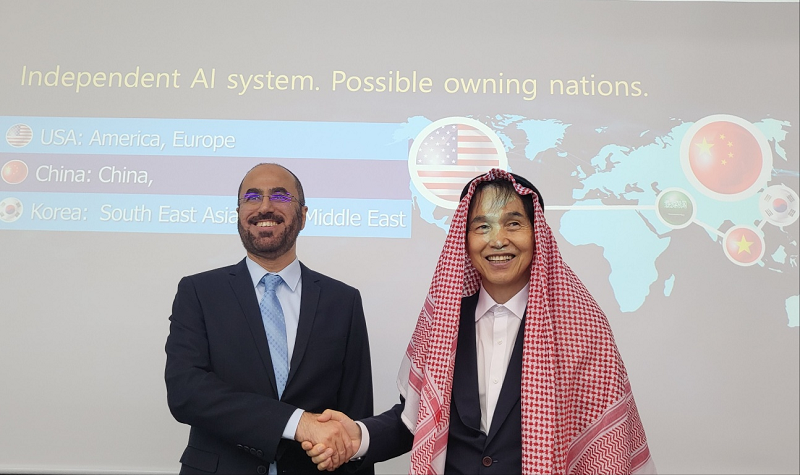 King Saud University and KAIST discussed Strategic AI Partnership
<From left> President Abdulla Al-Salman(King Saud University), President Kwang Hyung Lee(KAIST)
KAIST (President Kwang Hyung Lee) and King Saud University (President Abdulla Al-Salman) held a meeting on July 3 at the KAIST Campus in Seoul and agreed to pursue strategic cooperation in AI and digital platform development. The global AI landscape is increasingly polarized between closed models developed by the U.S. and China’s nationally focused technology ecosystems. In this context, many neutral countries have consistently called for an alternative third model that promotes both technological diversity and open access. President Lee has previously advocated for a "Tripartite Platform Strategy" (三分之計), proposing an international collaboration framework based on open-source principles to be free from binary digital power structures and foster cooperative coexistence.
This KAIST-KSU collaboration represents a step toward developing a new, inclusive AI model. The collaboration aims to establish an innovative multilateral framework, especially within the MENA, Japan, Korea, and Southeast Asia, by building an open-source-based AI alliance. Both institutions bring complementary strengths to the table. Saudi Arabia possesses large-scale capital and digital infrastructure, while Korea leads in core AI and semiconductor technologies, applied research, and talent cultivation.
Together, the two nations aim to establish a sustainable collaboration model that creates a virtuous cycle of investment, technology, and talent. This initiative is expected to contribute to the development of an open AI platform and promote diversity in the global AI ecosystem.
During the meeting, the two sides discussed key areas of future cooperation, including:
· Joint development of open-source AI technologies and digital platforms
· Launch of a KAIST-KSU dual graduate degree program
· Expansion of exchange programs for students, faculty, and researchers
· Collaborative research in basic science and STEM disciplines
In particular, the two institutions discussed to establish a joint AI research center to co-develop open AI models and explore practical industrial applications. The goal is to broaden access to AI technology and create an inclusive innovation environment for more countries and institutions.
President Abdulla Al-Salman stated, "Under Saudi Vision 2030, we are driving innovation in science and technology through new leadership, openness, and strategic investment. This partnership with KAIST will serve as a critical foundation for building a competitive AI ecosystem in the Middle East."
President Kwang Hyung Lee emphasized, "By combining Saudi Arabia's leadership, market, and investment capacity with KAIST's technological innovation and the rich talent pools from both countries, we will significantly contribute to diversifying the global AI ecosystem."
Both leaders further noted, "Through joint research leading to an independent AI model, our two institutions could establish a new axis beyond the existing US-China digital order—realizing a 'Tripartite AI Strategy' that will propel us into global markets extending far beyond the MENA and ASEAN regions."
KAIST and KSU plan to formalize this agreement by signing an MOU in the near future, followed by concrete actions such as launching the joint research institute and global talent development programs. This collaboration was initiated under the Korea Foundation’s Distinguished Guests Invitation Program, overseen by the Ministry of Foreign Affairs, and is expected to grow into a long-term strategic partnership with continued support from KF.
About King Saud University (KSU)
Founded in 1957, KSU is Saudi Arabia’s first and leading national university. As a top research-oriented institution in the Middle East, it has achieved international recognition in fields such as AI, energy, and biotechnology. It plays a central role in nurturing talent and driving innovation aligned with Saudi Arabia’s Vision 2030, and is expanding global partnerships to further strengthen its research capabilities.
About the Korea Foundation (KF)
Established in 1991 under the Ministry of Foreign Affairs, the Korea Foundation is a public diplomacy institution dedicated to strengthening international understanding and friendship with Korea. KF plays a key role in expanding Korea’s soft power through academic and cultural exchange, people-to-people networks, and global Korean studies programs. Its Distinguished Guests Invitation Program fosters strategic partnerships with global leaders in government, academia, and industry.
2025.07.04 View 7806
King Saud University and KAIST discussed Strategic AI Partnership
<From left> President Abdulla Al-Salman(King Saud University), President Kwang Hyung Lee(KAIST)
KAIST (President Kwang Hyung Lee) and King Saud University (President Abdulla Al-Salman) held a meeting on July 3 at the KAIST Campus in Seoul and agreed to pursue strategic cooperation in AI and digital platform development. The global AI landscape is increasingly polarized between closed models developed by the U.S. and China’s nationally focused technology ecosystems. In this context, many neutral countries have consistently called for an alternative third model that promotes both technological diversity and open access. President Lee has previously advocated for a "Tripartite Platform Strategy" (三分之計), proposing an international collaboration framework based on open-source principles to be free from binary digital power structures and foster cooperative coexistence.
This KAIST-KSU collaboration represents a step toward developing a new, inclusive AI model. The collaboration aims to establish an innovative multilateral framework, especially within the MENA, Japan, Korea, and Southeast Asia, by building an open-source-based AI alliance. Both institutions bring complementary strengths to the table. Saudi Arabia possesses large-scale capital and digital infrastructure, while Korea leads in core AI and semiconductor technologies, applied research, and talent cultivation.
Together, the two nations aim to establish a sustainable collaboration model that creates a virtuous cycle of investment, technology, and talent. This initiative is expected to contribute to the development of an open AI platform and promote diversity in the global AI ecosystem.
During the meeting, the two sides discussed key areas of future cooperation, including:
· Joint development of open-source AI technologies and digital platforms
· Launch of a KAIST-KSU dual graduate degree program
· Expansion of exchange programs for students, faculty, and researchers
· Collaborative research in basic science and STEM disciplines
In particular, the two institutions discussed to establish a joint AI research center to co-develop open AI models and explore practical industrial applications. The goal is to broaden access to AI technology and create an inclusive innovation environment for more countries and institutions.
President Abdulla Al-Salman stated, "Under Saudi Vision 2030, we are driving innovation in science and technology through new leadership, openness, and strategic investment. This partnership with KAIST will serve as a critical foundation for building a competitive AI ecosystem in the Middle East."
President Kwang Hyung Lee emphasized, "By combining Saudi Arabia's leadership, market, and investment capacity with KAIST's technological innovation and the rich talent pools from both countries, we will significantly contribute to diversifying the global AI ecosystem."
Both leaders further noted, "Through joint research leading to an independent AI model, our two institutions could establish a new axis beyond the existing US-China digital order—realizing a 'Tripartite AI Strategy' that will propel us into global markets extending far beyond the MENA and ASEAN regions."
KAIST and KSU plan to formalize this agreement by signing an MOU in the near future, followed by concrete actions such as launching the joint research institute and global talent development programs. This collaboration was initiated under the Korea Foundation’s Distinguished Guests Invitation Program, overseen by the Ministry of Foreign Affairs, and is expected to grow into a long-term strategic partnership with continued support from KF.
About King Saud University (KSU)
Founded in 1957, KSU is Saudi Arabia’s first and leading national university. As a top research-oriented institution in the Middle East, it has achieved international recognition in fields such as AI, energy, and biotechnology. It plays a central role in nurturing talent and driving innovation aligned with Saudi Arabia’s Vision 2030, and is expanding global partnerships to further strengthen its research capabilities.
About the Korea Foundation (KF)
Established in 1991 under the Ministry of Foreign Affairs, the Korea Foundation is a public diplomacy institution dedicated to strengthening international understanding and friendship with Korea. KF plays a key role in expanding Korea’s soft power through academic and cultural exchange, people-to-people networks, and global Korean studies programs. Its Distinguished Guests Invitation Program fosters strategic partnerships with global leaders in government, academia, and industry.
2025.07.04 View 7806 -
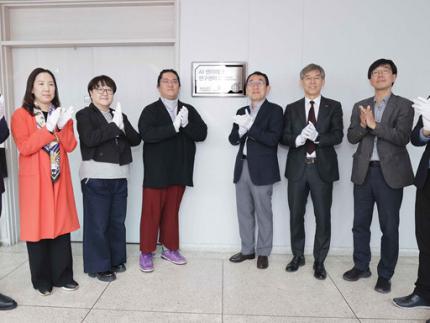 KAIST, Galaxy Corporation Hold Signboard Ceremony for ‘AI Entertech Research Center’
KAIST (President Kwang-Hyung Lee) announced on the 9th that it will hold a signboard ceremony for the establishment of the ‘AI Entertech Research Center’ with the artificial intelligence entertech company, Galaxy Corporation (CEO Yong-ho Choi) at the main campus of KAIST.
< (Galaxy Corporation, from center to the left) CEO Yongho Choi, Director Hyunjung Kim and related persons / (KAIST, from center to the right) Professor SeungSeob Lee of the Department of Mechanical Engineering, Provost and Executive Vice President Gyun Min Lee, Dean Jung Kim of the Department of Mechanical Engineering and Professor Yong Jin Yoon of the same department >
This collaboration is a part of KAIST’s art convergence research strategy and is an extension of its efforts to lead future K-Culture through the development of creative cultural content based on science and technology. Beyond simple technological development, KAIST has been continuously implementing the convergence model of ‘Tech-Art’ that expands the horizon of the content industry through the fusion of emotional technology and cultural imagination.
Previously, KAIST established the ‘Sumi Jo Performing Arts Research Center’ in collaboration with world-renowned soprano Sumi Jo, a visiting professor, and has been leading the convergence research of art and engineering, such as AI-based interactive performance technology and immersive content. The establishment of the ‘AI Entertech Research Center’ this time is being evaluated as a new challenge for the technological expansion of the K-content industry.
In addition, the role of singer G-Dragon (real name Kwon Ji-yong), an artist affiliated with Galaxy Corporation and a visiting professor in the Department of Mechanical Engineering at KAIST, was also a major factor. Since being appointed to KAIST last year, Professor Kwon has been actively promoting the establishment of a research center and soliciting KAIST research projects through his agency to develop the ‘AI Entertech’ field, which fuses entertainment and cutting-edge technology.
< (Galaxy Corporation, from center to the left) CEO Yongho Choi, Director Hyunjung Kim and related persons / (KAIST, from center to the right) Professor SeungSeob Lee of the Department of Mechanical Engineering, Provost and Executive Vice President Gyun Min Lee, Dean Jung Kim of the Department of Mechanical Engineering and Professor Yong Jin Yoon of the same department >
The AI Entertech Research Center is scheduled to officially launch in the third quarter of this year, and this inauguration ceremony was held in line with Professor Kwon Ji-yong’s schedule to visit KAIST. Galaxy Corporation recently had a private meeting with Microsoft (MS) CEO Nadella as the only entertech company, and is actively promoting the globalization of AI entertech. In addition, since last year, it has established a cooperative relationship with KAIST and plans to actively seek the convergence of entertech and technology that transcends time and space through the establishment of a research center.
Professor Kwon Ji-yong will attend the ‘Innovate Korea 2025’ event co-hosted by KAIST, Herald Media Group, and the National Research Council of Science and Technology, held at the KAIST Lyu Keun-Chul Sports Complex in the afternoon of the same day, and will give a special talk on the topic of ‘The Future of AI Entertech.’ In addition to Professor Kwon, Professor SeungSeob Lee of the Department of Mechanical Engineering at KAIST, Professor Sang-gyun Kim of Kyunghee University, and CEO Yong-ho Choi of Galaxy Corporation will also participate in this talk show.
The two organizations signed an MOU last year to jointly research science and technology for the global spread of K-pop, and the establishment of this research center is the first tangible result of this. Once the research center is fully operational, various projects such as the development of an AI-based entertech platform and joint research on global content technology will be promoted.
< A photo of Professor Kwon Ji-yong (right) from at the talk show with KAIST President Kwang-Hyung Lee (left) from the previous year >
Yong-ho Choi, Galaxy Corporation CHO (Chief Happiness Officer), said, “This collaboration is the starting point for providing a completely new entertainment experience to fans around the world by grafting KAIST AI and cutting-edge technologies onto the fandom platform,” and added, “The convergence of AI and entertech is not just technological advancement; it is a driving force for innovation that enriches human life.”
Kwang-Hyung Lee, KAIST President, said, “I am confident that KAIST’s scientific and technological capabilities, combined with Professor Kwon Ji-yong’s global sensibility, will lead the technological evolution of K-culture,” and added, “I hope that KAIST’s spirit of challenge and research DNA will create a new wave in the entertech market.”
Meanwhile, Galaxy Corporation, the agency of Professor G-Dragon Kwon Ji-yong, is an AI entertainment technology company that presents a new paradigm based on IP, media, tech, and entertainment convergence technology. (End)
2025.04.09 View 16627
KAIST, Galaxy Corporation Hold Signboard Ceremony for ‘AI Entertech Research Center’
KAIST (President Kwang-Hyung Lee) announced on the 9th that it will hold a signboard ceremony for the establishment of the ‘AI Entertech Research Center’ with the artificial intelligence entertech company, Galaxy Corporation (CEO Yong-ho Choi) at the main campus of KAIST.
< (Galaxy Corporation, from center to the left) CEO Yongho Choi, Director Hyunjung Kim and related persons / (KAIST, from center to the right) Professor SeungSeob Lee of the Department of Mechanical Engineering, Provost and Executive Vice President Gyun Min Lee, Dean Jung Kim of the Department of Mechanical Engineering and Professor Yong Jin Yoon of the same department >
This collaboration is a part of KAIST’s art convergence research strategy and is an extension of its efforts to lead future K-Culture through the development of creative cultural content based on science and technology. Beyond simple technological development, KAIST has been continuously implementing the convergence model of ‘Tech-Art’ that expands the horizon of the content industry through the fusion of emotional technology and cultural imagination.
Previously, KAIST established the ‘Sumi Jo Performing Arts Research Center’ in collaboration with world-renowned soprano Sumi Jo, a visiting professor, and has been leading the convergence research of art and engineering, such as AI-based interactive performance technology and immersive content. The establishment of the ‘AI Entertech Research Center’ this time is being evaluated as a new challenge for the technological expansion of the K-content industry.
In addition, the role of singer G-Dragon (real name Kwon Ji-yong), an artist affiliated with Galaxy Corporation and a visiting professor in the Department of Mechanical Engineering at KAIST, was also a major factor. Since being appointed to KAIST last year, Professor Kwon has been actively promoting the establishment of a research center and soliciting KAIST research projects through his agency to develop the ‘AI Entertech’ field, which fuses entertainment and cutting-edge technology.
< (Galaxy Corporation, from center to the left) CEO Yongho Choi, Director Hyunjung Kim and related persons / (KAIST, from center to the right) Professor SeungSeob Lee of the Department of Mechanical Engineering, Provost and Executive Vice President Gyun Min Lee, Dean Jung Kim of the Department of Mechanical Engineering and Professor Yong Jin Yoon of the same department >
The AI Entertech Research Center is scheduled to officially launch in the third quarter of this year, and this inauguration ceremony was held in line with Professor Kwon Ji-yong’s schedule to visit KAIST. Galaxy Corporation recently had a private meeting with Microsoft (MS) CEO Nadella as the only entertech company, and is actively promoting the globalization of AI entertech. In addition, since last year, it has established a cooperative relationship with KAIST and plans to actively seek the convergence of entertech and technology that transcends time and space through the establishment of a research center.
Professor Kwon Ji-yong will attend the ‘Innovate Korea 2025’ event co-hosted by KAIST, Herald Media Group, and the National Research Council of Science and Technology, held at the KAIST Lyu Keun-Chul Sports Complex in the afternoon of the same day, and will give a special talk on the topic of ‘The Future of AI Entertech.’ In addition to Professor Kwon, Professor SeungSeob Lee of the Department of Mechanical Engineering at KAIST, Professor Sang-gyun Kim of Kyunghee University, and CEO Yong-ho Choi of Galaxy Corporation will also participate in this talk show.
The two organizations signed an MOU last year to jointly research science and technology for the global spread of K-pop, and the establishment of this research center is the first tangible result of this. Once the research center is fully operational, various projects such as the development of an AI-based entertech platform and joint research on global content technology will be promoted.
< A photo of Professor Kwon Ji-yong (right) from at the talk show with KAIST President Kwang-Hyung Lee (left) from the previous year >
Yong-ho Choi, Galaxy Corporation CHO (Chief Happiness Officer), said, “This collaboration is the starting point for providing a completely new entertainment experience to fans around the world by grafting KAIST AI and cutting-edge technologies onto the fandom platform,” and added, “The convergence of AI and entertech is not just technological advancement; it is a driving force for innovation that enriches human life.”
Kwang-Hyung Lee, KAIST President, said, “I am confident that KAIST’s scientific and technological capabilities, combined with Professor Kwon Ji-yong’s global sensibility, will lead the technological evolution of K-culture,” and added, “I hope that KAIST’s spirit of challenge and research DNA will create a new wave in the entertech market.”
Meanwhile, Galaxy Corporation, the agency of Professor G-Dragon Kwon Ji-yong, is an AI entertainment technology company that presents a new paradigm based on IP, media, tech, and entertainment convergence technology. (End)
2025.04.09 View 16627 -
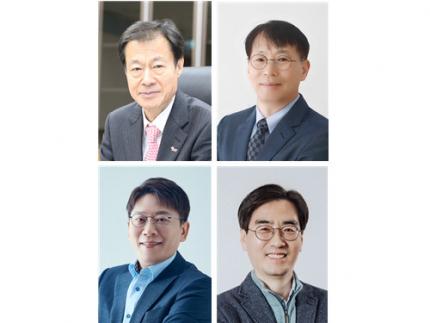 KAIST Alumni Association to Honor Alumni of the Year Award Winners
Photo 1. Photo of the KAIST Alumni of the Year Award Recipients
(From left) UST President Lee-whan Kim, CEO Han Chung of iThree Systems Co., Ltd., CEO Dong Myung Kim of LG Energy Solution Co., Ltd., and Professor Hyun Myung of the School of Electrical Engineering at KAIST
KAIST (President Kwang Hyung Lee) announced on Monday, the 13th of January that the Alumni Association (President Yun-Tae Lee) has selected its Alumni of the Year.
This year’s honorees are: ▴ President Lee-whan Kim of the Korea National University of Science and Technology (UST), ▴ CEO Han Chung of i3 Systems, ▴ CEO Dong Myung Kim of LG Energy Solution, and ▴ Professor Hyun Myung of the School of Electrical Engineering at KAIST.
The honorees were selected based on their achievements over the past year, and the award ceremony will be held at the 2025 KAIST Alumni Association New Year’s Gathering to be held at the L Tower in Seoul at 5 PM on Friday the 17th.
The KAIST Alumni of the Year Award is an award presented by the Alumni Association to alumni who have contributed to the development of the country and the society or have brought honor to their alma mater through outstanding academic achievements and community service. Since its establishment in 1992, 126 recipients have been awarded.
Lee-whan Kim (Master's graduate of Mechanical Engineering, 82), the President of the Korea National University of Science and Technology (UST), established a leading foundation for national science and technology policy and strategy, and played a leading role in innovating national science and technology capabilities through the advancement of the national research and development system and the advancement of science and technology personnel training. In particular, he played a pivotal role in the establishment of UST and the Korea Science Academy (KSA), and greatly contributed to establishing a foundation for the training and utilization of science and technology personnel.
Han Chung (Master's graduate of Electrical Engineering, 91, with Ph.D. degree in 96), the CEO of i3 Systems, is a first-generation researcher in the field of domestic infrared detectors. He developed military detectors for over 30 years and founded i3 Systems, a specialized infrared detector company, in 1998. Currently, he supplies more than 80% of the infrared detectors used by the Korean military, and has also achieved export results to over 20 countries.
Dong Myung Kim (Master's graduate of Materials Science and Engineering, 94, with Ph.D. degree in 98) the CEO of LG Energy Solution Co., Ltd. has led innovation in the battery field with his ceaseless exploration and challenging spirit, and is known as an authority in the secondary battery industry. He played a leading role in establishing K-Battery as a global leader, strengthened the country's future industrial competitiveness, and greatly contributed to the development of science and technology.
Hyun Myung (Bachelor's graduate of Electrical Engineering, 92, with Master's degree in 94, and Ph.D. degree in 98) a Professor of Electrical Engineering, KAIST, won first place in the world at the Quadruped Robot Challenge (QRC) hosted by the IEEE’s International Conference on Robotics and Automation (ICRA) 2023 with the 'DreamWaQ' system, an AI walking technology based on deep reinforcement learning that utilizes non-video sensory technologies. He contributed to enhancing the competitiveness of the domestic robot industry by developing his own fully autonomous walking technology that recognizes the environment around the robot and finds the optimal path.
Yun-Tae Lee, the 27th president of the KAIST Alumni Association, said, “KAIST alumni have been the driving force behind the growth of industries in all walks of life by continuously conducting research and development in the field of advanced science and technology for a long time,” and added, “I am very proud of the KAIST alumni award recipients who are leading science and technology on the world stage beyond Korea, and I sincerely thank them for their efforts and achievements.”
2025.01.15 View 19788
KAIST Alumni Association to Honor Alumni of the Year Award Winners
Photo 1. Photo of the KAIST Alumni of the Year Award Recipients
(From left) UST President Lee-whan Kim, CEO Han Chung of iThree Systems Co., Ltd., CEO Dong Myung Kim of LG Energy Solution Co., Ltd., and Professor Hyun Myung of the School of Electrical Engineering at KAIST
KAIST (President Kwang Hyung Lee) announced on Monday, the 13th of January that the Alumni Association (President Yun-Tae Lee) has selected its Alumni of the Year.
This year’s honorees are: ▴ President Lee-whan Kim of the Korea National University of Science and Technology (UST), ▴ CEO Han Chung of i3 Systems, ▴ CEO Dong Myung Kim of LG Energy Solution, and ▴ Professor Hyun Myung of the School of Electrical Engineering at KAIST.
The honorees were selected based on their achievements over the past year, and the award ceremony will be held at the 2025 KAIST Alumni Association New Year’s Gathering to be held at the L Tower in Seoul at 5 PM on Friday the 17th.
The KAIST Alumni of the Year Award is an award presented by the Alumni Association to alumni who have contributed to the development of the country and the society or have brought honor to their alma mater through outstanding academic achievements and community service. Since its establishment in 1992, 126 recipients have been awarded.
Lee-whan Kim (Master's graduate of Mechanical Engineering, 82), the President of the Korea National University of Science and Technology (UST), established a leading foundation for national science and technology policy and strategy, and played a leading role in innovating national science and technology capabilities through the advancement of the national research and development system and the advancement of science and technology personnel training. In particular, he played a pivotal role in the establishment of UST and the Korea Science Academy (KSA), and greatly contributed to establishing a foundation for the training and utilization of science and technology personnel.
Han Chung (Master's graduate of Electrical Engineering, 91, with Ph.D. degree in 96), the CEO of i3 Systems, is a first-generation researcher in the field of domestic infrared detectors. He developed military detectors for over 30 years and founded i3 Systems, a specialized infrared detector company, in 1998. Currently, he supplies more than 80% of the infrared detectors used by the Korean military, and has also achieved export results to over 20 countries.
Dong Myung Kim (Master's graduate of Materials Science and Engineering, 94, with Ph.D. degree in 98) the CEO of LG Energy Solution Co., Ltd. has led innovation in the battery field with his ceaseless exploration and challenging spirit, and is known as an authority in the secondary battery industry. He played a leading role in establishing K-Battery as a global leader, strengthened the country's future industrial competitiveness, and greatly contributed to the development of science and technology.
Hyun Myung (Bachelor's graduate of Electrical Engineering, 92, with Master's degree in 94, and Ph.D. degree in 98) a Professor of Electrical Engineering, KAIST, won first place in the world at the Quadruped Robot Challenge (QRC) hosted by the IEEE’s International Conference on Robotics and Automation (ICRA) 2023 with the 'DreamWaQ' system, an AI walking technology based on deep reinforcement learning that utilizes non-video sensory technologies. He contributed to enhancing the competitiveness of the domestic robot industry by developing his own fully autonomous walking technology that recognizes the environment around the robot and finds the optimal path.
Yun-Tae Lee, the 27th president of the KAIST Alumni Association, said, “KAIST alumni have been the driving force behind the growth of industries in all walks of life by continuously conducting research and development in the field of advanced science and technology for a long time,” and added, “I am very proud of the KAIST alumni award recipients who are leading science and technology on the world stage beyond Korea, and I sincerely thank them for their efforts and achievements.”
2025.01.15 View 19788 -
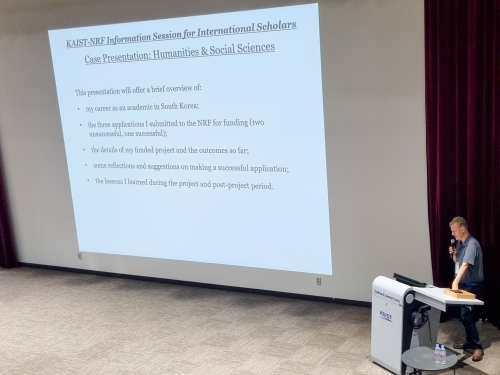 KAIST ISSS Research Session Captivates 150↑ International Scholars, Achieve Major Success
< Photo. Scholars gatheres for NRF Information Session at Chung Keun Mo Hall >
KAIST’s International Office, headed by Vice President Soyoung Kim, successfully organized the ‘NRF Information Session for International Scholars’ on September 11, 2024, in collaboration with the National Research Foundation of Korea (NRF).
The event was held at KAIST’s main campus to enourage the international scholar’s active participation in research projects and support their establishment of stable research environment and integration into Korea’s academic community by introducing NRF’s key research programs.
Divided into two main segments – science and engineering, and humanities and social sciences – the session attracted approximately 150 international faculty and researchers from 23 universities across the nation.
The event commenced with a keynote address by Vice President Soyoung Kim, followed by a presentation from Dr. Seol Min of the National Research Foundation, who highlighted basic research initiatives in the science and technology sector. Subsequently, Professor Daniel Martin from the Digital Humanities and Social Sciences Department and Professor Thomas Steinberger from the Department of Business and Technology Management presented practical research project support case studies, sharing invaluable insights gained from their domestic research experiences.
Following the information session, participants engaged in a networking event, where researchers involved in major R&D projects exchanged insights and discussed their ongoing research initiatives.
An international professor remarked, “My understanding of NRF’s research programs for international researchers has broadened considerably. I am now more inclined to actively participate in projects organized by NRF in the future.”
Vice President Kim expressed her aspiration that the event would address the challenges faced by researchers and offer essential support to those engaged in research projects. “We will stay attuned to the needs of the research community and work towards creating a more supportive research environment,” said the VP.
Meanwhile, KAIST hosts a distinguished faculty comprising 134 professors from 22 countries and 71 researchers representing 23 nations, all contributing to groundbreaking academic achievements. Additionally, KAIST is home to over 1,000 international students from more than 100 countries, actively pursuing their studies. This diverse composition of global talent reinforces KAIST's position as a leading international hub for research and education.
2024.09.13 View 14772
KAIST ISSS Research Session Captivates 150↑ International Scholars, Achieve Major Success
< Photo. Scholars gatheres for NRF Information Session at Chung Keun Mo Hall >
KAIST’s International Office, headed by Vice President Soyoung Kim, successfully organized the ‘NRF Information Session for International Scholars’ on September 11, 2024, in collaboration with the National Research Foundation of Korea (NRF).
The event was held at KAIST’s main campus to enourage the international scholar’s active participation in research projects and support their establishment of stable research environment and integration into Korea’s academic community by introducing NRF’s key research programs.
Divided into two main segments – science and engineering, and humanities and social sciences – the session attracted approximately 150 international faculty and researchers from 23 universities across the nation.
The event commenced with a keynote address by Vice President Soyoung Kim, followed by a presentation from Dr. Seol Min of the National Research Foundation, who highlighted basic research initiatives in the science and technology sector. Subsequently, Professor Daniel Martin from the Digital Humanities and Social Sciences Department and Professor Thomas Steinberger from the Department of Business and Technology Management presented practical research project support case studies, sharing invaluable insights gained from their domestic research experiences.
Following the information session, participants engaged in a networking event, where researchers involved in major R&D projects exchanged insights and discussed their ongoing research initiatives.
An international professor remarked, “My understanding of NRF’s research programs for international researchers has broadened considerably. I am now more inclined to actively participate in projects organized by NRF in the future.”
Vice President Kim expressed her aspiration that the event would address the challenges faced by researchers and offer essential support to those engaged in research projects. “We will stay attuned to the needs of the research community and work towards creating a more supportive research environment,” said the VP.
Meanwhile, KAIST hosts a distinguished faculty comprising 134 professors from 22 countries and 71 researchers representing 23 nations, all contributing to groundbreaking academic achievements. Additionally, KAIST is home to over 1,000 international students from more than 100 countries, actively pursuing their studies. This diverse composition of global talent reinforces KAIST's position as a leading international hub for research and education.
2024.09.13 View 14772 -
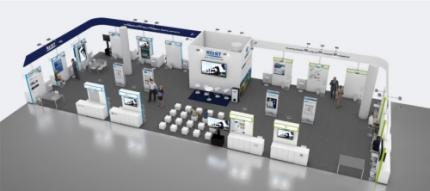 KAIST Demonstrates AI and sustainable technologies at CES 2024
On January 2, KAIST announced it will be participating in the Consumer Electronics Show (CES) 2024, held between January 9 and 12.
CES 2024 is one of the world’s largest tech conferences to take place in Las Vegas. Under the slogan “KAIST, the Global Value Creator” for its exhibition, KAIST has submitted technologies falling under one of following themes: “Expansion of Human Intelligence, Mobility, and Reality”, and “Pursuit of Human Security and Sustainable Development”.
24 startups and pre-startups whose technologies stand out in various fields including artificial intelligence (AI), mobility, virtual reality, healthcare and human security, and sustainable development, will welcome their visitors at an exclusive booth of 232 m2 prepared for KAIST at Eureka Park in Las Vegas.
12 businesses will participate in the first category, “Expansion of Human Intelligence, Mobility, and Reality”, including MicroPix, Panmnesia, DeepAuto, MGL, Reports, Narnia Labs, EL FACTORY, Korea Position Technology, AudAi, Planby Technologies, Movin, and Studio Lab.
In the “Pursuit of Human Security and Sustainable Development” category, 12 businesses including Aldaver, ADNC, Solve, Iris, Blue Device, Barreleye, TR, A2US, Greeners, Iron Boys, Shard Partners and Kingbot, will be introduced.
In particular, Aldaver is a startup that received the Korean Business Award 2023 as well as the presidential award at the Challenge K-Startup with its biomimetic material and printing technology. It has attracted 4.5 billion KRW of investment thus far.
Narnia Labs, with its AI design solution for manufacturing, won the grand prize for K-tech Startups 2022, and has so far attracted 3.5 billion KRW of investments.
Panmnesia is a startup that won the 2024 CES Innovation Award, recognized for their fab-less AI semiconductor technology. They attracted 16 billion KRW of investment through seed round alone.
Meanwhile, student startups will also be presented during the exhibition. Studio Lab received a CES 2024 Best of Innovation Award in the AI category. The team developed the software Seller Canvas, which automatically generates a page for product details when a user uploads an image of a product.
The central stage at the KAIST exhibition booth will be used to interview members of the participating startups between Jan 9 to 11, as well as a networking site for businesses and invited investors during KAIST NIGHT on the evening of 10th, between 5 and 7 PM.
Director Sung-Yool Choi of the KAIST Institute of Technology Value Creation said, “Through CES 2024, KAIST will overcome the limits of human intelligence, mobility, and space with the deep-tech based technologies developed by its startups, and will demonstrate its achievements for realizing its vision as a global value-creating university through the solutions for human security and sustainable development.”
2024.01.05 View 25263
KAIST Demonstrates AI and sustainable technologies at CES 2024
On January 2, KAIST announced it will be participating in the Consumer Electronics Show (CES) 2024, held between January 9 and 12.
CES 2024 is one of the world’s largest tech conferences to take place in Las Vegas. Under the slogan “KAIST, the Global Value Creator” for its exhibition, KAIST has submitted technologies falling under one of following themes: “Expansion of Human Intelligence, Mobility, and Reality”, and “Pursuit of Human Security and Sustainable Development”.
24 startups and pre-startups whose technologies stand out in various fields including artificial intelligence (AI), mobility, virtual reality, healthcare and human security, and sustainable development, will welcome their visitors at an exclusive booth of 232 m2 prepared for KAIST at Eureka Park in Las Vegas.
12 businesses will participate in the first category, “Expansion of Human Intelligence, Mobility, and Reality”, including MicroPix, Panmnesia, DeepAuto, MGL, Reports, Narnia Labs, EL FACTORY, Korea Position Technology, AudAi, Planby Technologies, Movin, and Studio Lab.
In the “Pursuit of Human Security and Sustainable Development” category, 12 businesses including Aldaver, ADNC, Solve, Iris, Blue Device, Barreleye, TR, A2US, Greeners, Iron Boys, Shard Partners and Kingbot, will be introduced.
In particular, Aldaver is a startup that received the Korean Business Award 2023 as well as the presidential award at the Challenge K-Startup with its biomimetic material and printing technology. It has attracted 4.5 billion KRW of investment thus far.
Narnia Labs, with its AI design solution for manufacturing, won the grand prize for K-tech Startups 2022, and has so far attracted 3.5 billion KRW of investments.
Panmnesia is a startup that won the 2024 CES Innovation Award, recognized for their fab-less AI semiconductor technology. They attracted 16 billion KRW of investment through seed round alone.
Meanwhile, student startups will also be presented during the exhibition. Studio Lab received a CES 2024 Best of Innovation Award in the AI category. The team developed the software Seller Canvas, which automatically generates a page for product details when a user uploads an image of a product.
The central stage at the KAIST exhibition booth will be used to interview members of the participating startups between Jan 9 to 11, as well as a networking site for businesses and invited investors during KAIST NIGHT on the evening of 10th, between 5 and 7 PM.
Director Sung-Yool Choi of the KAIST Institute of Technology Value Creation said, “Through CES 2024, KAIST will overcome the limits of human intelligence, mobility, and space with the deep-tech based technologies developed by its startups, and will demonstrate its achievements for realizing its vision as a global value-creating university through the solutions for human security and sustainable development.”
2024.01.05 View 25263 -
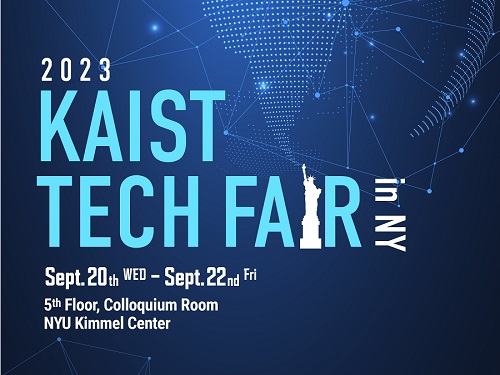 KAIST holds its first ‘KAIST Tech Fair’ in New York, USA
< Photo 1. 2023 KAIST Tech Fair in New York >
KAIST (President Kwang-Hyung Lee) announced on the 11th that it will hold the ‘2023 KAIST Tech Fair in New York’ at the Kimmel Center at New York University in Manhattan, USA, on the 22nd of this month. It is an event designed to be the starting point for KAIST to expand its startup ecosystem into the global stage, and it is to attract investments and secure global customers in New York by demonstrating the technological value of KAIST startup companies directly at location.
< Photo 2. President Kwang Hyung Lee at the 2023 KAIST Tech Fair in New York >
KAIST has been holding briefing sessions for technology transfer in Korea every year since 2018, and this year is the first time to hold a tech fair overseas for global companies.
KAIST Institute of Technology Value Creation (Director Sung-Yool Choi) has prepared for this event over the past six months with the Korea International Trade Association (hereinafter KITA, CEO Christopher Koo) to survey customer base and investment companies to conduct market analysis.
Among the companies founded with the technologies developed by the faculty and students of KAIST and their partners, 7 companies were selected to be matched with companies overseas that expressed interests in these technologies. Global multinational companies in the fields of IT, artificial intelligence, environment, logistics, distribution, and retail are participating as demand agencies and are testing the marketability of the start-up's technology as of September.
Daim Research, founded by Professor Young Jae Jang of the Department of Industrial and Systems Engineering, is a company specializing in smart factory automation solutions and is knocking on the door of the global market with a platform technology optimized for automated logistics systems.
< Photo 3. Presentation by Professor Young Jae Jang for DAIM Research >
It is a ‘collaborative intelligence’ solution that maximizes work productivity by having a number of robots used in industrial settings collaborate with one another. The strength of their solution is that logistics robots equipped with AI reinforced learning technology can respond to processes and environmental changes on their own, minimizing maintenance costs and the system can achieve excellent performance even with a small amount of data when it is combined with the digital twin technology the company has developed on its own.
A student startup, ‘Aniai’, is entering the US market, the home of hamburgers, with hamburger patty automation equipments and solutions. This is a robot kitchen startup founded by its CEO Gunpil Hwang, a graduate of KAIST’s School of Electrical Engineering which gathered together the experts in the fields of robot control, design, and artificial intelligence and cognitive technology to develop technology to automatically cook hamburger patties.
At the touch of a button, both sides of the patty are cooked simultaneously for consistent taste and quality according to the set condition. Since it can cook about 200 dishes in an hour, it is attracting attention as a technology that can not only solve manpower shortages but also accelerate the digital transformation of the restaurant industry.
Also, at the tech fair to be held at the Kimmel Center of New York University on the 22nd, the following startups who are currently under market verification in the U.S. will be participating: ▴'TheWaveTalk', which developed a water quality management system that can measure external substances and metal ions by transferring original technology from KAIST; ▴‘VIRNECT’, which helps workers improve their skills by remotely managing industrial sites using XR*; ▴‘Datumo’, a solution that helps process and analyze artificial intelligence big data, ▴‘VESSL AI’, the provider of a solution to eliminate the overhead** of machine learning systems; and ▴ ‘DolbomDream’, which developed an inflatable vest that helps the psychological stability of people with developmental disabilities.
* XR (eXtended Reality): Ultra-realistic technology that enhances immersion by utilizing augmented reality, virtual reality, and mixed reality technologies
** Overhead: Additional time required for stable processing of the program
In addition, two companies (Plasmapp and NotaAI) that are participating in the D-Unicorn program with the support of the Daejeon City and two companies (Enget and ILIAS Biologics) that are receiving support from the Scale Up Tips of the Ministry of SMEs and Startups, three companies (WiPowerOne, IDK Lab, and Artificial Photosynthesis Lab) that are continuing to realize the sustainable development goals for a total of 14 KAIST startups, will hold a corporate information session with about 100 invited guests from global companies and venture capital.
< Photo 4. Presentation for AP Lab >
Prior to this event, participating startups will be visiting the New York Economic Development Corporation and large law firms to receive advice on U.S. government support programs and on their attemps to enter the U.S. market. In addition, the participating companies plan to visit a startup support investment institution pursuing sustainable development goals and the Leslie eLab, New York University's one-stop startup support space, to lay the foundation for KAIST's leap forward in global technology commercialization.
< Photo 5. Sung-Yool Choi, the Director of KAIST Institute of Technology Value Creation (left) at the 2023 KAIST Tech Fair in New York with the key participants >
Sung-Yool Choi, the Director of KAIST Institute of Technology Value Creation, said, “KAIST prepared this event to realize its vision of being a leading university in creating global value.” He added, “We hope that our startups founded with KAIST technology would successfully completed market verification to be successful in securing global demands and in attracting investments for their endeavors.”
2023.09.11 View 43010
KAIST holds its first ‘KAIST Tech Fair’ in New York, USA
< Photo 1. 2023 KAIST Tech Fair in New York >
KAIST (President Kwang-Hyung Lee) announced on the 11th that it will hold the ‘2023 KAIST Tech Fair in New York’ at the Kimmel Center at New York University in Manhattan, USA, on the 22nd of this month. It is an event designed to be the starting point for KAIST to expand its startup ecosystem into the global stage, and it is to attract investments and secure global customers in New York by demonstrating the technological value of KAIST startup companies directly at location.
< Photo 2. President Kwang Hyung Lee at the 2023 KAIST Tech Fair in New York >
KAIST has been holding briefing sessions for technology transfer in Korea every year since 2018, and this year is the first time to hold a tech fair overseas for global companies.
KAIST Institute of Technology Value Creation (Director Sung-Yool Choi) has prepared for this event over the past six months with the Korea International Trade Association (hereinafter KITA, CEO Christopher Koo) to survey customer base and investment companies to conduct market analysis.
Among the companies founded with the technologies developed by the faculty and students of KAIST and their partners, 7 companies were selected to be matched with companies overseas that expressed interests in these technologies. Global multinational companies in the fields of IT, artificial intelligence, environment, logistics, distribution, and retail are participating as demand agencies and are testing the marketability of the start-up's technology as of September.
Daim Research, founded by Professor Young Jae Jang of the Department of Industrial and Systems Engineering, is a company specializing in smart factory automation solutions and is knocking on the door of the global market with a platform technology optimized for automated logistics systems.
< Photo 3. Presentation by Professor Young Jae Jang for DAIM Research >
It is a ‘collaborative intelligence’ solution that maximizes work productivity by having a number of robots used in industrial settings collaborate with one another. The strength of their solution is that logistics robots equipped with AI reinforced learning technology can respond to processes and environmental changes on their own, minimizing maintenance costs and the system can achieve excellent performance even with a small amount of data when it is combined with the digital twin technology the company has developed on its own.
A student startup, ‘Aniai’, is entering the US market, the home of hamburgers, with hamburger patty automation equipments and solutions. This is a robot kitchen startup founded by its CEO Gunpil Hwang, a graduate of KAIST’s School of Electrical Engineering which gathered together the experts in the fields of robot control, design, and artificial intelligence and cognitive technology to develop technology to automatically cook hamburger patties.
At the touch of a button, both sides of the patty are cooked simultaneously for consistent taste and quality according to the set condition. Since it can cook about 200 dishes in an hour, it is attracting attention as a technology that can not only solve manpower shortages but also accelerate the digital transformation of the restaurant industry.
Also, at the tech fair to be held at the Kimmel Center of New York University on the 22nd, the following startups who are currently under market verification in the U.S. will be participating: ▴'TheWaveTalk', which developed a water quality management system that can measure external substances and metal ions by transferring original technology from KAIST; ▴‘VIRNECT’, which helps workers improve their skills by remotely managing industrial sites using XR*; ▴‘Datumo’, a solution that helps process and analyze artificial intelligence big data, ▴‘VESSL AI’, the provider of a solution to eliminate the overhead** of machine learning systems; and ▴ ‘DolbomDream’, which developed an inflatable vest that helps the psychological stability of people with developmental disabilities.
* XR (eXtended Reality): Ultra-realistic technology that enhances immersion by utilizing augmented reality, virtual reality, and mixed reality technologies
** Overhead: Additional time required for stable processing of the program
In addition, two companies (Plasmapp and NotaAI) that are participating in the D-Unicorn program with the support of the Daejeon City and two companies (Enget and ILIAS Biologics) that are receiving support from the Scale Up Tips of the Ministry of SMEs and Startups, three companies (WiPowerOne, IDK Lab, and Artificial Photosynthesis Lab) that are continuing to realize the sustainable development goals for a total of 14 KAIST startups, will hold a corporate information session with about 100 invited guests from global companies and venture capital.
< Photo 4. Presentation for AP Lab >
Prior to this event, participating startups will be visiting the New York Economic Development Corporation and large law firms to receive advice on U.S. government support programs and on their attemps to enter the U.S. market. In addition, the participating companies plan to visit a startup support investment institution pursuing sustainable development goals and the Leslie eLab, New York University's one-stop startup support space, to lay the foundation for KAIST's leap forward in global technology commercialization.
< Photo 5. Sung-Yool Choi, the Director of KAIST Institute of Technology Value Creation (left) at the 2023 KAIST Tech Fair in New York with the key participants >
Sung-Yool Choi, the Director of KAIST Institute of Technology Value Creation, said, “KAIST prepared this event to realize its vision of being a leading university in creating global value.” He added, “We hope that our startups founded with KAIST technology would successfully completed market verification to be successful in securing global demands and in attracting investments for their endeavors.”
2023.09.11 View 43010