%4b%49%43
-
 KAIST to Foster a 'Robot Valley' in Daejeon with $10 Million Initiative
<Group Photo of Kick-off Meeting>
On September 3, KAIST announced the official launch of the "2025 Deep Tech Scale-up Valley Nurturing Project" with a kick-off meeting at the KAIST Department of Mechanical Engineering.
KAIST was selected for this project by the Ministry of Science and ICT and the Research and Development Special District Foundation. With this selection, the university plans to create a "Robot Valley".
Over the next three and a half years, KAIST will receive a total of 13.65 billion won (approximately $10 million) in funding. The university's goal is to intensively nurture globally competitive, innovative robotics companies based on foundational technologies and to develop Daejeon into a global hub for the robotics industry.
The initiative will leverage Daejeon's exceptional research talent and its startup and investment ecosystem to create a model for regional revitalization and to cultivate the robotics industry as a next-generation strategic sector.
KAIST's vision for this project is to develop "Human-Friendly Robots (HFR)" that are more than just automated machines; they are collaborative partners that share space, roles, and emotions with people.
The project will implement a multi-stage strategy that includes promoting the commercialization of robotics technology, supporting the startup ecosystem, securing global technological competitiveness, and developing robot commercialization platforms. This will establish a virtuous cycle of technology development, startup and investment growth, and reinvestment.
Unlike traditional startup support and scale-up programs, this project aims for the simultaneous growth of the entire robotics industry, not just individual companies. A key element is an open innovation model where leading robotics firms like Angel Robotics Inc. and EuRoBotics Inc. (led by Professor Byung-ho Yu and Professor Hyun Myung) will share common core technologies related to actuators, circuits, AI, and standardized data. This will allow startups to focus on developing robot products that directly meet customer needs.
The project team includes key KAIST robotics researchers. The project leader is Professor Jung Kim (President of the Korea Robotics Society) from the Department of Mechanical Engineering. Other participating professors include Geon-Jae Lee from the Department of Materials Science and Engineering (human augmentation sensors), Hyun Myung from the School of Electrical Engineering (winner of the QRC 2023 quadruped robot autonomous walking competition at IEEE ICRA), Kyung-Chul Kong from the Department of Mechanical Engineering (two-time champion of the Cybathlon International Competition and founder of Angel Robotics), and Suk-Hyung Bae from the Department of Industrial Design (winner of the ACM SIGGRAPH robot sketching competition).
In addition, the KAIST Technology Commercialization Office, KAIST Holdings, Global Techno Valley Lab (GTLAB), and the Daejeon Center for Creative Economy and Innovation will manage technology commercialization and valley construction. The Daejeon Technopark will also participate to provide comprehensive commercialization support.
"The strategic cooperation between Daejeon City's robotics industry nurturing plan and KAIST was the driving force behind the selection for this project," said Geon-Jae Lee, Director of the KAIST Technology Commercialization Office. "We will create a robotics innovation ecosystem based in Daejeon and systematically foster global companies to rival the likes of ABB in Switzerland and KUKA in Germany, which are considered among the top three robotics companies in the world."
< Kick-off Meeting Scene>
Project leader Jung Kim stated, "We will spearhead efforts to discover and nurture over 15 future unicorn companies by promoting the commercialization of deep-tech robotics developed at KAIST. The entire KAIST robotics research team will dedicate its full efforts to ensure that our research and development achievements lead to real-world industries and startups."
KAIST President Kwang-Hyung Lee emphasized, "As Korea's leading research-oriented university, KAIST will actively support Daejeon's growth into a global robotics hub. This project is more than just research and development; it will be a turning point for KAIST to stand at the center of the global robotics ecosystem and create a new growth engine for the region and the nation."
In collaboration with Daejeon City, KAIST plans to form an "HFR Valley Innovation Council" to share and review project outcomes, ultimately building a self-sustaining ecosystem. This initiative aims to establish Daejeon as a world-class robotics industry hub.
2025.09.03 View 4773
KAIST to Foster a 'Robot Valley' in Daejeon with $10 Million Initiative
<Group Photo of Kick-off Meeting>
On September 3, KAIST announced the official launch of the "2025 Deep Tech Scale-up Valley Nurturing Project" with a kick-off meeting at the KAIST Department of Mechanical Engineering.
KAIST was selected for this project by the Ministry of Science and ICT and the Research and Development Special District Foundation. With this selection, the university plans to create a "Robot Valley".
Over the next three and a half years, KAIST will receive a total of 13.65 billion won (approximately $10 million) in funding. The university's goal is to intensively nurture globally competitive, innovative robotics companies based on foundational technologies and to develop Daejeon into a global hub for the robotics industry.
The initiative will leverage Daejeon's exceptional research talent and its startup and investment ecosystem to create a model for regional revitalization and to cultivate the robotics industry as a next-generation strategic sector.
KAIST's vision for this project is to develop "Human-Friendly Robots (HFR)" that are more than just automated machines; they are collaborative partners that share space, roles, and emotions with people.
The project will implement a multi-stage strategy that includes promoting the commercialization of robotics technology, supporting the startup ecosystem, securing global technological competitiveness, and developing robot commercialization platforms. This will establish a virtuous cycle of technology development, startup and investment growth, and reinvestment.
Unlike traditional startup support and scale-up programs, this project aims for the simultaneous growth of the entire robotics industry, not just individual companies. A key element is an open innovation model where leading robotics firms like Angel Robotics Inc. and EuRoBotics Inc. (led by Professor Byung-ho Yu and Professor Hyun Myung) will share common core technologies related to actuators, circuits, AI, and standardized data. This will allow startups to focus on developing robot products that directly meet customer needs.
The project team includes key KAIST robotics researchers. The project leader is Professor Jung Kim (President of the Korea Robotics Society) from the Department of Mechanical Engineering. Other participating professors include Geon-Jae Lee from the Department of Materials Science and Engineering (human augmentation sensors), Hyun Myung from the School of Electrical Engineering (winner of the QRC 2023 quadruped robot autonomous walking competition at IEEE ICRA), Kyung-Chul Kong from the Department of Mechanical Engineering (two-time champion of the Cybathlon International Competition and founder of Angel Robotics), and Suk-Hyung Bae from the Department of Industrial Design (winner of the ACM SIGGRAPH robot sketching competition).
In addition, the KAIST Technology Commercialization Office, KAIST Holdings, Global Techno Valley Lab (GTLAB), and the Daejeon Center for Creative Economy and Innovation will manage technology commercialization and valley construction. The Daejeon Technopark will also participate to provide comprehensive commercialization support.
"The strategic cooperation between Daejeon City's robotics industry nurturing plan and KAIST was the driving force behind the selection for this project," said Geon-Jae Lee, Director of the KAIST Technology Commercialization Office. "We will create a robotics innovation ecosystem based in Daejeon and systematically foster global companies to rival the likes of ABB in Switzerland and KUKA in Germany, which are considered among the top three robotics companies in the world."
< Kick-off Meeting Scene>
Project leader Jung Kim stated, "We will spearhead efforts to discover and nurture over 15 future unicorn companies by promoting the commercialization of deep-tech robotics developed at KAIST. The entire KAIST robotics research team will dedicate its full efforts to ensure that our research and development achievements lead to real-world industries and startups."
KAIST President Kwang-Hyung Lee emphasized, "As Korea's leading research-oriented university, KAIST will actively support Daejeon's growth into a global robotics hub. This project is more than just research and development; it will be a turning point for KAIST to stand at the center of the global robotics ecosystem and create a new growth engine for the region and the nation."
In collaboration with Daejeon City, KAIST plans to form an "HFR Valley Innovation Council" to share and review project outcomes, ultimately building a self-sustaining ecosystem. This initiative aims to establish Daejeon as a world-class robotics industry hub.
2025.09.03 View 4773 -
 ‘InnoCORE Research Group’ Launched to Lead AI Convergence Innovation
KAIST announced on the 16th of June that it has launched the ‘InnoCORE (Innovation-Core) Research Group,’ which will lead advanced strategic research in AI convergence (AI+S&T), in cooperation with the Ministry of Science and ICT (Minister Yoo Sang-im, hereinafter referred to as MSIT) and DGIST, GIST, and UNIST*. Through this, the group plans to actively recruit up to 200 world-class postdoctoral researchers.
DGIST (Daegu Gyeongbuk Institute of Science & Technology), GIST (Gwangju Institute of Science & Technology), UNIST (Ulsan National Institute of Science and Technology)
The ‘InnoCORE Research Group’ aims to foster core research personnel who will lead innovation in the field of AI convergence, focusing on nurturing and attracting high-level research talent in AI+Science & Technology. This is a strategic response to prevent brain drain of domestic talent and attract excellent overseas talent amidst the accelerating global competition for AI talent.
Through this initiative, our university plans to accelerate AI-based science and technology innovation and disseminate research achievements across industries and the economy by supporting top domestic and international postdoctoral researchers to dedicate themselves to developing AI convergence technologies in an advanced collaborative research environment.
The InnoCORE project for advanced AI+S&T convergence research and global talent attraction is jointly promoted by four science and technology institutes, including KAIST. It is structured around AI core technologies (such as hyper-scale language models, AI semiconductors) and AI convergence technologies (such as bio, manufacturing, energy, and aerospace).
As the leading institution, our university operates the following four research groups:
Hyper-scale Language Model Innovation Research Group: Advancement of LLM technology and research on generative AI, multimodal AI, and ensuring reliability.
AI-based Intelligent Design-Manufacturing Integration Research Group: Establishment of an AI platform for the entire lifecycle of the manufacturing industry and innovation in design and processes.
AI-Innovation Drug Research Group: Securing AI-based drug development technologies across the entire lifecycle and overcoming intractable diseases.
AI-Transformed Aerospace Research Group: AI transformation of aerospace systems throughout their lifecycle and development of new technologies such as autonomous flight and space communication.
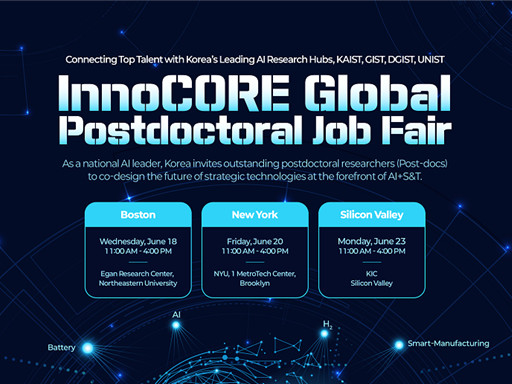
< Poster on the InnoCORE Global Jobfair for Recruitment of Postdoctoral Researchers >
In addition, a total of eight research groups are formed to promote global collaborative convergence research, including those led by DGIST, GIST, and UNIST: ▲Bio-Integrated Physical AI, ▲Early Diagnosis of Brain Diseases AI+Nano Convergence, ▲Intelligent Hydrogen Technology Innovation, and ▲AI-Space Solar Power Research Group.
Starting in 2025, the four science and technology institutes, including KAIST, will officially begin recruiting 400 postdoctoral researchers in the AI+S&T fields. Selected postdoctoral researchers will be guaranteed high-level treatment with an annual salary of over 90 million KRW, and additional support through matching with companies and research projects is also planned.
In particular, global recruitment fairs will be held in major US regions to expand the attraction of excellent overseas talent. Local recruitment fairs will be held in Boston (Harvard, MIT), New York (NYU), and Silicon Valley (Stanford) in June, along with promotions through global academic journals such as Nature and Science, and LinkedIn.
KAIST plans to provide multiple mentor programs, global joint research opportunities, and excellent infrastructure (such as supercomputers, semiconductor fabs, and AI research platforms) within the research groups to enable postdoctoral researchers to collaborate with experts from various academic and industrial fields.
President Kwang Hyung Lee emphasized, “Through this InnoCORE project, KAIST will leap forward as a Global Hub for AI+S&T convergence research. Young researchers from around the world will challenge themselves and grow at KAIST, and our country will play a pivotal role in establishing itself as a leading nation in global AI convergence research and industry. To achieve this, we will spare no effort in providing the best research environment and active support.”
KAIST plans to actively pursue the InnoCORE project to secure global competitiveness in AI convergence research and contribute to the development of advanced industries. The eight selected research groups will finalize their detailed research plans by the end of June and commence full-scale research in July.
2025.06.19 View 10230
‘InnoCORE Research Group’ Launched to Lead AI Convergence Innovation
KAIST announced on the 16th of June that it has launched the ‘InnoCORE (Innovation-Core) Research Group,’ which will lead advanced strategic research in AI convergence (AI+S&T), in cooperation with the Ministry of Science and ICT (Minister Yoo Sang-im, hereinafter referred to as MSIT) and DGIST, GIST, and UNIST*. Through this, the group plans to actively recruit up to 200 world-class postdoctoral researchers.
DGIST (Daegu Gyeongbuk Institute of Science & Technology), GIST (Gwangju Institute of Science & Technology), UNIST (Ulsan National Institute of Science and Technology)
The ‘InnoCORE Research Group’ aims to foster core research personnel who will lead innovation in the field of AI convergence, focusing on nurturing and attracting high-level research talent in AI+Science & Technology. This is a strategic response to prevent brain drain of domestic talent and attract excellent overseas talent amidst the accelerating global competition for AI talent.
Through this initiative, our university plans to accelerate AI-based science and technology innovation and disseminate research achievements across industries and the economy by supporting top domestic and international postdoctoral researchers to dedicate themselves to developing AI convergence technologies in an advanced collaborative research environment.
The InnoCORE project for advanced AI+S&T convergence research and global talent attraction is jointly promoted by four science and technology institutes, including KAIST. It is structured around AI core technologies (such as hyper-scale language models, AI semiconductors) and AI convergence technologies (such as bio, manufacturing, energy, and aerospace).
As the leading institution, our university operates the following four research groups:
Hyper-scale Language Model Innovation Research Group: Advancement of LLM technology and research on generative AI, multimodal AI, and ensuring reliability.
AI-based Intelligent Design-Manufacturing Integration Research Group: Establishment of an AI platform for the entire lifecycle of the manufacturing industry and innovation in design and processes.
AI-Innovation Drug Research Group: Securing AI-based drug development technologies across the entire lifecycle and overcoming intractable diseases.
AI-Transformed Aerospace Research Group: AI transformation of aerospace systems throughout their lifecycle and development of new technologies such as autonomous flight and space communication.
< Poster on the InnoCORE Global Jobfair for Recruitment of Postdoctoral Researchers >
In addition, a total of eight research groups are formed to promote global collaborative convergence research, including those led by DGIST, GIST, and UNIST: ▲Bio-Integrated Physical AI, ▲Early Diagnosis of Brain Diseases AI+Nano Convergence, ▲Intelligent Hydrogen Technology Innovation, and ▲AI-Space Solar Power Research Group.
Starting in 2025, the four science and technology institutes, including KAIST, will officially begin recruiting 400 postdoctoral researchers in the AI+S&T fields. Selected postdoctoral researchers will be guaranteed high-level treatment with an annual salary of over 90 million KRW, and additional support through matching with companies and research projects is also planned.
In particular, global recruitment fairs will be held in major US regions to expand the attraction of excellent overseas talent. Local recruitment fairs will be held in Boston (Harvard, MIT), New York (NYU), and Silicon Valley (Stanford) in June, along with promotions through global academic journals such as Nature and Science, and LinkedIn.
KAIST plans to provide multiple mentor programs, global joint research opportunities, and excellent infrastructure (such as supercomputers, semiconductor fabs, and AI research platforms) within the research groups to enable postdoctoral researchers to collaborate with experts from various academic and industrial fields.
President Kwang Hyung Lee emphasized, “Through this InnoCORE project, KAIST will leap forward as a Global Hub for AI+S&T convergence research. Young researchers from around the world will challenge themselves and grow at KAIST, and our country will play a pivotal role in establishing itself as a leading nation in global AI convergence research and industry. To achieve this, we will spare no effort in providing the best research environment and active support.”
KAIST plans to actively pursue the InnoCORE project to secure global competitiveness in AI convergence research and contribute to the development of advanced industries. The eight selected research groups will finalize their detailed research plans by the end of June and commence full-scale research in July.
2025.06.19 View 10230 -
 Professor Dan Keun Sung Endows Scholarship in Honor of His Retirement
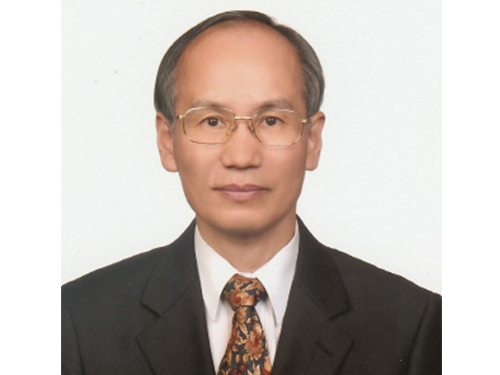
Professor Dan Keun Sung in the School of Electrical Engineering contributed a 100 million KRW scholarship fund this month to KAIST to mark his retirement after more than three decades of work.
“As my retirement date comes closer, I have been thinking about what I could do for the school. I wanted to leave something behind, even though it’s small, for my lifelong school and students. I am hoping that this scholarship fund will benefit the members of KAIST.”
This isn’t his first time making a donation to KAIST. In 2013, Professor Sung donated ten million KRW, which was his cash prize from the 9th Haedong Academic Award of The Korean Institute of Communications and Information Sciences (KICS). At that time, Professor Sung had the chance to create a scholarship fund in his name; however, he wanted to highlight that the scholarship fund was for ‘someone,’ not created by ‘someone.’ In that sense, his scholarship fund was created with no name to benefit students in the School of Electrical Engineering. His colleagues and students supported his idea. Professor Seonghwan Cho, students, and alumni also participated in fund raising efforts, which reached 55 million KRW in total.
Professor Sung emphasized, “Donations should always be remembered, no matter how small they are.” He then explained his purpose for creating the scholarship fund by saying, “Fundraising can be truly meaningful to contributors, knowing that their money is going to supporting the school and students.”
Professor Sung, a fellow of the Institute of Electrical and Electronics Engineers (IEEE) Communication Society, started his post at KAIST in 1986. For the past 30 years, he has devoted himself to fostering young scholars and studying in the area of information and communication. He also participated in developing technologies for the resource management of various future cellular components, such as satellites, switchboards, and signaling networks.
2017.08.11 View 14411
Professor Dan Keun Sung Endows Scholarship in Honor of His Retirement
Professor Dan Keun Sung in the School of Electrical Engineering contributed a 100 million KRW scholarship fund this month to KAIST to mark his retirement after more than three decades of work.
“As my retirement date comes closer, I have been thinking about what I could do for the school. I wanted to leave something behind, even though it’s small, for my lifelong school and students. I am hoping that this scholarship fund will benefit the members of KAIST.”
This isn’t his first time making a donation to KAIST. In 2013, Professor Sung donated ten million KRW, which was his cash prize from the 9th Haedong Academic Award of The Korean Institute of Communications and Information Sciences (KICS). At that time, Professor Sung had the chance to create a scholarship fund in his name; however, he wanted to highlight that the scholarship fund was for ‘someone,’ not created by ‘someone.’ In that sense, his scholarship fund was created with no name to benefit students in the School of Electrical Engineering. His colleagues and students supported his idea. Professor Seonghwan Cho, students, and alumni also participated in fund raising efforts, which reached 55 million KRW in total.
Professor Sung emphasized, “Donations should always be remembered, no matter how small they are.” He then explained his purpose for creating the scholarship fund by saying, “Fundraising can be truly meaningful to contributors, knowing that their money is going to supporting the school and students.”
Professor Sung, a fellow of the Institute of Electrical and Electronics Engineers (IEEE) Communication Society, started his post at KAIST in 1986. For the past 30 years, he has devoted himself to fostering young scholars and studying in the area of information and communication. He also participated in developing technologies for the resource management of various future cellular components, such as satellites, switchboards, and signaling networks.
2017.08.11 View 14411 -
 Foreign R&D Centers Cropping Up Here
Korea Times / 2004. 03. 26 By Kim Tae-gyu
Staff ReporterThe world"s top companies and research institutes are rushing to Korea to set up research and development (R&D) centers.
The Ministry of Science and Technology (MOST) on Thursday said it isunder negotiation with several world-renowned firms or foundations,including University of Cambridge Cavendish Laboratory, Novartis, DuPont and EMC.The Ministry of Information and Communication (MIC) is also lookingto attract five to six multinational companies to establish R&D centers here this year.
Korea has already become a home for R&D institutes from top-tier foreign outfits like the world"s No.1 computer-chip maker Intel Corp. and Paris-based medical foundation Institut Pasteur as well as Germany"s Fraunhofer-Gesellschaft.
The MOST said Cavendish will exchange a memorandum of understandingto set up a joint research center here together with the Korea Advanced Institute of Science and Technology (KAIST) as early as this May.
The two entities will join hands to accelerate knowledge in the fields of nanotechnology, optical technology and physics to name a few,a MOST official said.It also seeks to invite Swiss-based pharmaceutical group Norvatis toestablish an R&D center here on occasion of the medical symposium that will take place here from March 31.
The Fortune 500 company is expected to dispatch dozens of high-ranking staff to the two-day neuroscience convention.
The Korea Foundation for International Cooperation of Science and Technology (KICOS), an affiliate of MOST, expects a few American companies, including DuPont, to open shop here.``DuPont is likely to make a decision, and we are currently under negotiations with several big companies like EMC,"" KICOS official KimKey-hyup said.
EMC is the world"s third-largest maker of data-storage devices.Seoul seeks to host six high-tech information-technology (IT) research centers this year.
Up to now, Intel and Fraunhofer committed themselves to setting up research centers here, and IBM will likely open an R&D center as soonas its affiliate IBM Korea"s bribe scandal regarding a government contract is settled.
Such high-profile companies as Microsoft, Hewlett Packard and Qualcomm are welcome to open R&D centers in Korea, an MIC official said. The government is willing to provide financial incentives to foreignR&D centers.
2004.03.26 View 27802
Foreign R&D Centers Cropping Up Here
Korea Times / 2004. 03. 26 By Kim Tae-gyu
Staff ReporterThe world"s top companies and research institutes are rushing to Korea to set up research and development (R&D) centers.
The Ministry of Science and Technology (MOST) on Thursday said it isunder negotiation with several world-renowned firms or foundations,including University of Cambridge Cavendish Laboratory, Novartis, DuPont and EMC.The Ministry of Information and Communication (MIC) is also lookingto attract five to six multinational companies to establish R&D centers here this year.
Korea has already become a home for R&D institutes from top-tier foreign outfits like the world"s No.1 computer-chip maker Intel Corp. and Paris-based medical foundation Institut Pasteur as well as Germany"s Fraunhofer-Gesellschaft.
The MOST said Cavendish will exchange a memorandum of understandingto set up a joint research center here together with the Korea Advanced Institute of Science and Technology (KAIST) as early as this May.
The two entities will join hands to accelerate knowledge in the fields of nanotechnology, optical technology and physics to name a few,a MOST official said.It also seeks to invite Swiss-based pharmaceutical group Norvatis toestablish an R&D center here on occasion of the medical symposium that will take place here from March 31.
The Fortune 500 company is expected to dispatch dozens of high-ranking staff to the two-day neuroscience convention.
The Korea Foundation for International Cooperation of Science and Technology (KICOS), an affiliate of MOST, expects a few American companies, including DuPont, to open shop here.``DuPont is likely to make a decision, and we are currently under negotiations with several big companies like EMC,"" KICOS official KimKey-hyup said.
EMC is the world"s third-largest maker of data-storage devices.Seoul seeks to host six high-tech information-technology (IT) research centers this year.
Up to now, Intel and Fraunhofer committed themselves to setting up research centers here, and IBM will likely open an R&D center as soonas its affiliate IBM Korea"s bribe scandal regarding a government contract is settled.
Such high-profile companies as Microsoft, Hewlett Packard and Qualcomm are welcome to open R&D centers in Korea, an MIC official said. The government is willing to provide financial incentives to foreignR&D centers.
2004.03.26 View 27802