%48%61%72%76%61%72%64
-
 The Secret of Our Success Author Joseph Henrich to Deliver Special Lecture at KAIST
KAIST announced on the 19th that its Institute for Mind and Brain Sciences and the Department of Brain and Cognitive Science will be hosting a special lecture by world-renowned cultural evolution scholar, Professor Joseph Henrich of Harvard University. The free lecture will take place on the 22nd at the Conference Room on the 1st floor of the Meta-Convergence Hall at the KAIST main campus, with support from the Gikwan Foundation. The event is open to the public.
Professor Henrich, a professor in the Department of Human Evolutionary Biology at Harvard, is a leading authority on the evolution of culture and cooperation. He was recognized for his work on the origins of human cooperative behavior through a comparative study of 15 small-scale societies, earning the 2024 Panmure House Prize* (Adam Smith 300th Anniversary Prize) and the 2022 Hayek Book Prize.
* Panmure House Prize: An academic award established in honor of Adam Smith's scholarship, named after the building where he lived.
< Poster for Special Lecture by Professor Joseph Henrich of Harvard University >
His representative books, "The WEIRDest People in the World" and "The Secret of Our Success," have created a significant stir in both academia and the general public by offering new interpretations of the formation and development of human society from a cultural evolution perspective.
"The WEIRDest People in the World" emphasizes that human thought and behavior are products of specific cultural environments rather than universal truths. "The Secret of Our Success" presents a new perspective on how humanity, through cultural artifacts like language, tools, and institutions, has achieved unique success compared to other animals.
The lecture will be divided into two sessions: an academic seminar and a public lecture. The academic seminar, held from 10:00 AM to 11:30 AM, will be conducted in English on the topic of "Cultural Evolutionary Psychology, Kinship, and the Historical Origins of Modern Psychological Differences." It is intended for researchers, graduate students, and undergraduate students in related fields.
Following this, a public lecture will be held from 3:00 PM to 5:00 PM on the topic of "The Collective Brain: Social and Cultural Origins of Creativity." Professor Jeong Jae-seung of KAIST's Department of Brain and Cognitive Science will serve as the moderator, and simultaneous interpretation will be provided.
The lecture will cover how innovation and creativity are products of a collective intelligence formed by diverse people exchanging ideas through networks. It will also discuss how the pace of innovation within a population is determined by key factors such as community size, social connectivity, and cognitive diversity, and how these principles explain innovation in various social contexts, including cultural psychology, immigration, urbanization, and institutions. There will also be a Q&A session with the author of "The Secret of Our Success."
Regarding the lecture, Professor Henrich stated, "In human evolution, culture is not just a backdrop; it's the core driving force that makes us human. Through this lecture, I want to share how we have learned from each other, cooperated, and developed knowledge and institutions. I especially look forward to having a deep conversation with the audience about the evolutionary significance of the passion for education and learning culture in Korean society."
Professor Jeong Jae-seung of KAIST's Department of Brain and Cognitive Science said, "This lecture was organized to explore how the human mind and brain have evolved through interaction with culture. It will be a valuable opportunity to hear the insights of a world-renowned scholar from the interdisciplinary perspective of meditation science and brain and cognitive science."
To register for the event, you can use the link (https://forms.gle/7TW9FAKv1qgA3dBBA) or the QR code on the poster. For inquiries, please contact the KAIST Institute for Mind and Brain Sciences at 042-350-1361.
2025.09.19 View 1947
The Secret of Our Success Author Joseph Henrich to Deliver Special Lecture at KAIST
KAIST announced on the 19th that its Institute for Mind and Brain Sciences and the Department of Brain and Cognitive Science will be hosting a special lecture by world-renowned cultural evolution scholar, Professor Joseph Henrich of Harvard University. The free lecture will take place on the 22nd at the Conference Room on the 1st floor of the Meta-Convergence Hall at the KAIST main campus, with support from the Gikwan Foundation. The event is open to the public.
Professor Henrich, a professor in the Department of Human Evolutionary Biology at Harvard, is a leading authority on the evolution of culture and cooperation. He was recognized for his work on the origins of human cooperative behavior through a comparative study of 15 small-scale societies, earning the 2024 Panmure House Prize* (Adam Smith 300th Anniversary Prize) and the 2022 Hayek Book Prize.
* Panmure House Prize: An academic award established in honor of Adam Smith's scholarship, named after the building where he lived.
< Poster for Special Lecture by Professor Joseph Henrich of Harvard University >
His representative books, "The WEIRDest People in the World" and "The Secret of Our Success," have created a significant stir in both academia and the general public by offering new interpretations of the formation and development of human society from a cultural evolution perspective.
"The WEIRDest People in the World" emphasizes that human thought and behavior are products of specific cultural environments rather than universal truths. "The Secret of Our Success" presents a new perspective on how humanity, through cultural artifacts like language, tools, and institutions, has achieved unique success compared to other animals.
The lecture will be divided into two sessions: an academic seminar and a public lecture. The academic seminar, held from 10:00 AM to 11:30 AM, will be conducted in English on the topic of "Cultural Evolutionary Psychology, Kinship, and the Historical Origins of Modern Psychological Differences." It is intended for researchers, graduate students, and undergraduate students in related fields.
Following this, a public lecture will be held from 3:00 PM to 5:00 PM on the topic of "The Collective Brain: Social and Cultural Origins of Creativity." Professor Jeong Jae-seung of KAIST's Department of Brain and Cognitive Science will serve as the moderator, and simultaneous interpretation will be provided.
The lecture will cover how innovation and creativity are products of a collective intelligence formed by diverse people exchanging ideas through networks. It will also discuss how the pace of innovation within a population is determined by key factors such as community size, social connectivity, and cognitive diversity, and how these principles explain innovation in various social contexts, including cultural psychology, immigration, urbanization, and institutions. There will also be a Q&A session with the author of "The Secret of Our Success."
Regarding the lecture, Professor Henrich stated, "In human evolution, culture is not just a backdrop; it's the core driving force that makes us human. Through this lecture, I want to share how we have learned from each other, cooperated, and developed knowledge and institutions. I especially look forward to having a deep conversation with the audience about the evolutionary significance of the passion for education and learning culture in Korean society."
Professor Jeong Jae-seung of KAIST's Department of Brain and Cognitive Science said, "This lecture was organized to explore how the human mind and brain have evolved through interaction with culture. It will be a valuable opportunity to hear the insights of a world-renowned scholar from the interdisciplinary perspective of meditation science and brain and cognitive science."
To register for the event, you can use the link (https://forms.gle/7TW9FAKv1qgA3dBBA) or the QR code on the poster. For inquiries, please contact the KAIST Institute for Mind and Brain Sciences at 042-350-1361.
2025.09.19 View 1947 -
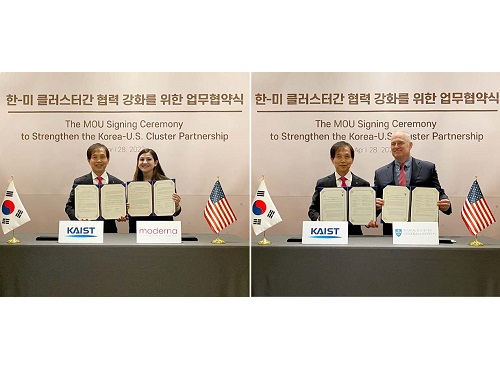 KAIST gearing up to train physician-scientists and BT Professionals joining hands with Boston-based organizations
KAIST (President Kwang Hyung Lee) announced on the 29th that it has signed MOUs with Massachusetts General Hospital, a founding member of the Mass General Brigham health care system and a world-class research-oriented hospital, and Moderna, a biotechnology company that developed a COVID-19 vaccine at the Langham Hotel in Boston, MA, USA on the morning of April 28th (local time). The signing ceremony was attended by officials from each institution joined by others headed by Minister LEE Young of the Korean Ministry of SMEs and Startups (MSS), and Commissioner LEE Insil of the Korean Intellectual Property Office.
< Photo 1. Photo from the Signing of MOU between KAIST-Harvard University Massachusetts General Hospital and KAIST-Moderna >
Mass General is the first and largest teaching hospital of Harvard Medical School in Boston, USA, and it is one of the most innovative hospitals in the world being the alma mater of more than 13 Nobel Prize winners and the home of the Mass General Research Institute, the world’s largest hospital-based research program that utilizes an annual research budget of more than $1.3 billion.
KAIST signed a general agreement to explore research and academic exchange with Mass General in September of last year and this MOU is a part of its follow-ups.
Mass General works with Harvard and the Massachusetts Institute of Technology (MIT), as well as local hospitals, to support students learn the theories of medicine and engineering, and gain rich clinical research experience.
Through this MOU, KAIST will explore cooperation with an innovative ecosystem created through the convergence of medicine and engineering. In particular, KAIST’s goal is to develop a Korean-style training program and implement a differentiated educational program when establishing the science and technology-oriented medical school in the future by further strengthening the science and engineering part of the training including a curriculum on artificial intelligence (AI) and the likes there of.
Also, in order to foster innovative physician-scientists, KAIST plans to pursue cooperation to develop programs for exchange of academic and human resources including programs for student and research exchanges and a program for students of the science and technology-oriented medical school at KAIST to have a chance to take part in practical training at Mass General.
David F.M. Brown, MD, Mass General President, said, “The collaboration with KAIST has a wide range of potentials, including advice on training of physician-scientists, academic and human resource exchanges, and vitalization of joint research by faculty from both institutions. Through this agreement, we will be able to actively contribute to global cooperation and achieve mutual goals.”
Meanwhile, an MOU between KAIST and Moderna was also held on the same day. Its main focus is to foster medical experts in cooperation with KAIST Graduate School of Medical Science and Engineering (GSMSE), and plans to cooperate in various ways in the future, including collaborating for development of vaccine and new drugs, virus research, joint mRNA research, and facilitation of technology commercialization.
In over 10 years since its inception, Moderna has transformed from a research-stage company advancing programs in the field of messenger RNA (mRNA) to an enterprise with a diverse clinical portfolio of vaccines and therapeutics across seven modalities. The Company has 48 programs in development across 45 development candidates, of which 38 are currently in active clinical trials.
“We are grateful to have laid a foundation for collaboration to foster industry experts with the Korea Advanced Institute of Science and Technology, a leader of science and technology innovation in Korea,” said Arpa Garay, Chief Commercial Officer, Moderna. “Based on our leadership and expertise in developing innovative mRNA vaccines and therapeutics, we hope to contribute to educating and collaborating with professionals in the bio-health field of Korea.“
President Kwang Hyung Lee of KAIST, said, “We deem this occasion to be of grave significance to be able to work closely with Massachusetts General Hospital, one of the world's best research-oriented hospitals, and Moderna, one of the most influential biomedical companies.”
President Lee continued, "On the basis of the collaboration with the two institutions, we will be able to bring up qualified physician-scientists and global leaders of the biomedical business who will solve problems of human health and their progress will in turn, accelerate the national R&D efforts in general and diversify the industry."
2023.04.29 View 22903
KAIST gearing up to train physician-scientists and BT Professionals joining hands with Boston-based organizations
KAIST (President Kwang Hyung Lee) announced on the 29th that it has signed MOUs with Massachusetts General Hospital, a founding member of the Mass General Brigham health care system and a world-class research-oriented hospital, and Moderna, a biotechnology company that developed a COVID-19 vaccine at the Langham Hotel in Boston, MA, USA on the morning of April 28th (local time). The signing ceremony was attended by officials from each institution joined by others headed by Minister LEE Young of the Korean Ministry of SMEs and Startups (MSS), and Commissioner LEE Insil of the Korean Intellectual Property Office.
< Photo 1. Photo from the Signing of MOU between KAIST-Harvard University Massachusetts General Hospital and KAIST-Moderna >
Mass General is the first and largest teaching hospital of Harvard Medical School in Boston, USA, and it is one of the most innovative hospitals in the world being the alma mater of more than 13 Nobel Prize winners and the home of the Mass General Research Institute, the world’s largest hospital-based research program that utilizes an annual research budget of more than $1.3 billion.
KAIST signed a general agreement to explore research and academic exchange with Mass General in September of last year and this MOU is a part of its follow-ups.
Mass General works with Harvard and the Massachusetts Institute of Technology (MIT), as well as local hospitals, to support students learn the theories of medicine and engineering, and gain rich clinical research experience.
Through this MOU, KAIST will explore cooperation with an innovative ecosystem created through the convergence of medicine and engineering. In particular, KAIST’s goal is to develop a Korean-style training program and implement a differentiated educational program when establishing the science and technology-oriented medical school in the future by further strengthening the science and engineering part of the training including a curriculum on artificial intelligence (AI) and the likes there of.
Also, in order to foster innovative physician-scientists, KAIST plans to pursue cooperation to develop programs for exchange of academic and human resources including programs for student and research exchanges and a program for students of the science and technology-oriented medical school at KAIST to have a chance to take part in practical training at Mass General.
David F.M. Brown, MD, Mass General President, said, “The collaboration with KAIST has a wide range of potentials, including advice on training of physician-scientists, academic and human resource exchanges, and vitalization of joint research by faculty from both institutions. Through this agreement, we will be able to actively contribute to global cooperation and achieve mutual goals.”
Meanwhile, an MOU between KAIST and Moderna was also held on the same day. Its main focus is to foster medical experts in cooperation with KAIST Graduate School of Medical Science and Engineering (GSMSE), and plans to cooperate in various ways in the future, including collaborating for development of vaccine and new drugs, virus research, joint mRNA research, and facilitation of technology commercialization.
In over 10 years since its inception, Moderna has transformed from a research-stage company advancing programs in the field of messenger RNA (mRNA) to an enterprise with a diverse clinical portfolio of vaccines and therapeutics across seven modalities. The Company has 48 programs in development across 45 development candidates, of which 38 are currently in active clinical trials.
“We are grateful to have laid a foundation for collaboration to foster industry experts with the Korea Advanced Institute of Science and Technology, a leader of science and technology innovation in Korea,” said Arpa Garay, Chief Commercial Officer, Moderna. “Based on our leadership and expertise in developing innovative mRNA vaccines and therapeutics, we hope to contribute to educating and collaborating with professionals in the bio-health field of Korea.“
President Kwang Hyung Lee of KAIST, said, “We deem this occasion to be of grave significance to be able to work closely with Massachusetts General Hospital, one of the world's best research-oriented hospitals, and Moderna, one of the most influential biomedical companies.”
President Lee continued, "On the basis of the collaboration with the two institutions, we will be able to bring up qualified physician-scientists and global leaders of the biomedical business who will solve problems of human health and their progress will in turn, accelerate the national R&D efforts in general and diversify the industry."
2023.04.29 View 22903 -
 KAIST to Participate in the Summer Davos Forum
KAIST will participate in the 2017 Summer Davos Forum in Dalian, China from June 27 to 29. The Summer Davos Forum with the official title “Annual Meeting of New Champions” is an annual international meeting co-hosted by China and the World Economic Forum (WEF) to address global issues which has been held since 2007.
Focusing on this year’s theme ‘Achieving Inclusive Growth in the Fourth Industrial Revolution,’ science and technology experts from 90 different countries will participate in various sessions to present on and discuss pending global innovative issues. KAIST is to be the only Korean university to run ‘IdeasLab,’ in which researchers will introduce current research trends and discuss ideas with global leaders. This is the sixth year for KAIST to run IdeasLab.
This year’s IdeasLab has the theme ‘Materials of the Future,’ and will include presentations and discussions on materials developed at KAIST which could lead the Fourth Industrial Revolution. President Sung-Chul Shin, the chairman of the session, will first introduce the current status of KAIST and IdeasLab, followed by a presentation of cutting-edge integrated research findings by KAIST professors.
President Shin will also participate in various sessions organized by the Global University Leaders Forum (GULF) as discussion leader. President Shin is the only Korean member of GULF, a community comprised of the presidents of the world’s top 27 universities. Other members include the presidents of the University of Oxford and the University of Cambridge in the U.K., MIT, Harvard, Stanford, and Columbia Universities in the US, and the University of Tokyo in Japan.
Further, President Shin will participate in a strategy session for inclusive growth in the era of the Fourth Industrial Revolution and a meeting with the WEF directors.
The Dean of KAIST Institutes, Distinguished Professor Sang Yup Lee from the Chemical and Biomolecular Engineering Department, who has been invited to the Davos Forum and Summer Davos Forum for the last 15 years, is to present in the ‘Future of Life: Medicine’ session to introduce advancements in traditional medicine through systems biology such as his research on microbiomes (gut microbes).
Professor Lee, as the chair of the Global Future Council on Biotechnology at the WEF, and committee member of the Annual Meeting of the Global Future Councils on the Fourth Industrial Revolution, is to participate in various bio-sessions and the Fourth Industrial Revolution banquet session to lead the discussions.
President Shin said, “KAIST has been sharing global research findings with global leaders through IdeasLab at the Davos Forum for the past six years and it has always been well received.” He continued, “The forum will be the place for in-depth discussion on the technological changes that accompany the Fourth Industrial Revolution and human-centered development plan, as well as introducing innovative research and integrated research findings from KAIST.”
This year’s speakers include Li Keqiang, the current Premier of the State Council of China; Guo Ping, the rotating C.E.O. of Huawei; and Ya-Qin Zhang, the President of Baidu, a company leading technological innovation in various fields such as robotics and autonomous vehicles. Two thousand distinguished guests in politics, administration, finance, and academia from 90 countries are to participate in the meeting.
2017.06.21 View 13727
KAIST to Participate in the Summer Davos Forum
KAIST will participate in the 2017 Summer Davos Forum in Dalian, China from June 27 to 29. The Summer Davos Forum with the official title “Annual Meeting of New Champions” is an annual international meeting co-hosted by China and the World Economic Forum (WEF) to address global issues which has been held since 2007.
Focusing on this year’s theme ‘Achieving Inclusive Growth in the Fourth Industrial Revolution,’ science and technology experts from 90 different countries will participate in various sessions to present on and discuss pending global innovative issues. KAIST is to be the only Korean university to run ‘IdeasLab,’ in which researchers will introduce current research trends and discuss ideas with global leaders. This is the sixth year for KAIST to run IdeasLab.
This year’s IdeasLab has the theme ‘Materials of the Future,’ and will include presentations and discussions on materials developed at KAIST which could lead the Fourth Industrial Revolution. President Sung-Chul Shin, the chairman of the session, will first introduce the current status of KAIST and IdeasLab, followed by a presentation of cutting-edge integrated research findings by KAIST professors.
President Shin will also participate in various sessions organized by the Global University Leaders Forum (GULF) as discussion leader. President Shin is the only Korean member of GULF, a community comprised of the presidents of the world’s top 27 universities. Other members include the presidents of the University of Oxford and the University of Cambridge in the U.K., MIT, Harvard, Stanford, and Columbia Universities in the US, and the University of Tokyo in Japan.
Further, President Shin will participate in a strategy session for inclusive growth in the era of the Fourth Industrial Revolution and a meeting with the WEF directors.
The Dean of KAIST Institutes, Distinguished Professor Sang Yup Lee from the Chemical and Biomolecular Engineering Department, who has been invited to the Davos Forum and Summer Davos Forum for the last 15 years, is to present in the ‘Future of Life: Medicine’ session to introduce advancements in traditional medicine through systems biology such as his research on microbiomes (gut microbes).
Professor Lee, as the chair of the Global Future Council on Biotechnology at the WEF, and committee member of the Annual Meeting of the Global Future Councils on the Fourth Industrial Revolution, is to participate in various bio-sessions and the Fourth Industrial Revolution banquet session to lead the discussions.
President Shin said, “KAIST has been sharing global research findings with global leaders through IdeasLab at the Davos Forum for the past six years and it has always been well received.” He continued, “The forum will be the place for in-depth discussion on the technological changes that accompany the Fourth Industrial Revolution and human-centered development plan, as well as introducing innovative research and integrated research findings from KAIST.”
This year’s speakers include Li Keqiang, the current Premier of the State Council of China; Guo Ping, the rotating C.E.O. of Huawei; and Ya-Qin Zhang, the President of Baidu, a company leading technological innovation in various fields such as robotics and autonomous vehicles. Two thousand distinguished guests in politics, administration, finance, and academia from 90 countries are to participate in the meeting.
2017.06.21 View 13727 -
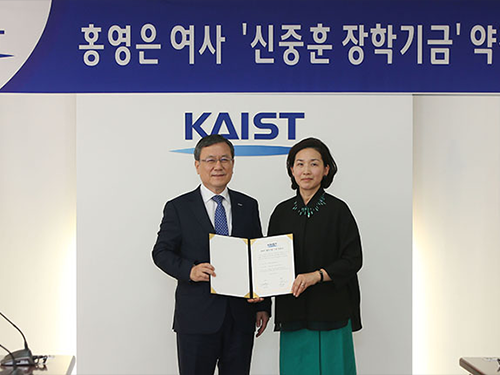 Scholarship in Memory of Professor Shin Endowed by His Family
Professor Joong-Hoon Shin of the Graduate School of Nanoscience and Technology was touted as a genius young scientist who would take the lead in nanoscience technology. After earning degrees from Harvard and the Caltech, he was appointed at KAIST at age 27. He was the youngest professor ever appointed in Korea.
Professor Shin’s outstanding research in the field of semiconductor nano-optics led him to be named as the ‘Scientist of the Year’ for three consecutive years from 2004 by the most prestigious scientist and technology organizations including the Korean Academy Science and Technology, the National Research Foundation of Korea, and the Korean government. However, a fatal car accident last September on the way home from a seminar in Gangwon Province took his life and a promising scholar’s research was left unfinished. He was 47 years old.
Mrs. Young-Eun Hong, the widow of the late Professor Shin, made a 100 million KRW gift to KAIST to establish the ‘Joong-Hoon Shin Scholarship’ on April 7. The scholarship will provide financial assistance to outstanding students of physics and nanoscience.
At the donation ceremony attended by President Sung-Chul Shin, Professor Shin’s colleagues and students, and family members, Mrs. Hong said, “My family would like to help young students achieve their dreams on behalf of my husband. I hope students will remember my husband’s passion and dedication toward his studies for a long time. He was a very hard worker.”
Working at KAIST, Professor Shin made significant achievements in field of semiconductor nano-optics, specializing in silicon photonics and silicon nanocrystal structures. In particular, his research team gained attention reproducing the structure of ‘Morpho butterfly’ wings, which produce the same colors from various angles, using external light as a light source without extra power. Their research led to the creation of original technology dubbed the biomimetics reflective display and was published in Nature in 2012.
Professor Shin’s legacy still endures. In February, a research team under Professor Shin-Hyun Kim of the Department of Chemical and Biomolecular Engineering includingthe late Professor Shin’s doctoral student Seung Yeol Lee, posthumously dedicated their research published on Advanced Materials to Professor Shin. ( click )
KAIST President Sung-Chul Shin, who is also a physicist, said “His passing is a great loss to the whole scientific and technology community, at home and abroad. But Joong-Hoon Shin scholarship will enable the growth and ensure the strength of nanoscience and its education at KAIST. We will uphold Professor Shin’s legacy by doing our best to make KAIST a world-leading university which can create global value.”
Mrs. Hong said she will continue her husband’s academic legacy at his alma maters, Harvard and the Caltech, where he earned his BS in physics and his Ph.D. in applied physics respectively. She said she will start fundraising to establish the Joong-Hoon Shin Scholarship at Harvard and Caltech from July.
(Mrs. Hong poses with President Sung-Chul Shin after donating 100 million KRW for establishing 'Joong-Hoon Shin Scholarship' in memory of her husband on April 7.)
2017.04.10 View 12070
Scholarship in Memory of Professor Shin Endowed by His Family
Professor Joong-Hoon Shin of the Graduate School of Nanoscience and Technology was touted as a genius young scientist who would take the lead in nanoscience technology. After earning degrees from Harvard and the Caltech, he was appointed at KAIST at age 27. He was the youngest professor ever appointed in Korea.
Professor Shin’s outstanding research in the field of semiconductor nano-optics led him to be named as the ‘Scientist of the Year’ for three consecutive years from 2004 by the most prestigious scientist and technology organizations including the Korean Academy Science and Technology, the National Research Foundation of Korea, and the Korean government. However, a fatal car accident last September on the way home from a seminar in Gangwon Province took his life and a promising scholar’s research was left unfinished. He was 47 years old.
Mrs. Young-Eun Hong, the widow of the late Professor Shin, made a 100 million KRW gift to KAIST to establish the ‘Joong-Hoon Shin Scholarship’ on April 7. The scholarship will provide financial assistance to outstanding students of physics and nanoscience.
At the donation ceremony attended by President Sung-Chul Shin, Professor Shin’s colleagues and students, and family members, Mrs. Hong said, “My family would like to help young students achieve their dreams on behalf of my husband. I hope students will remember my husband’s passion and dedication toward his studies for a long time. He was a very hard worker.”
Working at KAIST, Professor Shin made significant achievements in field of semiconductor nano-optics, specializing in silicon photonics and silicon nanocrystal structures. In particular, his research team gained attention reproducing the structure of ‘Morpho butterfly’ wings, which produce the same colors from various angles, using external light as a light source without extra power. Their research led to the creation of original technology dubbed the biomimetics reflective display and was published in Nature in 2012.
Professor Shin’s legacy still endures. In February, a research team under Professor Shin-Hyun Kim of the Department of Chemical and Biomolecular Engineering includingthe late Professor Shin’s doctoral student Seung Yeol Lee, posthumously dedicated their research published on Advanced Materials to Professor Shin. ( click )
KAIST President Sung-Chul Shin, who is also a physicist, said “His passing is a great loss to the whole scientific and technology community, at home and abroad. But Joong-Hoon Shin scholarship will enable the growth and ensure the strength of nanoscience and its education at KAIST. We will uphold Professor Shin’s legacy by doing our best to make KAIST a world-leading university which can create global value.”
Mrs. Hong said she will continue her husband’s academic legacy at his alma maters, Harvard and the Caltech, where he earned his BS in physics and his Ph.D. in applied physics respectively. She said she will start fundraising to establish the Joong-Hoon Shin Scholarship at Harvard and Caltech from July.
(Mrs. Hong poses with President Sung-Chul Shin after donating 100 million KRW for establishing 'Joong-Hoon Shin Scholarship' in memory of her husband on April 7.)
2017.04.10 View 12070 -
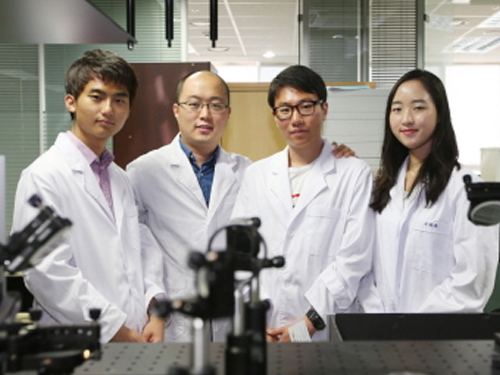 Professor YongKeun Park Produces Undergraduate Students with International Achievements
Three undergraduate students under the supervision of Professor YongKeun Park from the Department of Physics, KAIST, have published papers in globally renowned academic journals.
The most recent publication was made by YoungJu Jo, a senior in physics. Jo’s paper entitled “Angle-resolved light scattering of individual rod-shaped bacteria based on Fourier transform light scattering” was published in the May 28th edition of Scientific Reports.
Analyzing bacteria is a very important task in the field of health and food hygiene, but using the conventional biochemical methods of analysis takes days. However, observation with Jo’s newly developed method using light scattering analyzes bacteria within a matter of seconds.
SangYeon Cho from the Department of Chemistry also published papers in Cell (2012) and Nature (2013), respectively, under the guidance of Professor Park. SangYeon Cho’s outstanding research achievements were recognized by Harvard and MIT. He was accepted with a full scholarship to Harvard-MIT Health Sciences and Technology Graduate School. He will begin his graduate studies at Harvard-MIT this September.
Last March, SeoEun Lee from the Department of Biology was the recipient of the Best Paper Award by the Optical Society of Korea. She plans to pursue a doctoral degree at the College of Physicians and Surgeons, Columbia University in New York.
Professor Park said, “Undergraduate students, who are learning a variety of subjects concurrently, are at the most creative time of their lives. KAIST has offered many opportunities to undergraduate students to partake in various research programs.”
- Picture (a) and (b): Rod-shaped bacteria’s phase image and light-scattering patterns
- Picture (c): Quantitative analysis to illustrate the extraction of information from bacteria
2014.06.03 View 19603
Professor YongKeun Park Produces Undergraduate Students with International Achievements
Three undergraduate students under the supervision of Professor YongKeun Park from the Department of Physics, KAIST, have published papers in globally renowned academic journals.
The most recent publication was made by YoungJu Jo, a senior in physics. Jo’s paper entitled “Angle-resolved light scattering of individual rod-shaped bacteria based on Fourier transform light scattering” was published in the May 28th edition of Scientific Reports.
Analyzing bacteria is a very important task in the field of health and food hygiene, but using the conventional biochemical methods of analysis takes days. However, observation with Jo’s newly developed method using light scattering analyzes bacteria within a matter of seconds.
SangYeon Cho from the Department of Chemistry also published papers in Cell (2012) and Nature (2013), respectively, under the guidance of Professor Park. SangYeon Cho’s outstanding research achievements were recognized by Harvard and MIT. He was accepted with a full scholarship to Harvard-MIT Health Sciences and Technology Graduate School. He will begin his graduate studies at Harvard-MIT this September.
Last March, SeoEun Lee from the Department of Biology was the recipient of the Best Paper Award by the Optical Society of Korea. She plans to pursue a doctoral degree at the College of Physicians and Surgeons, Columbia University in New York.
Professor Park said, “Undergraduate students, who are learning a variety of subjects concurrently, are at the most creative time of their lives. KAIST has offered many opportunities to undergraduate students to partake in various research programs.”
- Picture (a) and (b): Rod-shaped bacteria’s phase image and light-scattering patterns
- Picture (c): Quantitative analysis to illustrate the extraction of information from bacteria
2014.06.03 View 19603 -
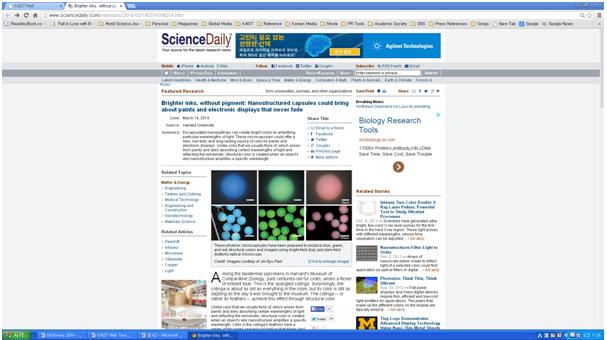 Science Daily: Nanostructured Capsules Could Bring About Paints and Electronic Displays That Never Fade
A collaborative research by Professor Shin-Hyun Kim of Chemical and Bimolecular Engineering, KAIST, and his student, Tae-Min Choi, on nano-structural colors with Harvard University was published by Science Daily on March 14, 2014.
For the article, please go to:
Science Daily,
March 14, 2014
Featured Research
"Brighter inks, without pigment: Nanostructured capsules could bring about paints and electronic displays that never fade"
http://www.sciencedaily.com/releases/2014/03/140314164214.htm
2014.03.17 View 13576
Science Daily: Nanostructured Capsules Could Bring About Paints and Electronic Displays That Never Fade
A collaborative research by Professor Shin-Hyun Kim of Chemical and Bimolecular Engineering, KAIST, and his student, Tae-Min Choi, on nano-structural colors with Harvard University was published by Science Daily on March 14, 2014.
For the article, please go to:
Science Daily,
March 14, 2014
Featured Research
"Brighter inks, without pigment: Nanostructured capsules could bring about paints and electronic displays that never fade"
http://www.sciencedaily.com/releases/2014/03/140314164214.htm
2014.03.17 View 13576 -
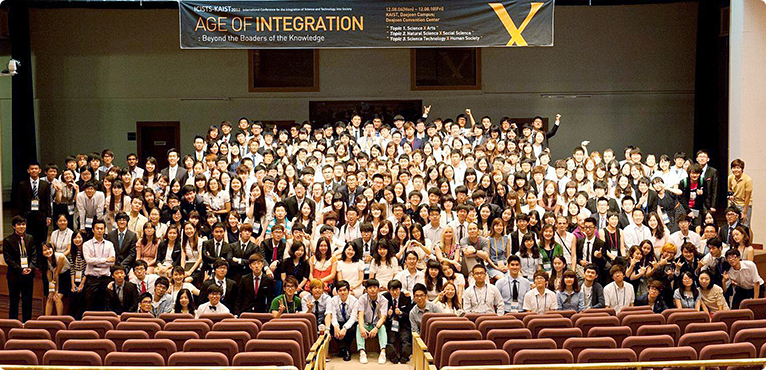 2013 International Conference for the Integration of Science, Technology, and Society at KAIST (ICISTS-KAIST)
The International Conference for the Integration of Science, Technology, and Society at KAIST (ICISTS-KAIST) is a global forum organized by KAIST undergraduate students to promote the exchange of ideas and facilitate the discussion of issues that are important to science, technology, society, and higher education. The ICISTS-KAIST conference has been held annually every summer since 2005, inviting distinguished speakers and guests from all around the world to share their insights and expertise with students gathered from Korea and abroad. Last year alone, more than 300 students from 22 nations and 40 speakers participated in the event.
Originally, the ICISTS-KAIST was established by KAIST students who were inspired by the Harvard Project for Asian and International Relations (HPAIR), which is one of the Harvard’s largest annual student conferences in Asia.
This year, 335 students from 103 universities in 22 countries joined the conference that was held on August 5th-9th in Daejeon, making the 2013 ICISTS-KAIST the biggest science and engineering gathering hosted by university students in Asia. About 36% of the participants were international students.
The theme of the conference was “Perfect Alliance: Coexistence for Human Society,” in which students and speakers addressed issues on how to harmonize the speed of scientific progress with the development of important values in society, as well as to explore solutions to overcome the chasm, if any, between the boundaries of science and society.
In his opening remarks, President Steve Kang said, “Creativity and innovation are born out of openness. Therefore, it is essential for young scientists and engineers to communicate with people from different cultural and political backgrounds. Through this kind of global interaction and exchange of ideas and views, students will have an opportunity to deepen their understanding of the world and to better examine the purpose of their intellectual exploration in science and technology.” At the 2013 ICISTS-KAIST, 25 distinguished speakers participated including Walter Bender, a former director of the Media Lab at MIT and David Christian, a professor of Macquarie University in Australia.
2013.08.08 View 15095
2013 International Conference for the Integration of Science, Technology, and Society at KAIST (ICISTS-KAIST)
The International Conference for the Integration of Science, Technology, and Society at KAIST (ICISTS-KAIST) is a global forum organized by KAIST undergraduate students to promote the exchange of ideas and facilitate the discussion of issues that are important to science, technology, society, and higher education. The ICISTS-KAIST conference has been held annually every summer since 2005, inviting distinguished speakers and guests from all around the world to share their insights and expertise with students gathered from Korea and abroad. Last year alone, more than 300 students from 22 nations and 40 speakers participated in the event.
Originally, the ICISTS-KAIST was established by KAIST students who were inspired by the Harvard Project for Asian and International Relations (HPAIR), which is one of the Harvard’s largest annual student conferences in Asia.
This year, 335 students from 103 universities in 22 countries joined the conference that was held on August 5th-9th in Daejeon, making the 2013 ICISTS-KAIST the biggest science and engineering gathering hosted by university students in Asia. About 36% of the participants were international students.
The theme of the conference was “Perfect Alliance: Coexistence for Human Society,” in which students and speakers addressed issues on how to harmonize the speed of scientific progress with the development of important values in society, as well as to explore solutions to overcome the chasm, if any, between the boundaries of science and society.
In his opening remarks, President Steve Kang said, “Creativity and innovation are born out of openness. Therefore, it is essential for young scientists and engineers to communicate with people from different cultural and political backgrounds. Through this kind of global interaction and exchange of ideas and views, students will have an opportunity to deepen their understanding of the world and to better examine the purpose of their intellectual exploration in science and technology.” At the 2013 ICISTS-KAIST, 25 distinguished speakers participated including Walter Bender, a former director of the Media Lab at MIT and David Christian, a professor of Macquarie University in Australia.
2013.08.08 View 15095 -
 The Harvard Crimson: Engineers Who Can Lead, April 14, 2011
An inspiring opinion on the role of engineers as global leaders in the era of science- and technology-based economies was published in the Harvard Crimson, the university’s newspaper, dated April 14, 2011. The piece was coauthored by Cherry A. Murray, the dean of the Harvard School of Engineering and Applied Sciences, and Andrew R. Garman, a graduate of the Harvard School, who is a managing partner at New Venture Partners.
For the opinion piece, please go to http://www.thecrimson.com/article/2011/4/14/engineering-engineers-science-new/.
Engineers Who Can Lead
By Andrew R. Garman and Cherry A. Murray
Published: Thursday, April 14, 2011
2011.04.20 View 13340
The Harvard Crimson: Engineers Who Can Lead, April 14, 2011
An inspiring opinion on the role of engineers as global leaders in the era of science- and technology-based economies was published in the Harvard Crimson, the university’s newspaper, dated April 14, 2011. The piece was coauthored by Cherry A. Murray, the dean of the Harvard School of Engineering and Applied Sciences, and Andrew R. Garman, a graduate of the Harvard School, who is a managing partner at New Venture Partners.
For the opinion piece, please go to http://www.thecrimson.com/article/2011/4/14/engineering-engineers-science-new/.
Engineers Who Can Lead
By Andrew R. Garman and Cherry A. Murray
Published: Thursday, April 14, 2011
2011.04.20 View 13340 -
KAIST College of Life Sciences and Bioengineering Signs MOU with Harvard
KAIST’s College of Life Sciences and Bioengineering recently signed a memorandum of understanding (MOU) with Harvard University’s Center for Brain Science on July 20, which will allow for joint research and exchange in researchers between the two institutions.
Headed by Director Kenneth Blum, Harvard’s Center for Brain Science leads the world in brain-related research. The new MOU will allow for research cooperation, exchanges of professors, researchers, and students, joint usage of infrastructure and research materials, and finally, sharing of research assignments.
The Dean of the College of Life Sciences and Bioengineering Sang Yup Lee, who concerted efforts to form the MOU said, “This agreement will bring together two of the world’s leading brain-related research teams, and I hope that combining their expertise will bring great advances in brain science and engineering.
KAIST’s College of Life Science and Bioengineering, which is known for its creative interdisciplinary research, is producing exemplary research results in the field of brain science from its Biological Sciences and Bio and Brain Engineering departments.
In addition to cooperation with Harvard, KAIST has also formed partnerships with Emory University, Japan’s RIKEN Brain Institute, and Germany’s Max Planck Institute. Not only does it have a worldwide network pertaining to brain research, but KAIST has also engaged in cooperative research with prominent domestic institutions such as, Asan Medical Center, the Korea Research Institute of Bioscience and Biotechnology, the Korea Research Institute of Standards and Science, and the SK Corporation. Through these connections, KAIST has managed to lead in mutually cooperative brain interdisciplinary research.
2009.08.10 View 25598