First+place
-
 KAIST Shows Strong Performance in Crypto Contest Korea 2018
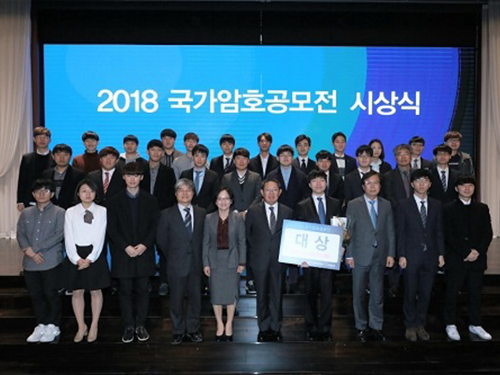
(Awardees at the ceremony for Crypto Contest Korea 2018)
A paper titled “Indifferentiability of Truncated Random Permutations” by PhD candidate Wonseok Choi and MS candidate Byeonghak Lee (under Professor Jooyoung Lee) from the KAIST Graduate School of Information Security (GSIS) won first place in Crypto Contest Korea 2018. Byeonghak Lee became a repeat winner since his paper titled “Tweakable Block Ciphers Secure Beyond the Birthday Bound in the Ideal Cipher Model” also received an award at Crypto Contest Korea 2017.
The contest, hosted by the Korea Cryptography Forum, the Korea Institute of Information Security & Cryptology, and the National Security Research Institute and sponsored by the National Intelligence Service, was held for promoting cryptography in Korea. The total prize money is fifty million won with ten million won going to the first place winners.
The contest was divided into three divisions: paper, problem solving, and idea. Among the three divisions, first place came from the paper division only.
Besides first place, KAIST students showed outstanding performance in the contest. PhD candidate Seongkwang Kim received participation prize while he also received special prizes with MS candidate Yeongmin Lee. The hacking club GoN (under Professor Sang Kil Cha), comprised of undergraduate students from the GSIS was awarded the grand prize in the division of problem solving.
The award ceremony was held during the Future Crypto Workshop 2018 on November 15. The awards ceremony for Crypto Expert Korea 2018 were also held there, and PhD candidate Ji-Eun Lee from the School of Computing and Byeonghak Lee received awards, the grand prize and runner-up prize respectively.
2018.11.27 View 9858
KAIST Shows Strong Performance in Crypto Contest Korea 2018
(Awardees at the ceremony for Crypto Contest Korea 2018)
A paper titled “Indifferentiability of Truncated Random Permutations” by PhD candidate Wonseok Choi and MS candidate Byeonghak Lee (under Professor Jooyoung Lee) from the KAIST Graduate School of Information Security (GSIS) won first place in Crypto Contest Korea 2018. Byeonghak Lee became a repeat winner since his paper titled “Tweakable Block Ciphers Secure Beyond the Birthday Bound in the Ideal Cipher Model” also received an award at Crypto Contest Korea 2017.
The contest, hosted by the Korea Cryptography Forum, the Korea Institute of Information Security & Cryptology, and the National Security Research Institute and sponsored by the National Intelligence Service, was held for promoting cryptography in Korea. The total prize money is fifty million won with ten million won going to the first place winners.
The contest was divided into three divisions: paper, problem solving, and idea. Among the three divisions, first place came from the paper division only.
Besides first place, KAIST students showed outstanding performance in the contest. PhD candidate Seongkwang Kim received participation prize while he also received special prizes with MS candidate Yeongmin Lee. The hacking club GoN (under Professor Sang Kil Cha), comprised of undergraduate students from the GSIS was awarded the grand prize in the division of problem solving.
The award ceremony was held during the Future Crypto Workshop 2018 on November 15. The awards ceremony for Crypto Expert Korea 2018 were also held there, and PhD candidate Ji-Eun Lee from the School of Computing and Byeonghak Lee received awards, the grand prize and runner-up prize respectively.
2018.11.27 View 9858 -
 Professor Kyung-Won Chung Receives the 2015 Design Value Awards
The Design Management Institute (DMI) announced eleven winners of its 2015 Design Value Awards.
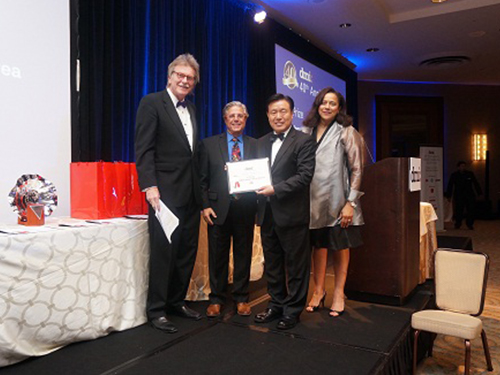
Professor Kyung-Won Chung of the Industrial Design Department at KAIST took one of the four First Place Design Value Awards. The award ceremony was held on September 28, 2015, at the Royal Sonesta Hotel in Boston.
DMI is an international organization that has actively advocated for the strategic value of design, sponsoring research, publishing academic papers, connecting members across disciplines and the globe, and sharing best design practices.
Commemorating its 40th anniversary, DMI created the inaugural Design Value Awards this year, which honors the contributions of design teams who have delivered significant value through design or design management practices.
There were four categories of the awards: first, second, and third prize, and Honorable Mention. The first place had four winners; both the second and third took two winners each. The honorable mention included three awardees.
The award noted Professor Chung's contributions to the development of design management theory and practices in Korea and his dedication to elevate KAIST’s industrial design department to one of the 30 leading design institutions in the world during his 30-year career at the university.
DMI also appointed Professor Chung a Life Fellow.
Professor Chung said,
“I am greatly honored to receive such a significant award, the equivalent of the Academy Awards in the field of design. I hope this award will encourage the further development of the Korean design industry to lead the global design community.”
He has served in various important positions in public and private organizations, including as the president of the Korea Institute of Design Promotion, Vice Mayor of Design for the City of Seoul, Advisor to the Design Division of Samsung Electronics, and a member of organizing committee of the International Council of Societies of Industrial Design.
2015.10.04 View 8417
Professor Kyung-Won Chung Receives the 2015 Design Value Awards
The Design Management Institute (DMI) announced eleven winners of its 2015 Design Value Awards.
Professor Kyung-Won Chung of the Industrial Design Department at KAIST took one of the four First Place Design Value Awards. The award ceremony was held on September 28, 2015, at the Royal Sonesta Hotel in Boston.
DMI is an international organization that has actively advocated for the strategic value of design, sponsoring research, publishing academic papers, connecting members across disciplines and the globe, and sharing best design practices.
Commemorating its 40th anniversary, DMI created the inaugural Design Value Awards this year, which honors the contributions of design teams who have delivered significant value through design or design management practices.
There were four categories of the awards: first, second, and third prize, and Honorable Mention. The first place had four winners; both the second and third took two winners each. The honorable mention included three awardees.
The award noted Professor Chung's contributions to the development of design management theory and practices in Korea and his dedication to elevate KAIST’s industrial design department to one of the 30 leading design institutions in the world during his 30-year career at the university.
DMI also appointed Professor Chung a Life Fellow.
Professor Chung said,
“I am greatly honored to receive such a significant award, the equivalent of the Academy Awards in the field of design. I hope this award will encourage the further development of the Korean design industry to lead the global design community.”
He has served in various important positions in public and private organizations, including as the president of the Korea Institute of Design Promotion, Vice Mayor of Design for the City of Seoul, Advisor to the Design Division of Samsung Electronics, and a member of organizing committee of the International Council of Societies of Industrial Design.
2015.10.04 View 8417 -
 KAIST's DRC-HUBO Wins the DARPA Robotics Challenge 2015
DRC-HUBO finished all eight assignments in less than 45 minutes, taking first place among 24 international teams and claiming the USD 2 million prize offered by a US defense research agency.
The Robotics Challenge Finals 2015 hosted by the US Defense Advanced Research Projects Agency (DARPA) took place on June 5-6, 2015 at the Fairplex in Pomona, California.
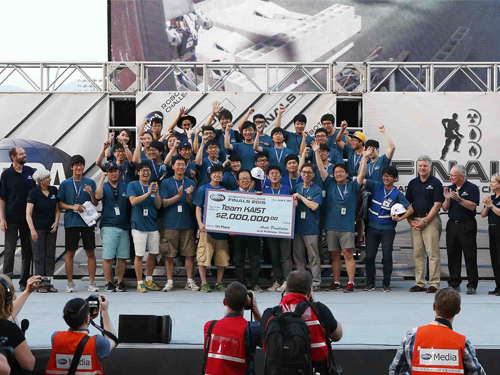
Team KAIST of the Republic of Korea led by Professor Jun-Ho Oh of the Mechanical Engineering Department at the Korea Advanced Institute of Science and Technology (KAIST), Professor In-So Kweon of the Electrical Engineering Department, and researchers from Rainbow Co., the university’s spin-off company that builds the robots, won the DARPA Finals. The team received USD 2 million as a prize.
The DARPA’s Robotics Challenge (DRC) promotes a competition of robot systems and software teams which seek to develop robots capable of assisting humans in responding to natural and man-made disasters such as the Fukushima Daiichi nuclear incident in 2011. The DRC consists of three competitions: a software-based Virtual Robotics Challenge which took place in June 2013; the Robotics Challenge Trials in Homestead, Florida, in December 2013; and the Finals in June 2015.
A total of 24 teams from universities and private and public research institutes from Korea, the US, Hong Kong, Germany, Japan, and Italy participated in the Finals. The participating teams had to finish eight assignments in 60 minutes, during which their robots were untethered and operated wirelessly without communication from their engineers.
Each team was assigned a series of tasks: they included driving a vehicle, getting out of a vehicle, opening a door, turning a valve, drilling a hole in a wall, a surprise task such as pushing a button or turning on a switch, walking over rubble or debris, and climbing stairs. Robots scored a point each time they completed their missions. To win, a team had to complete all the tasks successfully in the shortest amount of time possible.
Team KAIST completed the entire course in 44 minutes and 28 seconds, followed by the Institute of Human and Machine Cognition (IHMC) Robotics in Pensacola, Florida in 50:26, and Team TARTAN Rescue of the National Robotics Engineering Center at Carnegie Mellon University in 55:15.
For details, see an article below from the New York Times:
New York Times, June 6, 2015
“Korean Robot Makers Walk Off With $2 Million Prize”
http://www.nytimes.com/2015/06/07/science/korean-robot-makers-walk-off-with-2-million-prize.html?_r=1
DRC-HUBO sticks a plug into an outlet for the surprise task at the 2015 DARPA Robotics Challenge on June 5-6, 2015, in Pomona, California.
DRC-HUBO turns a valve in a clockwise direction.
DRC-HUBO drills to cut a circle into the wall.
Members of Team KAIST pose together after the award ceremony on June 6, 2015.
2015.06.07 View 25594
KAIST's DRC-HUBO Wins the DARPA Robotics Challenge 2015
DRC-HUBO finished all eight assignments in less than 45 minutes, taking first place among 24 international teams and claiming the USD 2 million prize offered by a US defense research agency.
The Robotics Challenge Finals 2015 hosted by the US Defense Advanced Research Projects Agency (DARPA) took place on June 5-6, 2015 at the Fairplex in Pomona, California.
Team KAIST of the Republic of Korea led by Professor Jun-Ho Oh of the Mechanical Engineering Department at the Korea Advanced Institute of Science and Technology (KAIST), Professor In-So Kweon of the Electrical Engineering Department, and researchers from Rainbow Co., the university’s spin-off company that builds the robots, won the DARPA Finals. The team received USD 2 million as a prize.
The DARPA’s Robotics Challenge (DRC) promotes a competition of robot systems and software teams which seek to develop robots capable of assisting humans in responding to natural and man-made disasters such as the Fukushima Daiichi nuclear incident in 2011. The DRC consists of three competitions: a software-based Virtual Robotics Challenge which took place in June 2013; the Robotics Challenge Trials in Homestead, Florida, in December 2013; and the Finals in June 2015.
A total of 24 teams from universities and private and public research institutes from Korea, the US, Hong Kong, Germany, Japan, and Italy participated in the Finals. The participating teams had to finish eight assignments in 60 minutes, during which their robots were untethered and operated wirelessly without communication from their engineers.
Each team was assigned a series of tasks: they included driving a vehicle, getting out of a vehicle, opening a door, turning a valve, drilling a hole in a wall, a surprise task such as pushing a button or turning on a switch, walking over rubble or debris, and climbing stairs. Robots scored a point each time they completed their missions. To win, a team had to complete all the tasks successfully in the shortest amount of time possible.
Team KAIST completed the entire course in 44 minutes and 28 seconds, followed by the Institute of Human and Machine Cognition (IHMC) Robotics in Pensacola, Florida in 50:26, and Team TARTAN Rescue of the National Robotics Engineering Center at Carnegie Mellon University in 55:15.
For details, see an article below from the New York Times:
New York Times, June 6, 2015
“Korean Robot Makers Walk Off With $2 Million Prize”
http://www.nytimes.com/2015/06/07/science/korean-robot-makers-walk-off-with-2-million-prize.html?_r=1
DRC-HUBO sticks a plug into an outlet for the surprise task at the 2015 DARPA Robotics Challenge on June 5-6, 2015, in Pomona, California.
DRC-HUBO turns a valve in a clockwise direction.
DRC-HUBO drills to cut a circle into the wall.
Members of Team KAIST pose together after the award ceremony on June 6, 2015.
2015.06.07 View 25594 -
 KAIST Team Wins International Hacking Competition, "SECCON CTF 2014"
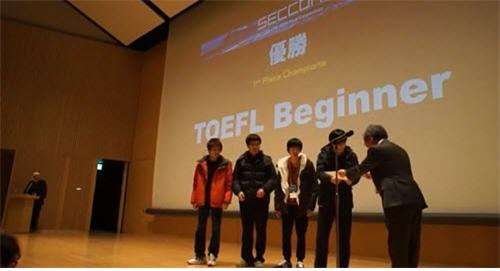
KAIST’s white hacker team, “TOFEL Beginner,” secured the first place in an international hacking competition, SECCON CTF 2014. SECCON is an international hacking competition which has operated for more than 20 years. It uses the Capture the Flag (CTF) method. Last year’s competition was held in Tokyo on December 7, 2014.
The TOFEL Beginner team consisted of two KAIST graduate students and two researchers from a private security company based in Korea: In-Soo Yoon of Computer Science, Eun-Soo Kim of the Graduate School of Information Security (GSIS), and Jong-Ho Lee and Jung-Hoon Lee of Raon Secure.
Of 4,186 competitors, 24 teams made it to the finals. The TOFEL Beginner took the lead with 4,506 points compared with HITCON (3,112 points) of Taiwan and PPP (2,858 points) of the USA.
With this victory, the KAIST team qualified to participate in the most renowned international hacking competition, the DEF CON Hacking Conference in 2015.
Professor Yongdae Kim of the Electrical Engineering Department at KAIST, who advised the TOEFL Beginner team, said, “Our members have achieved an outstanding result. By taking advantage of this opportunity, KAIST will continue to offer the best programs in information security in Korea and hopefully beyond.”
2015.02.24 View 11129
KAIST Team Wins International Hacking Competition, "SECCON CTF 2014"
KAIST’s white hacker team, “TOFEL Beginner,” secured the first place in an international hacking competition, SECCON CTF 2014. SECCON is an international hacking competition which has operated for more than 20 years. It uses the Capture the Flag (CTF) method. Last year’s competition was held in Tokyo on December 7, 2014.
The TOFEL Beginner team consisted of two KAIST graduate students and two researchers from a private security company based in Korea: In-Soo Yoon of Computer Science, Eun-Soo Kim of the Graduate School of Information Security (GSIS), and Jong-Ho Lee and Jung-Hoon Lee of Raon Secure.
Of 4,186 competitors, 24 teams made it to the finals. The TOFEL Beginner took the lead with 4,506 points compared with HITCON (3,112 points) of Taiwan and PPP (2,858 points) of the USA.
With this victory, the KAIST team qualified to participate in the most renowned international hacking competition, the DEF CON Hacking Conference in 2015.
Professor Yongdae Kim of the Electrical Engineering Department at KAIST, who advised the TOEFL Beginner team, said, “Our members have achieved an outstanding result. By taking advantage of this opportunity, KAIST will continue to offer the best programs in information security in Korea and hopefully beyond.”
2015.02.24 View 11129 -
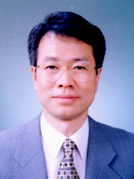 KAIST Professor Whang Turns VLDB Journal Into One of the Best in Its Field
Kyu-Young Whang, a Distinguished Professor at KAIST’s Computer Science Department, has developed The VLDB Journal into one of the world’s best journals on database technology.
Professor Whang, Editor-in-Chief of The VLDB Journal, is credited for the journal’s remarkable success evidenced by the rise of the publication’s Science Citation Index (SCI) impact factor from 3.818 to 6.8 in the period of one year. This placed the VLDB in the first place amongst 99 information systems journals and 44 hardware and architecture-related journals registered with the SCI. With only the exception of the Survey Journal, this makes The VLDB Journal the best in computer science.
The VLDB Journal is a quarterly journal published on behalf of the VLDB Endowment. The journal, launched in 1992, is dedicated to the publication of scholarly contributions to the advancement of information system architectures, the impact of technological advancements on information systems, and the development of novel database applications.
The VLDB Journal’s closest competitors in database technology, IEEE Transactions on Knowledge and Data Engineering and ACM Transactions on Database Systems, received an impact factor of 2.236 and 1.613 respectively. Comparatively, Professor Whang’s journal retains an impact factor nearly 3 to 4 times greater.
During Professor Whang’s six-year term as Editor-in-Chief, he has actively pursued the use of innovative ideas, strengthened the board of editors, standardized the length of review time, and made the journal much more accessible through the Internet. Furthermore, he drastically reduced publication time and sought a policy that focused more on the journal’s readers, which led to The VLDB Journal’s SCI impact factor rising from 1.149 (2002) to 6.8 (2008).
As one of The VLDB Journal’s founding members, Professor Whang has worked for the advancement of his journal tirelessly for 19 years with many accomplishments in database technology, including physical database design, determining the quality of a database, and the creation of a database management system. As a result, Professor Whang became the first IEEE fellow concerning domestic computer science. He is also a trustee of The VLDB Endowment, a fellow of the Korean Academy of Science and Technology, and of course, a Distinguished Professor at KAIST.
2009.07.16 View 17213
KAIST Professor Whang Turns VLDB Journal Into One of the Best in Its Field
Kyu-Young Whang, a Distinguished Professor at KAIST’s Computer Science Department, has developed The VLDB Journal into one of the world’s best journals on database technology.
Professor Whang, Editor-in-Chief of The VLDB Journal, is credited for the journal’s remarkable success evidenced by the rise of the publication’s Science Citation Index (SCI) impact factor from 3.818 to 6.8 in the period of one year. This placed the VLDB in the first place amongst 99 information systems journals and 44 hardware and architecture-related journals registered with the SCI. With only the exception of the Survey Journal, this makes The VLDB Journal the best in computer science.
The VLDB Journal is a quarterly journal published on behalf of the VLDB Endowment. The journal, launched in 1992, is dedicated to the publication of scholarly contributions to the advancement of information system architectures, the impact of technological advancements on information systems, and the development of novel database applications.
The VLDB Journal’s closest competitors in database technology, IEEE Transactions on Knowledge and Data Engineering and ACM Transactions on Database Systems, received an impact factor of 2.236 and 1.613 respectively. Comparatively, Professor Whang’s journal retains an impact factor nearly 3 to 4 times greater.
During Professor Whang’s six-year term as Editor-in-Chief, he has actively pursued the use of innovative ideas, strengthened the board of editors, standardized the length of review time, and made the journal much more accessible through the Internet. Furthermore, he drastically reduced publication time and sought a policy that focused more on the journal’s readers, which led to The VLDB Journal’s SCI impact factor rising from 1.149 (2002) to 6.8 (2008).
As one of The VLDB Journal’s founding members, Professor Whang has worked for the advancement of his journal tirelessly for 19 years with many accomplishments in database technology, including physical database design, determining the quality of a database, and the creation of a database management system. As a result, Professor Whang became the first IEEE fellow concerning domestic computer science. He is also a trustee of The VLDB Endowment, a fellow of the Korean Academy of Science and Technology, and of course, a Distinguished Professor at KAIST.
2009.07.16 View 17213 -
 KAIST ranked first place in National University Assessment 2006 by ChungAng Daily
KAIST is ranked at the first place in the National University Assessment 2006 performed by ChungAng Daily. KAIST occupies the top place in the sections of globalization, faculty researches, and improvement. Particularly, university innovation and globalization, which have been promoted by KAIST, played substantial roles in taking the top place in the assessment. KAIST is evaluated the best at the items in the section of education atmosphere and finance such as the amount of scholarship per student, the rate of scholarship beneficiaries, and the rate of scholarship to tuition fee, and at the items in the section of faculty researches such as the number of papers published in SCI by professor, and the number of intellectual properties possessed by professors. In the section of globalization, KAIST gained high scores throughout the four items such as the rate of foreign professors, the rate of English-spoken class, and so on.
2006.09.27 View 13902
KAIST ranked first place in National University Assessment 2006 by ChungAng Daily
KAIST ranked first place in National University Assessment 2006 by ChungAng Daily
KAIST is ranked at the first place in the National University Assessment 2006 performed by ChungAng Daily. KAIST occupies the top place in the sections of globalization, faculty researches, and improvement. Particularly, university innovation and globalization, which have been promoted by KAIST, played substantial roles in taking the top place in the assessment. KAIST is evaluated the best at the items in the section of education atmosphere and finance such as the amount of scholarship per student, the rate of scholarship beneficiaries, and the rate of scholarship to tuition fee, and at the items in the section of faculty researches such as the number of papers published in SCI by professor, and the number of intellectual properties possessed by professors. In the section of globalization, KAIST gained high scores throughout the four items such as the rate of foreign professors, the rate of English-spoken class, and so on.
2006.09.27 View 13902