%44%6f%6e%61%74%69%6f%6e
-
 Student Entrepreneur Inseo Chung Donates 1 Billion Won to Foster Inclusive AI Talent
< Photo of the Donation Agreement Ceremony >
KAIST announced on March 11th that Inseo Chung (28), an undergraduate student in the School of Interdisciplinary Studies and CEO of the global music-tech startup MPAG, donated 1 billion won in development funds on the 10th to foster ‘Inclusive AI’ talent. Inclusive AI talent refers to experts who research and develop AI technologies so that the socially vulnerable, including people with disabilities and the technologically marginalized, can also enjoy the benefits of AI technology.
Inseo Chung is a student entrepreneur who has dedicated himself to “solving social problems through technology” while balancing startup activities and research during his studies. Alongside his academic advisor, Professor Hyunwook Ka of the School of Interdisciplinary Studies, he has consistently researched how technology can embrace those who are marginalized.
His research, including software for the hearing impaired, studies for users requiring linguistic support in media, and bidirectional assistive technology devices for the visually and hearing impaired, has garnered attention at domestic and international conferences. This work has also led to several patent applications filed under the name of KAIST.
He founded the global music-tech startup MPAG, which operates a sheet music sales platform and AI music education service with over 4 million members worldwide, and is also developing features to provide braille sheet music for the visually impaired.
The donation will be used to establish a Master’s and Doctoral Education & Research Program in ‘AI-based Assistive Technology’ for the disabled and the technologically and socially vulnerable within the newly established KAIST AI College. This program aims to conduct research on AI-based rehabilitation assistive technology, nurture Master’s and Doctoral-level experts in the field, and build an inclusive technology ecosystem. Professor Hyunwook Ka, an expert in this field, will lead the operation and guidance of the degree program to ensure research continuity and expertise.
Inseo Chung emphasized, “As AI technology advances exponentially, it is absolutely necessary to expand into ‘Inclusive AI’ so that its benefits reach the disabled and the technologically marginalized. I am confident that through a formal graduate program, the number of experts in this field will grow, and KAIST’s specialized AI research capabilities will serve as the catalyst.”
This is not Inseo Chung’s first donation. He previously donated through the KAIST Development Foundation in 2024 and 2025 before contributing an additional 1 billion won this year. The 2024 donation was used to create the ‘Creative Workshop’ for junior students in the School of Interdisciplinary Studies to realize their creative ideas, and the 2025 donation was allocated to the School of Computing.
President Kwang Hyung Lee stated, “The decision by student Inseo Chung to donate the fruits of his startup efforts for the future of his alma mater and the realization of social values serves as a great inspiration to all members of KAIST. We will do our best to nurture inclusive AI talent so that the benefits of technology can spread throughout society, honoring the donor’s intent.”
2026.03.11 View 1254
Student Entrepreneur Inseo Chung Donates 1 Billion Won to Foster Inclusive AI Talent
< Photo of the Donation Agreement Ceremony >
KAIST announced on March 11th that Inseo Chung (28), an undergraduate student in the School of Interdisciplinary Studies and CEO of the global music-tech startup MPAG, donated 1 billion won in development funds on the 10th to foster ‘Inclusive AI’ talent. Inclusive AI talent refers to experts who research and develop AI technologies so that the socially vulnerable, including people with disabilities and the technologically marginalized, can also enjoy the benefits of AI technology.
Inseo Chung is a student entrepreneur who has dedicated himself to “solving social problems through technology” while balancing startup activities and research during his studies. Alongside his academic advisor, Professor Hyunwook Ka of the School of Interdisciplinary Studies, he has consistently researched how technology can embrace those who are marginalized.
His research, including software for the hearing impaired, studies for users requiring linguistic support in media, and bidirectional assistive technology devices for the visually and hearing impaired, has garnered attention at domestic and international conferences. This work has also led to several patent applications filed under the name of KAIST.
He founded the global music-tech startup MPAG, which operates a sheet music sales platform and AI music education service with over 4 million members worldwide, and is also developing features to provide braille sheet music for the visually impaired.
The donation will be used to establish a Master’s and Doctoral Education & Research Program in ‘AI-based Assistive Technology’ for the disabled and the technologically and socially vulnerable within the newly established KAIST AI College. This program aims to conduct research on AI-based rehabilitation assistive technology, nurture Master’s and Doctoral-level experts in the field, and build an inclusive technology ecosystem. Professor Hyunwook Ka, an expert in this field, will lead the operation and guidance of the degree program to ensure research continuity and expertise.
Inseo Chung emphasized, “As AI technology advances exponentially, it is absolutely necessary to expand into ‘Inclusive AI’ so that its benefits reach the disabled and the technologically marginalized. I am confident that through a formal graduate program, the number of experts in this field will grow, and KAIST’s specialized AI research capabilities will serve as the catalyst.”
This is not Inseo Chung’s first donation. He previously donated through the KAIST Development Foundation in 2024 and 2025 before contributing an additional 1 billion won this year. The 2024 donation was used to create the ‘Creative Workshop’ for junior students in the School of Interdisciplinary Studies to realize their creative ideas, and the 2025 donation was allocated to the School of Computing.
President Kwang Hyung Lee stated, “The decision by student Inseo Chung to donate the fruits of his startup efforts for the future of his alma mater and the realization of social values serves as a great inspiration to all members of KAIST. We will do our best to nurture inclusive AI talent so that the benefits of technology can spread throughout society, honoring the donor’s intent.”
2026.03.11 View 1254 -
 Three Generations of ‘Giving DNA’ Meets ‘KAIST DNA’
KAIST announced on February 26th that it has received 5.06 billion KRW in development funds, embodying the noble spirit of sharing from a single family. This donation is particularly meaningful as it was completed across three generations: rooted in a grandmother’s legacy, the father decided on the donation, and the daughter put that intention into action.
The donor stated, “I hope the research achievements of KAIST’s young scientists shine brighter than the donor’s name,” and declined all appointment ceremonies or honorary events where their name would be revealed. In accordance with the donor’s wishes, all procedures were conducted simply, and their identity will remain private.
The donor, a Seoul resident in their 70s, achieved success by building a business based on the legacy of their mother, who practiced sharing throughout her life. Recently, they decided to return a portion of their mother’s legacy to society. Having grown up watching their mother practice benevolence, donating was a natural choice. This decision was finalized through the daughter’s concrete execution. The donor’s daughter played a leading role in the entire donation process, serving as a bridge to pass the family’s spirit of sharing down to the next generation.
The donor remarked, “The sharing my mother practiced her whole life was our family’s greatest asset. Now, together with my daughter, I wish to pass that precious value to the leading figures of Korean science.” They added, “If this fund can provide practical help to young scholars, that alone is a sufficiently rewarding thing.”
Our university has decided to establish the ‘Cho Gi-yeop Next-Generation Research Leader Fellowship,’ named after the donor’s mother. The ‘Cho Gi-yeop Fellowship’ is designed as a principal-preserved fund, where the 5 billion KRW principal is maintained and the program is operated using the investment returns. Additionally, expressing the wish to “support young scientists as soon as possible,” the donor contributed an extra 60 million KRW for the first year of the program’s implementation.
Accordingly, starting this year, three ‘Cho Gi-yeop Fellows’ will be selected annually and supported with 20 million KRW each in academic activity expenses for three years. The fellowship is aimed at junior faculty members, specifically assistant and associate professors before tenure. This period is a ‘golden time’ when research capabilities grow explosively and innovative achievements are concentrated, but it is also a time when securing stable research funding is desperately needed. The support funds will be used to enhance research autonomy and scalability, such as for challenging research planning, international academic activities, and the expansion of research infrastructure. KAIST expects this fellowship to serve as a practical foundation for young researchers to make a global leap forward.
2026.02.26 View 1149
Three Generations of ‘Giving DNA’ Meets ‘KAIST DNA’
KAIST announced on February 26th that it has received 5.06 billion KRW in development funds, embodying the noble spirit of sharing from a single family. This donation is particularly meaningful as it was completed across three generations: rooted in a grandmother’s legacy, the father decided on the donation, and the daughter put that intention into action.
The donor stated, “I hope the research achievements of KAIST’s young scientists shine brighter than the donor’s name,” and declined all appointment ceremonies or honorary events where their name would be revealed. In accordance with the donor’s wishes, all procedures were conducted simply, and their identity will remain private.
The donor, a Seoul resident in their 70s, achieved success by building a business based on the legacy of their mother, who practiced sharing throughout her life. Recently, they decided to return a portion of their mother’s legacy to society. Having grown up watching their mother practice benevolence, donating was a natural choice. This decision was finalized through the daughter’s concrete execution. The donor’s daughter played a leading role in the entire donation process, serving as a bridge to pass the family’s spirit of sharing down to the next generation.
The donor remarked, “The sharing my mother practiced her whole life was our family’s greatest asset. Now, together with my daughter, I wish to pass that precious value to the leading figures of Korean science.” They added, “If this fund can provide practical help to young scholars, that alone is a sufficiently rewarding thing.”
Our university has decided to establish the ‘Cho Gi-yeop Next-Generation Research Leader Fellowship,’ named after the donor’s mother. The ‘Cho Gi-yeop Fellowship’ is designed as a principal-preserved fund, where the 5 billion KRW principal is maintained and the program is operated using the investment returns. Additionally, expressing the wish to “support young scientists as soon as possible,” the donor contributed an extra 60 million KRW for the first year of the program’s implementation.
Accordingly, starting this year, three ‘Cho Gi-yeop Fellows’ will be selected annually and supported with 20 million KRW each in academic activity expenses for three years. The fellowship is aimed at junior faculty members, specifically assistant and associate professors before tenure. This period is a ‘golden time’ when research capabilities grow explosively and innovative achievements are concentrated, but it is also a time when securing stable research funding is desperately needed. The support funds will be used to enhance research autonomy and scalability, such as for challenging research planning, international academic activities, and the expansion of research infrastructure. KAIST expects this fellowship to serve as a practical foundation for young researchers to make a global leap forward.
2026.02.26 View 1149 -
 Chairman Jae-Chul Kim of Dongwon Group Donates a Total of 60.3 Billion Won to KAIST
<Jae-Chul Kim, Honorary Chairman of Dongwon Group>
"In the era of AI, a new future lies within the sea of data. I ask that KAIST leaps forward to become the world's No. 1 AI research group." — Jae-Chul Kim, Honorary Chairman of Dongwon Group
KAIST announced on January 16th that Honorary Chairman Jae-Chul Kim of Dongwon Group has pledged an additional 5.9 billion KRW in development funds to foster Artificial Intelligence (AI) talent and strengthen research infrastructure, bringing his total contribution to 60.3 billion KRW. This marks his second additional donation since 2020, continuing his steadfast support for strengthening South Korea's national competitiveness in the field of AI.
Through his initial donation in 2020, Chairman Kim established the 'Kim Jaechul Graduate School of AI' at KAIST, urging the university to secure world-class capabilities. Upon hearing that KAIST’s AI research level ranked 5th among global universities over the past five years (2020–2024), Chairman Kim requested that the university strive to reach the No. 1 spot in the world.
In response, President Kwang Hyung Lee explained, "To surpass Carnegie Mellon University (CMU), which is currently evaluated as the world’s best with an AI faculty of about 45, the KAIST Graduate School of AI needs to expand its faculty to over 50 and construct a dedicated research building." Chairman Kim responded by saying, "I will build the building," and this latest donation is a fulfillment of that promise.
This third pledge of 5.9 billion KRW was decided to cover the projected budget shortfall as the design of the AI Education and Research Building enters full-scale development.
The AI Education and Research Building will be a facility with 8 floors above ground and 1 basement level, covering a total floor area of 18,182 m² (approx. 5,500 pyeong). It is scheduled for completion in February 2028. Once finished, it will serve as a global AI research hub housing 50 faculty members and 1,000 students.
Since the 2021 academic year, KAIST has been selecting 60 Master’s and 10 Doctoral students annually as 'Dongwon Scholars' outside of the regular quota for a period of 10 years. While the tuition and research incentives for the first three years were supported by the donation, KAIST has been utilizing its own budget since the 2024 academic year to ensure students can focus entirely on their research.
Moving forward, the Kim Jaechul Graduate School of AI plans to build a world-class faculty and operate systematic Master's and Doctoral programs to cultivate global AI leaders. In addition to technical expertise, the school will offer educational programs focused on character and holistic development, leading the charge in strengthening Korea's AI competitiveness.
Honorary Chairman Jae-Chul Kim stated, "I hope this donation serves as a small 'priming water' for South Korea to leap forward as an AI powerhouse. I look forward to seeing global core talents grow here and contribute to our national strength."
President Kwang Hyung Lee expressed his gratitude, saying, "Chairman Kim’s unwavering support is the greatest driving force for KAIST to secure global AI sovereignty. We will ensure the Kim Jaechul Graduate School of AI becomes a mecca where the world's best AI minds gather to innovate, honoring the Chairman’s vision."
2026.01.16 View 2107
Chairman Jae-Chul Kim of Dongwon Group Donates a Total of 60.3 Billion Won to KAIST
<Jae-Chul Kim, Honorary Chairman of Dongwon Group>
"In the era of AI, a new future lies within the sea of data. I ask that KAIST leaps forward to become the world's No. 1 AI research group." — Jae-Chul Kim, Honorary Chairman of Dongwon Group
KAIST announced on January 16th that Honorary Chairman Jae-Chul Kim of Dongwon Group has pledged an additional 5.9 billion KRW in development funds to foster Artificial Intelligence (AI) talent and strengthen research infrastructure, bringing his total contribution to 60.3 billion KRW. This marks his second additional donation since 2020, continuing his steadfast support for strengthening South Korea's national competitiveness in the field of AI.
Through his initial donation in 2020, Chairman Kim established the 'Kim Jaechul Graduate School of AI' at KAIST, urging the university to secure world-class capabilities. Upon hearing that KAIST’s AI research level ranked 5th among global universities over the past five years (2020–2024), Chairman Kim requested that the university strive to reach the No. 1 spot in the world.
In response, President Kwang Hyung Lee explained, "To surpass Carnegie Mellon University (CMU), which is currently evaluated as the world’s best with an AI faculty of about 45, the KAIST Graduate School of AI needs to expand its faculty to over 50 and construct a dedicated research building." Chairman Kim responded by saying, "I will build the building," and this latest donation is a fulfillment of that promise.
This third pledge of 5.9 billion KRW was decided to cover the projected budget shortfall as the design of the AI Education and Research Building enters full-scale development.
The AI Education and Research Building will be a facility with 8 floors above ground and 1 basement level, covering a total floor area of 18,182 m² (approx. 5,500 pyeong). It is scheduled for completion in February 2028. Once finished, it will serve as a global AI research hub housing 50 faculty members and 1,000 students.
Since the 2021 academic year, KAIST has been selecting 60 Master’s and 10 Doctoral students annually as 'Dongwon Scholars' outside of the regular quota for a period of 10 years. While the tuition and research incentives for the first three years were supported by the donation, KAIST has been utilizing its own budget since the 2024 academic year to ensure students can focus entirely on their research.
Moving forward, the Kim Jaechul Graduate School of AI plans to build a world-class faculty and operate systematic Master's and Doctoral programs to cultivate global AI leaders. In addition to technical expertise, the school will offer educational programs focused on character and holistic development, leading the charge in strengthening Korea's AI competitiveness.
Honorary Chairman Jae-Chul Kim stated, "I hope this donation serves as a small 'priming water' for South Korea to leap forward as an AI powerhouse. I look forward to seeing global core talents grow here and contribute to our national strength."
President Kwang Hyung Lee expressed his gratitude, saying, "Chairman Kim’s unwavering support is the greatest driving force for KAIST to secure global AI sovereignty. We will ensure the Kim Jaechul Graduate School of AI becomes a mecca where the world's best AI minds gather to innovate, honoring the Chairman’s vision."
2026.01.16 View 2107 -
 KAIST Professor and Alumni Who Won AIxCC Donate 150 Million KRW of Prize Money to Their Alma Mater
<(From Left) Professor Insu Yun from KAIST School of Electrical Engineering, Researcher HyungSeok Han from Samsung Research America>
KAIST (President Kwang Hyung Lee) announced on the 23rd of November that HyungSeok Han (Ph.D. alumnus from the School of Computing) and Insu Yun (B.S. alumnus, currently Associate Professor in the School of Electrical Engineering) donated 150 million KRW from the prize money won by Team Atlanta, which took first place in the world’s largest AI security competition, the “AI Cyber Challenge (AIxCC),” organized by the U.S. Defense Advanced Research Projects Agency (DARPA).
The AIxCC final round was held this August in Las Vegas, where Team Atlanta—a joint team consisting of researchers from Samsung Research, KAIST, POSTECH, and Georgia Tech—secured the top prize. AIxCC is the world’s largest AI security competition, with a total prize pool of 29.5 million USD (approx. 41 billion KRW). Over the past two years, security companies and research teams worldwide have competed with AI-based security technologies, showcasing state-of-the-art capabilities.
A total of 91 teams registered for the competition, 31 teams participated in the qualifiers, and 7 teams advanced to the finals. Team Atlanta won the first-place prize of 4 million USD (approx. 5.8 billion KRW), securing victory with an overwhelming margin comparable to the combined scores of the second- and third-place teams. The team also swept major titles such as “Most Vulnerabilities Identified” and “Highest Scoring Team,” demonstrating exceptional technical superiority.
HyungSeok Han earned his B.S. (2017) and Ph.D. (2023) from the KAIST School of Computing, then worked as a postdoctoral researcher at Georgia Tech before joining Samsung Research America where he currently works. In the competition, he served as the team leader for the development of the automatic vulnerability detection system and oversaw system integration and infrastructure, making major contributions.
Insu Yun received his B.S. (2015) from the KAIST School of Computing and his Ph.D. (2020) from Georgia Tech. Since 2021, he has been a faculty member in the KAIST School of Electrical Engineering. In this competition, he led the patch development team and played a central role in enhancing overall system completeness.
The two researchers decided to donate 150 million KRW of their prize money to the School of Computing and the School of Electrical Engineering. The School of Computing will use the donation as a scholarship fund, while the School of Electrical Engineering will apply it toward student education and research support, in line with the spirit of the donation.
Alumnus HyungSeok Han remarked, “Building a system in which AI autonomously discovers vulnerabilities and even generates patches has long been a dream of mine and an important milestone in the security field. I’m grateful to have achieved meaningful results together with KAIST alumni, and I hope KAIST will continue to exert a positive influence on global technological advancement.”
<Final Scoreboard>
Professor Insu Yun stated, “I’m truly grateful to every member of Team Atlanta. In particular, I want to thank Professor Taesoo Kim, our overall team leader and advisor, the students in our lab who worked tirelessly, and Dr. HyungSeok Han, who joined me in making this meaningful contribution.”
KAIST President Kwang Hyung Lee commented, “I deeply thank our alumni for achieving outstanding results on the world stage of technological competition and for generously giving back to their alma mater. This achievement demonstrates KAIST’s educational and research excellence and stands as meaningful evidence of the global competitiveness of Korea’s AI and security technologies. KAIST will continue to lead advanced AI and security innovation and do its utmost to nurture creative talent who will contribute to humanity and society.”
To encourage further alumni contributions, the KAIST Development Foundation is operating the Team KAIST (https://giving.kaist.ac.kr/ko/sub01/sub0103_1.php) campaign to promote alumni participation.
2025.11.24 View 1957
KAIST Professor and Alumni Who Won AIxCC Donate 150 Million KRW of Prize Money to Their Alma Mater
<(From Left) Professor Insu Yun from KAIST School of Electrical Engineering, Researcher HyungSeok Han from Samsung Research America>
KAIST (President Kwang Hyung Lee) announced on the 23rd of November that HyungSeok Han (Ph.D. alumnus from the School of Computing) and Insu Yun (B.S. alumnus, currently Associate Professor in the School of Electrical Engineering) donated 150 million KRW from the prize money won by Team Atlanta, which took first place in the world’s largest AI security competition, the “AI Cyber Challenge (AIxCC),” organized by the U.S. Defense Advanced Research Projects Agency (DARPA).
The AIxCC final round was held this August in Las Vegas, where Team Atlanta—a joint team consisting of researchers from Samsung Research, KAIST, POSTECH, and Georgia Tech—secured the top prize. AIxCC is the world’s largest AI security competition, with a total prize pool of 29.5 million USD (approx. 41 billion KRW). Over the past two years, security companies and research teams worldwide have competed with AI-based security technologies, showcasing state-of-the-art capabilities.
A total of 91 teams registered for the competition, 31 teams participated in the qualifiers, and 7 teams advanced to the finals. Team Atlanta won the first-place prize of 4 million USD (approx. 5.8 billion KRW), securing victory with an overwhelming margin comparable to the combined scores of the second- and third-place teams. The team also swept major titles such as “Most Vulnerabilities Identified” and “Highest Scoring Team,” demonstrating exceptional technical superiority.
HyungSeok Han earned his B.S. (2017) and Ph.D. (2023) from the KAIST School of Computing, then worked as a postdoctoral researcher at Georgia Tech before joining Samsung Research America where he currently works. In the competition, he served as the team leader for the development of the automatic vulnerability detection system and oversaw system integration and infrastructure, making major contributions.
Insu Yun received his B.S. (2015) from the KAIST School of Computing and his Ph.D. (2020) from Georgia Tech. Since 2021, he has been a faculty member in the KAIST School of Electrical Engineering. In this competition, he led the patch development team and played a central role in enhancing overall system completeness.
The two researchers decided to donate 150 million KRW of their prize money to the School of Computing and the School of Electrical Engineering. The School of Computing will use the donation as a scholarship fund, while the School of Electrical Engineering will apply it toward student education and research support, in line with the spirit of the donation.
Alumnus HyungSeok Han remarked, “Building a system in which AI autonomously discovers vulnerabilities and even generates patches has long been a dream of mine and an important milestone in the security field. I’m grateful to have achieved meaningful results together with KAIST alumni, and I hope KAIST will continue to exert a positive influence on global technological advancement.”
<Final Scoreboard>
Professor Insu Yun stated, “I’m truly grateful to every member of Team Atlanta. In particular, I want to thank Professor Taesoo Kim, our overall team leader and advisor, the students in our lab who worked tirelessly, and Dr. HyungSeok Han, who joined me in making this meaningful contribution.”
KAIST President Kwang Hyung Lee commented, “I deeply thank our alumni for achieving outstanding results on the world stage of technological competition and for generously giving back to their alma mater. This achievement demonstrates KAIST’s educational and research excellence and stands as meaningful evidence of the global competitiveness of Korea’s AI and security technologies. KAIST will continue to lead advanced AI and security innovation and do its utmost to nurture creative talent who will contribute to humanity and society.”
To encourage further alumni contributions, the KAIST Development Foundation is operating the Team KAIST (https://giving.kaist.ac.kr/ko/sub01/sub0103_1.php) campaign to promote alumni participation.
2025.11.24 View 1957 -
 Imdang Scholarship and Culture Foundation Donates 500 Million Won to Modernize KAIST's Space Research Infrastructure
< Photo of the Chung Mong-Hun Uri-Star Research Building at the Satellite Research Center >
KAIST announced on the Novemnber 21st that it received a donation of 500 million won from the Imdang Scholarship and Culture Foundation and will proceed with an environmental improvement project for the 'Chung Mong-Hun Uri-Star Research Building' at the Satellite Research Center on the main campus in Daejeon.
The Imdang Scholarship and Culture Foundation is a non-profit scholarship foundation established in 2005 by Chairwoman Moon-Hee Kim, the mother of Hyundai Group Chairwoman Jeong-Eun Hyun. Currently, Executive Director Ji-Yi Chung of Hyundai Movex, Chairwoman Hyun's eldest daughter, serves as the Chairwoman of the Foundation. The foundation has been carrying out various projects over three generations to promote education, culture, arts, sports, and nurture talent.
This donation from the Imdang Scholarship and Culture Foundation once again brings the special and long-standing relationship between KAIST and the Hyundai Group into the spotlight.
The 'Chung Mong-Hun Uri-Star Research Building,' located on the main KAIST campus in Daejeon, was established with a donation from the late Mong-Hun Chung, former Chairman of the Hyundai Group and husband of Chairwoman Hyun, to foster the development of domestic space research. This enabled the launch of the nation's first dedicated university-affiliated space research organization. Following this, Chairwoman Hyun also continued to show special interest and affection for research support projects. The research building was named its current name in 2008 to commemorate the 5th anniversary of the passing of the late Chairman Mong-Hun Chung. In this way, the partnership between Hyundai and KAIST is regarded as a healthy example of corporate social contribution, where a company participates in the development of the knowledge ecosystem and the nurturing of talent.
The KAIST Satellite Research Center, housed in the 'Chung Mong-Hun Uri-Star Research Building,' was established in 1989 as the nation's first dedicated university-affiliated space research organization. Starting with 'Uribyol-1,' which signaled the start of South Korea's space development, it has led the development of various satellites, including next-generation small satellites and ultra-small satellite constellations, based on independent domestic technology, growing into a world-class small satellite research institution.
Currently, about 80 researchers are stationed at the research building, dedicated to developing cutting-edge small satellite technology. However, the inconvenience of transporting research equipment due to the absence of an elevator and the lack of accessibility for mobility-impaired individuals have been persistent issues.
KAIST plans to use this donation to install an elevator connecting the basement floor to the 4th floor above ground. This will increase the efficiency of transporting research equipment while providing a convenient movement environment for both visitors and researchers.
Furthermore, the public relations hall, which has been operating since 2008, will be renovated into an experiential exhibition space, applying the latest digital display techniques to allow visitors to see KAIST's space research achievements and history at a glance. Visited by over 1,000 people annually, including domestic and international students, the general public, research institutions, businesses, and government officials, this space is expected to become a place for experiencing and sharing KAIST's space technology development process and future vision.
To commemorate this project and express gratitude for the sponsorship, our university will hold a plaque of appreciation ceremony at the KAIST Seoul Campus President's Office on Friday, November 21st, at 3:00 PM. Chairwoman Jeong-Eun Hyun of the Hyundai Group, President Kwang Hyung Lee of KAIST, and Director Jaeheung Han of the KAIST Space Science Research Institute attended the event to exchange expressions of mutual cooperation and gratitude.
Hyundai Group Chairwoman Jeong-Eun Hyun stated, "The late Chairman Mong-Hun Chung supported the development of the KAIST Satellite Research Center with his deep passion for science and space," and "I hope this environmental improvement project will carry on his legacy, contribute to the development of Korean space technology, and serve as an opportunity for more young talents to foster their dreams."
KAIST President Kwang Hyung Lee stated, "The Chung Mong-Hun Uri-Star Research Building is a symbolic space for the development of South Korea's space technology, and this environmental improvement project will serve as an opportunity to enhance both research efficiency and the value of public experience," adding, "The meaningful sponsorship from the Imdang Scholarship and Culture Foundation will be a great source of strength for KAIST's future space research development."
2025.11.21 View 2018
Imdang Scholarship and Culture Foundation Donates 500 Million Won to Modernize KAIST's Space Research Infrastructure
< Photo of the Chung Mong-Hun Uri-Star Research Building at the Satellite Research Center >
KAIST announced on the Novemnber 21st that it received a donation of 500 million won from the Imdang Scholarship and Culture Foundation and will proceed with an environmental improvement project for the 'Chung Mong-Hun Uri-Star Research Building' at the Satellite Research Center on the main campus in Daejeon.
The Imdang Scholarship and Culture Foundation is a non-profit scholarship foundation established in 2005 by Chairwoman Moon-Hee Kim, the mother of Hyundai Group Chairwoman Jeong-Eun Hyun. Currently, Executive Director Ji-Yi Chung of Hyundai Movex, Chairwoman Hyun's eldest daughter, serves as the Chairwoman of the Foundation. The foundation has been carrying out various projects over three generations to promote education, culture, arts, sports, and nurture talent.
This donation from the Imdang Scholarship and Culture Foundation once again brings the special and long-standing relationship between KAIST and the Hyundai Group into the spotlight.
The 'Chung Mong-Hun Uri-Star Research Building,' located on the main KAIST campus in Daejeon, was established with a donation from the late Mong-Hun Chung, former Chairman of the Hyundai Group and husband of Chairwoman Hyun, to foster the development of domestic space research. This enabled the launch of the nation's first dedicated university-affiliated space research organization. Following this, Chairwoman Hyun also continued to show special interest and affection for research support projects. The research building was named its current name in 2008 to commemorate the 5th anniversary of the passing of the late Chairman Mong-Hun Chung. In this way, the partnership between Hyundai and KAIST is regarded as a healthy example of corporate social contribution, where a company participates in the development of the knowledge ecosystem and the nurturing of talent.
The KAIST Satellite Research Center, housed in the 'Chung Mong-Hun Uri-Star Research Building,' was established in 1989 as the nation's first dedicated university-affiliated space research organization. Starting with 'Uribyol-1,' which signaled the start of South Korea's space development, it has led the development of various satellites, including next-generation small satellites and ultra-small satellite constellations, based on independent domestic technology, growing into a world-class small satellite research institution.
Currently, about 80 researchers are stationed at the research building, dedicated to developing cutting-edge small satellite technology. However, the inconvenience of transporting research equipment due to the absence of an elevator and the lack of accessibility for mobility-impaired individuals have been persistent issues.
KAIST plans to use this donation to install an elevator connecting the basement floor to the 4th floor above ground. This will increase the efficiency of transporting research equipment while providing a convenient movement environment for both visitors and researchers.
Furthermore, the public relations hall, which has been operating since 2008, will be renovated into an experiential exhibition space, applying the latest digital display techniques to allow visitors to see KAIST's space research achievements and history at a glance. Visited by over 1,000 people annually, including domestic and international students, the general public, research institutions, businesses, and government officials, this space is expected to become a place for experiencing and sharing KAIST's space technology development process and future vision.
To commemorate this project and express gratitude for the sponsorship, our university will hold a plaque of appreciation ceremony at the KAIST Seoul Campus President's Office on Friday, November 21st, at 3:00 PM. Chairwoman Jeong-Eun Hyun of the Hyundai Group, President Kwang Hyung Lee of KAIST, and Director Jaeheung Han of the KAIST Space Science Research Institute attended the event to exchange expressions of mutual cooperation and gratitude.
Hyundai Group Chairwoman Jeong-Eun Hyun stated, "The late Chairman Mong-Hun Chung supported the development of the KAIST Satellite Research Center with his deep passion for science and space," and "I hope this environmental improvement project will carry on his legacy, contribute to the development of Korean space technology, and serve as an opportunity for more young talents to foster their dreams."
KAIST President Kwang Hyung Lee stated, "The Chung Mong-Hun Uri-Star Research Building is a symbolic space for the development of South Korea's space technology, and this environmental improvement project will serve as an opportunity to enhance both research efficiency and the value of public experience," adding, "The meaningful sponsorship from the Imdang Scholarship and Culture Foundation will be a great source of strength for KAIST's future space research development."
2025.11.21 View 2018 -
 KAIST Seoul Campus Dormitory Remodeling Completed, Improving Student Housing
< President Kwang Hyung Lee, Booyoung Group Chairman Joong Keun Lee, and executives >
KAIST held a completion and donation ceremony for the newly remodeled Pajeongsa and Sojeongsa dormitories at the Seoul Campus on the 18th. The event was attended by key figures including President Kwang Hyung Lee, Booyoung Group Chairman Joong Keun Lee, and students.
Booyoung Group is a company that has consistently engaged in various social contribution activities, including housing rental, construction, and support for education and culture. With a deep interest in the field of education, the company is taking the lead in improving student welfare by enhancing university dormitory environments.
This remodeling project was carried out as part of a KRW 20 billion donation agreement signed by Booyoung Group last year to create a safe and comfortable learning environment for KAIST students.
< President Kwang Hyung Lee, Booyoung Group Chairman Joong Keun Lee, and executives >
This remodeling project is being conducted on a total of four dormitory buildings across the Daejeon and Seoul campuses. Three of these buildings, including Pajeongsa and Sojeongsa, have been completed, providing students with newly improved living spaces. The remaining one building is also expected to be completed soon.
Through this remodeling, the aging facilities of Pajeongsa and Sojeongsa on the Seoul Campus have been upgraded, including exterior construction and overall mechanical and electrical systems. The two buildings will be named "Ujeong Pajeongsa" and "Ujeong Sojeongsa," taking their names from the donor's pen name.
< Group photo of attendees at the Seoul Campus dormitory remodeling completion ceremony >
Chairman Joong Keun Lee said, "The dormitory remodeling project, which began with the hope that Korea's scientific talents would be able to devote themselves to their studies and research in a more stable home, has now come to fruition. I hope this will serve as the foundation for KAIST to develop into a world-class university for science and technology innovation." At the completion ceremony, President Kwang Hyung Lee said, "I am very happy to be able to introduce these buildings, which have been reborn through the chairman's donation. KAIST will engrave the chairman's great will in our hearts and dedicate ourselves to nurturing the world's best talent."
2025.09.18 View 2215
KAIST Seoul Campus Dormitory Remodeling Completed, Improving Student Housing
< President Kwang Hyung Lee, Booyoung Group Chairman Joong Keun Lee, and executives >
KAIST held a completion and donation ceremony for the newly remodeled Pajeongsa and Sojeongsa dormitories at the Seoul Campus on the 18th. The event was attended by key figures including President Kwang Hyung Lee, Booyoung Group Chairman Joong Keun Lee, and students.
Booyoung Group is a company that has consistently engaged in various social contribution activities, including housing rental, construction, and support for education and culture. With a deep interest in the field of education, the company is taking the lead in improving student welfare by enhancing university dormitory environments.
This remodeling project was carried out as part of a KRW 20 billion donation agreement signed by Booyoung Group last year to create a safe and comfortable learning environment for KAIST students.
< President Kwang Hyung Lee, Booyoung Group Chairman Joong Keun Lee, and executives >
This remodeling project is being conducted on a total of four dormitory buildings across the Daejeon and Seoul campuses. Three of these buildings, including Pajeongsa and Sojeongsa, have been completed, providing students with newly improved living spaces. The remaining one building is also expected to be completed soon.
Through this remodeling, the aging facilities of Pajeongsa and Sojeongsa on the Seoul Campus have been upgraded, including exterior construction and overall mechanical and electrical systems. The two buildings will be named "Ujeong Pajeongsa" and "Ujeong Sojeongsa," taking their names from the donor's pen name.
< Group photo of attendees at the Seoul Campus dormitory remodeling completion ceremony >
Chairman Joong Keun Lee said, "The dormitory remodeling project, which began with the hope that Korea's scientific talents would be able to devote themselves to their studies and research in a more stable home, has now come to fruition. I hope this will serve as the foundation for KAIST to develop into a world-class university for science and technology innovation." At the completion ceremony, President Kwang Hyung Lee said, "I am very happy to be able to introduce these buildings, which have been reborn through the chairman's donation. KAIST will engrave the chairman's great will in our hearts and dedicate ourselves to nurturing the world's best talent."
2025.09.18 View 2215 -
 Professor Jinsoo Kim Donates 3.4 Billion Won in Stocks to Pioneer Solutions for Climate and Food Crises through Gene Editing
< (From left) Daesoo Kim, Dean of College of Life Sciences and BioEngineering / Kyunmin Lee, Vice President for Academic Affairs/ Professor Jinsoo Kim/ Kwang Hyung Lee, President / Sang Yup Lee, Vice President for Research>
KAIST announced that Professor Jinsoo Kim of the Graduate School of Medical Science and Engineering has donated 85,000 shares of ToolGen Inc. stock to help overcome climate disasters and agricultural crises. The shares are valued at approximately 3.438 billion won as of September 15, and KAIST plans to use them to actively promote innovative research in the fields of agriculture and life sciences.
The donation will be used to establish the "Center for Plant-based Carbon Capture," which is scheduled to be founded in the second half of this year. Based on this, KAIST aims to contribute to a sustainable future by fully embarking on research to address climate change and global food security issues.
The research center will focus on developing technologies that maximize the photosynthetic efficiency of plants and microalgae. The goal is to contribute to carbon neutrality by increasing the absorption rate of atmospheric carbon dioxide, while also significantly improving food productivity to enhance food security.
The core technology is the "direct editing technology for organelle DNA (chloroplasts and mitochondria)," which Professor Kim developed for the first time in the world. Chloroplasts, which perform photosynthesis using sunlight, and mitochondria, which act as the cell's energy powerhouse, have their own DNA that could not be edited with existing CRISPR technology. This new technology can precisely edit even this DNA, and it can also be used in the future for research and treatment of intractable genetic diseases.
Furthermore, because the crops developed with this technology involve direct editing of the DNA already present in the plant rather than inserting foreign genes, they are not considered GMOs (Genetically Modified Organisms). They are recognized as "Non-GMOs" in countries like the United States and Japan. This lowers regulatory barriers and increases consumer acceptance, greatly expanding the potential for commercialization and market entry.
With the establishment of this research center, KAIST anticipates various achievements, including overcoming the food crisis amid climate change, a revolutionary increase in agricultural productivity, the presentation of sustainable carbon reduction methods, and the creation of a next-generation bioenergy industry.
Applying Professor Kim's core technology, high-efficiency crops that can absorb a large amount of carbon dioxide and be used as an energy source can be mass-produced. These crops can be used as a raw material for Sustainable Aviation Fuel (SAF), an eco-friendly aviation fuel, which is expected to be an important stepping stone for Korea to emerge as a powerhouse in future aviation fuels.
Professor Kim stated, "The climate change and food security crises facing humanity are no longer issues that we can turn a blind eye to. I decided to make this donation with the hope of contributing to a sustainable future through the advancement of gene editing science and technology, talent cultivation, and industry-academia-research collaboration."
KAIST President Kwang Hyung Lee emphasized, "Professor Jinsoo Kim's donation is a role model that shows a scientist's dedication and social responsibility. KAIST will lead innovative technologies and take the lead in solving the global climate and food crises through the Center for Plant-based Carbon Capture."
2025.09.16 View 2132
Professor Jinsoo Kim Donates 3.4 Billion Won in Stocks to Pioneer Solutions for Climate and Food Crises through Gene Editing
< (From left) Daesoo Kim, Dean of College of Life Sciences and BioEngineering / Kyunmin Lee, Vice President for Academic Affairs/ Professor Jinsoo Kim/ Kwang Hyung Lee, President / Sang Yup Lee, Vice President for Research>
KAIST announced that Professor Jinsoo Kim of the Graduate School of Medical Science and Engineering has donated 85,000 shares of ToolGen Inc. stock to help overcome climate disasters and agricultural crises. The shares are valued at approximately 3.438 billion won as of September 15, and KAIST plans to use them to actively promote innovative research in the fields of agriculture and life sciences.
The donation will be used to establish the "Center for Plant-based Carbon Capture," which is scheduled to be founded in the second half of this year. Based on this, KAIST aims to contribute to a sustainable future by fully embarking on research to address climate change and global food security issues.
The research center will focus on developing technologies that maximize the photosynthetic efficiency of plants and microalgae. The goal is to contribute to carbon neutrality by increasing the absorption rate of atmospheric carbon dioxide, while also significantly improving food productivity to enhance food security.
The core technology is the "direct editing technology for organelle DNA (chloroplasts and mitochondria)," which Professor Kim developed for the first time in the world. Chloroplasts, which perform photosynthesis using sunlight, and mitochondria, which act as the cell's energy powerhouse, have their own DNA that could not be edited with existing CRISPR technology. This new technology can precisely edit even this DNA, and it can also be used in the future for research and treatment of intractable genetic diseases.
Furthermore, because the crops developed with this technology involve direct editing of the DNA already present in the plant rather than inserting foreign genes, they are not considered GMOs (Genetically Modified Organisms). They are recognized as "Non-GMOs" in countries like the United States and Japan. This lowers regulatory barriers and increases consumer acceptance, greatly expanding the potential for commercialization and market entry.
With the establishment of this research center, KAIST anticipates various achievements, including overcoming the food crisis amid climate change, a revolutionary increase in agricultural productivity, the presentation of sustainable carbon reduction methods, and the creation of a next-generation bioenergy industry.
Applying Professor Kim's core technology, high-efficiency crops that can absorb a large amount of carbon dioxide and be used as an energy source can be mass-produced. These crops can be used as a raw material for Sustainable Aviation Fuel (SAF), an eco-friendly aviation fuel, which is expected to be an important stepping stone for Korea to emerge as a powerhouse in future aviation fuels.
Professor Kim stated, "The climate change and food security crises facing humanity are no longer issues that we can turn a blind eye to. I decided to make this donation with the hope of contributing to a sustainable future through the advancement of gene editing science and technology, talent cultivation, and industry-academia-research collaboration."
KAIST President Kwang Hyung Lee emphasized, "Professor Jinsoo Kim's donation is a role model that shows a scientist's dedication and social responsibility. KAIST will lead innovative technologies and take the lead in solving the global climate and food crises through the Center for Plant-based Carbon Capture."
2025.09.16 View 2132 -
 KAIST Kicks Off the Expansion of its Creative Learning Building, a 50th Anniversary Donation Landmark
KAIST announced on July 10th that it held a groundbreaking ceremony on July 9th for the expansion of its Creative Learning Building. This project, which celebrates the university's 50th anniversary, will become a significant donation-funded landmark and marks the official start of its construction.
<(From left) President Kwang Hyung Lee, Former President Sung-Chul Shin>
The groundbreaking ceremony was attended by key donors who graced the occasion, including KAIST President Kwang Hyung Lee, former President Sung-Chul Shin, Alumni Association President Yoon-Tae Lee, as well as parents and faculty member.
The Creative Learning Building serves as a primary space where KAIST undergraduate and graduate students attend lectures, functioning as a central hub for a variety of classes and talks. It also houses student support departments, including the Student Affairs Office, establishing itself as a student-centric complex that integrates educational, counseling, and welfare functions.
This expansion is more than just an increase in educational facilities; it's being developed as a "donation landmark" embodying KAIST's identity and future vision. Designed with a focus on creative convergence education, this project aims to create a new educational hub that organically combines education, exchange, and welfare functions
The campaign included over 230 participants, including KAIST alumni Byung-gyu Chang, Chairman of Krafton, former Alumni Association President Ki-chul Cha, Dr. Kun-mo Chung (former Minister of Science and Technology), as well as faculty members, parents, and current students. They collectively raised 6.5 billion KRW in donations. The total cost for this expansion project is 9 billion KRW, encompassing a gross floor area of 3,222.92㎡ across five above-ground floors, with completion targeted for September 2026.
2025.07.10 View 3909
KAIST Kicks Off the Expansion of its Creative Learning Building, a 50th Anniversary Donation Landmark
KAIST announced on July 10th that it held a groundbreaking ceremony on July 9th for the expansion of its Creative Learning Building. This project, which celebrates the university's 50th anniversary, will become a significant donation-funded landmark and marks the official start of its construction.
<(From left) President Kwang Hyung Lee, Former President Sung-Chul Shin>
The groundbreaking ceremony was attended by key donors who graced the occasion, including KAIST President Kwang Hyung Lee, former President Sung-Chul Shin, Alumni Association President Yoon-Tae Lee, as well as parents and faculty member.
The Creative Learning Building serves as a primary space where KAIST undergraduate and graduate students attend lectures, functioning as a central hub for a variety of classes and talks. It also houses student support departments, including the Student Affairs Office, establishing itself as a student-centric complex that integrates educational, counseling, and welfare functions.
This expansion is more than just an increase in educational facilities; it's being developed as a "donation landmark" embodying KAIST's identity and future vision. Designed with a focus on creative convergence education, this project aims to create a new educational hub that organically combines education, exchange, and welfare functions
The campaign included over 230 participants, including KAIST alumni Byung-gyu Chang, Chairman of Krafton, former Alumni Association President Ki-chul Cha, Dr. Kun-mo Chung (former Minister of Science and Technology), as well as faculty members, parents, and current students. They collectively raised 6.5 billion KRW in donations. The total cost for this expansion project is 9 billion KRW, encompassing a gross floor area of 3,222.92㎡ across five above-ground floors, with completion targeted for September 2026.
2025.07.10 View 3909 -
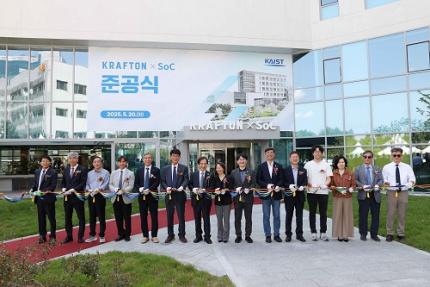 KAIST School of Computing Unveils 'KRAFTON Building,' A Symbol of Collective Generosity
< (From the fifth from the left) Provost and Executive Vice President Gyun Min Lee, Auditor Eun Woo Lee, President Kwang-Hyung Lee, Dean of the School of Computing Seok-Young Ryu, former Krafton member and donor Woong-Hee Cho, Krafton Chairman Byung-Gyu Chang >
KAIST announced on May 20th the completion of the expansion building for its School of Computing, the "KRAFTON Building." The project began in June 2021 with an ₩11 billion donation from KRAFTON and its employees, eventually growing to ₩11.7 billion with contributions from 204 donors.
Designed as a "Pay It Forward" space, the building aims to enable alumni to pass on the gratitude they received from the school to their juniors and foster connection. Byung-Gyu Chang, Chairman of KRAFTON and a KAIST alumnus, expressed his joy, stating, "I am very pleased that the first building created by alumni donations within KAIST is now complete, and I hope it will continue to be a space for communication, challenges, and growth that connects to the next generation."
The completion ceremony, held today at 3 PM in front of the KRAFTON SoC (School of Computing) Building at KAIST's main campus, was attended by over 100 people, including Chairman Byung-Gyu Chang, KAIST President Kwang-Hyung Lee, and Dean Seok-Young Ryu of the KAIST School of Computing.
The building's inception dates back to June 2021, with an ₩11 billion donation from the gaming company KRAFTON and its current and former members, dedicated to nurturing future software talent at KAIST. Four alumni, including KRAFTON Chairman Byung-Gyu Chang, who graduated from the KAIST School of Computing, were the first to pledge donations. This initial act inspired more participants, leading to ₩5.5 billion in individual donations from a total of 11 people. KRAFTON Inc. then matched this amount, bringing the total donation to ₩11 billion.
Since 2021, KRAFTON Inc. has operated a "Matching Grant" program, a donation culture initiative driven by its members. This system allows the company to match funds voluntarily raised by its employees, aiming to encourage active social participation and the creation of social value among its members.
Following this, another 11 KAIST alumni from Devsisters Inc., famous for the Cookie Run series, joined the donation effort. This wave of generosity expanded to include a total of 204 participants, comprising graduates, alumni professors, and current students, acting as a catalyst for the spread of a donation culture within the campus. To date, approximately ₩11.7 billion has been raised for the expansion of the School of Computing building. Furthermore, small donations, including those from alumni and the general public, have continuously grown, reaching over 50,000 instances from 2021 to May 2025.
The funds raised through donations were used to construct a 2,000-pyeong (approximately 6,600 square meters) building for individuals who, like Chairman Byung-Gyu Chang, will unleash their potential and become global leaders. The building was named "KRAFTON SoC (KRAFTON SoC)," and KRAFTON Inc. has further pledged additional donations for the building's maintenance over the next 10 years.
The newly completed KRAFTON Building is a six-story structure. From the second floor up, it features research labs for 20 professors and graduate students to freely pursue their research, along with large lecture halls. The first floor is designed as a meeting place for current students, alumni, and seniors, serving as a space to remember those who came before them.
The four lecture halls on the first floor are designated as "Immersion Camp Classrooms." During the summer and winter sessions, these rooms will be used for intensive month-long courses focused on improving coding and collaboration skills. During regular semesters, they will be utilized for other lectures.
Additionally, to support the physical and mental well-being of those weary from study and research, the building includes a small café on the first floor, a fitness center on the second floor, a Pilates studio on the fifth floor, and a soundproof band practice room in the basement.
Dean Seok-Young Ryu of the School of Computing explained, "The motivation for this wave of donations began with gratitude for the excellent professors and wonderful students, the free and open communication, the comfortable acceptance of diversity among various members, and the time when we could fearlessly dream. We cannot fully repay those who provided us with such precious time and space, but instead, this will be a 'Pay It Forward' space, a space of connection, where we share this gratitude with our juniors."
Alumnus Byung-Gyu Chang shared, "KAIST is more than just an academic foundation for me; it's a meaningful place that helped me set the direction for my life. I am very happy that this space, born from the desire of KRAFTON's members and myself to give back the opportunities and learning we received to the next generation, is completed today. I hope this space becomes a small but warm echo for KAIST members who freely communicate, challenge themselves, and grow."
< Congratulatory speech by alumnus Byung-Gyu Chang >
President Kwang-Hyung Lee stated, "The KRAFTON SoC, the expanded building for the School of Computing, is not just a space; it is the culmination of the KAIST community spirit created by alumni, current students, and faculty. I sincerely thank everyone who participated in this meaningful donation, which demonstrates the power of sharing and connection."
< Commemorative speech by President Kwang-Hyung Lee >
On a related note, the KAIST Development Foundation is actively promoting the "TeamKAIST" campaign for the general public and KAIST alumni to meet more "Daddy Long-Legs" (benefactors) for KAIST.
Website: https://giving.kaist.ac.kr/ko/sub01/sub0103_1.php
2025.05.21 View 10291
KAIST School of Computing Unveils 'KRAFTON Building,' A Symbol of Collective Generosity
< (From the fifth from the left) Provost and Executive Vice President Gyun Min Lee, Auditor Eun Woo Lee, President Kwang-Hyung Lee, Dean of the School of Computing Seok-Young Ryu, former Krafton member and donor Woong-Hee Cho, Krafton Chairman Byung-Gyu Chang >
KAIST announced on May 20th the completion of the expansion building for its School of Computing, the "KRAFTON Building." The project began in June 2021 with an ₩11 billion donation from KRAFTON and its employees, eventually growing to ₩11.7 billion with contributions from 204 donors.
Designed as a "Pay It Forward" space, the building aims to enable alumni to pass on the gratitude they received from the school to their juniors and foster connection. Byung-Gyu Chang, Chairman of KRAFTON and a KAIST alumnus, expressed his joy, stating, "I am very pleased that the first building created by alumni donations within KAIST is now complete, and I hope it will continue to be a space for communication, challenges, and growth that connects to the next generation."
The completion ceremony, held today at 3 PM in front of the KRAFTON SoC (School of Computing) Building at KAIST's main campus, was attended by over 100 people, including Chairman Byung-Gyu Chang, KAIST President Kwang-Hyung Lee, and Dean Seok-Young Ryu of the KAIST School of Computing.
The building's inception dates back to June 2021, with an ₩11 billion donation from the gaming company KRAFTON and its current and former members, dedicated to nurturing future software talent at KAIST. Four alumni, including KRAFTON Chairman Byung-Gyu Chang, who graduated from the KAIST School of Computing, were the first to pledge donations. This initial act inspired more participants, leading to ₩5.5 billion in individual donations from a total of 11 people. KRAFTON Inc. then matched this amount, bringing the total donation to ₩11 billion.
Since 2021, KRAFTON Inc. has operated a "Matching Grant" program, a donation culture initiative driven by its members. This system allows the company to match funds voluntarily raised by its employees, aiming to encourage active social participation and the creation of social value among its members.
Following this, another 11 KAIST alumni from Devsisters Inc., famous for the Cookie Run series, joined the donation effort. This wave of generosity expanded to include a total of 204 participants, comprising graduates, alumni professors, and current students, acting as a catalyst for the spread of a donation culture within the campus. To date, approximately ₩11.7 billion has been raised for the expansion of the School of Computing building. Furthermore, small donations, including those from alumni and the general public, have continuously grown, reaching over 50,000 instances from 2021 to May 2025.
The funds raised through donations were used to construct a 2,000-pyeong (approximately 6,600 square meters) building for individuals who, like Chairman Byung-Gyu Chang, will unleash their potential and become global leaders. The building was named "KRAFTON SoC (KRAFTON SoC)," and KRAFTON Inc. has further pledged additional donations for the building's maintenance over the next 10 years.
The newly completed KRAFTON Building is a six-story structure. From the second floor up, it features research labs for 20 professors and graduate students to freely pursue their research, along with large lecture halls. The first floor is designed as a meeting place for current students, alumni, and seniors, serving as a space to remember those who came before them.
The four lecture halls on the first floor are designated as "Immersion Camp Classrooms." During the summer and winter sessions, these rooms will be used for intensive month-long courses focused on improving coding and collaboration skills. During regular semesters, they will be utilized for other lectures.
Additionally, to support the physical and mental well-being of those weary from study and research, the building includes a small café on the first floor, a fitness center on the second floor, a Pilates studio on the fifth floor, and a soundproof band practice room in the basement.
Dean Seok-Young Ryu of the School of Computing explained, "The motivation for this wave of donations began with gratitude for the excellent professors and wonderful students, the free and open communication, the comfortable acceptance of diversity among various members, and the time when we could fearlessly dream. We cannot fully repay those who provided us with such precious time and space, but instead, this will be a 'Pay It Forward' space, a space of connection, where we share this gratitude with our juniors."
Alumnus Byung-Gyu Chang shared, "KAIST is more than just an academic foundation for me; it's a meaningful place that helped me set the direction for my life. I am very happy that this space, born from the desire of KRAFTON's members and myself to give back the opportunities and learning we received to the next generation, is completed today. I hope this space becomes a small but warm echo for KAIST members who freely communicate, challenge themselves, and grow."
< Congratulatory speech by alumnus Byung-Gyu Chang >
President Kwang-Hyung Lee stated, "The KRAFTON SoC, the expanded building for the School of Computing, is not just a space; it is the culmination of the KAIST community spirit created by alumni, current students, and faculty. I sincerely thank everyone who participated in this meaningful donation, which demonstrates the power of sharing and connection."
< Commemorative speech by President Kwang-Hyung Lee >
On a related note, the KAIST Development Foundation is actively promoting the "TeamKAIST" campaign for the general public and KAIST alumni to meet more "Daddy Long-Legs" (benefactors) for KAIST.
Website: https://giving.kaist.ac.kr/ko/sub01/sub0103_1.php
2025.05.21 View 10291 -
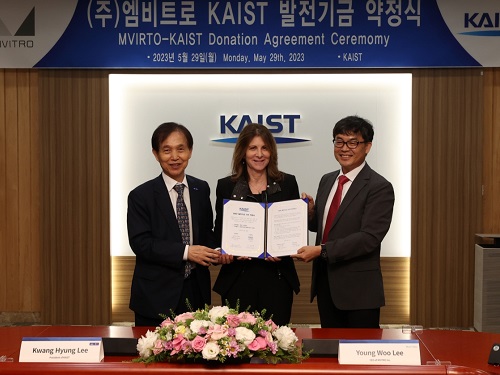 MVITRO Co., Ltd. Signs to Donate KRW 1 Billion as Development Fund toward KAIST-NYU Joint Campus
KAIST (President Kwang Hyung Lee) announced on the 29th that it has solicited a development fund of KRW 1 billion from MVITRO (CEO Young Woo Lee) for joint research at the KAIST-NYU Joint Campus, which is being pursued to be KAIST's first campus on the United States.
KAIST plans to use this development fund for research and development of various solutions in the field of 'Healthcare at Home' among several joint researches being conducted with New York University (hereinafter referred to as NYU).
Young Woo Lee, the CEO of MVITRO, said, "We decided to make the donation with the hope that the KAIST-NYU Joint Campus will become an ecosystem that would help with Korean companies’ advancement into the US."
After announcing its plans to enter New York in 2021, KAIST has formed partnerships with NYU and New York City last year. Currently, NYU and KAIST are devising plans for mid- to long-term joint research in nine fields of studies including AI and bio-medicine and technology, and are promoting cooperation in the field of education, including exchange students, minors, double majors, and joint degrees under the joint campus agreement,
The ceremony for the consigning of MVITRO Co., Ltd.’s donation was held at the main campus of KAIST in the afternoon of the 29th and was attended by KAIST officials such as President Kwang Hyung Lee and Jae-Hung Han, the executive director of KAIST Development Foundation, along with the NYU President-Designate Linda G. Mills, and the CEO of MVITRO, Young Woo Lee.
< Photo. (from left) Kwang Hyung Lee, the President of KAIST, Linda G. Mills, the President-Designate of NYU, and Young Woo Lee, the CEO of MVITRO, pose for the photo with the signed letter of donation on May 29, 2023 at KAIST >
Linda Mills, the nominee designated to be NYU president next term said, “I am proud to join our colleagues in celebrating this important gift from MVITRO, which will help support the partnership between KAIST and NYU. This global partnership leverages the distinctive strengths of both universities to drive advances in research poised to deliver profound impact, such as the intersections of healthcare, technology, and AI."
President Kwang Hyung Lee said, "The KAIST-NYU Joint Campus will be the first step in extending KAIST's excellent science and technology capabilities to the international stage and will serve as a bridgehead to help excellent technological advancements venture into the United States." Then, President Lee added, "I would like to express my gratitude to MVITRO for sympathizing with this vision. I will work with NYU to lead the creation of global values.”
On a different note, MVITRO Co., Ltd., is a home medical device maker that collaborated with Hyundai Futurenet Co., Ltd. to develop an IoT product that combined a painless laser lancet (blood collector) and a blood glucose meter into one for a convenient at-home health support, which received favorable reviews from overseas buyers at CES 2023.
2023.05.30 View 16650
MVITRO Co., Ltd. Signs to Donate KRW 1 Billion as Development Fund toward KAIST-NYU Joint Campus
KAIST (President Kwang Hyung Lee) announced on the 29th that it has solicited a development fund of KRW 1 billion from MVITRO (CEO Young Woo Lee) for joint research at the KAIST-NYU Joint Campus, which is being pursued to be KAIST's first campus on the United States.
KAIST plans to use this development fund for research and development of various solutions in the field of 'Healthcare at Home' among several joint researches being conducted with New York University (hereinafter referred to as NYU).
Young Woo Lee, the CEO of MVITRO, said, "We decided to make the donation with the hope that the KAIST-NYU Joint Campus will become an ecosystem that would help with Korean companies’ advancement into the US."
After announcing its plans to enter New York in 2021, KAIST has formed partnerships with NYU and New York City last year. Currently, NYU and KAIST are devising plans for mid- to long-term joint research in nine fields of studies including AI and bio-medicine and technology, and are promoting cooperation in the field of education, including exchange students, minors, double majors, and joint degrees under the joint campus agreement,
The ceremony for the consigning of MVITRO Co., Ltd.’s donation was held at the main campus of KAIST in the afternoon of the 29th and was attended by KAIST officials such as President Kwang Hyung Lee and Jae-Hung Han, the executive director of KAIST Development Foundation, along with the NYU President-Designate Linda G. Mills, and the CEO of MVITRO, Young Woo Lee.
< Photo. (from left) Kwang Hyung Lee, the President of KAIST, Linda G. Mills, the President-Designate of NYU, and Young Woo Lee, the CEO of MVITRO, pose for the photo with the signed letter of donation on May 29, 2023 at KAIST >
Linda Mills, the nominee designated to be NYU president next term said, “I am proud to join our colleagues in celebrating this important gift from MVITRO, which will help support the partnership between KAIST and NYU. This global partnership leverages the distinctive strengths of both universities to drive advances in research poised to deliver profound impact, such as the intersections of healthcare, technology, and AI."
President Kwang Hyung Lee said, "The KAIST-NYU Joint Campus will be the first step in extending KAIST's excellent science and technology capabilities to the international stage and will serve as a bridgehead to help excellent technological advancements venture into the United States." Then, President Lee added, "I would like to express my gratitude to MVITRO for sympathizing with this vision. I will work with NYU to lead the creation of global values.”
On a different note, MVITRO Co., Ltd., is a home medical device maker that collaborated with Hyundai Futurenet Co., Ltd. to develop an IoT product that combined a painless laser lancet (blood collector) and a blood glucose meter into one for a convenient at-home health support, which received favorable reviews from overseas buyers at CES 2023.
2023.05.30 View 16650 -
 Anonymous Donor Makes a Gift of Property Valued at 30 Billion KRW
The KAIST Development Foundation announced on May 9 that an anonymous donor in his 50s made a gift of real estate valued at 30 billion KRW. This is the first donation from an anonymous benefactor on such a grand scale. The benefactor expressed his wishes to fund scholarships for students in need and R&D for medical and bio sciences.
According to the Development Foundation official, the benefactor is reported to have said that he felt burdened that he earned much more than he needed and was looking for the right way to share his assets. The benefactor refused to hold an official donation ceremony and meeting with high-level university administrators.
The donor believes that KAIST is filled with young and dynamic energy, saying, “I would like to help KAIST move forward and create breakthroughs that will benefit the nation as well as all humanity.”
Before making up his mind to give his asset to KAIST, he had planned to establish his own social foundation but he changed his mind. “I decided that an investment in education would be the best investment,” he said. He explained that he was inspired by his KAIST graduate friend who is running a company. He was deeply motivated to help KAIST after witnessing the KAIST graduate’s passion for conducting his business.
After receiving the gift, KAIST President Kwang Hyung Lee was thankful for the full support and trust of the benefactor. “We will spare no effort to foster next-generation talents and advance science and technology in the field of biomedicine.”
2022.05.11 View 9191
Anonymous Donor Makes a Gift of Property Valued at 30 Billion KRW
The KAIST Development Foundation announced on May 9 that an anonymous donor in his 50s made a gift of real estate valued at 30 billion KRW. This is the first donation from an anonymous benefactor on such a grand scale. The benefactor expressed his wishes to fund scholarships for students in need and R&D for medical and bio sciences.
According to the Development Foundation official, the benefactor is reported to have said that he felt burdened that he earned much more than he needed and was looking for the right way to share his assets. The benefactor refused to hold an official donation ceremony and meeting with high-level university administrators.
The donor believes that KAIST is filled with young and dynamic energy, saying, “I would like to help KAIST move forward and create breakthroughs that will benefit the nation as well as all humanity.”
Before making up his mind to give his asset to KAIST, he had planned to establish his own social foundation but he changed his mind. “I decided that an investment in education would be the best investment,” he said. He explained that he was inspired by his KAIST graduate friend who is running a company. He was deeply motivated to help KAIST after witnessing the KAIST graduate’s passion for conducting his business.
After receiving the gift, KAIST President Kwang Hyung Lee was thankful for the full support and trust of the benefactor. “We will spare no effort to foster next-generation talents and advance science and technology in the field of biomedicine.”
2022.05.11 View 9191 -
 Baemin CEO Endows a Scholarship in Honor of the Late Professor Chwa
CEO Beom-Jun Kim of Woowa Brothers also known as ‘Baemin,’ a leading meal delivery app company, made a donation of 100 million KRW in honor of the late Professor Kyong-Yong Chwa from the School of Computing who passed away last year. The fund will be established for the “Kyong-Yong Chwa - Beom-Jun Kim Scholarship” to provide scholarships for four students over five years.
Kim finished his BS in 1997 and MS in 1999 at the School of Computing and Professor Chwa was his advisor. The late Professor Chwa was a pioneering scholar who brought the concept of computer algorithms to Korea. After graduating from Seoul National University in electric engineering, Professor Chwa earned his PhD at Northwestern University and began teaching at KAIST in 1980. Professor Chwa served as the President of the Korean Institute of Information Scientists and Engineers and a fellow emeritus at the Korean Academy of Science and Technology.
Professor Chwa encouraged younger students to participate in international computer programming contests. Under his wing, Team Korea, which was comprised of four high school students, including Kim, placed fourth in the International Olympiad Informatics (IOI). Kim, who participated in the contest as high school junior, won an individual gold medal in the fourth IOI competition in 1992. Since then, Korean students have actively participated in many competitions including the International Collegiate Programming Contest (ICPC) hosted by the Association for Computing Machinery.
Kim said, “I feel fortunate to have met so many good friends and distinguished professors. With them, I had opportunities to grow. I would like to provide such opportunities to my juniors at KAIST. Professor Chwa was a larger than life figure in the field of computer programming. He was always caring and supported us with a warm heart. I want this donation to help carry on his legacy for our students and for them to seek greater challenges and bigger dreams.”
2022.03.25 View 14010
Baemin CEO Endows a Scholarship in Honor of the Late Professor Chwa
CEO Beom-Jun Kim of Woowa Brothers also known as ‘Baemin,’ a leading meal delivery app company, made a donation of 100 million KRW in honor of the late Professor Kyong-Yong Chwa from the School of Computing who passed away last year. The fund will be established for the “Kyong-Yong Chwa - Beom-Jun Kim Scholarship” to provide scholarships for four students over five years.
Kim finished his BS in 1997 and MS in 1999 at the School of Computing and Professor Chwa was his advisor. The late Professor Chwa was a pioneering scholar who brought the concept of computer algorithms to Korea. After graduating from Seoul National University in electric engineering, Professor Chwa earned his PhD at Northwestern University and began teaching at KAIST in 1980. Professor Chwa served as the President of the Korean Institute of Information Scientists and Engineers and a fellow emeritus at the Korean Academy of Science and Technology.
Professor Chwa encouraged younger students to participate in international computer programming contests. Under his wing, Team Korea, which was comprised of four high school students, including Kim, placed fourth in the International Olympiad Informatics (IOI). Kim, who participated in the contest as high school junior, won an individual gold medal in the fourth IOI competition in 1992. Since then, Korean students have actively participated in many competitions including the International Collegiate Programming Contest (ICPC) hosted by the Association for Computing Machinery.
Kim said, “I feel fortunate to have met so many good friends and distinguished professors. With them, I had opportunities to grow. I would like to provide such opportunities to my juniors at KAIST. Professor Chwa was a larger than life figure in the field of computer programming. He was always caring and supported us with a warm heart. I want this donation to help carry on his legacy for our students and for them to seek greater challenges and bigger dreams.”
2022.03.25 View 14010