Best+Paper+Award
-
 KAIST Professor Jee-Hwan Ryu Receives Global IEEE Robotics Journal Best Paper Award
- Professor Jee-Hwan Ryu of Civil and Environmental Engineering receives the Best Paper Award from the Institute of Electrical and Electronics Engineers (IEEE) Robotics Journal, officially presented at ICRA, a world-renowned robotics conference.
- This is the highest level of international recognition, awarded to only the top 5 papers out of approximately 1,500 published in 2024.
- Securing a new working channel technology for soft growing robots expands the practicality and application possibilities in the field of soft robotics.
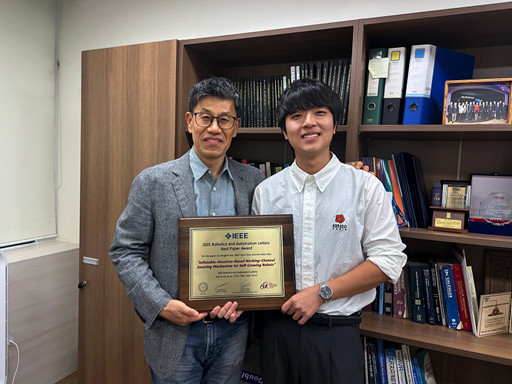
< Professor Jee-Hwan Ryu (left), Nam Gyun Kim, Ph.D. Candidate (right) from the KAIST Department of Civil and Environmental Engineering and KAIST Robotics Program >
KAIST (President Kwang-Hyung Lee) announced on the 6th that Professor Jee-Hwan Ryu from the Department of Civil and Environmental Engineering received the 2024 Best Paper Award from the Robotics and Automation Letters (RA-L), a premier journal under the IEEE, at the '2025 IEEE International Conference on Robotics and Automation (ICRA)' held in Atlanta, USA, on May 22nd.
This Best Paper Award is a prestigious honor presented to only the top 5 papers out of approximately 1,500 published in 2024, boasting high international competition and authority.
The award-winning paper by Professor Ryu proposes a novel working channel securing mechanism that significantly expands the practicality and application possibilities of 'Soft Growing Robots,' which are based on soft materials that move or perform tasks through a growing motion similar to plant roots.
< IEEE Robotics Journal Award Ceremony >
Existing soft growing robots move by inflating or contracting their bodies through increasing or decreasing internal pressure, which can lead to blockages in their internal passages. In contrast, the newly developed soft growing robot achieves a growing function while maintaining the internal passage pressure equal to the external atmospheric pressure, thereby successfully securing an internal passage while retaining the robot's flexible and soft characteristics.
This structure allows various materials or tools to be freely delivered through the internal passage (working channel) within the robot and offers the advantage of performing multi-purpose tasks by flexibly replacing equipment according to the working environment.
The research team fabricated a prototype to prove the effectiveness of this technology and verified its performance through various experiments. Specifically, in the slide plate experiment, they confirmed whether materials or equipment could pass through the robot's internal channel without obstruction, and in the pipe pulling experiment, they verified if a long pipe-shaped tool could be pulled through the internal channel.
< Figure 1. Overall hardware structure of the proposed soft growing robot (left) and a cross-sectional view composing the inflatable structure (right) >
Experimental results demonstrated that the internal channel remained stable even while the robot was growing, serving as a key basis for supporting the technology's practicality and scalability.
Professor Jee-Hwan Ryu stated, "This award is very meaningful as it signifies the global recognition of Korea's robotics technology and academic achievements. Especially, it holds great significance in achieving technical progress that can greatly expand the practicality and application fields of soft growing robots. This achievement was possible thanks to the dedication and collaboration of the research team, and I will continue to contribute to the development of robotics technology through innovative research."
< Figure 2. Material supplying mechanism of the Soft Growing Robot >
This research was co-authored by Dongoh Seo, Ph.D. Candidate in Civil and Environmental Engineering, and Nam Gyun Kim, Ph.D. Candidate in Robotics. It was published in IEEE Robotics and Automation Letters on September 1, 2024.
(Paper Title: Inflatable-Structure-Based Working-Channel Securing Mechanism for Soft Growing Robots, DOI: 10.1109/LRA.2024.3426322)
This project was supported simultaneously by the National Research Foundation of Korea's Future Promising Convergence Technology Pioneer Research Project and Mid-career Researcher Project.
2025.06.09 View 3050
KAIST Professor Jee-Hwan Ryu Receives Global IEEE Robotics Journal Best Paper Award
- Professor Jee-Hwan Ryu of Civil and Environmental Engineering receives the Best Paper Award from the Institute of Electrical and Electronics Engineers (IEEE) Robotics Journal, officially presented at ICRA, a world-renowned robotics conference.
- This is the highest level of international recognition, awarded to only the top 5 papers out of approximately 1,500 published in 2024.
- Securing a new working channel technology for soft growing robots expands the practicality and application possibilities in the field of soft robotics.
< Professor Jee-Hwan Ryu (left), Nam Gyun Kim, Ph.D. Candidate (right) from the KAIST Department of Civil and Environmental Engineering and KAIST Robotics Program >
KAIST (President Kwang-Hyung Lee) announced on the 6th that Professor Jee-Hwan Ryu from the Department of Civil and Environmental Engineering received the 2024 Best Paper Award from the Robotics and Automation Letters (RA-L), a premier journal under the IEEE, at the '2025 IEEE International Conference on Robotics and Automation (ICRA)' held in Atlanta, USA, on May 22nd.
This Best Paper Award is a prestigious honor presented to only the top 5 papers out of approximately 1,500 published in 2024, boasting high international competition and authority.
The award-winning paper by Professor Ryu proposes a novel working channel securing mechanism that significantly expands the practicality and application possibilities of 'Soft Growing Robots,' which are based on soft materials that move or perform tasks through a growing motion similar to plant roots.
< IEEE Robotics Journal Award Ceremony >
Existing soft growing robots move by inflating or contracting their bodies through increasing or decreasing internal pressure, which can lead to blockages in their internal passages. In contrast, the newly developed soft growing robot achieves a growing function while maintaining the internal passage pressure equal to the external atmospheric pressure, thereby successfully securing an internal passage while retaining the robot's flexible and soft characteristics.
This structure allows various materials or tools to be freely delivered through the internal passage (working channel) within the robot and offers the advantage of performing multi-purpose tasks by flexibly replacing equipment according to the working environment.
The research team fabricated a prototype to prove the effectiveness of this technology and verified its performance through various experiments. Specifically, in the slide plate experiment, they confirmed whether materials or equipment could pass through the robot's internal channel without obstruction, and in the pipe pulling experiment, they verified if a long pipe-shaped tool could be pulled through the internal channel.
< Figure 1. Overall hardware structure of the proposed soft growing robot (left) and a cross-sectional view composing the inflatable structure (right) >
Experimental results demonstrated that the internal channel remained stable even while the robot was growing, serving as a key basis for supporting the technology's practicality and scalability.
Professor Jee-Hwan Ryu stated, "This award is very meaningful as it signifies the global recognition of Korea's robotics technology and academic achievements. Especially, it holds great significance in achieving technical progress that can greatly expand the practicality and application fields of soft growing robots. This achievement was possible thanks to the dedication and collaboration of the research team, and I will continue to contribute to the development of robotics technology through innovative research."
< Figure 2. Material supplying mechanism of the Soft Growing Robot >
This research was co-authored by Dongoh Seo, Ph.D. Candidate in Civil and Environmental Engineering, and Nam Gyun Kim, Ph.D. Candidate in Robotics. It was published in IEEE Robotics and Automation Letters on September 1, 2024.
(Paper Title: Inflatable-Structure-Based Working-Channel Securing Mechanism for Soft Growing Robots, DOI: 10.1109/LRA.2024.3426322)
This project was supported simultaneously by the National Research Foundation of Korea's Future Promising Convergence Technology Pioneer Research Project and Mid-career Researcher Project.
2025.06.09 View 3050 -
 KAIST & CMU Unveils Amuse, a Songwriting AI-Collaborator to Help Create Music
Wouldn't it be great if music creators had someone to brainstorm with, help them when they're stuck, and explore different musical directions together? Researchers of KAIST and Carnegie Mellon University (CMU) have developed AI technology similar to a fellow songwriter who helps create music.
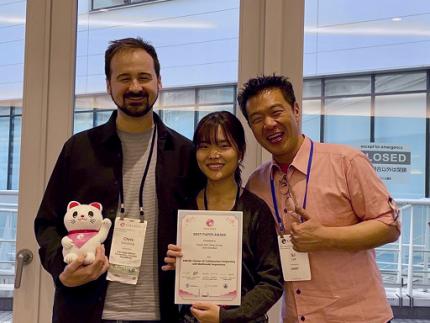
KAIST (President Kwang-Hyung Lee) has developed an AI-based music creation support system, Amuse, by a research team led by Professor Sung-Ju Lee of the School of Electrical Engineering in collaboration with CMU. The research was presented at the ACM Conference on Human Factors in Computing Systems (CHI), one of the world’s top conferences in human-computer interaction, held in Yokohama, Japan from April 26 to May 1. It received the Best Paper Award, given to only the top 1% of all submissions.
< (From left) Professor Chris Donahue of Carnegie Mellon University, Ph.D. Student Yewon Kim and Professor Sung-Ju Lee of the School of Electrical Engineering >
The system developed by Professor Sung-Ju Lee’s research team, Amuse, is an AI-based system that converts various forms of inspiration such as text, images, and audio into harmonic structures (chord progressions) to support composition.
For example, if a user inputs a phrase, image, or sound clip such as “memories of a warm summer beach”, Amuse automatically generates and suggests chord progressions that match the inspiration.
Unlike existing generative AI, Amuse is differentiated in that it respects the user's creative flow and naturally induces creative exploration through an interactive method that allows flexible integration and modification of AI suggestions.
The core technology of the Amuse system is a generation method that blends two approaches: a large language model creates music code based on the user's prompt and inspiration, while another AI model, trained on real music data, filters out awkward or unnatural results using rejection sampling.
< Figure 1. Amuse system configuration. After extracting music keywords from user input, a large language model-based code progression is generated and refined through rejection sampling (left). Code extraction from audio input is also possible (right). The bottom is an example visualizing the chord structure of the generated code. >
The research team conducted a user study targeting actual musicians and evaluated that Amuse has high potential as a creative companion, or a Co-Creative AI, a concept in which people and AI collaborate, rather than having a generative AI simply put together a song.
The paper, in which a Ph.D. student Yewon Kim and Professor Sung-Ju Lee of KAIST School of Electrical and Electronic Engineering and Carnegie Mellon University Professor Chris Donahue participated, demonstrated the potential of creative AI system design in both academia and industry. ※ Paper title: Amuse: Human-AI Collaborative Songwriting with Multimodal Inspirations DOI: https://doi.org/10.1145/3706598.3713818
※ Research demo video: https://youtu.be/udilkRSnftI?si=FNXccC9EjxHOCrm1
※ Research homepage: https://nmsl.kaist.ac.kr/projects/amuse/
Professor Sung-Ju Lee said, “Recent generative AI technology has raised concerns in that it directly imitates copyrighted content, thereby violating the copyright of the creator, or generating results one-way regardless of the creator’s intention. Accordingly, the research team was aware of this trend, paid attention to what the creator actually needs, and focused on designing an AI system centered on the creator.”
He continued, “Amuse is an attempt to explore the possibility of collaboration with AI while maintaining the initiative of the creator, and is expected to be a starting point for suggesting a more creator-friendly direction in the development of music creation tools and generative AI systems in the future.”
This research was conducted with the support of the National Research Foundation of Korea with funding from the government (Ministry of Science and ICT). (RS-2024-00337007)
2025.05.07 View 6419
KAIST & CMU Unveils Amuse, a Songwriting AI-Collaborator to Help Create Music
Wouldn't it be great if music creators had someone to brainstorm with, help them when they're stuck, and explore different musical directions together? Researchers of KAIST and Carnegie Mellon University (CMU) have developed AI technology similar to a fellow songwriter who helps create music.
KAIST (President Kwang-Hyung Lee) has developed an AI-based music creation support system, Amuse, by a research team led by Professor Sung-Ju Lee of the School of Electrical Engineering in collaboration with CMU. The research was presented at the ACM Conference on Human Factors in Computing Systems (CHI), one of the world’s top conferences in human-computer interaction, held in Yokohama, Japan from April 26 to May 1. It received the Best Paper Award, given to only the top 1% of all submissions.
< (From left) Professor Chris Donahue of Carnegie Mellon University, Ph.D. Student Yewon Kim and Professor Sung-Ju Lee of the School of Electrical Engineering >
The system developed by Professor Sung-Ju Lee’s research team, Amuse, is an AI-based system that converts various forms of inspiration such as text, images, and audio into harmonic structures (chord progressions) to support composition.
For example, if a user inputs a phrase, image, or sound clip such as “memories of a warm summer beach”, Amuse automatically generates and suggests chord progressions that match the inspiration.
Unlike existing generative AI, Amuse is differentiated in that it respects the user's creative flow and naturally induces creative exploration through an interactive method that allows flexible integration and modification of AI suggestions.
The core technology of the Amuse system is a generation method that blends two approaches: a large language model creates music code based on the user's prompt and inspiration, while another AI model, trained on real music data, filters out awkward or unnatural results using rejection sampling.
< Figure 1. Amuse system configuration. After extracting music keywords from user input, a large language model-based code progression is generated and refined through rejection sampling (left). Code extraction from audio input is also possible (right). The bottom is an example visualizing the chord structure of the generated code. >
The research team conducted a user study targeting actual musicians and evaluated that Amuse has high potential as a creative companion, or a Co-Creative AI, a concept in which people and AI collaborate, rather than having a generative AI simply put together a song.
The paper, in which a Ph.D. student Yewon Kim and Professor Sung-Ju Lee of KAIST School of Electrical and Electronic Engineering and Carnegie Mellon University Professor Chris Donahue participated, demonstrated the potential of creative AI system design in both academia and industry. ※ Paper title: Amuse: Human-AI Collaborative Songwriting with Multimodal Inspirations DOI: https://doi.org/10.1145/3706598.3713818
※ Research demo video: https://youtu.be/udilkRSnftI?si=FNXccC9EjxHOCrm1
※ Research homepage: https://nmsl.kaist.ac.kr/projects/amuse/
Professor Sung-Ju Lee said, “Recent generative AI technology has raised concerns in that it directly imitates copyrighted content, thereby violating the copyright of the creator, or generating results one-way regardless of the creator’s intention. Accordingly, the research team was aware of this trend, paid attention to what the creator actually needs, and focused on designing an AI system centered on the creator.”
He continued, “Amuse is an attempt to explore the possibility of collaboration with AI while maintaining the initiative of the creator, and is expected to be a starting point for suggesting a more creator-friendly direction in the development of music creation tools and generative AI systems in the future.”
This research was conducted with the support of the National Research Foundation of Korea with funding from the government (Ministry of Science and ICT). (RS-2024-00337007)
2025.05.07 View 6419 -
 Professor Hojong Chang’s Research Team Wins ISIITA 2020 Best Paper Award
The paper written by Professor Hojong Chang’s research team from KAIST Institute for IT Convergence won the best paper award from the International Symposium on Innovation in Information Technology Application (ISIITA) 2020, held this month at Ton Duc Thang University in Vietnam.
ISIITA is a networking symposium where leading researchers from various fields including information and communications, biotechnology, and computer systems come together and share on the convergence of technology.
Professor Chang’s team won the best paper award at this year’s symposium with its paper, “A Study of Single Photon Counting System for Quantitative Analysis of Luminescence”. The awarded paper discusses the realization of a signal processing system for silicon photomultipliers.
The silicon photomultiplier is the core of a urinalysis technique that tests for sodium and potassium in the body using simple chemical reactions. If our bodily sodium and potassium levels exceed a certain amount, it can lead to high blood pressure, cardiovascular problems, and kidney damage.
Through this research, the team has developed a core technique that quantifies the sodium and potassium discharged in the urine. When the reagent is injected into the urine, a very small amount of light is emitted as a result of the chemical reaction. However, if there is a large amount of sodium and potassium, they interrupt the reaction and reduce the emission. The key to this measurement technique is digitizing the strength of this very fine emission of light. Professor Chang’s team developed a system that uses a photomultiplier to measure the chemiluminescence.
Professor Chang said, “I look forward for this signal processing system greatly helping to prevent diseases caused by the excessive consumption of sodium and potassium through quick and easy detection.”
Researcher Byunghun Han who carried out the central research for the system design added, “We are planning to focus on miniaturizing the developed technique, so that anyone can carry our device around like a cellphone.”
The research was supported by the Ministry of Science and ICT.
(END)
2020.02.27 View 12664
Professor Hojong Chang’s Research Team Wins ISIITA 2020 Best Paper Award
The paper written by Professor Hojong Chang’s research team from KAIST Institute for IT Convergence won the best paper award from the International Symposium on Innovation in Information Technology Application (ISIITA) 2020, held this month at Ton Duc Thang University in Vietnam.
ISIITA is a networking symposium where leading researchers from various fields including information and communications, biotechnology, and computer systems come together and share on the convergence of technology.
Professor Chang’s team won the best paper award at this year’s symposium with its paper, “A Study of Single Photon Counting System for Quantitative Analysis of Luminescence”. The awarded paper discusses the realization of a signal processing system for silicon photomultipliers.
The silicon photomultiplier is the core of a urinalysis technique that tests for sodium and potassium in the body using simple chemical reactions. If our bodily sodium and potassium levels exceed a certain amount, it can lead to high blood pressure, cardiovascular problems, and kidney damage.
Through this research, the team has developed a core technique that quantifies the sodium and potassium discharged in the urine. When the reagent is injected into the urine, a very small amount of light is emitted as a result of the chemical reaction. However, if there is a large amount of sodium and potassium, they interrupt the reaction and reduce the emission. The key to this measurement technique is digitizing the strength of this very fine emission of light. Professor Chang’s team developed a system that uses a photomultiplier to measure the chemiluminescence.
Professor Chang said, “I look forward for this signal processing system greatly helping to prevent diseases caused by the excessive consumption of sodium and potassium through quick and easy detection.”
Researcher Byunghun Han who carried out the central research for the system design added, “We are planning to focus on miniaturizing the developed technique, so that anyone can carry our device around like a cellphone.”
The research was supported by the Ministry of Science and ICT.
(END)
2020.02.27 View 12664 -
 Professor Hojong Chang Wins the Best Paper Award at ISIITA 2018
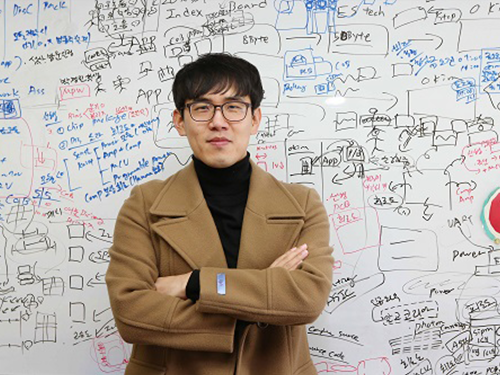
Professor Hojong Chang from the KAIST Institute won the best paper award at the International Symposium on Innovation in Information Technology and Application (ISIITA) 2018.
ISIITA is a global networking symposium in which leading researchers in the field of information technology and applications gather to exchange knowledge on technological convergence.
Professor Chang won the prize for his paper, titled ‘A Study on the Measurement of Aptamer in Urine Using SiPM’.
This paper proposes using aptamer to measure and analyze the density of sodium and potassium contained in urine, allowing diseases to be diagnosed in advance.
Professor Chang said, “With a point-of-care test system that facilitates a quick diagnosis without extra processes, such as centrifugation, it is possible to get an early diagnosis and check infection in real time. Through generalizing this crucial technology, we expect to develop adequate technology for enhancing quality of life.
2018.02.12 View 10120
Professor Hojong Chang Wins the Best Paper Award at ISIITA 2018
Professor Hojong Chang from the KAIST Institute won the best paper award at the International Symposium on Innovation in Information Technology and Application (ISIITA) 2018.
ISIITA is a global networking symposium in which leading researchers in the field of information technology and applications gather to exchange knowledge on technological convergence.
Professor Chang won the prize for his paper, titled ‘A Study on the Measurement of Aptamer in Urine Using SiPM’.
This paper proposes using aptamer to measure and analyze the density of sodium and potassium contained in urine, allowing diseases to be diagnosed in advance.
Professor Chang said, “With a point-of-care test system that facilitates a quick diagnosis without extra processes, such as centrifugation, it is possible to get an early diagnosis and check infection in real time. Through generalizing this crucial technology, we expect to develop adequate technology for enhancing quality of life.
2018.02.12 View 10120 -
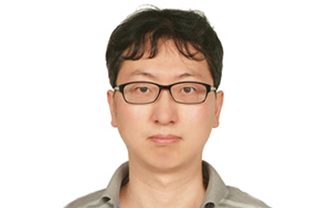 Professor Lee Recognized by the KMS as Best Paper Awardee
Professor Ji Oon Lee of the Department of Mathematical Sciences was selected as the 2017 Best Paper Awardee by the Korean Mathematical Society. The award will be presented during the KMS spring meeting on April 29. Dr. Lee is being honored for proving a necessary and sufficient condition for the Tracy-Wisdom law of Wigner matrices. In a paper titled ‘A Necessary and Sufficient Condition for Edge Universality of Wigner Matrices,’ he proposed a solution for one of the many unanswered problems in the field of random matrix theory that have existed for decades. The paper, co-authored with Professor Jun Yin at the University of Wisconsin – Madison, was published in the Duke Mathematical Journal in 2014. Professor Lee joined KAIST in 2010 after finishing his Ph.D. at Harvard University. He was named a ‘POSCI Science Fellow’ and received the ‘Young Scientist Award’ from the KMS in 2014.
2017.04.27 View 11559
Professor Lee Recognized by the KMS as Best Paper Awardee
Professor Ji Oon Lee of the Department of Mathematical Sciences was selected as the 2017 Best Paper Awardee by the Korean Mathematical Society. The award will be presented during the KMS spring meeting on April 29. Dr. Lee is being honored for proving a necessary and sufficient condition for the Tracy-Wisdom law of Wigner matrices. In a paper titled ‘A Necessary and Sufficient Condition for Edge Universality of Wigner Matrices,’ he proposed a solution for one of the many unanswered problems in the field of random matrix theory that have existed for decades. The paper, co-authored with Professor Jun Yin at the University of Wisconsin – Madison, was published in the Duke Mathematical Journal in 2014. Professor Lee joined KAIST in 2010 after finishing his Ph.D. at Harvard University. He was named a ‘POSCI Science Fellow’ and received the ‘Young Scientist Award’ from the KMS in 2014.
2017.04.27 View 11559 -
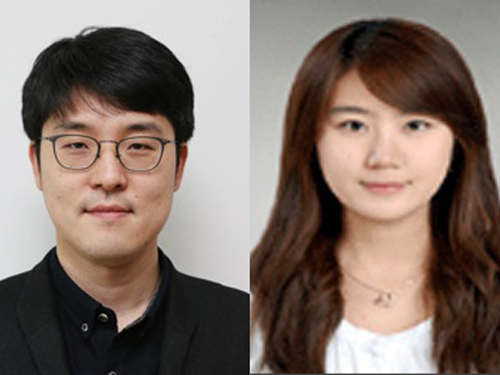 EEWS Graduate School Team Receives the S-Oil Best Paper Award
Professor Hyungjun Kim and Dr. He-Young Shin from the EEWS (Energy, Environment, Water and Sustainability) Graduate School at KAIST received the Best Paper Award in Chemistry from S-Oil, a Korean petroleum and refinery company, on November 29, 2016.
Established in 2011, the S-Oil Best Paper Awards are bestowed annually upon ten young scientists in the fields of five basic sciences: mathematics, physics, chemistry, biology, and earth science. The scientists are selected at the recommendation of the Korean Academy of Science and Technology and the Association of Korean Universities. The awards grant a total of USD 230,000 for research funding.
Dr. Shin, the lead author of the awarded research paper, said, “My research interest has been catalyst studies based on theoretical chemistry. I am pleased to accept this award that will support my studies, and will continue to research catalyst design that can predict parameters and integrate them into catalytic systems.”
Professor Hyungjun Kim (left) and Dr. He-Young Shin (right)
2016.12.23 View 12742
EEWS Graduate School Team Receives the S-Oil Best Paper Award
Professor Hyungjun Kim and Dr. He-Young Shin from the EEWS (Energy, Environment, Water and Sustainability) Graduate School at KAIST received the Best Paper Award in Chemistry from S-Oil, a Korean petroleum and refinery company, on November 29, 2016.
Established in 2011, the S-Oil Best Paper Awards are bestowed annually upon ten young scientists in the fields of five basic sciences: mathematics, physics, chemistry, biology, and earth science. The scientists are selected at the recommendation of the Korean Academy of Science and Technology and the Association of Korean Universities. The awards grant a total of USD 230,000 for research funding.
Dr. Shin, the lead author of the awarded research paper, said, “My research interest has been catalyst studies based on theoretical chemistry. I am pleased to accept this award that will support my studies, and will continue to research catalyst design that can predict parameters and integrate them into catalytic systems.”
Professor Hyungjun Kim (left) and Dr. He-Young Shin (right)
2016.12.23 View 12742 -
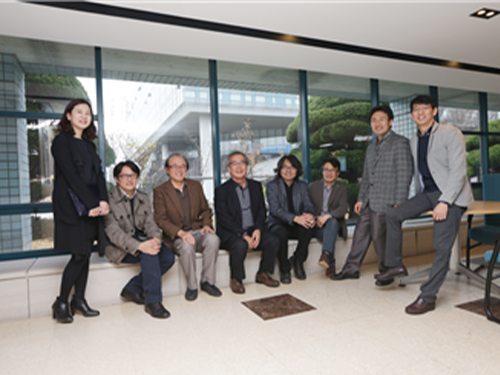 Mobile Software Platform Research Center Recognized by the MSIP
The Mobile Software Platform Research Center (MSPRC) at KAIST received an award from the Minister of Science, ICT and Future Planning of Korea on November 29, 2016, at Coex in Seoul. The award was presented at the Conference of Software R&D Annual Report 2016 hosted by the Ministry of Science, ICT and Future Planning (MISP) and the Institute for Information and Communications Technology Promotion (IITP).
The research center developed user experience (UX)-oriented mobile software platforms that support the invention of next-generation UX service technologies. The center has filed 37 patents and registered 15 technologies. Its researchers received ten Best Paper Awards and published a total of 133 papers in Korean and international journals.
Research teams at MSPRC expect that their software platforms will offer training programs for software engineers and new UX services. They also said that their extensive event processing platforms would reduce energy consumption on mobile devices.
Professor Seungryoul Maeng of the School of Computing, the Director of MSPRC, said, “This is a great honor for us. I am greatly thankful for the teamwork of participating departments--Computer Science, Industrial Design, and Industrial and Systems Engineering. We will continue to introduce our research outcomes and to work towards commercializing these results.”
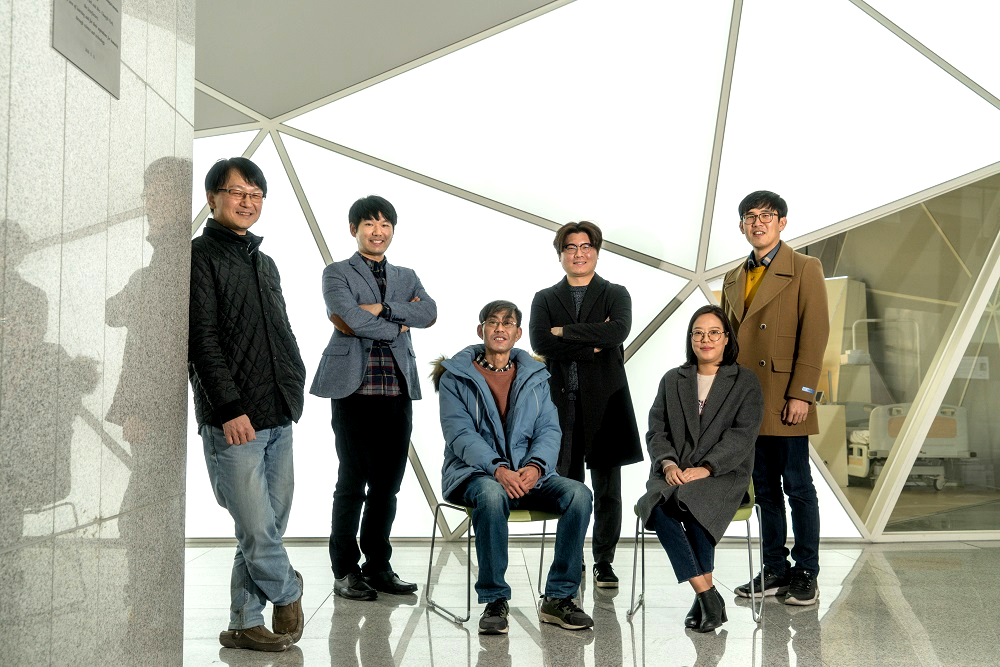
Members of the Mobile Software Platform Research Center, KAIST
2016.12.07 View 8416
Mobile Software Platform Research Center Recognized by the MSIP
The Mobile Software Platform Research Center (MSPRC) at KAIST received an award from the Minister of Science, ICT and Future Planning of Korea on November 29, 2016, at Coex in Seoul. The award was presented at the Conference of Software R&D Annual Report 2016 hosted by the Ministry of Science, ICT and Future Planning (MISP) and the Institute for Information and Communications Technology Promotion (IITP).
The research center developed user experience (UX)-oriented mobile software platforms that support the invention of next-generation UX service technologies. The center has filed 37 patents and registered 15 technologies. Its researchers received ten Best Paper Awards and published a total of 133 papers in Korean and international journals.
Research teams at MSPRC expect that their software platforms will offer training programs for software engineers and new UX services. They also said that their extensive event processing platforms would reduce energy consumption on mobile devices.
Professor Seungryoul Maeng of the School of Computing, the Director of MSPRC, said, “This is a great honor for us. I am greatly thankful for the teamwork of participating departments--Computer Science, Industrial Design, and Industrial and Systems Engineering. We will continue to introduce our research outcomes and to work towards commercializing these results.”
Members of the Mobile Software Platform Research Center, KAIST
2016.12.07 View 8416 -
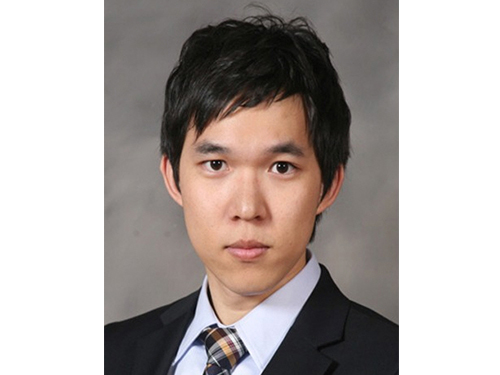 Dong-Young Lee, a Doctoral Candidate, Receives the Best Paper Award
Dong-Young Lee, a Ph.D. candidate in the Mechanical Engineering Department, KAIST, received the Best Paper Award at the 18th International Conference on Composite Structures (ICCS). The event was held in Lisbon, Portugal, on June 15-18, 2015. Mr. Lee’s adviser is Professor Dai-Gil Lee of the same department.
The ICCS is held every other year, and is one of the largest and long-established conferences on composite materials and structures in the world. At this year’s conference, a total of 680 papers were presented, among which, two papers were chosen for the Best Paper Award, including Mr. Lee’s.
The paper, entitled “Gasket-integrated Carbon and Silicon Elastomer Composite Bipolar Plate for High-temperature PEMFC,” will be published in the September issue of Composite Structures which is one of the top journals in mechanical engineering as judged by the Google Scholar Metrics rankings.
Mr. Lee dropped the conventional method of PEMFC (Proton Exchange Membrane Fuel Cells) assembly and instead developed a gasket-integrated carbon and silicone elastomer composite bipolar plate. This technology significantly increased the energy efficiency of fuel cells and their productivity.
Mr. Lee said, “I would like to thank the many people who supported me, especially my Ph.D. adviser, Professor Dai-Gil Lee. Without their encouragement, I would have not won this award. I hope my research will contribute to solving energy problems in the future.”
In addition, Professor Joon-Woo Im from Chonbuk National University, Senior Researcher Il-Bum Choi from the Agency for Defense Development, and a fellow doctoral candidate Soo-Hyun Nam from KAIST participated in this research project.
2015.07.09 View 11985
Dong-Young Lee, a Doctoral Candidate, Receives the Best Paper Award
Dong-Young Lee, a Ph.D. candidate in the Mechanical Engineering Department, KAIST, received the Best Paper Award at the 18th International Conference on Composite Structures (ICCS). The event was held in Lisbon, Portugal, on June 15-18, 2015. Mr. Lee’s adviser is Professor Dai-Gil Lee of the same department.
The ICCS is held every other year, and is one of the largest and long-established conferences on composite materials and structures in the world. At this year’s conference, a total of 680 papers were presented, among which, two papers were chosen for the Best Paper Award, including Mr. Lee’s.
The paper, entitled “Gasket-integrated Carbon and Silicon Elastomer Composite Bipolar Plate for High-temperature PEMFC,” will be published in the September issue of Composite Structures which is one of the top journals in mechanical engineering as judged by the Google Scholar Metrics rankings.
Mr. Lee dropped the conventional method of PEMFC (Proton Exchange Membrane Fuel Cells) assembly and instead developed a gasket-integrated carbon and silicone elastomer composite bipolar plate. This technology significantly increased the energy efficiency of fuel cells and their productivity.
Mr. Lee said, “I would like to thank the many people who supported me, especially my Ph.D. adviser, Professor Dai-Gil Lee. Without their encouragement, I would have not won this award. I hope my research will contribute to solving energy problems in the future.”
In addition, Professor Joon-Woo Im from Chonbuk National University, Senior Researcher Il-Bum Choi from the Agency for Defense Development, and a fellow doctoral candidate Soo-Hyun Nam from KAIST participated in this research project.
2015.07.09 View 11985 -
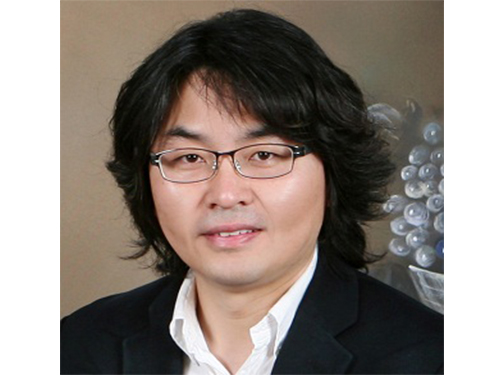 KAIST's Patina Engraving System Awarded at ACM CHI
Professor Tek-Jin Nam’s research team of the Industrial Design Department of KAIST received the Best Paper Award in the 2015 Association for Computing Machinery’s (ACM) Conference on Human Factors in Computing Systems (CHI) which was held from April 18 to 23, 2015. The team consisted of two KAIST students: Moon-Hwan Lee, a Ph.D. candidate, and Sejin Cha, a master's student. The team was the first in Asia to receive the award.
The ACM CHI represents the premier conference in the field of Human-Computer Interaction (HCI). This year’s event, held in Seoul, South Korea, was the first conference that the ACM had held in Asia in its thirty-three year history. The KAIST team’s paper, entitled “Patina Engraver: Visualizing Activity Logs as Patina in Fashionable Trackers,” ranked in the top 1% of 2,000 submitted papers.
The team developed Patina Engraver, an activity tracker, which monitors and tracks fitness-related metrics such as distances walked or run, calorie consumption, heartbeat, sleep quality, and blood pressure. The device wirelessly connects to a computer or smartphone so that it can store and utilize long-term tracking data.
However, what makes Patina Engraver, a smart wristband, different from other health trackers is its ability to display different design patterns based on users’ activity on the surface of the wristband. The research team was inspired to build this system from the fact that wearable electronics including activity trackers can be used not only as health care devices, but also as fashion items to express emotions and personalities.
Equipped with an engraving feature, the charging pad or holder for Patina Engraver draws individualized patterns to reflect the user’s activities, such as walking or running, while the device is being charged. The pattern display syncs with the frequency of usage, therefore, the more the tracker is used, the greater the number of patterns will show up.
According to the team, since Patina Engraver provides users with a personalized illustration of their activity on the tracker, users are more motivated to put on the tracker and exercise.
Professor Nam said, “This research can be applied in producing other wearable devices to enhance users’ emotional satisfaction. When wearable technology is combined with design and emotion, the industry market will quickly expand.”
Figure 1: Patina engraving system developed by KAIST research team
Figure 2: The process of engraving illustrations of the activity records onto the tracker
Figure 3: Personalized activity trackers based on activity records
2015.05.15 View 16165
KAIST's Patina Engraving System Awarded at ACM CHI
Professor Tek-Jin Nam’s research team of the Industrial Design Department of KAIST received the Best Paper Award in the 2015 Association for Computing Machinery’s (ACM) Conference on Human Factors in Computing Systems (CHI) which was held from April 18 to 23, 2015. The team consisted of two KAIST students: Moon-Hwan Lee, a Ph.D. candidate, and Sejin Cha, a master's student. The team was the first in Asia to receive the award.
The ACM CHI represents the premier conference in the field of Human-Computer Interaction (HCI). This year’s event, held in Seoul, South Korea, was the first conference that the ACM had held in Asia in its thirty-three year history. The KAIST team’s paper, entitled “Patina Engraver: Visualizing Activity Logs as Patina in Fashionable Trackers,” ranked in the top 1% of 2,000 submitted papers.
The team developed Patina Engraver, an activity tracker, which monitors and tracks fitness-related metrics such as distances walked or run, calorie consumption, heartbeat, sleep quality, and blood pressure. The device wirelessly connects to a computer or smartphone so that it can store and utilize long-term tracking data.
However, what makes Patina Engraver, a smart wristband, different from other health trackers is its ability to display different design patterns based on users’ activity on the surface of the wristband. The research team was inspired to build this system from the fact that wearable electronics including activity trackers can be used not only as health care devices, but also as fashion items to express emotions and personalities.
Equipped with an engraving feature, the charging pad or holder for Patina Engraver draws individualized patterns to reflect the user’s activities, such as walking or running, while the device is being charged. The pattern display syncs with the frequency of usage, therefore, the more the tracker is used, the greater the number of patterns will show up.
According to the team, since Patina Engraver provides users with a personalized illustration of their activity on the tracker, users are more motivated to put on the tracker and exercise.
Professor Nam said, “This research can be applied in producing other wearable devices to enhance users’ emotional satisfaction. When wearable technology is combined with design and emotion, the industry market will quickly expand.”
Figure 1: Patina engraving system developed by KAIST research team
Figure 2: The process of engraving illustrations of the activity records onto the tracker
Figure 3: Personalized activity trackers based on activity records
2015.05.15 View 16165 -
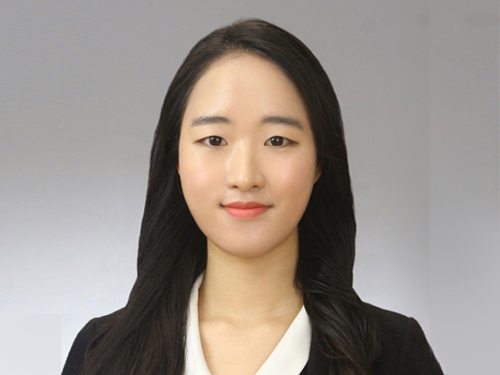 Seo-Eun Lee, an undergaruate student receives the Best Paper Award from Optical Society of Korea
Seo-Eun Lee, a student studying at KAIST’s Department of Biological Sciences, has won the Best Paper Award from Bio-Photonics Division at the 2014 Optical Society of Korea Winter Conference, held on 19th February at Daejeon Convention Center.
Only one outstanding paper per division is given an award among the total of 270 papers, and it is very unusual for an undergraduate student to win the award in the field that is not her major.
Lee has studied cell imaging using holography technology since June 2013 under the supervision of Professor Yong-Geun Park from the Department of Physics.
The Optical Society of Korea was founded in 1989, and as the largest academy in the field of optics in Korea, it holds academic presentations, seminars and lectures every year.
2014.03.06 View 11781
Seo-Eun Lee, an undergaruate student receives the Best Paper Award from Optical Society of Korea
Seo-Eun Lee, a student studying at KAIST’s Department of Biological Sciences, has won the Best Paper Award from Bio-Photonics Division at the 2014 Optical Society of Korea Winter Conference, held on 19th February at Daejeon Convention Center.
Only one outstanding paper per division is given an award among the total of 270 papers, and it is very unusual for an undergraduate student to win the award in the field that is not her major.
Lee has studied cell imaging using holography technology since June 2013 under the supervision of Professor Yong-Geun Park from the Department of Physics.
The Optical Society of Korea was founded in 1989, and as the largest academy in the field of optics in Korea, it holds academic presentations, seminars and lectures every year.
2014.03.06 View 11781 -
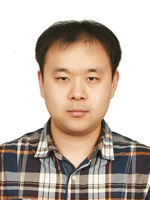 Seung-Han Lee, a doctoral student in electrical engineering, receives the best paper award from ISQED 2014
Seung-Han
Lee, a doctoral candidate in the department of electrical engineering at KAIST,
received a Best Paper Award from the International Symposium on Quality
Electronic Design (ISQED), a high-profile international conference started in 2000 to promote innovation and quality in electronic and
engineering designs through inter- and multidisciplinary approaches. The
award ceremony will take place at the 2014 ISQED on March 3-5, 2014 at the Convention
Center in Santa Clara, CA, USA.
Professor
Chong-Min Kyung, an advisor to Seung-Han, expressed his excitement about his student's achievement.
“This is
the first time a Korean has ever received the best paper award at this academic
conference. It’s great news to our student as well as to KAIST.”
The topic
of Lee’s research paper was dynamic cache data management for minimizing the
energy consumption of three-dimensional multi-processor semiconductor chips.
2014.03.03 View 12848
Seung-Han Lee, a doctoral student in electrical engineering, receives the best paper award from ISQED 2014
Seung-Han
Lee, a doctoral candidate in the department of electrical engineering at KAIST,
received a Best Paper Award from the International Symposium on Quality
Electronic Design (ISQED), a high-profile international conference started in 2000 to promote innovation and quality in electronic and
engineering designs through inter- and multidisciplinary approaches. The
award ceremony will take place at the 2014 ISQED on March 3-5, 2014 at the Convention
Center in Santa Clara, CA, USA.
Professor
Chong-Min Kyung, an advisor to Seung-Han, expressed his excitement about his student's achievement.
“This is
the first time a Korean has ever received the best paper award at this academic
conference. It’s great news to our student as well as to KAIST.”
The topic
of Lee’s research paper was dynamic cache data management for minimizing the
energy consumption of three-dimensional multi-processor semiconductor chips.
2014.03.03 View 12848 -
 College of Cultural Sciences Announces Results for 6th Best Paper Award
The College of Cultural Sciences cohosts with the EFL Program the Best Paper Award each semester. The Best Paper Awards went to Jo Hyeong Chan and Oh Shin Ah undergraduate students. The Best Paper Award was established in 2009 in order to encourage and improve the English writing skills of undergraduate students.
The College of Humanities and Social Sciences opened up 69 English courses in Spring of 2012 and 14 papers were recommended by the respective professors as ‘best papers’. Out of these papers 2 were selected for First Prize and 4 were selected as Honorable Mentions. The two recipients’ papers were recommended by Professor Park Woo Seok (Topics in Philosophy).
2012.10.16 View 8866
College of Cultural Sciences Announces Results for 6th Best Paper Award
The College of Cultural Sciences cohosts with the EFL Program the Best Paper Award each semester. The Best Paper Awards went to Jo Hyeong Chan and Oh Shin Ah undergraduate students. The Best Paper Award was established in 2009 in order to encourage and improve the English writing skills of undergraduate students.
The College of Humanities and Social Sciences opened up 69 English courses in Spring of 2012 and 14 papers were recommended by the respective professors as ‘best papers’. Out of these papers 2 were selected for First Prize and 4 were selected as Honorable Mentions. The two recipients’ papers were recommended by Professor Park Woo Seok (Topics in Philosophy).
2012.10.16 View 8866