%49%6e%63
-
 KAIST Reveals the Orbital Principle of Electron Motion for Realizing Memory of Dreams
<(From Left) Dr. Geun-Hee Lee, Professor Kyung-Jin Lee, Professor Kyoung-Whan Kim>
Research is actively underway to develop a “dream memory” that can reduce heat generation in smartphones and laptops while delivering faster performance and lower power consumption. Korean researchers have now proposed a new possibility for controlling magnetism using the exchange interaction of electron orbitals—the motion of electrons orbiting around an atomic nucleus—rather than relying on the conventional exchange interaction of electron spin, the rotational property of electrons inside semiconductors.
KAIST (President Kwang Hyung Lee) announced on the 16th of March that a joint research team led by Professor Kyung-Jin Lee of the Department of Physics at KAIST and Professor Kyoung-Whan Kim of the Department of Physics at Yonsei University (President Dong-Sup Yoon) has established, for the first time in the world, a new theoretical framework enabling magnetism to be freely controlled through orbital exchange interaction*, surpassing the limitations of conventional technologies that control magnetism using electric currents.*Orbital exchange interaction: a phenomenon in which the orbitals formed by electrons moving around an atomic nucleus interact with one another, thereby influencing the direction or properties of magnetism.
Until now, next-generation memory research has mainly focused on the spin of electrons. Spin refers to the property of electrons that rotate on their own axis like tiny spinning tops, and information can be stored by using the direction of this rotation. However, electrons simultaneously move around the atomic nucleus along paths known as orbitals. In this study, the research team theoretically demonstrated that when electric current flows, the orbital energy of electrons interacts directly with the orbitals of magnetic materials, enabling the transmission of information. Through this mechanism, they confirmed that the properties of magnets can be altered much more efficiently than with conventional spin-based approaches.
The most significant outcome of this research is the discovery that electric current does not merely change the direction of a magnet but can also modify the intrinsic properties of the magnet itself, such as the magnetic anisotropy (a magnet’s preferred direction) and rotational characteristics.
In particular, calculations by the research team showed that orbital-based control effects could be significantly stronger than existing spin-based methods. This finding suggests the possibility of a future era of orbital-based electronic devices, in which orbitals rather than spin play the central role in semiconductor components. The researchers also proposed practical experimental methods to measure these effects, which is expected to increase the potential for industrial applications.
The principle may also apply to altermagnetic materials, which have recently attracted significant attention in academia. Altermagnetism refers to a new form of magnetic material in which electron spins within atoms are arranged in alternating directions in an ordered pattern. Although these materials do not appear magnetic externally, they strongly influence electron motion. Because of this property, they allow precise control of electron states and are considered promising for high-speed, low-power semiconductor devices and next-generation memory technologies. The study therefore provides a strong theoretical foundation for developing future logic and memory devices.
Dr. Geun-Hee Lee stated, “This study demonstrates that controlling magnetism with electric current does not necessarily have to rely solely on spin. A new perspective—understanding and controlling magnetism using the orbital motion of electrons—will become an important milestone for the development of next-generation ultra-fast, low-power memory.”
In this research, Dr. Geun-Hee Lee (KAIST) participated as the first author, while Professor Kyoung-Whan Kim (Yonsei University) and Professor Kyung-Jin Lee (KAIST) served as co-corresponding authors. The results were published on February 2 in the internationally renowned journal Nature Communications, recognizing the academic significance of the work.
※ Paper title: “Orbital exchange-mediated current control of magnetism,” DOI: https://doi.org/10.1038/s41467-026-68846-x
This research was supported by the Frontier Challenge R&D Project, the Mid-Career Researcher Program, the Science Research Center (SRC) program, the Early Career Researcher Program of the National Research Foundation of Korea, and Samsung Electronics.
2026.03.16 View 953
KAIST Reveals the Orbital Principle of Electron Motion for Realizing Memory of Dreams
<(From Left) Dr. Geun-Hee Lee, Professor Kyung-Jin Lee, Professor Kyoung-Whan Kim>
Research is actively underway to develop a “dream memory” that can reduce heat generation in smartphones and laptops while delivering faster performance and lower power consumption. Korean researchers have now proposed a new possibility for controlling magnetism using the exchange interaction of electron orbitals—the motion of electrons orbiting around an atomic nucleus—rather than relying on the conventional exchange interaction of electron spin, the rotational property of electrons inside semiconductors.
KAIST (President Kwang Hyung Lee) announced on the 16th of March that a joint research team led by Professor Kyung-Jin Lee of the Department of Physics at KAIST and Professor Kyoung-Whan Kim of the Department of Physics at Yonsei University (President Dong-Sup Yoon) has established, for the first time in the world, a new theoretical framework enabling magnetism to be freely controlled through orbital exchange interaction*, surpassing the limitations of conventional technologies that control magnetism using electric currents.*Orbital exchange interaction: a phenomenon in which the orbitals formed by electrons moving around an atomic nucleus interact with one another, thereby influencing the direction or properties of magnetism.
Until now, next-generation memory research has mainly focused on the spin of electrons. Spin refers to the property of electrons that rotate on their own axis like tiny spinning tops, and information can be stored by using the direction of this rotation. However, electrons simultaneously move around the atomic nucleus along paths known as orbitals. In this study, the research team theoretically demonstrated that when electric current flows, the orbital energy of electrons interacts directly with the orbitals of magnetic materials, enabling the transmission of information. Through this mechanism, they confirmed that the properties of magnets can be altered much more efficiently than with conventional spin-based approaches.
The most significant outcome of this research is the discovery that electric current does not merely change the direction of a magnet but can also modify the intrinsic properties of the magnet itself, such as the magnetic anisotropy (a magnet’s preferred direction) and rotational characteristics.
In particular, calculations by the research team showed that orbital-based control effects could be significantly stronger than existing spin-based methods. This finding suggests the possibility of a future era of orbital-based electronic devices, in which orbitals rather than spin play the central role in semiconductor components. The researchers also proposed practical experimental methods to measure these effects, which is expected to increase the potential for industrial applications.
The principle may also apply to altermagnetic materials, which have recently attracted significant attention in academia. Altermagnetism refers to a new form of magnetic material in which electron spins within atoms are arranged in alternating directions in an ordered pattern. Although these materials do not appear magnetic externally, they strongly influence electron motion. Because of this property, they allow precise control of electron states and are considered promising for high-speed, low-power semiconductor devices and next-generation memory technologies. The study therefore provides a strong theoretical foundation for developing future logic and memory devices.
Dr. Geun-Hee Lee stated, “This study demonstrates that controlling magnetism with electric current does not necessarily have to rely solely on spin. A new perspective—understanding and controlling magnetism using the orbital motion of electrons—will become an important milestone for the development of next-generation ultra-fast, low-power memory.”
In this research, Dr. Geun-Hee Lee (KAIST) participated as the first author, while Professor Kyoung-Whan Kim (Yonsei University) and Professor Kyung-Jin Lee (KAIST) served as co-corresponding authors. The results were published on February 2 in the internationally renowned journal Nature Communications, recognizing the academic significance of the work.
※ Paper title: “Orbital exchange-mediated current control of magnetism,” DOI: https://doi.org/10.1038/s41467-026-68846-x
This research was supported by the Frontier Challenge R&D Project, the Mid-Career Researcher Program, the Science Research Center (SRC) program, the Early Career Researcher Program of the National Research Foundation of Korea, and Samsung Electronics.
2026.03.16 View 953 -
 KAIST–Princeton University Officially Launch “Net-Zero Korea” to Address Climate Crisis
KAIST (President Kwang Hyung Lee) announced on the 27th of August that a research team led by Professor Hae-Won Jeon of the Graduate School of Green Growth and Sustainable Development has signed a memorandum of understanding (MOU) with the Andlinger Center for Energy and the Environment at Princeton University in the United States to promote joint research on carbon neutrality, officially launching the Net-Zero Korea (NZK) project. This project was unveiled at the World Climate Industry EXPO (WCE) held in BEXCO, Busan, and will begin with seed funding from Google.
The NZK project aims, in the short term, to accelerate the transition of Korea’s energy and industrial sectors toward carbon neutrality, and in the mid- to long term, to strengthen Korea’s energy system modeling capabilities for policy formulation and implementation. Energy system modeling plays a critical role in studying the transition to clean energy and carbon neutrality.
In particular, this research plans to apply Princeton’s leading modeling methodologies from the Net-Zero America project—published in 2021 and widely recognized—to the Korean context by integrating them with KAIST’s integrated assessment modeling research.
The Net-Zero Korea project will be supported by funding from Google, KAIST, and Princeton University. This research is characterized by its detailed analysis of a wide range of factors, from regional land-use changes to job creation, and by concretely visualizing the resulting transformations in energy and industrial systems. It will also be conducted through an international collaborative network while reflecting Korea’s specific conditions. In particular, KAIST will develop an optimization-based open-source energy and industrial system model that integrates the effects of international trade, thereby contributing to global academia and policy research.
Therefore, the core of this modeling research is to apply to Korea the precise analysis and realistic approach that drew attention in Net-Zero America. Through this, it will be possible to visualize changes in the energy and industrial systems at high spatial, temporal, sectoral, and technological resolution, and to comprehensively analyze various factors such as regional land-use changes, capital investment requirements, job creation, and health impacts from air pollution. This will provide stakeholders with practical and reliable information.
In addition, the KAIST research team will collaborate with Princeton researchers, who have conducted national-scale decarbonization modeling studies with major research institutions in Australia, Brazil, China, India, Poland, and others, leveraging a global research network for joint studies.
Building on its experience in developing globally recognized integrated assessment models (IAM) tailored to Korea, KAIST will lead a new initiative to integrate international trade impacts into optimization-based open-source energy and industrial system models. This effort seeks to overcome the limitations of existing national energy modeling by reflecting the particularity of Korea, where trade plays a vital role across the economy.
Professor Wei Peng, Princeton’s principal investigator, said: “Through collaboration with KAIST’s world-class experts in integrated assessment modeling, we will be able to build new research that combines the strengths of macro-energy models and integrated assessment models, thereby developing capabilities applicable to many countries where trade plays a crucial role in the economy, such as Korea.”
Antonia Gawel, Director of Partnerships at Google, stated: “We are very pleased to support this meaningful research being conducted by KAIST and Princeton University in Korea. It will greatly help Google achieve our goal of net-zero emissions across our supply chain by 2030.”
Professor Haewon McJeon of KAIST commented: “Through joint research with Princeton University, which has been leading net-zero studies, we expect to provide science-based evidence to support Korea’s achievement of carbon neutrality and sustainable energy.”
President Kwang Hyung Lee of KAIST remarked: “It is deeply meaningful that KAIST, as Korea’s representative research institution, joins hands with Princeton University, a leading institution in the United States, to jointly build a science-based policy support system for responding to the climate crisis. This collaboration will contribute not only to achieving carbon neutrality in Korean society but also to the global response to the climate crisis.”
2025.08.28 View 4776
KAIST–Princeton University Officially Launch “Net-Zero Korea” to Address Climate Crisis
KAIST (President Kwang Hyung Lee) announced on the 27th of August that a research team led by Professor Hae-Won Jeon of the Graduate School of Green Growth and Sustainable Development has signed a memorandum of understanding (MOU) with the Andlinger Center for Energy and the Environment at Princeton University in the United States to promote joint research on carbon neutrality, officially launching the Net-Zero Korea (NZK) project. This project was unveiled at the World Climate Industry EXPO (WCE) held in BEXCO, Busan, and will begin with seed funding from Google.
The NZK project aims, in the short term, to accelerate the transition of Korea’s energy and industrial sectors toward carbon neutrality, and in the mid- to long term, to strengthen Korea’s energy system modeling capabilities for policy formulation and implementation. Energy system modeling plays a critical role in studying the transition to clean energy and carbon neutrality.
In particular, this research plans to apply Princeton’s leading modeling methodologies from the Net-Zero America project—published in 2021 and widely recognized—to the Korean context by integrating them with KAIST’s integrated assessment modeling research.
The Net-Zero Korea project will be supported by funding from Google, KAIST, and Princeton University. This research is characterized by its detailed analysis of a wide range of factors, from regional land-use changes to job creation, and by concretely visualizing the resulting transformations in energy and industrial systems. It will also be conducted through an international collaborative network while reflecting Korea’s specific conditions. In particular, KAIST will develop an optimization-based open-source energy and industrial system model that integrates the effects of international trade, thereby contributing to global academia and policy research.
Therefore, the core of this modeling research is to apply to Korea the precise analysis and realistic approach that drew attention in Net-Zero America. Through this, it will be possible to visualize changes in the energy and industrial systems at high spatial, temporal, sectoral, and technological resolution, and to comprehensively analyze various factors such as regional land-use changes, capital investment requirements, job creation, and health impacts from air pollution. This will provide stakeholders with practical and reliable information.
In addition, the KAIST research team will collaborate with Princeton researchers, who have conducted national-scale decarbonization modeling studies with major research institutions in Australia, Brazil, China, India, Poland, and others, leveraging a global research network for joint studies.
Building on its experience in developing globally recognized integrated assessment models (IAM) tailored to Korea, KAIST will lead a new initiative to integrate international trade impacts into optimization-based open-source energy and industrial system models. This effort seeks to overcome the limitations of existing national energy modeling by reflecting the particularity of Korea, where trade plays a vital role across the economy.
Professor Wei Peng, Princeton’s principal investigator, said: “Through collaboration with KAIST’s world-class experts in integrated assessment modeling, we will be able to build new research that combines the strengths of macro-energy models and integrated assessment models, thereby developing capabilities applicable to many countries where trade plays a crucial role in the economy, such as Korea.”
Antonia Gawel, Director of Partnerships at Google, stated: “We are very pleased to support this meaningful research being conducted by KAIST and Princeton University in Korea. It will greatly help Google achieve our goal of net-zero emissions across our supply chain by 2030.”
Professor Haewon McJeon of KAIST commented: “Through joint research with Princeton University, which has been leading net-zero studies, we expect to provide science-based evidence to support Korea’s achievement of carbon neutrality and sustainable energy.”
President Kwang Hyung Lee of KAIST remarked: “It is deeply meaningful that KAIST, as Korea’s representative research institution, joins hands with Princeton University, a leading institution in the United States, to jointly build a science-based policy support system for responding to the climate crisis. This collaboration will contribute not only to achieving carbon neutrality in Korean society but also to the global response to the climate crisis.”
2025.08.28 View 4776 -
 KAIST Develops Virtual Staining Technology for 3D Histopathology
Moving beyond traditional methods of observing thinly sliced and stained cancer tissues, a collaborative international research team led by KAIST has successfully developed a groundbreaking technology. This innovation uses advanced optical techniques combined with an artificial intelligence-based deep learning algorithm to create realistic, virtually stained 3D images of cancer tissue without the need for serial sectioning nor staining. This breakthrough is anticipated to pave the way for next-generation non-invasive pathological diagnosis.
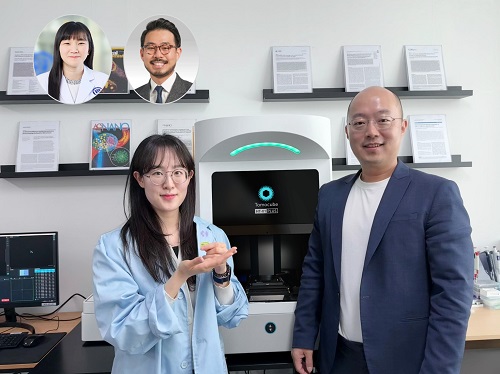
< Photo 1. (From left) Juyeon Park (Ph.D. Candidate, Department of Physics), Professor YongKeun Park (Department of Physics) (Top left) Professor Su-Jin Shin (Gangnam Severance Hospital), Professor Tae Hyun Hwang (Vanderbilt University School of Medicine) >
KAIST (President Kwang Hyung Lee) announced on the 26th that a research team led by Professor YongKeun Park of the Department of Physics, in collaboration with Professor Su-Jin Shin's team at Yonsei University Gangnam Severance Hospital, Professor Tae Hyun Hwang's team at Mayo Clinic, and Tomocube's AI research team, has developed an innovative technology capable of vividly displaying the 3D structure of cancer tissues without separate staining.
For over 200 years, conventional pathology has relied on observing cancer tissues under a microscope, a method that only shows specific cross-sections of the 3D cancer tissue. This has limited the ability to understand the three-dimensional connections and spatial arrangements between cells.
To overcome this, the research team utilized holotomography (HT), an advanced optical technology, to measure the 3D refractive index information of tissues. They then integrated an AI-based deep learning algorithm to successfully generate virtual H&E* images.* H&E (Hematoxylin & Eosin): The most widely used staining method for observing pathological tissues. Hematoxylin stains cell nuclei blue, and eosin stains cytoplasm pink.
The research team quantitatively demonstrated that the images generated by this technology are highly similar to actual stained tissue images. Furthermore, the technology exhibited consistent performance across various organs and tissues, proving its versatility and reliability as a next-generation pathological analysis tool.
< Figure 1. Comparison of conventional 3D tissue pathology procedure and the 3D virtual H&E staining technology proposed in this study. The traditional method requires preparing and staining dozens of tissue slides, while the proposed technology can reduce the number of slides by up to 10 times and quickly generate H&E images without the staining process. >
Moreover, by validating the feasibility of this technology through joint research with hospitals and research institutions in Korea and the United States, utilizing Tomocube's holotomography equipment, the team demonstrated its potential for full-scale adoption in real-world pathological research settings.
Professor YongKeun Park stated, "This research marks a major advancement by transitioning pathological analysis from conventional 2D methods to comprehensive 3D imaging. It will greatly enhance biomedical research and clinical diagnostics, particularly in understanding cancer tumor boundaries and the intricate spatial arrangements of cells within tumor microenvironments."
< Figure 2. Results of AI-based 3D virtual H&E staining and quantitative analysis of pathological tissue. The virtually stained images enabled 3D reconstruction of key pathological features such as cell nuclei and glandular lumens. Based on this, various quantitative indicators, including cell nuclear distribution, volume, and surface area, could be extracted. >
This research, with Juyeon Park, a student of the Integrated Master’s and Ph.D. Program at KAIST, as the first author, was published online in the prestigious journal Nature Communications on May 22.
(Paper title: Revealing 3D microanatomical structures of unlabeled thick cancer tissues using holotomography and virtual H&E staining.
[https://doi.org/10.1038/s41467-025-59820-0]
This study was supported by the Leader Researcher Program of the National Research Foundation of Korea, the Global Industry Technology Cooperation Center Project of the Korea Institute for Advancement of Technology, and the Korea Health Industry Development Institute.
2025.05.26 View 11342
KAIST Develops Virtual Staining Technology for 3D Histopathology
Moving beyond traditional methods of observing thinly sliced and stained cancer tissues, a collaborative international research team led by KAIST has successfully developed a groundbreaking technology. This innovation uses advanced optical techniques combined with an artificial intelligence-based deep learning algorithm to create realistic, virtually stained 3D images of cancer tissue without the need for serial sectioning nor staining. This breakthrough is anticipated to pave the way for next-generation non-invasive pathological diagnosis.
< Photo 1. (From left) Juyeon Park (Ph.D. Candidate, Department of Physics), Professor YongKeun Park (Department of Physics) (Top left) Professor Su-Jin Shin (Gangnam Severance Hospital), Professor Tae Hyun Hwang (Vanderbilt University School of Medicine) >
KAIST (President Kwang Hyung Lee) announced on the 26th that a research team led by Professor YongKeun Park of the Department of Physics, in collaboration with Professor Su-Jin Shin's team at Yonsei University Gangnam Severance Hospital, Professor Tae Hyun Hwang's team at Mayo Clinic, and Tomocube's AI research team, has developed an innovative technology capable of vividly displaying the 3D structure of cancer tissues without separate staining.
For over 200 years, conventional pathology has relied on observing cancer tissues under a microscope, a method that only shows specific cross-sections of the 3D cancer tissue. This has limited the ability to understand the three-dimensional connections and spatial arrangements between cells.
To overcome this, the research team utilized holotomography (HT), an advanced optical technology, to measure the 3D refractive index information of tissues. They then integrated an AI-based deep learning algorithm to successfully generate virtual H&E* images.* H&E (Hematoxylin & Eosin): The most widely used staining method for observing pathological tissues. Hematoxylin stains cell nuclei blue, and eosin stains cytoplasm pink.
The research team quantitatively demonstrated that the images generated by this technology are highly similar to actual stained tissue images. Furthermore, the technology exhibited consistent performance across various organs and tissues, proving its versatility and reliability as a next-generation pathological analysis tool.
< Figure 1. Comparison of conventional 3D tissue pathology procedure and the 3D virtual H&E staining technology proposed in this study. The traditional method requires preparing and staining dozens of tissue slides, while the proposed technology can reduce the number of slides by up to 10 times and quickly generate H&E images without the staining process. >
Moreover, by validating the feasibility of this technology through joint research with hospitals and research institutions in Korea and the United States, utilizing Tomocube's holotomography equipment, the team demonstrated its potential for full-scale adoption in real-world pathological research settings.
Professor YongKeun Park stated, "This research marks a major advancement by transitioning pathological analysis from conventional 2D methods to comprehensive 3D imaging. It will greatly enhance biomedical research and clinical diagnostics, particularly in understanding cancer tumor boundaries and the intricate spatial arrangements of cells within tumor microenvironments."
< Figure 2. Results of AI-based 3D virtual H&E staining and quantitative analysis of pathological tissue. The virtually stained images enabled 3D reconstruction of key pathological features such as cell nuclei and glandular lumens. Based on this, various quantitative indicators, including cell nuclear distribution, volume, and surface area, could be extracted. >
This research, with Juyeon Park, a student of the Integrated Master’s and Ph.D. Program at KAIST, as the first author, was published online in the prestigious journal Nature Communications on May 22.
(Paper title: Revealing 3D microanatomical structures of unlabeled thick cancer tissues using holotomography and virtual H&E staining.
[https://doi.org/10.1038/s41467-025-59820-0]
This study was supported by the Leader Researcher Program of the National Research Foundation of Korea, the Global Industry Technology Cooperation Center Project of the Korea Institute for Advancement of Technology, and the Korea Health Industry Development Institute.
2025.05.26 View 11342 -
 KAIST Research Team Breaks Down Musical Instincts with AI
Music, often referred to as the universal language, is known to be a common component in all cultures. Then, could ‘musical instinct’ be something that is shared to some degree despite the extensive environmental differences amongst cultures?
On January 16, a KAIST research team led by Professor Hawoong Jung from the Department of Physics announced to have identified the principle by which musical instincts emerge from the human brain without special learning using an artificial neural network model.
Previously, many researchers have attempted to identify the similarities and differences between the music that exist in various different cultures, and tried to understand the origin of the universality. A paper published in Science in 2019 had revealed that music is produced in all ethnographically distinct cultures, and that similar forms of beats and tunes are used. Neuroscientist have also previously found out that a specific part of the human brain, namely the auditory cortex, is responsible for processing musical information.
Professor Jung’s team used an artificial neural network model to show that cognitive functions for music forms spontaneously as a result of processing auditory information received from nature, without being taught music. The research team utilized AudioSet, a large-scale collection of sound data provided by Google, and taught the artificial neural network to learn the various sounds. Interestingly, the research team discovered that certain neurons within the network model would respond selectively to music. In other words, they observed the spontaneous generation of neurons that reacted minimally to various other sounds like those of animals, nature, or machines, but showed high levels of response to various forms of music including both instrumental and vocal.
The neurons in the artificial neural network model showed similar reactive behaviours to those in the auditory cortex of a real brain. For example, artificial neurons responded less to the sound of music that was cropped into short intervals and were rearranged. This indicates that the spontaneously-generated music-selective neurons encode the temporal structure of music. This property was not limited to a specific genre of music, but emerged across 25 different genres including classic, pop, rock, jazz, and electronic.
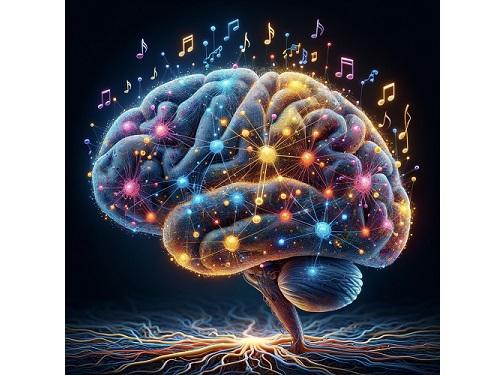
< Figure 1. Illustration of the musicality of the brain and artificial neural network (created with DALL·E3 AI based on the paper content) >
Furthermore, suppressing the activity of the music-selective neurons was found to greatly impede the cognitive accuracy for other natural sounds. That is to say, the neural function that processes musical information helps process other sounds, and that ‘musical ability’ may be an instinct formed as a result of an evolutionary adaptation acquired to better process sounds from nature.
Professor Hawoong Jung, who advised the research, said, “The results of our study imply that evolutionary pressure has contributed to forming the universal basis for processing musical information in various cultures.” As for the significance of the research, he explained, “We look forward for this artificially built model with human-like musicality to become an original model for various applications including AI music generation, musical therapy, and for research in musical cognition.” He also commented on its limitations, adding, “This research however does not take into consideration the developmental process that follows the learning of music, and it must be noted that this is a study on the foundation of processing musical information in early development.”
< Figure 2. The artificial neural network that learned to recognize non-musical natural sounds in the cyber space distinguishes between music and non-music. >
This research, conducted by first author Dr. Gwangsu Kim of the KAIST Department of Physics (current affiliation: MIT Department of Brain and Cognitive Sciences) and Dr. Dong-Kyum Kim (current affiliation: IBS) was published in Nature Communications under the title, “Spontaneous emergence of rudimentary music detectors in deep neural networks”.
This research was supported by the National Research Foundation of Korea.
2024.01.23 View 13354
KAIST Research Team Breaks Down Musical Instincts with AI
Music, often referred to as the universal language, is known to be a common component in all cultures. Then, could ‘musical instinct’ be something that is shared to some degree despite the extensive environmental differences amongst cultures?
On January 16, a KAIST research team led by Professor Hawoong Jung from the Department of Physics announced to have identified the principle by which musical instincts emerge from the human brain without special learning using an artificial neural network model.
Previously, many researchers have attempted to identify the similarities and differences between the music that exist in various different cultures, and tried to understand the origin of the universality. A paper published in Science in 2019 had revealed that music is produced in all ethnographically distinct cultures, and that similar forms of beats and tunes are used. Neuroscientist have also previously found out that a specific part of the human brain, namely the auditory cortex, is responsible for processing musical information.
Professor Jung’s team used an artificial neural network model to show that cognitive functions for music forms spontaneously as a result of processing auditory information received from nature, without being taught music. The research team utilized AudioSet, a large-scale collection of sound data provided by Google, and taught the artificial neural network to learn the various sounds. Interestingly, the research team discovered that certain neurons within the network model would respond selectively to music. In other words, they observed the spontaneous generation of neurons that reacted minimally to various other sounds like those of animals, nature, or machines, but showed high levels of response to various forms of music including both instrumental and vocal.
The neurons in the artificial neural network model showed similar reactive behaviours to those in the auditory cortex of a real brain. For example, artificial neurons responded less to the sound of music that was cropped into short intervals and were rearranged. This indicates that the spontaneously-generated music-selective neurons encode the temporal structure of music. This property was not limited to a specific genre of music, but emerged across 25 different genres including classic, pop, rock, jazz, and electronic.
< Figure 1. Illustration of the musicality of the brain and artificial neural network (created with DALL·E3 AI based on the paper content) >
Furthermore, suppressing the activity of the music-selective neurons was found to greatly impede the cognitive accuracy for other natural sounds. That is to say, the neural function that processes musical information helps process other sounds, and that ‘musical ability’ may be an instinct formed as a result of an evolutionary adaptation acquired to better process sounds from nature.
Professor Hawoong Jung, who advised the research, said, “The results of our study imply that evolutionary pressure has contributed to forming the universal basis for processing musical information in various cultures.” As for the significance of the research, he explained, “We look forward for this artificially built model with human-like musicality to become an original model for various applications including AI music generation, musical therapy, and for research in musical cognition.” He also commented on its limitations, adding, “This research however does not take into consideration the developmental process that follows the learning of music, and it must be noted that this is a study on the foundation of processing musical information in early development.”
< Figure 2. The artificial neural network that learned to recognize non-musical natural sounds in the cyber space distinguishes between music and non-music. >
This research, conducted by first author Dr. Gwangsu Kim of the KAIST Department of Physics (current affiliation: MIT Department of Brain and Cognitive Sciences) and Dr. Dong-Kyum Kim (current affiliation: IBS) was published in Nature Communications under the title, “Spontaneous emergence of rudimentary music detectors in deep neural networks”.
This research was supported by the National Research Foundation of Korea.
2024.01.23 View 13354 -
 KAIST to showcase a pack of KAIST Start-ups at CES 2023
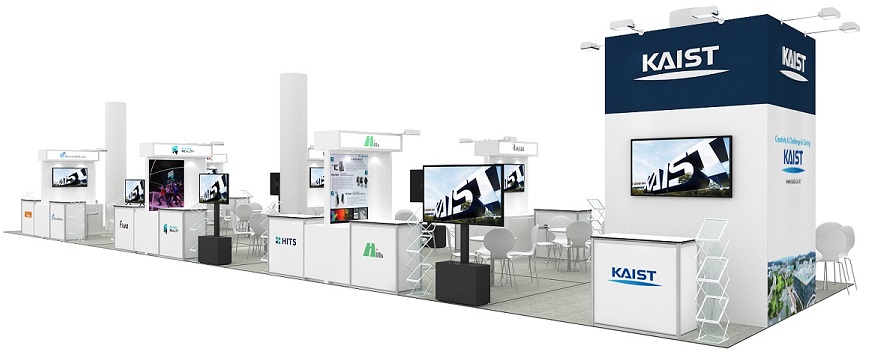
- KAIST is to run an Exclusive Booth at the Venetian Expo (Hall G) in Eureka Park, at CES 2023, to be held in Las Vegas from Thursday, January 5th through Sunday, the 8th.
- Twelve businesses recently put together by KAIST faculty, alumni, and the start-ups given legal usage of KAIST technologies will be showcased.
- Out of the participating start-ups, the products by Fluiz and Hills Robotics were selected as the “CES Innovation Award 2023 Honoree”, scoring top in their respective categories.
On January 3, KAIST announced that there will be a KAIST booth at Consumer Electronics Show (CES) 2023, the most influential tech event in the world, to be held in Las Vegas from January 3 to 8.
At this exclusive corner, KAIST will introduce the technologies of KAIST start-ups over the exhibition period.
KAIST first started holding its exclusive booth in CES 2019 with five start-up businesses, following up at CES 2020 with 12 start-ups and at CES 2022 with 10 start-ups. At CES 2023, which would be KAIST’s fourth conference, KAIST will be accompanying 12 businesses including start-ups by the faculty members, alumni, and technology transfer companies that just began their businesses with technologies from their research findings that stands a head above others.
To maximize the publicity opportunity, KAIST will support each company’s marketing strategies through cooperation with the Korea International Trade Association (KITA), and provide an opportunity for the school and each startup to create global identity and exhibit the excellence of their technologies at the convention.
The following companies will be at the KAIST Booth in Eureka Park:
The twelve startups mentioned above aim to achieve global technology commecialization in their respective fields of expertise spanning from eXtended Reality (XR) and gaming, to AI and robotics, vehicle and transport, mobile platform, smart city, autonomous driving, healthcare, internet of thing (IoT), through joint research and development, technology transfer and investment attraction from world’s leading institutions and enterprises.
In particular, Fluiz and Hills Robotics won the CES Innovation Award as 2023 Honorees and is expected to attain greater achievements in the future.
A staff member from the KAIST Institute of Technology Value Creation said, “The KAIST Showcase for CES 2023 has prepared a new pitching space for each of the companies for their own IR efforts, and we hope that KAIST startups will actively and effectively market their products and technologies while they are at the convention. We hope it will help them utilize their time here to establish their name in presence here which will eventually serve as a good foothold for them and their predecessors to further global commercialization goals.”
2023.01.04 View 29312
KAIST to showcase a pack of KAIST Start-ups at CES 2023
- KAIST is to run an Exclusive Booth at the Venetian Expo (Hall G) in Eureka Park, at CES 2023, to be held in Las Vegas from Thursday, January 5th through Sunday, the 8th.
- Twelve businesses recently put together by KAIST faculty, alumni, and the start-ups given legal usage of KAIST technologies will be showcased.
- Out of the participating start-ups, the products by Fluiz and Hills Robotics were selected as the “CES Innovation Award 2023 Honoree”, scoring top in their respective categories.
On January 3, KAIST announced that there will be a KAIST booth at Consumer Electronics Show (CES) 2023, the most influential tech event in the world, to be held in Las Vegas from January 3 to 8.
At this exclusive corner, KAIST will introduce the technologies of KAIST start-ups over the exhibition period.
KAIST first started holding its exclusive booth in CES 2019 with five start-up businesses, following up at CES 2020 with 12 start-ups and at CES 2022 with 10 start-ups. At CES 2023, which would be KAIST’s fourth conference, KAIST will be accompanying 12 businesses including start-ups by the faculty members, alumni, and technology transfer companies that just began their businesses with technologies from their research findings that stands a head above others.
To maximize the publicity opportunity, KAIST will support each company’s marketing strategies through cooperation with the Korea International Trade Association (KITA), and provide an opportunity for the school and each startup to create global identity and exhibit the excellence of their technologies at the convention.
The following companies will be at the KAIST Booth in Eureka Park:
The twelve startups mentioned above aim to achieve global technology commecialization in their respective fields of expertise spanning from eXtended Reality (XR) and gaming, to AI and robotics, vehicle and transport, mobile platform, smart city, autonomous driving, healthcare, internet of thing (IoT), through joint research and development, technology transfer and investment attraction from world’s leading institutions and enterprises.
In particular, Fluiz and Hills Robotics won the CES Innovation Award as 2023 Honorees and is expected to attain greater achievements in the future.
A staff member from the KAIST Institute of Technology Value Creation said, “The KAIST Showcase for CES 2023 has prepared a new pitching space for each of the companies for their own IR efforts, and we hope that KAIST startups will actively and effectively market their products and technologies while they are at the convention. We hope it will help them utilize their time here to establish their name in presence here which will eventually serve as a good foothold for them and their predecessors to further global commercialization goals.”
2023.01.04 View 29312 -
 KAIST-NYU Digital Governance Forum Held
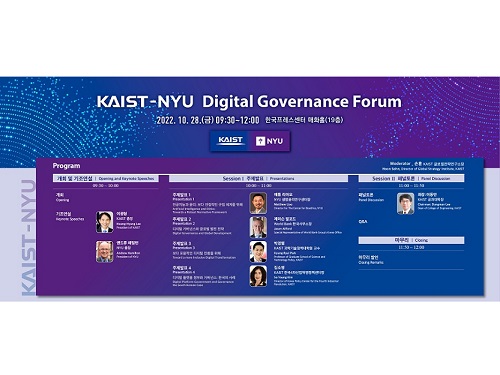
KAIST (President Kwang Hyung Lee) held the 'KAIST-NYU Digital Governance Forum' at the Korea Press Center in the morning of October 28th, 2022.
This forum was held in continuation to discuss the objectives of the 'Digital Vision Forum' that was hosted by New York University (NYU) back in September in the United States, and is the first public event to be held through joint efforts by KAIST and NYU since the signage of the 'KAIST-NYU Joint Campus' was presented at the New York forum.
< Signage of KAIST-NYU Joint Campus >
This forum was promoted based on the consensus of the two universities to create an international forum of solidarity to solve global challenges and seek new governance in the era of digital transformation.
Digital innovation technology is expected to bring economic and industrial benefits as well as political, social and ethical risks such as accelerating the digital divide, among others. In particular, in a time of global digital transformation, as the competition for digital and AI supremacy based on technology nationalism catches fire, there is an emergent need for a global governance system in which digital innovation and the value of freedom co-exist. With the consensus formed through this forum with NYU, KAIST plans to focus on detailing the vision for future digital cooperation that encompasses various stakeholders in our society.
To this end, President Kwang Hyung Lee of KAIST and President Andrew Hamilton of NYU led the forum with keynote addresses with President Hamilton taking part virtually, followed by NYU Professor Matthew Liao, a world-renowned scholar specialized in the ethics in the field of science and technology, and Jason Allford, Special Representative of the World Bank Group to Korea, presenting on relevant topics for discussion.
From KAIST, Professor Kyung Ryul Park of the Graduate School of Science and Technology Policy and Director So Young Kim of the Korea Policy Center for the Fourth Industrial Revolution, followed with their presentations. A panel discussion on governance in the period of digital transformation was also held, led by Professor Dongman Lee, the Dean of the College of Engineering.
To kick things off, Professor Matthew Liao of NYU proposed a normative system that can harmonize technology and social ethics while explaining various ethical issues following the technological development of artificial intelligence.
Jason Allford, Special Representative of the World Bank Group to Korea, outlined the changing roles of government in the digital era from the perspective of transparency and government efficiency and explained global development strategies through various cases of digital innovations by international organizations.
Professor Kyung Ryul Park of the Graduate School of Science and Technology Policy at KAIST emphasized that the core of new digital governance is not only innovative technology but also the participation and harmony of various stakeholders at home at abroad and brought up the importance of multi-dimensional international solidarity based on digital transformation that goes beyond the flat ‘technological geopolitics.’
Professor So Young Kim, the Director of the Korea Policy Center for the Fourth Industrial Revolution at KAIST, commented on the current government's digital platform strategy and emphasized the need for a leading digital transformation strategy that goes beyond the governance of the existing government.
Edward Mermelstein, the Commissioner for International Affairs of New York City, said, “The City of New York, shall also provide active support for the cooperative governance initiative organized by KAIST in Korea. As the conversation progresses further, we can draw up plans to organize international organizations to support the effort, likely to be named ‘Digitization for Good’, and we can go on to consider future collaboration,” to express the city’s willingness and anticipation for active cooperation.
Andrew Hamilton, the President of NYU, said "NYU is thrilled by the partnership we are embarking upon with KAIST, which goes hand in hand with our global tradition, and is based upon our bedrock commitment to the free movement of people and ideas.” He added that “As data-driven software, AI, and social networks become even more essential parts of our daily lives, I am confident that today’s discussions will lead to new and promising insights.”
President Kwang Hyung Lee of KAIST said, “It is significant that we are to cooperate with New York University to prepare a venue to assess the changes of the forth coming era at a time in which digital technology, government platforms, and public data are attracting attention as a medium that can create various social and economic value.”
President Lee added, “KAIST and NYU, the two institutions in cross-continental partnership to lead innovations in higher education via the creation of a joint campus, have joined forces to host this forum to create an opportunity to envision the future of a cooperative governance that is inclusive of key players like the government, businesses, the civil societies, academia, and international organizations.”
The 'KAIST-NYU Digital Governance Forum' was broadcast live on KAIST’s Official YouTube Channel from 9:30 am on the 28th of October (Korea Standard Time) with simultaneous interpretation provided in both Korean and English. A recording of the video is available online for everyone to watch free of charge.
KAIST’s YouTube Channel: https://www.youtube.com/c/KAISTofficial
Forum Recording with English interpretation: https://youtu.be/Vs31i7BtfEw
2022.10.28 View 11531
KAIST-NYU Digital Governance Forum Held
KAIST (President Kwang Hyung Lee) held the 'KAIST-NYU Digital Governance Forum' at the Korea Press Center in the morning of October 28th, 2022.
This forum was held in continuation to discuss the objectives of the 'Digital Vision Forum' that was hosted by New York University (NYU) back in September in the United States, and is the first public event to be held through joint efforts by KAIST and NYU since the signage of the 'KAIST-NYU Joint Campus' was presented at the New York forum.
< Signage of KAIST-NYU Joint Campus >
This forum was promoted based on the consensus of the two universities to create an international forum of solidarity to solve global challenges and seek new governance in the era of digital transformation.
Digital innovation technology is expected to bring economic and industrial benefits as well as political, social and ethical risks such as accelerating the digital divide, among others. In particular, in a time of global digital transformation, as the competition for digital and AI supremacy based on technology nationalism catches fire, there is an emergent need for a global governance system in which digital innovation and the value of freedom co-exist. With the consensus formed through this forum with NYU, KAIST plans to focus on detailing the vision for future digital cooperation that encompasses various stakeholders in our society.
To this end, President Kwang Hyung Lee of KAIST and President Andrew Hamilton of NYU led the forum with keynote addresses with President Hamilton taking part virtually, followed by NYU Professor Matthew Liao, a world-renowned scholar specialized in the ethics in the field of science and technology, and Jason Allford, Special Representative of the World Bank Group to Korea, presenting on relevant topics for discussion.
From KAIST, Professor Kyung Ryul Park of the Graduate School of Science and Technology Policy and Director So Young Kim of the Korea Policy Center for the Fourth Industrial Revolution, followed with their presentations. A panel discussion on governance in the period of digital transformation was also held, led by Professor Dongman Lee, the Dean of the College of Engineering.
To kick things off, Professor Matthew Liao of NYU proposed a normative system that can harmonize technology and social ethics while explaining various ethical issues following the technological development of artificial intelligence.
Jason Allford, Special Representative of the World Bank Group to Korea, outlined the changing roles of government in the digital era from the perspective of transparency and government efficiency and explained global development strategies through various cases of digital innovations by international organizations.
Professor Kyung Ryul Park of the Graduate School of Science and Technology Policy at KAIST emphasized that the core of new digital governance is not only innovative technology but also the participation and harmony of various stakeholders at home at abroad and brought up the importance of multi-dimensional international solidarity based on digital transformation that goes beyond the flat ‘technological geopolitics.’
Professor So Young Kim, the Director of the Korea Policy Center for the Fourth Industrial Revolution at KAIST, commented on the current government's digital platform strategy and emphasized the need for a leading digital transformation strategy that goes beyond the governance of the existing government.
Edward Mermelstein, the Commissioner for International Affairs of New York City, said, “The City of New York, shall also provide active support for the cooperative governance initiative organized by KAIST in Korea. As the conversation progresses further, we can draw up plans to organize international organizations to support the effort, likely to be named ‘Digitization for Good’, and we can go on to consider future collaboration,” to express the city’s willingness and anticipation for active cooperation.
Andrew Hamilton, the President of NYU, said "NYU is thrilled by the partnership we are embarking upon with KAIST, which goes hand in hand with our global tradition, and is based upon our bedrock commitment to the free movement of people and ideas.” He added that “As data-driven software, AI, and social networks become even more essential parts of our daily lives, I am confident that today’s discussions will lead to new and promising insights.”
President Kwang Hyung Lee of KAIST said, “It is significant that we are to cooperate with New York University to prepare a venue to assess the changes of the forth coming era at a time in which digital technology, government platforms, and public data are attracting attention as a medium that can create various social and economic value.”
President Lee added, “KAIST and NYU, the two institutions in cross-continental partnership to lead innovations in higher education via the creation of a joint campus, have joined forces to host this forum to create an opportunity to envision the future of a cooperative governance that is inclusive of key players like the government, businesses, the civil societies, academia, and international organizations.”
The 'KAIST-NYU Digital Governance Forum' was broadcast live on KAIST’s Official YouTube Channel from 9:30 am on the 28th of October (Korea Standard Time) with simultaneous interpretation provided in both Korean and English. A recording of the video is available online for everyone to watch free of charge.
KAIST’s YouTube Channel: https://www.youtube.com/c/KAISTofficial
Forum Recording with English interpretation: https://youtu.be/Vs31i7BtfEw
2022.10.28 View 11531 -
 ‘Urban Green Space Affects Citizens’ Happiness’
Study finds the relationship between green space, the economy, and happiness
A recent study revealed that as a city becomes more economically developed, its citizens’ happiness becomes more directly related to the area of urban green space.
A joint research project by Professor Meeyoung Cha of the School of Computing and her collaborators studied the relationship between green space and citizen happiness by analyzing big data from satellite images of 60 different countries.
Urban green space, including parks, gardens, and riversides not only provides aesthetic pleasure, but also positively affects our health by promoting physical activity and social interactions. Most of the previous research attempting to verify the correlation between urban green space and citizen happiness was based on few developed countries. Therefore, it was difficult to identify whether the positive effects of green space are global, or merely phenomena that depended on the economic state of the country. There have also been limitations in data collection, as it is difficult to visit each location or carry out investigations on a large scale based on aerial photographs.
The research team used data collected by Sentinel-2, a high-resolution satellite operated by the European Space Agency (ESA) to investigate 90 green spaces from 60 different countries around the world. The subjects of analysis were cities with the highest population densities (cities that contain at least 10% of the national population), and the images were obtained during the summer of each region for clarity. Images from the northern hemisphere were obtained between June and September of 2018, and those from the southern hemisphere were obtained between December of 2017 and February of 2018.
The areas of urban green space were then quantified and crossed with data from the World Happiness Report and GDP by country reported by the United Nations in 2018. Using these data, the relationships between green space, the economy, and citizen happiness were analyzed.
The results showed that in all cities, citizen happiness was positively correlated with the area of urban green space regardless of the country’s economic state. However, out of the 60 countries studied, the happiness index of the bottom 30 by GDP showed a stronger correlation with economic growth. In countries whose gross national income (GDP per capita) was higher than 38,000 USD, the area of green space acted as a more important factor affecting happiness than economic growth. Data from Seoul was analyzed to represent South Korea, and showed an increased happiness index with increased green areas compared to the past.
The authors point out their work has several policy-level implications. First, public green space should be made accessible to urban dwellers to enhance social support. If public safety in urban parks is not guaranteed, its positive role in social support and happiness may diminish. Also, the meaning of public safety may change; for example, ensuring biological safety will be a priority in keeping urban parks accessible during the COVID-19 pandemic.
Second, urban planning for public green space is needed for both developed and developing countries. As it is challenging or nearly impossible to secure land for green space after the area is developed, urban planning for parks and green space should be considered in developing economies where new cities and suburban areas are rapidly expanding.
Third, recent climate changes can present substantial difficulty in sustaining urban green space. Extreme events such as wildfires, floods, droughts, and cold waves could endanger urban forests while global warming could conversely accelerate tree growth in cities due to the urban heat island effect. Thus, more attention must be paid to predict climate changes and discovering their impact on the maintenance of urban green space.
“There has recently been an increase in the number of studies using big data from satellite images to solve social conundrums,” said Professor Cha. “The tool developed for this investigation can also be used to quantify the area of aquatic environments like lakes and the seaside, and it will now be possible to analyze the relationship between citizen happiness and aquatic environments in future studies,” she added.
Professor Woo Sung Jung from POSTECH and Professor Donghee Wohn from the New Jersey Institute of Technology also joined this research. It was reported in the online issue of EPJ Data Science on May 30.
-PublicationOh-Hyun Kwon, Inho Hong, Jeasurk Yang, Donghee Y. Wohn, Woo-Sung Jung, andMeeyoung Cha, 2021. Urban green space and happiness in developed countries. EPJ Data Science. DOI: https://doi.org/10.1140/epjds/s13688-021-00278-7
-ProfileProfessor Meeyoung ChaData Science Labhttps://ds.ibs.re.kr/
School of Computing
KAIST
2021.06.21 View 19400
‘Urban Green Space Affects Citizens’ Happiness’
Study finds the relationship between green space, the economy, and happiness
A recent study revealed that as a city becomes more economically developed, its citizens’ happiness becomes more directly related to the area of urban green space.
A joint research project by Professor Meeyoung Cha of the School of Computing and her collaborators studied the relationship between green space and citizen happiness by analyzing big data from satellite images of 60 different countries.
Urban green space, including parks, gardens, and riversides not only provides aesthetic pleasure, but also positively affects our health by promoting physical activity and social interactions. Most of the previous research attempting to verify the correlation between urban green space and citizen happiness was based on few developed countries. Therefore, it was difficult to identify whether the positive effects of green space are global, or merely phenomena that depended on the economic state of the country. There have also been limitations in data collection, as it is difficult to visit each location or carry out investigations on a large scale based on aerial photographs.
The research team used data collected by Sentinel-2, a high-resolution satellite operated by the European Space Agency (ESA) to investigate 90 green spaces from 60 different countries around the world. The subjects of analysis were cities with the highest population densities (cities that contain at least 10% of the national population), and the images were obtained during the summer of each region for clarity. Images from the northern hemisphere were obtained between June and September of 2018, and those from the southern hemisphere were obtained between December of 2017 and February of 2018.
The areas of urban green space were then quantified and crossed with data from the World Happiness Report and GDP by country reported by the United Nations in 2018. Using these data, the relationships between green space, the economy, and citizen happiness were analyzed.
The results showed that in all cities, citizen happiness was positively correlated with the area of urban green space regardless of the country’s economic state. However, out of the 60 countries studied, the happiness index of the bottom 30 by GDP showed a stronger correlation with economic growth. In countries whose gross national income (GDP per capita) was higher than 38,000 USD, the area of green space acted as a more important factor affecting happiness than economic growth. Data from Seoul was analyzed to represent South Korea, and showed an increased happiness index with increased green areas compared to the past.
The authors point out their work has several policy-level implications. First, public green space should be made accessible to urban dwellers to enhance social support. If public safety in urban parks is not guaranteed, its positive role in social support and happiness may diminish. Also, the meaning of public safety may change; for example, ensuring biological safety will be a priority in keeping urban parks accessible during the COVID-19 pandemic.
Second, urban planning for public green space is needed for both developed and developing countries. As it is challenging or nearly impossible to secure land for green space after the area is developed, urban planning for parks and green space should be considered in developing economies where new cities and suburban areas are rapidly expanding.
Third, recent climate changes can present substantial difficulty in sustaining urban green space. Extreme events such as wildfires, floods, droughts, and cold waves could endanger urban forests while global warming could conversely accelerate tree growth in cities due to the urban heat island effect. Thus, more attention must be paid to predict climate changes and discovering their impact on the maintenance of urban green space.
“There has recently been an increase in the number of studies using big data from satellite images to solve social conundrums,” said Professor Cha. “The tool developed for this investigation can also be used to quantify the area of aquatic environments like lakes and the seaside, and it will now be possible to analyze the relationship between citizen happiness and aquatic environments in future studies,” she added.
Professor Woo Sung Jung from POSTECH and Professor Donghee Wohn from the New Jersey Institute of Technology also joined this research. It was reported in the online issue of EPJ Data Science on May 30.
-PublicationOh-Hyun Kwon, Inho Hong, Jeasurk Yang, Donghee Y. Wohn, Woo-Sung Jung, andMeeyoung Cha, 2021. Urban green space and happiness in developed countries. EPJ Data Science. DOI: https://doi.org/10.1140/epjds/s13688-021-00278-7
-ProfileProfessor Meeyoung ChaData Science Labhttps://ds.ibs.re.kr/
School of Computing
KAIST
2021.06.21 View 19400 -
 Professor Jihee Kim Wins the Lucas Prize for Her Income Inequality Theory
Professor Jihee Kim from the School of Business and Technology Management at KAIST was announced as one of two winners of the 2021 Robert E. Lucas Jr. Prize. Professor Kim was recognized for having provided an empirical analysis on engines of income growth, sources of income inequality, and their rich interplay in her paper published in the Journal of Political Economy (JPE) in October 2018. The co-author of this study, Professor Charles I. Jones at Stanford University, was honored to be another awardee of this year’s Lucas Prize.
The Robert E. Lucas Jr. Prize, simply known as the Lucas Prize, is awarded biannually for the most interesting paper in the area of Dynamic Economics published in the leading economics journal JPE in the preceding two years. The prize was established in 2016 in celebration of the 1995 Nobel Prize in Economics Laureate Dr. Lucas’s seminal contributions to economics. The two former prizes were presented in 2019 and 2017 respectively.
Professor Kim and Professor Jones, in their award-winning paper titled 'A Schumpeterian Model of Top Income Inequality', observed that top income inequality was relatively low and stable between 1960 and 1980, but then rose sharply in some countries, including the United States and the United Kingdom.
The authors focused on entrepreneurial activities and the resulting income as the driving force of income inequality. They assumed that the forces that increased the efforts of fast-growing entrepreneurs to improve their products or increased productivity of their efforts could increase income inequality. On the other hand, the forces that enhanced creative destruction or that raised the rate at which high-growth entrepreneurs lost that status could decrease income inequality, according to the authors’ theory.
Professor Kim explained, “Various economic forces due to globalization, the advancement in AI and IT technologies, taxes, and policies related to innovation blocking may explain the varied patterns in income inequality.”
“Through follow-up research, I will continue developing economic theory models that can analyze the impact of changes such as income tax rates and salary negotiations on income inequality,” she added.
Professor Kim received her bachelor’s degree from the KAIST School of Computing in 2005 and pursued her graduates studies at Stanford University, acquiring a master’s degree in economics in 2011 and a doctoral degree in management science and engineering in 2013.
(END)
2021.03.26 View 12235
Professor Jihee Kim Wins the Lucas Prize for Her Income Inequality Theory
Professor Jihee Kim from the School of Business and Technology Management at KAIST was announced as one of two winners of the 2021 Robert E. Lucas Jr. Prize. Professor Kim was recognized for having provided an empirical analysis on engines of income growth, sources of income inequality, and their rich interplay in her paper published in the Journal of Political Economy (JPE) in October 2018. The co-author of this study, Professor Charles I. Jones at Stanford University, was honored to be another awardee of this year’s Lucas Prize.
The Robert E. Lucas Jr. Prize, simply known as the Lucas Prize, is awarded biannually for the most interesting paper in the area of Dynamic Economics published in the leading economics journal JPE in the preceding two years. The prize was established in 2016 in celebration of the 1995 Nobel Prize in Economics Laureate Dr. Lucas’s seminal contributions to economics. The two former prizes were presented in 2019 and 2017 respectively.
Professor Kim and Professor Jones, in their award-winning paper titled 'A Schumpeterian Model of Top Income Inequality', observed that top income inequality was relatively low and stable between 1960 and 1980, but then rose sharply in some countries, including the United States and the United Kingdom.
The authors focused on entrepreneurial activities and the resulting income as the driving force of income inequality. They assumed that the forces that increased the efforts of fast-growing entrepreneurs to improve their products or increased productivity of their efforts could increase income inequality. On the other hand, the forces that enhanced creative destruction or that raised the rate at which high-growth entrepreneurs lost that status could decrease income inequality, according to the authors’ theory.
Professor Kim explained, “Various economic forces due to globalization, the advancement in AI and IT technologies, taxes, and policies related to innovation blocking may explain the varied patterns in income inequality.”
“Through follow-up research, I will continue developing economic theory models that can analyze the impact of changes such as income tax rates and salary negotiations on income inequality,” she added.
Professor Kim received her bachelor’s degree from the KAIST School of Computing in 2005 and pursued her graduates studies at Stanford University, acquiring a master’s degree in economics in 2011 and a doctoral degree in management science and engineering in 2013.
(END)
2021.03.26 View 12235 -
 Researchers Report Longest-lived Aqueous Flow Batteries
New technology to overcome the life limit of next-generation water-cell batteries
A research team led by Professor Hee-Tak Kim from the Department of Chemical and Biomolecular Engineering has developed water-based zinc/bromine redox flow batteries (ZBBs) with the best life expectancy among all the redox flow batteries reported by identifying and solving the deterioration issue with zinc electrodes.
Professor Kim, head of the Advanced Battery Center at KAIST's Nano-fusion Research Institute, said, "We presented a new technology to overcome the life limit of next-generation water-cell batteries. Not only is it cheaper than conventional lithium-ion batteries, but it can contribute to the expansion of renewable energy and the safe supply of energy storage systems that can run with more than 80 percent energy efficiency."
ZBBs were found to have stable life spans of more than 5,000 cycles, even at a high current density of 100 mA/cm2. It was also confirmed that it represented the highest output and life expectancy compared to Redox flow batteries (RFBs) reported worldwide, which use other redox couples such as zinc-bromine, zinc-iodine, zinc-iron, and vanadium.
Recently, more attention has been focused on energy storage system (ESS) that can improve energy utilization efficiency by storing new and late-night power in large quantities and supplying it to the grid if necessary to supplement the intermittent nature of renewable energy and meet peak power demand.
However, lithium-ion batteries (LIBs), which are currently the core technology of ESSs, have been criticized for not being suitable for ESSs, which store large amounts of electricity due to their inherent risk of ignition and fire. In fact, a total of 33 cases of ESSs using LIBs in Korea had fire accidents, and 35% of all ESS facilities were shut down. This is estimated to have resulted in more than 700 billion won in losses.
As a result, water-based RFBs have drawn great attention. In particular, ZBBs that use ultra-low-cost bromide (ZnBr2) as an active material have been developed for ESSs since the 1970s, with their advantages of high cell voltage, high energy density, and low price compared to other RFBs. Until now, however, the commercialization of ZBBs has been delayed due to the short life span caused by the zinc electrodes. In particular, the uneven "dendrite" growth behavior of zinc metals during the charging and discharging process leads to internal short circuits in the battery which shorten its life.
The research team noted that self-aggregation occurs through the surface diffusion of zinc nuclei on the carbon electrode surface with low surface energy, and determined that self-aggregation was the main cause of zinc dendrite formation through quantum mechanics-based computer simulations and transmission electron microscopy. Furthermore, it was found that the surface diffusion of the zinc nuclei was inhibited in certain carbon fault structures so that dendrites were not produced.
Single vacancy defect, where one carbon atom is removed, exchanges zinc nuclei and electrons, and is strongly coupled, thus inhibiting surface diffusion and enabling uniform nuclear production/growth. The research team applied carbon electrodes with high density fault structure to ZBBs, achieving life characteristics of more than 5,000 cycles at a high charge current density (100 mA/cm2), which is 30 times that of LIBs.
This ESS technology, which can supply eco-friendly electric energy such as renewable energy to the private sector through technology that can drive safe and cheap redox flow batteries for long life, is expected to draw attention once again.
Publication:
Ju-Hyuk Lee, Riyul Kim, Soohyun Kim, Jiyun Heo, Hyeokjin Kwon, Jung Hoon Yang, and Hee-Tak Kim. 2020. Dendrite-free Zn electrodeposition triggered by interatomic orbital hybridization of Zn and single vacancy carbon defects for aqueous Zn-based flow batteries. Energy and Environmental Science, 2020, 13, 2839-2848.
Link to download the full-text paper:http://xlink.rsc.org/?DOI=D0EE00723D
Profile: Prof. Hee-Tak Kimheetak.kim@kaist.ac.krhttp://eed.kaist.ac.krAssociate ProfessorDepartment of Chemical & Biomolecular EngineeringKAIST
2020.12.16 View 19922
Researchers Report Longest-lived Aqueous Flow Batteries
New technology to overcome the life limit of next-generation water-cell batteries
A research team led by Professor Hee-Tak Kim from the Department of Chemical and Biomolecular Engineering has developed water-based zinc/bromine redox flow batteries (ZBBs) with the best life expectancy among all the redox flow batteries reported by identifying and solving the deterioration issue with zinc electrodes.
Professor Kim, head of the Advanced Battery Center at KAIST's Nano-fusion Research Institute, said, "We presented a new technology to overcome the life limit of next-generation water-cell batteries. Not only is it cheaper than conventional lithium-ion batteries, but it can contribute to the expansion of renewable energy and the safe supply of energy storage systems that can run with more than 80 percent energy efficiency."
ZBBs were found to have stable life spans of more than 5,000 cycles, even at a high current density of 100 mA/cm2. It was also confirmed that it represented the highest output and life expectancy compared to Redox flow batteries (RFBs) reported worldwide, which use other redox couples such as zinc-bromine, zinc-iodine, zinc-iron, and vanadium.
Recently, more attention has been focused on energy storage system (ESS) that can improve energy utilization efficiency by storing new and late-night power in large quantities and supplying it to the grid if necessary to supplement the intermittent nature of renewable energy and meet peak power demand.
However, lithium-ion batteries (LIBs), which are currently the core technology of ESSs, have been criticized for not being suitable for ESSs, which store large amounts of electricity due to their inherent risk of ignition and fire. In fact, a total of 33 cases of ESSs using LIBs in Korea had fire accidents, and 35% of all ESS facilities were shut down. This is estimated to have resulted in more than 700 billion won in losses.
As a result, water-based RFBs have drawn great attention. In particular, ZBBs that use ultra-low-cost bromide (ZnBr2) as an active material have been developed for ESSs since the 1970s, with their advantages of high cell voltage, high energy density, and low price compared to other RFBs. Until now, however, the commercialization of ZBBs has been delayed due to the short life span caused by the zinc electrodes. In particular, the uneven "dendrite" growth behavior of zinc metals during the charging and discharging process leads to internal short circuits in the battery which shorten its life.
The research team noted that self-aggregation occurs through the surface diffusion of zinc nuclei on the carbon electrode surface with low surface energy, and determined that self-aggregation was the main cause of zinc dendrite formation through quantum mechanics-based computer simulations and transmission electron microscopy. Furthermore, it was found that the surface diffusion of the zinc nuclei was inhibited in certain carbon fault structures so that dendrites were not produced.
Single vacancy defect, where one carbon atom is removed, exchanges zinc nuclei and electrons, and is strongly coupled, thus inhibiting surface diffusion and enabling uniform nuclear production/growth. The research team applied carbon electrodes with high density fault structure to ZBBs, achieving life characteristics of more than 5,000 cycles at a high charge current density (100 mA/cm2), which is 30 times that of LIBs.
This ESS technology, which can supply eco-friendly electric energy such as renewable energy to the private sector through technology that can drive safe and cheap redox flow batteries for long life, is expected to draw attention once again.
Publication:
Ju-Hyuk Lee, Riyul Kim, Soohyun Kim, Jiyun Heo, Hyeokjin Kwon, Jung Hoon Yang, and Hee-Tak Kim. 2020. Dendrite-free Zn electrodeposition triggered by interatomic orbital hybridization of Zn and single vacancy carbon defects for aqueous Zn-based flow batteries. Energy and Environmental Science, 2020, 13, 2839-2848.
Link to download the full-text paper:http://xlink.rsc.org/?DOI=D0EE00723D
Profile: Prof. Hee-Tak Kimheetak.kim@kaist.ac.krhttp://eed.kaist.ac.krAssociate ProfessorDepartment of Chemical & Biomolecular EngineeringKAIST
2020.12.16 View 19922 -
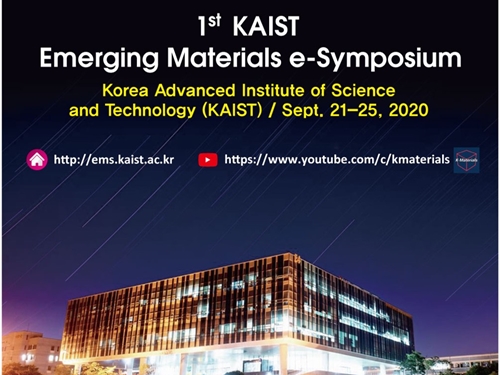 Big Ideas on Emerging Materials Explored at EMS
Renowned scholars and editors from academic journals joined the Emerging Materials e-Symposium (EMS) held at KAIST and shared the latest breakthroughs and big ideas in new material development last month. This e-symposium was organized by Professor Il-Doo Kim from the KAIST Department of Materials Sciences and Engineering over five days from September 21 through 25 via Zoom and YouTube. Professor Kim also serves as an associate editor of ACS Nano.
Esteemed scholars and editors of academic journals including ACS Nano, Nano Energy, and Energy Storage Materials made Zoom presentations in three main categories: 1) nanostructures for next-generation applications, 2) chemistry and biotechnology for applications in the fields of environment and industry, and 3) material innovation for technological applications.
During Session I, speakers including Professor John A. Rogers of Northwestern University and Professor Zhenan Bao of Stanford University led the session on Emerging Soft Electronics and 3D printing.
In later sessions, other globally recognized scholars gave talks titled Advanced Nanostructuring for Emerging Materials, Frontiers in Emerging Materials Research, Advanced Energy Materials and Functional Nanomaterials, and Latest Advances in Nanomaterials Research.
These included 2010 Nobel Prize laureate and professor at Manchester University Andre Geim, editor-in-chief of ACS Nano and professor at UCLA Paul S. Weiss, Professor Paul Alivisatos of UC Berkeley, Professor William Chueh of Stanford University, and Professor Mircea Dinca of MIT.
KAIST President Sung-Chul Shin, who is also a materials physicist, said in his opening address, “Innovation in materials science will become an important driving force to change our way of life. All the breakthroughs in materials have extended a new paradigm that has transformed our lives.”
“Creative research projects alongside global collaborators like all of you will allow the breakthroughs that will deliver us from these crises,” he added.
(END)
2020.10.06 View 24664
Big Ideas on Emerging Materials Explored at EMS
Renowned scholars and editors from academic journals joined the Emerging Materials e-Symposium (EMS) held at KAIST and shared the latest breakthroughs and big ideas in new material development last month. This e-symposium was organized by Professor Il-Doo Kim from the KAIST Department of Materials Sciences and Engineering over five days from September 21 through 25 via Zoom and YouTube. Professor Kim also serves as an associate editor of ACS Nano.
Esteemed scholars and editors of academic journals including ACS Nano, Nano Energy, and Energy Storage Materials made Zoom presentations in three main categories: 1) nanostructures for next-generation applications, 2) chemistry and biotechnology for applications in the fields of environment and industry, and 3) material innovation for technological applications.
During Session I, speakers including Professor John A. Rogers of Northwestern University and Professor Zhenan Bao of Stanford University led the session on Emerging Soft Electronics and 3D printing.
In later sessions, other globally recognized scholars gave talks titled Advanced Nanostructuring for Emerging Materials, Frontiers in Emerging Materials Research, Advanced Energy Materials and Functional Nanomaterials, and Latest Advances in Nanomaterials Research.
These included 2010 Nobel Prize laureate and professor at Manchester University Andre Geim, editor-in-chief of ACS Nano and professor at UCLA Paul S. Weiss, Professor Paul Alivisatos of UC Berkeley, Professor William Chueh of Stanford University, and Professor Mircea Dinca of MIT.
KAIST President Sung-Chul Shin, who is also a materials physicist, said in his opening address, “Innovation in materials science will become an important driving force to change our way of life. All the breakthroughs in materials have extended a new paradigm that has transformed our lives.”
“Creative research projects alongside global collaborators like all of you will allow the breakthroughs that will deliver us from these crises,” he added.
(END)
2020.10.06 View 24664 -
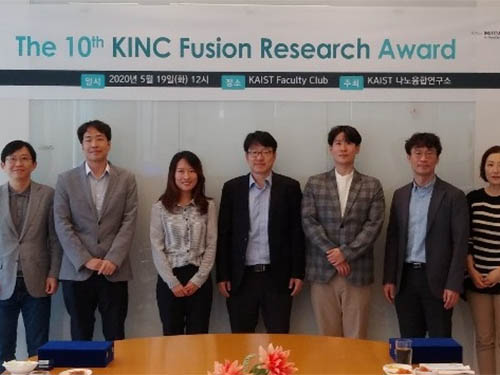 The 10th KINC Fusion Research Awardees
The KAIST Institute for NanoCentury (KINC) recognized three distinguished researchers whose convergence studies made significant impacts. The KINC presented the 10th KINC Fusion Research Awards during a ceremony that took place at KAIST’s main campus in Daejeon on May 19.
This year’s ‘best’ convergence research award went to a joint research group led by Professor Hee Tak Kim from the Department of Chemical and Biomolecular Engineering and Professor Sang Ouk Kim from the Department of Materials Science and Engineering. Their research, featured in the December 27 issue of Advanced Materials as a front cover article last year, introduced the world’s first high-energy efficiency, membraneless, flowless, zinc-bromine battery. This study, in which research professor Gyoung Hwa Jeong, postdoctoral researcher Yearin Byun, and PhD candidate Ju-Hyuck Lee took part as co-lead authors, is deemed as an example of a best practice in convergence research in which two groups’ respective expertise in the fields of carbon materials and electrochemical analysis created a synergistic effect.
Professor Bumjoon Kim from the Department of Chemical and Biomolecular Engineering was also recognized for having published the most interdisciplinary research papers on polymer electronics and nanomaterials at home and abroad.
Professor Hee-Tae Jung, the Director of KINC and the host of the KINC Fusion Research Awards, said, “The KINC is happy to announce the 10th awardees in nano-fusion research this year. Since convergence is crucial for making revolutionary changes, the importance of convergence studies should be recognized. Our institute will spare no effort to create a research environment suitable for convergence studies, which will be crucial for making a significant difference.”
The KINC was established in June 2006 under the KAIST Institute with the mission of facilitating convergence studies by tearing down boarders among departments and carrying out interdisciplinary joint research. Currently, the institute is comprised of approximately 90 professors from 13 departments. It aims to become a hub of university institutes for nano-fusion research.
(END)
2020.05.19 View 21853
The 10th KINC Fusion Research Awardees
The KAIST Institute for NanoCentury (KINC) recognized three distinguished researchers whose convergence studies made significant impacts. The KINC presented the 10th KINC Fusion Research Awards during a ceremony that took place at KAIST’s main campus in Daejeon on May 19.
This year’s ‘best’ convergence research award went to a joint research group led by Professor Hee Tak Kim from the Department of Chemical and Biomolecular Engineering and Professor Sang Ouk Kim from the Department of Materials Science and Engineering. Their research, featured in the December 27 issue of Advanced Materials as a front cover article last year, introduced the world’s first high-energy efficiency, membraneless, flowless, zinc-bromine battery. This study, in which research professor Gyoung Hwa Jeong, postdoctoral researcher Yearin Byun, and PhD candidate Ju-Hyuck Lee took part as co-lead authors, is deemed as an example of a best practice in convergence research in which two groups’ respective expertise in the fields of carbon materials and electrochemical analysis created a synergistic effect.
Professor Bumjoon Kim from the Department of Chemical and Biomolecular Engineering was also recognized for having published the most interdisciplinary research papers on polymer electronics and nanomaterials at home and abroad.
Professor Hee-Tae Jung, the Director of KINC and the host of the KINC Fusion Research Awards, said, “The KINC is happy to announce the 10th awardees in nano-fusion research this year. Since convergence is crucial for making revolutionary changes, the importance of convergence studies should be recognized. Our institute will spare no effort to create a research environment suitable for convergence studies, which will be crucial for making a significant difference.”
The KINC was established in June 2006 under the KAIST Institute with the mission of facilitating convergence studies by tearing down boarders among departments and carrying out interdisciplinary joint research. Currently, the institute is comprised of approximately 90 professors from 13 departments. It aims to become a hub of university institutes for nano-fusion research.
(END)
2020.05.19 View 21853 -
 Algorithm Identifies Optimal Pairs for Composing Metal-Organic Frameworks
The integration of metal-organic frameworks (MOFs) and other metal nanoparticles has increasingly led to the creation of new multifunctional materials. Many researchers have integrated MOFs with other classes of materials to produce new structures with synergetic properties.
Despite there being over 70,000 collections of synthesized MOFs that can be used as building blocks, the precise nature of the interaction and the bonding at the interface between the two materials still remains unknown. The question is how to sort out the right matching pairs out of 70,000 MOFs.
An algorithmic study published in Nature Communications by a KAIST research team presents a clue for finding the perfect pairs. The team, led by Professor Ji-Han Kim from the Department of Chemical and Biomolecular Engineering, developed a joint computational and experimental approach to rationally design MOF@MOFs, a composite of MOFs where an MOF is grown on a different MOF.
Professor Kim’s team, in collaboration with UNIST, noted that the metal node of one MOF can coordinately bond with the linker of a different MOF and the precisely matched interface configurations at atomic and molecular levels can enhance the likelihood of synthesizing MOF@MOFs.
They screened thousands of MOFs and identified optimal MOF pairs that can seamlessly connect to one another by taking advantage of the fact that the metal node of one MOF can form coordination bonds with the linkers of the second MOF. Six pairs predicted from the computational algorithm successfully grew into single crystals.
This computational workflow can readily extend into other classes of materials and can lead to the rapid exploration of the composite MOFs arena for accelerated materials development. Even more, the workflow can enhance the likelihood of synthesizing MOF@MOFs in the form of large single crystals, and thereby demonstrated the utility of rationally designing the MOF@MOFs.
This study is the first algorithm for predicting the synthesis of composite MOFs, to the best of their knowledge. Professor Kim said, “The number of predicted pairs can increase even more with the more general 2D lattice matching, and it is worth investigating in the future.”
This study was supported by Samsung Research Funding & Incubation Center of Samsung Electronics.
(Figure: An example of a rationally synthesized MOF@MOFs (cubic HKUST-1@MOF-5 ))
2019.08.30 View 22563
Algorithm Identifies Optimal Pairs for Composing Metal-Organic Frameworks
The integration of metal-organic frameworks (MOFs) and other metal nanoparticles has increasingly led to the creation of new multifunctional materials. Many researchers have integrated MOFs with other classes of materials to produce new structures with synergetic properties.
Despite there being over 70,000 collections of synthesized MOFs that can be used as building blocks, the precise nature of the interaction and the bonding at the interface between the two materials still remains unknown. The question is how to sort out the right matching pairs out of 70,000 MOFs.
An algorithmic study published in Nature Communications by a KAIST research team presents a clue for finding the perfect pairs. The team, led by Professor Ji-Han Kim from the Department of Chemical and Biomolecular Engineering, developed a joint computational and experimental approach to rationally design MOF@MOFs, a composite of MOFs where an MOF is grown on a different MOF.
Professor Kim’s team, in collaboration with UNIST, noted that the metal node of one MOF can coordinately bond with the linker of a different MOF and the precisely matched interface configurations at atomic and molecular levels can enhance the likelihood of synthesizing MOF@MOFs.
They screened thousands of MOFs and identified optimal MOF pairs that can seamlessly connect to one another by taking advantage of the fact that the metal node of one MOF can form coordination bonds with the linkers of the second MOF. Six pairs predicted from the computational algorithm successfully grew into single crystals.
This computational workflow can readily extend into other classes of materials and can lead to the rapid exploration of the composite MOFs arena for accelerated materials development. Even more, the workflow can enhance the likelihood of synthesizing MOF@MOFs in the form of large single crystals, and thereby demonstrated the utility of rationally designing the MOF@MOFs.
This study is the first algorithm for predicting the synthesis of composite MOFs, to the best of their knowledge. Professor Kim said, “The number of predicted pairs can increase even more with the more general 2D lattice matching, and it is worth investigating in the future.”
This study was supported by Samsung Research Funding & Incubation Center of Samsung Electronics.
(Figure: An example of a rationally synthesized MOF@MOFs (cubic HKUST-1@MOF-5 ))
2019.08.30 View 22563