College+of+Business
-
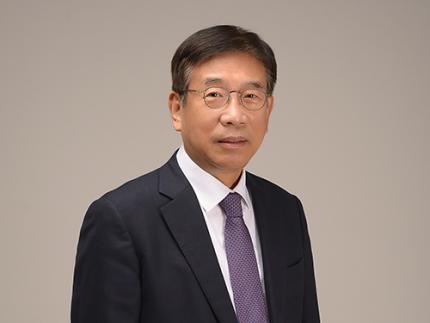 Emeritus Professor Jae-Kyu Lee Wins the AIS LEO Award
Emeritus Professor Jae-Kyu Lee has won the Association for Information Systems LEO Award 2020. Professor Lee, the first Korean to receive the LEO Award, was recognized for his research and development in preventative cyber security, which is a major part of the efforts he leads to realize what Professor Lee has named "Bright Internet."
Established in 1999, this award was named after the world’s first business application of computing, the Lyons Electronic Office and recognizes outstanding individuals in the field of information systems. The LEO Award recognized four winners including Professor Lee this year.
He has been professor and HHI Chair Professor at KAIST from 1985 to 2016 since he has received his Ph.D. in information and operations management from the Wharton School, University of Pennsylvania. He served as the Dean of College of Business and supervised around 30 doctoral students. He is currently the Distinguished Professor of School of Management at Xi’an Jiaotong University.
His research mainly focused on the creation of Bright Internet for preventive cybersecurity, improving relevance of research from Axiomatic Theories, and development of AI for electronic commerce and managerial decision support.
He is a fellow and was the president of the Association for Information Systems, and co-chaired the International Conference on Information Systems in 2017. He was the founder of Principles for the Bright Internet and established the Bright Internet Research Center at KAIST and Xi’an Jiatong University. He also established the Bright Internet Global Summit since ICIS 2017 in Seoul, and organized the Bright Internet Project Consortium in 2019 as a combined effort of academia-industry partnership. (www.brightinternet.org.)
He was a charter member of the Pacific Asia Conference in Information Systems, and served as conference chair. He was the founder editor-in-chief of the journal, Electronic Commerce Research and Applications (Elsevier), and was the founding chair of the International Conference on Electronic Commerce. In Korea, her served as president of Korea Society of Management Information Systems and Korea Society of Intelligent Information Systems.
"I am honored to be designated the first Korean winner of the honorable LEO Award," Lee said. "Based on my life-long efforts for developments in the field, I will continue to contribute to the research and development of information media systems."
2020.12.16 View 7815
Emeritus Professor Jae-Kyu Lee Wins the AIS LEO Award
Emeritus Professor Jae-Kyu Lee has won the Association for Information Systems LEO Award 2020. Professor Lee, the first Korean to receive the LEO Award, was recognized for his research and development in preventative cyber security, which is a major part of the efforts he leads to realize what Professor Lee has named "Bright Internet."
Established in 1999, this award was named after the world’s first business application of computing, the Lyons Electronic Office and recognizes outstanding individuals in the field of information systems. The LEO Award recognized four winners including Professor Lee this year.
He has been professor and HHI Chair Professor at KAIST from 1985 to 2016 since he has received his Ph.D. in information and operations management from the Wharton School, University of Pennsylvania. He served as the Dean of College of Business and supervised around 30 doctoral students. He is currently the Distinguished Professor of School of Management at Xi’an Jiaotong University.
His research mainly focused on the creation of Bright Internet for preventive cybersecurity, improving relevance of research from Axiomatic Theories, and development of AI for electronic commerce and managerial decision support.
He is a fellow and was the president of the Association for Information Systems, and co-chaired the International Conference on Information Systems in 2017. He was the founder of Principles for the Bright Internet and established the Bright Internet Research Center at KAIST and Xi’an Jiatong University. He also established the Bright Internet Global Summit since ICIS 2017 in Seoul, and organized the Bright Internet Project Consortium in 2019 as a combined effort of academia-industry partnership. (www.brightinternet.org.)
He was a charter member of the Pacific Asia Conference in Information Systems, and served as conference chair. He was the founder editor-in-chief of the journal, Electronic Commerce Research and Applications (Elsevier), and was the founding chair of the International Conference on Electronic Commerce. In Korea, her served as president of Korea Society of Management Information Systems and Korea Society of Intelligent Information Systems.
"I am honored to be designated the first Korean winner of the honorable LEO Award," Lee said. "Based on my life-long efforts for developments in the field, I will continue to contribute to the research and development of information media systems."
2020.12.16 View 7815 -
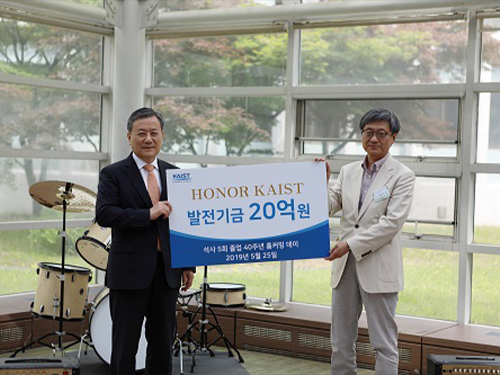 Class of '79 Donates 2 Billion KRW at Homecoming Event
The class of 1979 held a reunion on May 25 at the College of Business at the KAIST Seoul campus, which was the main campus when they were students 40 years ago. These leaders, who now serve in diverse sectors of academia, research, business, and industry both in Korea and abroad, held a homecoming event in celebration of the 40th anniversary of their graduation.
At the event, Chairman Chong-Don Kim of Miwon Commercial, who was representing their class, donated 2 billion KRW toward the KAIST development fund.
Chairman Kim reminisced saying, “Today’s event takes my friends and I back in time and reminds us of our old school days here at KAIST. It means a lot to us to re-visit the campus with grateful hearts for our alma mater.” He continued, “We raised this fund in the spirit of ‘Honor KAIST’, hoping for KAIST to continue to grow towards its vision of becoming a world-leading institution. Our class always has and forever will dearly support KAIST with all our hearts.”
‘Honor KAIST’ is an alumni-led spontaneous donation campaign first initiated in 2015 by the class of ’75, the first group of masters students who graduated from KAIST, with the aim of raising 1 trillion KRW fund for the development of KAIST.
President Sung-Chul Shin responded, “The deep contributions and consistent engagement being made by our alumni groups for KAIST’s institutional growth is truly beneficial, far beyond what meets the eye. The entire school would like to express our sincere gratitude to the class of ’79 for your generous donation which will serve as a run-up for the university's many future initiatives.”
More than 100 graduates and emeritus professors including Professor Jae-Kyoon Kim and Professor Choong-Ki Kim from the School of Electrical Engineering, as well as Chairman of the KAIST Alumni Association Dr. Ki-Chul Cha, were able to attend.
2019.05.31 View 5071
Class of '79 Donates 2 Billion KRW at Homecoming Event
The class of 1979 held a reunion on May 25 at the College of Business at the KAIST Seoul campus, which was the main campus when they were students 40 years ago. These leaders, who now serve in diverse sectors of academia, research, business, and industry both in Korea and abroad, held a homecoming event in celebration of the 40th anniversary of their graduation.
At the event, Chairman Chong-Don Kim of Miwon Commercial, who was representing their class, donated 2 billion KRW toward the KAIST development fund.
Chairman Kim reminisced saying, “Today’s event takes my friends and I back in time and reminds us of our old school days here at KAIST. It means a lot to us to re-visit the campus with grateful hearts for our alma mater.” He continued, “We raised this fund in the spirit of ‘Honor KAIST’, hoping for KAIST to continue to grow towards its vision of becoming a world-leading institution. Our class always has and forever will dearly support KAIST with all our hearts.”
‘Honor KAIST’ is an alumni-led spontaneous donation campaign first initiated in 2015 by the class of ’75, the first group of masters students who graduated from KAIST, with the aim of raising 1 trillion KRW fund for the development of KAIST.
President Sung-Chul Shin responded, “The deep contributions and consistent engagement being made by our alumni groups for KAIST’s institutional growth is truly beneficial, far beyond what meets the eye. The entire school would like to express our sincere gratitude to the class of ’79 for your generous donation which will serve as a run-up for the university's many future initiatives.”
More than 100 graduates and emeritus professors including Professor Jae-Kyoon Kim and Professor Choong-Ki Kim from the School of Electrical Engineering, as well as Chairman of the KAIST Alumni Association Dr. Ki-Chul Cha, were able to attend.
2019.05.31 View 5071 -
 KAIST Earns AACSB Business School Accreditation
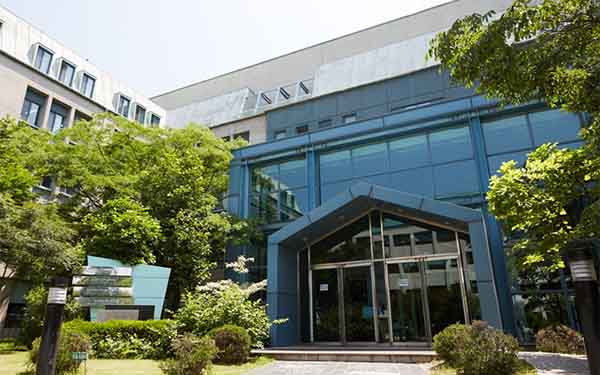
The KAIST College of Business re-earned business school accreditation from the Association to Advance Collegiate Schools of Business (AACSB) International. The school first earned the accreditation in 2003, and has continued to receive the accreditation four consecutive times. Currently only 5% of the 16,000 business schools around the world have earned AACSB accreditation. KAIST received a good evaluation for the competitive research of its faculty, its executive education programs based on strong industry-academia ties, and specialized MBA and master’s program, which includes programs such as social entrepreneurship and green business and policy.Alexander Triantis, dean of the Robert H. Smith School of Business at the University of Maryland and a judge for AACSB Accreditation said, “I was impressed to see students from KAIST have a high standard of knowledge. A number of its graduates continue to be appointed as professors of top universities abroad, which shows its strong global competence”. AACSB was founded in 1916 by deans of business colleges from prestigious universities such as Harvard University, Stanford University and Columbia University, to provide business and accounting accreditation to universities. Evaluation for AACSB accreditation takes place every five years. Schools are evaluated based on fifteen standards, including student admission and graduation requirements, student-faculty ratios, faculty’s intellectual contributions, research infrastructure, global cooperation, and industry-academia programs. They can be eligible for re-accreditation if they satisfy the conditions offered by AACSB International and are committed to continuous improvement every five years. KAIST also earned the accreditation from the European Foundation for Management Development Quality Improvement System (EQUIS) three consecutive times since 2010. In 2013, it earned membership into the Partnership in International Management (PIM). Membership is only possible for those who have AACSB and EQUIS accreditation and they can be listed as a candidate school through voting. The candidate schools can finally earn membership after one year of strict screening. As of January 2019, there are 65 prestigious graduate schools of business, including KAIST, listed as PIM members.
2019.02.01 View 6911
KAIST Earns AACSB Business School Accreditation
The KAIST College of Business re-earned business school accreditation from the Association to Advance Collegiate Schools of Business (AACSB) International. The school first earned the accreditation in 2003, and has continued to receive the accreditation four consecutive times. Currently only 5% of the 16,000 business schools around the world have earned AACSB accreditation. KAIST received a good evaluation for the competitive research of its faculty, its executive education programs based on strong industry-academia ties, and specialized MBA and master’s program, which includes programs such as social entrepreneurship and green business and policy.Alexander Triantis, dean of the Robert H. Smith School of Business at the University of Maryland and a judge for AACSB Accreditation said, “I was impressed to see students from KAIST have a high standard of knowledge. A number of its graduates continue to be appointed as professors of top universities abroad, which shows its strong global competence”. AACSB was founded in 1916 by deans of business colleges from prestigious universities such as Harvard University, Stanford University and Columbia University, to provide business and accounting accreditation to universities. Evaluation for AACSB accreditation takes place every five years. Schools are evaluated based on fifteen standards, including student admission and graduation requirements, student-faculty ratios, faculty’s intellectual contributions, research infrastructure, global cooperation, and industry-academia programs. They can be eligible for re-accreditation if they satisfy the conditions offered by AACSB International and are committed to continuous improvement every five years. KAIST also earned the accreditation from the European Foundation for Management Development Quality Improvement System (EQUIS) three consecutive times since 2010. In 2013, it earned membership into the Partnership in International Management (PIM). Membership is only possible for those who have AACSB and EQUIS accreditation and they can be listed as a candidate school through voting. The candidate schools can finally earn membership after one year of strict screening. As of January 2019, there are 65 prestigious graduate schools of business, including KAIST, listed as PIM members.
2019.02.01 View 6911 -
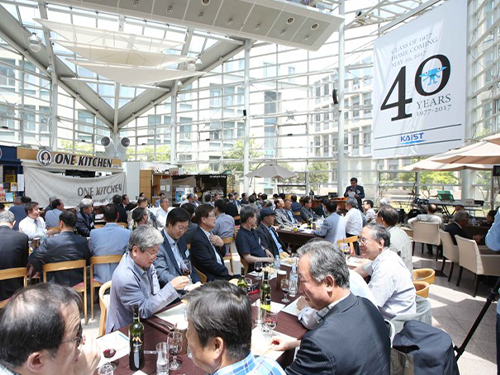 KAIST Class of '77 Celebrates 40-Year Reunion
The class of 1977 reunited on April 20 at the College of Business in Seoul campus, which was once the main campus when they were students 40 years ago. Now leaders of Korea in the sectors of industry, academia, and research, the class of ‘77 held a homecoming event in celebration of the 40th anniversary of their graduation.
The class of ’77 includes KAIST President Sung-Chul Shin and the Minister of Science, ICT and Future Planning Yanghee Choi. More than 100 graduates and 20 professors gathered at the homecoming event. Many of them were former ministers of science and technology, presidents of universities, heads of research institutes, and top managers from leading corporations such as Samsung Electronics and SK Telecom in Korea.
At the event, Professor Dong-Hoon Choi at Hangyang University, representing alumni Yoon-Mo Koo, Oh-Hyun Kwon, Dae-Young Kim, Yoo-Hyun Moon, Nam-Ho Paik, Ki Hwang Baek, Sung-Chul Shin, Mann-Ho Lee, and Sang-Bum Lee, donated a scholarship of 100 million KRW. Professor Choi said that, “This may not be a large sum of money, but we raised it with grateful hearts for the country and for KAIST. I hope this scholarship will become a small seed to raise bigger fruit.”
President Shin reminisced that, “The achievements made at KAIST during the last half century were only possible due to the dreams, visions, and innovative ideas of those who established KAIST, and the passion for research, education, and learning of our former professors and students.”
President Shin continued, “KAIST was the light of hope in the early industrialization period in Korea half a century ago, and as alumnus president I will devote body and soul for KAIST to be the light of hope in the early stages of the Industry 4.0, and thus continue to be the light of hope for the future of Korea.”
Notable guests presented include Former Minister of Science and Technology and former Provost of KAIST Kun-Mo Chung, Former Minister of Communications and former Professor Soon-Hoon Bae, Vice Chairman and CEO for Samsung Electronics Oh-Hyun Kwon, SK Telecom ICT President for Technology Ho-Soo Lee; President of Yeungnam University Gil Soo Sur; former President of the University of Seoul Sang-Bum Lee; President of the Korea Research Institute of Chemical Technology Kew-Ho Lee; and former President of the Korea Research Institute of Bioscience and Biotechnology Sang-Ki Rhee.
2017.05.23 View 7328
KAIST Class of '77 Celebrates 40-Year Reunion
The class of 1977 reunited on April 20 at the College of Business in Seoul campus, which was once the main campus when they were students 40 years ago. Now leaders of Korea in the sectors of industry, academia, and research, the class of ‘77 held a homecoming event in celebration of the 40th anniversary of their graduation.
The class of ’77 includes KAIST President Sung-Chul Shin and the Minister of Science, ICT and Future Planning Yanghee Choi. More than 100 graduates and 20 professors gathered at the homecoming event. Many of them were former ministers of science and technology, presidents of universities, heads of research institutes, and top managers from leading corporations such as Samsung Electronics and SK Telecom in Korea.
At the event, Professor Dong-Hoon Choi at Hangyang University, representing alumni Yoon-Mo Koo, Oh-Hyun Kwon, Dae-Young Kim, Yoo-Hyun Moon, Nam-Ho Paik, Ki Hwang Baek, Sung-Chul Shin, Mann-Ho Lee, and Sang-Bum Lee, donated a scholarship of 100 million KRW. Professor Choi said that, “This may not be a large sum of money, but we raised it with grateful hearts for the country and for KAIST. I hope this scholarship will become a small seed to raise bigger fruit.”
President Shin reminisced that, “The achievements made at KAIST during the last half century were only possible due to the dreams, visions, and innovative ideas of those who established KAIST, and the passion for research, education, and learning of our former professors and students.”
President Shin continued, “KAIST was the light of hope in the early industrialization period in Korea half a century ago, and as alumnus president I will devote body and soul for KAIST to be the light of hope in the early stages of the Industry 4.0, and thus continue to be the light of hope for the future of Korea.”
Notable guests presented include Former Minister of Science and Technology and former Provost of KAIST Kun-Mo Chung, Former Minister of Communications and former Professor Soon-Hoon Bae, Vice Chairman and CEO for Samsung Electronics Oh-Hyun Kwon, SK Telecom ICT President for Technology Ho-Soo Lee; President of Yeungnam University Gil Soo Sur; former President of the University of Seoul Sang-Bum Lee; President of the Korea Research Institute of Chemical Technology Kew-Ho Lee; and former President of the Korea Research Institute of Bioscience and Biotechnology Sang-Ki Rhee.
2017.05.23 View 7328 -
 KAIST's College of Business Places Fourth in the 2015 Better World MBA Ranking
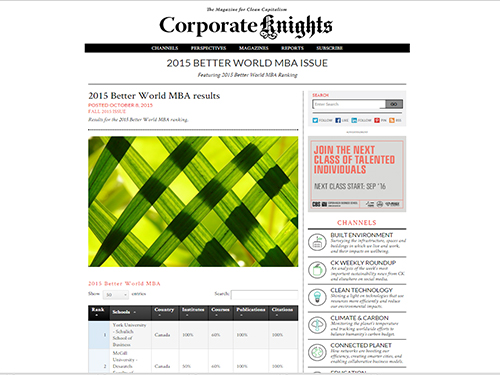
The Corporate Knights, a business and society magazine based in Canada, released the results of the 2015 Better World MBA Ranking on October 8, 2015.
KAIST’s business school ranked fourth globally and, number one in Asia, according to the list.
The 2015 Corporate Knights Better World MBA Ranking included a total of 121 schools; York University’s Schulich School of Business of Canada took first place.
The rankings were based on three criteria: the number of curricula (core and required courses) dedicated to sustainability, the number of research institutions and centers at the business school, and the volume of faculty research focused on better world topics such as sustainable finance, clean energy, or gender diversity.
The Better World MBA Ranking aims to identify business schools that best equip graduates who seek to change the world for the better by offering students opportunities to learn how to integrate social and environmental factors in their understanding of management functions via core MBA courses, faculty expertise, and research centers.
Dean Dong-Seok Kim of the College of Business at KAIST said,
“For years, our school has introduced a wide range of programs and research initiatives that address important social needs and issues. As part of this effort, we created the Graduate School of Green Growth and MBA for Social Entrepreneurship back in 2013. I believe that these endeavors played a favorable role in our receiving high scores in the ranking.”
KAIST’s Graduate School of Green Growth previously ranked sixth in the world’s top Green MBA School list published by Corporate Knights.
For the 2015 Better World MBA Ranking, go to
http://www.corporateknights.com/reports/2015-global-sustainable-mba/11153-14442629/.
2015.10.12 View 6053
KAIST's College of Business Places Fourth in the 2015 Better World MBA Ranking
The Corporate Knights, a business and society magazine based in Canada, released the results of the 2015 Better World MBA Ranking on October 8, 2015.
KAIST’s business school ranked fourth globally and, number one in Asia, according to the list.
The 2015 Corporate Knights Better World MBA Ranking included a total of 121 schools; York University’s Schulich School of Business of Canada took first place.
The rankings were based on three criteria: the number of curricula (core and required courses) dedicated to sustainability, the number of research institutions and centers at the business school, and the volume of faculty research focused on better world topics such as sustainable finance, clean energy, or gender diversity.
The Better World MBA Ranking aims to identify business schools that best equip graduates who seek to change the world for the better by offering students opportunities to learn how to integrate social and environmental factors in their understanding of management functions via core MBA courses, faculty expertise, and research centers.
Dean Dong-Seok Kim of the College of Business at KAIST said,
“For years, our school has introduced a wide range of programs and research initiatives that address important social needs and issues. As part of this effort, we created the Graduate School of Green Growth and MBA for Social Entrepreneurship back in 2013. I believe that these endeavors played a favorable role in our receiving high scores in the ranking.”
KAIST’s Graduate School of Green Growth previously ranked sixth in the world’s top Green MBA School list published by Corporate Knights.
For the 2015 Better World MBA Ranking, go to
http://www.corporateknights.com/reports/2015-global-sustainable-mba/11153-14442629/.
2015.10.12 View 6053 -
 Interview with KAIST MBA: 5 Reasons to Study in Korea for Your MBA
The Graduate Management Admission Council (GMAC) published online an interview with Mija Yoon, the director of the Admission & Placement Center at KAIST College of Business (KAIST MBA) in Seoul, Korea, on July 18, 2014.
In the interview, Director Yoon listed the benefits of studying MBA programs at Korean universities, as well as working in Korea.
For the article, please visit the link below:
GMAT, July 18, 2014
“5 Reasons to Study in Korea for Your MBA”
http://www.beatthegmat.com/mba/2014/07/18/5-reasons-to-study-in-korea-for-your-mba
2014.07.21 View 10047
Interview with KAIST MBA: 5 Reasons to Study in Korea for Your MBA
The Graduate Management Admission Council (GMAC) published online an interview with Mija Yoon, the director of the Admission & Placement Center at KAIST College of Business (KAIST MBA) in Seoul, Korea, on July 18, 2014.
In the interview, Director Yoon listed the benefits of studying MBA programs at Korean universities, as well as working in Korea.
For the article, please visit the link below:
GMAT, July 18, 2014
“5 Reasons to Study in Korea for Your MBA”
http://www.beatthegmat.com/mba/2014/07/18/5-reasons-to-study-in-korea-for-your-mba
2014.07.21 View 10047