Technology
-
 Professor Moon-Jeong Choi Appointed as an Advisor for the ITU's 'AI for Good Global Summit'
Professor Moon-Jeong Choi from KAIST’s Graduate School of Science and Technology Policy has been appointed as an advisor for "Innovate for Impact" at the AI for Good Global Summit, organized by the International Telecommunication Union (ITU), a specialized agency of the United Nations (UN).
The ITU is the UN's oldest specialized agency in the field of information and communication technology (ICT) and serves as a crucial body for coordinating global ICT policies and standards.
This advisory committee was formed to explore global cooperation strategies for realizing the social value of Artificial Intelligence (AI) and promoting sustainable development. Experts from around the world are participating as committee members, with Professor Choi being the sole Korean representative.
<Moon-Jeong Choi from KAIST’s Graduate School of Science and Technology Policy>
The AI for Good Global Summit is taking place in Geneva, Switzerland from July 8 to 11. It is organized by the ITU in collaboration with approximately 40 other UN-affiliated organizations. The summit aims to address global challenges facing humanity through the use of AI technology, focusing on key agenda items such as identifying AI application cases, discussing international policies and technical standards, and strengthening global partnerships.
As an "Innovate for Impact" advisor, Professor Choi will evaluate AI application cases from various countries, participating in case analyses primarily focused on public interest and social impact. The summit will move beyond discussions of technical performance to focus on how AI can contribute to the public good, with diverse case studies from around the world being debated. Notably, during a policy panel discussion at the summit, Professor Choi will discuss policy frameworks for AI transparency, inclusivity, and fairness under the theme of "Responsible AI Development."
Professor Choi commented, "I believe the social impact of technology mirrors the values and systems of each nation. As a society's core values permeate technology, the way AI is developed and used varies significantly from country to country. These differences lead to diverse manifestations of AI's impact on society." She further emphasized, "Korea's vision of becoming an AI powerhouse should not merely be about technological superiority, but rather about enhancing social capital through human-centered AI and realizing communal values that enable us to live together."
Professor Moon-Jeong Choi currently serves as the Dean of the Graduate School of Science and Technology Policy. She is also an external director for the National Information Society Agency (2023-present) and chair of the Korea-OECD Digital Society Initiative (2024-present).
For more information about the AI for Good Global Summit, please visit the official website: https://aiforgood.itu.int.
2025.07.08 View 210
Professor Moon-Jeong Choi Appointed as an Advisor for the ITU's 'AI for Good Global Summit'
Professor Moon-Jeong Choi from KAIST’s Graduate School of Science and Technology Policy has been appointed as an advisor for "Innovate for Impact" at the AI for Good Global Summit, organized by the International Telecommunication Union (ITU), a specialized agency of the United Nations (UN).
The ITU is the UN's oldest specialized agency in the field of information and communication technology (ICT) and serves as a crucial body for coordinating global ICT policies and standards.
This advisory committee was formed to explore global cooperation strategies for realizing the social value of Artificial Intelligence (AI) and promoting sustainable development. Experts from around the world are participating as committee members, with Professor Choi being the sole Korean representative.
<Moon-Jeong Choi from KAIST’s Graduate School of Science and Technology Policy>
The AI for Good Global Summit is taking place in Geneva, Switzerland from July 8 to 11. It is organized by the ITU in collaboration with approximately 40 other UN-affiliated organizations. The summit aims to address global challenges facing humanity through the use of AI technology, focusing on key agenda items such as identifying AI application cases, discussing international policies and technical standards, and strengthening global partnerships.
As an "Innovate for Impact" advisor, Professor Choi will evaluate AI application cases from various countries, participating in case analyses primarily focused on public interest and social impact. The summit will move beyond discussions of technical performance to focus on how AI can contribute to the public good, with diverse case studies from around the world being debated. Notably, during a policy panel discussion at the summit, Professor Choi will discuss policy frameworks for AI transparency, inclusivity, and fairness under the theme of "Responsible AI Development."
Professor Choi commented, "I believe the social impact of technology mirrors the values and systems of each nation. As a society's core values permeate technology, the way AI is developed and used varies significantly from country to country. These differences lead to diverse manifestations of AI's impact on society." She further emphasized, "Korea's vision of becoming an AI powerhouse should not merely be about technological superiority, but rather about enhancing social capital through human-centered AI and realizing communal values that enable us to live together."
Professor Moon-Jeong Choi currently serves as the Dean of the Graduate School of Science and Technology Policy. She is also an external director for the National Information Society Agency (2023-present) and chair of the Korea-OECD Digital Society Initiative (2024-present).
For more information about the AI for Good Global Summit, please visit the official website: https://aiforgood.itu.int.
2025.07.08 View 210 -
 KAIST's Pioneering VR Precision Technology & Choreography Tool Receive Spotlights at CHI 2025
Accurate pointing in virtual spaces is essential for seamless interaction. If pointing is not precise, selecting the desired object becomes challenging, breaking user immersion and reducing overall experience quality. KAIST researchers have developed a technology that offers a vivid, lifelike experience in virtual space, alongside a new tool that assists choreographers throughout the creative process.
KAIST (President Kwang-Hyung Lee) announced on May 13th that a research team led by Professor Sang Ho Yoon of the Graduate School of Culture Technology, in collaboration with Professor Yang Zhang of the University of California, Los Angeles (UCLA), has developed the ‘T2IRay’ technology and the ‘ChoreoCraft’ platform, which enables choreographers to work more freely and creatively in virtual reality. These technologies received two Honorable Mention awards, recognizing the top 5% of papers, at CHI 2025*, the best international conference in the field of human-computer interaction, hosted by the Association for Computing Machinery (ACM) from April 25 to May 1.
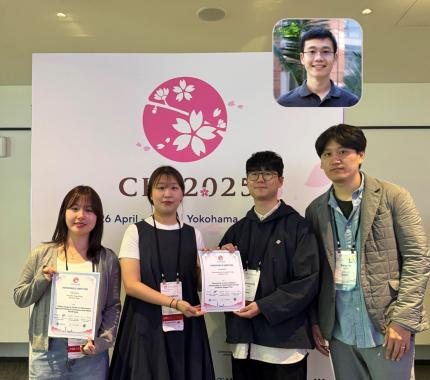
< (From left) PhD candidates Jina Kim and Kyungeun Jung along with Master's candidate, Hyunyoung Han and Professor Sang Ho Yoon of KAIST Graduate School of Culture Technology and Professor Yang Zhang (top) of UCLA >
T2IRay: Enabling Virtual Input with Precision
T2IRay introduces a novel input method that allows for precise object pointing in virtual environments by expanding traditional thumb-to-index gestures. This approach overcomes previous limitations, such as interruptions or reduced accuracy due to changes in hand position or orientation.
The technology uses a local coordinate system based on finger relationships, ensuring continuous input even as hand positions shift. It accurately captures subtle thumb movements within this coordinate system, integrating natural head movements to allow fluid, intuitive control across a wide range.
< Figure 1. T2IRay framework utilizing the delicate movements of the thumb and index fingers for AR/VR pointing >
Professor Sang Ho Yoon explained, “T2IRay can significantly enhance the user experience in AR/VR by enabling smooth, stable control even when the user’s hands are in motion.”
This study, led by first author Jina Kim, was supported by the Excellent New Researcher Support Project of the National Research Foundation of Korea under the Ministry of Science and ICT, as well as the University ICT Research Center (ITRC) Support Project of the Institute of Information and Communications Technology Planning and Evaluation (IITP).
▴ Paper title: T2IRay: Design of Thumb-to-Index Based Indirect Pointing for Continuous and Robust AR/VR Input▴ Paper link: https://doi.org/10.1145/3706598.3713442
▴ T2IRay demo video: https://youtu.be/ElJlcJbkJPY
ChoreoCraft: Creativity Support through VR for Choreographers
In addition, Professor Yoon’s team developed ‘ChoreoCraft,’ a virtual reality tool designed to support choreographers by addressing the unique challenges they face, such as memorizing complex movements, overcoming creative blocks, and managing subjective feedback.
ChoreoCraft reduces reliance on memory by allowing choreographers to save and refine movements directly within a VR space, using a motion-capture avatar for real-time interaction. It also enhances creativity by suggesting movements that naturally fit with prior choreography and musical elements. Furthermore, the system provides quantitative feedback by analyzing kinematic factors like motion stability and engagement, helping choreographers make data-driven creative decisions.
< Figure 2. ChoreoCraft's approaches to encourage creative process >
Professor Yoon noted, “ChoreoCraft is a tool designed to address the core challenges faced by choreographers, enhancing both creativity and efficiency. In user tests with professional choreographers, it received high marks for its ability to spark creative ideas and provide valuable quantitative feedback.”
This research was conducted in collaboration with doctoral candidate Kyungeun Jung and master’s candidate Hyunyoung Han, alongside the Electronics and Telecommunications Research Institute (ETRI) and One Million Co., Ltd. (CEO Hye-rang Kim), with support from the Cultural and Arts Immersive Service Development Project by the Ministry of Culture, Sports and Tourism.
▴ Paper title: ChoreoCraft: In-situ Crafting of Choreography in Virtual Reality through Creativity Support Tools▴ Paper link: https://doi.org/10.1145/3706598.3714220
▴ ChoreoCraft demo video: https://youtu.be/Ms1fwiSBjjw
*CHI (Conference on Human Factors in Computing Systems): The premier international conference on human-computer interaction, organized by the ACM, was held this year from April 25 to May 1, 2025.
2025.05.13 View 4680
KAIST's Pioneering VR Precision Technology & Choreography Tool Receive Spotlights at CHI 2025
Accurate pointing in virtual spaces is essential for seamless interaction. If pointing is not precise, selecting the desired object becomes challenging, breaking user immersion and reducing overall experience quality. KAIST researchers have developed a technology that offers a vivid, lifelike experience in virtual space, alongside a new tool that assists choreographers throughout the creative process.
KAIST (President Kwang-Hyung Lee) announced on May 13th that a research team led by Professor Sang Ho Yoon of the Graduate School of Culture Technology, in collaboration with Professor Yang Zhang of the University of California, Los Angeles (UCLA), has developed the ‘T2IRay’ technology and the ‘ChoreoCraft’ platform, which enables choreographers to work more freely and creatively in virtual reality. These technologies received two Honorable Mention awards, recognizing the top 5% of papers, at CHI 2025*, the best international conference in the field of human-computer interaction, hosted by the Association for Computing Machinery (ACM) from April 25 to May 1.
< (From left) PhD candidates Jina Kim and Kyungeun Jung along with Master's candidate, Hyunyoung Han and Professor Sang Ho Yoon of KAIST Graduate School of Culture Technology and Professor Yang Zhang (top) of UCLA >
T2IRay: Enabling Virtual Input with Precision
T2IRay introduces a novel input method that allows for precise object pointing in virtual environments by expanding traditional thumb-to-index gestures. This approach overcomes previous limitations, such as interruptions or reduced accuracy due to changes in hand position or orientation.
The technology uses a local coordinate system based on finger relationships, ensuring continuous input even as hand positions shift. It accurately captures subtle thumb movements within this coordinate system, integrating natural head movements to allow fluid, intuitive control across a wide range.
< Figure 1. T2IRay framework utilizing the delicate movements of the thumb and index fingers for AR/VR pointing >
Professor Sang Ho Yoon explained, “T2IRay can significantly enhance the user experience in AR/VR by enabling smooth, stable control even when the user’s hands are in motion.”
This study, led by first author Jina Kim, was supported by the Excellent New Researcher Support Project of the National Research Foundation of Korea under the Ministry of Science and ICT, as well as the University ICT Research Center (ITRC) Support Project of the Institute of Information and Communications Technology Planning and Evaluation (IITP).
▴ Paper title: T2IRay: Design of Thumb-to-Index Based Indirect Pointing for Continuous and Robust AR/VR Input▴ Paper link: https://doi.org/10.1145/3706598.3713442
▴ T2IRay demo video: https://youtu.be/ElJlcJbkJPY
ChoreoCraft: Creativity Support through VR for Choreographers
In addition, Professor Yoon’s team developed ‘ChoreoCraft,’ a virtual reality tool designed to support choreographers by addressing the unique challenges they face, such as memorizing complex movements, overcoming creative blocks, and managing subjective feedback.
ChoreoCraft reduces reliance on memory by allowing choreographers to save and refine movements directly within a VR space, using a motion-capture avatar for real-time interaction. It also enhances creativity by suggesting movements that naturally fit with prior choreography and musical elements. Furthermore, the system provides quantitative feedback by analyzing kinematic factors like motion stability and engagement, helping choreographers make data-driven creative decisions.
< Figure 2. ChoreoCraft's approaches to encourage creative process >
Professor Yoon noted, “ChoreoCraft is a tool designed to address the core challenges faced by choreographers, enhancing both creativity and efficiency. In user tests with professional choreographers, it received high marks for its ability to spark creative ideas and provide valuable quantitative feedback.”
This research was conducted in collaboration with doctoral candidate Kyungeun Jung and master’s candidate Hyunyoung Han, alongside the Electronics and Telecommunications Research Institute (ETRI) and One Million Co., Ltd. (CEO Hye-rang Kim), with support from the Cultural and Arts Immersive Service Development Project by the Ministry of Culture, Sports and Tourism.
▴ Paper title: ChoreoCraft: In-situ Crafting of Choreography in Virtual Reality through Creativity Support Tools▴ Paper link: https://doi.org/10.1145/3706598.3714220
▴ ChoreoCraft demo video: https://youtu.be/Ms1fwiSBjjw
*CHI (Conference on Human Factors in Computing Systems): The premier international conference on human-computer interaction, organized by the ACM, was held this year from April 25 to May 1, 2025.
2025.05.13 View 4680 -
 KAIST sends out Music and Bio-Signs of Professor Kwon Ji-yong, a.k.a. G-Dragon, into Space to Pulsate through Universe and Resonate among Stars
KAIST (President Kwang-Hyung Lee) announced on the 10th of April that it successfully promoted the world’s first ‘Space Sound Source Transmission Project’ based on media art at the KAIST Space Research Institute on April 9th through collaboration between Professor Jinjoon Lee of the Graduate School of Culture Technology, a world-renowned media artist, and the global K-Pop artist, G-Dragon.
This project was proposed as part of the ‘AI Entertech Research Center’ being promoted by KAIST and Galaxy Corporation. It is a project to transmit the message and sound of G-Dragon (real name, Kwon Ji-yong), a singer/song writer affiliated with Galaxy Corporation and a visiting professor in the Department of Mechanical Engineering at KAIST, to space for the first time in the world.
This is a convergence project that combines science, technology, art, and popular music, and is a new form of ‘space culture content’ experiment that connects KAIST’s cutting-edge space technology, Professor Jinjoon Lee’s media art work, and G-Dragon’s voice and sound source containing his latest digital single, "HOME SWEET HOME".
< Photo 1. Professor Jinjoon Lee's Open Your Eyes Project "Iris"'s imagery projected on the 13m space antenna at the Space Research Institute >
This collaboration was planned with the theme of ‘emotional signals that expand the inner universe of humans to the outer universe.’ The image of G-Dragon’s iris was augmented through AI as a window into soul symbolizing his uniqueness and identity, and the new song “Home Sweet Home” was combined as an audio message containing the vibration of that emotion.
This was actually transmitted into space using a next-generation small satellite developed by KAIST Space Research Institute, completing a symbolic performance in which an individual’s inner universe is transmitted to outer space.
Professor Jinjoon Lee’s cinematic media art work “Iris” was unveiled at the site. This work was screened in the world’s first projection mapping method* on KAIST Space Research Institute’s 13m space antenna. This video was created using generative artificial intelligence (AI) technology based on the image of G-Dragon's iris, and combined with sound using the data of the sounds of Emile Bell rings – the bell that holds a thousand years of history, it presented an emotional art experience that transcends time and space.
*Projection Mapping: A technology that projects light and images onto actual structures to create visual changes, and is a method of expression that artistically reinterprets space.
This work is one of the major research achievements of KAIST TX Lab and Professor Lee based on new media technology based on biometric data such as iris, heartbeat, and brain waves.
Professor Jinjoon Lee said, "The iris is a symbol that reflects inner emotions and identity, so much so that it is called the 'mirror of the soul,' and this work sought to express 'the infinite universe seen from the inside of humanity' through G-Dragon's gaze."
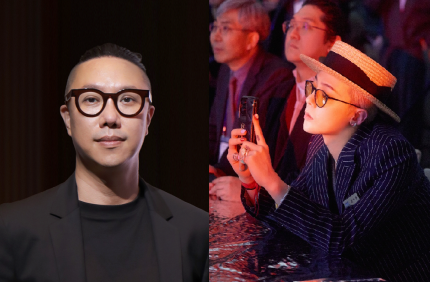
< Photo 2. (From left) Professor Jinjoon Lee of the Graduate School of Culture Technology and G-Dragon (Visiting Professor Kwon Ji-yong of the Department of Mechanical Engineering) >
He continued, "The universe is a realm of technology as well as a stage for imagination and emotion, and I look forward to an encounter with the unknown through a new attempt to speak of art in the language of science including AI and imagine science in the form of art." “G-Dragon’s voice and music have now begun their journey to space,” said Yong-ho Choi, Galaxy Corporation’s Chief Happiness Officer (CHO). “This project is an act of leaving music as a legacy for humanity, while also having an important meaning of attempting to communicate with space.” He added, “This is a pioneering step to introduce human culture to space, and it will remain as a monumental performance that opens a new chapter in the history of music comparable to the Beatles.”
Galaxy Corporation is leading the future entertainment technology industry through its collaboration with KAIST, and was recently selected as the only entertainment technology company in a private meeting with Microsoft CEO Nadella. In particular, it is promoting the globalization of AI entertainment technology, receiving praise as a “pioneer of imagination” for new forms of AI entertainment content, including the AI contents for the deceased.
< Photo 3. Photo of G-Dragon's Home Sweet Home being sent into the space via Professor Jinjoon Lee's Space Sound Source Transmission Project >
Through this project, KAIST Space Research Institute presented new possibilities for utilizing satellite technology, and showed a model for science to connect with society in a more popular way.
KAIST President Kwang-Hyung Lee said, “KAIST is a place that always supports new imaginations and challenges,” and added, “We will continue to strive to continue creative research that no one has ever thought of, like this project that combines science, technology, and art.”
In the meantime, Galaxy Corporation, the agency of G-Dragon’s Professor Kwon Ji-yong, is an AI entertainment company that presents a new paradigm based on IP, media, tech, and entertainment convergence technology.
2025.04.10 View 5616
KAIST sends out Music and Bio-Signs of Professor Kwon Ji-yong, a.k.a. G-Dragon, into Space to Pulsate through Universe and Resonate among Stars
KAIST (President Kwang-Hyung Lee) announced on the 10th of April that it successfully promoted the world’s first ‘Space Sound Source Transmission Project’ based on media art at the KAIST Space Research Institute on April 9th through collaboration between Professor Jinjoon Lee of the Graduate School of Culture Technology, a world-renowned media artist, and the global K-Pop artist, G-Dragon.
This project was proposed as part of the ‘AI Entertech Research Center’ being promoted by KAIST and Galaxy Corporation. It is a project to transmit the message and sound of G-Dragon (real name, Kwon Ji-yong), a singer/song writer affiliated with Galaxy Corporation and a visiting professor in the Department of Mechanical Engineering at KAIST, to space for the first time in the world.
This is a convergence project that combines science, technology, art, and popular music, and is a new form of ‘space culture content’ experiment that connects KAIST’s cutting-edge space technology, Professor Jinjoon Lee’s media art work, and G-Dragon’s voice and sound source containing his latest digital single, "HOME SWEET HOME".
< Photo 1. Professor Jinjoon Lee's Open Your Eyes Project "Iris"'s imagery projected on the 13m space antenna at the Space Research Institute >
This collaboration was planned with the theme of ‘emotional signals that expand the inner universe of humans to the outer universe.’ The image of G-Dragon’s iris was augmented through AI as a window into soul symbolizing his uniqueness and identity, and the new song “Home Sweet Home” was combined as an audio message containing the vibration of that emotion.
This was actually transmitted into space using a next-generation small satellite developed by KAIST Space Research Institute, completing a symbolic performance in which an individual’s inner universe is transmitted to outer space.
Professor Jinjoon Lee’s cinematic media art work “Iris” was unveiled at the site. This work was screened in the world’s first projection mapping method* on KAIST Space Research Institute’s 13m space antenna. This video was created using generative artificial intelligence (AI) technology based on the image of G-Dragon's iris, and combined with sound using the data of the sounds of Emile Bell rings – the bell that holds a thousand years of history, it presented an emotional art experience that transcends time and space.
*Projection Mapping: A technology that projects light and images onto actual structures to create visual changes, and is a method of expression that artistically reinterprets space.
This work is one of the major research achievements of KAIST TX Lab and Professor Lee based on new media technology based on biometric data such as iris, heartbeat, and brain waves.
Professor Jinjoon Lee said, "The iris is a symbol that reflects inner emotions and identity, so much so that it is called the 'mirror of the soul,' and this work sought to express 'the infinite universe seen from the inside of humanity' through G-Dragon's gaze."
< Photo 2. (From left) Professor Jinjoon Lee of the Graduate School of Culture Technology and G-Dragon (Visiting Professor Kwon Ji-yong of the Department of Mechanical Engineering) >
He continued, "The universe is a realm of technology as well as a stage for imagination and emotion, and I look forward to an encounter with the unknown through a new attempt to speak of art in the language of science including AI and imagine science in the form of art." “G-Dragon’s voice and music have now begun their journey to space,” said Yong-ho Choi, Galaxy Corporation’s Chief Happiness Officer (CHO). “This project is an act of leaving music as a legacy for humanity, while also having an important meaning of attempting to communicate with space.” He added, “This is a pioneering step to introduce human culture to space, and it will remain as a monumental performance that opens a new chapter in the history of music comparable to the Beatles.”
Galaxy Corporation is leading the future entertainment technology industry through its collaboration with KAIST, and was recently selected as the only entertainment technology company in a private meeting with Microsoft CEO Nadella. In particular, it is promoting the globalization of AI entertainment technology, receiving praise as a “pioneer of imagination” for new forms of AI entertainment content, including the AI contents for the deceased.
< Photo 3. Photo of G-Dragon's Home Sweet Home being sent into the space via Professor Jinjoon Lee's Space Sound Source Transmission Project >
Through this project, KAIST Space Research Institute presented new possibilities for utilizing satellite technology, and showed a model for science to connect with society in a more popular way.
KAIST President Kwang-Hyung Lee said, “KAIST is a place that always supports new imaginations and challenges,” and added, “We will continue to strive to continue creative research that no one has ever thought of, like this project that combines science, technology, and art.”
In the meantime, Galaxy Corporation, the agency of G-Dragon’s Professor Kwon Ji-yong, is an AI entertainment company that presents a new paradigm based on IP, media, tech, and entertainment convergence technology.
2025.04.10 View 5616 -
 KAIST Wins CES 2025 Innovation Award, Showcasing Innovative Technologies
KAIST will showcase innovative technologies at the world’s largest technology fair, the Consumer Electronics Show (CES 2025). In addition, KAIST startups VIRNECT Inc., Standard Energy Inc., A2US Inc., and Panmnesia, Inc. won the 2025 CES Innovation Awards.
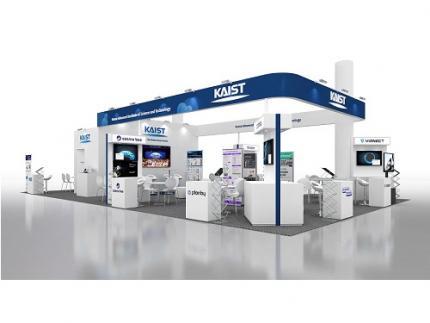
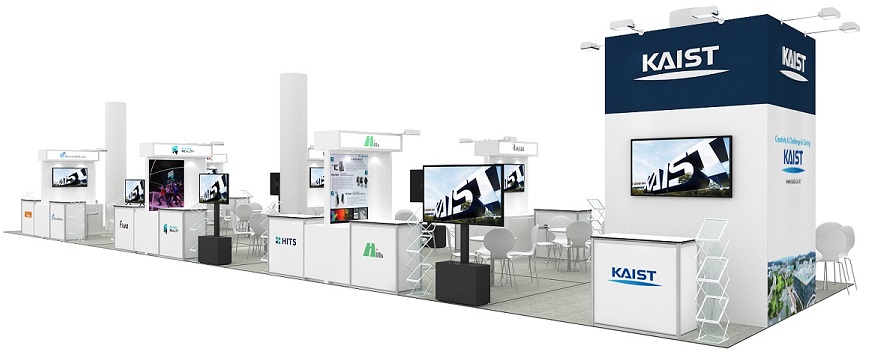
< Image 1. 3D-Graphical Profile of CES 2025 KAIST Exhibition Booth >
KAIST (President Kwang-Hyung Lee) announced on the 31st that it will operate a 140㎡ standalone booth at CES Eureka Park, which will be held in Las Vegas, USA from January 7th to 10th next year, to showcase KAIST's innovative technologies to global companies and investors.
KAIST startups VIRNECT, Standard Energy, A2US, and Panmnesia, Inc. won the 2025 CES Innovation Awards. ▴VIRNECT won the Innovation Award in the ‘Industrial Equipment and Machinery’ category for ‘VisionX’, an AI-based smart glass for industrial sites; ▴Standard Energy Co., Ltd. won the Innovation Award in the ‘Smart City’ category for developing the world’s first vanadium-ion battery; ▴A2US won the Innovation Award in the ‘Environment & Energy’ category for its portable air purifier that eliminates bacteria, odors, and fine dust in the air with just water droplets; ▴Panmnesia, Inc. won the Innovation Award in the ‘Computer Peripherals and Accessories’ category for its ‘CXL-based GPU Memory Expansion Kit’ that can drastically reduce the cost of building AI infrastructure.
< Image 2. (From left on the top row) VIRNECT, Standard Energy, (From left on the bottom row) A2US, Panmnesia, Inc. >
This exhibition will feature 15 startups that are standing out in cutting-edge technologies such as artificial intelligence (AI), robotics, mobility, and sustainability. In particular, AI-based deep tech startups in various industries such as logistics, architecture, and medicine will take up half of the total, showcasing the companies’ innovative AI technologies.
Polyphenol Factory Co.,Ltd introduces ‘Grabity’, a hair loss shampoo launched domestically, which applies the patented ingredient ‘LiftMax 308™’ that forms an instantaneous protective layer on the hair during the shampooing process. A real-time demonstration will be held at this exhibition hall so that visitors can experience the effects of the ingredient directly, and plans to enter the global market starting with the launch on Amazon in the US in January 2025.
VIRNECT will present ‘VisionX’, a prototype that won the Innovation Award this time. The product provides a chatbot AI through an AI voice interface, and has a function that allows users to check the status of the equipment in real time through conversations with the AI and receive troubleshooting guidance through voice conversations, so users can experience it directly at the KAIST Hall.
‘Standard Energy’ plans to exhibit ‘Energy Tile’, an indoor ESS that utilizes the world’s first vanadium ion battery (hereinafter referred to as VIB). VIB is absolutely safe from fire and has high installation flexibility, so it can be applied to smart cities and AI data centers.
‘A2US’ is the only company in the world that has hydroxyl radical water production technology, and won the Innovation Award for its first product, an air purifier. In the future, it is expected to be widely commercialized in air and water purification, smart farms, food tech, and semiconductor cleaning using safe and environmentally friendly hydroxyl radical water.
Panmnesia, Inc. won the CES Innovation Award for its GPU memory expansion solution equipped with its CXL 3.1 IP. By connecting a memory expansion device using Panmnesia’s CXL IP, the GPU’s memory capacity can be expanded to the terabyte level. Following the Innovation Award for ‘CXL-equipped AI Accelerator’ at CES 2024 last year, it is the only company to have won the Innovation Award for its AI-oriented CXL solution for two consecutive years.
In addition, technologies from a total of 15 companies will be introduced, including ▴Omelet ▴NEXTWAVE ▴Planby Technologies ▴Cosmo Bee ▴ImpactAI ▴Roen Surgical ▴DIDEN Roboticss ▴Autopedia ▴OAQ ▴HydroXpand ▴BOOKEND ▴Sterri.
On the central stage of the KAIST Hall, KAIST students selected as CES Student Supporters will conduct interviews with participating companies and promote the companies' innovative technologies and solutions. On the 8th, from 5 PM to 7 PM, a KAIST NIGHT event will be held where pre-invited investors and participating companies can network.
Keon Jae Lee, the head of the Institute of Technology Value Creation, said, “Through CES 2025, we will showcase innovative technologies and solutions from startups based on KAIST’s deep science and deep tech, and lead commercialization in cutting-edge technology fields such as AI, robotics, mobility, and environment/energy. KAIST plans to further promote technology commercialization by supporting the growth and marketing of innovative startups through the Institute of Technology Value Creation and by strengthening global networks and expanding cooperation opportunities.”
2024.12.31 View 7682
KAIST Wins CES 2025 Innovation Award, Showcasing Innovative Technologies
KAIST will showcase innovative technologies at the world’s largest technology fair, the Consumer Electronics Show (CES 2025). In addition, KAIST startups VIRNECT Inc., Standard Energy Inc., A2US Inc., and Panmnesia, Inc. won the 2025 CES Innovation Awards.
< Image 1. 3D-Graphical Profile of CES 2025 KAIST Exhibition Booth >
KAIST (President Kwang-Hyung Lee) announced on the 31st that it will operate a 140㎡ standalone booth at CES Eureka Park, which will be held in Las Vegas, USA from January 7th to 10th next year, to showcase KAIST's innovative technologies to global companies and investors.
KAIST startups VIRNECT, Standard Energy, A2US, and Panmnesia, Inc. won the 2025 CES Innovation Awards. ▴VIRNECT won the Innovation Award in the ‘Industrial Equipment and Machinery’ category for ‘VisionX’, an AI-based smart glass for industrial sites; ▴Standard Energy Co., Ltd. won the Innovation Award in the ‘Smart City’ category for developing the world’s first vanadium-ion battery; ▴A2US won the Innovation Award in the ‘Environment & Energy’ category for its portable air purifier that eliminates bacteria, odors, and fine dust in the air with just water droplets; ▴Panmnesia, Inc. won the Innovation Award in the ‘Computer Peripherals and Accessories’ category for its ‘CXL-based GPU Memory Expansion Kit’ that can drastically reduce the cost of building AI infrastructure.
< Image 2. (From left on the top row) VIRNECT, Standard Energy, (From left on the bottom row) A2US, Panmnesia, Inc. >
This exhibition will feature 15 startups that are standing out in cutting-edge technologies such as artificial intelligence (AI), robotics, mobility, and sustainability. In particular, AI-based deep tech startups in various industries such as logistics, architecture, and medicine will take up half of the total, showcasing the companies’ innovative AI technologies.
Polyphenol Factory Co.,Ltd introduces ‘Grabity’, a hair loss shampoo launched domestically, which applies the patented ingredient ‘LiftMax 308™’ that forms an instantaneous protective layer on the hair during the shampooing process. A real-time demonstration will be held at this exhibition hall so that visitors can experience the effects of the ingredient directly, and plans to enter the global market starting with the launch on Amazon in the US in January 2025.
VIRNECT will present ‘VisionX’, a prototype that won the Innovation Award this time. The product provides a chatbot AI through an AI voice interface, and has a function that allows users to check the status of the equipment in real time through conversations with the AI and receive troubleshooting guidance through voice conversations, so users can experience it directly at the KAIST Hall.
‘Standard Energy’ plans to exhibit ‘Energy Tile’, an indoor ESS that utilizes the world’s first vanadium ion battery (hereinafter referred to as VIB). VIB is absolutely safe from fire and has high installation flexibility, so it can be applied to smart cities and AI data centers.
‘A2US’ is the only company in the world that has hydroxyl radical water production technology, and won the Innovation Award for its first product, an air purifier. In the future, it is expected to be widely commercialized in air and water purification, smart farms, food tech, and semiconductor cleaning using safe and environmentally friendly hydroxyl radical water.
Panmnesia, Inc. won the CES Innovation Award for its GPU memory expansion solution equipped with its CXL 3.1 IP. By connecting a memory expansion device using Panmnesia’s CXL IP, the GPU’s memory capacity can be expanded to the terabyte level. Following the Innovation Award for ‘CXL-equipped AI Accelerator’ at CES 2024 last year, it is the only company to have won the Innovation Award for its AI-oriented CXL solution for two consecutive years.
In addition, technologies from a total of 15 companies will be introduced, including ▴Omelet ▴NEXTWAVE ▴Planby Technologies ▴Cosmo Bee ▴ImpactAI ▴Roen Surgical ▴DIDEN Roboticss ▴Autopedia ▴OAQ ▴HydroXpand ▴BOOKEND ▴Sterri.
On the central stage of the KAIST Hall, KAIST students selected as CES Student Supporters will conduct interviews with participating companies and promote the companies' innovative technologies and solutions. On the 8th, from 5 PM to 7 PM, a KAIST NIGHT event will be held where pre-invited investors and participating companies can network.
Keon Jae Lee, the head of the Institute of Technology Value Creation, said, “Through CES 2025, we will showcase innovative technologies and solutions from startups based on KAIST’s deep science and deep tech, and lead commercialization in cutting-edge technology fields such as AI, robotics, mobility, and environment/energy. KAIST plans to further promote technology commercialization by supporting the growth and marketing of innovative startups through the Institute of Technology Value Creation and by strengthening global networks and expanding cooperation opportunities.”
2024.12.31 View 7682 -
 KAIST holds its first ‘KAIST Tech Fair’ in New York, USA
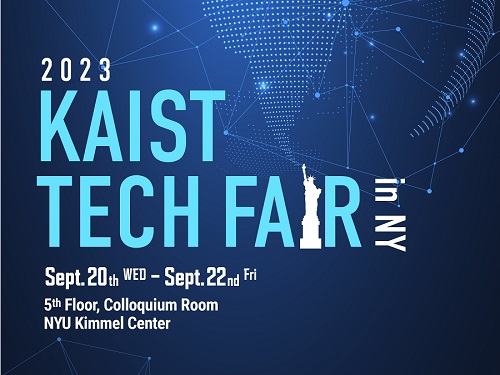
< Photo 1. 2023 KAIST Tech Fair in New York >
KAIST (President Kwang-Hyung Lee) announced on the 11th that it will hold the ‘2023 KAIST Tech Fair in New York’ at the Kimmel Center at New York University in Manhattan, USA, on the 22nd of this month. It is an event designed to be the starting point for KAIST to expand its startup ecosystem into the global stage, and it is to attract investments and secure global customers in New York by demonstrating the technological value of KAIST startup companies directly at location.
< Photo 2. President Kwang Hyung Lee at the 2023 KAIST Tech Fair in New York >
KAIST has been holding briefing sessions for technology transfer in Korea every year since 2018, and this year is the first time to hold a tech fair overseas for global companies.
KAIST Institute of Technology Value Creation (Director Sung-Yool Choi) has prepared for this event over the past six months with the Korea International Trade Association (hereinafter KITA, CEO Christopher Koo) to survey customer base and investment companies to conduct market analysis.
Among the companies founded with the technologies developed by the faculty and students of KAIST and their partners, 7 companies were selected to be matched with companies overseas that expressed interests in these technologies. Global multinational companies in the fields of IT, artificial intelligence, environment, logistics, distribution, and retail are participating as demand agencies and are testing the marketability of the start-up's technology as of September.
Daim Research, founded by Professor Young Jae Jang of the Department of Industrial and Systems Engineering, is a company specializing in smart factory automation solutions and is knocking on the door of the global market with a platform technology optimized for automated logistics systems.
< Photo 3. Presentation by Professor Young Jae Jang for DAIM Research >
It is a ‘collaborative intelligence’ solution that maximizes work productivity by having a number of robots used in industrial settings collaborate with one another. The strength of their solution is that logistics robots equipped with AI reinforced learning technology can respond to processes and environmental changes on their own, minimizing maintenance costs and the system can achieve excellent performance even with a small amount of data when it is combined with the digital twin technology the company has developed on its own.
A student startup, ‘Aniai’, is entering the US market, the home of hamburgers, with hamburger patty automation equipments and solutions. This is a robot kitchen startup founded by its CEO Gunpil Hwang, a graduate of KAIST’s School of Electrical Engineering which gathered together the experts in the fields of robot control, design, and artificial intelligence and cognitive technology to develop technology to automatically cook hamburger patties.
At the touch of a button, both sides of the patty are cooked simultaneously for consistent taste and quality according to the set condition. Since it can cook about 200 dishes in an hour, it is attracting attention as a technology that can not only solve manpower shortages but also accelerate the digital transformation of the restaurant industry.
Also, at the tech fair to be held at the Kimmel Center of New York University on the 22nd, the following startups who are currently under market verification in the U.S. will be participating: ▴'TheWaveTalk', which developed a water quality management system that can measure external substances and metal ions by transferring original technology from KAIST; ▴‘VIRNECT’, which helps workers improve their skills by remotely managing industrial sites using XR*; ▴‘Datumo’, a solution that helps process and analyze artificial intelligence big data, ▴‘VESSL AI’, the provider of a solution to eliminate the overhead** of machine learning systems; and ▴ ‘DolbomDream’, which developed an inflatable vest that helps the psychological stability of people with developmental disabilities.
* XR (eXtended Reality): Ultra-realistic technology that enhances immersion by utilizing augmented reality, virtual reality, and mixed reality technologies
** Overhead: Additional time required for stable processing of the program
In addition, two companies (Plasmapp and NotaAI) that are participating in the D-Unicorn program with the support of the Daejeon City and two companies (Enget and ILIAS Biologics) that are receiving support from the Scale Up Tips of the Ministry of SMEs and Startups, three companies (WiPowerOne, IDK Lab, and Artificial Photosynthesis Lab) that are continuing to realize the sustainable development goals for a total of 14 KAIST startups, will hold a corporate information session with about 100 invited guests from global companies and venture capital.
< Photo 4. Presentation for AP Lab >
Prior to this event, participating startups will be visiting the New York Economic Development Corporation and large law firms to receive advice on U.S. government support programs and on their attemps to enter the U.S. market. In addition, the participating companies plan to visit a startup support investment institution pursuing sustainable development goals and the Leslie eLab, New York University's one-stop startup support space, to lay the foundation for KAIST's leap forward in global technology commercialization.
< Photo 5. Sung-Yool Choi, the Director of KAIST Institute of Technology Value Creation (left) at the 2023 KAIST Tech Fair in New York with the key participants >
Sung-Yool Choi, the Director of KAIST Institute of Technology Value Creation, said, “KAIST prepared this event to realize its vision of being a leading university in creating global value.” He added, “We hope that our startups founded with KAIST technology would successfully completed market verification to be successful in securing global demands and in attracting investments for their endeavors.”
2023.09.11 View 20693
KAIST holds its first ‘KAIST Tech Fair’ in New York, USA
< Photo 1. 2023 KAIST Tech Fair in New York >
KAIST (President Kwang-Hyung Lee) announced on the 11th that it will hold the ‘2023 KAIST Tech Fair in New York’ at the Kimmel Center at New York University in Manhattan, USA, on the 22nd of this month. It is an event designed to be the starting point for KAIST to expand its startup ecosystem into the global stage, and it is to attract investments and secure global customers in New York by demonstrating the technological value of KAIST startup companies directly at location.
< Photo 2. President Kwang Hyung Lee at the 2023 KAIST Tech Fair in New York >
KAIST has been holding briefing sessions for technology transfer in Korea every year since 2018, and this year is the first time to hold a tech fair overseas for global companies.
KAIST Institute of Technology Value Creation (Director Sung-Yool Choi) has prepared for this event over the past six months with the Korea International Trade Association (hereinafter KITA, CEO Christopher Koo) to survey customer base and investment companies to conduct market analysis.
Among the companies founded with the technologies developed by the faculty and students of KAIST and their partners, 7 companies were selected to be matched with companies overseas that expressed interests in these technologies. Global multinational companies in the fields of IT, artificial intelligence, environment, logistics, distribution, and retail are participating as demand agencies and are testing the marketability of the start-up's technology as of September.
Daim Research, founded by Professor Young Jae Jang of the Department of Industrial and Systems Engineering, is a company specializing in smart factory automation solutions and is knocking on the door of the global market with a platform technology optimized for automated logistics systems.
< Photo 3. Presentation by Professor Young Jae Jang for DAIM Research >
It is a ‘collaborative intelligence’ solution that maximizes work productivity by having a number of robots used in industrial settings collaborate with one another. The strength of their solution is that logistics robots equipped with AI reinforced learning technology can respond to processes and environmental changes on their own, minimizing maintenance costs and the system can achieve excellent performance even with a small amount of data when it is combined with the digital twin technology the company has developed on its own.
A student startup, ‘Aniai’, is entering the US market, the home of hamburgers, with hamburger patty automation equipments and solutions. This is a robot kitchen startup founded by its CEO Gunpil Hwang, a graduate of KAIST’s School of Electrical Engineering which gathered together the experts in the fields of robot control, design, and artificial intelligence and cognitive technology to develop technology to automatically cook hamburger patties.
At the touch of a button, both sides of the patty are cooked simultaneously for consistent taste and quality according to the set condition. Since it can cook about 200 dishes in an hour, it is attracting attention as a technology that can not only solve manpower shortages but also accelerate the digital transformation of the restaurant industry.
Also, at the tech fair to be held at the Kimmel Center of New York University on the 22nd, the following startups who are currently under market verification in the U.S. will be participating: ▴'TheWaveTalk', which developed a water quality management system that can measure external substances and metal ions by transferring original technology from KAIST; ▴‘VIRNECT’, which helps workers improve their skills by remotely managing industrial sites using XR*; ▴‘Datumo’, a solution that helps process and analyze artificial intelligence big data, ▴‘VESSL AI’, the provider of a solution to eliminate the overhead** of machine learning systems; and ▴ ‘DolbomDream’, which developed an inflatable vest that helps the psychological stability of people with developmental disabilities.
* XR (eXtended Reality): Ultra-realistic technology that enhances immersion by utilizing augmented reality, virtual reality, and mixed reality technologies
** Overhead: Additional time required for stable processing of the program
In addition, two companies (Plasmapp and NotaAI) that are participating in the D-Unicorn program with the support of the Daejeon City and two companies (Enget and ILIAS Biologics) that are receiving support from the Scale Up Tips of the Ministry of SMEs and Startups, three companies (WiPowerOne, IDK Lab, and Artificial Photosynthesis Lab) that are continuing to realize the sustainable development goals for a total of 14 KAIST startups, will hold a corporate information session with about 100 invited guests from global companies and venture capital.
< Photo 4. Presentation for AP Lab >
Prior to this event, participating startups will be visiting the New York Economic Development Corporation and large law firms to receive advice on U.S. government support programs and on their attemps to enter the U.S. market. In addition, the participating companies plan to visit a startup support investment institution pursuing sustainable development goals and the Leslie eLab, New York University's one-stop startup support space, to lay the foundation for KAIST's leap forward in global technology commercialization.
< Photo 5. Sung-Yool Choi, the Director of KAIST Institute of Technology Value Creation (left) at the 2023 KAIST Tech Fair in New York with the key participants >
Sung-Yool Choi, the Director of KAIST Institute of Technology Value Creation, said, “KAIST prepared this event to realize its vision of being a leading university in creating global value.” He added, “We hope that our startups founded with KAIST technology would successfully completed market verification to be successful in securing global demands and in attracting investments for their endeavors.”
2023.09.11 View 20693 -
 KAIST to showcase a pack of KAIST Start-ups at CES 2023
- KAIST is to run an Exclusive Booth at the Venetian Expo (Hall G) in Eureka Park, at CES 2023, to be held in Las Vegas from Thursday, January 5th through Sunday, the 8th.
- Twelve businesses recently put together by KAIST faculty, alumni, and the start-ups given legal usage of KAIST technologies will be showcased.
- Out of the participating start-ups, the products by Fluiz and Hills Robotics were selected as the “CES Innovation Award 2023 Honoree”, scoring top in their respective categories.
On January 3, KAIST announced that there will be a KAIST booth at Consumer Electronics Show (CES) 2023, the most influential tech event in the world, to be held in Las Vegas from January 3 to 8.
At this exclusive corner, KAIST will introduce the technologies of KAIST start-ups over the exhibition period.
KAIST first started holding its exclusive booth in CES 2019 with five start-up businesses, following up at CES 2020 with 12 start-ups and at CES 2022 with 10 start-ups. At CES 2023, which would be KAIST’s fourth conference, KAIST will be accompanying 12 businesses including start-ups by the faculty members, alumni, and technology transfer companies that just began their businesses with technologies from their research findings that stands a head above others.
To maximize the publicity opportunity, KAIST will support each company’s marketing strategies through cooperation with the Korea International Trade Association (KITA), and provide an opportunity for the school and each startup to create global identity and exhibit the excellence of their technologies at the convention.
The following companies will be at the KAIST Booth in Eureka Park:
The twelve startups mentioned above aim to achieve global technology commecialization in their respective fields of expertise spanning from eXtended Reality (XR) and gaming, to AI and robotics, vehicle and transport, mobile platform, smart city, autonomous driving, healthcare, internet of thing (IoT), through joint research and development, technology transfer and investment attraction from world’s leading institutions and enterprises.
In particular, Fluiz and Hills Robotics won the CES Innovation Award as 2023 Honorees and is expected to attain greater achievements in the future.
A staff member from the KAIST Institute of Technology Value Creation said, “The KAIST Showcase for CES 2023 has prepared a new pitching space for each of the companies for their own IR efforts, and we hope that KAIST startups will actively and effectively market their products and technologies while they are at the convention. We hope it will help them utilize their time here to establish their name in presence here which will eventually serve as a good foothold for them and their predecessors to further global commercialization goals.”
2023.01.04 View 18950
KAIST to showcase a pack of KAIST Start-ups at CES 2023
- KAIST is to run an Exclusive Booth at the Venetian Expo (Hall G) in Eureka Park, at CES 2023, to be held in Las Vegas from Thursday, January 5th through Sunday, the 8th.
- Twelve businesses recently put together by KAIST faculty, alumni, and the start-ups given legal usage of KAIST technologies will be showcased.
- Out of the participating start-ups, the products by Fluiz and Hills Robotics were selected as the “CES Innovation Award 2023 Honoree”, scoring top in their respective categories.
On January 3, KAIST announced that there will be a KAIST booth at Consumer Electronics Show (CES) 2023, the most influential tech event in the world, to be held in Las Vegas from January 3 to 8.
At this exclusive corner, KAIST will introduce the technologies of KAIST start-ups over the exhibition period.
KAIST first started holding its exclusive booth in CES 2019 with five start-up businesses, following up at CES 2020 with 12 start-ups and at CES 2022 with 10 start-ups. At CES 2023, which would be KAIST’s fourth conference, KAIST will be accompanying 12 businesses including start-ups by the faculty members, alumni, and technology transfer companies that just began their businesses with technologies from their research findings that stands a head above others.
To maximize the publicity opportunity, KAIST will support each company’s marketing strategies through cooperation with the Korea International Trade Association (KITA), and provide an opportunity for the school and each startup to create global identity and exhibit the excellence of their technologies at the convention.
The following companies will be at the KAIST Booth in Eureka Park:
The twelve startups mentioned above aim to achieve global technology commecialization in their respective fields of expertise spanning from eXtended Reality (XR) and gaming, to AI and robotics, vehicle and transport, mobile platform, smart city, autonomous driving, healthcare, internet of thing (IoT), through joint research and development, technology transfer and investment attraction from world’s leading institutions and enterprises.
In particular, Fluiz and Hills Robotics won the CES Innovation Award as 2023 Honorees and is expected to attain greater achievements in the future.
A staff member from the KAIST Institute of Technology Value Creation said, “The KAIST Showcase for CES 2023 has prepared a new pitching space for each of the companies for their own IR efforts, and we hope that KAIST startups will actively and effectively market their products and technologies while they are at the convention. We hope it will help them utilize their time here to establish their name in presence here which will eventually serve as a good foothold for them and their predecessors to further global commercialization goals.”
2023.01.04 View 18950 -
 Game Design Guide Book for Middle-Aged and Older Adult Players Helps Rewrite Gaming Culture
The online book ‘Game Design Guide for Adults in Their 50s and Older’ helps to increase accessibility for adult gamers
A KAIST multi-disciplinary research team published a game guide to respond to the new demands of senior gamers and expand the gaming market. The guide will be helpful for designing interfaces fit for senior groups as a way to minimize the cognitive burdens related to aging. It also helps readers understand older users’ cognitive abilities and socioemotional characteristics.
“This guide analyzed the game experience of players in their 50s and older and converted it into a game design element that can be easily referred to by game developers and designers,” explained Professor Young Im Do from the Graduate School of Culture Technology who led the research.
The gaming industry is paying attention to the emerging trend of ‘active aging’ and senior gamers. According to the National Purchase Diary Panel Inc., game play time increased significantly in the 45-64 age group compared to other age groups during the pandemic. Despite the growing number of senior gamers, it is still difficult for older novice players to start video games because most commercial games focus on younger players. For example, older players can feel frustrated if the game requires fast reflexes and accurate timing. Font sizes and objects that are too small as well as interfaces that are too complicated can be challenging for senior gamers.
The research team presents how to handle these difficulties in game design considering the visual-motor coordination of people in age groups ranging from their 20s to 80s. It also proposes various game elements such as audio-visual elements, cognitive and motor elements, game rules, stories and characters, social aspects, in-app purchases, and advertisements for senior groups. The guide also proposes a game service model and introduces examples of game prototypes that apply supportive technology.
For this guide, the researchers operated the “International Game Living Lab”, which is an open space for creating novel and innovative solutions by converging IT technology into daily life. In the lab, ordinary citizens, research institutes, companies, and local communities formed a cooperative network and actively participated in experiments, education, and discussions for finding solutions over three years.
Researchers in multi-disciplinary fields, including computer science, psychology, game design, and gerontechnology, covered various methodologies to understand the game experience of adults in their 50s and older. In order to profile players of this age group, three different approaches were performed: visual-motor coordination experiments, an EEG (Electroencephalogram) test, and a gameplay workshop. Then, they converted the results into practical knowledge that can be used in the gaming industry.
Professor Kyung Myun Lee from the School of Digital Humanities and Computational Social Sciences at KAIST, Professor Byungjoo Shin from Yonsei University, CEO Junyoung Shin of CareU, and CEO Minseok Doh of Heartverse participated in this online book which is available to the public at https://wikidocs.net/book/7356.
2022.06.10 View 7557
Game Design Guide Book for Middle-Aged and Older Adult Players Helps Rewrite Gaming Culture
The online book ‘Game Design Guide for Adults in Their 50s and Older’ helps to increase accessibility for adult gamers
A KAIST multi-disciplinary research team published a game guide to respond to the new demands of senior gamers and expand the gaming market. The guide will be helpful for designing interfaces fit for senior groups as a way to minimize the cognitive burdens related to aging. It also helps readers understand older users’ cognitive abilities and socioemotional characteristics.
“This guide analyzed the game experience of players in their 50s and older and converted it into a game design element that can be easily referred to by game developers and designers,” explained Professor Young Im Do from the Graduate School of Culture Technology who led the research.
The gaming industry is paying attention to the emerging trend of ‘active aging’ and senior gamers. According to the National Purchase Diary Panel Inc., game play time increased significantly in the 45-64 age group compared to other age groups during the pandemic. Despite the growing number of senior gamers, it is still difficult for older novice players to start video games because most commercial games focus on younger players. For example, older players can feel frustrated if the game requires fast reflexes and accurate timing. Font sizes and objects that are too small as well as interfaces that are too complicated can be challenging for senior gamers.
The research team presents how to handle these difficulties in game design considering the visual-motor coordination of people in age groups ranging from their 20s to 80s. It also proposes various game elements such as audio-visual elements, cognitive and motor elements, game rules, stories and characters, social aspects, in-app purchases, and advertisements for senior groups. The guide also proposes a game service model and introduces examples of game prototypes that apply supportive technology.
For this guide, the researchers operated the “International Game Living Lab”, which is an open space for creating novel and innovative solutions by converging IT technology into daily life. In the lab, ordinary citizens, research institutes, companies, and local communities formed a cooperative network and actively participated in experiments, education, and discussions for finding solutions over three years.
Researchers in multi-disciplinary fields, including computer science, psychology, game design, and gerontechnology, covered various methodologies to understand the game experience of adults in their 50s and older. In order to profile players of this age group, three different approaches were performed: visual-motor coordination experiments, an EEG (Electroencephalogram) test, and a gameplay workshop. Then, they converted the results into practical knowledge that can be used in the gaming industry.
Professor Kyung Myun Lee from the School of Digital Humanities and Computational Social Sciences at KAIST, Professor Byungjoo Shin from Yonsei University, CEO Junyoung Shin of CareU, and CEO Minseok Doh of Heartverse participated in this online book which is available to the public at https://wikidocs.net/book/7356.
2022.06.10 View 7557 -
 KAIST and KNUA to Collaborate on Culture Technology
Distinguished Visiting Scholar Soprano Sumi Jo Accompanied by AI pianist ‘VirtuosoNet’ during the Special Concert at KAIST
KAIST will expand the convergence of arts education and culture technology research in collaboration with the Korea National University of Arts (KNUA), the nation’s top arts university. KAIST President Kwang Hyung Lee signed an MOU with President Daejin Kim of the Korea National University of Art on January 6 at KAIST’s Daejeon campus for collaborations in arts education and research.
KAIST and KNUA will expand educational programs such as student exchanges and co-credit programs. The two universities will team up for cooperation focusing on research centers and academic conferences for the creation of culture technology and convergence arts.
Minister of Culture, Sports, and Tourism Hee Hwang also attended the ceremony. Minister Hwang said that the Ministry will invest 132 billion KRW in R&D for developing metaverse and content technologies. He added that this collaboration will be a very meaningful turning point for creating a new culture combining high-level technologies.
President Kim also expressed his expectations saying, “The collaboration of our two universities will generate a huge synergistic impact for nurturing talents and the creation of convergence arts.
President Lee said that the collaboration with KNUA will take KAIST another step forward as it aims to foster well-rounded talents. “We look forward to proactive collaborative research that will expand the new chapter of convergence arts and future stage performances.”
Right after the signing ceremony, world renowned soprano Sumi Jo, who was named a Distinguished Visiting Scholar, took the KAIST auditorium stage for a special concert. AI pianist ‘VirtuosoNet’, developed by Professor Juhan Nam at the Graduate School of Culture Technology, made its debut at the concert by playing Mozart’s Turkish March arranged by Arcardi Volrodos. VirtuosoNet also accompanied Soprano Jo on one of her songs.
The concert by Sumi Jo and AI pianist VirtuosoNet heralds what KAIST is pursuing for education and research in culture technology. The Graduate School of Culture Technology plans to conduct research on future culture industries combined with technologies for the metaverse. The Sumi Jo Performing Arts Research Center will conduct research on performing technologies together with virtual artists. Head of the Graduate School of Culture Technology Woontack Woo said that KAIST will expand the sphere of the culture industry including tourism in collaboration with KNUA by incorporating technology into arts.
2022.01.10 View 8880
KAIST and KNUA to Collaborate on Culture Technology
Distinguished Visiting Scholar Soprano Sumi Jo Accompanied by AI pianist ‘VirtuosoNet’ during the Special Concert at KAIST
KAIST will expand the convergence of arts education and culture technology research in collaboration with the Korea National University of Arts (KNUA), the nation’s top arts university. KAIST President Kwang Hyung Lee signed an MOU with President Daejin Kim of the Korea National University of Art on January 6 at KAIST’s Daejeon campus for collaborations in arts education and research.
KAIST and KNUA will expand educational programs such as student exchanges and co-credit programs. The two universities will team up for cooperation focusing on research centers and academic conferences for the creation of culture technology and convergence arts.
Minister of Culture, Sports, and Tourism Hee Hwang also attended the ceremony. Minister Hwang said that the Ministry will invest 132 billion KRW in R&D for developing metaverse and content technologies. He added that this collaboration will be a very meaningful turning point for creating a new culture combining high-level technologies.
President Kim also expressed his expectations saying, “The collaboration of our two universities will generate a huge synergistic impact for nurturing talents and the creation of convergence arts.
President Lee said that the collaboration with KNUA will take KAIST another step forward as it aims to foster well-rounded talents. “We look forward to proactive collaborative research that will expand the new chapter of convergence arts and future stage performances.”
Right after the signing ceremony, world renowned soprano Sumi Jo, who was named a Distinguished Visiting Scholar, took the KAIST auditorium stage for a special concert. AI pianist ‘VirtuosoNet’, developed by Professor Juhan Nam at the Graduate School of Culture Technology, made its debut at the concert by playing Mozart’s Turkish March arranged by Arcardi Volrodos. VirtuosoNet also accompanied Soprano Jo on one of her songs.
The concert by Sumi Jo and AI pianist VirtuosoNet heralds what KAIST is pursuing for education and research in culture technology. The Graduate School of Culture Technology plans to conduct research on future culture industries combined with technologies for the metaverse. The Sumi Jo Performing Arts Research Center will conduct research on performing technologies together with virtual artists. Head of the Graduate School of Culture Technology Woontack Woo said that KAIST will expand the sphere of the culture industry including tourism in collaboration with KNUA by incorporating technology into arts.
2022.01.10 View 8880 -
 Recipe for Success: Reputations Start from Inner Circles
A study on social network data of EDM DJs finds the relationship between social standing and identity building
If you would like to succeed in your career, carve out your own distinctiveness, then break your boundaries along with collaborators. This sounds very common. However, a study on social networks has proven that is the recipe for success.
A recent research on electric dance music DJs’ music identity and their reputation found that music DJs with a distinct genre identity as well as network positions combining brokerage and cohesion tend to place higher in terms of their social standing.
What do Calvin Harris, the star of Electro house, Diplo, the icon of Moombahton & Trap, Sebastian Ingrosso, the master of Progressive House, and Armin Van Buuren, the leader of Trance have in common? One commonality of these star DJs in the electronic music market is that they are the leaders who build their genres with solid musical identities and are artists who constantly try experimental and innovative connections with other genres.
Professor Wonjae Lee and Dr. Hyeongseok Wi from the Graduate School of Culture and Technology analyzed the playlist data performed by electronic dance music (EDM) DJs at several EDM festivals that were popular around the world before COVID-19 and the track data that they released during that period.
“This study investigates how social standing is attained within a professional group of artists whose members play a key role in evaluating their artistic products in the EDM market,” said Professor Lee.
Particularly, the team considered DJs' social standing as an effective means of ensuring the quality of their artwork in emerging music markets such as EDM and identified two important factors, the musical identity and the social position within the professional DJ’s group.
They analyzed the data from 3,164 playlists of 815 DJs who performed at nine festivals held from 2013 to 2016 as a sort of citation network among DJs, and transformed it into network data to measure social positions among the DJs. They considered the DJs who received a lot of citations from other DJs as having a high social standing. In addition, the genre, beats per minute (BPM), and key scale data of the songs released during the period were quantified to analyze the association with the musical identity.
First, the results of analysis of the released track data demonstrated that focused distinct musical identity is correlated with social standing among EDM DJs. The EDM market is an emerging specialist market that is constantly developing and differentiating new styles and genres. It includes artists who establish value criteria and demarcate categorical space into separate identity positions reflecting the artistic forms of a similar type.
Second, this study focuses on the two advantages of two types of social positioning, brokerage and cohesive, which can effectively reduce uncertainty in the market. The results show that DJs with a hybrid position, combining elements of both brokerage and cohesion, have higher social standing. This hybrid position is the most advantageous position for controlling new opportunities and inflows of resources and for utilizing them. Unlike existing studies that divide the merits of the two positions into a dichotomy, this study follows the practice of recent studies that show that the two positions can generate synergy in a complementary manner.
The remix culture prominent in EDM provides a convincing explanation for this phenomenon. Because constructing playlist sets represents a DJ’s main specialty, the ability to creatively combine a variety of tracks using one’s own artistic style is crucial. To showcase their remix skills, DJs skillfully select tracks to maximize the displays of their talent. Recognized DJs prefer to select tracks from other genres, borrowing from existing contexts and creating new reinterpretations while drawing upon their own musical backgrounds.
“Acquiring social acknowledgement within a professional group is an effective way to ensure the quality of products they produce and a strong reputation,” explained Professor Lee.
The research team also pointed out the unique case of Techno DJs, who are showing Galápagos syndrome by avoiding crossover between genres and sticking to their own musical identity, unlike most genres in EDM. This research was reported in PLos ONE on Aug. 25 and funded by KAIST and the BK21 Plus Postgraduate Organization for Content Science.
-ProfileProfessor Wonjae LeeGraduate School of Culture TechnologyKAIST
-PublicationHyeongseok Wi, Wonjae Lee “Stars inside have reached outside: The effects of electronic dance music DJ’s social standing and musical identity on track success,” Aug.25, 2021 PLosONE (https://doi.org/10.1371/journal.pone.0254618)
2021.09.09 View 8316
Recipe for Success: Reputations Start from Inner Circles
A study on social network data of EDM DJs finds the relationship between social standing and identity building
If you would like to succeed in your career, carve out your own distinctiveness, then break your boundaries along with collaborators. This sounds very common. However, a study on social networks has proven that is the recipe for success.
A recent research on electric dance music DJs’ music identity and their reputation found that music DJs with a distinct genre identity as well as network positions combining brokerage and cohesion tend to place higher in terms of their social standing.
What do Calvin Harris, the star of Electro house, Diplo, the icon of Moombahton & Trap, Sebastian Ingrosso, the master of Progressive House, and Armin Van Buuren, the leader of Trance have in common? One commonality of these star DJs in the electronic music market is that they are the leaders who build their genres with solid musical identities and are artists who constantly try experimental and innovative connections with other genres.
Professor Wonjae Lee and Dr. Hyeongseok Wi from the Graduate School of Culture and Technology analyzed the playlist data performed by electronic dance music (EDM) DJs at several EDM festivals that were popular around the world before COVID-19 and the track data that they released during that period.
“This study investigates how social standing is attained within a professional group of artists whose members play a key role in evaluating their artistic products in the EDM market,” said Professor Lee.
Particularly, the team considered DJs' social standing as an effective means of ensuring the quality of their artwork in emerging music markets such as EDM and identified two important factors, the musical identity and the social position within the professional DJ’s group.
They analyzed the data from 3,164 playlists of 815 DJs who performed at nine festivals held from 2013 to 2016 as a sort of citation network among DJs, and transformed it into network data to measure social positions among the DJs. They considered the DJs who received a lot of citations from other DJs as having a high social standing. In addition, the genre, beats per minute (BPM), and key scale data of the songs released during the period were quantified to analyze the association with the musical identity.
First, the results of analysis of the released track data demonstrated that focused distinct musical identity is correlated with social standing among EDM DJs. The EDM market is an emerging specialist market that is constantly developing and differentiating new styles and genres. It includes artists who establish value criteria and demarcate categorical space into separate identity positions reflecting the artistic forms of a similar type.
Second, this study focuses on the two advantages of two types of social positioning, brokerage and cohesive, which can effectively reduce uncertainty in the market. The results show that DJs with a hybrid position, combining elements of both brokerage and cohesion, have higher social standing. This hybrid position is the most advantageous position for controlling new opportunities and inflows of resources and for utilizing them. Unlike existing studies that divide the merits of the two positions into a dichotomy, this study follows the practice of recent studies that show that the two positions can generate synergy in a complementary manner.
The remix culture prominent in EDM provides a convincing explanation for this phenomenon. Because constructing playlist sets represents a DJ’s main specialty, the ability to creatively combine a variety of tracks using one’s own artistic style is crucial. To showcase their remix skills, DJs skillfully select tracks to maximize the displays of their talent. Recognized DJs prefer to select tracks from other genres, borrowing from existing contexts and creating new reinterpretations while drawing upon their own musical backgrounds.
“Acquiring social acknowledgement within a professional group is an effective way to ensure the quality of products they produce and a strong reputation,” explained Professor Lee.
The research team also pointed out the unique case of Techno DJs, who are showing Galápagos syndrome by avoiding crossover between genres and sticking to their own musical identity, unlike most genres in EDM. This research was reported in PLos ONE on Aug. 25 and funded by KAIST and the BK21 Plus Postgraduate Organization for Content Science.
-ProfileProfessor Wonjae LeeGraduate School of Culture TechnologyKAIST
-PublicationHyeongseok Wi, Wonjae Lee “Stars inside have reached outside: The effects of electronic dance music DJ’s social standing and musical identity on track success,” Aug.25, 2021 PLosONE (https://doi.org/10.1371/journal.pone.0254618)
2021.09.09 View 8316 -
 Professor Jihee Kim Wins the Lucas Prize for Her Income Inequality Theory
Professor Jihee Kim from the School of Business and Technology Management at KAIST was announced as one of two winners of the 2021 Robert E. Lucas Jr. Prize. Professor Kim was recognized for having provided an empirical analysis on engines of income growth, sources of income inequality, and their rich interplay in her paper published in the Journal of Political Economy (JPE) in October 2018. The co-author of this study, Professor Charles I. Jones at Stanford University, was honored to be another awardee of this year’s Lucas Prize.
The Robert E. Lucas Jr. Prize, simply known as the Lucas Prize, is awarded biannually for the most interesting paper in the area of Dynamic Economics published in the leading economics journal JPE in the preceding two years. The prize was established in 2016 in celebration of the 1995 Nobel Prize in Economics Laureate Dr. Lucas’s seminal contributions to economics. The two former prizes were presented in 2019 and 2017 respectively.
Professor Kim and Professor Jones, in their award-winning paper titled 'A Schumpeterian Model of Top Income Inequality', observed that top income inequality was relatively low and stable between 1960 and 1980, but then rose sharply in some countries, including the United States and the United Kingdom.
The authors focused on entrepreneurial activities and the resulting income as the driving force of income inequality. They assumed that the forces that increased the efforts of fast-growing entrepreneurs to improve their products or increased productivity of their efforts could increase income inequality. On the other hand, the forces that enhanced creative destruction or that raised the rate at which high-growth entrepreneurs lost that status could decrease income inequality, according to the authors’ theory.
Professor Kim explained, “Various economic forces due to globalization, the advancement in AI and IT technologies, taxes, and policies related to innovation blocking may explain the varied patterns in income inequality.”
“Through follow-up research, I will continue developing economic theory models that can analyze the impact of changes such as income tax rates and salary negotiations on income inequality,” she added.
Professor Kim received her bachelor’s degree from the KAIST School of Computing in 2005 and pursued her graduates studies at Stanford University, acquiring a master’s degree in economics in 2011 and a doctoral degree in management science and engineering in 2013.
(END)
2021.03.26 View 9497
Professor Jihee Kim Wins the Lucas Prize for Her Income Inequality Theory
Professor Jihee Kim from the School of Business and Technology Management at KAIST was announced as one of two winners of the 2021 Robert E. Lucas Jr. Prize. Professor Kim was recognized for having provided an empirical analysis on engines of income growth, sources of income inequality, and their rich interplay in her paper published in the Journal of Political Economy (JPE) in October 2018. The co-author of this study, Professor Charles I. Jones at Stanford University, was honored to be another awardee of this year’s Lucas Prize.
The Robert E. Lucas Jr. Prize, simply known as the Lucas Prize, is awarded biannually for the most interesting paper in the area of Dynamic Economics published in the leading economics journal JPE in the preceding two years. The prize was established in 2016 in celebration of the 1995 Nobel Prize in Economics Laureate Dr. Lucas’s seminal contributions to economics. The two former prizes were presented in 2019 and 2017 respectively.
Professor Kim and Professor Jones, in their award-winning paper titled 'A Schumpeterian Model of Top Income Inequality', observed that top income inequality was relatively low and stable between 1960 and 1980, but then rose sharply in some countries, including the United States and the United Kingdom.
The authors focused on entrepreneurial activities and the resulting income as the driving force of income inequality. They assumed that the forces that increased the efforts of fast-growing entrepreneurs to improve their products or increased productivity of their efforts could increase income inequality. On the other hand, the forces that enhanced creative destruction or that raised the rate at which high-growth entrepreneurs lost that status could decrease income inequality, according to the authors’ theory.
Professor Kim explained, “Various economic forces due to globalization, the advancement in AI and IT technologies, taxes, and policies related to innovation blocking may explain the varied patterns in income inequality.”
“Through follow-up research, I will continue developing economic theory models that can analyze the impact of changes such as income tax rates and salary negotiations on income inequality,” she added.
Professor Kim received her bachelor’s degree from the KAIST School of Computing in 2005 and pursued her graduates studies at Stanford University, acquiring a master’s degree in economics in 2011 and a doctoral degree in management science and engineering in 2013.
(END)
2021.03.26 View 9497 -
 PhD Graduate Mekuria Teklemariam Inspired to Better Serve Ethiopia
Ethiopia’s Former Minister of Urban Development and Housing Mekuria Teklemariam became a KAIST alumnus, earning his PhD in the Global IT Technology Program (ITTP) last month. Dr. Telkemariam completed his degree summa cum laude in business administration in four years. He is the highest-ranking official among the ITTP Program recipients.
Dr. Teklemarian cited the ‘Saemaul Undong,’ also known as the New Community Movement as well as the strong infrastructure of IT industry as part of the driving forces behind Korea’s rapid economic success and this inspired him to choose KAIST as his academic destination.
The Global ITTP was launched in 2006 to educate elite public officials from diverse countries on information and communication technology. This program has played a vital role in transferring Korea’s advanced information and communications technology to many countries whose industries are in the budding stages.
Approximately 200 officials from over 50 countries have enrolled in the ITTP program, and the program has expanded to cover diverse areas of ICT and grown into a global network of ICT leaders abroad. The 2020 Class graduated five PhDs and five master’s degree holders.
Dr. Teklemariam plans to benchmark Korea to aid the development of Ethiopia when he returns home. “Korea is a country that has made remarkable progress in all areas including politics and economics in the last few decades, emerged from one of the poorest countries in the 1960s to be among the largest economies in the world today,” Dr. Telkemariam said.
“So I wanted to study what transformed Korea to make such a miraculous transformation academically for my country’s own development too,” he added, explaining his motivation to study in Korea. He also cited diverse IT education programs for the elderly as a Korean policy he would like to see applied in his country.
The 50-year-old former minister and incumbent urban affairs advisor to the prime minister of Ethiopia was elected to the country's parliament a decade ago, becoming the youngest member in Ethiopian history. He has led the economic development of Ethiopia in the areas of smart city development, land management, and housing development policies.
While studying at KAIST, Dr. Telkemariam became the two-time winner of the Outstanding Collaborative Research Award presented by the KAIST Institute for IT Convergence through collaborative research with the National IT Industry Promotion Agency (NIPA) and the Science and Technology Policy Institute (STEPI).
In addition, his graduation thesis, "Differentiating mobile broadband policies across diffusion stages: A panel data analysis" was published in Telecommunications Policy.
President Sung-Chul Shin met with him during a luncheon meeting before he returned to home. During the meeting Dr. Telkemariam said, “I was impressed by the Korean people, who not only work hard to do their part wherever they are, but also put whatever they say into practice. I will apply and practice what I have learned from Korea and KAIST to Ethiopia.” President Shin responded, “We shall seek to find ways to cooperate that can be practically used to expand exchanges between the two countries.”
2020.09.21 View 8374
PhD Graduate Mekuria Teklemariam Inspired to Better Serve Ethiopia
Ethiopia’s Former Minister of Urban Development and Housing Mekuria Teklemariam became a KAIST alumnus, earning his PhD in the Global IT Technology Program (ITTP) last month. Dr. Telkemariam completed his degree summa cum laude in business administration in four years. He is the highest-ranking official among the ITTP Program recipients.
Dr. Teklemarian cited the ‘Saemaul Undong,’ also known as the New Community Movement as well as the strong infrastructure of IT industry as part of the driving forces behind Korea’s rapid economic success and this inspired him to choose KAIST as his academic destination.
The Global ITTP was launched in 2006 to educate elite public officials from diverse countries on information and communication technology. This program has played a vital role in transferring Korea’s advanced information and communications technology to many countries whose industries are in the budding stages.
Approximately 200 officials from over 50 countries have enrolled in the ITTP program, and the program has expanded to cover diverse areas of ICT and grown into a global network of ICT leaders abroad. The 2020 Class graduated five PhDs and five master’s degree holders.
Dr. Teklemariam plans to benchmark Korea to aid the development of Ethiopia when he returns home. “Korea is a country that has made remarkable progress in all areas including politics and economics in the last few decades, emerged from one of the poorest countries in the 1960s to be among the largest economies in the world today,” Dr. Telkemariam said.
“So I wanted to study what transformed Korea to make such a miraculous transformation academically for my country’s own development too,” he added, explaining his motivation to study in Korea. He also cited diverse IT education programs for the elderly as a Korean policy he would like to see applied in his country.
The 50-year-old former minister and incumbent urban affairs advisor to the prime minister of Ethiopia was elected to the country's parliament a decade ago, becoming the youngest member in Ethiopian history. He has led the economic development of Ethiopia in the areas of smart city development, land management, and housing development policies.
While studying at KAIST, Dr. Telkemariam became the two-time winner of the Outstanding Collaborative Research Award presented by the KAIST Institute for IT Convergence through collaborative research with the National IT Industry Promotion Agency (NIPA) and the Science and Technology Policy Institute (STEPI).
In addition, his graduation thesis, "Differentiating mobile broadband policies across diffusion stages: A panel data analysis" was published in Telecommunications Policy.
President Sung-Chul Shin met with him during a luncheon meeting before he returned to home. During the meeting Dr. Telkemariam said, “I was impressed by the Korean people, who not only work hard to do their part wherever they are, but also put whatever they say into practice. I will apply and practice what I have learned from Korea and KAIST to Ethiopia.” President Shin responded, “We shall seek to find ways to cooperate that can be practically used to expand exchanges between the two countries.”
2020.09.21 View 8374 -
 KAIST Technology Value Tops in Commercialization Market
KAIST became the first Korean university to achieve 10.183 billion KRW in annual technology royalties, and was also selected as an ‘Institution of Outstanding Patent Quality Management’ and an ‘Institution of Outstanding Public Patent Technology Transfer’ for 2020.
KAIST earns its technology royalties through 56 technology transfer contracts. Following KAIST in the rankings were Seoul National University (SNU) in second place with 8.8 billion KRW from 87 contracts and Korea University (KU) in the third with 5.4 billion KRW from 133 contracts. The data shows the high value of KAIST-created technology in the market.
The Korean Intellectual Property Office (KIPO) started to recognize the Institution of Outstanding Patent Quality Management this year to encourage profit-driven patent management at universities and public research institutes, and KAIST was selected as one of the four first recipients of this distinction.
In addition, KAIST was selected as an Institution of Outstanding Public Patent Technology Transfer, a title given by KIPO to three universities and public research institutes this year with outstanding achievements in technology transfers and commercialization to encourage patent utilization.
Director of the KAIST Institute of Technology Value Creation (ITVC) Professor Kyung-cheol Choi said that KAIST’s achievement in annual technology royalties and technology transfers and commercialization were prime examples of accelerating competitiveness in intellectual property through innovative R&D investment.
In April, KAIST expanded and reorganized its Industry-Academia Collaboration Team into the ITVC to support technology transfers and commercialization. Specialized organizations such as the Intellectual Property and Technology Transfer Center and Industrial Liaison Center have been established under the ITVC, and industry experts have been recruited as special professors focusing on industry-academia collaborations to enhance its specialized functions.
KAIST also operates an enterprise membership system and technology consulting system, aimed at sharing its outstanding intellectual property within domestic industries. In 2019, it secured a technology transfer commercialization fund of 1.2 billion KRW available for three years under KIPO’s Intellectual Property Profit Reinvestment Support Program (formerly the Korean Patent Gap Fund Creation Project).
This program was introduced to bridge the gap between the technology developed in universities and the level of technology required by industry. Under the program, bold investments are made in early-stage technologies at the research paper or experiment phase.
The program encourages enterprises to take active steps for the transfer of technologies by demonstrating their commercial potential through prototype production, testing and certification, and standard patent filing. KAIST is currently funding approximately 20 new technologies under this program as of July 2020.
KAIST’s outstanding intellectual property management has also received international recognition, with its selection as Asia’s leading institution in university R&D intellectual property at the Intellectual Property Business Congress (IPBC) Asia 2019 held in Tokyo, Japan last October.
(END)
2020.08.18 View 12460
KAIST Technology Value Tops in Commercialization Market
KAIST became the first Korean university to achieve 10.183 billion KRW in annual technology royalties, and was also selected as an ‘Institution of Outstanding Patent Quality Management’ and an ‘Institution of Outstanding Public Patent Technology Transfer’ for 2020.
KAIST earns its technology royalties through 56 technology transfer contracts. Following KAIST in the rankings were Seoul National University (SNU) in second place with 8.8 billion KRW from 87 contracts and Korea University (KU) in the third with 5.4 billion KRW from 133 contracts. The data shows the high value of KAIST-created technology in the market.
The Korean Intellectual Property Office (KIPO) started to recognize the Institution of Outstanding Patent Quality Management this year to encourage profit-driven patent management at universities and public research institutes, and KAIST was selected as one of the four first recipients of this distinction.
In addition, KAIST was selected as an Institution of Outstanding Public Patent Technology Transfer, a title given by KIPO to three universities and public research institutes this year with outstanding achievements in technology transfers and commercialization to encourage patent utilization.
Director of the KAIST Institute of Technology Value Creation (ITVC) Professor Kyung-cheol Choi said that KAIST’s achievement in annual technology royalties and technology transfers and commercialization were prime examples of accelerating competitiveness in intellectual property through innovative R&D investment.
In April, KAIST expanded and reorganized its Industry-Academia Collaboration Team into the ITVC to support technology transfers and commercialization. Specialized organizations such as the Intellectual Property and Technology Transfer Center and Industrial Liaison Center have been established under the ITVC, and industry experts have been recruited as special professors focusing on industry-academia collaborations to enhance its specialized functions.
KAIST also operates an enterprise membership system and technology consulting system, aimed at sharing its outstanding intellectual property within domestic industries. In 2019, it secured a technology transfer commercialization fund of 1.2 billion KRW available for three years under KIPO’s Intellectual Property Profit Reinvestment Support Program (formerly the Korean Patent Gap Fund Creation Project).
This program was introduced to bridge the gap between the technology developed in universities and the level of technology required by industry. Under the program, bold investments are made in early-stage technologies at the research paper or experiment phase.
The program encourages enterprises to take active steps for the transfer of technologies by demonstrating their commercial potential through prototype production, testing and certification, and standard patent filing. KAIST is currently funding approximately 20 new technologies under this program as of July 2020.
KAIST’s outstanding intellectual property management has also received international recognition, with its selection as Asia’s leading institution in university R&D intellectual property at the Intellectual Property Business Congress (IPBC) Asia 2019 held in Tokyo, Japan last October.
(END)
2020.08.18 View 12460