Breakthrough in Data Processing via Light Control... Enhancing AI Accelerators and Quantum Communication
< (From left) Undergraduate researcher Taewon Kim and Professor Sangsik Kim >
A new technology has been developed that allows light to be "designed" into desired forms, potentially making Artificial Intelligence (AI) and communication technologies faster and more accurate. A KAIST research team has developed an "integrated photonic resonator"—a core component of next-generation optical integrated circuits that process data using light. The research is particularly significant as it was led by an undergraduate student. This technology is expected to serve as a key foundation for next-generation security technologies such as high-speed data processing and quantum communication.
KAIST announced on the 15th that a research team led by Professor Sangsik Kim from the School of Electrical Engineering, in collaboration with Professor Jae Woong Yoon’s team from the Department of Physics at Hanyang University (President Kigeong Lee), has developed a new integrated photonic resonator structure capable of freely controlling optical signals by utilizing light interference (the phenomenon where two light waves meet and influence each other).
Photonic Integrated Circuits (PICs) process data at ultra-high speeds and with low power consumption using light. They are garnering significant attention as a fundamental platform technology for next-generation fields such as AI, data centers, and quantum information processing.
The core of this technology lies in the precision with which light can be controlled. Specifically, the ability to freely adjust the spectrum (color or wavelength distribution) and phase response (timing or wave position) of optical signals is essential for implementing high-performance optical communication and computing. However, conventional methods have faced fundamental limitations.
The integrated photonic resonator (optical resonator) focused on by the research team is a key optical device that traps light in a specific space to amplify it or select specific colors (wavelengths), similar to how the body of a musical instrument amplifies sound. However, existing single-bus resonators have had limitations in precisely adjusting the phase and spectrum of optical signals.
To overcome these challenges, the research team introduced a "dual-bus" structure. This design allows light that has passed through the resonator to recombine with light that has not, enabling precise control over interference. This allows for the free design of optical signals into desired forms, making it possible to control various types of light signals that were previously difficult to implement.
By applying this technology, the research team secured new characteristics for more precise control of wavelength properties and presented new possibilities for non-linear frequency conversion research (changing the color of light). Utilizing this technology enables faster and more accurate data processing, which is expected to provide the groundwork for performance enhancements in future high-speed data centers, AI accelerators, and quantum communication systems.
This research is especially meaningful as it was led by an undergraduate student. Taewon Kim, an undergraduate student who conducted the study through the KAIST Undergraduate Research Program (URP), stated, "I was able to develop the resonator principles I learned in the Introduction to Integrated Optics class into actual device designs and a published paper."
< Research Image of the Dual-bus Resonator >
Professor Sangsik Kim remarked, "This study goes beyond proposing a new device; it demonstrates that by precisely analyzing previously overlooked optical characteristics, physical limitations can be overcome. We expect this to contribute broadly to the development of optics-based AI accelerators and optical communication technologies."
KAIST undergraduate student Taewon Kim participated as the lead author of this study, and the results were published on March 6th in the international optics journal, Laser & Photonics Reviews.
Paper Title: Dual-bus resonator for multi-port spectral engineering DOI: 10.1002/lpor.202502935 Authors: Taewon Kim, Mehedi Hasan, Yu Sung Choi, Jae Woong Yoon, and Sangsik Kim
This research was supported by the KAIST URP Program, the Institute of Information & Communications Technology Planning & Evaluation (IITP), the U.S. Asian Office of Aerospace Research and Development (AOARD), and the National Research Foundation of Korea (NRF).
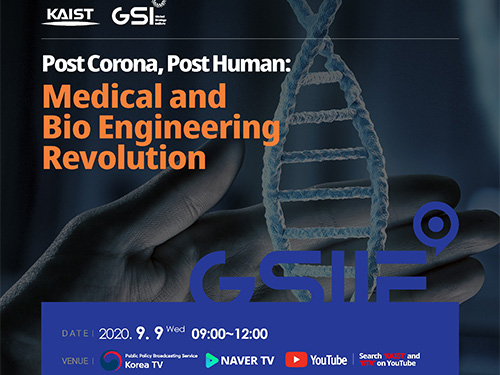
Life After COVID-19: Big Questions on Medical and Bio-Engineering
KAIST GSI forum explores big questions in the medical and bio-engineering revolution caused by the COVID-19 in fight against infectious diseases and life quality
On September 9, the Global Strategy Institute at KAIST will delve into innovative future strategies for the medical and bio-engineering sectors that have been disrupted by COVID-19. The forum will live stream via YouTube, KTV, and Naver TV from 9:00 am Korean time.
The online forum features a speaker lineup of world-renowned scholars who will discuss an array of bio-engineering technologies that will improve our quality of life and even extend our life span. This is the GSI’s third online forum since the first one in April that covered the socio-economic implications of the global pandemic and the second one in June focusing on the education sector.
In hosting the third round of the GSI Forum series, KAIST President Sung-Chul Shin stressed the power of science and technology saying, “In this world full of uncertainties, one thing for sure is that only the advancement of science and technology will deliver us from this crisis.” Korean Prime Minister Sye-Kyun Chung will also deliver a speech explaining the government’s response to COVID-19 and vaccine development strategies.
The President of the National Academy of Medicine in the US will share ideal policies to back up the bio-engineering and medical sectors and Futurist Thomas Frey from the Davinci Institute will present his distinct perspectives on our future lives after COVID-19. His thought-provoking insights on advancements in the bioengineering sector will examine whether humanity can put an end to infectious diseases and find new ways to lengthen our lives.
Two distinguished professors in the field of genetic engineering technology will share their latest breakthroughs. Professor George McDonald Church from Harvard Medical School who developed genome sequencing will deliver a keynote speech on how the advancement of gene editing and genome technology will overcome diseases and contribute to extending human life spans.
Professor Kwang-Soo Kim, a KAIST alumnus from Harvard Medical School who recently reported new discoveries for Parkinson’s disease treatment by reprogramming a patient’s own skin cells to replace cells in the brain, will introduce the latest clinical cell treatment technologies based on personalized therapeutics.
Senior Vice President and Chief Product Officer of Illumina Susan Tousi, a leading genome sequencing solution provider, will describe genome analysis technology and explore the potential for disease prevention.
KAIST medical scientist Jeong Ho Lee, who was the first to identify the causes of intractable epilepsies and has identified the genes responsible for several developmental brain disorders. Professor Jin-Hyung Lee from Stanford University and Dr. David B. Resnik from the National Institute of Environmental Health Science will also join the speaker lineup to discuss genetics-based personalized solutions to extend human life spans.
The forum will also invite about 50 young scientists and medical researchers from around the world to participate in an online panel session. They will engage in a Q&A session and a discussion with the speakers.
(END)