people
< (From left) Sang Ouk Kim, Bumjoon Kim, Yearin Byun, Hee-Tae Jung, Ju-Hyuk Lee, Hee Tak Kim, and Gyoung Hwa Jeong >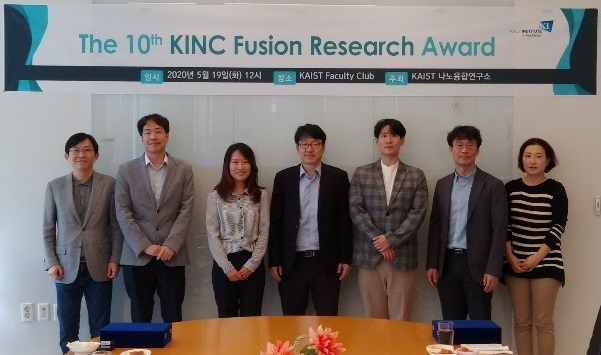
The KAIST Institute for NanoCentury (KINC) recognized three distinguished researchers whose convergence studies made significant impacts. The KINC presented the 10th KINC Fusion Research Awards during a ceremony that took place at KAIST’s main campus in Daejeon on May 19.
This year’s ‘best’ convergence research award went to a joint research group led by Professor Hee Tak Kim from the Department of Chemical and Biomolecular Engineering and Professor Sang Ouk Kim from the Department of Materials Science and Engineering. Their research, featured in the December 27 issue of Advanced Materials as a front cover article last year, introduced the world’s first high-energy efficiency, membraneless, flowless, zinc-bromine battery. This study, in which research professor Gyoung Hwa Jeong, postdoctoral researcher Yearin Byun, and PhD candidate Ju-Hyuck Lee took part as co-lead authors, is deemed as an example of a best practice in convergence research in which two groups’ respective expertise in the fields of carbon materials and electrochemical analysis created a synergistic effect.
Professor Bumjoon Kim from the Department of Chemical and Biomolecular Engineering was also recognized for having published the most interdisciplinary research papers on polymer electronics and nanomaterials at home and abroad.
Professor Hee-Tae Jung, the Director of KINC and the host of the KINC Fusion Research Awards, said, “The KINC is happy to announce the 10th awardees in nano-fusion research this year. Since convergence is crucial for making revolutionary changes, the importance of convergence studies should be recognized. Our institute will spare no effort to create a research environment suitable for convergence studies, which will be crucial for making a significant difference.”
The KINC was established in June 2006 under the KAIST Institute with the mission of facilitating convergence studies by tearing down boarders among departments and carrying out interdisciplinary joint research. Currently, the institute is comprised of approximately 90 professors from 13 departments. It aims to become a hub of university institutes for nano-fusion research.
(END)
-
research KAIST Uses Light to Distinguish Real from Fake with Hard-to-Replicate “Artificial Fingerprints”
Shine a light, and the real can be distinguished from the fake. KAIST researchers have developed a security technology that uses unique “artificial fingerprints” created by the random assembly of nanoparticles. Although extremely difficult to replicate, these fingerprints can be conveniently authenticated using only a smartphone flashlight and a laser pointer, opening up potential applications in anti-counterfeiting and electronic device authentication. KAIST announced on August 2
2026-08-26 -
event KAIST Professor Insu Yun, Students and Alumni Finish Second at DEF CON CTF 2026, the World’s Premier Hacking Competition
KAIST (President Choongsik Bae) announced on August 14 that the Korean hacking team “0x4b52,” which included Professor Insu Yun of the School of Electrical Engineering as well as numerous KAIST students and alumni, finished second at DEF CON CTF 2026, held in Las Vegas, the United States, from August 7 to 9. Comprising approximately 30 Korean hackers, 0x4b52 competed against world-class multinational teams to claim the runner-up position. This marks the best result achieved by an
2026-08-14 -
research KAIST Controls the Rotation Direction of Light Without Complex New Materials
A new pathway has opened for controlling the rotation direction of light simply by changing how molecules are arranged, without having to synthesize complex new materials. Circularly polarized light is a special form of light that travels while rotating like a pinwheel either to the left or to the right. Because different rotation directions can carry different information, it is drawing attention as a key light source for next-generation displays, optical communications, and security technolo
2026-08-14 -
research KAIST Shapes a " Templates a ‘Gas Lattice’ in Porous Materials”: The Moment Gas Forms a Crystal-like Lattice
Capturing carbon or storing hydrogen to combat global warming requires compressing gases into sponge-like porous materials. Until now, gas molecules were thought to adsorb in a disordered manner throughout the pores. But what if invisible gas molecules could be lined up in regular order — like ice crystals or LEGO bricks? KAIST (President Choongsik Bae) announced on August 11 that a research team led by Professor Jihan Kim of the Department of Chemical and Biomolecular Engineering has d
2026-08-11 -
research KAIST brings ‘giant batteries’ closer to commercialization in the AI data center era
The explosive growth of AI data centers has brought the commercialization of "giant batteries" one step closer. A KAIST research team has developed a process that cuts the production time for a core material used in large-capacity batteries by 67%, resolving the largest production bottleneck standing in the way of commercialization. KAIST (President Choongsik Bae) announced on August 5 that a research team led by Professor Hee-Tak Kim from the Department of Chemical and Biomolecular Engineeri
2026-08-05