policy
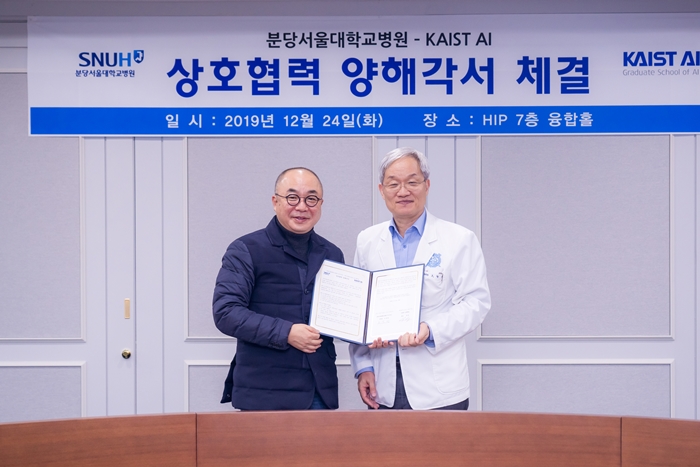
< Dean Song Chong (left) and Director Chang Wan Oh (right)
at the KAIST GSAI - SNUBH MOU Signing Ceremony >
The Graduate School of AI (GSAI) at KAIST and the Seoul National University Bundang Hospital (SNUBH) signed a memorandum of understanding (MOU) to cooperate in AI education and research in the field of healthcare last month. The two institutions have agreed to collaborate on research and technology development through the implementation of academic and personnel exchange programs.
The GSAI, opened in August 2019 as Korea’s first AI graduate school, has been in the forefront of nurturing top-tier AI specialists in the era of Fourth Industrial Revolution. The school employs a two-track strategy that not only provides students with core AI-related courses on machine learning, data mining, computer vision, and natural language processing, but also a multidisciplinary curriculum incorporating the five key fields of healthcare, autonomous vehicles, manufacturing, security, and emerging technologies. Its faculty members are "the cream of the crop” in their early 40s, achieving world-class performance in their respective fields.
SNUBH opened the Healthcare Innovation Park in 2016, the first hospital-led convergence research complex among Korean medical institutions. It is leading future medical research in five specialized areas: medical devices, healthcare ICT, human genetics, nano-machines, and regenerative medicine.
The Dean of the GSAI, Song Chong, said, “We have set the stage for a cooperative platform for continuous and efficient joint education and research by the two institutions.” He expressed his excitement, saying, “Through this platform and our expertise in AI engineering and medicine, we will lead future AI-based medical technology.”
The Director of the SNUBH Research Division, Chang Wan Oh, stressed that “the mutual cooperation between the two institutions will become a crucial turning point in AI education and research, which is at the core of future healthcare.” He added, “Through a high level of cooperation, we will have the ability to bring about global competitiveness and innovation.”
(END)
-
research RAIBO Runs over Walls with Feline Agility... Ready for Effortless Search over Mountaineous and Rough Terrains
< Photo 1. Research Team Photo (Professor Jemin Hwangbo, second from right in the front row) > KAIST's quadrupedal robot, RAIBO, can now move at high speed across discontinuous and complex terrains such as stairs, gaps, walls, and debris. It has demonstrated its ability to run on vertical walls, leap over 1.3-meter-wide gaps, sprint at approximately 14.4 km/h over stepping stones, and move quickly and nimbly on terrain combining 30° slopes, stairs, and stepping stones. RAIBO is ex
2025-06-04 -
research Professor Hyun Myung's Team Wins First Place in a Challenge at ICRA by IEEE
< Photo 1. (From left) Daebeom Kim (Team Leader, Ph.D. student), Seungjae Lee (Ph.D. student), Seoyeon Jang (Ph.D. student), Jei Kong (Master's student), Professor Hyun Myung > A team of the Urban Robotics Lab, led by Professor Hyun Myung from the KAIST School of Electrical Engineering, achieved a remarkable first-place overall victory in the Nothing Stands Still Challenge (NSS Challenge) 2025, held at the 2025 IEEE International Conference on Robotics and Automation (ICRA), the world
2025-05-30 -
event Formosa Group of Taiwan to Establish Bio R&D Center at KAIST Investing 12.5 M USD
KAIST (President Kwang-Hyung Lee) announced on February 17th that it signed an agreement for cooperation in the bio-medical field with Formosa Group, one of the three largest companies in Taiwan. < Formosa Group Chairman Sandy Wang and KAIST President Kwang-Hyung Lee at the signing ceremony > Formosa Group Executive Committee member and Chairman Sandy Wang, who leads the group's bio and eco-friendly energy sectors, decided to establish a bio-medical research center within KAIST and i
2025-02-17 -
research KAIST develops ‘Hoverbike’ to roam the future skies
< Photo 1. A group photo of the research team > Hoverbike is a kind of next-generation mobility that can complement the existing transportation system and can be used as an air transportation means without traffic congestion through high-weight payloads and long-distance flights. It is expected that domestic researchers will contribute to the development of the domestic PAV* and UAM markets by developing a domestically developed manned/unmanned hybrid aircraft that escapes dependence
2024-12-27 -
event KAIST’s RAIBO2 becomes the World’s First Robo-dog to Successfully Complete a Full-course Marathon
KAIST's quadrupedal walking robot "RAIBO", which can run seamlessly on sandy beaches, has now evolved into "RAIBO2"and achieved the groundbreaking milestone by becomeing the world's first quadrupedal robot to successfully complete a full-course marathon in an official event. < Photo 1. A group photo of RAIBO2 and the team after completing the full-course marathon > KAIST (President Kwang Hyung Lee) announced on the 17th of November that Professor Je Min Hwangbo's research team of t
2024-11-17