event
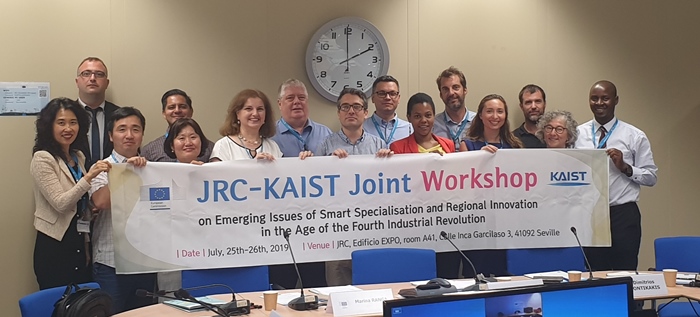
The Fourth Industrial Revolution Intelligence Center (FIRIC) at KAIST discussed ‘Smart Specialization’ for regional innovation and economic growth in the wake of the Fourth Industrial Revolution during the workshop with the EU Joint Research Center (EU-JRC) in Seville, Spain last week. The two sides also agreed to sign an MOU to expand mutual collaboration.
KAIST’s FIRIC was founded in cooperation with the World Economic Forum in July 2017 to carry out policy research for the promotion of science and technology-based inclusive growth and innovation and to lead related global efforts. The EU-JRC has committed to developing cohesive policies that aim to narrow regional gaps within the European Union. Founded in 1958 in Brussels, the EU-JRC has long been in charge of EU strategies for regional innovation based on emerging technologies.
The workshop also covered issues related to public-private partnerships and innovation clusters from the perspective of the EU and Asia, such as the global value chain and the implementation of industrial clusters policy amid the changes in the industrial ecosystem due to digitalization, automation, and the utilization of robotics during the Fourth Industrial Revolution.
In addition, the session included discussions on inclusive growth and job market changes in the era of the Fourth Industrial Revolution, addressing how Smart Specialization and the outcomes of the 4IR will shift the paradigm of current job and technology capabilities, as well as employment issues in many relevant industries. In particular, the actual case studies and their related policies and regulatory trends regarding the potential risks and ethical issues of artificial intelligence were introduced.
Regarding the financial services that utilize blockchain technologies and the establishment of public sector governance for such technologies, the participating experts noted difficulties in the diffusion of blockchain-based local currencies or public services, which call for a sophisticated analytical and practical framework for innovative and transparent governance.
Dr. Mark Boden, the Team Leader of the EU-JRC, introduced the EU’s initiatives to promote Smart Specialization, such as its policy process, governance design, vision sharing, and priority setting, with particular emphasis on targeted support for Smart Specialization in lagging regions.
Professor So Young Kim, who is the dean of the Graduate School of Science and Technology Policy and FIRIC’s Deputy Director said, “KAIST’s global role regarding the Fourth Industrial Revolution will be expanded in the process of exploring and developing innovative models of technology-policy governance while working jointly with the EU-JRC.”
-
research RAIBO Runs over Walls with Feline Agility... Ready for Effortless Search over Mountaineous and Rough Terrains
< Photo 1. Research Team Photo (Professor Jemin Hwangbo, second from right in the front row) > KAIST's quadrupedal robot, RAIBO, can now move at high speed across discontinuous and complex terrains such as stairs, gaps, walls, and debris. It has demonstrated its ability to run on vertical walls, leap over 1.3-meter-wide gaps, sprint at approximately 14.4 km/h over stepping stones, and move quickly and nimbly on terrain combining 30° slopes, stairs, and stepping stones. RAIBO is ex
2025-06-04 -
research Professor Hyun Myung's Team Wins First Place in a Challenge at ICRA by IEEE
< Photo 1. (From left) Daebeom Kim (Team Leader, Ph.D. student), Seungjae Lee (Ph.D. student), Seoyeon Jang (Ph.D. student), Jei Kong (Master's student), Professor Hyun Myung > A team of the Urban Robotics Lab, led by Professor Hyun Myung from the KAIST School of Electrical Engineering, achieved a remarkable first-place overall victory in the Nothing Stands Still Challenge (NSS Challenge) 2025, held at the 2025 IEEE International Conference on Robotics and Automation (ICRA), the world
2025-05-30 -
event Formosa Group of Taiwan to Establish Bio R&D Center at KAIST Investing 12.5 M USD
KAIST (President Kwang-Hyung Lee) announced on February 17th that it signed an agreement for cooperation in the bio-medical field with Formosa Group, one of the three largest companies in Taiwan. < Formosa Group Chairman Sandy Wang and KAIST President Kwang-Hyung Lee at the signing ceremony > Formosa Group Executive Committee member and Chairman Sandy Wang, who leads the group's bio and eco-friendly energy sectors, decided to establish a bio-medical research center within KAIST and i
2025-02-17 -
research KAIST develops ‘Hoverbike’ to roam the future skies
< Photo 1. A group photo of the research team > Hoverbike is a kind of next-generation mobility that can complement the existing transportation system and can be used as an air transportation means without traffic congestion through high-weight payloads and long-distance flights. It is expected that domestic researchers will contribute to the development of the domestic PAV* and UAM markets by developing a domestically developed manned/unmanned hybrid aircraft that escapes dependence
2024-12-27 -
event KAIST’s RAIBO2 becomes the World’s First Robo-dog to Successfully Complete a Full-course Marathon
KAIST's quadrupedal walking robot "RAIBO", which can run seamlessly on sandy beaches, has now evolved into "RAIBO2"and achieved the groundbreaking milestone by becomeing the world's first quadrupedal robot to successfully complete a full-course marathon in an official event. < Photo 1. A group photo of RAIBO2 and the team after completing the full-course marathon > KAIST (President Kwang Hyung Lee) announced on the 17th of November that Professor Je Min Hwangbo's research team of t
2024-11-17