people
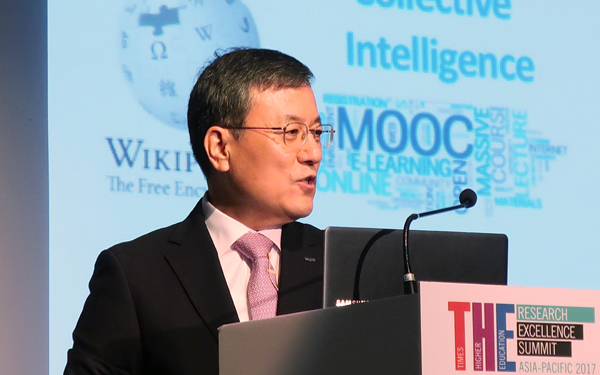
(President Shin makes a keynote speech at the Times Higher Education Research Excellence Summit held in Taiwan on July 4.)
KAIST President Sung-Chul Shin stressed that innovations in education, research, and technology commercialization of universities are critical for responding to the transformations that the Fourth Industrial Revolution will bring about.
In his keynote speech at the Times Higher Education Research Excellence Summit held in Taiwan on July 4, he cited connectivity, superintelligence, and convergence in science and technology as three components the Fourth Industrial Revolution will pierce, saying the speed and breadth of the transformation will be beyond our imagination. He also presented megatrends in science and technology in the years to come and how KAIST is addressing the challenges and opportunities.
“It is imperative to foster creative young talents fluent in convergence, collaboration, and communication skills in the new era. To this end, we need to focus on whole brain education by enhancing basic education in science and engineering plus humanities and social studies,” he stressed. He also presented a Non-Departmental Education Track, which KAIST plans to implement from next semester. The track, designed to prepare students for the new industrial era, will focus on whole brain education including entrepreneurship and leadership education during the undergraduate period.
He also emphasized an effective new teaching methodology. “We need to develop various new teaching methods. The paradigm should shift from lecturer-centered to student-centered. KAIST is revising our curriculum to facilitate team-based, project-based learning and flipped learning,” he explained.
President Shin also pointed out that the educational goals for the next generation should be to sustain the value of people’s own thoughtfulness, wisdom, emotion, and caring against the advent of a new tribe of AI, dubbed Robo Sapiens. “Those traits add undeniable educational value that we should continue to pursue even in the era of Robo Sapiens,” he added.
As for research innovation, he emphasized inter- and multi-disciplinary collaborative research. “Especially, in addressing pressing global issues and big science, international collaboration will be very effective and crucial,” he said.
At the summit, convergence research projects currently underway at KAIST using emerging technologies such as the smart mobile healthcare project, Dr, M; the humanoid robot, HUBO; and AI drone swarms drew lots of attention from the participants, even receiving proposals to join the projects as collaborators.
In the new era, according to Shin, technology commercialization at universities will emerge as a hub of R&DB. Citing that KAIST has long been a draw for startups, he noted that KAIST has also set a high value on entrepreneurship education including social entrepreneurship and startups.
He continued, “The Korean government is making every effort to harness the challenges and opportunities of the Fourth Industrial Revolution by creating a new economic growth engine. For the success of the government initiative, universities should also respond to make innovations commensurate with the changing needs and challenges. KAIST will take the lead in this new initiative for making a new future.”
-
research KAIST Uses AI to Discover Optimal New Material for Removing Radioactive Iodine Contamination
<(From the Right) Professor Ho Jin Ryu, Department of Nuclear and Quantum Engineering, Dr. Sujeong Lee, a graduate of the KAIST Department of Materials Science and Engineering, and Dr. Juhwan Noh of KRICT’s Digital Chemistry Research Center> Managing radioactive waste is one of the core challenges in the use of nuclear energy. In particular, radioactive iodine poses serious environmental and health risks due to its long half-life (15.7 million years in the case of I-129), hi
2025-07-03 -
event 2025 KAIST Global Entrepreneurship Summer School Concludes Successfully in Silicon Valley
< A group photo taken at the 2025 GESS Special Lecture.Vice President So Young Kim from the International Office, VC Jay Eum from GFT Ventures, Professor Byungchae Jin from the Impact MBA Program at the Business School, and Research Assistant Professor Sooa Lee from the Office of Global Initiative> The “2025 KAIST Global Entrepreneurship Summer School (2025 KAIST GESS),” organized by the Office of Global Initiative of the KAIST International Office (Vice President
2025-07-01 -
research KAIST Develops AI to Easily Find Promising Materials That Capture Only CO₂
< Photo 1. (From left) Professor Jihan Kim, Ph.D. candidate Yunsung Lim and Dr. Hyunsoo Park of the Department of Chemical and Biomolecular Engineering > In order to help prevent the climate crisis, actively reducing already-emitted CO₂ is essential. Accordingly, direct air capture (DAC) — a technology that directly extracts only CO₂ from the air — is gaining attention. However, effectively capturing pure CO₂ is not easy due to water vapor (H₂O) present in the air. KAIST r
2025-06-29 -
research Military Combatants Usher in an Era of Personalized Training with New Materials
< Photo 1. (From left) Professor Steve Park of Materials Science and Engineering, Kyusoon Pak, Ph.D. Candidate (Army Major) > Traditional military training often relies on standardized methods, which has limited the provision of optimized training tailored to individual combatants' characteristics or specific combat situations. To address this, our research team developed an e-textile platform, securing core technology that can reflect the unique traits of individual combatants and
2025-06-25 -
event KAIST to Lead the Way in Nurturing Talent and Driving S&T Innovation for a G3 AI Powerhouse
* Focusing on nurturing talent and dedicating to R&D to become a G3 AI powerhouse (Top 3 AI Nations). * Leading the realization of an "AI-driven Basic Society for All" and developing technologies that leverage AI to overcome the crisis in Korea's manufacturing sector. * 50 years ago, South Korea emerged as a scientific and technological powerhouse from the ashes, with KAIST at its core, contributing to the development of scientific and technological talent, innovative technology, national
2025-06-24