policy
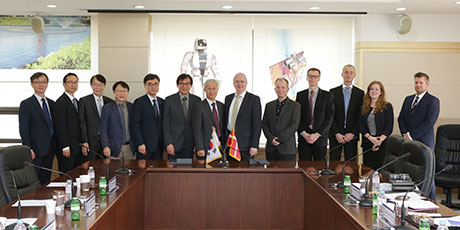
KAIST and the Technical University of Denmark (DTU) established a joint degree program for master’s students in electrical engineering. The agreement, made on October 22, 2015, will allow master students from both universities to study for one year at each institution.
For details, go to the DTU news: http://www.dtu.dk/english/News/Nyhed?id=9e7b91e5-1719-4421-8cc2-5e3fe7d605d7
-
research Unraveling Mitochondrial DNA Mutations in Human Cells
Throughout our lifetime, cells accumulate DNA mutations, which contribute to genetic diversity, or “mosaicism”, among cells. These genomic mutations are pivotal for the aging process and the onset of various diseases, including cancer. Mitochondria, essential cellular organelles involved in energy metabolism and apoptosis, possess their own DNA, which are susceptible to mutations. However, studies on mtDNA mutations and mosaicism have been limited due to a variety of technical challe
2024-07-24 -
research KAIST Develops Microbial Liquid Egg Substitute
A team of researchers published a paper on developing a substitute for eggs using microorganisms, grabbing international attention. It is expected that the development of egg substitutes using non-animal raw materials will solve the problems of factory farming, which causes problems like increased emission of greenhouse gas and waste, and contribute to building a sustainable food system that allows easy protein intake. KAIST (President Kwang-Hyung Lee) announced that Research Professor Kyeong R
2024-07-05 -
event The 3rd Global Entrepreneurship Summer School (GESS 2024) Successfully Completed in Silicon Valley
The 2024 Global Entrepreneurship Summer School (2024 KAIST GESS), hosted by the Office of Global Initiatives under the KAIST International Office (Director Man-Sung Yim), was held for the third time. This program allows students to visit Silicon Valley, a global startup hub, to directly experience its famous startup ecosystem and develop their capabilities for global expansion. A total of 20 students were selected through applications, interviews, final presentations, mentoring, and peer evaluat
2024-07-03 -
research KAIST Employs Image-recognition AI to Determine Battery Composition and Conditions
An international collaborative research team has developed an image recognition technology that can accurately determine the elemental composition and the number of charge and discharge cycles of a battery by examining only its surface morphology using AI learning. KAIST (President Kwang-Hyung Lee) announced on July 2nd that Professor Seungbum Hong from the Department of Materials Science and Engineering, in collaboration with the Electronics and Telecommunications Research Institute (ETRI) and
2024-07-02 -
people KAIST President Kwang-Hyung Lee receives honorary doctorate from Université de Montréal
KAIST (President Kwang-Hyung Lee) announced on June 16th that President Kwang-Hyung Lee received an honorary doctorate on the 15th, local time, from the Université de Montréal in Canada, one of the largest French-speaking universities in North America. < Image. (from left) Mr. Pierre Lassonde, Chairman of the Board of Polytechnique Montréal, President Maud Cohen of Polytechnique Montréal, President Kwang-Hyung Lee of KAIST, Chancellor Frantz Saintellemy of Uni
2024-06-16