policy
Courtesy of École Centrale Paris News: http://www.ecp.fr/lang/en/home/news?actuID=48892
Strengthening of the partnership betwenn CentraleSupélec and KAIST University, South Korea
The two institutions signed a new agreement.
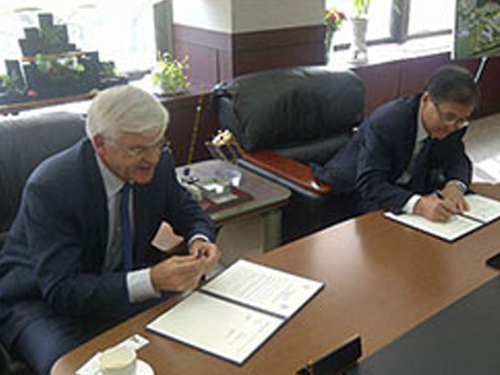
Hervé Biausser (left in the picture), Director of CentraleSupélec, has met Sung-Mo Steve Kang (right in the picture), the President of the Korea Advanced Institute of Science and Technology (KAIST). They signed an agreement aiming to strengthen the partnership between the two institutions concerning research and higher education.
CentraleSupélec and KAIST have cooperated since 2010 on research projects in the context of the Erasmus Mundus BEAM and EASED programs, which are coordinated by CentraleSupélec.
The next step is now the application of graduate academic mobility in the common fields of excellency of the institutions: energy, electronic, physics and mathematics.
-
research KAIST Develops Glare-Free, Heat-Blocking 'Smart Window'... Applicable to Buildings and Vehicles
• Professor Hong Chul Moon of the Department of Chemical and Biomolecular Engineering develops RECM, a next-generation smart window technology, expecting cooling energy savings and effective indoor thermal management. • When using the developed RECM, a significantly superior temperature reduction effect is observed compared to conventional windows. • With a 'pedestrian-friendly smart window' design that eliminates glare by suppressing external reflections, it is expected to be a
2025-06-20 -
research KAIST Successfully Develops High-Performance Water Electrolysis Without Platinum, Bringing Hydrogen Economy Closer
< Photo 1. (Front row, from left) Jeesoo Park (Ph.D. Candidate), Professor Hee-Tak Kim (Back row, from left) Kyunghwa Seok (Ph.D. Candidate), Dr. Gisu Doo, Euntaek Oh (Ph.D. Candidate) > Hydrogen is gaining attention as a clean energy source that emits no carbon. Among various methods, water electrolysis, which splits water into hydrogen and oxygen using electricity, is recognized as an eco-friendly hydrogen production method. Specifically, proton exchange membrane water electrolysis
2025-06-11 -
research KAIST Succeeds in Real-Time Carbon Dioxide Monitoring Without Batteries or External Power
< (From left) Master's Student Gyurim Jang, Professor Kyeongha Kwon > KAIST (President Kwang Hyung Lee) announced on June 9th that a research team led by Professor Kyeongha Kwon from the School of Electrical Engineering, in a joint study with Professor Hanjun Ryu's team at Chung-Ang University, has developed a self-powered wireless carbon dioxide (CO2) monitoring system. This innovative system harvests fine vibrational energy from its surroundings to periodically measure CO2 concentra
2025-06-09 -
research KAIST Captures Hot Holes: A Breakthrough in Light-to-Electricity Energy Conversion
When light interacts with metallic nanostructures, it instantaneously generates plasmonic hot carriers, which serve as key intermediates for converting optical energy into high-value energy sources such as electricity and chemical energy. Among these, hot holes play a crucial role in enhancing photoelectrochemical reactions. However, they thermally dissipate within picoseconds (trillionths of a second), making practical applications challenging. Now, a Korean research team has successfully devel
2025-03-17 -
research KAIST Develops Neuromorphic Semiconductor Chip that Learns and Corrects Itself
< Photo. The research team of the School of Electrical Engineering posed by the newly deveoped processor. (From center to the right) Professor Young-Gyu Yoon, Integrated Master's and Doctoral Program Students Seungjae Han and Hakcheon Jeong and Professor Shinhyun Choi > - Professor Shinhyun Choi and Professor Young-Gyu Yoon’s Joint Research Team from the School of Electrical Engineering developed a computing chip that can learn, correct errors, and process AI tasks - Equipping
2025-01-17