research
Professor Wangyeol Oh of KAIST’s Mechanical Engineering Department has succeeded in developing an optical imaging endoscope system that employs an imaging velocity, which is up to 3.5 times faster than the previous systems. Furthermore, he has utilized this endoscope to acquire the world’s first high-resolution 3D images of the insides of in vivo blood vessel.
Professor Oh’s work is Korea’s first development of blood vessel endoscope system, possessing an imaging speed, resolution, imaging quality, and image-capture area. The system can also simultaneously perform a functional imaging, such as polarized imaging, which is advantageous for identifying the vulnerability of the blood vessel walls.
The Endoscopic Optical Coherence Tomography (OCT) System provides the highest resolution that is used to diagnose cardiovascular diseases, represented mainly by myocardial infarction.
However, the previous system was not fast enough to take images inside of the vessels, and therefore it was often impossible to accurately identify and analyze the vessel condition. To achieve an in vivo blood vessel optical imaging in clinical trials, the endoscope needed to be inserted, after which a clear liquid flows instantly, and pictures can be taken in only a few seconds.
The KAIST research team proposed a solution for such problem by developing a high-speed, high-resolution optical tomographic imaging system, a flexible endoscope with a diameter of 0.8 mm, as well as a device that can scan the imaging light within the blood vessels at high speed. Then, these devices were combined to visualize the internal structure of the vessel wall.
Using the developed system, the researchers were able to obtain high-resolution images of about 7 cm blood vessels of a rabbit’s aorta, which is similar size to human’s coronary arteries. The tomography scan took only 5.8 seconds, at a speed of 350 scans per second in all three directions with a resolution of 10~35㎛.
If the images are taken every 200 ㎛, like the currently available commercial vascular imaging endoscopes, a 7cm length vessel can be imaged in only one second.
Professor Wangyeol Oh said, “Our newly developed blood vessel endoscope system was tested by imaging a live animal’s blood vessels, which is similar to human blood vessels. The result was very successful.”
“Collaborating closely with hospitals, we are preparing to produce the imaging of an animal’s coronary arteries, which is similar in size to the human heart,” commented Professor Oh on the future clinical application and commercialization of the endoscope system. He added, “After such procedures, the technique can be applied in clinical patients within a few years.”
Professor Oh’s research was supported by the National Research Foundation of Korea and the Global Frontier Project by the Korean government. The research results were published in the 2014 January’s edition of Biomedical Optics Express.
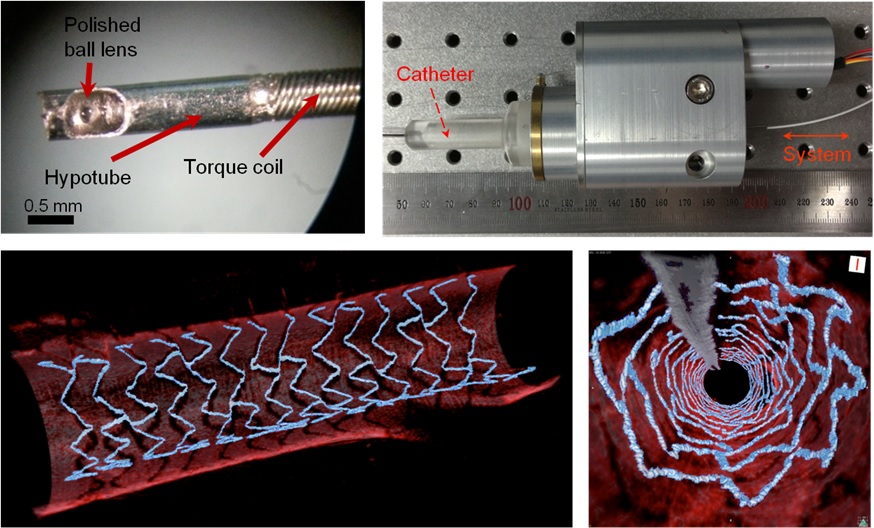
Figure 1: End portion of optical endoscope (upper left)
Figure 2: High-speed optical scanning unit of the endoscope (top right)
Figure 3: High-resolution images of the inside of in vivo animal blood vessels (in the direction of vascular circumference and length)
Figure 4: High-resolution images of the inside of in vivo animal blood vessels (in the direction of the vein depth)
-
people KAIST President Kwang-Hyung Lee receives honorary doctorate from Université de Montréal
KAIST (President Kwang-Hyung Lee) announced on June 16th that President Kwang-Hyung Lee received an honorary doctorate on the 15th, local time, from the Université de Montréal in Canada, one of the largest French-speaking universities in North America. < Image. (from left) Mr. Pierre Lassonde, Chairman of the Board of Polytechnique Montréal, President Maud Cohen of Polytechnique Montréal, President Kwang-Hyung Lee of KAIST, Chancellor Frantz Saintellemy of Uni
2024-06-16 -
event World-renowned Soprano Sumi Jo and Broadcom CEO Hock Tan awarded honorary doctorate from KAIST
< (From left) Sumi Jo, Distinguished Visiting Professor at the Graduate School of Culture and Technology, and Broadcom President and CEO Hock Tan > KAIST (President Kwang-Hyung Lee) announced that it awarded honorary doctorates to world-renowned soprano Sumi Jo, a distinguished visiting professor at the Graduate School of Culture and Technology, and the President and Chief Executive Officer of Broadcom Inc., Hock Tan, at the graduation ceremony held on the 16th of February, 2024. P
2024-02-17 -
people KAIST confers Honorary Doctorate of Science on NYU President Emeritus John Edward Sexton
< Photo 1. NYU President Emeritus John Edward Sexton posing with KAIST President Kwang Hyung Lee holding the Honorary Doctorate at the KAIST Commencement Ceremony > KAIST (President Kwang Hyung Lee) announced that it conferred an honorary doctorate of science degree on NYU President Emeritus John Edward Sexton at the Commencement Ceremony held on the 17th. An official from KAIST explained, "KAIST is conferring an honorary doctorate for President Sexton's longstanding leadership in
2023-02-17 -
event Commencement Ceremony Honors the Class of 2022
Third online commencement ceremony since the pandemic outbreak celebrates 2741 graduates The 2022 commencement ceremony convened online on February 18 to celebrate and award degrees to the Class of 2022. The graduating class of 2022 included 663 PhDs, 1,383 Masters, and 695 Bachelors. The limited number of attendees included 86 graduate representatives and approximately 20 faculty members in senior leadership, as well as Korea’s Minister of Science and ICT Hyesook Lim. The ceremony was
2022-02-18 -
event Marien Buissonniere Awarded the 9th Grand Award for Future Strategy
Global healthcare and humanitarian activist honored by the Grand Award for Future Strategy The Moon Soul Graduate School of Future Strategy awarded the 9th Grand Award for Future Strategy to Marine Buissonniere, an independent advisor and practitioner in the fields of global health and humanitarian action. She currently works as a senior advisor to the Prevent Epidemics team at Resolve to Save Lives. She also co-chairs Doctors Without Borders’ Transformational Investment Capacity. Bu
2021-11-11