people
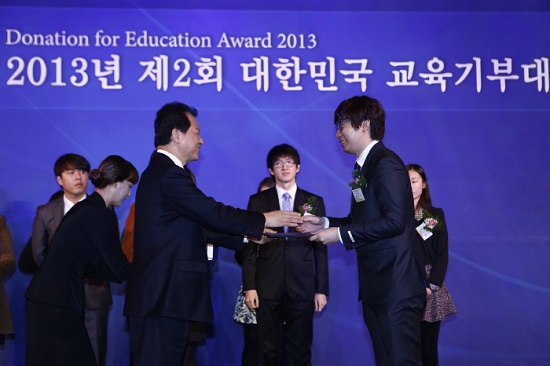
Chalk, a KAIST student club which donates their educational knowledge, received an award from the Education Minister of the Republic of Korea at the 2nd Donation for Education Award held on December 16th, 2013 at the Plaza Hotel in Seoul.
The Donation for Eduation Award aims to find and reward corporations, organizations, and individuals, which have actively contributed to growing the dreams and talents of students, as well as revitalizing the culture of donation for education. It has been awarded by the Ministry of Education since 2012 to promote the awareness and participation of students for education.
Chalk provides free online video lectures on www.playchalk.com and runs a mentoring-based education program. The club has been recognized for offering online courses, math and science classes in particular, to teenage students who are from socially and economically less privileged backgrounds.
Chalk was founded by five KAIST students in 2011. Their ultimate goal is to create a society where students can fully enjoy the benefits of education, regardless of their economic conditions. About 60 undergraduate students currently participate in the club, with more than 5,000 students attending over 160 lectures without any cost.
-
people Distinguished Professor Sang Yup Lee Wins 2025 Global Metabolic Engineering Award
< Distinguished Professor Sang Yup Lee (Senior Vice President for Research) from the Department of Chemical & Biomolecular Engineering > KAIST announced on the 20th that Professor Sang Yup Lee, who serves as the Vice President for Research and a Distinguished Professor at our university, has been awarded the '2025 Gregory N. Stephanopoulos Award for Metabolic Engineering' by the International Metabolic Engineering Society (IMES). Professor Lee delivered his award lecture at the 16
2025-06-20 -
research KAIST Professor Jee-Hwan Ryu Receives Global IEEE Robotics Journal Best Paper Award
- Professor Jee-Hwan Ryu of Civil and Environmental Engineering receives the Best Paper Award from the Institute of Electrical and Electronics Engineers (IEEE) Robotics Journal, officially presented at ICRA, a world-renowned robotics conference. - This is the highest level of international recognition, awarded to only the top 5 papers out of approximately 1,500 published in 2024. - Securing a new working channel technology for soft growing robots expands the practicality and application possib
2025-06-09 -
research KAIST & CMU Unveils Amuse, a Songwriting AI-Collaborator to Help Create Music
Wouldn't it be great if music creators had someone to brainstorm with, help them when they're stuck, and explore different musical directions together? Researchers of KAIST and Carnegie Mellon University (CMU) have developed AI technology similar to a fellow songwriter who helps create music. KAIST (President Kwang-Hyung Lee) has developed an AI-based music creation support system, Amuse, by a research team led by Professor Sung-Ju Lee of the School of Electrical Engineering in collaboration
2025-05-07 -
event KAIST Alumni Association to Honor Alumni of the Year Award Winners
Photo 1. Photo of the KAIST Alumni of the Year Award Recipients (From left) UST President Lee-whan Kim, CEO Han Chung of iThree Systems Co., Ltd., CEO Dong Myung Kim of LG Energy Solution Co., Ltd., and Professor Hyun Myung of the School of Electrical Engineering at KAIST KAIST (President Kwang Hyung Lee) announced on Monday, the 13th of January that the Alumni Association (President Yun-Tae Lee) has selected its Alumni of the Year. This year’s honorees are: ▴ President Lee-whan K
2025-01-15 -
event KAIST Wins CES 2025 Innovation Award, Showcasing Innovative Technologies
KAIST will showcase innovative technologies at the world’s largest technology fair, the Consumer Electronics Show (CES 2025). In addition, KAIST startups VIRNECT Inc., Standard Energy Inc., A2US Inc., and Panmnesia, Inc. won the 2025 CES Innovation Awards. < Image 1. 3D-Graphical Profile of CES 2025 KAIST Exhibition Booth > KAIST (President Kwang-Hyung Lee) announced on the 31st that it will operate a 140㎡ standalone booth at CES Eureka Park, which will be held in Las Vegas,
2024-12-31