policy
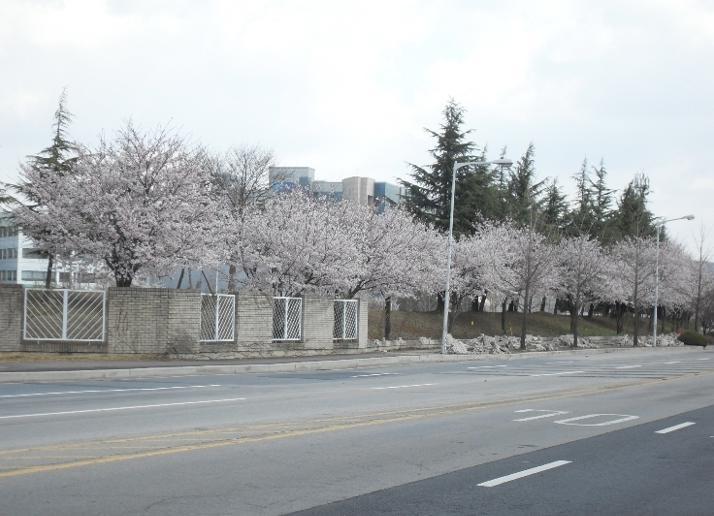
KAIST and the City of Daejeon have taken on a project to remove a stretch of fence on campus that faces Gap-Chun River, making the campus accessible to all citizens and visitors. The work will last for three months beginning on April 5th and throughout June 2010. Gradually, KAIST plans to remove the entire fence surrounding the campus within a few years.
The city government has encouraged government and public organizations in Daejeon to open up their public space to citizens and visitors as part of its initiatives to reach out to local communities. As of December 2008, seven public organizations have completed to rid of their boundary markers, and eight more organizations will make their gardens and campus available to the public by the end of this year.
All the expenses related to the removal of the fence will be borne by the city government. At the place where the fence is knocked down will become a park so that neighbors and visitors can come and rest.
A school official said, “This is an important campaign for us because it promotes more exchanges between the university and local community. Our campus has rich green foliage, and visitors will surely enjoy it. By opening up our campus to the public, we hope to return to the society what we have received as a public institution and create a forum where art, science, and technology meet together.”
In addition to the removal of the fence, KAIST and the city government will install flowerbeds, health facilities, and walking trails for the citizens.
-
event 2025 KAIST Global Entrepreneurship Summer School Concludes Successfully in Silicon Valley
< A group photo taken at the 2025 GESS Special Lecture.Vice President So Young Kim from the International Office, VC Jay Eum from GFT Ventures, Professor Byungchae Jin from the Impact MBA Program at the Business School, and Research Assistant Professor Sooa Lee from the Office of Global Initiative> The “2025 KAIST Global Entrepreneurship Summer School (2025 KAIST GESS),” organized by the Office of Global Initiative of the KAIST International Office (Vice President
2025-07-01 -
research KAIST Professor Jee-Hwan Ryu Receives Global IEEE Robotics Journal Best Paper Award
- Professor Jee-Hwan Ryu of Civil and Environmental Engineering receives the Best Paper Award from the Institute of Electrical and Electronics Engineers (IEEE) Robotics Journal, officially presented at ICRA, a world-renowned robotics conference. - This is the highest level of international recognition, awarded to only the top 5 papers out of approximately 1,500 published in 2024. - Securing a new working channel technology for soft growing robots expands the practicality and application possib
2025-06-09 -
event KAIST School of Computing Unveils 'KRAFTON Building,' A Symbol of Collective Generosity
< (From the fifth from the left) Provost and Executive Vice President Gyun Min Lee, Auditor Eun Woo Lee, President Kwang-Hyung Lee, Dean of the School of Computing Seok-Young Ryu, former Krafton member and donor Woong-Hee Cho, Krafton Chairman Byung-Gyu Chang > KAIST announced on May 20th the completion of the expansion building for its School of Computing, the "KRAFTON Building." The project began in June 2021 with an ₩11 billion donation from KRAFTON and its employees, eventually gr
2025-05-21 -
event Life Springs at KAIST: A Tale of Two Special Campus Families
A Gift of Life on Teachers' Day: Baby Geese Born at KAIST Pond On Teachers' Day, a meaningful miracle of life arrived at the KAIST campus. A pair of geese gave birth to two goslings by the duck pond. < On Teachers' Day, a pair of geese and their goslings leisurely swim in the pond. > The baby goslings, covered in yellow down, began exploring the pond's edge, scurrying about, while their aunt geese steadfastly stood by. Their curious glances, watchful gazes, playful hops on water
2025-05-21 -
event KAIST Art Museum Showcases the Works of Van Gogh, Cy Twombly, and More at "The Vault of Masterpieces"
KAIST (President Kwang Hyung Lee) opened a special exhibition, "The Vault of Masterpieces", featuring the architects of the Gallerist Hong Gyu Shin, who is active in New York, on April 29th. Since its opening in December 2024, the KAIST Museum of Art, which has mainly exhibited works from its own collection, has boldly invited internationally renowned Gallerist Shin Hong-gyu to hold its first full-scale special exhibition, displaying a large number of his collections in the center of the camp
2025-04-30