event
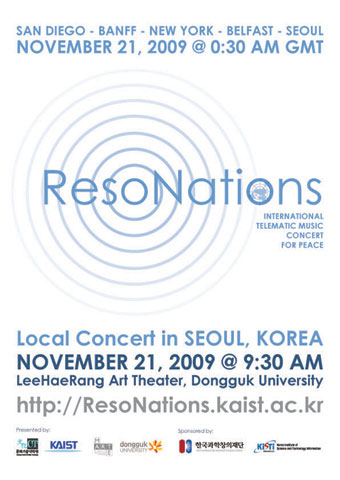
Renowned musicians in five international locations perform new contemporary music works for peace through a real-time performance on the internet. Local audiences in Seoul, Banff, New York, San Diego and Belfast will also have a chance to hear a program.
In Seoul, the "International Telematic Music Concert for Peace" will be held at the LeeHaeRang Art Theater, Dongguk University, in Seoul on Nov. 20 at 9:30 a.m., under the presentation of KAIST"s Graduate School of Culture Technology and MARTE Lab, Dongguk University. Telematic music is real-time performance via the internet by musicians in different geographic locations.
The program of the concert includes "Hope"s Dream" by Mark Dresser and Sarah Weaver; "Disparate Bodies" by Pedro Rebelo, "Rock, Paper, Scissors" by Chris Chafe. The Korean act to be performed is "Green-colored Harmony" by Jun Kim.
In addition to the two Korean universities, the World Association of Former United Nations Internes and Fellows (WAFUNIF), University of California San Diego, the Banff Center of Canada and Queen"s University in Belfast are participating in the project.
The performance will take place on high-bandwidth internet with JackTrip audio software developed by Chris Chafe and Access Grid video software developed at Argonne National Laboratory.
"Connecting the five different cities together through super-speed Internet network and transmitting sound and images in real time is challenging technically. But, we also expect that more exciting results will be created in the course of transforming the sound into visual images," said Woon-Seung Yeo, a professor of the Graduate School of Culture Technology, who was responsible for visuals in the project.
-
event 2025 KAIST Global Entrepreneurship Summer School Concludes Successfully in Silicon Valley
<A group photo taken at the 2025 GESS Special Lecture. Vice President So Young Kim, Vice Chancellor Jae Hoon EUM, Professor Byung Chae JIN from Head of the Impact MBA Program at the Business School, and Research Professor Sooah Lee from Office of Global Initiatvie> The “2025 KAIST Global Entrepreneurship Summer School (2025 KAIST GESS),” organized by the Office of Global Initiative of the KAIST International Office (Vice President So Young Kim), successfully concluded.
2025-07-01 -
research KAIST Professor Jee-Hwan Ryu Receives Global IEEE Robotics Journal Best Paper Award
- Professor Jee-Hwan Ryu of Civil and Environmental Engineering receives the Best Paper Award from the Institute of Electrical and Electronics Engineers (IEEE) Robotics Journal, officially presented at ICRA, a world-renowned robotics conference. - This is the highest level of international recognition, awarded to only the top 5 papers out of approximately 1,500 published in 2024. - Securing a new working channel technology for soft growing robots expands the practicality and application possib
2025-06-09 -
event KAIST School of Computing Unveils 'KRAFTON Building,' A Symbol of Collective Generosity
< (From the fifth from the left) Provost and Executive Vice President Gyun Min Lee, Auditor Eun Woo Lee, President Kwang-Hyung Lee, Dean of the School of Computing Seok-Young Ryu, former Krafton member and donor Woong-Hee Cho, Krafton Chairman Byung-Gyu Chang > KAIST announced on May 20th the completion of the expansion building for its School of Computing, the "KRAFTON Building." The project began in June 2021 with an ₩11 billion donation from KRAFTON and its employees, eventually gr
2025-05-21 -
event Life Springs at KAIST: A Tale of Two Special Campus Families
A Gift of Life on Teachers' Day: Baby Geese Born at KAIST Pond On Teachers' Day, a meaningful miracle of life arrived at the KAIST campus. A pair of geese gave birth to two goslings by the duck pond. < On Teachers' Day, a pair of geese and their goslings leisurely swim in the pond. > The baby goslings, covered in yellow down, began exploring the pond's edge, scurrying about, while their aunt geese steadfastly stood by. Their curious glances, watchful gazes, playful hops on water
2025-05-21 -
event KAIST Art Museum Showcases the Works of Van Gogh, Cy Twombly, and More at "The Vault of Masterpieces"
KAIST (President Kwang Hyung Lee) opened a special exhibition, "The Vault of Masterpieces", featuring the architects of the Gallerist Hong Gyu Shin, who is active in New York, on April 29th. Since its opening in December 2024, the KAIST Museum of Art, which has mainly exhibited works from its own collection, has boldly invited internationally renowned Gallerist Shin Hong-gyu to hold its first full-scale special exhibition, displaying a large number of his collections in the center of the camp
2025-04-30