research
Sodium (Na), which is over 500 times more abundant than lithium (Li), has recently garnered significant attention for its potential in sodium-ion battery technologies. However, existing sodium-ion batteries face fundamental limitations, including lower power output, constrained storage properties, and longer charging times, necessitating the development of next-generation energy storage materials.
On the 11th of April, KAIST (represented by President Kwang Hyung Lee) announced that a research team led by Professor Jeung Ku Kang from the Department of Materials Science and Engineering had developed a high-energy, high-power hybrid sodium-ion battery capable of rapid charging.
The innovative hybrid energy storage system integrates anode materials typically used in batteries with cathodes suitable for supercapacitors. This combination allows the device to achieve both high storage capacities and rapid charge-discharge rates, positioning it as a viable next-generation alternative to lithium-ion batteries.
However, the development of a hybrid battery with high energy and high power density requires an improvement to the slow energy storage rate of battery-type anodes as well as the enhancement of the relatively low capacity of supercapacitor-type cathode materials.
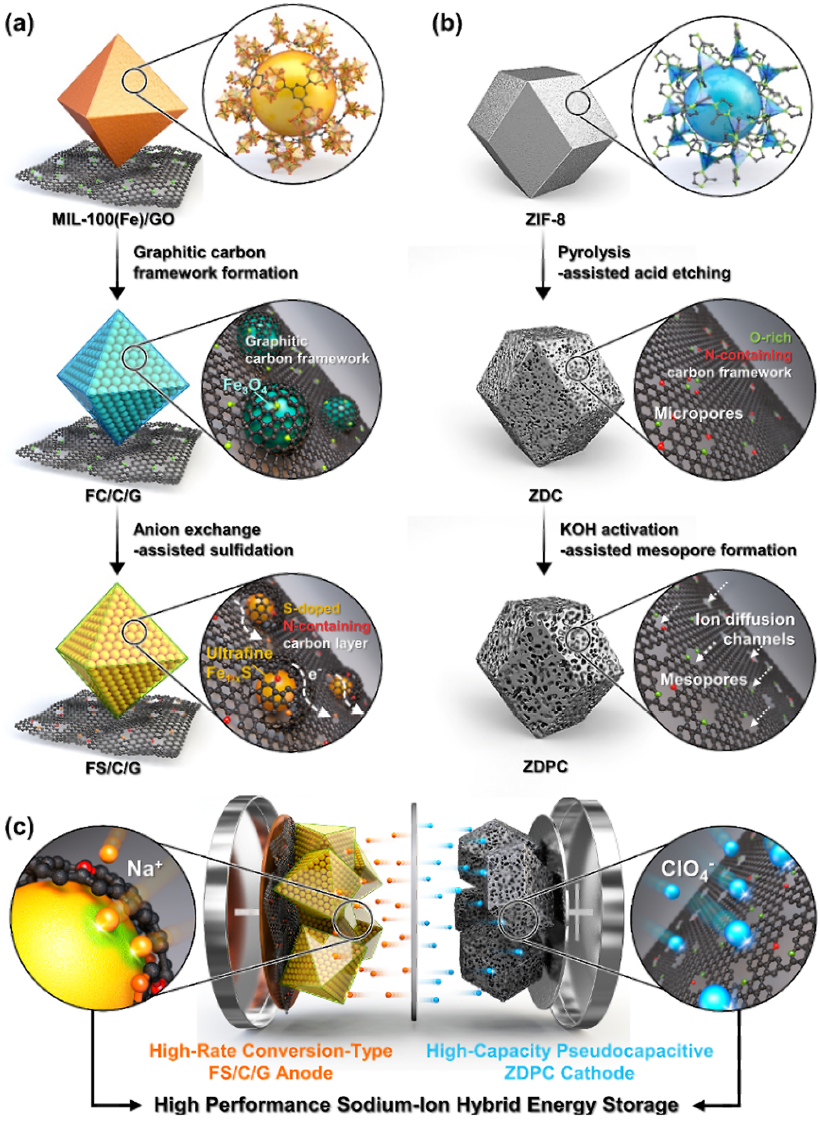
< Figure 1. Schematic synthetic procedures of high-capacity/high-rate anode and cathode materials for a sodium-ion hybrid energy storages (SIHES) and their proposed energy storage mechanisms. Synthetic procedures for (a) ultrafine iron sulfide-embedded S-doped carbon/graphene (FS/C/G) anode and (b) zeolitic imidazolate framework-derived porous carbon (ZDPC) cathode materials. (c) Proposed energy storage mechanisms of Na+ ions in FS/C/G anode and ClO-4 ions in ZDPC cathode for an SIHES. >
To account for this, Professor Kang's team utilized two distinct metal-organic frameworks for the optimized synthesis of hybrid batteries. This approach led to the development of an anode material with improved kinetics through the inclusion of fine active materials in porous carbon derived from metal-organic frameworks. Additionally, a high-capacity cathode material was synthesized, and the combination of the cathode and anode materials allowed for the development of a sodium-ion storage system optimizing the balance and minimizing the disparities in energy storage rates between the electrodes.
The assembled full cell, comprising the newly developed anode and cathode, forms a high-performance hybrid sodium-ion energy storage device. This device surpasses the energy density of commercial lithium-ion batteries and exhibits the characteristics of supercapacitors' power density. It is expected to be suitable for rapid charging applications ranging from electric vehicles to smart electronic devices and aerospace technologies.
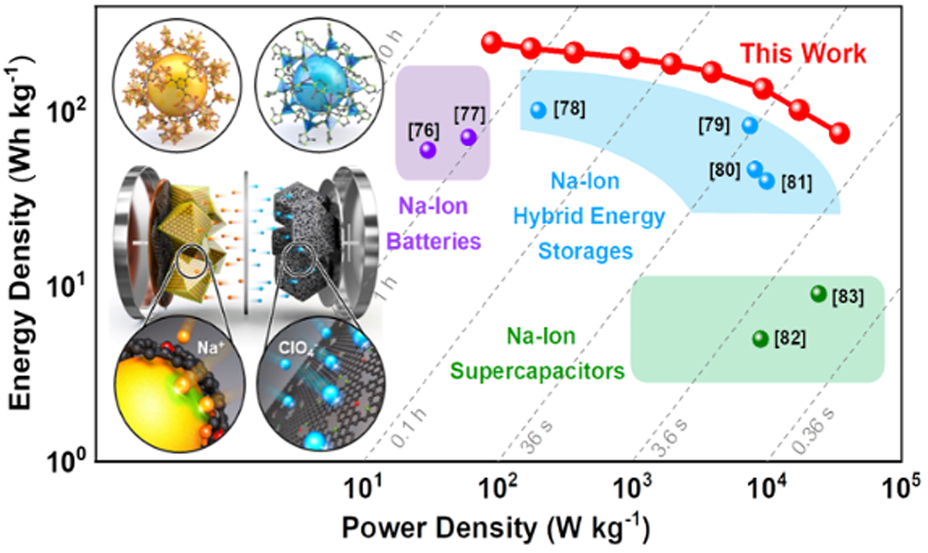
< Figure 2. Electrochemical characterizations of FS/C/G-20//ZDPC SIHES full cells (left). Ragone plots for FS/C/G-20//ZDPC (this work) and other previously reported sodium-ion electrochemical energy storage devices (right). >
Professor Kang noted that the hybrid sodium-ion energy storage device, capable of rapid charging and achieving an energy density of 247 Wh/kg and a power density of 34,748 W/kg, represents a breakthrough in overcoming the current limitations of energy storage systems. He anticipates broader applications across various electronic devices, including electric vehicles.
This research, co-authored by KAIST doctoral candidates Jong Hui Choi and Dong Won Kim, was published in the international journal Energy Storage Materials on March 29 with the title "Low-crystallinity conductive multivalence iron sulfide-embedded S-doped anode and high-surface-area O-doped cathode of 3D porous N-rich graphitic carbon frameworks for high-performance sodium-ion hybrid energy storages."
The study was conducted with support from the Ministry of Science and ICT and the National Research Foundation of Korea through the Nanomaterial Technology Development Project.
-
event KAIST Holds 'Wearable Computer Contest'
Application for ‘2014 Wearable Computer Contest’ until May 23rd KAIST is holding the 2014 Wearable Computer Contest (WCC) sponsored by Samsung Electronics in November and is currently receiving applications until May 23rd. Wearable Computer is a device that can be worn on body or clothing, which allows users to be connected while on the move. It is currently receiving attention as the next generation of computer industry that will replace smart phones. The Wearable Computer
2014-03-28 -
event Great Success!: 2011 Wearable Computer Contest
The 2011 Wearable Computer Contest (WCC) was held on the 28th and 29th of November at Seoul COEX. The WCC is hosted by KAIST and Korea Next Generation Computing Society and is an annual event. A wearable computer allows the user to freely use the computer even a moving environment and involves the miniaturization, weight lightening to incorporate the computer into clothing. It is the fusion of IT technology and fashion and is opening new fields like entertainment, healthcare and other forms of
2012-01-31 -
event 2011 Wearable Computer Competition Participant Registration Started
The registration process for the ‘Wearable Computer Contest’ (WCC) held by KAST and Korea Next Generation Computing Institute. The contest is the only contest that designs wearable computers in Korea. This year’s theme is ‘Smart Wear for the Smart Life’ in response to the spread of smartphones. In 2010 the contest was run cooperatively with International Symposium on Wearable Computer (ISWC) and is fast becoming an international even with students from foreig
2011-03-26 -
event KAIST was invited to the World Economic Forum's fourth “Summer Davos.â€
KAIST attended the World Economic Forum’s “Summer Davos Forum” held from September 13 to 15 in Tianjin, China. The Summer Davos Forum hosted various sessions and meetings with international dignitaries from governments, business and public organizations, and academia on the main theme of “Driving Growth through Sustainability.” On September 14, four subjects including “Electric Vehicles,” “Humanoid Robotics,” “Next Generation of
2010-09-17 -
people KAIST has developed a powerless and wireless keyboard that can be folded and easily carried around.
The KAIST Institute for Information Technology Convergence (KIITC) has developed the next generation keyboard that does not need power and wires. The powerless/wireless keyboard developed by KIITC is flexible, foldable, portable, and compact, making the possession of keyboard easier and more convenient. The idea of this technology was derived from "Idea Contest for Future Device" opened by KIITC in 2007, and Future Device Team (Team Leader: Dr. Sungkwan Jung) of KIITC embodie
2010-08-12