event
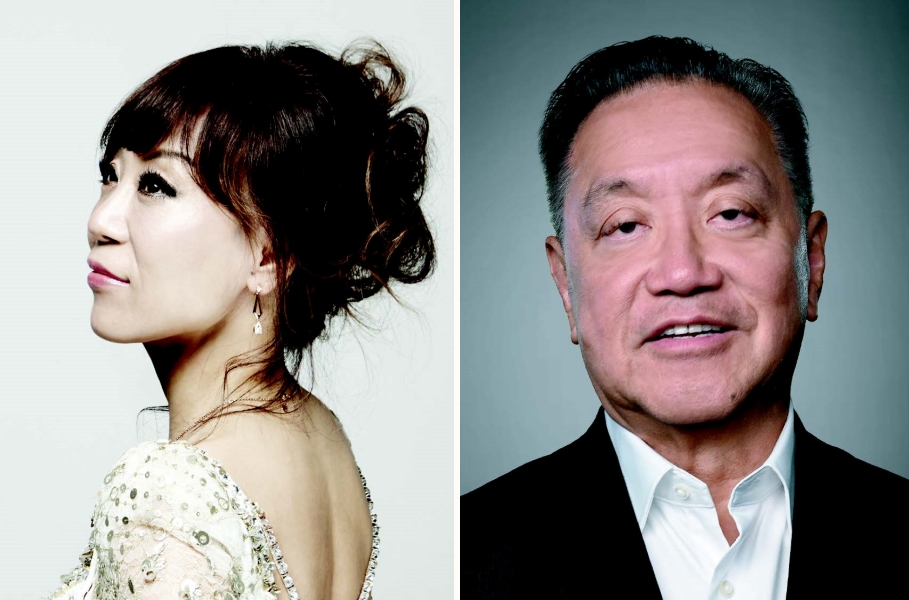
< (From left) Sumi Jo, Distinguished Visiting Professor at the Graduate School of Culture and Technology, and Broadcom President and CEO Hock Tan >
KAIST (President Kwang-Hyung Lee) announced that it awarded honorary doctorates to world-renowned soprano Sumi Jo, a distinguished visiting professor at the Graduate School of Culture and Technology, and the President and Chief Executive Officer of Broadcom Inc., Hock Tan, at the graduation ceremony held on the 16th of February, 2024.
Professor Sumi Jo, who received an honorary doctorate in science and technology, was appointed as a visiting professor at KAIST Graduate School of Culture and Technology in 2021 and established the "Sumi Jo Performing Arts Research Center" and have been involved in research providing valuable feedback on projects to put on stage performances utilizing AI-orchestrated musical ensemble technology and research on virtual voices using vocal synthesis technology, as well as participating in the demonstration of the technological performance showcased at KAIST. Also, she held a special lecture and a talk concert for KAIST students, sharing her experience as a celebrated soprano on the world stage and having honest conversations with students.
KAIST said, “The doctorate is being awarded in recognition of her contributions that is broadening the spectrum of research in the field of science and technology to lead the digital era by suggesting a direction for future
science and technology to take led by culture. Also, her significant contribution to promoting necessary internationalization capabilities helps KAIST as it is growing into a world-class university through new academic challenges.”
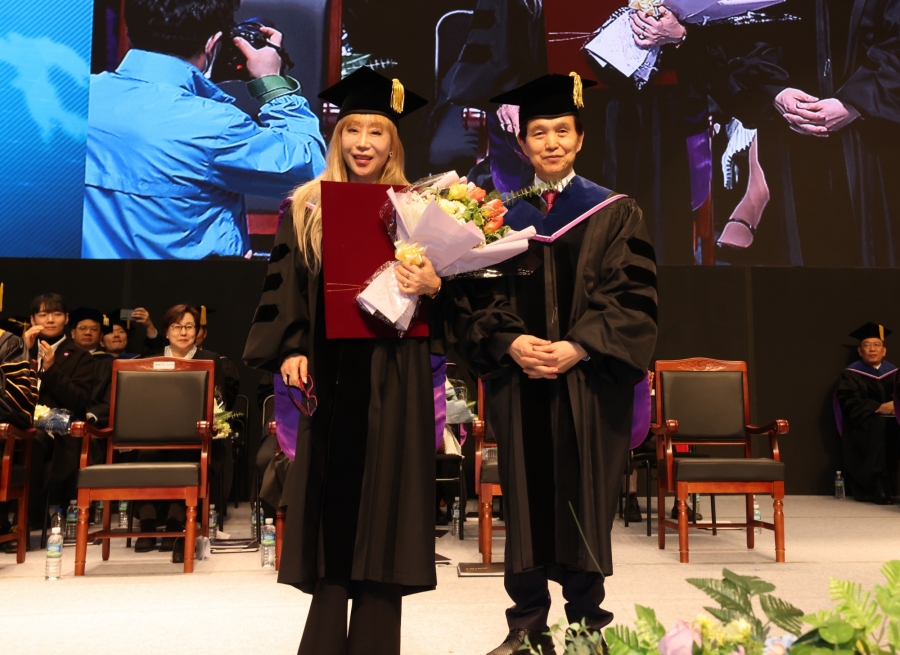
< Professor Sumi Jo (left), who received an honorary doctorate in science and technology, and President Kwang-Hyung Lee >
Professor Sumi Jo, who debuted as Gilda in the opera
Professor Sumi Jo said, “When I received a proposal from President Kwang-Hyung Lee of KAIST to convey what I experienced and felt on the world stage to students of science at KAIST under the topic of ‘Music and My Life,’ questions started to swirl inside of me.”
She continued, “Singing on stage is about ‘expressing,’ and it is a comprehensive artistic process that unfolding the artist’s inner self (expression) and showing it (presentation) in a way that the audience can best feel it through
methods such as sound, lighting, and directing. And I realized that, I was singing all my life in an environment where science and technology coexisted with culture and art.”
“When I worked with the students here at KAIST, I came to realize that when scientific and technologically talented people are set free to really enjoy their ideas and explore them on their own terms, their insight become sharper and their creativity become richer,” she said. She went on to add, “I am proud to be able to join the graduates at the ceremony and would like to express my gratitude for awarding me the honorary doctorate.”
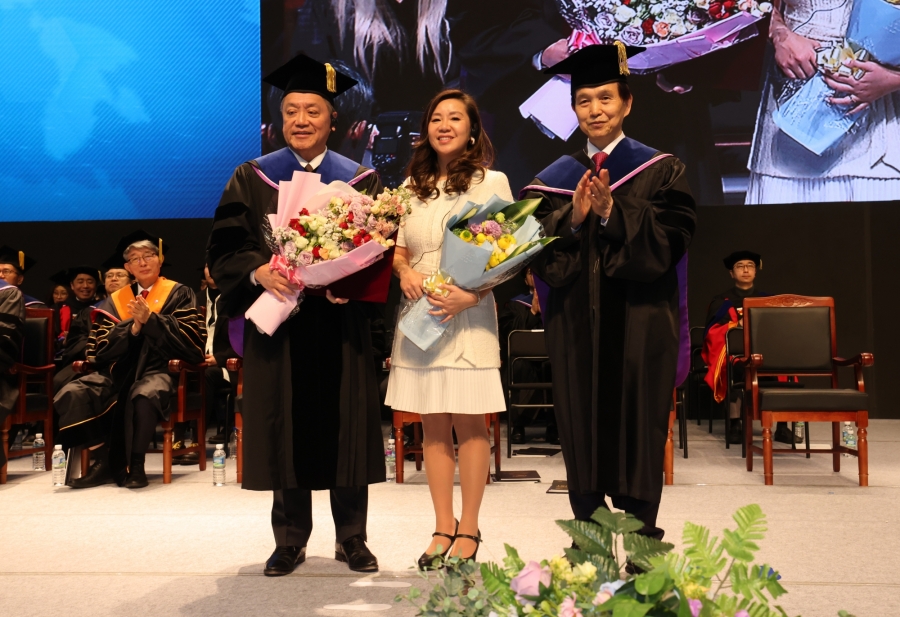
< (From left) President Hock Tan, who received the honorary doctorate in engineering, Mrs. Lya Trung Tan, and President Kwang-Hyung Lee >
Hock Tan received an honorary doctorate in engineering. He is a highly successful businessman who demonstrated entrepreneurship based on a profound understanding of science and technology, which transformed Broadcom into a global enterprise in technology that provides semiconductor and software solutions.
Broadcom has achieved advancement and technological innovation in the semiconductor industry tailored to computer and telecommunication networks, and is evaluated as having played a major role in bringing about the digital transformation movement that is now encompassing the global communities.
Tan attributes the secret to his success to ‘the considerate decision made by the university to award him the scholarship which enabled him to pursue his degree’ and ‘the great team members working with him’..’ Also, he is well-known as a person who considers giving back to society his most important mission.
To support effective medical treatment and identification of the cause of autism, Tan has made large donations to MIT and Harvard University since 2017 several times, and during the COVID-19 pandemic, he reinforced his support to improve the treatment of workers at community medical institutions and non-profit organizations. He also founded the Broadcom Foundation, which supports science, technology, engineering, and mathematics (STEM) education programs for students in and outside the United States.
KAIST said, “We are awarding CEO Hock Tan the honorary doctorate in recognition of his contribution to KAIST’s emergence as a world-class university, as he emphasized the importance of convergence research and
internationalization of KAIST during his time serving as an overseas member of the KAIST President's Advisory Council from 2006 to 2013, while providing policy advices built on his experiences of innovations from various parts around the world.”
Tan emphasized, “KAIST has been vital to Korea’s advancement in the global economy. (KAIST) remains a source of technological innovation,” and that, “It is truly an honor to be recognized by an institution with such a distinguished record of excellence in science, engineering and research.”
President Kwang-Hyung Lee said, “Professor Sumi Jo’s exploration into the future of performing arts through science and technology helps to expand KAIST’s scope and enhance our creative capabilities, while the dedication and humane efforts Hock Tan demonstrates as he contributes to digital innovation through corporate management and engages in various social contribution activities serves as a superb example to all members of KAIST.”
He continued, “These two have lived out the values of challenge and innovation and became examples for many, and we are very pleased to welcome them as the newest members of the KAIST family. On behalf of all members of KAIST, I deliver our sincere congratulations.”
-
research KAIST Research Team Creates the Scent of Jasmine from Microorganisms
The fragrance of jasmine and ylang-ylang, used widely in the manufacturing of cosmetics, foods, and beverages, can be produced by direct extraction from their respective flowers. In reality, this makes it difficult for production to meet demand, so companies use benzyl acetate, a major aromatic component of the two fragrances that is chemically synthesized from raw materials derived from petroleum. On February 26, a KAIST research team led by Research Professor Kyeong Rok Choi from the BioPro
2024-03-05 -
research A Korean research team develops a new clinical candidate for fatty liver disease
A team of Korean researchers have succeeded in developing a new drug candidate for the treatment of non-alcoholic fatty liver disease (NAFLD) acting on peripheral tissues. To date, there has not been an optimal treatment for non-alcoholic steatohepatitis (NASH), and this discovery is expected to set the grounds for the development of new drugs that can safely suppress both liver fat accumulation and liver fibrosis at the same time. A joint research team led by Professor Jin Hee Ahn from Gwang
2024-02-21 -
research KAIST presents strategies for environmentally friendly and sustainable polyamides production
- Provides current research trends in bio-based polyamide production - Research on bio-based polyamides production gains importance for achieving a carbon-neutral society Global industries focused on carbon neutrality, under the slogan "Net-Zero," are gaining increasing attention. In particular, research on microbial production of polymers, replacing traditional chemical methods with biological approaches, is actively progressing. Polyamides, represented by nylon, are linear polymers wide
2023-12-21 -
research KAIST proposes alternatives to chemical factories through “iBridge”
- A computer simulation program “iBridge” was developed at KAIST that can put together microbial cell factories quickly and efficiently to produce cosmetics and food additives, and raw materials for nylons - Eco-friendly and sustainable fermentation process to establish an alternative to chemical plants As climate change and environmental concerns intensify, sustainable microbial cell factories garner significant attention as candidates to replace chemical plants. To develo
2023-11-09 -
event KAIST holds its first ‘KAIST Tech Fair’ in New York, USA
< Photo 1. 2023 KAIST Tech Fair in New York > KAIST (President Kwang-Hyung Lee) announced on the 11th that it will hold the ‘2023 KAIST Tech Fair in New York’ at the Kimmel Center at New York University in Manhattan, USA, on the 22nd of this month. It is an event designed to be the starting point for KAIST to expand its startup ecosystem into the global stage, and it is to attract investments and secure global customers in New York by demonstrating the technological value
2023-09-11