fund
Dong-Myoung Kim donated 2 billion KRW to fund the Kim Jae-Chul AI Graduate School
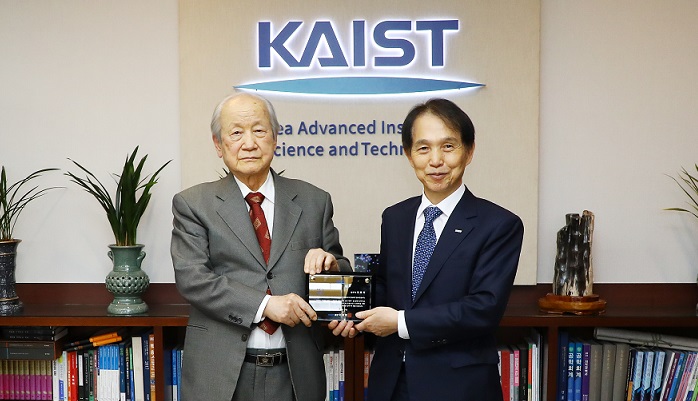
< President Lee (left) poses with Dong-Myoung Kim who donated 2 billion KRW to KAIST during a ceremony on December 6. >
Dong-Myong Kim, a 90-year-old resident living in Seongnam City in Kyonggido made a gift of 300 million KRW in cash and property valued at 1.7 billion KRW to fund the Kim Jae-Chul AI Graduate School. KAIST President Kwang Hyung Lee and a senior leadership team warmly received Kim during the donation ceremony on December 6 and delivered a plaque of appreciation.
Kim, a certified judicial scrivener, sent a letter regarding his intention to donate to the KAIST Development Foundation Office in October. Development foundation officers contacted him for a meeting and presented the major achievements of KAIST and new vision for the future during the meeting. After meeting with KAIST officials, Kim completed all the legal procedures for donating such as handing over the title of his property.
A Development Foundation official said that Kim was well aware of what KAIST has achieved and is doing now. “He had already searched KAIST’s website and scrutinized what we are doing now. He was clear about his intentions,” said the official.
Kim said that media news reports on the recent series of huge donations to KAIST inspired him. “I thought there was something special behind the donors’ intention to make such a decision.”
Kim said the studies on futurism he started in the 1980s led him to become interested in new technologies. “I firmly believe that KAIST will make huge contributions to the nation and our society through advances in science and technology. It is said that the joy of giving is much larger than that of receiving. I am now experiencing such immense joy. I will be even happier if KAIST can lead the nation through its AI research.”
President Kwang Hyung Lee said Kim’s letter of intention touched him deeply. He thanked Kim, saying that the entire KAIST community will make every effort to respond to Kim’s donation wishes.
-
research KAIST introduces microbial food as a strategy food production of the future
The global food crisis is increasing due to rapid population growth and declining food productivity to climate change. Moreover, today's food production and supply system emit a huge amount of carbon dioxide, reaching 30% of the total amount emitted by humanity, aggravating climate change. Sustainable and nutritious microbial food is attracting attention as a key to overcoming this impasse. KAIST (President Kwang Hyung Lee) announced on April 12th that Research Professor Kyeong Rok Choi of th
2024-04-12 -
research KAIST Research Team Creates the Scent of Jasmine from Microorganisms
The fragrance of jasmine and ylang-ylang, used widely in the manufacturing of cosmetics, foods, and beverages, can be produced by direct extraction from their respective flowers. In reality, this makes it difficult for production to meet demand, so companies use benzyl acetate, a major aromatic component of the two fragrances that is chemically synthesized from raw materials derived from petroleum. On February 26, a KAIST research team led by Research Professor Kyeong Rok Choi from the BioPro
2024-03-05 -
event KAIST to begin Joint Research to Develop Next-Generation LiDAR System with Hyundai Motor Group
< (From left) Jong-Soo Lee, Executive Vice President at Hyundai Motor, Sang-Yup Lee, Senior Vice President for Research at KAIST > The ‘Hyundai Motor Group-KAIST On-Chip LiDAR Joint Research Lab’ was opened at KAIST’s main campus in Daejeon to develop LiDAR sensors for advanced autonomous vehicles. The joint research lab aims to develop high-performance and compact on-chip sensors and new signal detection technology, which are essential in the increasingly compe
2024-02-27 -
event KAIST Demonstrates AI and sustainable technologies at CES 2024
On January 2, KAIST announced it will be participating in the Consumer Electronics Show (CES) 2024, held between January 9 and 12. CES 2024 is one of the world’s largest tech conferences to take place in Las Vegas. Under the slogan “KAIST, the Global Value Creator” for its exhibition, KAIST has submitted technologies falling under one of following themes: “Expansion of Human Intelligence, Mobility, and Reality”, and “Pursuit of Human Security and Sustaina
2024-01-05 -
research A KAIST Research Team Develops High-Performance Stretchable Solar Cells
With the market for wearable electric devices growing rapidly, stretchable solar cells that can function under strain have received considerable attention as an energy source. To build such solar cells, it is necessary that their photoactive layer, which converts light into electricity, shows high electrical performance while possessing mechanical elasticity. However, satisfying both of these two requirements is challenging, making stretchable solar cells difficult to develop. On December 26,
2024-01-04